Why A Disk?

Late Summer is quiet time on campus and in my office. Too quiet. I head over to Cal’s coffee shop in search of company. “Morning, Cal.”

“Morning, Sy. Sure am glad to see you. There’s no‑one else around.”

“So I see. No scones in the rack?”

“Not enough traffic yet to justify firing up the oven on such a hot day. How about a biscotti instead?”

“If it’s only the one it’s a biscotto. Pizza Eddie’s very firm on that. Yeah, I’ll have one.”

“Always learning. By the way, a photo spread in one of my astronomy magazines got me thinking. How come there’s so much flat out there?”

“Huh? I know you’re not one of those flat‑Earthers.”

“Not the planets, I mean the way their orbits go all in the same plane. Same for most of the asteroids and the Kuiper belt, even. Our Milky Way galaxy’s basically flat, too, and so are a lot of the others. Black hole accretion disks are flat. You’d think if some baby star or galaxy was attracting stuff from everywhere to grow itself, the incoming would make a big globe. But it’s not, we get flatness. How come?”

“Bad aim and angular momentum.”

“What’s aim got to do with it?”

“Suppose there’s only two objects in the Universe and they’re closing in on each other. If they’re aimed dead‑center to each other, what happens?”

“CaaaRUNCH!!!”

“Right. Now what if the aim’s off so they don’t quite touch?”

“Oh, I know that one … it’ll come to me … yeah, Roche’s limit, it was in an article a few months ago. Whichever’s less dense will break up and all the pieces go like Saturn’s rings. Which are also flat, by the way.”

“In orbit around the survivor, mm‑hm. The pieces can’t fall straight down because they still have angular momentum.”

“I know about momentum like when you crash a car if you go too fast for your brakes. Heavier car or faster speed, you get a worse crash. How does angle fit into that — bigger angle, more angular momentum?”

“Not quite. In general, momentum is mass multiplied by speed. It’s a measure of the force required to stop something or at least slow it down. You’ve described linear momentum, where ‘speed’ is straight‑line distance per time. If you’re moving along a curve, ‘speed’ is arc‑length per time.”

“Arc‑length?”

“Distance around part of a circle. Arc‑length is angle in radians, multiplied by the circle’s radius. If you zip halfway around a big circle in the same time it took me to go halfway around a small circle, you’ve got more angular momentum than I do and it’d take more force to stop you. Make sense?”

“What if it’s not a circle? The planet orbits are all ellipses.”

“It’s still arc‑length except that you need calculus to figure it. That’s why Newton and Leibniz invented their methods. A falling something that misses a gravity center keeps falling but on an orbit. Whatever momentum it has acts as angular momentum relative to that center. There’s no falling any further in without banging into something else coming the other way and each object canceling the other’s momentum.”

“Or burning fuel if it’s a spaceship.”

“… Right. … So anyway, suppose you’ve got a star or something initially surrounded by a spherical cloud of space junk whirling around in all different orbits. What’s going to happen?”

“Lots of banging and momentum canceling until everything’s swirling more‑or‑less in the same direction and closer in than at come‑together time. But it’s still a ball.”

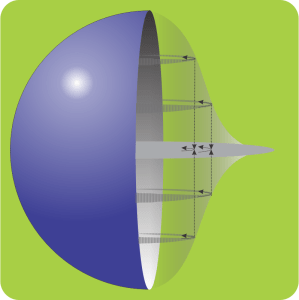
“Gravity’s not done. Think about northern debris. It’s attracted to the center, but it’s also attracted to the southern debris and vice-versa. They’ll meet midway and build a disk. The ball‑to‑disk collapse isn’t even opposed by angular momentum. Material at high latitudes, north and south, can lose gravitational potential energy by dropping straight in toward the equator and still be at the orbitally correct distance from the axis of rotation.”

“That’d work for stuff collecting around a planet, wouldn’t it?”

“It’d even work for stuff collecting around nothing, just a clump in a random density field. That may be how stars are born. Collapsing’s the hard part.”

~ Rich Olcott

The Beaming Beacon

“So, Vinnie, that first article’s bogus. Blobs in M87’s supermassive black hole’s jet don’t travel faster than light. Your second article — is it also about M87*?”

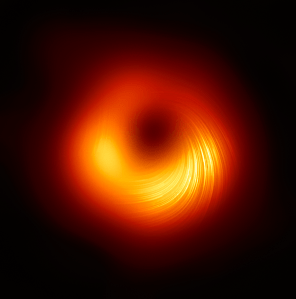
“Yeah, Cathleen. It’s got this picture which a while ago Sy explained looks like a wrung‑out towel because that’s the way the thing’s magnetic field forces electrons to line up and give off polarized light.”

“As always, Vinnie, your memory impresses.”

“Thanks, I work at it. Anyhow, this one‑paragraph article says they figured out from the picture that everything’s spinning around as fast as it’s possible to spin. How fast is that, and how’d they get the spin speed if they only used one frequency so redshift/blueshift doesn’t apply?”

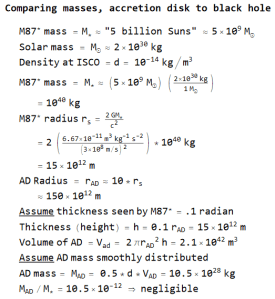
Cathleen’s been poking at her tablet. “HAH! Found the real paper behind your pop‑sci article, Vinnie. Give me a minute…” <pause, with mumbling> “Wow, not much there in the disk. They estimate even at the crowded innermost orbit, they call it ISCO, the density’s about 10-14 kg/m3 which would be one nanopascal of pressure. Most labs consider that ultrahigh vacuum. They get angular momentum from something called ‘Doppler beaming’, which I’m not familiar with.” <passes tablet to me> “Your turn, Sy.”

“ISCO’s the Innermost Stable Circular Orbit. ISCO’s radius depends on the black hole’s mass and spin.” <pause, with mumbling> “Doppler beaming’s a velocity‑dependent brightness shift from outbound to inbound sides of ISCO. They connected brightness range within the images to ISCO velocity, multiplied that by ISCO radius and the black hole’s mass to get the disk’s angular momentum, J. The lightspeed rotation angular momentum Jmax comes from theory. The paper puts a number to M87*’s J/Jmax.

“My article says it’s near 100%.”

“That’s not what the paper says, Vinnie. ‘…our value of 0.8 would appear to be a lower limit,’ in other words, something above 80% but definitely not 100%. Like I said, pop‑sci journalism. So what’s Doppler beaming, Sy?”

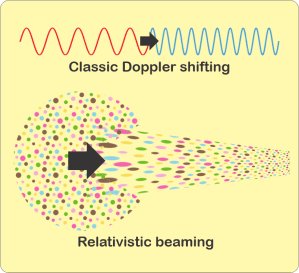
“Classical Doppler shifts happen when a wave source moves relative to us. Motion toward us crams successive wave peaks into decreasing distance. Motion away increases wavelength. The same principle applies to light waves, sound waves, even ocean waves.”

“Blueshifting.”

“Mm‑hm. By contrast, beaming is about how a source’s motion affects the photon count we receive per second. Imagine a beacon steadily sending us photons as it whips at near‑lightspeed around M87*. When the beacon screams towards us its motion crams more photons into one of our seconds than when it dashes away.”

“More blueshifting.”

“Not quite. Photon‑count compression sort‑of resembles the blueshifting process but wavelength isn’t relevant. It combines with the other part of beaming, Special Relativity space compression, which concentrates a moving beacon’s photons in the direction of motion. It’s like focusing a fancy flashlight, narrowing the beam to concentrate it. The faster the beacon travels in our direction, the greater proportion of its photons are sent towards us.”

Vinnie looks up and to the left. “If ISCO’s going near lightspeed, won’t the disk’s inertia drag on the black hole?”

“Sure, within limits. M87* and Sagittarius-A* both have magnetic fields; most black holes probably do. Accretion disk plasma must be frozen into the field. The whole structure would rotate like a spongy wheel with a fuzzy boundary. The lightspeed limit could cut in at the wheel’s rim, much farther out than the Event Horizon’s sphere.”

Count on Vinnie to jump on vagueness. “Spongy? Fuzzy?”

“Because nothing about a black hole’s extended architecture is rigid. It’s a messy mix of gravitational, electric and magnetic fields, all randomly agitated by transients from inbound chunks of matter and feeding outbursts from inside ISCO. The disk’s outer boundary is the raggedy region where the forces finally give way as centrifugal force works to fling particles out into the Universe. I don’t know how to calculate where the boundary is, but this image suggests it’s out about 10 times the Horizon’s radius. The question is, how does the boundary’s speed limit affect spin?” <tapping rapidly on Old Reliable’s screen>

“And the answer is…?”

“Disk particles driven close to lightspeed do push back. They lightly scramble those mushy fields but much too feebly to slow the central spin.”

~ Rich Olcott

Not Even A Sneeze in A Hurricane

Quite a commotion at the lakeshore this morning. I walk over to see what’s going on. Not surprised at who’s involved. “Come away from there, Mr Feder, you’re too close to their goslings.” Doesn’t work, of course, so I resort to stronger measures. “Hey, Mr Feder, any questions for me?”

That did the trick. “Hey, yeah, Moire, I got one. There’s this big problem with atomic power ’cause there’s leftovers when the fuel’s all used up and nobody wants it buried their back yard and I unnerstand that. How about we just load all that stuff into one of Musk’s Starships and send it off to burn up in the Sun? Or would that make the Sun blow up?”

“Second part first. Do you sneeze?”

“What kinda question is that? Of course I sneeze. Everyone sneezes.”

“Ever been in a hurricane?”

“Oohyeah. Sandy, back in 2012. Did a number on my place in Fort Lee. Took out my back fence, part of the roof, branches down all over the place—”

“Did you sneeze during the storm?”

“Who remembers that sort of thing?”

“If you had, would it have made any difference to how the winds blew?”

“Nah, penny‑ante compared to what else was going on. Besides, the storm eye went a couple hundred miles west of us.”

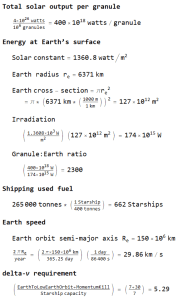
“Well, there you go. The Sun’s surface is covered by about a million granules, each about the size of Texas, and each releasing about 400 exawatts—”.

“Exawha?”

“Exawatt. One watt is one joule of energy per second. Exa– means 1018. So just one of those granules releases 400×1018 joules of energy per second. By my numbers that’s about 2300 times the total energy that Earth gets from the Sun. There’s a million more granules like that. Still think one of our rockets would make much difference with all that going on?”

“No difference anybody’d notice. But that just proves it’d be safe to send our nuclear trash straight to the Sun.”

“Safe, yes, but not practical.”

“When someone says ‘practical’ they’re about to do numbers, right?”

“Indeed. How much nuclear waste do you propose to ship to the Sun?”

“I dunno. How much we got?”

“I saw a 2022 estimate from the International Atomic Energy Agency that our world‑wide accumulation so far is over 265 000 tonnes, mostly spent fuel. Our heaviest heavy‑lift vehicle is the SpaceX Starship. Maximum announced payload to low‑Earth orbit is 400 tonnes for a one‑way trip. You ready to finance 662 launches?”

“Not right now, I’m a little short ’til next payday. How about we just launch the really dangerous stuff, like plutonium?”

“Much easier rocket‑wise, much harder economics‑wise.”

“Why do you say that?”

“Because most of the world’s nuclear power plants depend on MOX fuel, a mixture of plutonium and uranium oxides. Take away all the plutonium, you mess up a significant chunk of our carbon‑free‑mostly electricity production. But I haven’t gotten to the really bad news yet.”

“I’m always good for bad news. Give.”

“Even with the best of intentions, it’s an expensive challenge to shoot a rocket straight from Earth into the Sun.”

“Huh? It’d go down the gravity well just like dropping a ball.”

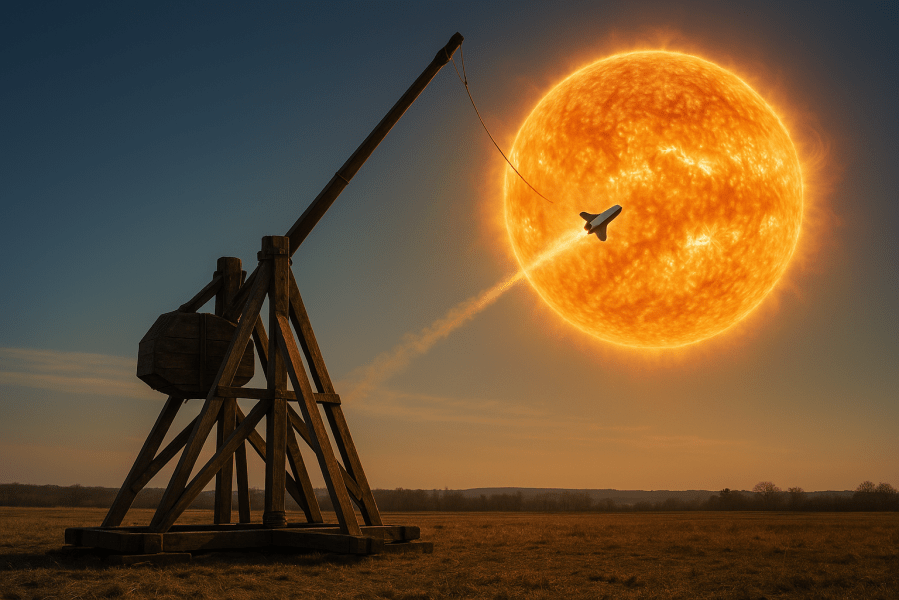
“Nope, not like dropping a ball. More like flinging it off to the side with a badly‑aimed trebuchet. Guess how fast the Earth moves around the Sun.”

“Dunno. I heard it’s a thousand miles an hour at the Equator.”

“That’s the planet’s rotation on its own axis. My question was how fast we go taking a year to do an orbit around the Sun. I’ll spare you the arithmetic — the planet speeds eastward at 30 kilometers per second. Any rocket taking off from Earth starts with that vector, and it’s at right angles to the Earth‑Sun line. You can’t hit the Sun without shedding all that lateral momentum. If you keep it, the rules of orbital mechanics force the ship to go faster and faster sideways as it drops down the well — you flat‑out miss the Sun. By the way, LEO delta‑v for SpaceX’s most advanced Starship is about 7 km/s, less than a fifth of the minimum necessary for an Earth‑to‑Sun lift.”

~ Rich Olcott
A Play Beyond The Play

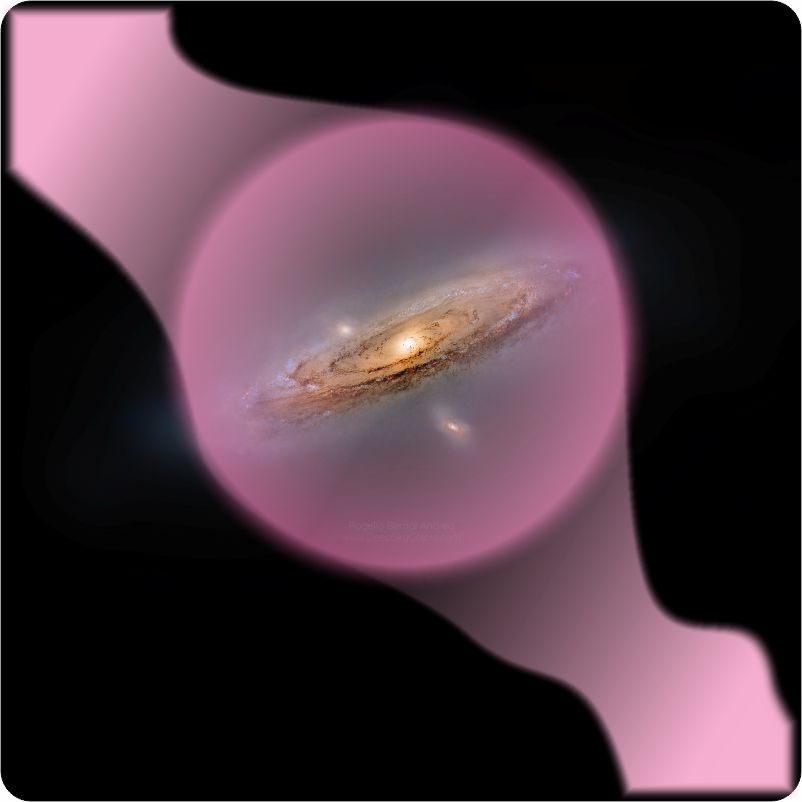
Vinnie takes a long thoughtful look at the image that had dashed his beautiful six‑universe idea. “Wait, Sy. I don’t like this picture”

“Because it messes up your invention?”

“No, because how can they know what that halo looks like? I mean, the whole thing with dark matter is that we can’t see it.”

“You’re right about that. Dark matter’s so transparent that even with five times more mass than normal matter, it doesn’t block CMB photons coming from 13.8 billion lightyears away. That still boggles my brain every once in a while. But dark matter’s gravitational effects — those we can see.”

“Yeah, I remember a long time ago we talked about Fritz Zwicky and Vera Rubin and how they told people about galaxies held together by too much gravity but nobody believed them.”

“Well, they did, after a while—”

“A long while, like a long while since those talks. Remind me what ‘too much gravity’ was about.”

“It was about conflicts between their observations and the prevailing theoretical models. Everyone thought that galaxies and galaxy clusters should operate pretty much like planetary orbits — your speed increases the closer you are to the center, up to Einstein’s speed limit. Newton’s Laws of Motion predict how fast you should move if you’re at a certain distance from a body with a certain mass. If you’re moving faster than that, you fly away.”

“Yeah, escape velocity. So the galaxies in Zwicky’s cluster didn’t follow Newton’s Laws?”

“They didn’t seem to. Galaxies that should have escaped were still in there. The only way he could explain the stability was to suppose the galaxies are only a small fraction of the cluster’s mass. Extra gravity from the extra mass must bind things together. Forty years later Rubin’s improved technology revealed that stars within galaxies had the same anomalous motion.”

“I’m guessing the ‘faster near the center’ rule didn’t hold, or else you wouldn’t be telling this story. Spun like a wheel, I bet.”

“When a wheel spins, every part of it rotates at the same angular speed, the same number of degrees per second, right?”

“Ahh, the bigger my circle the higher my airspeed so the rule would be ‘faster farther out’.”

“That’s the wheel rule, right, but Rubin’s data showed that stars within galaxies don’t obey that one either. She measured lots of stars in Andromeda and other galaxies. Their linear speeds, kilometers per second, are nearly identical from near the center all the way out. Even dust and gas clouds beyond the galactic starry edges also fit the ‘same linear speed everywhere’ rule. You’d lose the bet.”

“That just doesn’t feel right. How can just gravity make that happen?”

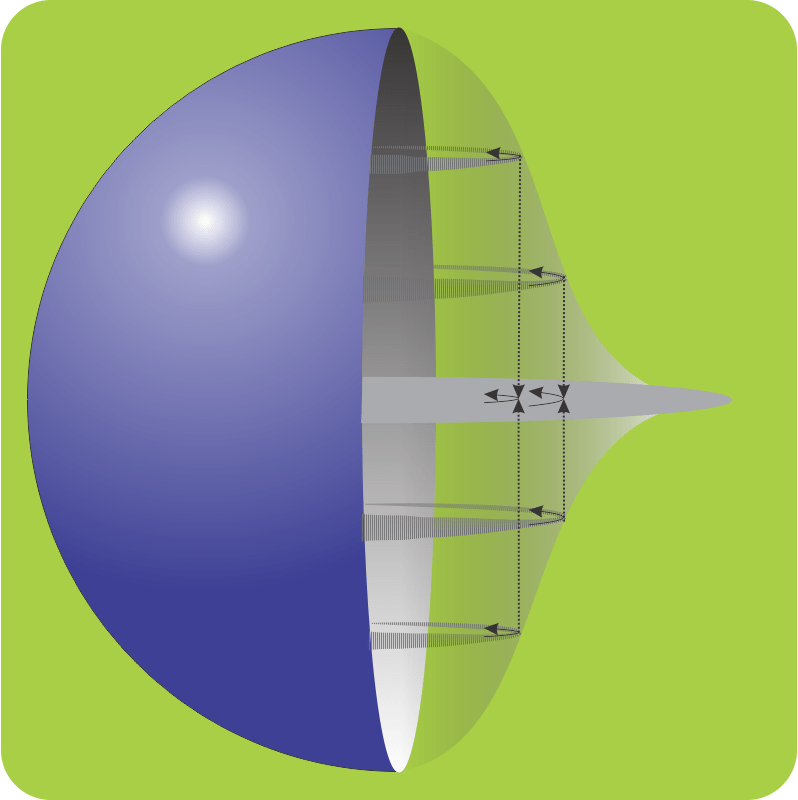
“It can if the right amount of dark matter’s distributed in the right‑shaped smeared‑out hollowed‑out spherical halo. The halo’s radial density profile looks about like this. Of course, profiles for different galaxies differ in spread‑outness and other details, but the models are pretty consistent.”

“Wait, if dark matter only does gravity like you said, why’s that hole in the middle? Why doesn’t everything just fall inward?”

“Dark matter has mass so it also has inertia, momentum and angular momentum, just as normal matter does. Suppose some of the dark matter has collected gravitationally into a blob and the blob is moving slower than escape velocity. If it’s flying straight at the center of gravity it’ll get there and stay there, more or less. But if the blob’s aimed in any other direction, it has angular momentum relative to the center. Momentum’s conserved for dark matter, too. The blob eventually goes into orbit and winds up as part of the shell.”

“Does Zwicky’s galaxy cluster have a halo, too?”

“Not in the same way. Each galaxy probably has its own halo but the galaxies are far apart relative to their size. The theoreticians have burned huge amounts of computer time simulating the chaos inside large ensembles of gravity‑driven blobs. I just read one paper about a 4‑billion‑particle calculation and mind you, a ‘particle’ in this study carried more than a million solar masses. Big halos host subhalos, with filaments of minihalos tying them together. What we can’t see is complicated, too.”

~ Rich Olcott

Deep Dive

“Sy, I’m trying to get my head wrapped around how the potential‑kinetic energy thing connects with your enthalpy thing.”

“Alright, Vinnie, what’s your cut so far?”

“It has to do with scale. Big things, like us and planets, we can see things moving and so we know they got kinetic energy. If they’re not moving steady in a straight line we know they’re swapping kinetic energy, give and take, with some kind of potential energy, probably gravity or electromagnetic. Gravity pulls things into a circle unless angular momentum gets in the way. How’m I doing so far?”

“I’d tweak that a little, but nothing to argue with. Keep at it.”

“Yeah, I know the moving is relative to whether we’re in the same reference frame and all that. Beside the point, gimme a break. So anyway, down to the quantum level. Here you say heat makes the molecules waggle so that’s kinetic energy. What’s potential energy like down there?”

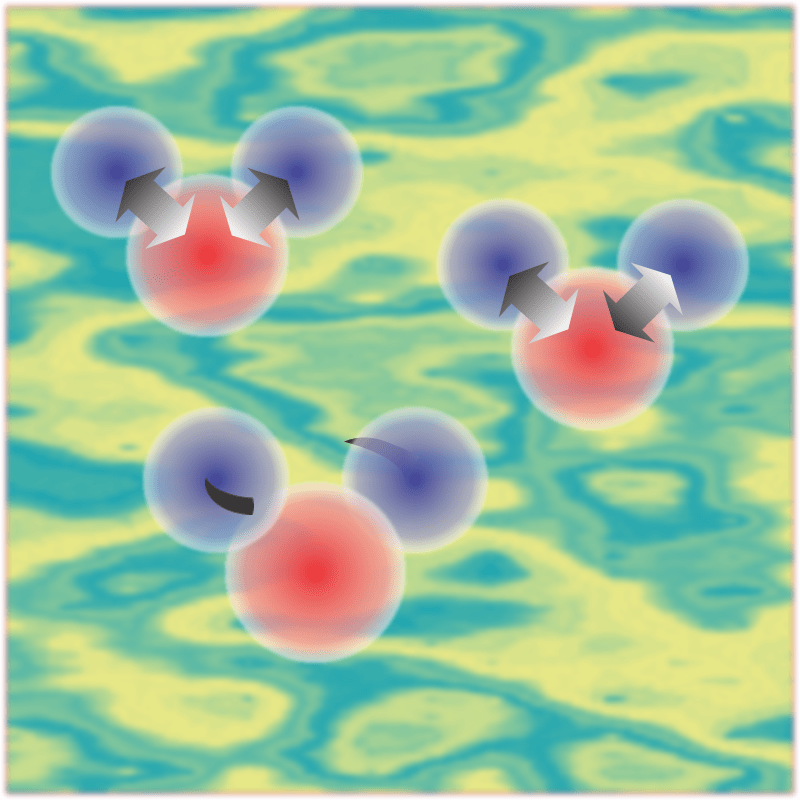
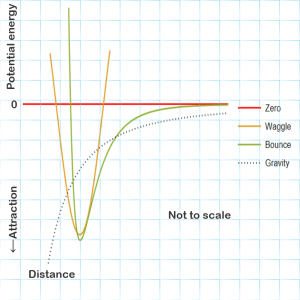
<grabs another paper napkin> “Here’s a quick sketch of the major patterns.”

“Hmm. You give up potential energy when you fall and gravity’s graph goes down from zero to more negative forever, I guess, so gravity’s always attracting.”

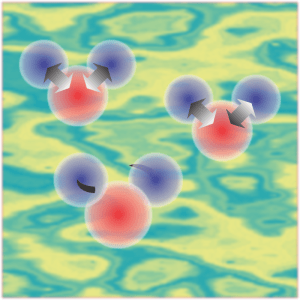
“Pretty much, but at this level we don’t have to bother with gravity at all. It’s about a factor of 1038 weaker than electric interactions. Molecular motions are dominated by electromagnetic fields. Some are from a molecule’s other internal components, some from whatever’s around that brandishes a charge. We’ve got two basic patterns. One of them, I’m labeling it ‘Waggle,’ works like a pendulum, sweeping up and down that U‑shape around some minimum position, high kinetic energy where the potential energy’s lowest and vice‑versa. You know how water’s H‑O‑H molecules have that the V‑shape?”

“Yeah, me you and Eddie talked about that once.”

“Mm‑hm. Well, the V‑shape gives that molecule three different ways to waggle. One’s like breathing, both sides out then both sides in. If the hydrogens move too far from the oxygen, that stretches their chemical bonds and increases their potential energy so they turn around and go back. If they get too close, same thing. Bond strength is about the depth of the U. The poor hydrogens just stretch in and out eternally, swinging up and down that symmetric curve.”

“Awww.”

“That’s a chemist’s picture. The physics picture is cloudier. In the quantum version, over here’s a trio of fuzzy quarks whirling around each other to make a proton. Over there’s a slightly different fuzzy trio pirouetting as a neutron. Sixteen of those roiling about make up the oxygen nucleus plus two more for the hydrogens plus all their electrons — imagine a swarm of gnats. On the average the oxygen cloud and the two hydrogen clouds configure near the minimum of that U‑shaped potential curve but there’s a lot of drifting that looks like symmetrical breathing.”

“What about the other two waggles?”

“I knew you’d ask. One’s like the two sides of a teeterboard, oscillating in and out asymmetrically. The other’s a twist, one side coming toward you and then the other side. Each waggle has its own distinct set of resistance forces that define its own version of waggle curve. Each kind interacts with different wavelengths of infrared light which is how we even know about them. Waggle’s official name is ‘harmonic oscillator.’ More complicated molecules have lots of them.”

“What’s that ‘bounce’ curve about?”

“Officially that’s a Lennard-Jones potential, the simplest version of a whole family of curves for modeling how molecules bounce off each other. Little or no interaction at large distances, serious repulson if two clouds get too close, and a little stickiness at some sweet-spot distance. If it weren’t for the stickiness, the Ideal Gas Law would work even better than it does. So has your head wrapped better?”

“Sorta. From what I’ve seen, enthalpy’s PV part doesn’t apply in quantum. The heat capacity part comes from your waggles which is kinetic energy even if it’s clouds moving. Coming the other way, quantum potential energy becomes enthalpy’s chemical part with breaking and making chemical bonds. Did I bridge the gap?”

“Mostly, if you insist on avoiding equations.”

~ Rich Olcott

Rumford’s Boring Story

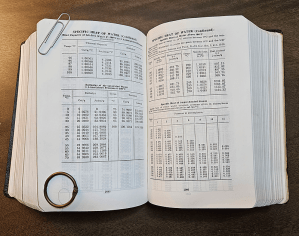
“Okay, Mr Moire, my grandfather’s engineering handbook has Specific Heat tables because Specific Heat measures molecular wabbling. If he’s got them, though, why’s Enthalpy in the handbook, too?”

“Enthalpy’s not my favorite technical term, Jeremy. It’s wound up in a centuries‑old muddle. Nobody back then had a good, crisp notion of energy. Descartes, Leibniz, Newton and a host of German engineers and aristocratic French hobby physicists all recognized that something made motion happen but everyone had their own take on what that was and how to calculate its effects. They used a slew of terms like vis viva, ‘quantity of motion,’ ‘driving force,’ ‘quantity of work,’ a couple of different definitions of ‘momentum‘ — it was a mess. It didn’t help that a lot of the argument went on before Euler’s algebraic notations were widely adopted; technical arguments without math are cumbersome and can get vague and ambiguous. Lots of lovely theories but none of them worked all that well in the real world.”

“Isn’t that usually what happens? I always have problems in the labs.”

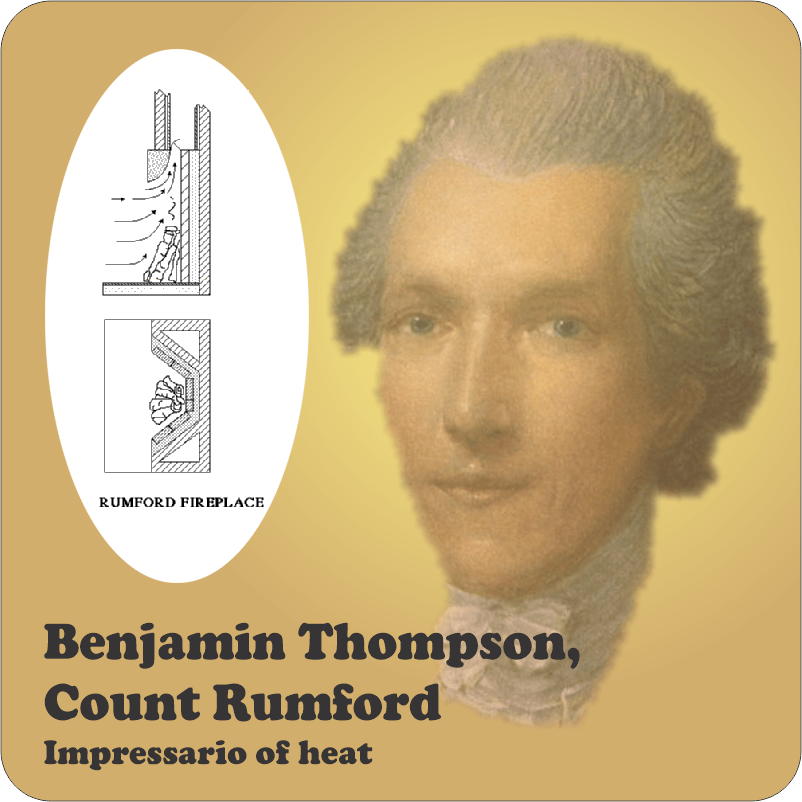
“You’re not alone. Centuries ago, Newton’s Laws of Motion and Gravity made good predictions for planets, not so good for artillery trajectories. Gunners always had to throw in correction factors because their missiles fell short. Massachusetts‑born Benjamin Thompson, himself an artilleryman, found part of the reason.”

“Should I know that name?”

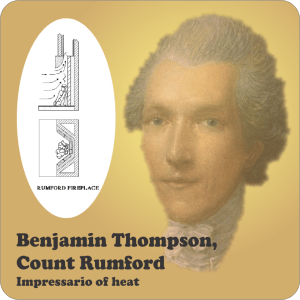
“In later years he became Count Rumford. One of those people who get itchy if they’re not creating something. He was particularly interested in heat — how to trap it and how to make it go where you want.”

“Wait, he was an American but he was a Count? I thought that was illegal.”

“Oh, he left the States before they were the States. During the Revolution he organized a Royalist militia in New York and then lit out for Europe. The Bavarians made him a Count after he spent half‑a‑dozen years doing creative things like reorganizing their army, building public works and introducing potato farming. He concocted a nourishing soup for the poor and invented the soup line for serving it up. But all this time his mind was on a then‑central topic of Physics — what is heat?”

“That was the late 1700s? When everyone said heat was some sort of fluid they called ‘caloric‘?”

“Not everyone, and in fact there were competing theories about caloric — an early version of the particle‑versus‑wave controversy. For a while Rumford even supported the notion that ‘frigorific’ radiation transmitted cold the same way that caloric rays transmitted heat. Whatever, his important contributions were more practical and experimental than theoretical. His redesign of the common fireplace was such an improvement that it took first England and then Europe by storm. Long‑term, though, we remember him for a side observation that he didn’t think important enough to measure properly.”

“Something to do with heat, I’ll bet.”

“Of course. As a wave theory guy, Rumford stood firmly against the ‘caloric is a fluid‘ camp. ‘If heat is material,‘ he reasoned, ‘then a heat‑generating process must eventually run out of caloric.’ He challenged that notion by drilling out a cannon barrel while it was immersed in cold water. A couple of hours of steady grinding brought the water up to boiling. The heating was steady, too, and apparently ‘inexhaustible.’ Better yet, the initial barrel, the cleaned‑out barrel and the drilled‑out shavings all had the same specific heat so no heat had been extracted from anything. He concluded that heat is an aspect of motion, totally contradicting the leading caloric theories and what was left of phlogiston.”

<chuckle> “He was a revolutionary, after all. But what about ‘Enthalpy‘?”

“Here’s an example. Suppose you’ve got a puddle of gasoline, but its temperature is zero kelvins and somehow it’s compressed to zero volume. Add energy to those waggling molecules until the puddle’s at room temperature. Next, push enough atmosphere out of the way to let the puddle expand to its normal size. Pushing the atmosphere takes energy, too — the physicists call that ‘PV work‘ because it’s calculated as the pressure times the volume. The puddle’s enthalpy is its total energy content — thermal plus PV plus the chemical energy you get when it burns.”

~~ Rich Olcott

Mushy stuff

“Amanda! Amanda! Amanda!”

“All right, everyone, settle down for our final Crazy Theorist. Jim, you’re up.”

“Thanks, Cathleen. To be honest I’m a little uncomfortable because what I’ve prepared looks like a follow-on to Newt’s idea but we didn’t plan it that way. This is about something I’ve been puzzling over. Like Newt said, black holes have mass, which is what everyone pays attention to, and charge, which is mostly unimportant, and spin. Spin’s what I’ve been pondering. We’ve all got this picture of a perfect black sphere, so how do we know it’s spinning?”

Voice from the back of the room — “Maybe it’s got lumps or something on it.”

“Nope. The No-hair Theorem says the event horizon is mathematically smooth, no distinguishing marks or tattoos. Question, Jeremy?”

“Yessir. Suppose an asteroid or something falls in. Time dilation makes it look like it’s going slower and slower as it gets close to the event horizon, right? Wouldn’t the stuck asteroid be a marker to track the black hole’s rotation?”

“Excellent question.” <Several of Jeremy’s groupies go, “Oooh.”> “Two things to pay attention to here. First, if we can see the asteroid, it’s not yet inside the horizon so it wouldn’t be a direct marker. Beyond that, the hole’s rotation drags nearby spacetime around with it in the ergosphere, that pumpkin‑shaped region surrounding the event horizon except at the rotational poles. As soon as the asteroid penetrates the ergosphere it gets dragged along. From our perspective the asteroid spirals in instead of dropping straight. What with time dilation, if the hole’s spinning fast enough we could even see multiple images of the same asteroid at different levels approaching the horizon.”

Jeremy and all his groupies go, “Oooh.”

“Anyhow, astronomical observation has given us lots of evidence that black holes do spin. I’ve been pondering what’s spinning in there. Most people seem to think that once an object crosses the event horizon it becomes quantum mush. There’d be this great mass of mush spinning like a ball. In fact, that was Schwarzchild’s model for his non-rotating black hole — a simple sphere of incompressible fluid that has the same density throughout, even at the central singularity.”

VBOR — “Boring!”

“Well yeah, but it might be correct, especially if spaghettification and the Firewall act to grind everything down to subatomic particles on the way in. But I got a different idea when I started thinking about what happened to those two black holes that LIGO heard collide in 2015. It just didn’t seem reasonable that both of those objects, each dozens of solar masses in size, would get mushed in the few seconds it took to collide. Question, Vinnie?”

“Yeah, nice talk so far. Hey, Sy and me, we talked a while ago about you can’t have a black hole inside another black hole, right, Sy?”

“That’s not quite what I said, Vinnie. What I proved was that after two black holes collide they can’t both still be black holes inside the big one. That’s different and I don’t think that’s where Jim’s going with this.”

“Right, Mr Moire. I’m not claiming that our two colliders retain their black hole identities. My crazy theory is that each one persists as a high‑density nubbin in an ocean of mush and the nubbins continue to orbit in there as gravity propels them towards the singularity.”

VBOR —”Orbit? Like they just keep that dance going after the collision?”

“Sure. What we can see of their collision is an interaction between the two event horizons and all the external structures. From the outside, we’d see a large part of each object’s mass eternally inbound, locked into the time dilation just above the joined horizon. From the infalling mass perspective, though, the nubbins are still far apart. They collide farther in and farther into the future. The event horizon collision is in their past, and each nubbin still has a lot of angular momentum to stir into the mush. Spin is stirred-up mush.”

Cathleen’s back at the mic. “Well, there you have it. Amanda’s male-pattern baldness theory, Newt’s hyper‑planetary gear, Kareem’s purple snowball or Jim’s mush. Who wins the Ceremonial Broom?”

The claque responds — “Amanda! Amanda! Amanda!”

~ Rich Olcott

Virial Yang And Yin

“But Mr Moire, how does the Virial Equation even work?”

“Sometimes it doesn’t, Jeremy. There’s an ‘if’ buried deep in the derivation. It only works for a system in equilibrium. Sometimes people use the equation as a test for equilibrium.”

“Sorry, what does that mean?”

“Let’s take your problem galaxy cluster as an example. Suppose the galaxies are all alone in the Universe and far apart even by astronomical standards. Gravity’s going to pull them together. Galaxy i and galaxy j are separated by distance Rij. The potential energy in that interaction is Vij = G·mi·mj / Rij. The R‘s are very large numbers in this picture so the V attractions are very small. The Virial is the average of all the V’s so our starting Virial is nearly zero.”

“Nearly but not quite zero, I get that. Wait, if the potential energy starts near zero when things are far apart, and a falling‑in object gives up potential energy, then whatever potential energy it still has must go negative.”

“It does. The total energy doesn’t change when potential energy converts to kinetic energy so yes, we say potential energy decreases even though the negative number’s magnitude gets larger. It’d be less confusing if we measured potential energy going positive from an everything-all-together situation. However, it makes other things in Physics much simpler if we simply write (change in potential energy)+(change in kinetic energy)=0 so that’s the convention.”

“The distances do eventually get smaller, though.”

“Sure, and as the objects move closer they gain momentum and kinetic energy. Gaining momentum is gaining kinetic energy. You’re used to writing kinetic energy as T=m·v²/2, but momentum is p=m·v so it’s just as correct to write T=p²/2m. The two are different ways of expressing the same quantity. When a system is in equilibrium, individual objects may be gaining or losing potential energy, but the total potential energy across the system has reached its minimum. For a system held together by gravity or electrostatic forces, that’s when the Virial is twice the average kinetic energy. As an equation, V+2T=0.”

“So what you’re saying is, one galaxy might fall so far into the gravity well that its potential energy goes more negative than –2T. But if the cluster’s in equilibrium, galaxy‑galaxy interactions during the fall‑in process speed up other galaxies just enough to make up the difference. On the flip side, if a galaxy’s already in deep, other galaxies will give up a little T to pull it outward to a less negative V.”

“Well stated.”

“But why 2? Why not or some other number?”

“The 2 comes from the kinetic energy expression’s ½. The multiplier could change depending on how the potential energy varies with distance. For both gravity and electrostatic interactions the potential energy varies the same way and 2 is fine the way it is. In a system with a different rule, say Hooke’s Law for springs and rubber bands, the 2 gets multiplied by something other than unity.”

“All that’s nice and I see how the Virial Equation lets astronomers calculate cluster‑average masses or distances from velocity measurements. I suppose if you also have the masses and distances you can test whether or not a collection of galaxies is in equilibrium. What else can we do with it?”

“People analyze collections of stars the same way, but Professor Hanneken’s a physicist, not an astronomer. He wouldn’t have used class time on the Virial if it weren’t good for a broad list of phenomena in and outside of astronomy. Quantum mechanics, for instance. I’ll give you an important example — the Sun.”

“One star, all by itself? Pretty trivial to take its average.”

“Not averaging the Sun as an object, averaging its plasma contents — hydrogen nuclei and their electrons, buffeted by intense heat all the way down to the nuclear reactions that run near the Sun’s core. It’s gravitational potential energy versus kinetic energy all over again, but at the atomic level this time. The Virial Theorem still holds, even though turbulence and electromagnetic effects generate a complicated situation.”

“I’m glad he didn’t assign that as a homework problem.”

“The semester’s not over yet.”

~~ Rich Olcott

Viral, Virial, What’s The Difference?

A young man’s knock at my office door, eager yet a bit hesitant. “C’mon in, Jeremy, the door’s open.”

“Hi, Mr Moire. Got a minute?”

“It’s slow season, Jeremy. What can I do for you?”

“It’s my physics homework, sir. Professor Hanneken asked a question that I don’t understand.”

“John’s a bit of a joker but asking unsolvable questions isn’t usually one of his things. Well, except for that one about how long it would take to play Mahler’s Piano Quartet if you had only two musicians because of budget restrictions. What’s the question?”

“He wants us to use something called ‘the viral theorem‘ to deduce things about a certain galaxy cluster. I know what viral memes are but I don’t think I’ve ever heard of a theorem that spreads like a virus. I’ve done searches on my class notes and online textbook — nothing. So what is it and how am I supposed to use it?”

“Do you have the question with you?”

“Yessir, it’s #4 on this sheet.”

“Ah, just as I thought. Read it again. The word is ‘virial,’ not ‘viral.’ Big difference.”

“I suppose, but what’s a virial then?”

“We need some context. Imagine a cluster of free‑floating objects bound together by mutual forces of attraction. No central attractor, just lots of pairwise pulling, okay?”

“What kind of forces?”

“That’s the thing, it doesn’t matter. Gravitational, electrostatic, rubber bands even. The only restriction is that the force between each pair of objects follows the same force‑distance rule. For rubber bands it’s mostly just 1/distance until you get near the elastic limit. For gravity and electrostatics the rule is that force runs as 1/distance2. Got that picture?”

<grin> “It’d be tricky rigging up those rubber bands to not get tangled. Anyhow, instead of planets around the Sun you want me to think of stars held in a cluster by each other’s gravity. Do they all have to be the same size or the same distance apart?”

“No, because of what happens next. You’re thinking right — a heavier star pulls harder than a lighter one, and two stars close together feel more mutual force than stars far apart. We account for that variation by taking an average. Multiply force times distance for every possible pairing, then divide the total by the number of objects. The averaged number is the Virial, symbol V.”

“Wait, force times distance. That’s the Physics definition of work, like pulling something up against gravity.”

“Exactly. Work is directed energy. What we’re talking about here is the amount of energy required to pull all those objects away from the center of mass or charge or whatever, out to their current positions. The Virial is the average energy per object. It’s average potential energy because it depends on position, not motion.”

“They’d release all that energy if they just fell together so why don’t … wait, they’re going all different directions so momentum won’t let them, right?”

“You’re on your way. Motion’s involved.”

“Umm … Kepler’s Law — the closer any two of them get, the faster they orbit each other … OH! Kinetic energy! When things fall, potential energy’s converted to kinetic energy. Is there an average kinetic energy that goes up to compensate for the Virial getting smaller?”

“Bingo. When you say ‘average kinetic energy‘ what quantity springs to mind?”

“Temperature. But that’s only for molecules.”

“No reason we can’t define a galactic analog. In fact, Eddington did that back in 1916 when he brought the notion from gas theory over to astrophysics. He even used ‘T‘ for the kinetic average, but remember, this T refers to kinetic energy of stars moving relative to each other, not the temperatures of the stars themselves. Anyhow, the Virial Theorem says that a system of objects is in gravitational or electrostatic equilibrium when the Virial is T/2. Clausius’ ground‑breaking 1870 proof for gases was so general that the theorem’s been used to study everything from sub‑atomic particles to galaxies and dark matter.”

<bigger grin> “With coverage like that, the Virial’s viral after all. Thanks, Mr Moire.”

~~ Rich Olcott

  • Thanks to Dr KaChun Yu for helpful pointers to the literature. Naturally, any errors in this post are my own.

Little Strings And Big Ones

It’ll be another hot day so I’m walking the park early. No geese in the lake — they’ve either flown north or else they’re attacking a farmer’s alfalfa field. A familiar voice shatters the quiet. “Wait up, Moire, I got questions.”

“Good morning, Mr Feder. First question, but please pick up your pace, I want to get back to the air conditioning.”

“I thought string theory was about little teeny stuff but this guy said about cosmic strings. How can they be teeny and cosmic?”

“They can’t. Totally different things, probably. Next question.”

“C’mon, Moire, that wasn’t even an answer, just opened up a bunch more questions.”

“It’s a tangled path but the track mostly started in the late 18th Century. Joseph Fourier derived the equation for how heat progresses along a uniform metal bar. Turned out the equation’s general solution was the sum of an infinite series of sine waves.”

“Sign waves? Like a protest rally?”

“Haha. No, s‑i‑n‑e, a mathematical function where something regularly and smoothly deviates about some central value. Anyhow, mathematicians soon realized that Fourier’s cute trick for his heat equation could be applied to equations for everything from sound waves to signal processing to pretty much all of Physics. Economics, even. Any time you use the word ‘frequency‘ you owe something to Fourier.”

“If he ain’t got it in writing from the Patent Office, I ain’t paying nothing.”

“It’s not the kind of thing you can patent, and besides, he lived in France and died almost two centuries ago. Be generous with your gratitude, at least. Let’s move on. Fourier’s Big Idea was already <ahem> in the air early in the 20th Century when Bohr and the Physics gang were looking at atoms. No surprise, they extended the notion to describe how electronic charge worked in there.”

“I’m waiting for the strings.”

“The key is that an atom’s a confined system like a guitar string that only vibrates between the bridge and whatever fret you’re pressing on. Sound waves traveling in open space can have any wavelength, but if you pluck a confined guitar string the only wavelengths you can excite are whole number multiples of its active length. No funny fractions like π/73 of the length no matter how hard or soft you pluck the string. Atoms work the same way — charge is confined around the nucleus so only certain wave sizes and shapes are allowed.”

“You said ‘strings.’ We getting somewhere finally?”

“Closing in on it. String theory strings aren’t just teeny. If your body were suddenly made as large as the Observable Universe, string theory is about what might happen inside a box a billion times smaller than your size now.”

“Really tight quarters, got it, so only certain vibrations are allowed.”

“Mm-hm, except it’s not really vibration, it would be something that acts mathematically like vibration. Go back to your guitar string. Plucking gives it up‑down motion, strumming moves it side‑to‑side. Two degrees of freedom. The math says whatever’s going on in a string theory box needs 8 or 11 or maybe 25 degrees of freedom, depending on the theory. At the box‑size scale if there’s structure at all it looks nothing like a string.”

“Then how about the big cosmic strings? What’s confining them?”

“Nothing, and I mean that literally. If they exist they’re bounded by different flavors of empty space. It goes back to what we think happened right after the Big Bang during rapid space expansion. Whatever forces drove the process were probably limited by lightspeed. Local acceleration in one region wouldn’t immediately affect events in regions lightyears away. Nearly adjacent parts of the Universe could have been evolving at very different rates. Have you ever watched the whirlpools that form when a fast‑moving stream of water meets a slower‑moving one?”

“Fort Lee had a storm‑sewer pipe that let into the Hudson River. You got crazy whirlpools there after a hard rain.”

“Whirlpools are one kind of topological defect. They die away in water because friction dissipates the angular momentum. Hiding behind a whole stack of ifs and maybes, some theorists think collisions between differently‑evolving spacetime structures might generate long‑lived defects like cosmic strings or sheets.”

~~ Rich Olcott