A Momentous Occasion

<creak> Teena’s enjoying her new-found power in the swings. “Hey, Uncle Sy? <creak> Why doesn’t the Earth fall into the Sun?”

“What in the world got you thinking about that on such a lovely day?”

“The Sun gets in my eyes when I swing forward <creak> and that reminded me of the time we saw the eclipse <creak> and that reminded of how the planets and moons are all floating in space <creak> and the Sun’s gravity’s holding them together but if <creak> the Sun’s pulling on us why don’t we just fall in?” <creak>

“An excellent question, young lady. Isaac Newton thought about it long and hard back when he was inventing Physics.”

“Isaac Newton? Is he the one with all the hair and a long, skinny nose and William Tell shot an arrow off his head?”

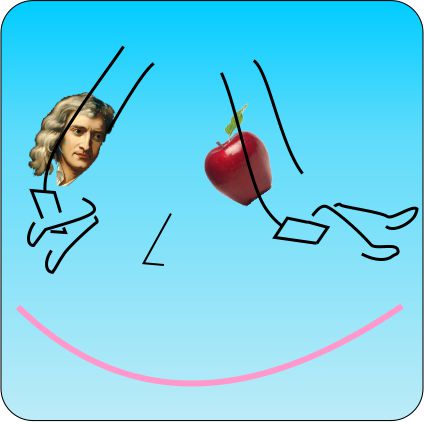
“Well, you’ve described his picture, but you’ve mixed up two different stories. William Tell’s apple story was hundreds of years before Newton. Isaac’s apple story had the fruit falling onto his head, not being shot off of it. That apple got him thinking about gravity and how Earth’s gravity pulling on the apple was like the Sun’s gravity pulling on the planets. When he was done explaining planet orbits, he’d also explained how your swing works.”

“My swing works like a planet? No, my swing goes back and forth, but planets go round and round.”

“Jump down and we can draw pictures over there in the sandbox.”

<thump!! scamper!> “I beat you here!”

“Of course you did. OK, what’s your new M-word?”

“Mmmo-MMENN-tummm!”

“Right. Mr Newton’s Law of Inertia is about momentum. It says that things go in a straight line unless something interferes. It’s momentum that keeps your swing going.”

“B-u-u-t, I wasn’t going in a straight line, I was going in part of a circle.”

“Good observing, Teena, that’s exactly right. Mr Newton’s trick was that a really small piece of a circle looks like a straight line. Look here. I’ll draw a circle … and inside it I’ll put a triangle… and between them I’ll put a hexagon — see how it has an extra point halfway between each of the triangle’s points? — and up top I’ll put the top part of whatever has 12 sides. See how the 12-thing’s sides are almost on the circle?”

“Ooo, that’s pretty! Can we do that with a square, too?”

“Sure. Here’s the circle … and the square … and an octagon … and a 16-thing. See, that’s even closer to being a circle.”

“Ha-ha — ‘octagon’ — that’s like ‘octopus’.”

“For good reason. An octopus has eight arms and an octagon has eight sides. ‘Octo-‘ means ‘eight.’ So anyway, Mr Newton realized that his momentum law would apply to something moving along that tiny straight line on a circle. But then he had another idea — you can move in two directions at once so you can have momentum in two directions at once.”

“That’s silly, Uncle Sy. There’s only one of me so I can’t move in two directions at once.”

“Can you move North?”

“Uh-huh.”

“Can you move East?”

“Sure.”

“Can you move Northeast?”

“Oh … does that count as two?”

“It can for some situations, like planets in orbit or you swinging on a swing. You move side-to-side and up-and-down at the same time, right?”

“Uh-huh.”

“When you’re at either end of the trip and as far up as you can get, you stop for that little moment and you have no momentum. When you’re at the bottom, you’ve got a lot of side-to-side momentum across the ground. Anywhere in between, you’ve got up-down momentum and side-to-side momentum. One kind turns into the other and back again.”

“So complicated.”

“Well, it is. Newton simplified things with revised directions — one’s in-or-out from the center, the other’s the going-around angle. Each has its own momentum. The swing’s ropes don’t change length so your in-out momentum is always zero. Your angle-momentum is what keeps you going past your swing’s bottom point. Planets don’t have much in-out momentum, either — they stay about their favorite distance from the Sun.”

“Earth’s angle-momentum is why we don’t fall in?”

“Yep, we’ve got so much that we’re always falling past the Sun.”

~~ Rich Olcott

Swinging into Physics

A gorgeous Spring day, perfect for taking my 7-year-old niece to the park. We politely say “Hello” to the geese and then head to the playground. Of course she runs straight to the swing set. “Help me onto the high one, Uncle Sy!”

“Why that one, Teena? Your feet won’t reach the ground and you won’t be able to kick the ground to get going.”

“The high one goes faster,”

“How do you know that?”

“I saw some kids have races and the kid on the high swing always did more back-and-forths. Sometimes it was a big kid, sometimes a little kid but they always went faster.”

“Good observing, Sweetie. OK, upsy-daisy — there you are.”

“Now give me pushes.”

“I’m not doing all the work. Tell you what, I’ll give you a start-up shove and then you pump to keep swinging.”

“But I don’t know how!”

“When you’re going forward, lean way back and put your feet up as high as you can. Then when you’re going backward, do the opposite — lean forward and bend your knees way back. Now <hnnnhh!> try it.

<creak … creak> “Hey, I’m doing it! Wheee!”

<creak> “Good job, you’re an expert now.”

“How’s it work, Uncle Sy?”

“It’s a dance between kinetic energy, potential energy and momentum.”

“I’m just a little kid, Uncle Sy, I don’t know what any of those things are.”

“Mmm… Energy is what makes things move or change. You know your toy robot? What happens when its batteries run down?”

“It stops working, silly, until Mommie puts its battery in the charger overnight and then it works again.”

“Right. Your robot needs energy to move. The charger stores energy in the battery. Stored energy is called potential which is like ‘maybe,’ because it’s not actually making something happen. When the robot gets its full-up battery back and you press its GO button, the robot can move around and that’s kinetic energy. ‘Kinetic’ is another word for ‘moving.'”

“So when I’m running around that’s kinetic energy and when I get tired and fall asleep I’m recharging my potential energy?”

“Exactly. You’re almost as smart as your Mommie.”

“An’ when I’m on the swing and it’s moving, that’s kinetic.”

“You’ve got part of it. Watch what’s happening while you swing. Are you always moving?”

<creak … creak> “Ye-e—no! Between when I swing up and when I come down, I stop for just a teeny moment at the top. And I stop again between backing up and going forward. Is that when I’m potential?”

“Sort of, except it’s not you, it’s your swinging-energy that’s all potential at the top. Away from the top you turn potential energy into kinetic energy, going faster and faster until you’re at the bottom. That’s when you go fastest because all your potential energy has become kinetic energy. As you move up from the bottom you slow down because you’re turning your kinetic energy back into potential energy.”

<creak> “Back and forth, potential to kinetic to potential, <creak> over and over. Wheee! Mommie would say I’m recycling!”

“Yes, she would.”

<creak> “Hey, Uncle Sy, how come I don’t stop at the bottom when I’m all out of potential?”

“Ah. What’s your favorite kind of word?”

M-words! I love M-words! Like ‘murmuration‘ and ‘marbles.'”

“Well, I’ve got another one for you — momentum.”

“Oh, that’s yummy — mmmo-MMMENN-tummmm. What’s it mean?”

“It’s about how things that are moving in a straight line keep moving along that line unless something else interferes. Or something that’s standing still will just stay there until something gives it momentum. When we first sat you in the swing you didn’t go anywhere, did you?”

“No, ’cause my toes don’t reach down to the ground and I can’t kick to get myself started.”

“That would have been one way to get some momentum going. When I gave you that push, that’s another way.”

“Or I could wear a jet-pack like Tony Stark. Boy, that’d give me a LOT of momentum!”

“Way too much. You’d wrap the swing ropes round the bar and you’d be stuck up there. Anyway, when you swing past the bottom, momentum is what keeps you going upward.”

“Yay, momentum!” <creak>

~~ Rich Olcott

Dancing in The Dark

Change-me Charlie at his argument table

The impromptu seminar at Change-me Charlie’s “Change My Mind” table is still going strong, but it looks like Physicist-in-training Newt and Astronomer-in-training Jim have met his challenge. He’s switched from arguing that dark matter doesn’t exist to asking how it worked in the Bullet Cluster’s massive collision between two collections of galaxies with their clouds of plasma and dark matter. “OK, the individual galaxies are so spread out they slide past each other without slowing down but the plasma clouds obstruct each other by friction. Wouldn’t friction in the dark matter hold things back, too?”

Jim’s still standing in front of the table. “Now that’s an interesting question, so interesting that research groups have burned a bazillion computer cycles trying to answer it.”

“Interesting, yes, but that interesting?”

“For sure. What we know about dark matter is mostly what it doesn’t do. It doesn’t give off light, it doesn’t absorb light, it doesn’t seem to participate in the strong or weak nuclear forces or interact with normal matter by any means other than gravity, and no identifiable dark matter particles have been detected by bleeding-edge experiments like IceCube and the Large Hadron Collider. So people wonder, does dark matter even interact with itself? If we could answer that question one way or the other, that ought to tell us something about what dark matter is.”

“How’re we gonna do that?”

Newt’s still perched on Charlie’s oppo chair. “By using computers and every theory tool on the shelf to run what-if? simulations. From what we can tell, nearly everywhere in the Universe normal matter is embedded in a shell of dark matter. The Bullet Cluster and a few other objects out there appear to break that rule and give us a wonderful check on the theory work.”

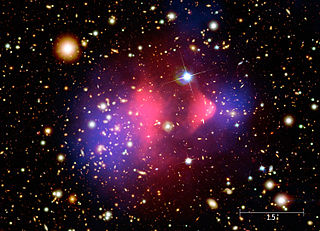
The Bullet Cluster, 1E 0657-56 (NASA image)

“Like for instance.”

“Simple case. What would the collision would looked like if dark matter wasn’t involved? Some researchers built a simulation program and loaded it with a million pretend plasma particles in two cluster-sized regions moving towards each other from 13 million pretend lightyears apart. They also loaded in position and momentum data for the other stars and galaxies shown in the NASA image. The simulation tracked them all as pretend-time marched along stepwise. At each time-step the program applied known or assumed laws of physics to compute every object’s new pretend position and momentum since the prior step. Whenever two pretend-particles entered the same small region of pretend-space, the program calculated a pretend probability for their collision. The program’s output video marked each successful collision with a pink pixel so pinkness means proton-electron plasma. Here’s the video for this simulation.”

“Doesn’t look much like the NASA picture. The gas just spreads out, no arc or cone to the sides.”

“Sure not, which rules out virtually all models that don’t include dark matter. So now the team went to a more complicated model. They added a million dark matter particles that they positioned to match the observed excess gravity distribution. Those’re marked with blue pixels in the videos. Dark matter particles in the model were allowed to scatter each other, too, under control of a self-interaction parameter. The researchers ran the simulations with a whole range of parameter values, from no-friction zero up to about twice what other studies have estimated. Here’s the too-much case.”

“Things hold together better with all that additional gravity, but it’s not a good match either.”

“Right, and here’s the other end of the range — no friction between dark matter particles. Robertson, the video’s author/director, paused the simulation in the middle to insert NASA’s original image so we could compare.”

“Now we’re getting somewhere.”

“It’s not a perfect match. Here’s an image I created by subtracting a just-after-impact simulation frame from the NASA image, then amplifying the red. There’s too much left-over plasma at the outskirts, suggesting that maybe no-friction overstates the case and maybe dark matter particles interact, very slightly, beyond what a pure-gravity theory predicts.”

“Wait, if the particles don’t use gravity, electromagnetism or the nuclear forces on each other, maybe there’s a fifth force!”

“New Physics!”

A roar from Cap’n Mike — “Or they’re not particles!”

~~ Rich Olcott

The Prints of Darkness

There’s a commotion in front of Al’s coffee shop. Perennial antiestablishmentarian Change-me Charlie’s set up his argument table there and this time the ‘establishment’ he’s taking on is Astrophysics. Charlie’s an accomplished chain-yanker and he’s working it hard. “There’s no evidence for dark matter, they’ve never found any of the stuff and there’s tons of no-dark-matter theories to explain the evidence.”

Big Cap’n Mike’s shouts from the back of the crowd. “What they’ve been looking for and haven’t found is particles. By my theory dark matter’s an aspect of gravity which ain’t particles so there’s no particles for them to find.”

Astronomer-in-training Jim spouts off right in Charlie’s face. “Dude, you can’t have it both ways. Either there’s no evidence to theorize about, or there’s evidence.”

Physicist-in-training Newt Barnes takes the oppo chair. “So what exactly are we talking about here?”

“That’s the thing, guy, no-one knows. It’s like that song, ‘Last night I saw upon the stair / A little man who wasn’t there. / He wasn’t there again today. / Oh how I wish he’d go away.‘ It’s just buzzwords about a bogosity. Nothin’ there.”

I gotta have my joke. “Oh, it’s past nothing, it’s a negative.”

“Come again?”

“The Universe is loaded with large rotating but stable structures — solar systems, stellar binaries, globular star clusters, galaxies, galaxy clusters, whatever. Newton’s Law of Gravity accounts nicely for the stability of the smallest ones. Their angular momentum would send them flying apart if it weren’t for the gravitational attraction between each component and the mass of the rest. Things as big as galaxies and galaxy clusters are another matter. You can calculate from its spin rate how much mass a galaxy must have in order to keep an outlying star from flying away. Subtract that from the observed mass of stars and gas. You get a negative number. Something like five times more negative than the mass you can account for.”

“Negative mass?”

“Uh-uh, missing positive mass to combine with the observed mass to account for the gravitational attraction holding the structure together. Zwicky and Rubin gave us the initial object-tracking evidence but many other astronomers have added to that particular stack since then. According to the equations, the unobserved mass seems to form a spherical shell surrounding a galaxy.”

“How about black holes and rogue planets?”

Newt’s thing is cosmology so he catches that one. “No dice. The current relative amounts of hydrogen, helium and photons say that the total amount of normal matter (including black holes) in the Universe is nowhere near enough to make up the difference.”

“So maybe Newton’s Law of Gravity doesn’t work when you get to big distances.”

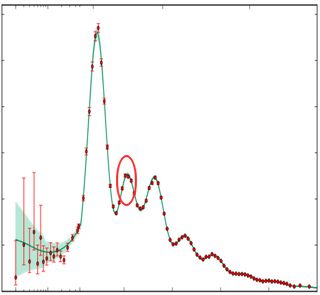
“Biggest distance we’ve got is the edge of the observable Universe. Jim, show him that chart of the angular power distribution in the Planck satellite data for the Cosmological Microwave Background.” <Jim pulls out his smart-phone, pulls up an image.> “See the circled peak? If there were no dark matter that peak would be a valley.”

Charlie’s beginning to wilt a little. “Ahh, that’s all theory.”

The Bullet Cluster ( 1E 0657-56 )

<Jim pulls up another picture.> “Nope, we’ve got several kinds of direct evidence now. The most famous one is this image of the Bullet Cluster, actually two clusters caught in the act of colliding head-on. High-energy particle-particle collisions emit X-rays that NASA’s Chandra satellite picked up. That’s marked in pink. But on either side of the pink you have these blue-marked regions where images of further-away galaxies are stretched and twisted. We’ve known for a century how mass bends light so we can figure from the distortions how much lensing mass there is and where it is. This picture does three things — it confirms the existence of invisible mass by demonstrating its effect, and it shows that invisible mass and visible mass are separate phenomena. I’ve got no pictures but I just read a paper about two galaxies that don’t seem to be associated with dark matter at all. They rotate just as Newton would’ve expected from their visible mass alone. No surprise, they’re also a lot less dense without that five-fold greater mass squeezing them in.”

“You said three.”

“Gotcha hooked, huh?

~~ Rich Olcott

In A Pinch And Out Again

<Vinnie’s phone rings> “Yeah, Michael? That ain’t gonna work, Micheal.” <to me> “Michael wants to hoist us out through the elevator cab’s ceiling hatch.” <to phone> “No, it’s a great idea, Michael, it’d be no problem for Sy, he’s skinny, but no way am I gonna fit through that hatch. Yeah, keep looking for the special lever. Hey, call Eddie downstairs for some pizza you can send through the hatch. Yeah, you’re right, pizza grease and elevator grease don’t mix. Right, we’ll wait, like we got any choice. Bye.” <to me> “You heard.”

“Yeah, I got the drift. Plenty more time to talk about the improved portable kilogram standard.”

“I thought we were talking about lasers. No, wait, we got there by talking about the time standard.”

“We were and we did, but all the improved measurements are based on laser tech. Mode-locking, optical tweezers and laser cooling, for instance, are key to the optical clockwork you need for a really good time standard.”

“Optical tweezers?”

“Mm-hm, that’s yet another laser-related Nobel Prize topic. There’s been nearly a dozen so far. Optical tweezers use light beams to grab and manipulate small particles. Really small, like cells or molecules or even single atoms.”

“Grabbing something with light? How’s that work?”

“Particles smaller than a light beam get drawn in to where the beam’s electric field varies the most. With a tightly-focused laser beam that special place is just a little beyond its focus point. You can use multiple beams to trap particles even more tightly where the beams cross.”

“Is that how ‘laser cooling’ works? You hold an atom absolutely still and it’s at absolute zero?”

“Nice idea, Vinnie, but your atom couldn’t ever reach absolute zero because everything has a minimum amount of zero-point energy. But you’re close to how the most popular technique is set up. It’s elegant. You start with a thin gas of the atoms you want to work with. Their temperature depends on their average kinetic energy as they zip around, right?”

“Yeah, so you want to slow them down.”

“Now you shine in two laser beams, one pointing east and one pointing west, and their wavelengths are just a little to the red of what those atoms absorb. Imagine yourself sitting on one of those atoms coming toward the east-side laser.”

Blue shift! I’m coming toward the waves so I see them scrunched together at a wavelength where my atom can absorb a photon. But what about the other laser?”

“You’d see its wavelength red-shifted away from your atom’s sweet spot and the atom doesn’t absorb that photon. But we’re not done. Now your excited atom relaxes by emitting a photon in some random direction. Repeat often. The north-south momentum change after each cycle averages out to zero but east-west momentum always goes down. The gas temperature drops.”

“Cool.”

All this talk of particles balanced in force fields gives me an idea. “Vinnie, d’ya think we stopped closer to the fifth floor or the sixth?”

“I think we’re almost down to five.”

“Good, that gives us a better chance. Where were you standing when we stopped?”

“Right by the buttons, like always. Whaddaya got in mind?”

“Michael said that’s a new elevator door, right? No offense, you’re heavy and I’m no light-weight. Both of us were standing at the very front of the cab. I’m thinking maybe our unbalanced weight tilted the cab just enough to catch an edge on some part of the door mechanism they didn’t put in quite right. Let’s switch places and both jump up and while we’re in the air wallop the top of the cab’s back wall as hard as we can. OK, on three — one, two, three!” “

<B-BLAMkchitKKzzzzzrrrrrrr-T>

“Michael. It’s Vinnie. We’re out. Yeah, ‘s wunnerful, I’m glad you’re glad. Look, something was sorta outta place in the new door mechanism on five and now it’s way outta place and the cab’s probably here for the duration. Call your repair guys, but before you do that bring up some Caution tape and something that’ll block the door open. Quick-like, right? I’m holding this door but I ain’t gonna be a statue long ’cause I’m hungry.”

~~ Rich Olcott

The Big Splash? Maybe.

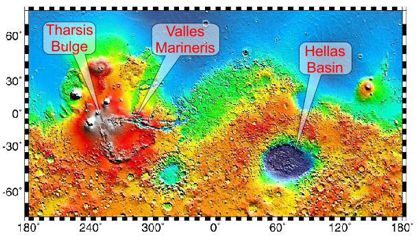
You’ve not seen half of it, Mr Feder.  Mars has the Solar System’s tallest volcano, most massive volcano, biggest planetary meteor strike, deepest and longest  canyon…”

“Wait, kid, I’ve been to the Grand Canyon.  Thing is … BIG!  What’d they say?  A mile deep, 18 miles wide, 250 miles long.  No way Mars can beat that.”

“Valles Marineris is 4½ miles deep, 120 miles wide and 2500 miles long.  The Grand Canyon meanders, packing its length into only 150 miles of bee-line distance.  Marineris stretches straight as a string.  No river carved that formation, but the planetologists can’t agree on what did.”

Labeled Mars map 2 420
Mars map from NASA/JPL/GSFC

“They got evidence, don’t they?”

“Not enough.  Different facts point in different directions and no overall theory has won yet.  Most of it has to do with the landforms.  Start with the Tharsis Bulge, big as a continent and rising kilometers above Mars’ average altitude.  Near the Bulge’s highest point, except for the volcanoes, is a fractured-looking region called Noctis Labyrinthus.  Starting just west of  the Labyrinth a whole range of wrinkly highlands and mountains arcs around south and then east to point towards the eastern end of Marineris.  Marineris completes the arc by meeting the Labyrinth to its west.  Everything inside that arc is higher than everything else around it.  Except for the volcanoes, of course.”

“Looks like something came up from underneath to push all that stuff up.”

“Mm-hm, but we don’t know what, or what drove it, or even how fast everything happened.  There are theories all over the place”

“Like what?”

“Well, maybe it’s upwellng from a magma hotspot, like the one under the Pacific that’s been creating Hawaiian Islands one at a time for the past 80 million years.  Some people think the upwelling mostly lifted the existing crust like expanding gas bubbles push up the crust of baking bread.  Other people think that the upwelling’s magma broke through the crust to form enormous lava flows that covered up whatever had been there before.”

“You said ‘maybe.'”

“Yeah.  Another group of theories sees a connection between Tharsis and Hellas Basin, which is almost exactly on the other side of the planet.  Hellas is the rock-record of a mega-sized meteorite strike, the third largest confirmed one in the Solar System.  Before you ask, the other two are on the Moon.  Like I said, it’s a group of theories.  The gentlest one, if you can call it that, is that energy from the impact rippled all around the planet to focus on the point opposite the impact.  That would have disrupted the local equilibrium between crustal weight and magma’s upward pressure.  An imbalance like that would encourage uplift, crustal cracking and, ultimately, Valles Marineris.”

“Doesn’t sound very gentle.”

“It wouldn’t have been but it might even have been nastier.  Another possibility is that the meteorite may not have stopped at the crust.  It could have hit hard enough, and maybe with enough spin, to drill who knows how far through the fluid-ish body of the planet, raising the Bulge just by momentum and internal slosh.  Worst case, some of Tharsis’ rock might even have come from the intruder.”

Realistic Orange-red Liquid Splash Vector
Adapted from an image by Vecteezy

“Wow, that would have been a sight to see!”

“Yeah, from a distance.  Any spacecraft flying a Mars orbit would be in jeopardy from rock splatter.  We’ve found meteors on Earth that we know originated on Mars because they have bubbles holding trapped gas that matches the isotope signature of Martian atmosphere.  A collision as violent as the one I just described could certainly have driven rocky material past escape velocity and on its way to us.  Oh, by the way and speaking of sights — you’d be disappointed if you actually visited Valles Marineris.”

“How could anything that ginormous be a disappointment?”

“You could look down into it but you probably couldn’t see the far side.  Mars is smaller than Earth and its surface curves downward more rapidly.  Suppose you stood on one side of the valley’s floor where it’s 4 miles deep.  The opposite wall, maybe 100 miles away, would be beyond your 92-mile horizon limit for an object that tall.”

“Aw, phooey!”

~~ Rich Olcott

The Neapolitan Particle

“Welcome back, Jennie.  Why would anyone want to steer an ice cube?

“Thanks, Jeremy, it’s nice to be back..  And the subject’s not an ice cube, it’s IceCube, the big neutrino observatory in the Antarctic.”

“Then I’m with Al’s question.  Observatories have this big dome that rotates and inside there’s a lens or mirror or whatever that goes up and down to sight on the night’s target.  OK, the Hubble doesn’t have a dome and it uses gyros but even there you’ve got to point it.  How does IceCube point?”

“It doesn’t.  The targets point themselves.”

“Huh?”

“Ever relayed a Web-page?”

“Sure.”

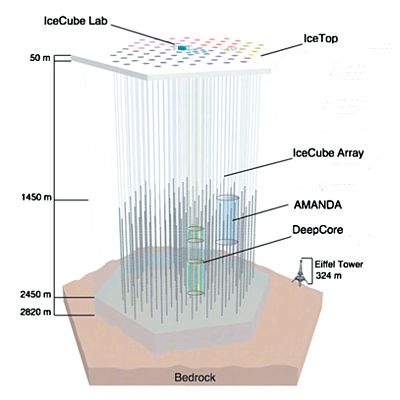
“Guess what?  You don’t know where the page came from, you don’t know where it’s going to end up.  But it could carry a tracking bug to tell someone at some call-home server when and where the page had been opened.  IceCube works the same way, sort of.  It has a huge 3D array of detectors to record particles coming in from any direction.  A neutrino can come from above, below, any side, no problem — the detectors it touches will signal its path.”

IceCube architecture
Adapted from a work by Francis Halzen, Department of Physics, University of Wisconsin

“How huge?”

“Vastly huge.  The instrument is basically a cubic kilometer of ultra-clear Antarctic ice that’s ages old.  The equivalent of the tracking bugs is 5000 sensors in a honeycomb array more than a kilometer wide.  Every hexagon vertex marks a vertical string of sensors going down 2½ kilometers into the ice.  Each string has a couple of sensors near the surface but the rest of them are deeper than 1½ kilometers.  The sensors are looking for flashes of light.  Keep track of which sensor registered a flash when and you know the path a particle took through the array.”

icecube event 3“Why should there be flashes? I thought neutrinos didn’t interact with matter.”

“Make that, they rarely interact with matter.  Even that depends on what particle the neutrino encounters and what flavor neutrino it happens to be at the moment.”

That gets both Al and me interested.  His “Neutrinos come in flavors?” overlaps my “At the moment?”

“I thought that would get you into this, Sy.  Early experiments detected only 1/3 of the neutrinos we expected to come from the Sun.  Unwinding all that was worth four Nobel prizes and counting.  The upshot’s that there are three different neutrino flavors and they mutate.  The experiments caught only one.”

Vinnie’s standing behind us.  “You’re going to tell us the flavors, right?”

“Hoy, Vinnie, Jeremy’s question was first, and it bears on the others.  Jeremy, you know that blue glow you see around water-cooled nuclear fuel rods?”

“Yeah, looks spooky.  That’s neutrinos?”

“No, that’s mostly electrons, but it could be other charged particles.  It has to do with exceeding the speed of light in the medium.”

“Hey, me and Sy talked about that.  A lightwave makes local electrons wiggle, and how fast the wiggles move forward can be different from how fast the wave group moves.  Einstein’s speed-of-light thing was about the wave group’s speed, right, Sy?”

“That’s right, Vinnie.”

“So anyhow, Jeremy, a moving charged particle affects the local electromagnetic field.  If the particle moves faster than the surrounding atoms can adjust, that generates light, a conical electromagnetic wave with a continuous spectrum.  The light’s called Cherenkov radiation and it’s mostly in the ultra-violet, but enough leaks down to the visible range that we see it as blue.”

“But you said it takes a charged particle.  Neutrinos aren’t charged.  So how do the flashes happen in IceCube?”

“Suppose an incoming high-energy neutrino transfers some of its momentum to a charged particle in the ice — flash!  Even better, the flash pattern provides information for distinguishing between the neutrino flavors.  Muon neutrinos generate a more sharp-edged Cherenkov cone than electron neutrinos do.  Taus are so short-lived that IceCube doesn’t even see them.”Leptons

“I suppose muon and tau are flavors?”

“Indeed, Vinnie.  Any subatomic reaction that releases an electron also emits an electron-flavored neutrino.  If the reaction releases the electron’s heavier cousin, a muon, then you get a muon-flavored neutrino.  Taus are even heavier  and they’ve got their own associated neutrino.”

“And they mutate?”

“In a particularly weird way.”

~~ Rich Olcott

Bigger than you’d think

Al’s coffee shop, the usual mid-afternoon crowd of chatterers and laptop-tappers.  Al’s walking his refill rounds, but I notice he’s carrying a pitcher rather than his usual coffee pot.  “Hey, Al, what’s with the hardware?”

“Got iced coffee here, Sy.  It’s hot out, people want to cool down.  Besides, this is in honor of IceCube.”

“Didn’t realize you’re gangsta fan.”

“Nah, not the rapper, the cool experiment down in the Antarctic.  It was just in the news.”

“Oh?  What did they say about it?”

“It’s the biggest observatory in the world, set up to look for the tiniest particles we know of, and it uses a cubic mile of ice which I can’t think how you’d steer it.”

A new voice, or rather, a familiar one. “One doesn’t, Al.”
Neutrino swirl 1“Hello, Jennie.  Haven’t seen you for a while.”

“I flew home to England to see my folks.  Now I’m back here for the start of the Fall term.  I’ve already picked a research topic — neutrinos.  They’re weird.”

“Hey, Jennie, why are they so tiny?”

“It’s the other way to, Al.  They’re neutrinos because they’re so tiny.  Sy would say that for a long time they were simply an accounting gimmick to preserve the conservation laws.”

“I would?”

“Indeed.  People had noticed that when uranium atoms give off alpha particles to become thorium, the alpha particles always have about the same amount of energy.  The researchers accounted for that by supposing that each kind of nucleus has some certain quantized amount of internal energy.  When one kind downsizes to another, the alpha particle carries off the difference.”

“That worked well, did it?”

“Oh, yes, there are whole tables of nuclear binding energy for alpha radiation.  But when a carbon-14 atom emits a beta particle to become nitrogen-14, the particle can have pretty much any amount of energy up to a maximum.  It’s as though the nuclear quantum levels don’t exist for beta decay.  Physicists called it the continuous beta-spectrum problem and people brought out all sorts of bizarre theories to try to explain it.  Finally Pauli suggested maybe something we can’t see carries off energy and leaves less for the beta.  Something with no charge and undetectable mass and the opposite spin from what the beta has.”

“Yeah, that’d be an accounting gimmick, alright.  The mass disappears into the rounding error.”

“It might have done, but twenty years later they found a real particle.  Oh, I should mention that after Pauli made the suggestion Fermi came up with a serious theory to support it.  Being Italian, he gave the particle its neutrino name because it was neutral and small.”

“But how small?”

“We don’t really know, Al.  We know the neutrino’s mass has to be greater than zero because it doesn’t travel quite as fast as light does.  On the topside, though, it has to be lighter than than a hydrogen atom by at least a factor of a milliard.”

“Milliard?”

“Oh, sorry, I’m stateside, aren’t I?  I should have said a billion.  Ten-to-the-ninth, anyway.”

“That’s small.  I guess that’s why they can sneak past all the matter in Earth like the TV program said and never even notice.”

This gives me an idea.  I unholster Old Reliable and start to work.

“Be right with you… <pause> … Jennie, I noticed that you were being careful to say that neutrinos are light, rather than small.  Good careful, ’cause ‘size’ can get tricky at this scale.  In the early 1920s de Broglie wrote that every particle is associated with a wave whose wavelength depends on the particle’s momentum.  I used his formula, together with Jennie’s upper bound for the neutrino’s mass, to calculate a few wavelength lower bounds.Neutrino wavelength calcMomentum is velocity times mass.  These guys fly so close to lightspeed that for a long time scientists thought that neutrinos are massless like photons.  They’re not, so I used several different v/c ratios to see what the relativistic correction does.  Slow neutrinos are huge, by atom standards.  Even the fastest ones are hundreds of times wider than a nucleus.”

“With its neutrino-ness spread so thin, no wonder it’s so sneaky.”

“That may be part of it, Al.”

“But how do you steer IceCube?”

~~ Rich Olcott

Lighting and a diagram of a linac

Curiosity in The Internet Market

“I got another question, Moire.”

“Of course you do, Mr Feder.  Let’s hear it.”

“I read on the Internet that there’s every kind of radioactivity coming out of lightning bolts.  So is that true, how’s it happen and how come we’re not all glowing in the dark?”

“Well, now, like much else you read on the Internet there’s a bit of truth in there, and a bit of not-truth, all wrapped up in hype.  The ‘every kind of radioactivity’ part, for instance, that’s false.”

“Oh yeah?  What’s false about that?”

“Kinds like heavy-atom fission and alpha-particle ejection.  Neither have been reported near lightning strikes and they’re not likely to be.  Lightning travels through air.  Air is 98% nitrogen and oxygen with a sprinkling of light atoms.  Atoms like that don’t do those kinds of radioactivity.”

“So what’s left?”

“There’s only two kinds worth worrying about — beta decay, where the nucleus spits out an electron or positron, and some processes that generate gamma-rays.  Gamma’s a high-energy photon, higher even than X-rays.  Gamma photons are strong enough to ionize atoms and molecules.”

“You said ‘worth worrying about.’  I like worrying.  What’s in the not-worth-it bucket?”

“Neutrinos.  They’re so light and interact so little with matter that many physicists think of them as just an accounting device.  Trillions go through you every second and you don’t notice and neither do they.  Really, don’t worry about them.”

“Easy for you to say.  Awright, so how does lightning make the … I guess the beta and gamma radioactivity?”

“We know the general outlines, although a lot of details have yet to be filled in.  What do you know about linear accelerators?”

“Not a clue.  What is one?”

Lighting and a diagram of a linac
Linac diagram adapted from
Sgbeer – Own work, CC BY-SA 3.0

“It’s a technology for making high-energy electrons and other charged particles.  Picture a straight evacuated pipe equipped with ring electrodes at various distances from the source end.  The source could be an electron gun or maybe a rig that spits out ions of some sort.  Voltages between adjacent electrodes downstream of a particle will give it a kick when it passes en route to the target end.  By using the right voltages at the right times you can boost an electron’s kinetic energy into the hundred-million-eV range.  That’s a lot of kinetic energy.  Got that picture?”

“Suppose that I do.  Then what?”

“Lightning is the same thing but without the pipe and it’s not straight.  The electrons have an evacuated path, because plasma formation drives most of the molecules out of there.  Activity inside the clouds gives them high voltages, up to a couple hundred megavolts.  But on top of that there’s bremsstrahlung.”

“Brem…?”

Bremsstrahlung — German for braking radiation.  You know how your car’s tires squeal when you make a turn at speed?”

“One of my favorite sounds, ‘specially when … never mind.  What about it?”

“That’s your tires converting your forward momentum into sound waves.  Electrons do that, too, but with electromagnetism.  The lightning path zigs and zags.  An electron’s path has to follow suit.  At each swerve, the electron throws off some of its kinetic energy as an electromagnetic wave, otherwise known as a photon.  Those can be very high-energy photons, X-rays or even gamma-rays.”

“So that’s where the gammas come from.”

“Yup.  But there’s more.  Remember those nitrogen atoms?  Ninety-nine-plus percent of them are nitrogen-14, a nice, stable isotope with seven protons and seven neutrons.  If a sufficiently energetic gamma strikes a nitrogen-14, the atom’s nucleus can kick out a neutron and turn into unstable nitrogen-13.  That nucleus emits a positron to become stable carbon-13.  So you’ve got free neutrons and positrons to add to the radiation list.”

“With all that going on, how come I’m not glowing in the dark?”

“‘Because the radiation goes away quickly and isn’t contagious.  Most of the neutrons are soaked up by  hydrogen atoms in passing water molecules (it’s raining, remember?).  Nitrogen-13 has a 10-minute half-life and it’s gone.  The remaining neutrons, positrons and gammas can ionize stuff, but that happens on the outsides of molecules, not in the nuclei.  Turning things radioactive is a lot harder to do.  Don’t worry about it.”

“Maybe I want to.”

“Your choice, Mr Feder.”

~~ Rich Olcott

Planetary Pastry, Second Course

We’re still sitting in Al’s coffee shop.  “OK, Cathleen, so Jupiter’s Great Red Spot acts like a hurricane turned inside-out.  Where’s the problem?”

“Just that it goes completely against all the computer models we’ve built to understand and predict hurricane activity.  It’ll take a whole new generation of even more complicated models for Jupiter-like planets.”

“Here’s the doughnuts you asked for, Cathleen.”

“Thanks, Al.  Perfect timing. <drawing on a paper napkin>  Let’s look at hurricanes first, OK, Sy?”

“Sure.”

“We’ll start with this doughnut that I’ve just taken a bite out of.  First thing that happens is that warm ocean water heats up the overlying air.  Warmed air rises, so we’ve got an updraft.”

“And then?”

“The rising air is humid (ocean air, remember?).  As it rises it cools and forces moisture to condense out.  Upward flow stops when the warmed air hits the top of the troposphere.  But there’s still more warm air pushing up the plume.  The cooled air has to go somewhere so it spreads out.  That’s where these red arrows on my paper napkin go horizontal.  The cooled air, loaded with water droplets, is heavy so it starts sinking which is why the red arrows turn downward.  They move back across that ocean water again ’cause they’re caught in the inflow.  Full cycle and that’s number 1 here, got it?”

“Yeah.”

“Hey, Cathleen,  are you gonna need more paper napkins?”Donuts 1
“A couple should be enough, Al, thanks.  Now we get to number 2, the Coriolis thing. That’s always tough to talk students through but let’s try.  The Earth rotates once every 24 hours, right, and its circumference at the Equator is 25,000 miles, so relative to the Sun anything at the Equator is flying eastward at about 1,000 miles per hour.  Any place north of the Equator has to be going slower than that, and further north, even slower.  With me, Sy?”

“Gimme a minute … OK, I suppose.”

“Good.  Now suppose a balloon is floating in the breeze somewhere south of that rising plume.  Relative to the plume, it’ll have eastward momentum.  Now the balloon’s caught in the plume’s inflow but it doesn’t go straight in because of that eastward momentum.  Instead it’s going to arc around the plume.  See how I’ve got it coming in off-center?  Al, would that be clockwise or counterclockwise if you’re looking down from a satellite or something?”

“Umm … counterclockwise, yeah?”

“Mm-hm.  What about a balloon that starts out north of the plume?”

“Uhh … It’ll be going slower than the plume, so the plume gets ahead of it and it’ll arc … hey, counterclockwise again!”

“How ’bout that?  Anywhere in the northern hemisphere, air flowing into a low-pressure region will turn it counterclockwise.  As the inflow draws from greater distances, there’s a greater speed difference to drive the counterclockwise spin.  So that’s number 2 here.  Add those two cycles together and you’ve got number 3, which spirals all around the doughnut.  And there’s your hurricane.”

“Cool.  So how does that model not account for the Great Red Spot?”

“To begin with, the Spot’s in Jupiter’s southern hemisphere so it ought to be going clockwise which it definitely is not.  And there’s no broad band of surrounding clouds — just a lot of structure inside the ring, not outside.  There’s something else going on that swamps Coriolis.”

“So how’s Jupiter different from Earth?  Besides being bigger, of course.”

“Lots of ways, Sy.  You know how labels on healthcare products divide the contents into active ingredients and inert ingredients?  The inert ones just carry or modify the effects of the active ones.  Atmospheres work the same way.  On Earth the inert ingredients are nitrogen and oxygen…”

“Hey, oxygen’s important!”

“Sure, Al, but not when you’re modeling air movement.  The important active ingredient is water — it transports a lot of heat when it evaporates from one place and condenses somewhere else.  The biggest outstanding problem in Earth meteorology is accounting for clouds.”

“You’re gonna tell us that Jupiter’s inactive ingredients are hydrogen and helium, I suppose.”

“Precisely, Sy.  Jupiter has two active ingredients, water and ammonia, plus smaller amounts of sulfur and phosphorus compounds.  Makes for a crazy complicated modeling problem.  I’m going to need more pastries.”

“Comin’ up.”


~~ Rich Olcott