Flipping An Edge Case

“Why’s the Ag box look weird in your chart, Susan?”
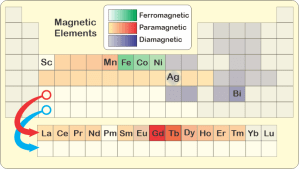
“That’s silver, Eddie. It’s an edge case. The pure metal’s diamagnetic. If you alloy silver with even a small amount of iron, the mixture is paramagnetic. How that works isn’t my field. Sy, it’s your turn to bet and explain.”

I match Eddie’s bet (the hand’s not over). “It’s magnetism and angular momentum and how atoms work, and there are parts I can’t explain. Even Feynman couldn’t explain some of it. Vinnie, what do you remember about electromagnetic waves?”

“Electric part pushes electrons up and down, magnetic part twists ’em sideways.”

“Good enough, but as Newton said, action begets reaction. Two centuries ago, Ørsted discovered that electrons moving along a wire create a magnetic field. Moving charges always do that. The effect doesn’t even depend on wires — auroras, fusion reactor and solar plasmas display all sorts of magnetic phenomena.”

“You said it’s about how atoms work.”

“Yes, I did. Atoms don’t follow Newton’s rules because electrons aren’t bouncing balls like those school‑book pictures show. An electron’s only a particle when it hits something and stops; otherwise it’s a wave. The moving wave carries charge so it generates a magnetic field proportional to the wave’s momentum. With me?”

“Keep going.”

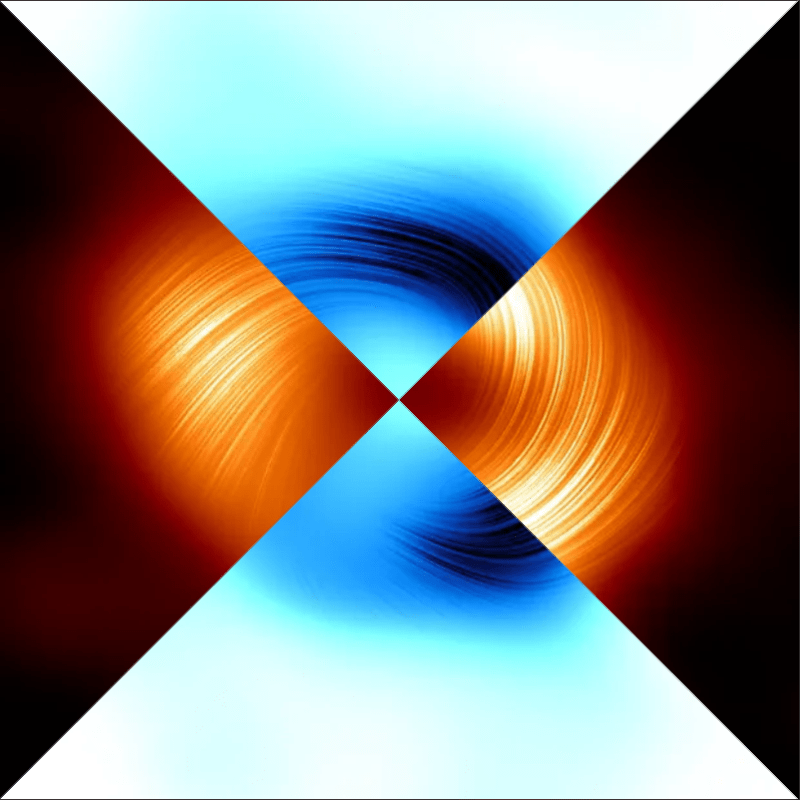
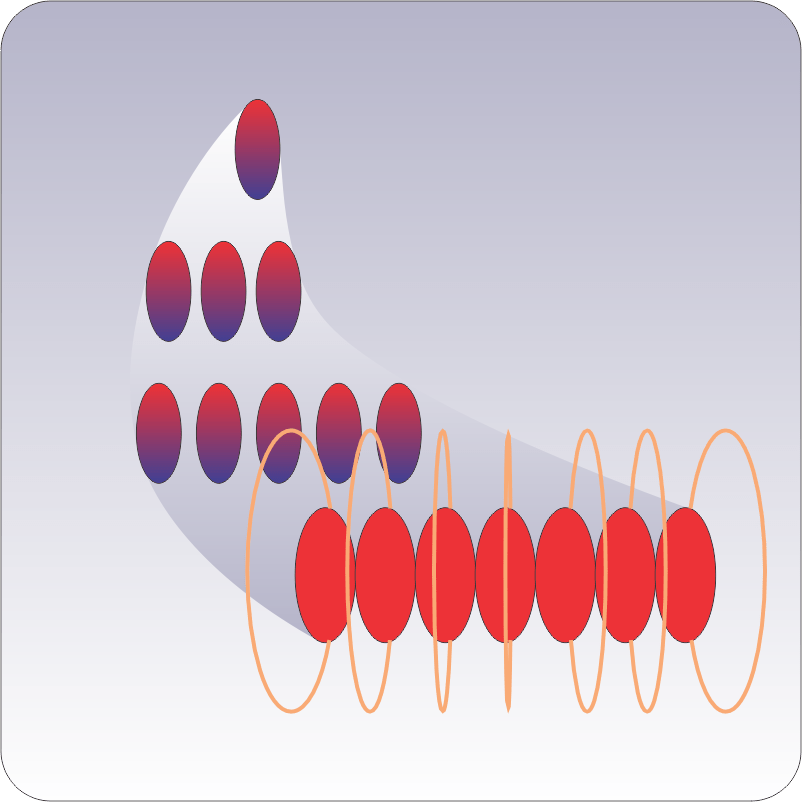
“That picture’s fine for a wave traveling through space, but in an atom all the charge waves circle the nucleus. Linear momentum in open space becomes angular momentum around the core. If every wave in an atom went in the same direction it’d look like an electron donut generating a good strong dipolar magnetic field coming up through the hole.”

“You said ‘if’.”

“Yes, because they don’t do that. I’m way over‑simplifying here but you can think of the waves pairing up, two single‑electron waves going in opposite directions.”

“If they do that, the magnetism cancels.”

“Mm‑hm. Paired‑up configurations are almost always the energy‑preferred ones. An external magnetic field has trouble penetrating those structures. They push the field away so we classify them as diamagnetic. The gray elements in Susan’s chart are almost exclusively in paired‑up configurations, whether as pure elements or in compounds.”

“Okay, so what about all those paramagnetic elements?”

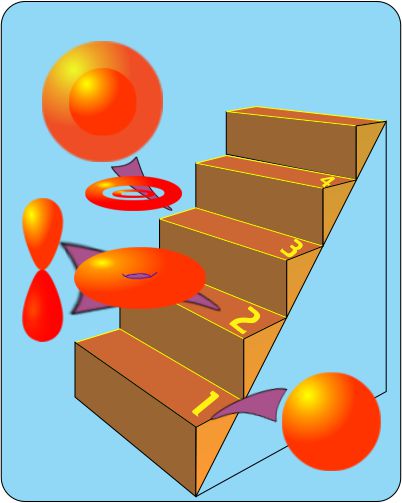
“Here’s where we get into atom structure. An atom’s electron cloud is described by spherical harmonic modes we call orbitals, with different energy levels and different amounts of angular momentum — more complex shapes have more momentum. Any orbital hosting an unpaired charge has uncanceled angular momentum. Two kinds of angular momentum, actually — orbital momentum and spin momentum.”

“Wait, how can a wave spin?”

“Hard to visualize, right? Experiments show that an electron carries a dipolar magnetic field just like a spinning charge nubbin would. That’s the part that Feynman couldn’t explain without math. A charge wave with spin and orbital angular momentum is charge in motion; it generates a magnetic field just like current through a wire does. The math makes good predictions but it’s not something that everyday experience prepares us for. Anyway, the green and yellow‑orange‑ish elements feature unpaired electrons in high‑momentum orbitals buried deep in the atom’s charge cloud.”

“So what?”

“So when an external magnetic field comes along, the atom’s unpaired electrons join the party. They orient their fields parallel to the external field, in effect allowing it to penetrate. That qualifies the atom as paramagnetic. More unpaired electrons means stronger interaction, which is why iron goes beyond paramagnetic to ferromagnetic.”

“How does iron have so many?”

“Iron’s halfway across its row of ten transition metals—”

“I know where you’re going with this, Sy. It’ll help to say that these elements tend to lose their outer electrons. Scandium over on the left ionizes to Sc3+ and has zero d‑electrons. Then you add one electron in a d orbital for each move to the right.”

“Thanks, Susan. Count ’em off, Vinnie. Five steps over to iron, five added d‑electrons, all unpaired. Gadolinium, down in the lanthanides, beats that with seven half‑filled f‑orbitals. That’s where the strength in rare earth magnets arises.”

“So unpaired electrons from iron flip alloyed silver paramagnetic?”

“Vinnie wins this pot.”

~ Rich Olcott

A No-Charge Transaction

I ain’t done yet, Sy. I got another reason for Dark Matter being made of faster‑then‑light tachyons.”

“I’m still listening, Vinnie.”

“Dark Matter gotta be electrically neutral, right, otherwise it’d do stuff with light and that doesn’t happen. I say tachyons gotta be neutral.”

“Why so?”

“Stands to reason. Suppose tachyons started off as charged particles. The electric force pushes and pulls on charges hugely stronger than gravity pulls—”

“1036 times stronger at any given distance.”

“Yeah, so right off the bat charged tachyons either pair up real quick or they fly away from the slower‑than‑light bradyon neighborhood leaving only neutral tachyons behind for us bradyon slowpokes to look at.”

“But we’ve got un‑neutral bradyon matter all around us — electrons trapped in Earth’s Van Allen Belt and Jupiter’s radiation belts, for example, and positive and negative plasma ions in the solar wind. Couldn’t your neutral tachyons get ionized?”

“Probably not much. Remember, tachyon particles whiz past each other too fast to collect into a star and do fusion stuff so there’s nobody to generate tachyonic super‑high‑energy radiation that makes tachyon ions. No ionized winds either. If a neutral tachyon collides with even a high-energy bradyon, the tachyon carries so much kinetic energy that the bradyon takes the damage rather than ionize the tachyon. Dark Matter and neutral tachyons both don’t do electromagnetic stuff so Dark Matter’s made of tachyons.”

“Ingenious, but you missed something way back in your initial assumptions.”

“Which assumption? Show me.”

“You assumed that tachyon mass works the same way that bradyon mass does. The math says it doesn’t.” <grabbing scratch paper for scribbling> “Whoa, don’t panic, just two simple equations. The first relates an object’s total energy E to its rest mass m and its momentum p and lightspeed c.”

E² = (mc²)² + (pc)²

“I recognize the mc² part, that’s from Einstein’s Equation, but what’s the second piece and why square everything again?”

“The keyword is rest mass.”

“Geez, it’s frames again?”

“Mm‑hm. The (mc²)² term is about mass‑energy strictly within the object’s own inertial frame where its momentum is zero. Einstein’s famous E=mc² covers that special case. The (pc)² term is about the object’s kinetic energy relative to some other‑frame observer with relative momentum p. When kinetic energy is comparable to rest‑mass energy you’re in relativity territory and can’t just add the two together. The sum‑of‑squares form makes the arithmetic work when two observers compare notes. Can I go on?”

“I’m still waitin’ to hear about tachyons.”

“Almost there. If we start with that equation, expand momentum as mass times velocity and re‑arrange a little, you get this formula

E = mc² / √(1 – v²/c²)

The numerator is rest‑mass energy. The v²/c² measures relative kinetic energy. The Lorentz factor down in the denominator accounts for that. See, when velocity is zero the factor is 1.0 and you’ve got Einstein’s special case.”

“Give me a minute. … Okay. But when the velocity gets up to lightspeed the E number gets weird.”

“Which is why c is the upper threshold for bradyons. As the velocity relative to an observer approaches c, the Lorentz factor approaches zero, the fraction goes to infinity and so does the object’s energy that the observer measures.”

“Okay, here’s where the tachyons come in ’cause their v is bigger than c. … Wait, now the equation’s got the square root of a negative number. You can’t do that! What does that even mean?”

“It’s legal, when you’re careful, but interpretation gets tricky. A tachyon’s Lorentz factor contains √(–1) which makes it an imaginary number. However, we know that the calculated energy has to be a real number. That can only be true if the tachyon’s mass is also an imaginary number, because i/i=1.”

“What makes imaginary energy worse than imaginary mass?”

“Because energy’s always conserved. Real energy stays that way. Imaginary mass makes no sense in Newton’s physics but in quantum theory imaginary mass is simply unstable like a pencil balanced on its point. The least little jiggle and the tachyon shatters into real particles with real kinetic energy to burn. Tachyons disintegrating may have powered the Universe’s cosmic inflation right after the Big Bang — but they’re all gone now.”

“Another lovely theory shot down.”

~ Rich Olcott

Sussing Out The Unseeable

<chirp, chirp> “Moire here.”

“Hello, Mr Moire.”

“Afternoon, Walt. Pizza time again?”

“No, too public. Poor craft to be seen too often in the same place. There’s a park bench by the lake.”

“I know the spot.”

“Fifteen minutes.”

“Twenty.”


“Afternoon, Walt. What are your people curious about this time?”

“Word is that astronomers uncovered a huge amount of matter they’d been searching for. We’re interested in concealment techniques, so we want to know how it was hidden and how was it found.”

“Forty percent of all baryonic matter—”

“Baryonic?”

“Made out of atoms. Baryons are multi-quark particles like protons and—”

“Leave the weeds and get back to the topic. Where was that 40% hiding?”

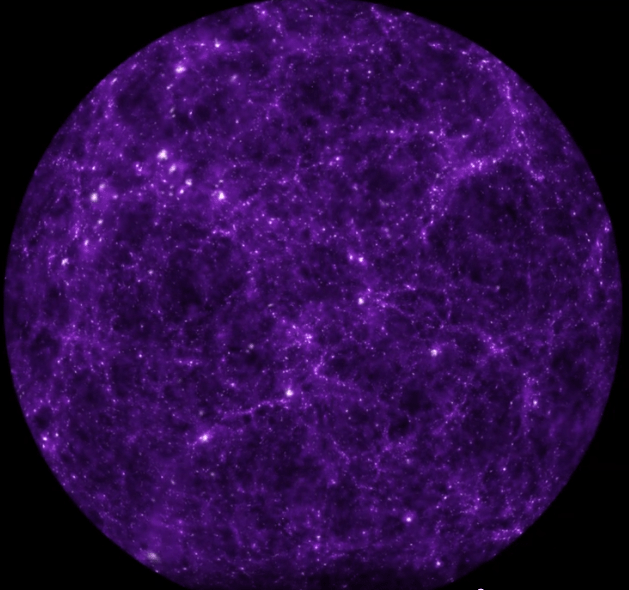
“In plain sight, all over the sky, in strands forming a network that connects galaxies and galaxy clusters. They’re calling it the Cosmic Web.”

“Something that big … how was hidden?”

“Some techniques I’m sure you’ll recognize. First, the material in the strands is diffuse — just an atom or two per cubic meter. An Earth laboratory would be proud to pump down a vacuum ten million times more dense.”

<taking notes> “Spread your forces so there’s no prime target for counter‑attack, mm‑hm. But if the material’s that thin, surely it doesn’t mass much.”

“Remember how big space is. These filaments span the widths of multiple galaxies. Do the math. A thread could be on the order of 100 million lightyears long by 1000 lightyears in diameter. A lightyear is 1016 meters. The thread has a volume of about 1062 cubic meters. At 10-26 kilogram per cubic meter that’s 1036 kilograms which is comparable to the mass of a small galaxy. That’s just one thread. Add them up and you get roughly half the baryons in the Universe, all hiding in the Web.”

“Concealment by dispersal, got it. What’s another technique?”

“Camouflage. No, not tiny uniforms in a woodland pattern. These atoms fade into the background because oncoming light waves pass right by them unless the wave has exactly the right wavelength for an absorption.”

“So how did astronomers detect these scattered and camouflaged atoms?”

“A couple of different ways. X‑rays, for one.”

“But these atoms are camouflaged against passing light. X‑rays are light waves.”

“X‑rays the atoms emit. Everybody thinks that space is cold, but those lonely atoms bounce around with a kinetic energy equivalent to million‑degree temperatures. When two of them collide some of that kinetic energy escapes as high‑frequency light, X‑ray range. Not a whole lot, because the atoms are sparse, but enough that European and Japanese space telescopes were able to tweeze it out of the background.”

“Use sensitive mics to pick up whispered convo in the opposing line.”

<pause> “Right, more or less. What do you know about refraction?”

“Mmm… Newton and his prism, splitting white light into different colors. I’ve no idea how that works.”

“The short answer is that the speed of light depends on its wavelength and the medium it’s traversing. In a perfect vacuum, light always goes at top speed just like Einstein said, but charged particles in its path slow it down.”

“Even those atoms in space that you said can’t absorb light?”

“Yup. It’s called virtual coupling; quantum’s involved. One inaccurate way to describe the interaction is that atoms occasionally absorb wrong‑wavelength photons but spit them right back out again after a brief delay. Short wavelengths see more of that effect than long wavelengths do. With me?”

<pause> “Go on.”

“Does the phrase ‘Fast Radio Burst’ sound familiar?”

“Of course, but probably not the way you mean.”

“Ah. Right. For this context, Fast Radio Bursts are isolated pulses of radio‑frequency light from incredibly bright extra-galactic sources we don’t understand. They’re all over the sky. A pulse lasts only a millisecond or so. What’s important here is that refraction skews each pulse’s wavelength profile as it travels through the intergalactic medium. Researchers analyze the distortions to detect and characterize Web filaments in the direction each pulse came from.”

“Intercept the oppo’s communications to the front.”

“That’s about the size of it.”

“Bye.”

“Don’t mention it.”

~ Rich Olcott
Black, White And Wormy

“Whaddaya mean, Sy, if white holes exist? You just told me how they’re in the equations just like black holes.”

“Math gives us only models of reality, Vinnie. Remarkably good models, some of them, but they’re only abstractions. Necessarily they leave out things that might skew math results away from physical results or the other way around. Einstein believed his math properly reflected how the Universe works, but even so, he doubted that black holes could exist. He didn’t think it’d be possible to collect that much mass into such a small space. Two decades after he said that, Oppenheimer figured out how that could happen.”

“Oppenheimer like the A‑bomb movie guy?”

“Same Oppenheimer. He was a major physicist even before they put him in charge of the Manhattan Project. He did a paper in 1939 showing how a star‑collapse could create the most common type of black hole we know of. Twenty‑five years after that the astronomers found proof that black holes exist.”

“Well, if Einstein was wrong about black holes, why wasn’t he wrong about white holes?”

“We need another Oppenheimer to solve that. So far, no‑one has come up with a mechanism that would create a stand‑alone white hole. That level of stress on spacetime requires an enormous amount of mass‑energy in a tiny volume. Whatever does that must somehow do it with a time‑twist opposite to how a black hole is formed. Worse yet, by definition the white hole’s Event Horizon leaks matter and energy. The thing ought to evaporate almost as soon as it’s formed.”

“I heard weaseling. You said, ‘a stand‑alone white hole,’ like there’s maybe another kind. How about that?”

“Could be, maybe not, depending on who’s talking and whether or not they’re accounting for magnetic fields, neutrinos or quantum effects. The discussion generally involves wormholes.”

“Wormholes.”

“Mm-hm. Some cosmologists think that wormholes might bridge between highly stressed points in spacetime. Black hole or white, the stress is what matters. The idea’s been around nearly as long as our modern idea of black holes. No surprise, ‘wormhole’ was coined by John Archibald Wheeler, the same guy who came up with the phrases ‘black hole’ and ‘quantum foam’.”

“Quantum—. Nope, not gonna bite. Get back to white holes.”

“I’m getting there. Anyway, the relativity theory community embraced black holes, white holes and wormholes as primary tools for studying how spacetime works.”

“How’re they gonna do that? That squib Cal showed me said we’ve never seen a white hole.”

“Fair question. Last I heard, the string theory community confidently predicted 10500 different Universes with little hope of narrowing the field. In contrast, relativity theory is firmly constrained by well‑founded math, a century of confirmation from experimental tests and a growing amount of good black hole data. Perfectly good math says that wormholes and white holes could form but only under certain unlikely conditions. Those conditions constrain white holes like Oppenheimer’s conditions constrained forming a stellar‑size black hole.”

“So how do we make one?”

We don’t. If the Universe can make the right conditions happen somewhere in spacetime, it could contain white holes and maybe a network of wormholes; otherwise, not. Maybe we don’t see them because they’ve all evaporated.”

“I remember reading one time that with quantum, anything not forbidden must happen.”

“Pretty much true, but we’re not talking quantum here. Macro‑scale, some things don’t happen even though they’re not forbidden.”

“Name one.”

“Anti‑matter. The laws of physics work equally well for atoms with positive or negative nuclear charge. We’ve yet to come up with an explanation for why all the nuclear matter we see in the Universe has the positive‑nucleus structure. The mystery’s got me considering a guess for Cathleen’s next Crazy Theories seminar.”

“Oh, yeah? Let’s have it.”

“Strictly confidential, okay?”

“Sure, sure.”

“Suppose the Big Bang’s chaos set up just the right conditions to make a pair of CPT‑twin black holes, expanding in opposite directions along spacetime’s time dimension. Suppose we’re inside one twin. Our time flows normally. If we could see into the other twin, we’d see inside‑out atoms and clocks running backwards. From our perspective the twin would be a white hole.”

“Stay outta that wormhole bridge.”

~ Rich Olcott

A Carefully Plotted Tale

<chirp, chirp> “Moire here.”

“Hello, Mr Moire. Remember me?”

“Yes, I do, Walt. I hope your people were satisfied with what you brought them from our last meeting.”

“They were, which is why I’m calling. Buy you pizza at Eddie’s, fifteen minutes?”

“Make it twenty.”


We’re at the rear‑corner table, Walt facing both doors, naturally. “So, what’s the mysterious question this time?”

“Word on the street is that the CPT Law’s being violated. We want to know who’s involved, and what’s their connection with ChatGPT.”

Good thing I’ve just bit into my pizza so I can muffle my chuckle in my chewing. “What do you know about anti‑matter?”

“Inside‑out atoms — protons outside whizzing around electrons in the nucleus.”

“Common misconception. One proton has the mass of 1800 electrons. An atom built as you described would be unstable — the thing would fly apart. You’ve got anti‑matter’s charges arranged right but not the particles. Anti‑matter has negative anti‑protons in the nucleus and positrons, positive electrons, on the outside.”

<writing rapidly in his notebook> “You can do that? Just flip the sign on a particle?”

“No, positrons and such are respectable particles in their own right, distinct from their anti‑partners. Electric charge comes built into the identity. What’s important is, an anti‑atom behaves exactly like a normal atom does. Maxwell’s Equations and everything derived from them, including quantum mechanics, work equally well for either charge structure.”

“There’s a bit of Zen there — change but no‑change.”

“Nice. Physicists call that sort of thing a symmetry. In this case it’s charge symmetry, often written as C.”

“The C in CPT?”

“Exactly.”

“What about the P and T?”

“When someone says something is symmetrical, what do you think of first?”

“Right side’s a reflection of left side. Symmetrical faces look better but they’re usually less memorable.”

“Interesting choice of example. Anyway, reflection symmetry is important in common physical systems.”

“Classical Greek and Cambodian architecture; the Baroque aesthetic without the decorative frills.”

“I suppose so. Anyway, we call reflection symmetry Parity, or P for short.”

“And T?”

“Time.”

“Time’s not symmetrical. It’s always past‑to‑future.”

“Maybe, maybe not. In all our physical laws that deal with a small number of particles, you can replace t for time with –t and get the same results except for maybe a flipped sign. Newton’s Laws would run the Solar System in reverse just as well as they do forward.”

“But … Ah, ‘small number of particles,’ that’s your out. If your system has a large number of particles, you’re in chaos territory where randomness and entropy have to increase. Entropy increase is the arrow for one‑way time.”

“Good quote.”

“I’ve been in some interesting conversations. You’re not my only Physics source. So CPT is about Charge AND Parity AND Time symmetries. But you can’t simply add them together.”

“You multiply them. Technically, each of them is represented by a mathematical operator—”

“Step away from the technically.”

“Understood. This’ll be simpler. If a system’s atoms have positive nuclei, set C=1, otherwise set C=1. If the system’s naturally‑driven motion is counterclockwise set P=1, otherwise P=1. If time is increasing, set T=1, otherwise set T=1. Okay?”

“Go on.”

“You can summarize any system’s CPT state by multiplying the prevailing symmetry values. The product will be either +1 or 1. The CPT Law says that in any universe where quantum mechanics and relativity work, one CPT state must hold universe‑wide.”

“Make it real for me.”

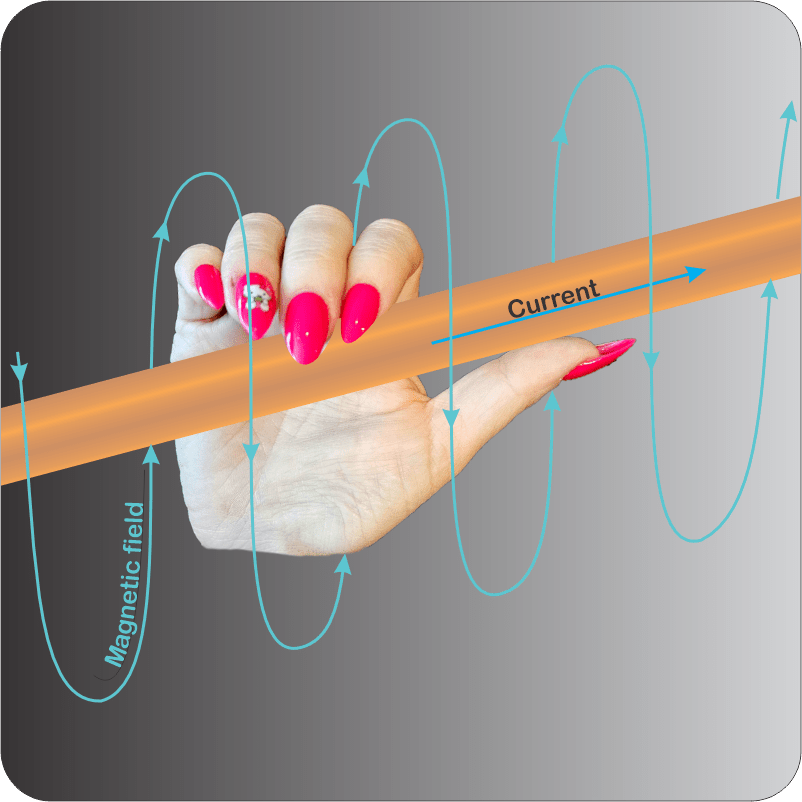
“You know the Right-hand Rule for electromagnetism?”

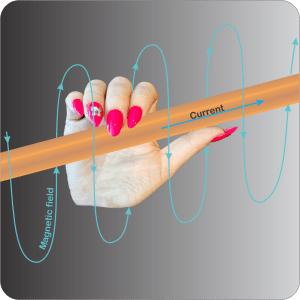
“Grab the wire with your right hand, thumb pointing along the current. Your fingers wrap in the direction of the spiraling magnetic field.”

“Perfect. Suppose C*P*T=+1 for this case. Now reverse the charge, making C=1. What happens?”

“Ssss… The magnetic spin flips orientation. That’s a reflection operation so P=1. The C*P*T calculation is (+1)*(1)*(1)=+1, no change.”

“The CPT Law in action. The CPT violation you’ve heard about is only observed in rare weak‑force‑mediated radioactive decays of a carefully prepared nucleus. That was a 1956 Nobel‑winning discovery, though the right person didn’t win it.”

“1956. Decades before A.I.”

“Yup, ChatGPT is off the hook. For that.”

“Bye.”

“Don’t mention it.”

~ Rich Olcott

  • Thanks to Caitlin, the hand model.

A Sublime Moment

It’s either late Winter or early Spring, trying to make up its mind. Either way, today’s lakeside walk is calm until I get to the parking lot and there he is, all bundled up and glaring at a huge pile of snow. “Morning, Mr Feder. You look even more out of sorts than usual. Why so irate?”

“The city’s dump truck buried my car in that stuff.”

“Your car’s under that? But there’s a sign saying not to park in that spot when there’s a snow event.”

“Yeah, yeah. Back on Fort Lee we figure the city just puts up signs like that to remind us we pay taxes. I’ll park where I want to. Freedom!”

“I’m beginning to understand you better, Mr Feder. Got a spare shovel? I can help you dig out.”

“My car shovel’s in the car, of course. I got another one at home for the sidewalk.”

I notice something, move over for a better view. “Step over here and look close just above the top of the pile where the sunlight’s hitting it.”

“Smoke! My car’s burning up under there!”

“No, no, something much more interesting. You’re looking at something that I’ve seen only a couple of times so you’re a lucky man. That’s steam, or it would be steam at a slightly higher temperature. What you’re looking at is distilled snow. See the sparkles from ice crystals in that cloud? Beautiful. Takes a very special set of circumstances to make that happen.”

“I’d rather be lucky in the casino. What’s so special?”

“The air has to be still, absolutely no breeze to sweep floating water molecules away from the pile. Temperature below freezing but not too much. Humidity at the saturation point for that temperature. Bright sun shining on snow that’s a bit dirty.”

“Dirty’s good?”

“In this case. Here’s the sequence. Snow is water molecules locked into a crystalline structure, right? Most of them are bonded to neighbors top, bottom and every direction. The molecules on the surface don’t have as many neighbors, right, so they’re not bonded as tightly. So along comes sunlight, not only visible light but also infrared radiation—”

“Infrared’s light, too?”

“Mm-hm, just colors we can’t see. Turns out because of quantum, infrared light photons are even more effective than visible light photons when it comes to breaking water molecules away from their neighbors. So a top molecule, I’ll call it Topper, escapes its snow crystal to float around in the air. Going from solid directly to free-floating gas molecules, we call that sublimation. Going the other way is deposition. Humidity’s at saturation, right, so pretty soon Topper runs into another water molecule and they bond together.”

<sarcasm, laid on heavily> “And they make a cute little snow crystal.”

“Not so fast. With only two molecules in the structure, you can’t call it either solid or liquid but it does grow by adding on more molecules. Thing is, every molecule they encounter gives up some heat energy as it ties down. If the weather’s colder than it is here, that’s not enough to overcome the surrounding chill. The blob winds up solid, falls back down onto the pile. If it’s just a tad warmer you get a liquid blob that warms the sphere of air around it just enough to float gently upwards—”

“Like a balloon, I got the picture.”

“Floats up briefly. It doesn’t get up far before the surrounding chill draws out that heat and wins again. Not so brief when there’s a little dirt in there.”

“The dirt floats?”

“Of course not. The dirt’s down in the snow pile, but it’s dark and absorbs more sunlight energy than snow crystals do. What the dirt does is, it tilts the playing field. Heat coming from the dirt particles increases the molecular break‑free rate and there’s more blobs. It also warms the air around the blobs and floats them high enough to form this sparkling cloud we can see and enjoy.”

“You can enjoy it. I’m seeing my car all covered over and that’s not improving my mood.”

“Better head home for that shovel, Mr Feder. The snow dumper’s coming back with another load.”

~ Rich Olcott

Deep Dive

“Sy, I’m trying to get my head wrapped around how the potential‑kinetic energy thing connects with your enthalpy thing.”

“Alright, Vinnie, what’s your cut so far?”

“It has to do with scale. Big things, like us and planets, we can see things moving and so we know they got kinetic energy. If they’re not moving steady in a straight line we know they’re swapping kinetic energy, give and take, with some kind of potential energy, probably gravity or electromagnetic. Gravity pulls things into a circle unless angular momentum gets in the way. How’m I doing so far?”

“I’d tweak that a little, but nothing to argue with. Keep at it.”

“Yeah, I know the moving is relative to whether we’re in the same reference frame and all that. Beside the point, gimme a break. So anyway, down to the quantum level. Here you say heat makes the molecules waggle so that’s kinetic energy. What’s potential energy like down there?”

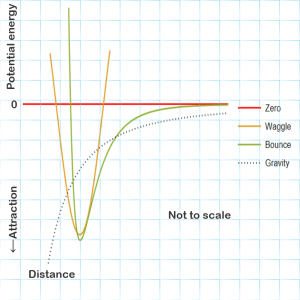
<grabs another paper napkin> “Here’s a quick sketch of the major patterns.”

“Hmm. You give up potential energy when you fall and gravity’s graph goes down from zero to more negative forever, I guess, so gravity’s always attracting.”

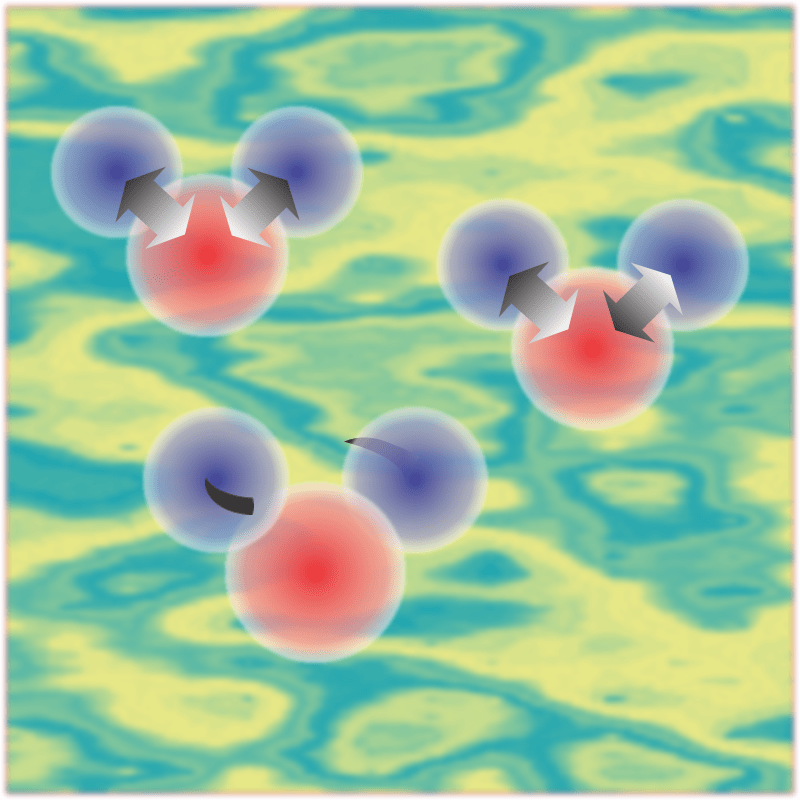
“Pretty much, but at this level we don’t have to bother with gravity at all. It’s about a factor of 1038 weaker than electric interactions. Molecular motions are dominated by electromagnetic fields. Some are from a molecule’s other internal components, some from whatever’s around that brandishes a charge. We’ve got two basic patterns. One of them, I’m labeling it ‘Waggle,’ works like a pendulum, sweeping up and down that U‑shape around some minimum position, high kinetic energy where the potential energy’s lowest and vice‑versa. You know how water’s H‑O‑H molecules have that the V‑shape?”

“Yeah, me you and Eddie talked about that once.”

“Mm‑hm. Well, the V‑shape gives that molecule three different ways to waggle. One’s like breathing, both sides out then both sides in. If the hydrogens move too far from the oxygen, that stretches their chemical bonds and increases their potential energy so they turn around and go back. If they get too close, same thing. Bond strength is about the depth of the U. The poor hydrogens just stretch in and out eternally, swinging up and down that symmetric curve.”

“Awww.”

“That’s a chemist’s picture. The physics picture is cloudier. In the quantum version, over here’s a trio of fuzzy quarks whirling around each other to make a proton. Over there’s a slightly different fuzzy trio pirouetting as a neutron. Sixteen of those roiling about make up the oxygen nucleus plus two more for the hydrogens plus all their electrons — imagine a swarm of gnats. On the average the oxygen cloud and the two hydrogen clouds configure near the minimum of that U‑shaped potential curve but there’s a lot of drifting that looks like symmetrical breathing.”

“What about the other two waggles?”

“I knew you’d ask. One’s like the two sides of a teeterboard, oscillating in and out asymmetrically. The other’s a twist, one side coming toward you and then the other side. Each waggle has its own distinct set of resistance forces that define its own version of waggle curve. Each kind interacts with different wavelengths of infrared light which is how we even know about them. Waggle’s official name is ‘harmonic oscillator.’ More complicated molecules have lots of them.”

“What’s that ‘bounce’ curve about?”

“Officially that’s a Lennard-Jones potential, the simplest version of a whole family of curves for modeling how molecules bounce off each other. Little or no interaction at large distances, serious repulson if two clouds get too close, and a little stickiness at some sweet-spot distance. If it weren’t for the stickiness, the Ideal Gas Law would work even better than it does. So has your head wrapped better?”

“Sorta. From what I’ve seen, enthalpy’s PV part doesn’t apply in quantum. The heat capacity part comes from your waggles which is kinetic energy even if it’s clouds moving. Coming the other way, quantum potential energy becomes enthalpy’s chemical part with breaking and making chemical bonds. Did I bridge the gap?”

“Mostly, if you insist on avoiding equations.”

~ Rich Olcott

It’s in The Book

A young man’s knock, eager yet a bit hesitant. “Door’s open, Jeremy, c’mon in.”

“Hi, Mr Moire, I’ve got something to show you. It’s from my acheii, my grandfather. He said he didn’t need it any more now he’s retired so he gave it to me. What do you think?”

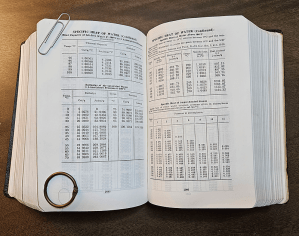
“Wow, the CRC Handbook of Chemistry And Physics, in the old format, not the 8½×11″ monster. An achievement award, too — my congratulations to your grandfather. Let’s see … over 3000 pages, and that real thin paper you can read through. It’s still got the math tables in front — they moved those to an Appendix by the time I bought my copy. Oooh yeah, lots of data in here, probably represents millions of grad student lab hours. Tech staff, too. And then their bosses spent time checking the work before publishing.”

Acheii said I’d have to learn a lot before I could use it properly. I see lots of words in there I don’t recognize.” <opens book to a random page> “See, five- and six‑figure values for, what’re Specific Heat and Enthalpy?”

“Your grandfather’s absolutely correct. Much of the data’s extremely specialized. Most techs, including me, have a few personal‑favorite sections they use a lot, never touch the rest of the book. These particular pages, for instance, would be gold for a someone who designs or operates steam‑driven equipment.”

“But what do these numbers mean?”

“Specific Heat is the amount of heat energy you need to put into a certain mass of something in order to raise its temperature by a certain amount. In the early days the Brits, the Scots really, defined the British Thermal Unit as the amount of energy it took to raise the temperature of one pound of liquid water by one degree Fahrenheit. You’d calculate a fuel purchase according to how many BTUs you’d need. Science work these days is metric so these pages tabulate Specific Heat for a substance in joules per gram per °C. Tech in the field moves slow so BTUs are still popular inside the USA and outside the lab.”

“But these tables show different numbers for different temperatures and they’re all for water. Why water? Why isn’t the Specific Heat the same number for every temperature?”

“Water’s important because most power systems use steam or liquid water as the working fluid or coolant. Explaining why heat capacity varies with temperature was one of the triumphs of 19th‑century science. Turns out it’s all about how atomic motion but atoms were a controversial topic at the time. Ostwald, for instance—”

“Who?”

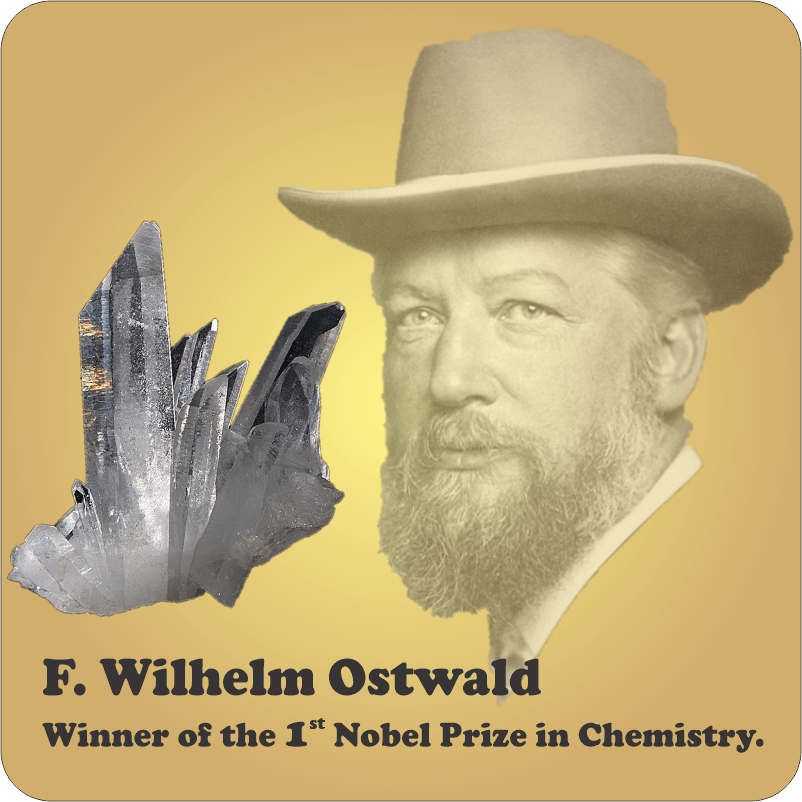
“Wilhelm Ostwald, one of science’s Big Names in the late 1800s. Chemistry back then was mostly about natural product analysis and seeing what reacted with what. Ostwald put his resources into studying chemical processes themselves, things like crystallization and catalysis. He’s regarded as the founder of Physical Chemistry. Even though he invented the mole he steadfastly maintained that atoms and molecules were nothing more than diffraction‑generated illusions. He liked a different theory but that one didn’t work out.”

“Too bad for him.”

“Oh, he won the first Nobel Prize in Chemistry so no problem. Anyway, back to Specific Heat. In terms of its molecules, how do you raise something’s temperature?”

“Um, temperature’s average kinetic energy, so I’d just make the molecules move faster.”

“Well said, except in the quantum world there’s another option. The molecules can’t just waggle any which way. There are rules. Different molecules do different waggles. Some kinds of motion take more energy to excite than others do. Rule 1 is that the high‑energy waggles don’t get to play until the low‑energy ones are engaged. Raising the temperature is a matter of activating more of the high‑energy waggles. Make sense?”

“Like electron shells in an atom, right? Filling the lowest‑energy shells first unless a photon supplies more energy?”

“Exactly, except we’re talking atoms moving within a molecule. Smaller energies, by a factor of 100 or more. My point is, the heat capacity of a substance depends on which waggles activate as the temperature rises. We didn’t understand heat capacity until we applied quantum thinking to the waggles.”

“What about ‘Enthalpy’ then?”

~ Rich Olcott

The Oldest Clock Ticks Slowest

<Cliff‑hanger Cathleen strikes again> “How can you even measure a 2million year halflife?”

Kareem’s right back at her. “What’s a halflife?”

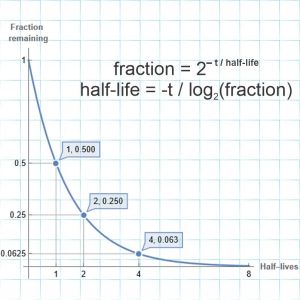
“Start a clock, weigh a sample, wait around for a while and then weigh it again to see how much is still there. When half of it’s gone, stop the clock and you’ve measured a half‑life. Simple.”

“Simple but not that simple or maybe a bit simpler. For one thing, you don’t have to wait for a full halflife. For spontaneous radioactivity, all you have to know is the interval and whatever fraction disappeared. There’s a nice equation that ties those two to the halflife.”

“Spontaneous? Like there’s another kind?”

“Stimulated radioactivity. That’s what nuclear reactors do — spew neutrons at uranium235 atoms, for instance, transmuting them to uranium236 so they’ll split into krypton and barium atoms and release energy and more neutrons. How often that happens depends on neutron concentration. Without that provoking push, the uranium nuclei would just split when they felt like it and that’s the natural halflife.”

“Wait. I know that curve, it’s an exponential. Why isn’t e in the equation?”

“It could be. Would you prefer e-0.69315*t/half‑life? Works just as well but it’s clumsier. Base‑2 makes more sense when you’re talking halves. Usually when you say ‘exponential’ people visualize an increase. Here we’re looking at a decrease by a constant percentage rate but yeah, that’s an exponential, too. You get a falling curve like that from a Geiger counter and you’re watching counts per minute from someone’s thyroid that’s been treated with iodine‑131. Its 8‑day half‑life is slow enough to track that way. Really short half‑lives I don’t know much about; I care about the slow disintegraters that are either primordial or generated by some process.”

“Primordial — that means ‘back to the beginning’, which in your specialty would mean the beginning of the Solar System. We’re pretty sure the Sun’s pre‑planetary disk was built from dust broadcast by stars that went nova. Isotopes in the dust must be the primordial isotopes, right? Which ones are the other kind?”

“Mmm, aluminum‑26 is a good example. The half‑life equation still applies even for million‑year intervals. Half‑life of aluminum‑26 is about 0.7 million years and it decays to magnesium‑26. Whatever amount got here from the stars would have burnt down to a trillionth of that within the first 30 million years or so after arrival. Any aluminum‑26 we find today couldn’t be primordial. On the other hand, cosmic rays can smack a proton and neutron out of a silicon‑28 nucleus and voila! a new aluminum‑26. There’s a steady rain of cosmic rays out in space so there’s a steady production of aluminum‑26 out there. Not here on Earth, though, because our atmosphere blocks out most of the rays. Very nice for us geologists who can compare measured aluminum‑26 to excess magnesium‑26 to determine when a meteorite fell.”

“Excess?”

“Background magnesium is about 10% magnesium‑26 so we have subtract that to get the increment which came from aluminum‑26. A lot of the arguments in our field hinge on how much of which isotope is background or was background when a given rock formed. That’s one reason you see so much press about tiny but rugged zircons. They’re key to uranium‑lead dating. Crystallizing zirconium silicate doesn’t allow lead ions into its structure but it happily incorporates uranium ions. Uranium‑235 and uranium‑238 both decay to crystal‑trapped lead, but each isotope goes to a different lead isotope and with a different half‑life. The arithmetic’s simpler and the results are more definitive when you know that the initial lead content was zero.”

“So that aluminum‑magnesium trick’s not your only tool?”

“Hardly. The nuclear chemists have given us a long list of isotope chains, what decays to what with what half‑life and how much energy the radiating particle gets. Nuclei flit between quantum energy levels just like atoms and molecules do, except a spectrum of alpha or beta particles is a different game from the light‑wave spectrum. Tell me a radiated particle’s energy and I can probably tell you which isotope spat it out and disappeared.”

“Your ladder rungs are Cheshire Cat grins.”

~~ Rich Olcott

The Not-so-dangerous Banana

“Y’know, Cathleen, both our ladders boil down to time. Your Astronomy ladder connects objects at different times in the history of the Universe. My Geology ladder looks back into the Solar System’s history.”

“As an astronomer I normally think of parsecs or lightyear distances but you have a point, Kareem. Edwin Hubble linked astronomical space with time. Come to think of it, my cosmologist colleagues work almost exclusively in the time domain, like ‘T=0 plus a few lumptiseconds.’ Billions of years down to that teeny time interval — how does your time ladder compare?”

“Lumptiseconds out to a hundred trillion times the age of the Universe. I win.”

“C’mon, Kareem.”

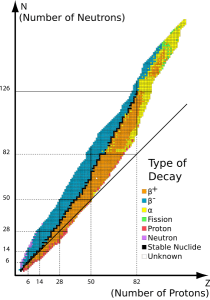
“No, really, Sy. My ladder uses isotopes. Every carbon atom has 6 protons in the nucleus, right? Carbon‑12 adds 6 neutrons and it’s stable but another isotope, carbon‑14, has 8 neutrons. It’s radioactive — spits out an electron and becomes stable nitrogen‑14 with 7 and 7. Really heavy isotopes like uranium‑238 spit out alpha particles.”

“Wait, if carbon‑14 spits out an electron doesn’t that make it a carbon ion?”

“Uh‑uh, Cathleen, the electron comes out of the nucleus, not the electron cloud. It’s got a hundred thousand times more energy than a chemical kick could give it. Sy could explain—”

“Nice try, Kareem, this is your geologic time story. Let’s stay with that.”

“If I must. So, the stable isotopes last forever, pretty much, but the radioactive ones are ticking bombs with random detonation times.”

“What’s doing the ticking? Surely there’s no springs or pendulums in there.”

“Quantum, Cathleen. Sy’s trying to stay out of this so I’ll give you my outsider answer. I picture every kind of subatomic particle constantly trying to leave every nucleus, butting their little heads bazillions of times a second against walls set up by the weak and strong nuclear forces. Nearly every try is a bounce‑back, but one success is enough to break the nucleus. Every isotope has its own personal set of parameters for each kind of particle — wall height, wall thickness, something like an internal temperature ruling how hard the particles hit the walls. The ticking is those head‑butts; the randomness comes from quantum’s goofy rules somehow. How’s that, Sy?”

“Good enough for jazz, Kareem. Carry on.”

“Right. So every kind of radioisotope is characterized by what kinds of particle it emits, how much energy each kind has after busting through a wall, and how often that happens in a given sample size. And the isotope’s chemistry, of course, which is the same as every other isotope that has the same number of protons. The general rule is that the stable isotopes have maybe a few more neutrons than protons but nearly every element has some unstable isotopes. The ones with too many neutrons, like carbon‑14, emit electrons as beta particles. They go up a square in the Periodic Table. Too few and they drop down by emitting a positron.”

“All those radioactive stand‑ins for normal atoms. Sounds ghastly. Why are we still here and not all burnt up?”

“First, when one of these atoms decays by itself it’s a lot of energy for that one atom, but the energy spreads out as heat across many atoms. Unless a bunch of atoms crumble at about the same time, there’s only a tiny bit of general heating. The major biological danger from radioactivity comes from spit‑out particles breaking protein or DNA molecules.”

“Mutated, not burnt.”

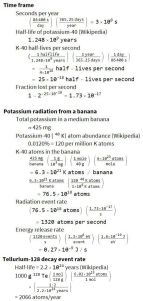
“Mm‑hm. Second, the radioactives are generally rare relative to their stable siblings. In many cases that’s because the bad guys, like aluminum‑26, have had time to decay to near‑zero. That banana you’re eating has about half a gram of potassium atoms but only 0.012% are unstable potassium‑40. Third, an isotope with a long half‑life doesn’t lose many atoms per unit time. A kilogram of tellurium‑128, for instance, loses 2000 atoms per year. The potassium‑40 in your banana has a half‑life of nearly 2 million years. Overall, it releases only about 1300 beta particles per second producing less than a nanowatt of heat‑you‑up power. Not to worry.”

“Two million years? How do you measure something that slow?”

~~ Rich Olcott