A Cosmological Horse Race

A crisp Fall day, perfect for a brisk walk around the park. I see why the geese are huddled at the center of the lake — Mr Feder, not their best friend, is on patrol again. Then he spots me. “Hey, Moire, I gotta question!”

“Of course you do, Mr Feder. What is it?”

“Some guy on TV said Einstein proved gravity goes at the speed of light and if the Sun suddenly went away it’d take eight minutes before we went flying off into space. Did Einstein really say that? Why’d he say that? Was the TV guy right? And what would us flying across space feel like?”

“I’ll say this, Mr Feder, you’re true to form. Let’s see… Einstein didn’t quite prove it, the TV fellow was right, and we’d notice being cold and in the dark well before we’d notice we’d left orbit. As to why, that’s a longer story. Walk along with me.”

“Okay, but not too fast. What’s not quite about Einstein’s proving?”

“Physicists like proofs that use dependable mathematical methods to get from experimentally-tested principles, like conservation of energy, to some result they can trust. We’ve been that way since Galileo used experiments to overturn Aristotle’s pure‑thought methodology. When Einstein linked gravity to light the linkage was more like poetry. Beautiful poetry, though.”

“What’s so beautiful about something like that?”

“All the rhymes, Mr Feder, all the rhymes. Both gravity and light get less intense with the square of the distance. Gravity and light have the same kinds of symmetries—”

“What the heck does that mean?”

“If an object or system has symmetry, you can execute certain operations on it yet make no apparent difference. Rotate a square by 90° and it looks just the same. Gravity and light both have spherical symmetry. At a given distance from a source, the field intensity’s the same no matter what direction you are from the source. Because of other symmetries they both obey conservation of momentum and conservation of energy. In the late 1890s researchers found Lorentz symmetry in Maxwell’s equations governing light’s behavior.”

“You’re gonna have to explain that Lorentz thing.”

Lorentz symmetry has to do with phenomena an observer sees near an object when their speed relative to the object approaches some threshold. Einstein’s Special Relativity theory predicted that gravity would also have Lorentz symmetry. Observations showed he was right.”

“So they both do Lorentz stuff. That makes them the same?”

“Oh, no, completely different physics but they share the same underlying structure. Maxwell’s equations say that light’s threshold is lightspeed.”

“Gravity does lightspeed, too, I suppose.”

“There were arguments about that. Einstein said beauty demands that both use the same threshold. Other people said, ‘Prove it.’ The strongest argument in his favor at the time was rough, indirect, complicated, and had to do with fine details of Earth’s orbit around the Sun. Half a century later pulsar timing data gave us an improved measurement, still indirect and complicated. This one showed gravity’s threshold to be with 0.2% of lightspeed.”

“Anything direct like I could understand it?”

“How about a straight‑up horse race? In 2017, the LIGO facility picked up a gravitational signal that came in at the same time that optical and gamma ray observatories recorded pulses from the same source, a colliding pair of neutron stars in a galaxy 130 million lightyears away. A long track, right?”

“Waves, not horses, but how far apart were the signals?”

“Close enough that the measured speed of gravity is within 10–15 of the speed of light.”

“A photo-finish.”

“Nice pun, Mr Feder. We’re about 8½ light-minutes away from the Sun so we’re also 8½ gravity-minutes from the Sun. As the TV announcer said, if the Sun were to suddenly dematerialize then Earth would lose the Sun’s orbital attraction 8½ minutes later. We as individuals wouldn’t go floating off into space, though. Earth’s gravity would still hold us close as the whole darkened, cooling planet leaves orbit and heads outward.”

“I like it better staying close to home.”
~ Rich Olcott

A Sublime Moment

It’s either late Winter or early Spring, trying to make up its mind. Either way, today’s lakeside walk is calm until I get to the parking lot and there he is, all bundled up and glaring at a huge pile of snow. “Morning, Mr Feder. You look even more out of sorts than usual. Why so irate?”

“The city’s dump truck buried my car in that stuff.”

“Your car’s under that? But there’s a sign saying not to park in that spot when there’s a snow event.”

“Yeah, yeah. Back on Fort Lee we figure the city just puts up signs like that to remind us we pay taxes. I’ll park where I want to. Freedom!”

“I’m beginning to understand you better, Mr Feder. Got a spare shovel? I can help you dig out.”

“My car shovel’s in the car, of course. I got another one at home for the sidewalk.”

I notice something, move over for a better view. “Step over here and look close just above the top of the pile where the sunlight’s hitting it.”

“Smoke! My car’s burning up under there!”

“No, no, something much more interesting. You’re looking at something that I’ve seen only a couple of times so you’re a lucky man. That’s steam, or it would be steam at a slightly higher temperature. What you’re looking at is distilled snow. See the sparkles from ice crystals in that cloud? Beautiful. Takes a very special set of circumstances to make that happen.”

“I’d rather be lucky in the casino. What’s so special?”

“The air has to be still, absolutely no breeze to sweep floating water molecules away from the pile. Temperature below freezing but not too much. Humidity at the saturation point for that temperature. Bright sun shining on snow that’s a bit dirty.”

“Dirty’s good?”

“In this case. Here’s the sequence. Snow is water molecules locked into a crystalline structure, right? Most of them are bonded to neighbors top, bottom and every direction. The molecules on the surface don’t have as many neighbors, right, so they’re not bonded as tightly. So along comes sunlight, not only visible light but also infrared radiation—”

“Infrared’s light, too?”

“Mm-hm, just colors we can’t see. Turns out because of quantum, infrared light photons are even more effective than visible light photons when it comes to breaking water molecules away from their neighbors. So a top molecule, I’ll call it Topper, escapes its snow crystal to float around in the air. Going from solid directly to free-floating gas molecules, we call that sublimation. Going the other way is deposition. Humidity’s at saturation, right, so pretty soon Topper runs into another water molecule and they bond together.”

<sarcasm, laid on heavily> “And they make a cute little snow crystal.”

“Not so fast. With only two molecules in the structure, you can’t call it either solid or liquid but it does grow by adding on more molecules. Thing is, every molecule they encounter gives up some heat energy as it ties down. If the weather’s colder than it is here, that’s not enough to overcome the surrounding chill. The blob winds up solid, falls back down onto the pile. If it’s just a tad warmer you get a liquid blob that warms the sphere of air around it just enough to float gently upwards—”

“Like a balloon, I got the picture.”

“Floats up briefly. It doesn’t get up far before the surrounding chill draws out that heat and wins again. Not so brief when there’s a little dirt in there.”

“The dirt floats?”

“Of course not. The dirt’s down in the snow pile, but it’s dark and absorbs more sunlight energy than snow crystals do. What the dirt does is, it tilts the playing field. Heat coming from the dirt particles increases the molecular break‑free rate and there’s more blobs. It also warms the air around the blobs and floats them high enough to form this sparkling cloud we can see and enjoy.”

“You can enjoy it. I’m seeing my car all covered over and that’s not improving my mood.”

“Better head home for that shovel, Mr Feder. The snow dumper’s coming back with another load.”

~ Rich Olcott

Competing Curves

It’s still October but there’s a distinct taste of oncoming November in the air — grey, gusty with a moist chill as I step into Cal’s coffee shop. “You’re looking a bit grumpy, Cal.”

“Sure am, Sy. Some lady come in here, wanted pumpkin spice. The nerve! I sell good honest high‑quality coffee, special beans and everything, no goofy flavors. You want peppermint or apple brown betty, go down to the mermaid place. Here’s your mugfull, double‑dark as always. By the way, fair warning — Richard Feder’s in town and looking for you. He’s at that corner table.”

“Thanks, Cal.” <sound of footsteps> “Morning, Mr Feder. How’d things go in Fort Lee?

“Nicely, nicely… I got a question, Moire.”

“Of course you do.”

“I been reading your stuff, you had a graph in one post looks just like the graph in a different post. Here, I printed ’em out. What’s up with that?”

“But they plot entirely different things, brightness against distance in one, atom loss against time in the other, completely different equations.”

“Yeah, yeah, but the shapes are the same I don’t care you say they got different equations. Look, they even both go through the same points at x=2 and 4. What’re you trying to pull here?”

“Not pulling anything. Those two curves are similar, yes, but they’re not identical.” <quickly building charts on Old Reliable> “Here, I’ve laid them both on the same axis. For good measure I’ve extended the x‑axis into a second panel with a stretched‑out y‑axis. What do you see?”

“Well, the orange one goes up and stops but it looks like the blue one’s headed for the sky.”

“It is. But where on the x-axis do those things happen?”

“Zero and one. Okay so the blue line squoze in a little.”

“How about out there at the x=8 end? Looks like they’re close, I’ll grant you, but check the y‑values at at the left of the second panel.”

“Uhh… Looks like blue’s four times higher than orange. Then the orange line flattens out but the blue line not so much.”

“Mm‑hm. So they behave differently at that end, too.”

“Yeah, but what about in the middle here” <jabs finger at Old Reliable’s screen> “where they’re real close and even cross over each other a couple times and you could just draw a straight line?”

“You’ve put your finger on something that challenges every theoretician and research experimentalist who works in a quantitative field. How do you connect the dots? Sure, you can eyeball a straight line through observed points sometimes, there are even statistical techniques for locating the best possible straight line, but is a straight line even appropriate? Sometimes it is, sometimes it’s not, and often we don’t know.”

“How can you not know? Everything starts with a straight line, shortest distance between two points, right?”

“Only if they’re the right points. Real observations are always uncertain. Lenses are never perfect, adjustment screws have a little bit of play, detector pixels are larger than a perfect point would be, whatever. Good experimentalists put enormous amounts of time and care into eliminating or at least controlling for every imaginable error source, but perfect measurements just don’t happen.”

“So it’ll be a fuzzy straight line.”

“For some range of ‘fuzzy’, mm‑hm. Now we get into the theory issues. We’ve already seen the simplest one — range of validity. Your straight‑line approximation might be good enough for some purposes in the x‑range between 2 and 4, but things get out of hand outside of that range.”

“Okay, in graphs. But these two curves both look good. Why choose one over the other?”

“That’s where theory and data collude. Sometimes theories tell us what data to look for, sometimes the data challenges us to develop an explanatory theory, sometimes we just try curve after curve until we find one that works across the full range that experiment can reach but we don’t know why. What’s exciting is when we get to use the data to determine which of several competing theories is the correct one. Or least incorrect.”

“I got other ways to get excited.”

“Of course you do.”

~~ Rich Olcott

Eclipse Correction

From: Robin Feder <rjfeder@fortleenj.com>
To: Sy Moire <sy@moirestudies.com>
Subj: Bad diagram

My Dad said I should write you about the bad video that is in your “Elliptically Speaking” post. It shows a circle around a blue dot that’s supposed to be the Earth, and an oval shape that’s supposed to be the Moon’s orbit around the Earth, and blinking thingies that are supposed to show what eclipses look like. I took a screen shot of the video to show you. But the diagram is all wrong because it has two places where the Moon is far away from the Earth and two places where the Moon is closer and that’s wrong. All the orbit pictures I can find in my class books show there’s only one of each. Please fix this. Sincerely, Robin Feder


From: Sy Moire <sy@moirestudies.com>
To: Robin Feder <rjfeder@fortleenj.com>
Subj: Bad Diagram

You’re absolutely correct. That’s a terrible graphic and I’ll have to apologize to Cathleen, Teena and all my readers. Thanks for drawing my attention to my mistake. When I built that animation I was thinking too much about squashed circles and not enough about orbits. I’ve revised the animation, moving the Earth and its circle sideways a bit. Strictly speaking, Earth and the Moon both orbit around their common center of gravity. Also, the COG should be at one focus of an ellipse. An ellipse has two foci located on either side of the figure’s center. However, both of those corrections for the Earth‑Moon system are so small at this scale that you wouldn’t be able to see them. I drew my oval (not a true ellipse) out of scale to make the effect more visible.

Moving the oval so that there’s only one close place and one far place (astronomers call them perigee and apogee) meant that I also had to move the blinking eclipse markers. I think the new locations do a better job of showing why we have both annular and total eclipses. You just have to imagine the Sun being beyond the Moon in each special location so that the eclipse shadow meets the Earth.

I’ve swapped out the bad diagram on the website. Here’s a screenshot of the better diagram I’ve put in its place.

Please remember to use proper eclipse-viewing eyewear when you look at this October’s annular eclipse. And give my regards to your Dad.

~~ Rich Olcott

  • Thanks to Ric Werme for gently pointing out my bogus graphic.

Three Feet High And Rising

“Bless you, Al, for your air conditioning and your iced coffee.”

“Hiya, Susan. Yeah, you guys do look a little warm. What’ll you have, Sy and Mr Feder?”

“Just my usual mug of mud, Al, and a strawberry scone. Put Susan’s and my orders on Mr Feder’s tab, he’s been asking us questions.”

“Oh? Well, I suppose, but in that case I get another question. Cold brew for me, Al, with ice and put a shot of vanilla in there.”

“So what’s your question?”

“Is sea level rising or not? I got this cousin he keeps sending me proofs it ain’t but I’m reading how NYC’s talking big bucks to build sea walls around Manhattan and everything. Sounds like a big boondoggle.” <pulling a crumpled piece of paper from his pocket and smoothing it out a little> “Here’s something he’s sent me a couple times.”

“That’s bogus, Mr Feder. They don’t tell us moon phase or time of day for either photo. We can’t evaluate the claim without that information. The 28‑day lunar tidal cycle and the 24‑hour solar cycle can reinforce or cancel each other. Either picture could be a spring tide or a neap tide or anything in‑between. That’s a difference of two meters or more.”

“Sy. the meme’s own pictures belie its claim. Look close at the base of the tower. The water in the new picture covers that sloping part of the base that was completely above the surface in the old photo. A zero centimeter rise, my left foot.”

“Good point, Susan. Mind if I join the conversation from a geologist’s perspective? And yes, we have lots of independent data sources that show sea levels are rising in general.”

“Dive right in, Kareem, but I thought you were an old‑rocks guy.”

“I am, but I study old rocks to learn about the rise and fall of land masses. Sea level variation is an important part of that story. It’s way more complicated than what that photo pretends to deny.”

“Okay, I get that tides go up and down so you average ’em out over a day, right? What’s so hard?”

“Your average will be invalid two weeks later, Mr Feder, like Sy said. To suppress the the Sun’s and Moon’s cyclic variations you’d have to take data for a full year, at least, although a decade would be better.”

“I thought they went like clockwork.”

“They do, mostly, but the Earth doesn’t. There’s several kinds of wobbles, a few of which may recently have changed because Eurasia weighs less.”

“Huh?”
 ”Huh?”
  ”Huh?”

“Mm-hm, its continental interior is drying out, water fleeing the soil and going everywhere else. That’s 10% of the planet’s surface area, all in the Northern hemisphere. Redistributing so much water to the Southern hemisphere’s oceans changes the balance. The world will spin different. Besides, the sea’s not all that level.”

“Sea level’s not level?”

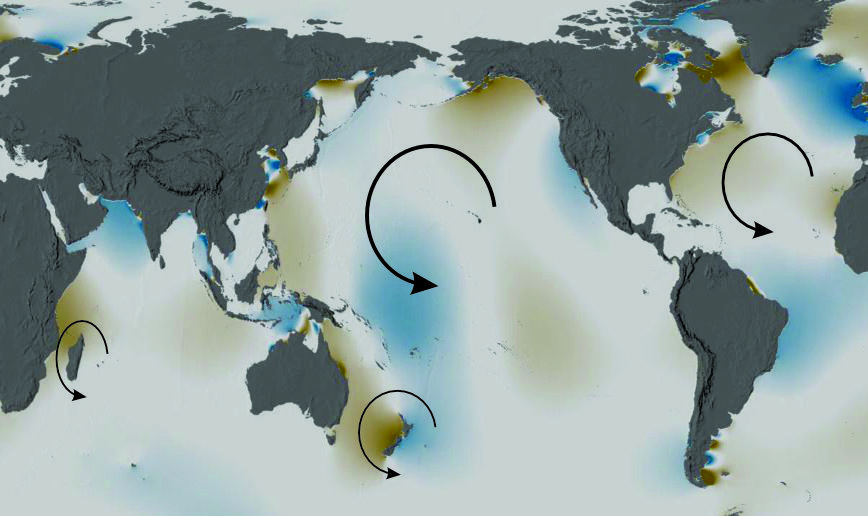
“Nope. Surely you’ve sloshed water in a sink or bathtub. The sea sloshes, too, counterclockwise. Galileo thought sloshing completely accounted for tides, but that was before Newton showed that the Moon’s gravity drives them. NASA used satellite data to build a fascinating video of sea height all over the world. The sea on one side of New Zealand is always about 2 meters higher than on the opposite side but the peak tide rotates. Then there’s storm surges, tsunamis, seiche resonances from coastal and seafloor terrain, gravitational irregularities, lots of local effects.”

Adapted from a video by NASA’s Scientific Visualization Studio

Susan, a chemist trained to consider conservation of mass, perks up. “Wait. Greenland and Antarctica are both melting, too. That water plus Eurasia’s has to raise sea level.”

“Not so much. Yes, the melting frees up water mass that had been locked up as land-bound ice. But on the other hand, it also counteracts sea rise’s major driver.”

“Which is?”

“Expansion of hot water. I did a quick calculation. The Mediterranean Sea averages 1500 meters deep and about 15°C in the wintertime. Suppose it all warms up to 35°C. Its sea level would rise by about 3.3 meters, that’s 10 feet! Unfortunately, not much of Greenland’s chilly outflow will get past the Straits of Gibraltar.”

~~ Rich Olcott

Not Silly-Season Stuff, Maybe

“Keep up the pace, Mr Feder, air conditioning is just up ahead.”

“Gotta stop to breathe, Moire, but I got just one more question.”

“A brief pause, then. What’s your question?”

“What’s all this about LK99 being a superconductor? Except it ain’t? Except maybe it is? What is LK99, anyway, and how do superconductors work? <puffing>”

“So many question marks for just one question. Are you done?”

“And why do news editors care?”

“There’s lots of ways we’d put superconductivity to work if it didn’t need liquid‑helium temperatures. Efficient electric power transmission, portable MRI machines, maglev trains, all kinds of advances, maybe even Star Trek tricorders.”

“Okay, I get how zero‑resistance superconductive wires would be great for power transmission, but how do all those other things have anything to do with it?”

“They depend on superconductivity’s conjoined twin, diamagnetism.”

Dia—?”

“Means ‘against.’ It’s sort of an application of Newton’s Third Law.”

“That’s the one says, ‘If you push on the Universe it pushes back,’ right?”

“Very good, Mr Feder. In electromagnetism that’s called Lenz’ Law. Suppose you bring a magnet towards some active conductor, say a moving sheet of copper. Or maybe it’s already carrying an electric current. Either way, the magnet’s field makes charge carriers in the sheet move perpendicular to the field and to the prevailing motion. That’s an eddy current.”

“How come?”

“Because quantum and I’m not about to get into that in this heat. Emil Lenz didn’t propose a mechanism when he discovered his Law in 1834 but it works. What’s interesting is what happens next. The eddy current generates its own magnetic field that opposes your magnet’s field. There’s your push‑back and it’s called diamagnetism.”

“I see where you’re going, Moire. With a superconductor there’s zero resistance and those eddy currents get big, right?”

“In theory they could be infinite. In practice they’re exactly strong enough to cancel out any external magnetic field, up to a limit that depends on the material. A maglev train’s superconducting pads would float above its superconducting track until someone loads it too heavily.”

“What about portable MRI you said? It’s not like someone’s gonna stand on one.”

“A portable MRI would require a really strong magnet that doesn’t need plugging in. Take that superconducting sheet and bend it into a doughnut. Run your magnet through the hole a few times to start a current. That current will run forever and so will the magnetic field it generates, no additional power required. You can make the field as strong as you like, again within a limit that depends on the material.”

“Speaking of materials, what’s the limit for that LK99 stuff?”

“Ah, just in time! Ahoy, Susan! Out for a walk yourself, I see. We’re on our way to Al’s for coffee and air conditioning. Mr Feder’s got a question that’s more up your Chemistry alley than my Physics.”

“LK99, right? It’s so newsy.”

“Yeah. What is it? Does it superconduct or not?”

“Those answers have been changing by the week. Chemically, it’s basically lead phosphate but with copper ions replacing some of the lead ions.”

“They can do that?”

“Oh yes, but not as neatly as we’d like. Structurally, LK99’s an oxide framework in the apatite class — a lattice of oxygens with phosphorus ions sitting in most of the holes in the lattice, lead ions in some of the others. Natural apatite minerals also have a sprinkling of hydroxides, fluorides or chlorides, but the reported synthesis doesn’t include a source for any of those.”

“Synthesis — so the stuff is hand‑made?”

“Mm‑hm, from a series of sold‑state reactions. Those can be tricky — you grind each of your reactants to a fine powder, mix the powders, seal them in a tube and bake at high temperature for hours. The heat scrambles the lattices. The atoms can settle wherever they want, mostly. I think that’s part of the problem.”

“Like maybe they don’t?”

“Maybe. There are uncontrollable variables — grinding precision, grain size distribution, mixing details, reaction tube material, undetected but critical impurities — so many. That’s probably why other labs haven’t been able to duplicate the results. Superconductivity might be so structure‑sensitive that you have to prepare your sample j‑u‑s‑t right.”

~~ Rich Olcott

Loud Enough Was Good Enough

“Okay, Moire, enough with the strings. I got another question.”

“Of course you do, Mr Feder, but step along more quickly, please. In this heat the sooner I get back to the air conditioning the better I’ll like it.”

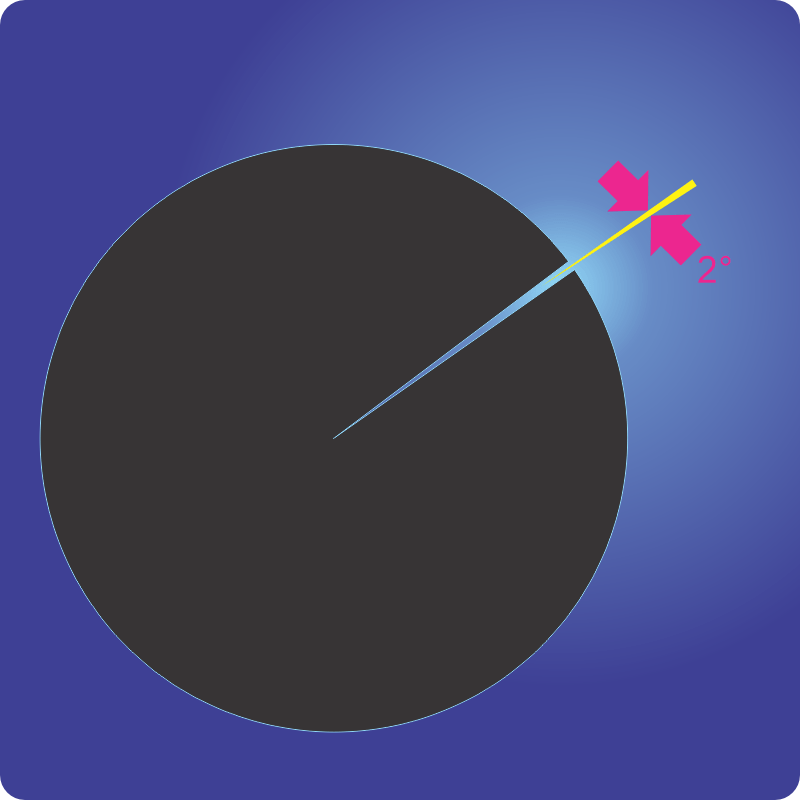
“Alright,” <puffing> “why all this fuss about the Voyager 2 spacecraft missing its target by two degrees? Earth’s pretty big, two degrees I can barely see on a protractor. Should be an easy hit.”

“Can you see the Moon?”

“Sure, if there’s no clouds in front of it. Sometimes even in the daytime.”

“A full Moon is only half a degree wide, ¼ of your two degrees.”

“No!”

“Yes.”

“But when it’s just rising it’s huge, takes up half the sky.”

“Check that carefully some evening. Hold up your hand at arm’s length. Your little finger’s about one degree wide. The Moon will be half as wide as that no matter where it is in the sky, we’ve talked about this. You can see half a degree easy and probably a lot less than that. Tycho Brahe, the last great pre‑telescope astronomer, was able to make measurements as small as 1/150 of a degree.”

“Okay, I guess two degrees is a little bigger than I was thinking. But still, Earth’s pretty big, there’s no excuse for Voyager 2 missing it by two degrees.”

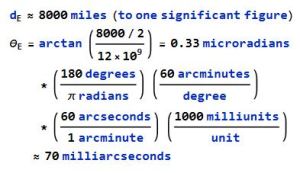
“A two‑degree angle is huge when it extends across astronomical distances.” <drawing Old Reliable from its holster, tapping screen> “From Voyager 2‘s perspective at 12 billion miles out the short leg of a two‑degree isosceles triangle spans 419 million miles. That’s over twice the width of Earth’s orbit! Poor Voyager could be pointing past Mars away from us.”

“Big distances from a small angle make a long triangle, got it. What did NASA have to do to get things pointed right again?”

“I consider it a technological miracle. At Voyager‘s distance, Earth’s 8000‑mile diameter spans only 70 milliarcseconds. And before you ask, a milliarcsecond is a thousandth of 1/60 of 1/60 of a degree, about 3 billionths of the way across your little finger. Pretty darn small. Frankly, I’m amazed that Voyager 2 has been able to keep its antenna pointed at us so accurately for so long using tech that dates back to the mid‑70s and earlier. Our tax dollars working hard.”

“Amazing, yeah — something like that’s gotta have a kajillion moving parts. A lubrication nightmare in space I bet.”

“Not as many as you might think. The only parts that move on purpose are small things like its gyroscopes, its tracking optics and the valves on its attitude‑adjustment thrusters.”

“Wait, how’d they point the antenna towards us in the first place? I figured that was on gears.”

“Way too much play in a gear train for this level of accuracy. No, the antenna’s solidly fixed to the rest of the structure. Voyager 2‘s Attitude and Articulation Control System adjusts the whole probe as a unit using propellant bursts through its choice of little thrusters. The mass of a single burst is so small compared to the spacecraft mass that the AACS can manage milliarcsecond‑level orientation control.”

“I heard they finally got it talking to us again. How’d they manage that if it was pointed the wrong way?”

“The key is it was only mostly pointing the wrong way.”

“Like the guy’s ‘mostly dead’ in Princess Bride?”

“Mr Feder, you know that movie?”

“Hey, it’s got the greatest sword fight ever, plus the two‑cups poison challenge and the part where the pirate keeps insulting the prince. What’s not to like? Whaddaya mean, mostly the wrong way?”

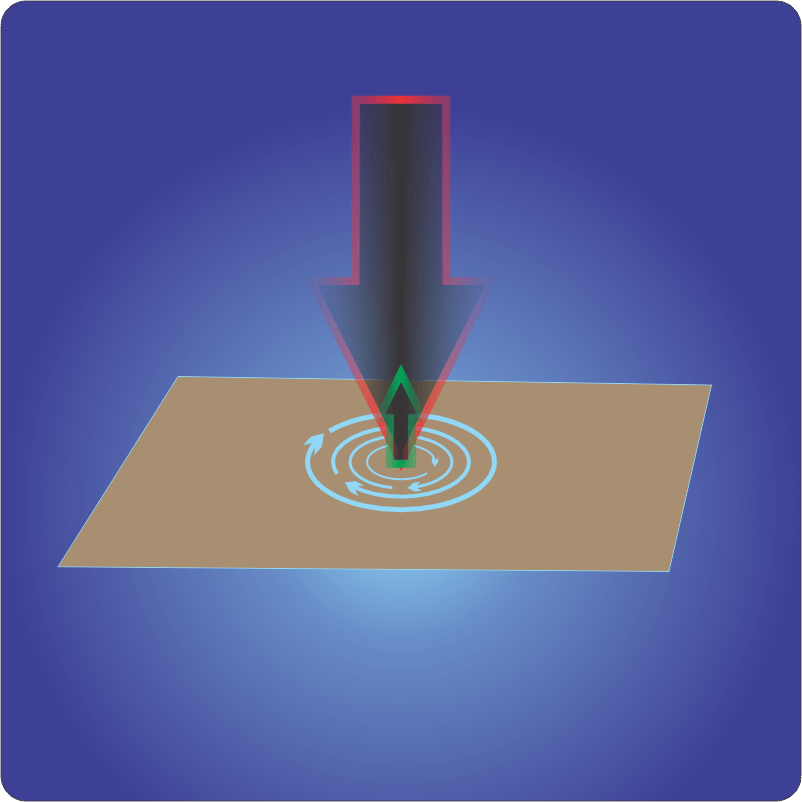
Voyager 2‘s antenna is parabolic, the best shape for transmitting a tight beam. Best doesn’t mean perfect — 50% of the beam’s power stays within a degree or so either side of the center but the rest leaks out to the sides. The same pattern applies to signal reception. Optimal reception happens when the antenna is pointing right at you. If it’s aimed off‑center, reception is worse. Our normal transmission power level wasn’t high enough to punch though the two-degree offset penalty but NASA’s extra-high-power ‘shout’ worked.”

“Caught the flash outta the corner of its eye, huh?”

~~ Rich Olcott

Little Strings And Big Ones

It’ll be another hot day so I’m walking the park early. No geese in the lake — they’ve either flown north or else they’re attacking a farmer’s alfalfa field. A familiar voice shatters the quiet. “Wait up, Moire, I got questions.”

“Good morning, Mr Feder. First question, but please pick up your pace, I want to get back to the air conditioning.”

“I thought string theory was about little teeny stuff but this guy said about cosmic strings. How can they be teeny and cosmic?”

“They can’t. Totally different things, probably. Next question.”

“C’mon, Moire, that wasn’t even an answer, just opened up a bunch more questions.”

“It’s a tangled path but the track mostly started in the late 18th Century. Joseph Fourier derived the equation for how heat progresses along a uniform metal bar. Turned out the equation’s general solution was the sum of an infinite series of sine waves.”

“Sign waves? Like a protest rally?”

“Haha. No, s‑i‑n‑e, a mathematical function where something regularly and smoothly deviates about some central value. Anyhow, mathematicians soon realized that Fourier’s cute trick for his heat equation could be applied to equations for everything from sound waves to signal processing to pretty much all of Physics. Economics, even. Any time you use the word ‘frequency‘ you owe something to Fourier.”

“If he ain’t got it in writing from the Patent Office, I ain’t paying nothing.”

“It’s not the kind of thing you can patent, and besides, he lived in France and died almost two centuries ago. Be generous with your gratitude, at least. Let’s move on. Fourier’s Big Idea was already <ahem> in the air early in the 20th Century when Bohr and the Physics gang were looking at atoms. No surprise, they extended the notion to describe how electronic charge worked in there.”

“I’m waiting for the strings.”

“The key is that an atom’s a confined system like a guitar string that only vibrates between the bridge and whatever fret you’re pressing on. Sound waves traveling in open space can have any wavelength, but if you pluck a confined guitar string the only wavelengths you can excite are whole number multiples of its active length. No funny fractions like π/73 of the length no matter how hard or soft you pluck the string. Atoms work the same way — charge is confined around the nucleus so only certain wave sizes and shapes are allowed.”

“You said ‘strings.’ We getting somewhere finally?”

“Closing in on it. String theory strings aren’t just teeny. If your body were suddenly made as large as the Observable Universe, string theory is about what might happen inside a box a billion times smaller than your size now.”

“Really tight quarters, got it, so only certain vibrations are allowed.”

“Mm-hm, except it’s not really vibration, it would be something that acts mathematically like vibration. Go back to your guitar string. Plucking gives it up‑down motion, strumming moves it side‑to‑side. Two degrees of freedom. The math says whatever’s going on in a string theory box needs 8 or 11 or maybe 25 degrees of freedom, depending on the theory. At the box‑size scale if there’s structure at all it looks nothing like a string.”

“Then how about the big cosmic strings? What’s confining them?”

“Nothing, and I mean that literally. If they exist they’re bounded by different flavors of empty space. It goes back to what we think happened right after the Big Bang during rapid space expansion. Whatever forces drove the process were probably limited by lightspeed. Local acceleration in one region wouldn’t immediately affect events in regions lightyears away. Nearly adjacent parts of the Universe could have been evolving at very different rates. Have you ever watched the whirlpools that form when a fast‑moving stream of water meets a slower‑moving one?”

“Fort Lee had a storm‑sewer pipe that let into the Hudson River. You got crazy whirlpools there after a hard rain.”

“Whirlpools are one kind of topological defect. They die away in water because friction dissipates the angular momentum. Hiding behind a whole stack of ifs and maybes, some theorists think collisions between differently‑evolving spacetime structures might generate long‑lived defects like cosmic strings or sheets.”

~~ Rich Olcott

A Two-Way Stretch, Maybe

“Okay, Moire, I guess I gotta go with the Big Bang happening, but I still have a problem with it making everything come from a point full of nothing.”

“Back at you, Mr Feder. I have problems with your problem. To begin with, forget about your notion of a point with zero size. There’s some reason to think the Bang started with an event sized on the order of the Planck length, 10-35 meter. That’s small, but it’s not zero.”

“I suppose, but with the whole mass of the Universe crammed in there, ain’t that a recipe for the ultimate black hole? Nothing could get outta there.”

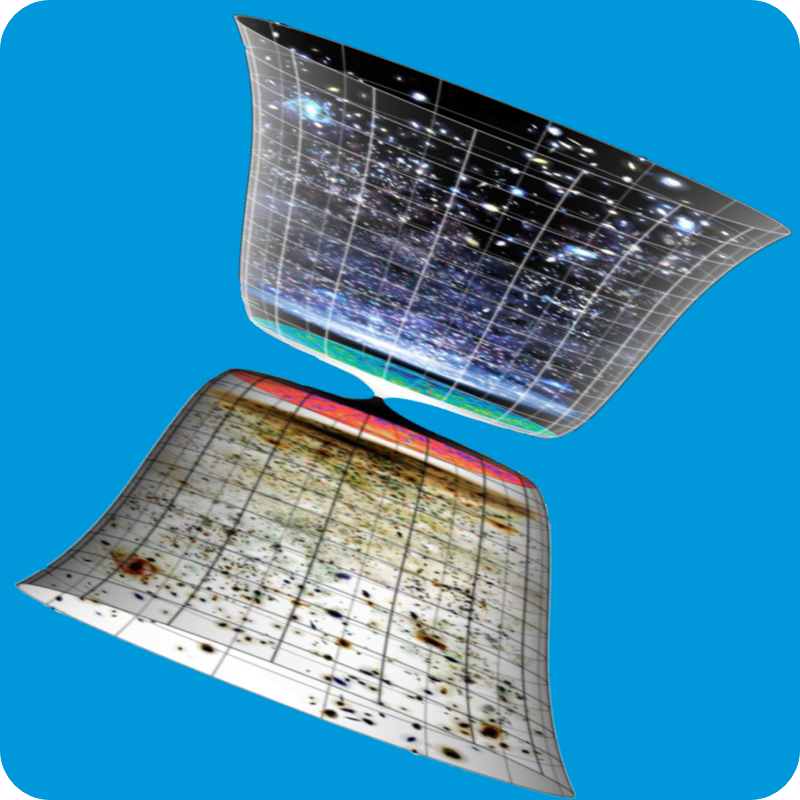
“Nothing needs to. What’s inside is already everything, remember? Besides, there isn’t an outside — space simply doesn’t exist outside of the spacetime the Bang created. Those bell‑shaped ‘Evolution of The Universe‘ diagrams are so misleading. I say that even though I’ve used the diagram myself. It’s just a graph with Time running along the central axis and Space expanding perpendicular to that. People have prettied it up to make it cylindrical and added galaxies and such. The lines just represent how much Space has expanded since the Bang. Unfortunately, people look at the bell as a some kind of boundary with empty space outside, but that’s so wrong.”

“No outside? Hard to wrap your head around.”

“Understandable. Only physicists and mathematicians get used to thinking in those terms and mostly we do it with equations instead of trying to visualize. Our equations tell us the Universe expands at the speed of light plus a bit.”

“Wait, I thought nothing could go faster than the speed of light.”

“True, nothing can traverse space faster than light or gravity, but space itself expands. At large distances it’s doing that faster than light. We actually had to devise two different definitions of distance. ‘Co‑moving distance‘ includes the expansion. ‘Proper distance‘ doesn’t. In another couple billion years, the farthest things we can see today will be co‑moving away so fast that the photons they emit will be carried away faster than they can fly towards us. Those objects will leave our Observable Universe, the spherical bubble that encloses the objects whose light gets a chance to reach us.”

“My head hurts from the expanding. Get back to the Bang thing ’cause it was small. Too small to hold atoms I guess so how can it explode to be everything?”

‘Expand’, not ‘explode‘ — they’re different — but good guess. The Bang’s singularity was smaller than an atom by at least a factor of 1024, but conditions were far too hot in there for atoms to exist, or nuclei, or even protons and neutrons. Informally we call it a quark soup, which is okay because we think quarks are structureless points that can cram to near‑infinite density. We don’t yet know enough Physics for good calculations of temperature, density or much of anything else.”

“That’s a lot of energy, even if it’s not particles. Which is what I’m getting at. I keep hearing you can’t create energy, just transform it, right? So where did the energy come from?”

“That’s a deep question, Mr Feder, and we don’t have an answer or hypothesis or even a firm guess. It gets down to what energy even is — we’re just barely nibbling at the edges of that one. One crazy idea I kind of like is that creating our Universe took zero energy because the process was exactly compensated for by creating an anti‑Universe whose total anti‑energy matches our total energy.”

“Whaddaya mean, anti‑Universe and anti‑energy?”

<deep breath> “You know an atom has negatively‑charged electrons bound to its positively‑charged nucleus, right? Well, the anti‑Universe I’m thinking of has that situation and everything else reversed. Positive electrons, negative nucleus, but also flipped left‑right parities for some electroweak particle interactions. Oh, and time runs backwards which is how anti‑energy becomes a thing. Our Universe and my crazy anti‑Universe emerge at Time Zero from the singularity. Then they expand in opposite directions along the Time axis. Maybe the quarks and their anti‑quarks got sorted out at the flash‑point, I dunno.”

“So there’s an anti‑me out there somewhere?”

“I wouldn’t go that far.”

~~ Rich Olcott

Everything Everywhere All at Once

It’s either late Winter or early Spring, the weather can’t make up its mind. The geese don’t seem to approve of my walk around the park’s lake but then I realize it’s not me they object to. “Hey, Moire, wait up, I got a question for you!”

“Good morning, Mr Feder. What can I do for you?”

“This Big Bang thing I been hearing about. How can it make everything from nothing like they say?”

“You’re in good form, Mr Feder, lots of questions buried within a question.”

“Oh yeah? Seems pretty simple to me. How do we even know it happened?”

“Well, there you go, one buried question up already. We have several lines of evidence to support the idea. One of them is the CMB.”

“Complete Monkey Business?”

“Very funny. No, it’s the Cosmic Microwave Background, long‑wavelength light that completely surrounds us. It has the same wavelength profile and the same intensity within a dozen parts per million no matter what direction we look. The best explanation we have for it is that the light is finally arriving here from the Big Bang roughly 14 billion years ago. Well, a couple hundred thousand years after the Bang itself. It took that long for things to cool down enough for electrons and protons to pair up as atoms. The photons had been bouncing around between charged particles but when the charges neutralized each other the photons could roam free.”

“Same in all directions so we’re in the center, huh? The Bang musta been real close‑by.”

“Not really. Astronomers have measured the radiation’s effects on a distant intergalactic dust cloud. The effect is just what we’d expect if the cloud were right here. We’re not in a special location. From everything we can measure, the Bang happened everywhere and all at once.”

“Weird. Hard to see how that can happen.”

“We answered that nearly a century ago when Edwin Hubble discovered that there are other galaxies outside the Milky Way and that they’re in motion.”

“Yeah, I heard about that, too, with everything running away from us.”

“Sorry, no. We’re not that special, remember? On the average, everything’s running away from everything else.”

“Whaddaya mean, ‘on the average‘? Why the wishy-washy?”

“Because things cluster together and swirl around. The Andromeda galaxy is coming straight toward us, for instance, but it won’t get here for 5 billion years. The general trend only shows up when you look at large volumes, say a hundred million lightyears across or bigger. The evidence says yeah, everything’s spreading out.”

“But how can everything be moving away from everything? You run away from something, you gotta be running toward something else.”

“That’d be true if your somethings are all confined in a room whose walls don’t move. The Universe doesn’t work that way. The space between somethings continually grows new space. The volume of the whole assemblage increases.”

“Is that why I just hadda buy new pants?”

“No, that’s just you gaining weight from all that beer and bar food. The electromagnetism that holds your atoms and molecules together is much stronger than what’s driving the expansion. So is the gravitation that holds solar systems and galaxies together. Expansion only gets significant when distances get so large that the inverse square laws diminish both those forces to near zero.”

“What’s this got to do with the CMB?”

“The CMB tells us that the Bang happened everywhere, but expansion says that at early times when stars and galaxies first formed, ‘everywhere‘ was on a much smaller scale than it is now. Imagine having a video of the expansion and playing it backwards. Earendel‘s the farthest star we’ve seen, but if we and it existed 12 billion years ago we’d measure it as being close‑by but still all the way across the observable Universe. Carry that idea the rest of the way. The Big Bang is expansion from a super‑compressed everywhere.”

“Okay, what’s driving the expansion?”

“We don’t know. We call it ‘dark energy‘ but the name’s about all we have for it.”

“Aaaa-HAH! At last something you don’t know!”

“Science is all about finding things we don’t know and working to figure them out.”

~~ Rich Olcott