It’s All About The Coupling

The game‘s over but there’s still pizza on the table so Eddie picks up the conversation. “So if gadolinoleum has even more unpaired electrons than iron, how come it’s not ferromagnetic like iron is?”

Vinnie’s tidying up the chips he just won. “I bet I know part of it, Eddie. Sy and me, we talked about magnetic domains some years ago. If I remember right, each iron atom in a chunk is a tiny little magnet, which I guess is the fault of its five unpaired electrons, but usually the atom magnets are pointing in all different directions so they all average out and the whole chunk doesn’t have a field. If you stroke the chunk with a magnet, that collects the little magnets into domains and the whole thing gets magnetic. How come gadomonium” <winks at Eddie, Eddie winks back> “doesn’t play the domain game, Susan?”

“It’s gadolinium, boys, please. As to the why, part’s at the atom level and part’s higher up. My lab neighbor Tammy schooled me on rare earth magnetism just last week. She does high‑temperature solid state chemistry with lanthanide‑containing materials. Anyway, she says it’s all about coupling.”

“I hope she told you more than that.”

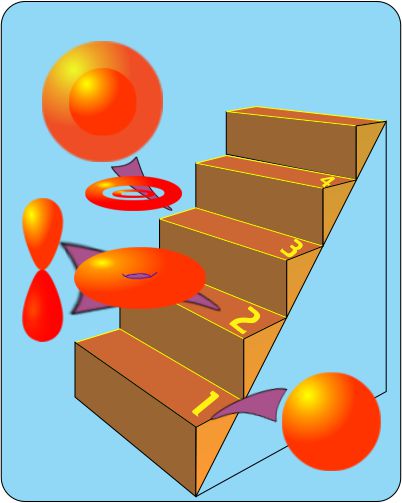
“She did. Say you’ve got a single gadolinium atom floating in space. Its environment is spherically symmetrical, no special direction to organize the wave‑orbitals hosting unpaired charges. Now turn on a magnetic field to tell the atom which way is up, call that the z‑axis. The atom’s wave‑orbital with zero angular momentum orients along z. Six more wave‑orbitals with non‑zero angular momentum spin one way or the other at various angles to the z‑axis. Those charges in motion build the atom’s personal magnetic field.”

“But we’re on Earth, not in space.”

“Bear with me. First, as a chemist I must say that most of the transition and lanthanide elements happily lose two electrons so in general we’re dealing with ions. Before you ask, Vinnie, that goes even for metals where the ions float in an electron sea. When Tammy said ‘coupling’ she was talking about how strongly one ion feels the neighboring fields. Iron and other ferromagnetic materials have a strong coupling, much stronger than the paramagnetics do.”
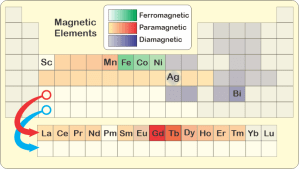
“Why’s the ferro- coupling so much stronger?”

“Two effects. You can read both of them right off the Periodic Table. Physical size, for one. Each row down in the table represents one electronic shell which takes up space. The atom or ion in any row is bigger than the ones above it. Yes, the heavy elements have more nuclear charge to pull electronic charge close, but shielding from their completed lower shells lets the outer charge cloud expand. Tammy told me that gadolinium’s ions are about 20% wider than iron’s.”

“Makes sense — you make the ions get further apart, they won’t connect so good. What’s the other effect?”

“It’s about how each orbital distributes its charge. There are tradeoffs between shell number, angular momentum and distance from the nucleus. Unpaired charge concentration in gadolinium’s high‑momentum 4f‑orbitals on the average stays inside of all its 3‑shell waves. The outermost charge shelters the unpaired waves inside it. That weakens magnetic coupling with unpaired charge in neighboring ions. Bottom line — gadolinium and its cousins are paramagnetic because they’re bigger and less sensitive than ferromagnetic iron is.”

“Then how come rare earth supermagnets the Chinese make are better than the cheapie ironic kinds we can make here?”

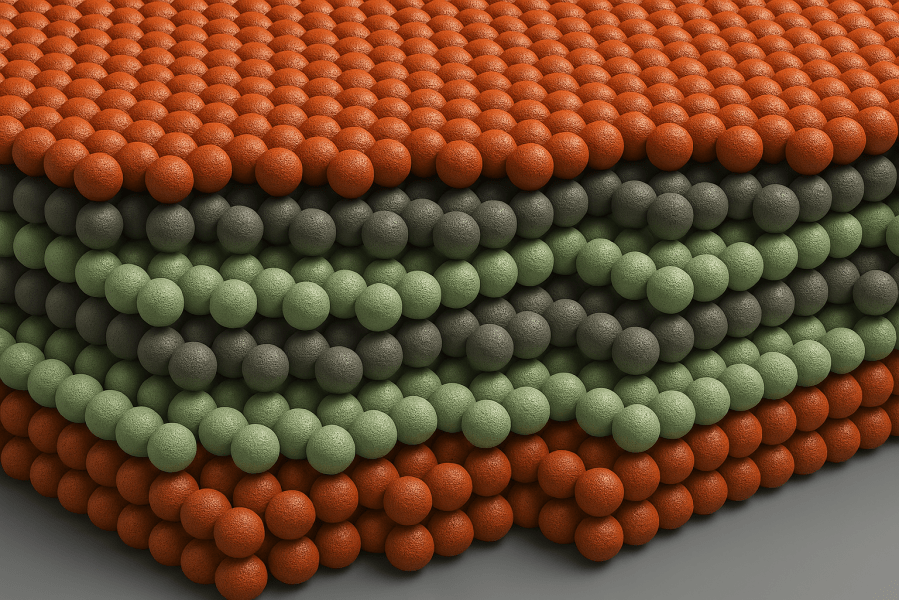
“The key is getting the right atoms into the right places in a crystalline solid. Neodymium magnets, for instance, have clusters of iron atoms around each lanthanide. The cluster arrangement aligns everyone’s z‑axes letting the unpaired charges gang up big‑time. You find materials like that mostly by luck and persistence. Tammy’s best samples are multi‑element oxides that arrange themselves in planar layers. Pick a component just 1% off the ideal size or cook your mixture with the wrong temperature sequence and the structure has completely different properties. Chinese scientists worked decades to perfect their recipes. USA chose to starve research in that area.”

~ Rich Olcott
Flipping An Edge Case

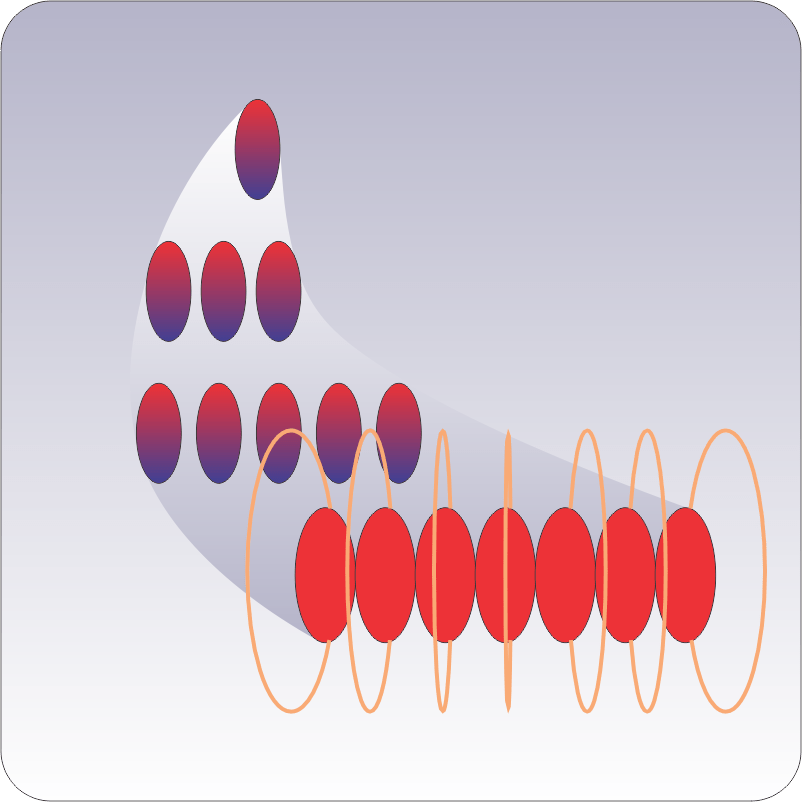
“Why’s the Ag box look weird in your chart, Susan?”

“That’s silver, Eddie. It’s an edge case. The pure metal’s diamagnetic. If you alloy silver with even a small amount of iron, the mixture is paramagnetic. How that works isn’t my field. Sy, it’s your turn to bet and explain.”

I match Eddie’s bet (the hand’s not over). “It’s magnetism and angular momentum and how atoms work, and there are parts I can’t explain. Even Feynman couldn’t explain some of it. Vinnie, what do you remember about electromagnetic waves?”

“Electric part pushes electrons up and down, magnetic part twists ’em sideways.”

“Good enough, but as Newton said, action begets reaction. Two centuries ago, Ørsted discovered that electrons moving along a wire create a magnetic field. Moving charges always do that. The effect doesn’t even depend on wires — auroras, fusion reactor and solar plasmas display all sorts of magnetic phenomena.”

“You said it’s about how atoms work.”

“Yes, I did. Atoms don’t follow Newton’s rules because electrons aren’t bouncing balls like those school‑book pictures show. An electron’s only a particle when it hits something and stops; otherwise it’s a wave. The moving wave carries charge so it generates a magnetic field proportional to the wave’s momentum. With me?”

“Keep going.”

“That picture’s fine for a wave traveling through space, but in an atom all the charge waves circle the nucleus. Linear momentum in open space becomes angular momentum around the core. If every wave in an atom went in the same direction it’d look like an electron donut generating a good strong dipolar magnetic field coming up through the hole.”

“You said ‘if’.”

“Yes, because they don’t do that. I’m way over‑simplifying here but you can think of the waves pairing up, two single‑electron waves going in opposite directions.”

“If they do that, the magnetism cancels.”

“Mm‑hm. Paired‑up configurations are almost always the energy‑preferred ones. An external magnetic field has trouble penetrating those structures. They push the field away so we classify them as diamagnetic. The gray elements in Susan’s chart are almost exclusively in paired‑up configurations, whether as pure elements or in compounds.”

“Okay, so what about all those paramagnetic elements?”

“Here’s where we get into atom structure. An atom’s electron cloud is described by spherical harmonic modes we call orbitals, with different energy levels and different amounts of angular momentum — more complex shapes have more momentum. Any orbital hosting an unpaired charge has uncanceled angular momentum. Two kinds of angular momentum, actually — orbital momentum and spin momentum.”

“Wait, how can a wave spin?”

“Hard to visualize, right? Experiments show that an electron carries a dipolar magnetic field just like a spinning charge nubbin would. That’s the part that Feynman couldn’t explain without math. A charge wave with spin and orbital angular momentum is charge in motion; it generates a magnetic field just like current through a wire does. The math makes good predictions but it’s not something that everyday experience prepares us for. Anyway, the green and yellow‑orange‑ish elements feature unpaired electrons in high‑momentum orbitals buried deep in the atom’s charge cloud.”

“So what?”

“So when an external magnetic field comes along, the atom’s unpaired electrons join the party. They orient their fields parallel to the external field, in effect allowing it to penetrate. That qualifies the atom as paramagnetic. More unpaired electrons means stronger interaction, which is why iron goes beyond paramagnetic to ferromagnetic.”

“How does iron have so many?”

“Iron’s halfway across its row of ten transition metals—”

“I know where you’re going with this, Sy. It’ll help to say that these elements tend to lose their outer electrons. Scandium over on the left ionizes to Sc3+ and has zero d‑electrons. Then you add one electron in a d orbital for each move to the right.”

“Thanks, Susan. Count ’em off, Vinnie. Five steps over to iron, five added d‑electrons, all unpaired. Gadolinium, down in the lanthanides, beats that with seven half‑filled f‑orbitals. That’s where the strength in rare earth magnets arises.”

“So unpaired electrons from iron flip alloyed silver paramagnetic?”

“Vinnie wins this pot.”

~ Rich Olcott

A Cosmological Horse Race

A crisp Fall day, perfect for a brisk walk around the park. I see why the geese are huddled at the center of the lake — Mr Feder, not their best friend, is on patrol again. Then he spots me. “Hey, Moire, I gotta question!”

“Of course you do, Mr Feder. What is it?”

“Some guy on TV said Einstein proved gravity goes at the speed of light and if the Sun suddenly went away it’d take eight minutes before we went flying off into space. Did Einstein really say that? Why’d he say that? Was the TV guy right? And what would us flying across space feel like?”

“I’ll say this, Mr Feder, you’re true to form. Let’s see… Einstein didn’t quite prove it, the TV fellow was right, and we’d notice being cold and in the dark well before we’d notice we’d left orbit. As to why, that’s a longer story. Walk along with me.”

“Okay, but not too fast. What’s not quite about Einstein’s proving?”

“Physicists like proofs that use dependable mathematical methods to get from experimentally-tested principles, like conservation of energy, to some result they can trust. We’ve been that way since Galileo used experiments to overturn Aristotle’s pure‑thought methodology. When Einstein linked gravity to light the linkage was more like poetry. Beautiful poetry, though.”

“What’s so beautiful about something like that?”

“All the rhymes, Mr Feder, all the rhymes. Both gravity and light get less intense with the square of the distance. Gravity and light have the same kinds of symmetries—”

“What the heck does that mean?”

“If an object or system has symmetry, you can execute certain operations on it yet make no apparent difference. Rotate a square by 90° and it looks just the same. Gravity and light both have spherical symmetry. At a given distance from a source, the field intensity’s the same no matter what direction you are from the source. Because of other symmetries they both obey conservation of momentum and conservation of energy. In the late 1890s researchers found Lorentz symmetry in Maxwell’s equations governing light’s behavior.”

“You’re gonna have to explain that Lorentz thing.”

Lorentz symmetry has to do with phenomena an observer sees near an object when their speed relative to the object approaches some threshold. Einstein’s Special Relativity theory predicted that gravity would also have Lorentz symmetry. Observations showed he was right.”

“So they both do Lorentz stuff. That makes them the same?”

“Oh, no, completely different physics but they share the same underlying structure. Maxwell’s equations say that light’s threshold is lightspeed.”

“Gravity does lightspeed, too, I suppose.”

“There were arguments about that. Einstein said beauty demands that both use the same threshold. Other people said, ‘Prove it.’ The strongest argument in his favor at the time was rough, indirect, complicated, and had to do with fine details of Earth’s orbit around the Sun. Half a century later pulsar timing data gave us an improved measurement, still indirect and complicated. This one showed gravity’s threshold to be with 0.2% of lightspeed.”

“Anything direct like I could understand it?”

“How about a straight‑up horse race? In 2017, the LIGO facility picked up a gravitational signal that came in at the same time that optical and gamma ray observatories recorded pulses from the same source, a colliding pair of neutron stars in a galaxy 130 million lightyears away. A long track, right?”

“Waves, not horses, but how far apart were the signals?”

“Close enough that the measured speed of gravity is within 10–15 of the speed of light.”

“A photo-finish.”

“Nice pun, Mr Feder. We’re about 8½ light-minutes away from the Sun so we’re also 8½ gravity-minutes from the Sun. As the TV announcer said, if the Sun were to suddenly dematerialize then Earth would lose the Sun’s orbital attraction 8½ minutes later. We as individuals wouldn’t go floating off into space, though. Earth’s gravity would still hold us close as the whole darkened, cooling planet leaves orbit and heads outward.”

“I like it better staying close to home.”

~ Rich Olcott

Got To Be Good-lookin’ ‘Cause He’s So Hard To See

I’ll be sorry when Acme Building’s management swaps out our old‑style door locks for electronic ones. Vinnie has such fun lock‑picking his way past my office door in the morning. “Morning, Vinnie.”

“Morning, Sy. Hey, I got a new Crazy Theory for you. Nobody knows what Dark Matter is, right?”

“Right. All we know is that it has about five times as much mass as normal matter so it participates in gravitational interactions. Some of it seems to gather in spherical halos around galaxies and some of it seems to collect in spikes near their centers. Cosmologists are arguing about whether or not Dark Matter is particles, much less how they’d be quantized. And we call it Dark because it absolutely doesn’t care about electromagnetism.”

“That’s what I thought. I remember you said if Dark Matter did play with light waves at all it’d block our view of the CMB. So yeah, absolute. Good.”

“I gather your theory is about Dark Matter.”

“Mm-hm. I thought of a way that all that mass could be hiding in plain sight except we can’t see it.”

“Alright, I’m listening.”

“Tachyons.”

“Come again?”

“Tachyons — particles that fly around faster than light. I read an article about ’em. Some people say they can’t exist but hear me out, okay? The reason they’re not supposed to exist is ’cause it would take an infinite amount of energy to boost something up past lightspeed. I got that, but suppose they were born above lightspeed, back when the Big Bang singularity had energy packed so tight the Physics laws we know don’t apply. A lot of particles got flung out below lightspeed, but maybe even more got flung out above it.”

“What does this have to do with dark matter?”

“I’m gettin’ there. The thing with tachyons is, the article said it’d take infinite energy to slow one down to lightspeed. A tachyon rock hits a slow rock, it don’t stop ’cause the slow rock don’t have the juice for that. The collision may take a little energy from the tachyon rock but that just changes its trajectory.”

“Mmm, those tachyon rocks can’t be a thing. The — what can I call it? slow matter?”

“The article called ’em bradyons.”

“Thanks. We know that 92% of all … bradyonic atoms in the Universe are hydrogens. Rocks are made of silicon, oxygen and other atoms that are even heavier. Everything heavier than hydrogen and maybe some helium was created by nuclear reactions inside a star. Tachyonic atoms zooming beyond lightspeed couldn’t gather together to form a star or even join one. No significant tachyonic fusion, no tachyonic rocks.”

“Okay, they all stay tachy‑hydrogen, still not a problem. The point is, there could be a lot of them and they could add up to a lot of mass. So the next thing I asked is, where would tachyons hang out? Gotta be around galaxies, but being tachyons going super‑lightspeed they can’t just hang, they orbit around the centers. They’d spend the most time where they go slowest which is where they’re farthest away ’cause that’s how orbits work. But they’d be thickest close in ’cause of gravity but that’s where they go fastest.”

“Cute, so you’re predicting galaxies with halos of tachyons, plus spikes of them at each center. That just happens to be the dark matter distribution the astronomers find.”

“It gets better, Sy. I’m not so sure of this because math, but it feels right. I don’t think tachyons can do electromagnetism things.”

“Why not?”

“No blue glow — you know, that blue glow in nuclear reactors when electrons go through the cooling water faster than light?”

“Cherenkov radiation, happens when fast electrons polarize the water. The polarizing slows light in water relative to a vacuum.”

“Right, but tachyons in space travel through vacuum. They ought to polarize the vacuum like what fast electrons do to water. Electromagnetic tachyons orbiting galaxies ought to make a blue glow but there isn’t one, so tachyons don’t do electromagnetism things and that makes them Dark Matter.”

“You’re going to have to do better than that, Vinnie. Absence of evidence just might be evidence of absence. Maybe they’re not there to begin with.”

~ Rich Olcott

Why A Disk?

Late Summer is quiet time on campus and in my office. Too quiet. I head over to Cal’s coffee shop in search of company. “Morning, Cal.”

“Morning, Sy. Sure am glad to see you. There’s no‑one else around.”

“So I see. No scones in the rack?”

“Not enough traffic yet to justify firing up the oven on such a hot day. How about a biscotti instead?”

“If it’s only the one it’s a biscotto. Pizza Eddie’s very firm on that. Yeah, I’ll have one.”

“Always learning. By the way, a photo spread in one of my astronomy magazines got me thinking. How come there’s so much flat out there?”

“Huh? I know you’re not one of those flat‑Earthers.”

“Not the planets, I mean the way their orbits go all in the same plane. Same for most of the asteroids and the Kuiper belt, even. Our Milky Way galaxy’s basically flat, too, and so are a lot of the others. Black hole accretion disks are flat. You’d think if some baby star or galaxy was attracting stuff from everywhere to grow itself, the incoming would make a big globe. But it’s not, we get flatness. How come?”

“Bad aim and angular momentum.”

“What’s aim got to do with it?”

“Suppose there’s only two objects in the Universe and they’re closing in on each other. If they’re aimed dead‑center to each other, what happens?”

“CaaaRUNCH!!!”

“Right. Now what if the aim’s off so they don’t quite touch?”

“Oh, I know that one … it’ll come to me … yeah, Roche’s limit, it was in an article a few months ago. Whichever’s less dense will break up and all the pieces go like Saturn’s rings. Which are also flat, by the way.”

“In orbit around the survivor, mm‑hm. The pieces can’t fall straight down because they still have angular momentum.”

“I know about momentum like when you crash a car if you go too fast for your brakes. Heavier car or faster speed, you get a worse crash. How does angle fit into that — bigger angle, more angular momentum?”

“Not quite. In general, momentum is mass multiplied by speed. It’s a measure of the force required to stop something or at least slow it down. You’ve described linear momentum, where ‘speed’ is straight‑line distance per time. If you’re moving along a curve, ‘speed’ is arc‑length per time.”

“Arc‑length?”

“Distance around part of a circle. Arc‑length is angle in radians, multiplied by the circle’s radius. If you zip halfway around a big circle in the same time it took me to go halfway around a small circle, you’ve got more angular momentum than I do and it’d take more force to stop you. Make sense?”

“What if it’s not a circle? The planet orbits are all ellipses.”

“It’s still arc‑length except that you need calculus to figure it. That’s why Newton and Leibniz invented their methods. A falling something that misses a gravity center keeps falling but on an orbit. Whatever momentum it has acts as angular momentum relative to that center. There’s no falling any further in without banging into something else coming the other way and each object canceling the other’s momentum.”

“Or burning fuel if it’s a spaceship.”

“… Right. … So anyway, suppose you’ve got a star or something initially surrounded by a spherical cloud of space junk whirling around in all different orbits. What’s going to happen?”

“Lots of banging and momentum canceling until everything’s swirling more‑or‑less in the same direction and closer in than at come‑together time. But it’s still a ball.”

“Gravity’s not done. Think about northern debris. It’s attracted to the center, but it’s also attracted to the southern debris and vice-versa. They’ll meet midway and build a disk. The ball‑to‑disk collapse isn’t even opposed by angular momentum. Material at high latitudes, north and south, can lose gravitational potential energy by dropping straight in toward the equator and still be at the orbitally correct distance from the axis of rotation.”

“That’d work for stuff collecting around a planet, wouldn’t it?”

“It’d even work for stuff collecting around nothing, just a clump in a random density field. That may be how stars are born. Collapsing’s the hard part.”

~ Rich Olcott

Look, Look Again, Then Think

Cathleen and I are sharing scones and memories when Vinnie trundles up to our table. “Glad I got you two together. I just ran across a couple news items and I need some explanations.”

“Astronomy AND Physics in the same news items? Do tell.”

“They’re only one paragraph each and read like someone wrote ’em before their morning coffee. They’re both about that big black hole they’ve been taking pictures of.”

“The one in our galaxy or the M87* supermassive black hole in the Messier‑87 galaxy?”

“The second one, Cathleen. This item says it shot out a jet traveling faster than light.”

<sigh> “Pop‑sci journalism at its worst, right, Sy? I know the work that’s based on and the academic reports don’t say that. Good observations leading to less flamboyant conclusions.”

“Maybe it was supposed to be a bigger article but the editors cut it down badly. That happens. I’m sure it’s not really a superluminal jet—”

“Superluminal’s faster‑than‑light, right?”

“Right, Vinnie. Sorry to get technical. Anyway, it’s an illusion.”

“Ah geez, it’ll be frames again, right?” <eyes suddenly open wide> “Wait, I got it! I betcha it’s about the time difference. Take a blob in that jet, it’s flying out at near lightspeed. Time dilation happens when relativity’s in the game, me and Sy talked about that, so blob‑frame seconds look like they take longer than ours do. We see the blob cramming a lightsecond of distance traveled into less than one of our seconds and that’s superluminal. Am I right, Sy?”

“Right answer to a different question, I’m afraid. You’re straight on the time dilation but it doesn’t apply to this situation. Something happening within the blob’s frame, maybe a star blowing up or something weird metabolizing in there, Special Relativity’s time distortion hijinks would show us that action taking place in slow motion. But this superluminal blob claim hinges on how the blob’s whole frame moves relative to ours. That motion isn’t superluminal but it can look that way if conditions are right. As I understand it, the M87* jet qualifies. Your bailiwick rather than mine, Cathleen.”

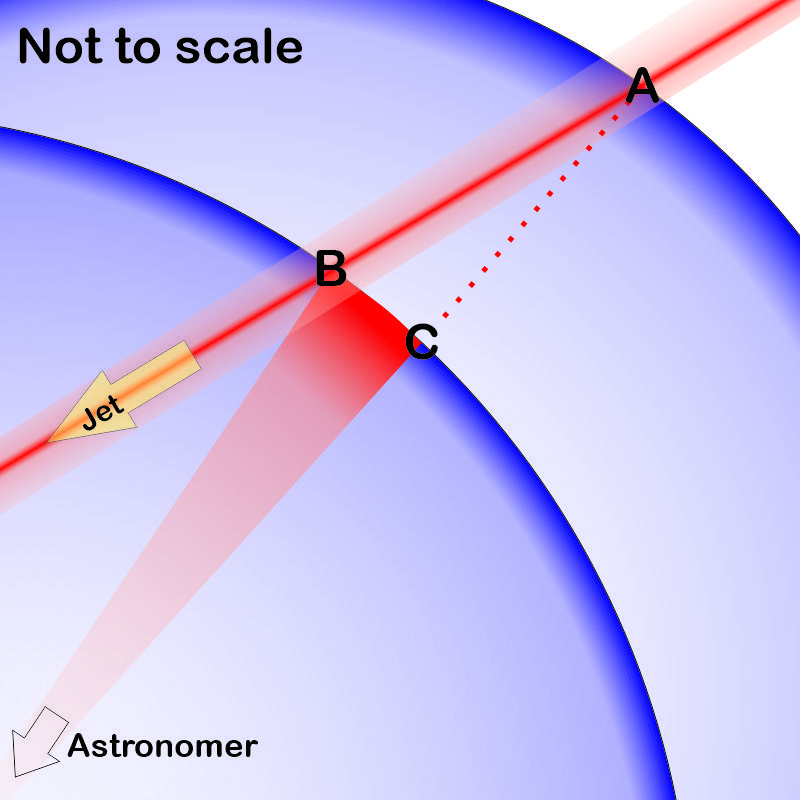
“Actually it is a frames thing, Vinnie, but timeframes, not spacetime. Those blobs move too slowly in our sky to watch in real time. We take snapshot A and then maybe a few years later we take snapshot B and compare. Speed is the ratio of distance to time. We need the A‑B distance in 3‑D space to compare to the known time between snapshots. But we can’t see the blob’s trajectory in 3‑D. All we can capture is its 2‑D arc C‑B across an imaginary spherical shell we call the sky. If the M87* jet were perpendicular to our line of sight the C‑B image on the sky‑sphere would match the 3‑D path. Multiply the image’s angle in radians by the distance to M87* and we’re done.”

“We’re not done?”

“Nope. This jet points only 20° away from our direct line of sight. I’ll spare you the trigonometry and just say that distance A‑B is about 3 times longer than C‑B.”

“So we measure C‑B, triple the angle and multiply by the M87* distance. No problem.”

“Problem. That tripling is what makes the blob’s A‑B journey appear to go faster than light. Three times 0.4c equals 1.2c. But you missed something important. Your arithmetic assumed you could use a simple ‘M87* distance’. Not in this case, because the blob moves towards us at close to lightspeed. Visualize two concentric sky‑spheres. The outer one’s radius runs from us to the blob’s location at A‑time. The inner sphere’s radius runs to the blob’s location at B‑time. The B‑sphere is our reference frame. The light we saw at A‑time had to travel from the outer sphere to the inner one before we could register the C‑B image.”

“Can’t be very far.”

“We’re talking years at lightspeed, so lightyears, so significant. A properly illusion‑free A‑B travel calculation must include the A‑C travel time in the denominator of the distance/time ratio. The true kilometers per second come out well below lightspeed. Oh, and relativity’s not involved.”

“Dang, Cathleen, it was such a cool illusion.”

~ Rich Olcott

A Play Beyond The Play

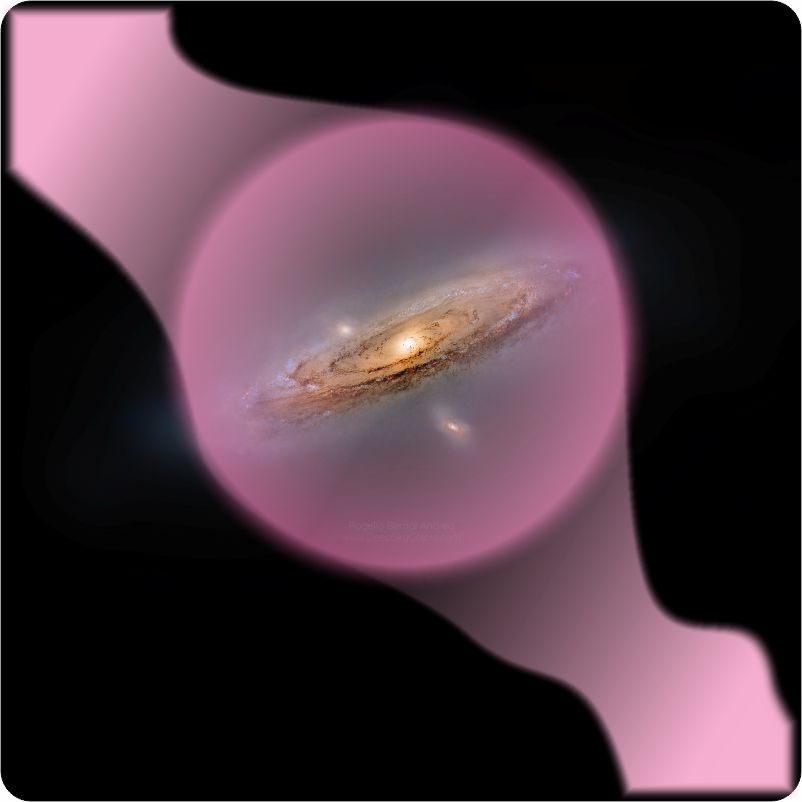
Vinnie takes a long thoughtful look at the image that had dashed his beautiful six‑universe idea. “Wait, Sy. I don’t like this picture”

“Because it messes up your invention?”

“No, because how can they know what that halo looks like? I mean, the whole thing with dark matter is that we can’t see it.”

“You’re right about that. Dark matter’s so transparent that even with five times more mass than normal matter, it doesn’t block CMB photons coming from 13.8 billion lightyears away. That still boggles my brain every once in a while. But dark matter’s gravitational effects — those we can see.”

“Yeah, I remember a long time ago we talked about Fritz Zwicky and Vera Rubin and how they told people about galaxies held together by too much gravity but nobody believed them.”

“Well, they did, after a while—”

“A long while, like a long while since those talks. Remind me what ‘too much gravity’ was about.”

“It was about conflicts between their observations and the prevailing theoretical models. Everyone thought that galaxies and galaxy clusters should operate pretty much like planetary orbits — your speed increases the closer you are to the center, up to Einstein’s speed limit. Newton’s Laws of Motion predict how fast you should move if you’re at a certain distance from a body with a certain mass. If you’re moving faster than that, you fly away.”

“Yeah, escape velocity. So the galaxies in Zwicky’s cluster didn’t follow Newton’s Laws?”

“They didn’t seem to. Galaxies that should have escaped were still in there. The only way he could explain the stability was to suppose the galaxies are only a small fraction of the cluster’s mass. Extra gravity from the extra mass must bind things together. Forty years later Rubin’s improved technology revealed that stars within galaxies had the same anomalous motion.”

“I’m guessing the ‘faster near the center’ rule didn’t hold, or else you wouldn’t be telling this story. Spun like a wheel, I bet.”

“When a wheel spins, every part of it rotates at the same angular speed, the same number of degrees per second, right?”

“Ahh, the bigger my circle the higher my airspeed so the rule would be ‘faster farther out’.”

“That’s the wheel rule, right, but Rubin’s data showed that stars within galaxies don’t obey that one either. She measured lots of stars in Andromeda and other galaxies. Their linear speeds, kilometers per second, are nearly identical from near the center all the way out. Even dust and gas clouds beyond the galactic starry edges also fit the ‘same linear speed everywhere’ rule. You’d lose the bet.”

“That just doesn’t feel right. How can just gravity make that happen?”

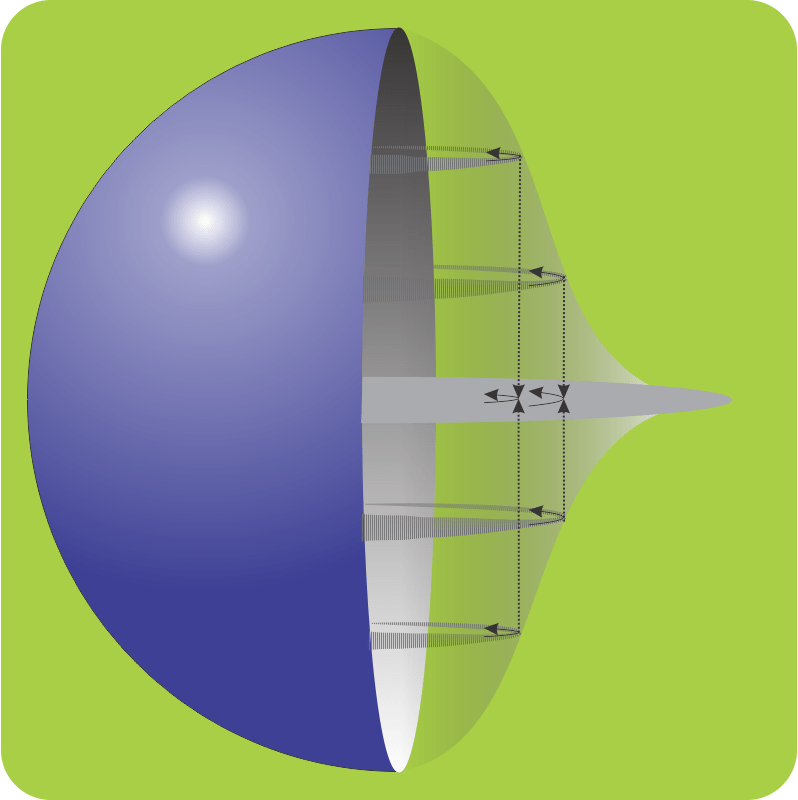
“It can if the right amount of dark matter’s distributed in the right‑shaped smeared‑out hollowed‑out spherical halo. The halo’s radial density profile looks about like this. Of course, profiles for different galaxies differ in spread‑outness and other details, but the models are pretty consistent.”

“Wait, if dark matter only does gravity like you said, why’s that hole in the middle? Why doesn’t everything just fall inward?”

“Dark matter has mass so it also has inertia, momentum and angular momentum, just as normal matter does. Suppose some of the dark matter has collected gravitationally into a blob and the blob is moving slower than escape velocity. If it’s flying straight at the center of gravity it’ll get there and stay there, more or less. But if the blob’s aimed in any other direction, it has angular momentum relative to the center. Momentum’s conserved for dark matter, too. The blob eventually goes into orbit and winds up as part of the shell.”

“Does Zwicky’s galaxy cluster have a halo, too?”

“Not in the same way. Each galaxy probably has its own halo but the galaxies are far apart relative to their size. The theoreticians have burned huge amounts of computer time simulating the chaos inside large ensembles of gravity‑driven blobs. I just read one paper about a 4‑billion‑particle calculation and mind you, a ‘particle’ in this study carried more than a million solar masses. Big halos host subhalos, with filaments of minihalos tying them together. What we can’t see is complicated, too.”

~ Rich Olcott

Five More Alternate Universes?

I unlock my office door and there’s Vinnie inside, looking out the window. “Your 12th‑floor view’s pretty nice, Sy. From above the tree tops you can see leaf buds just starting to show their early green colors.”

“What are you doing here, Vinnie? I thought you were charter‑flying to Vancouver.”

“The guy canceled. Said with all the on‑again, off‑again tariffs there’s no sense traveling to make a deal when he doesn’t know what he’s dealing with. So I got some time to think.”

“And you came here so it’s something physics‑technical.”

“Yeah, some. I notice colors a lot when I’m flying. Some of those trees down there this time of year are exactly the same bright yellow‑green as some of the rice paddies I’ve flown over. But all the trees get the same hard dark green by August before they go every different color when the chlorophyll fades away.”

I’ve noticed that. So you came here to talk about spectra?”

“Some other time. This time I want to talk about dark matter.”

“But we call it dark matter precisely because it doesn’t do light. All our normal matter is made of atoms and the atoms are made of electrons and nuclei and each nucleus is made of protons and neutrons and protons and neutrons are made of quarks. Electrons and quarks carry electrical charge. Anything with electrical charge is subject to electromagnetism, one way or another. Dark matter doesn’t notice electromagnetism. If dark matter had even the slightest interaction with light’s electromagnetic field, we wouldn’t be able to see galaxies billions of lightyears away.”

“Calm down, Sy, breath a couple times. Stay with me here. From your stuff and what else I’ve read, all we know about dark matter is a lot of things it isn’t or doesn’t do. The only force we know it respects is gravity so it attracts itself and also normal matter and they all clump up to make galaxies and such, right?”

<a bit reluctantly and on a rising note> “Mm‑hnn…?”

“I read your three‑part series about the Bullet Cluster, where we think two galaxy clusters went though each other and their gas clouds gave off a lot of X‑rays that didn’t match where the stars were or where the gravity was so the astronomers blame dark matter for the gravity, right?”

“That’s pretty much it. So?”

“So the other thing I got from that series was maybe there’s friction between dark matter and other dark matter, like it doesn’t just slide past itself. If dark matter is particles, maybe they’re sorta sticky and don’t bounce off each other like billiard balls. That doesn’t make sense if all they do is gravity.”

“I see where you’re going. You’re thinking that maybe dark matter feels some kind of force that’s not gravity or electromagnetism.”

“That’s it! We’ve got light photons carrying electromagnetic forces to hold our molecules and rocks together. Could there be dark photons carrying some dark‑sticky force to connect up dark molecules and dark rocks and stuff?”

“That’s an interesting—”

“I ain’t done yet, Sy. It gets better. I’ve read a bunch of articles saying there’s about five times as much dark matter in the Universe as normal matter. You physicists love symmetry, suppose it’s exactly five times as much. There’d be six kinds of force, one called electromagnetism and a different snooty force each for five kinds of dark matter and that’ll add up to the 25% we can’t see. Like, a purple dark force for purple dark rocks, naturally they’re not really purple, and a yellow dark force and so on.”

“You’re proposing that each kind of dark matter responds only to its own special force, so no cross‑communication?”

“Yup, gravity’s the only thing they’d all agree on. That bein’ the case, the galaxies would hold six times as many stars as we think, except 5/6 of them are invisible to our 1/6. Five alternate universes sharing space with ours. Cozy, huh?”

“Clever, Vinnie, except for the evidence that most galaxies are embedded in huge nearly‑spherical halos of dark matter. The halos would have collapsed long ago if only gravity and stickiness were in play.”

“Dang.”

~ Rich Olcott

New (Old) Word: Frigorific!

A quiet morning at Cal’s Coffee. I’m sipping my morning mud when Susan Kim bustles to my table, mocha latte in hand. “There you are, Sy. I loved your posts in tribute to the well‑thumbed copy of the CRC Handbook on my desk.”

“Glad you enjoyed them.”

“Your Rumford stuff made it even better because I did a class report on him once so I caught your ‘frigorific‘ reference. What do you know about the background to that?”

“Not much. Didn’t sound like a real word when I ran across it.”

“Oh, it’s a real word but it has a technical meaning now that it didn’t in Newton’s time. Back then it was only about making something cold. These days we also use the word for a mixture that maintains a dependable cold temperature. Liquid water and ice, for instance, stays at 0°C as long as there’s still ice in the cold bath. I used to use an ammonium chloride/water frigorific when I needed something down around -15°C. Now of course I use a benchtop refrigerator.”

“Rumford would have liked that. What were the ‘frigorific rays‘ he got all excited about?”

“Long story but there’s a couple of fun twists. Background first. At the end of the 1700s there was a <grin> heated debate about heat. The phlogiston theory was dead by that time but people still liked the idea that heat was a material fluid. It addressed some chemical puzzles but heat transmission was still mysterious. Everyone knew that a hot object gives off heat by radiation, that the radiation travels in straight lines and that it’s reflected by metal mirrors.”

“Right, the Greeks are supposed to have used huge sun‑focusing mirrors to burn up attacking Roman ships.”

“Maybe. Anyhow, those properties connected heat with light. However, a pane of glass blocks radiated heat, at least until the glass gets hot. People argued this meant heat and light weren’t connected. About 1790 a group of physicists loosely associated with the Academy of Geneva dove into the fray. Rumford was in the group, along with Prévost, Saussure and his student Pictet. They had lots of fun with heat theories and experiments. One of Pictet’s experiments lit Rumford’s fire, so to speak.”

“Good one.”

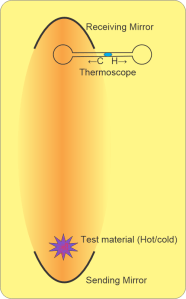
<smile> “It’s a fairly simple setup that a high school science teacher could do. Pictet hung a concave metallic mirror facing down from the ceiling of a draft‑free room. He placed another concave metallic mirror at floor level immediately beneath it, facing upward. He probably used spherical mirrors which are easy to make, but they could have been elliptical or parabolic sections. Anyhow, he put a thermoscope at the upper mirror’s focal point and a hot object at the lower focal point. Sure enough, the upper focal point got hotter, just as you’d expect.”

“No great surprise, the Greeks would have expected that, too.”

“The surprise happened when he put a cold object in there. The thermoscope’s droplet moved in the cold direction.”

“Wait, like anti‑infrared?”

“That’s the effect. Wave‑theory supporter Rumford took that thought, called it ‘frigorific radiation‘ and ran with it. He constructed a whole thesis around cold waves and heat waves as symmetric partners. He maintained wave intensity, both kinds, increases with temperature difference. Our heat sources are hundreds or thousand of degrees hotter than we are but our cold sources are at most a few dozen degrees colder. By his theory that’s why cold wave phenomena are masked by heat waves.”

“Give me a minute. … Ah, got it. The very meaning of a focal point is that all waves end or start there. A cold object at the sending station emits much less infrared than the warm object did. The thermoscope bulb now gets less than it emits. With less input from below its net energy drops. It chills.”

“Nice, Sy. Now for the other twist. Rumford published his theory in 1805. Herschel had already identified infrared radiation in the Sun’s spectrum in 1800. Two strikes against Herschel, I guess — he was British and he was an astronomer. Continental physicists wouldn’t bother to read his stuff.”

~ Rich Olcott

Caged But Free

Afternoon coffee time. Cal waves a handful of astronomy magazines at us as Cathleen and I enter his shop. “Hey, guys, there’s a ton of black hole stuff in the news all of a sudden.”

Cathleen plucks a scone from the rack. “Not surprised, Cal. James Webb Space Telescope looks harder and deeper than we ever could before and my colleagues have been feasting on the data. Black holes are highly energetic so the most extreme ones show up well. The Hubble and JWST folks find new extremes every week.”

Cal would be disappointed if I didn’t ask. “So what’s the new stuff in there?”

<flipping through the magazines> “This seems to be quasar jet month. We’ve got a new champion jet and this article says M87’s quasar makes novas.”

“Remind me, Cathleen, what’s a quasar?”

“A quasi‑stellar object, Sy, except we now know it’s a galaxy with a supermassive black hole—”

“I thought they all had super‑massives.”

“Most do, but these guys are special. For reasons researchers are still arguing about, they emit enormous amounts of energy, as much as a trillion average stars. Quasar luminosity is more‑or‑less flat all across the spectrum from X-rays down as low as we can measure. Which isn’t easy, because the things are so far away that Universe expansion has stretched their waves by z‑factors of 6 or 8 or more. We see their X‑ray emissions in the infrared range, which is why JWST’s optimized for infrared.”

“What does ‘flat’ tell you?”

“Sy’d give a better answer than I would. Sy?”

“Fun fact, Cal. Neither atoms nor the Sun have flat spectra and for the same reason: confinement. Electromagnetic waves come from jiggling charges, right? In an atom the electron charge clouds are confined to specific patterns centered on the nucleus. Each pattern holds a certain amount of energy. The atom can only move to a different charge pattern by emitting or absorbing a wave whose energy matches the difference between the pattern it’s in and some alternate pattern. Atomic and molecular spectra show peaks at the energies where those transitions happen.”

“But the Sun doesn’t have those patterns.”

“Not in the stepped energy‑difference sense. The Sun’s made of plasma, free electrons and nuclei all bouncing off each other, moving wherever but confined to the Sun’s spherical shape by gravity. Any particle that’s much more or less energetic than the local average eventually gets closer to average by exchanging energy with its neighbors. Free charged particles radiate over a continuous, not stepwise, spectrum of energies. The free‑particle combined spectrum has a single peak that depends on the average temperature. You only get flat spectra from systems that aren’t confined either way.”

“What I get from all that is a jet’s flat spectrum says that its electrons or whatever aren’t confined. But they must be — the things are thin as a pencil for thousands of lightyears. Something’s gotta be holding them together but why no peaks?”

“Excellent question, Cal. By the way, jets can be even longer than you said. I’ve read about your champion jet. It extends 23 million lightyears, more than a hundred times the width of the Milky Way galaxy. Straight as a string, no kinks or wiggles during a billion years of growth. I think what’s going on is that the charged particles are confined side‑to‑side somehow but they’re free to roam along the jet’s axis. If that’s the case, the flat‑spectrum light ought to be polarized. I’m sure someone is working on that test now. Your thoughts, Sy?”

“As a physicist I’m interested in the ‘somehow.’ We only know of four forces. The distances are too big for weak and strong nuclear forces. Gravity’s out, too, because it acts equally in all directions, not just crosswise to the axis. That leaves electromagnetic fields in some super‑strong self‑reinforcing configuration. The particles must be spiraling like mad about that central axis. I’ll bet that explains Cal’s quasar galaxy concentrating novae close to its SMBH jet axis. A field that strong could generate enough interference to wreak havoc on an unstable star’s plasma.”

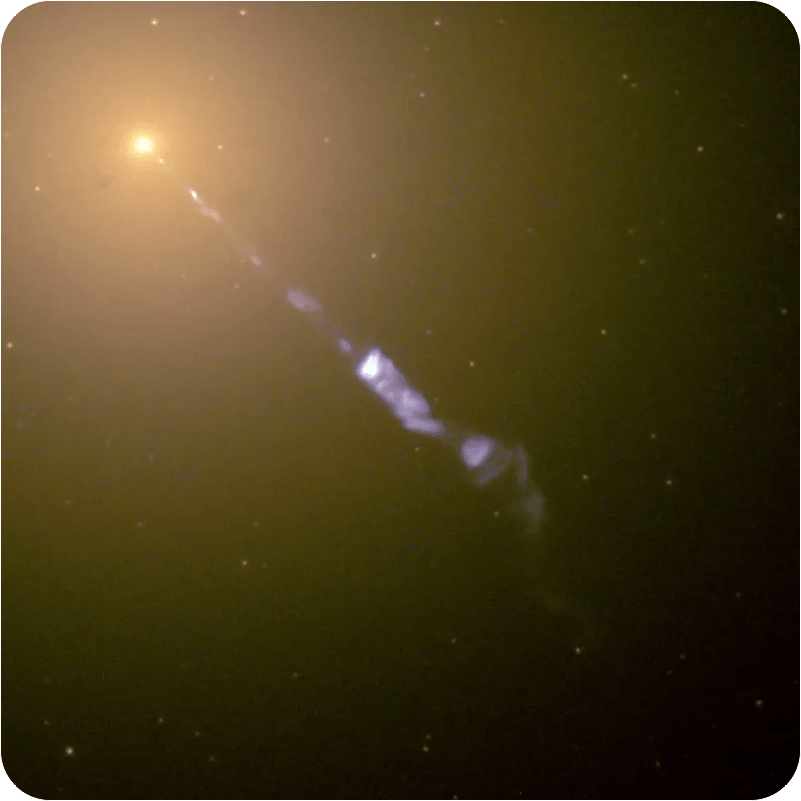
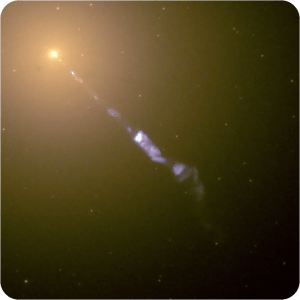
Hubble’s view of the M87 galaxy and jet
Credit NASA and the Hubble Heritage Team (STScI/AURA)

~ Rich Olcott