Galaxies Sing In A Low Register

Jeremy gets a far‑away look. ”It’s gotta be freakin’ noisy inside the Sun.” just as our resident astronomer steps into Cal’s Coffee.

“Wouldn’t bet that, Jeremy. Depends on where you are in the Sun and on how you define noise.”

Vinnie booms, quietly. ”We just defined it, Cathleen. Atoms or molecules bumping each other in compression waves. Oh, wait, that’s ‘sound,’ you said ‘noise.’ Is that different?”

Susan slurps the last of her chocolate latte. ”Depends on your mood, I guess. All noise is sound, but some sound can be signal. Some people don’t like my slurping so for them it’s noise but Cal hears it as an order for another which makes him happy.”

“Comin’ up, Susan. Hey, Cathleen, maybe you can slap down Sy. He said spiral galaxies have something to do with sound which don’t make sense. Set him straight, okay?”

“Sy, have you all settled that sound isn’t limited to what humans hear?”

“Sure. Everybody’s agreed that infrasound and ultrasound are sound, and that Bishop Berkeley’s fallen tree made a sound even though nobody heard it. That’s probably what got Jeremy thinking about sound inside the Sun.” Jeremy nods.

“Then Vinnie’s definition is too limited and Sy’s statement is correct. Probably.”

That gets a reaction from everyone, though mine is a smile. ”Let ’em have it, Cathleen.”
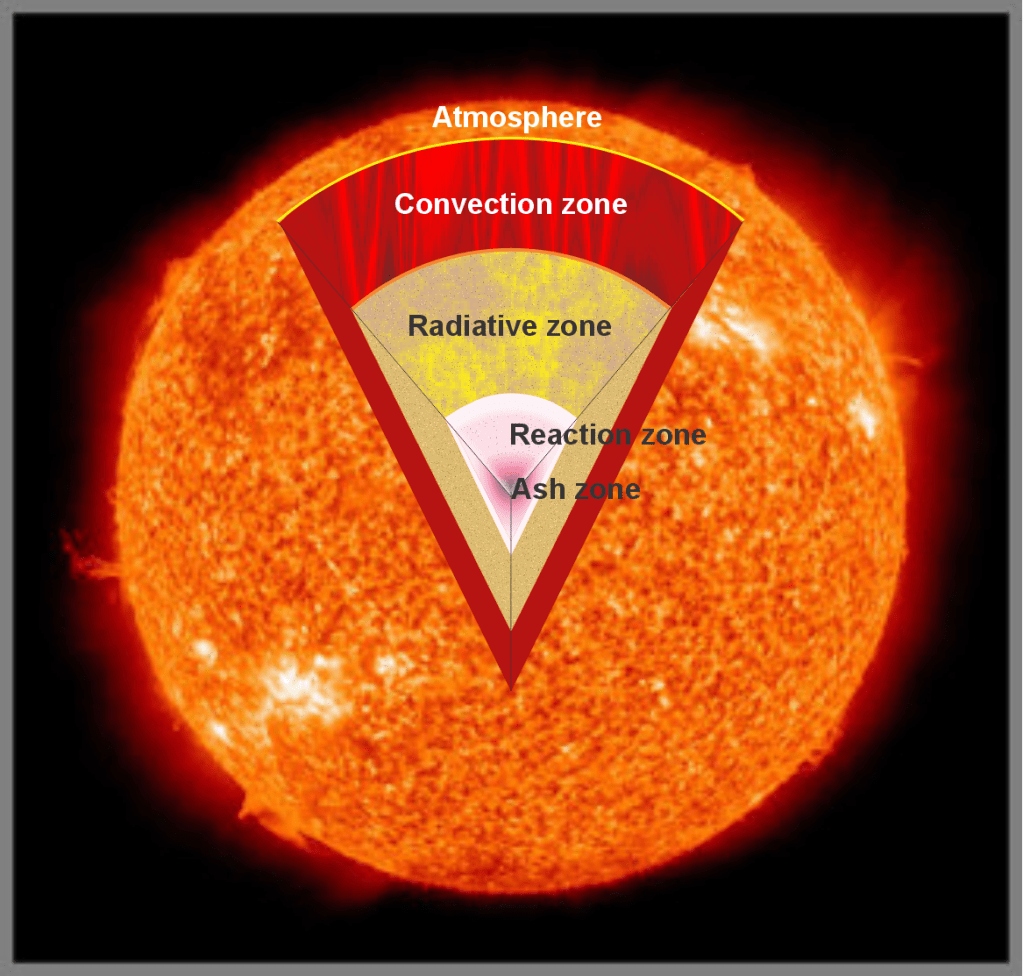
“Okay. Let’s take Jeremy’s idea first and then we’ll get to galaxies.” <fetches her tablet from her purse and a display on her tablet> “Here’s a diagram of the Sun I did for class. If you restrict ‘sound‘ to mean only coherent waves borne by atoms and molecules, there’s no sound in the innermost three zones. The only motion, if Sy grants I can call it that, is photons and subnuclear particles randomly swapping between adjacent nuclei that are basically locked into position by the pressure. Not much actual atomic motion until you’re up in the Convection Zone where rising turbulence is the whole game. Even there most of the particles are ions and electrons rather than neutral atoms. Loud? You might say so but it’d be a continuous random crackle‑buzz, not anything your ears would recognize. Sound waves as such don’t happen until you reach the atmospheric layers. Up there, oh yes, Jeremy, it’s loud.”

Geologist Kareem is a quiet guy, normally just sits and listens to our chatter, but Cathleen’s edging onto his turf. ”How about seismic waves? If there’s a big flare or CME up top, won’t that send vibrations all the way through?”

“Good point, Kareem. Yes, the Sun has p and s waves just like Earth does, but they travel no deeper than the Convection Zone. A different variety we may not have, g waves, would involve the core. Unfortunately, theory says g waves are so weak that the Convection Zone’s chaos swamps them. Anyway, the Sun’s s, p and g waves wouldn’t contribute to what Jeremy would hear because their frequencies are measured in hours or days. Can I get to galaxies now?”

“Please do.”

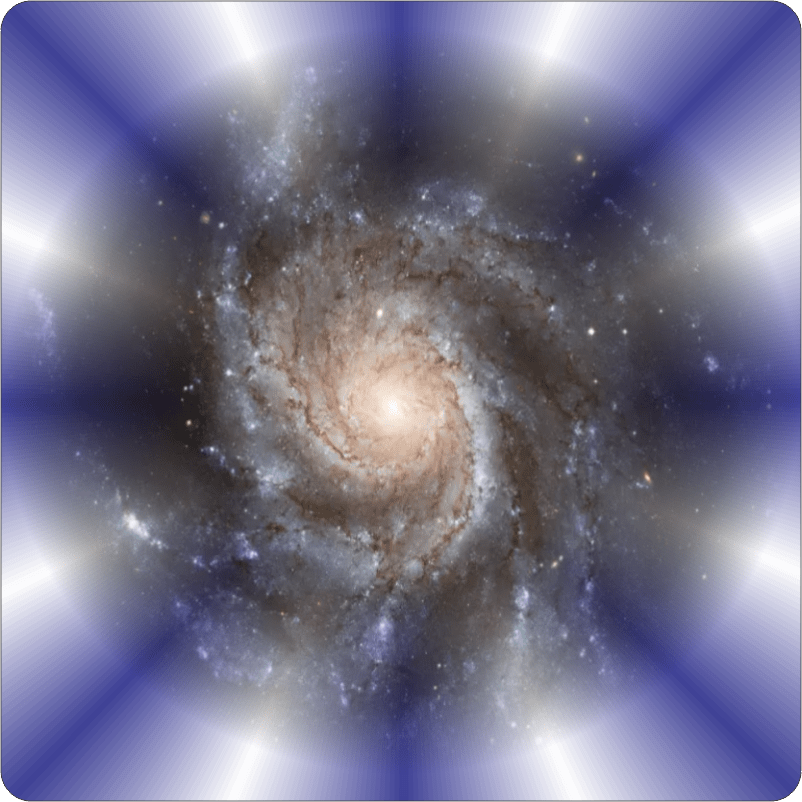
“Thanks.” <another display on her tablet> “Here’s a classic spiral galaxy. Gorgeous, huh? The obvious question is, is it winding in or spraying out? The evidence says ‘No‘ to both. The stars are neither pulled into a whirlpool nor flung out from a central star‑spawner. By and large, the stars or clusters of them are in perfectly good Newtonian orbits around the galactic center of gravity. So why are they collected into those arms? Here’s a clue — most of the blue stars are in the arms.”

“What’s special about blue stars?”

“In general, blue stars are large, hot and young. Our Sun is yellow, about halfway through a 10‑million‑year lifetime. The blue guys burn through their fuel and go nova in a tenth of that time. Blue stars out there tell us that the arms serve as stellar nurseries. It’s not stars gathering into arms, it’s galaxy‑wide rotating waves of gas birthing stars there. There’s argument about whether the wave rotation is intrinsic or whether there’s feedback as each wave is pulled along by star formation at the leading edge and pushed by novae at the trailing edge. Sy’s point, though, is that an arm‑dwelling old red star would experience the spinning gas density pattern as a basso profundo sound wave with a frequency even lower than the million‑year range. Right, Sy?”

“As always, Cathleen.”

~~ Rich Olcott

  • More thanks to Alex.

Screams And Thunders

Coffee time. I step into Cal’s shop and he’s all over me. ”Sy, have you heard about the the NASA sonification project?”

Susan puts down her mocha latte. “I didn’t like some of what they’ve released. Sounds too much like people screaming.”

Jeremy looks up from the textbook he’s reading. ”In space, no-one can hear you scream.”

Vinnie rumbles from his usual table by the door. “Any of these got anything to do with the Cosmic Hum?”

“They have nothing to do with each other, except they do. Spiral galaxies, too.”

“Huh?”
 ”Huh?”
  ”Huh?”
   ”Huh?”

“A mug of my usual, Cal, please, and a strawberry scone.”

“Sure, Sy, here ya go, but you can’t say something like that around here without you tellin’ us how come.”

“Does the name Bishop Berkeley ring a bell with anyone?”

Vinnie’s on it. ”That the ‘If a tree falls in the forest…‘ guy, right? Claimed there’s no sound unless somebody’s there to hear it?”

“And by extension, no sound outside human hearing range.”

“But bats and them use sound we can’t hear.”
 ”So do elephants and whales.”

“Well there you go. So are we agreed that he was wrong?”

“Not quite, Mr Moire. His definition of ‘sound‘ was different from one you’d like. He was a philosopher theorizing about perception, but you’re a physicist. You two don’t even define reality the same way.”

Vinnie’s rumble. ”Good shot, Jeremy. Sound is waves. Sy and me, we talked about them a lot. One molecule bangs into the next one and so on. The molecules don’t move forward, mostly, but the banging does. Sy showed me a video once. So yeah, people listening or not, that tree made a sound. There’s molecules up in space, so there’s sound up there, too, right, Sy?”

“Mmm, depends on where you are. And what sounds you’re equipped to listen for. The mechanism still works, things advancing a wave by bouncing off each other, but the wave’s length has to be longer than the average distance between the things.” <drawing Old Reliable, pulling up display> “Here’s that video Vinnie saw. I’ve marked two of the particles. You see them moving back and forth over about a wavelength. Suppose a much shorter wave comes along.”

“Umm… Each one would get a forward kick before they got back into position. They wouldn’t oscillate, they’d just keep moving in that direction. No sound wave, just a whoosh.”

“Right, Jeremy. Each out‑of‑sync interaction converts some of the wave’s oscillating energy into one‑way motion. The wave doesn’t get energy back. A dozen wavelengths along, no more wave. So the average distance between particles, we call it the mean free path, sets limits to the length and frequency of a viable wave. Our ears would say it filters out the treble.”

“Space ain’t quite empty so it still has a few atoms to bump together. What kinds of limits do we get out there?”

“Well, there’s degrees of empty. Interplanetary space has more atoms per cubic meter than interstellar which is more crowded than intergalactic. Nebulae and molecular clouds can be even less empty. Huge range, but in general we’re talking wavelengths longer than a million kilometers. Frequencies measured in months or years — low even for your voice, Vinnie.”

Jeremy gets a look on his face. ”One of my girlfriends is a soprano. We tested her in the audio lab and she could hit a note just under two kilohertz, that’s two thousand cycles per second. My top screech was below half that. I could scream in space, but I guess not low enough to be heard.”

“Yeah, keep that spacesuit helmet closed and be sure your radio intercom’s working.”

“Wait, what about screaming over the radio?”

“Radio operates with electromagnetic waves, not bumping atoms. Mean free path limits don’t apply. Radio’s frequency range is around a hundred megahertz, screeching’s no problem. Your broadcast equipment’s response range would set your limits.”

“Sy, those screamy sounds I objected to — you say they can’t have traveled across space as sound waves. Was that a radio transmission?”

“Maybe, Susan. From what I’ve read, we’ve picked up beaucoodles of radio sources, all different types and all over the sky. Each broadcasts a spectrum of different radio frequencies. Some of them are constant radiators, some vary at different rates. You may have heard a recording of a kilohertz variable source.”

<shudder> “All nasty treble, no bass or harmony.”

~~ Rich Olcott

  • Thanks to Alex, who raised several questions.

A Spherical Bandstand

“Whoa, Sy, something’s not right. Your zonal harmonics — I can see how latitudes go from pole to pole and that’s all there are. Your sectorial harmonic longitudes start over when they get to 360°, fine. But this chart you showed us says that the radius basically disappears crazy close to zero. The radius should keep going forever, just like x, y and z do.”

“Ah, I see the confusion, Susan. The coordinate system and the harmonic systems and the waves are three different things, um, groups of things. You can think of a coordinate system as a multilevel stage where chords of harmonic musicians can interact to play a composition of wave signals. The spherical system has latitude and longitude levels for the brass and woodwind players, plus one in back for the linear percussion section. Whichever direction the brass and woodwinds point, that’s where the signals go out, but it’s the percussion that determines how far they get. Sure, radius lines extend to infinity but except for R0 radial harmonics damp out pretty quickly.”

“Signals… Like Kaski’s team interpreted Juno‘s orbital twitches as a signal about Jupiter’s gravitational unevenness. Good thing Juno got close enough to be inside the active range for those radial harmonics. How’d they figure that?”

“They probably didn’t, Cathleen, because radial harmonics don’t fit easily into real situations. First problem is scale — what units do you measure r in? There’s an easy answer if the system you’re working with is a solid ball, not so easy if it’s blurry like a protein blob or galaxy cluster.”

“What makes a ball easy?”

“Its rigid surface that doesn’t move so it’s always a node. Useful radial harmonics must have a node there, another node at zero and an integer number of nodes between. Better yet, with the ball’s radius as a natural length unit the r coordinate runs linearly between zero at the center and 1.0 at the surface. Simplifies computation and analysis. In contrast, blurries usually don’t have convenient natural radial units so we scrabble around for derived metrics like optical depth or mixing length. If we’re forced into doing that, though, we probably have worse challenges.”

“Like what?”

“Most real-world spherical systems aren’t the same all the way through. Jupiter, for instance, has separate layers of stratosphere, troposphere, several chemically distinct cloud‑phases, down to helium raining on layers of hydrogen in liquid, maybe slushy or even solid form. Each layer has its own suite of physical properties that put kinks into a radial harmonic’s smooth curve. Same problem with the Sun.”

“How about my atoms? The whole Periodic Table is based on atoms having a shell structure. What about the energy level diagrams for atomic spectra? They show shells.”

“Well, they do and they don’t, Susan. Around the turn of the last Century, Lyman, Balmer, Paschen, Brackett and Pfund—”

“Sounds like a law firm.”

“<ironically> Ha, ha. No, they were experimental physicists who gave the theoreticians an important puzzle. Over a 40‑year period first Balmer and then the others, one series at a time, measured the wavelengths of dozens of lines in hydrogen’s spectrum. ’Okay, smarties, explain those!‘ So the theoreticians invented quantum mechanics. The first shot did a pretty good job for hydrogen. It explained the lines as transitions between discrete states with different energy levels. It then explained the energy levels in terms of charge being concentrated at different distances from the nucleus. That’s where the shell idea came from. Unfortunately, the theory ran into problems for atoms with more than one electron.”

“Give us a second… Ah, I get why. If one electron avoids a node, another one dives in there and that radius isn’t a node any more.”

“Got it in one, Cathleen. Although I prefer to think of electrons as charge clouds rather than particles. Anyhow, when an atom has multiple charge concentrations their behavior is correlated. That opens the door to a flood of transitions between states that simply aren’t options for a single‑electron system. That’s why the visible spectrum of helium, with just one additional electron, has three times more lines than hydrogen does.”

“So do we walk away from spherical harmonics for atoms?”

“Oh, no, Susan, your familiar latitude and longitude harmonics fit well into the quantum framework. These days, though, we mostly use combinations of radial fade‑aways like my Sn00 example.”

~~ Rich Olcott

Jupiter And The Atoms

“Okay, Sy, what’s your third solution?”

“Solution to what, Susan?”

These harmonic thingies. They’re about angles so it makes sense to chart them in polar or spherical coordinates, but when they take on negative values the radius goes the wrong way. You said one solution was to chart the negatives in a different color. That’s confusing, though. Another solution is to square all the values to get everything into positive territory. That’s okay for chemists like me because the peaks and nodes we care about stay in the same places. What’s the third option?”

“One that gets to why these ‘harmonic thingies’ are interesting at all. When Juno‘s orbiting Jupiter, does it feel each of Kaspi’s Jn shapes individually?”

“No, of course not, she just reacts to how they all add togethherrr … Oh! So you’re saying we can handle negative values from one harmonic by adding it to another one that’s more positive and plotting the combination.”

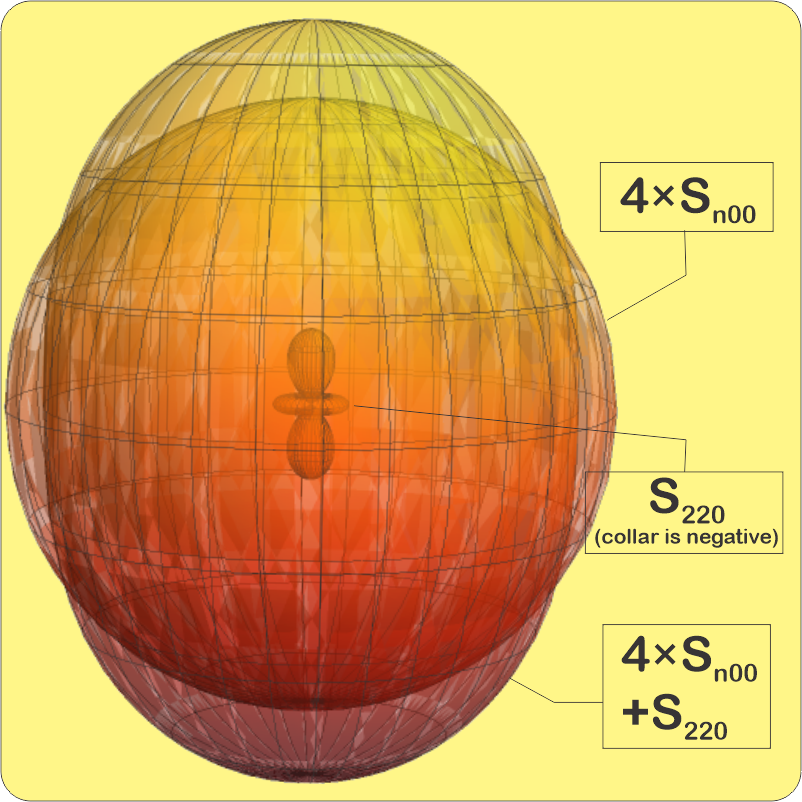
<pointing to paper napkin> “Bingo! Remember this linear plot of J2 where I colored its negative section pink?” <pointing to display on Old Reliable> “When you multiply J2 by C0 you get S220. I added that to four helpings of Sn00 to get this combination.”

“Ah, that negative region in S220‘s middle shaves back the equator on Sn00‘s sphere while the positive part adds bumps top and bottom.” <Susan gives me the side‑eye> “Why’d you pick that 4‑to‑1 ratio, and what’s with those n subscripts instead of numbers?”

“Getting a little ahead of myself. For the moment let’s concentrate on Juno‘s experience with Jupiter’s gravity. One reason I chose that ratio was that it’s pretty easy to see in the picture. In real cases the physical system determines the ratios. Kaspi’s team derived their ratios experimentally. They used math to fit a model to Juno‘s very slightly wobbly orbit. Their model of Jupiter’s gravity field started from the spherical J0 shape. They tweaked that by adding different ratios of J2 through J40, adjusting the ratios until the model’s total gravity field predicted an orbit that matched the real‑world one. J2‘s share was about 15 parts per thousand but most of the rest contributed less than a part per million. Jupiter probably uses multiple mass blobs to make the J2 shape. The point is, the planet’s really a mess but we can analyze the mess in terms of the harmonics.”

“So that’s how you drew what Cal called your wiggle-waggles — you followed Kaski’s Jn recipe and then added some constant to push the polar plot out far enough that the negatives didn’t poke out the wrong side. That constant — what value did you use and why that one?”

“That’s exactly what I did do, Cathleen. Frankly, I don’t even remember what constant I added, just something that was big enough to make the negatives behave nicely, not so large that the peaks vanished by comparison. Calibrating accurately to Jupiter’s J0 would shrink the peaks down to parts‑per‑thousand invisibility. After all, I was more concerned with peak position than peak size.”

“Now we’re back to your 4‑to‑1 ratio. Was that arbitrary, too?”

“No, it wasn’t, Susan. Would it have been closer to Chemistry if I’d labeled that figure as 1s22s22p1?”

“Two electrons in the 1s‑shell, two in the 2s‑shell plus one 2p electron … that’s a boron atom? But you’re showing only one radial shell, not two separate ones.”

“True, but that’s to make another point. There isn’t an electron in the 1s shell, or even a pair of them nicely staying on opposite sides. The atom’s charge, all five electrons‑worth of it, is smeared out as a wave pattern across the entire structure. The Sn00 pattern captures everything that’s spherical. The S220 pattern gets what’s left.”

“But what about the radial nodes? Isn’t that the difference between 1s and 2s, that 2s has a node?”

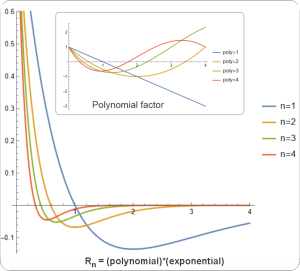
“Oh there are nodes, alright, but they don’t have much effect. Each radial harmonic is the product of two factors — a polynomial and an exponential. The exponential part squeezes the polynomial so hard that adjacent peaks and valleys are barely bumps and dents.”

“So Jupiter and atoms use the same math, huh?”

“So does the Sun.”

~~ Rich Olcott

Shapes And Numbers

I’m nursing my usual mug of eye‑opener in Cal’s Coffee Shop when astronomer Cathleen and chemist Susan chatter in and head for my table. Susan fires the first volley.

“Sy, those spherical harmonics you’ve posted don’t look anything like the atomic orbitals in my Chem text. Shouldn’t they?”
 ”How do you add and multiply shapes together?”
  ”What does the result even mean?”
   ”And what was that about solar seismology?”

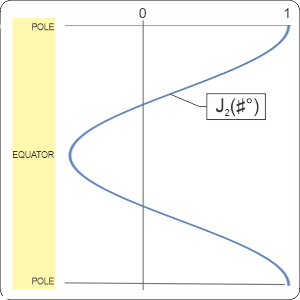
“Whoa, have you guys taken interrogation lessons from Mr Feder? One at a time, please. Let’s start with the basics.” <sketching on a paper napkin> “For example, the J2 zonal harmonic depends only on the latitude, not on the longitude or the distance from the center, so whatever it does encircles the axis. Starting at the north pole and swinging down to the south pole, the blue line shows how J2 varies from 1.0 down to some negative decimal. At any latitude, whatever else is going on will be multiplied by the local value of J2.”

“The maximum is 1.0, huh? Something multiplied by a number less than 1 becomes even smaller. But what happens where J2 is zero? Or goes negative?”

“Wherever Jn‘s zero you’re multiplying by zero which makes that location a node. Furthermore, the zero extends along its latitude all around the sphere so the node’s a ring. J2‘s negative value range does just what you’d expect it to — multiply by the magnitude but flip the product’s sign. No real problem with that, but can you see the problem in drawing a polar graph of it?”

“Sure. The radius in a polar graph starts from zero at the center. A negative radius wouldn’t make sense mixed in with positives in the opposite direction.”

“Well it can, Cathleen, but you need to label it properly, make the negative region a different color or something. There are other ways to handle the problem. The most common is to square everything.” <another paper napkin> “That makes all the values positive.”

“But squaring a magnitude less than 1 makes it an even smaller multiplier.”

“That does distort the shapes a bit but it has absolutely no effect on where the nodes are. ’Nothin’ times nothin’ is nothin’,’ like the song says. Many of the Chem text orbital illustrations I’ve seen emphasize the peaks and nodes. That’s exactly what you’d get from a square‑everything approach. Makes sense in a quantum context, because the squared functions model electron charge distributions.”

“Thanks for the nod, Sy. We chemists care about charge peaks and nodes around atoms because they control molecular structures. Chemical bonds and reactions tend to localize near those places.”

“I aim for fairness, Susan. There is another way to handle a negative radius but it needs more context to look reasonable. Meanwhile, we’ve established that at any given latitude each Jn is just a number so let’s look at longitudes.” <a third paper napkin> “Here’s the first two sectorial harmonics plotted out in linear coordinates.”

“Looks familiar.”

“Mm‑hm. Similar principles, except that we’re looking at a full circle and the value at 360° must match the value at 0°. That’s why Cm always has an even node count — with an odd number you’d have -1 facing +1 and that’s not stable. In polar coordinates,” <the fourth paper napkin> “it’s like you’re looking down at the north pole. C0 says ‘no directional dependence,’ but C1 plays favorites. By the way, see how C1‘s negative radii in the 90°‑270° range flip direction to cover up the positives?”

“Ah, I see where you’re going, Sy. Each of these harmonics has a numeric value at each angle around the center. You’re going to tell us that we can multiply the shapes by multiplying their values point by point, one for each latitude for a J and each longitude for a C.”

“You’re way ahead of me as usual, Cathleen. You with us, Susan?”

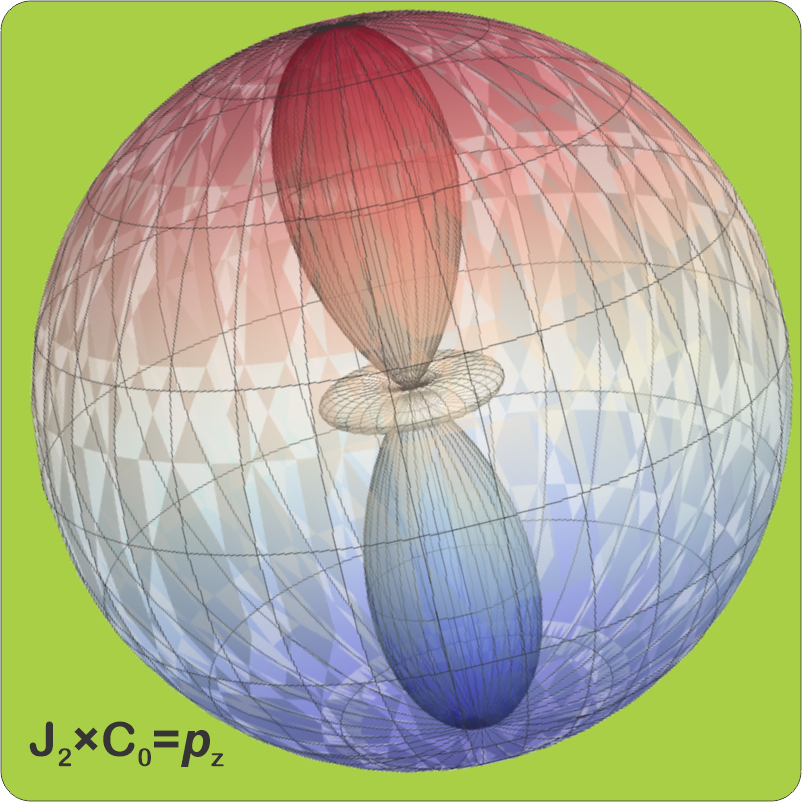
“Oh, yes. In my head I multiplied your J2 by C0 and got a pz orbital.”

“I’m impressed.”
 ”Me, too.”

“Oh, I didn’t do it numerically. I just followed the nodes. J2 has two latitude nodes, C0 has no longitude nodes. There it is, easy‑peasy.”

~~ Rich Olcott

More Map Games

Vinnie’s not in his usual afternoon spot at the table by the coffee shop door. Then I hear him. “Hey, Sy, over here.” He’s at the center table, surrounded by Cal’s usual clientele but they’re passing sheets of paper around. I worm my way through the crowd. ”What’s going on, Vinnie?”

“Me and Larry are both between piloting assignments so we spent the weekend playing with that map software he bought. He’s figured out how to link it with online databases so we can map just about anything all different ways. Hey, you’re into history, right?”

“Some, yes.”

“This one’s about how far countries go back. I kinda thought countries have always just been there, but no. We found a list of when each country got to have their own government independent of somebody else in charge, so we made this map with the oldest countries the darkest. Look how pale most of the world is. Look at us — the USA is the tenth oldest country. I couldn’t believe it.”

“Ah, I know Denmark started with the Vikings soon after the Roman Empire collapsed. Hungary’s history as a kingdom started about the same time. Then there’s a handful of old states defended by mountains — yup, I see Nepal and Switzerland. Andorra, Liechtenstein and San Marino are in the same category, but they’re too small for this map to show them.”

“You missed the Netherlands from 1579 when they broke free from Spain. No mountains. Larry graphed the numbers down in the corner.”

“Mm-hm. I see two waves. The USA and France started the first one in the late 1700s. That took in most of the New World by the mid‑1800s. Then two World Wars and ‘Katie, bar the door!‘ I hadn’t realized how abruptly de‑colonization took place. Wow. All of Africa and most of southeast Asia became free‑standing countries in just half a century. What’s with Russia — missing data?”

“Gotcha, Sy. That was 1991, when the USSR broke up. Bang! Twenty new countries, all near the top of the scale.” <shuffling papers> “Here’s another one you’ll like. Larry has this theory that countries with lots of neighbors get militarized ’cause they’ve always got a war going on somewhere but if you don’t share borders with hardly anyone, no problem. He did up this map to check his theory. See Canada’s light blue ’cause it’s got only us, we’re dark blue ’cause we got Canada and Mexico. Dark green countries got four and so on. Whaddaya see here?”

“Uh-oh.”

“Yeah. Top of the list, 14 each, are Russia and China who are not best buddies with hardly anybody. Brazil’s got 10, but rainforest is probably as good as mountains.”

“Good point.”

“Excuse me, guys, but I’ve got personal counter‑example experience.”

“Hi, Susan. What’s that?”

“I grew up in Korea, right? Only 2 neighbors, China and Japan, but we’ve got a tough history because each of them just used us as a bridge to get to the other one. Tell Larry it makes a difference who you share a border with.”

“I’ll pass the word. Wait a minute…” <more paper shuffling> “Here’s one we did just for you, Ms Chemist.”

“Weird. How do you even read this?”

“We ran into a problem with the standard maps when we colored each country according to how many chemical elements were discovered there. Most of the action mushed into western Europe’s small area when we showed the other countries. Larry tried a bunch of different projections. This one’s like a fish‑eye lens looking down near the North Pole. See, Russia’s spread around the center but Europe’s bigger?”

“Ah, once I know what to look for it snaps in.”

“I cropped it down to the oval ’cause all the blue sea didn’t fit on the page.”

“Understandable. Lesseee… The UK’s on top mostly because of Wollaston’s geochemistry, Humphry Davy’s work on electropositive metals, and Ramsay isolating the inert gases. The USA owes its second‑place status to Seaborg’s isotope factory at UCal Berkeley. One step down, Germany, France and Sweden ran a discovery horse‑race during the 1800s. Russia came on strong with radioactives but that was late in the game.”

“Wait, Susan. How’d the purples get into this? No big labs there.”

“Except for nihonium, it’s mostly right‑place‑right‑time luck. India gets credit because a French astronomer observing an eclipse from there spotted a helium line in the solar spectrum. Later, an Italian recorded the line on Earth and a Scot isolated the gas.”

~~ Rich Olcott

Zoning Out over Jupiter

I’m nursing my usual mug of eye‑opener in Cal’s Coffee Shop when astronomer Cathleen and chemist Susan chatter in. “Morning, ladies. Cathleen, prepare to be even more smug.”

“Ooo, what should I be smug about?”

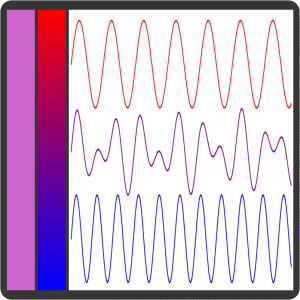
Your Jupiter suggestion. Grab some coffee and a couple of chairs.” <screen‑tapping on Old Reliable> “Ready? First step — purple and violet. You’ll never see violet or purple light coming from a standard video screen.”

“He’s going spectrum‑y on us, right, Cathleen?”

“More like anti‑spectrum‑y, Susan. Purple light doesn’t exist in the spectrum. We only perceive that color when we see red mixed with blue like that second band on Sy’s display. Violet light is a thing in nature, we can see it in flowers and dyes and rainbows beyond blue. Standard screens can’t show violet because their LEDs just emit red, blue and green wavelengths. Old Reliable uses mixtures of those three to fake all its colors. Where are you going with this, Sy?””

“Deeper into Physics. Cast your eyes upon the squiggles to the right. The one in the middle represents the lightwave coming from purple‑in‑the‑middle. The waveform’s jaggedy, but if you compare peaks and troughs you can see its shape is the sum of the red and blue shapes. I scaled the graphs up from 700 nanometers for red and 450 for blue.”

“Straightforward spectroscopy, Sy, Fourier analysis of a complicated linear waveform. Some astronomers make their living using that principle. So do audio engineers and lots of other people.”

“Patience, Cathleen, I’m going beyond linear. Fourier’s work applies to variation along a line. Legendre and Poisson extended the analysis to—”

“Aah, spherical harmonics! I remember them from Physical Chemistry class. They’re what gives shapes to atoms. They’ve got electron shells arranged around the nucleus. Electron charge stays as close to the nucleus as quantum will let it. Atoms absorb light energy by moving charge away from there. If the atom’s in a magnetic field or near other atoms that gives it a z-axis direction then the shells split into wavey lumps going to the poles and different directions and that’s your p-, d– and f-orbitals. Bigger shells have more room and they make weird forms but only the transition metals care about that.”

The angular portion of the lowest-energy spherical harmonics
Credit: Inigo.quilez, under CCA SA 3.0 license

“Considering you left out all the math, Susan, that’s a reasonable summary. I prefer to think of spherical harmonics as combinations of wave shapes at right angles. Imagine a spherical blob of water floating in space. If you tap it on top, waves ripple down to the bottom and back up again and maybe back down again. Those are zonal waves. A zonal harmonic averages over all E‑W longitudes at each N‑S latitude. Or you could stroke the blob on the side and set up a sectorial wave pattern that averages latitudes.”

“How about center‑out radial waves?”

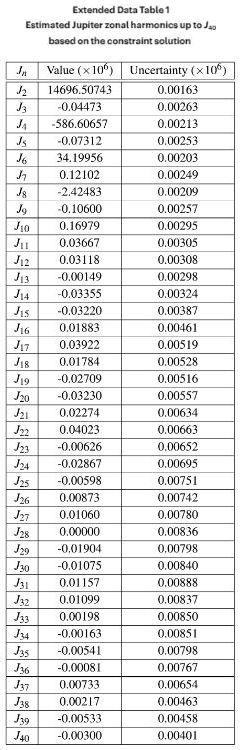
“Susan’s shells do that job. My point was going to be that what sine waves do for characterizing linear things like sound and light, spherical harmonics do for central‑force systems. We describe charge in atoms, yes, but also sound coming from an explosion, heat circulating in a star, gravity shaping a planet. Specifically, Jupiter. Kaspi’s paper you gave me, Cathleen, I read it all the way to the Results table at the tail end. That was the rabbit‑hole.”

“Oh? What’s in the table?”

“Jupiter’s zonal harmonics — J‑names in the first column, J‑intensities in the second. Jn‘s shape resembles a sine wave and has n zeroes. Jupiter’s never‑zero central field is J0. Jn increases or decreases J0‘s strength wherever it’s non‑zero. For Jupiter that’s mostly by parts per million. What’s cool is the pattern you see when you total the dominating Jeven contributions.”

Data from Kaspi, et al.

Cathleen’s squinting in thought. “Hmm… green zone A would be excess gravity from Jupiter’s equatorial bulge. B‘s excess is right where Kaspi proposed the heavy downflow. Ah‑HAH! C‘s pink deficit zone’s right on top of the Great Red Spot’s buoyant updraft. Perfect! Okay, I’m smug.”

~ Rich Olcott

A Disk of Heat And Violence

Susan suddenly sits bolt upright. “WOW! Kareem, that Chicxulub meteor that killed off the dinosaurs — paleontologists found iridium from it all over the world, right?”

“Right, the famous K‑T or K‑Pg boundary So?”

“It’d take a lot of iridium to cover the world. Iridium’s deep in the Periodic Table’s Soft Siderophile territory. Iron’s Soft. When Earth was molten, iron would extract and concentrate iridium. That’s why there’s so little iridium in Earth’s crust ’cause it’s all gone to the core. That iridium‑carrying meteorite must have been the iron kind.”

“Probably.”

Vinnie guffaws. “HAW! Earth’s Hard and crunchy on the outside, Soft and chewy in the inside, just like a good cookie.”

“Or an armored knight, from the dragon’s viewpoint. But how did Earth get that way, Cathleen?”

“Long story, Sy. The academics are still arguing about the details.”

“I love a good story, especially if it ends up explaining asteroid Psyche.”

“It starts 4½ billion years ago, when the Solar System was a rotating disk of galactic debris, clouds of hydrogen plus heavier dust and grit spewed out by energetic stars. Some of the atoms in that grit were important, right, Kareem?”

“Yup. Iron and nickel for planetary cores, silicon and oxygen for the crusts, radioactive isotopes of potassium, uranium and thorium but especially the short‑lived radioactives like aluminum‑26. Half‑life for that one’s only a million years.”

Al, Eddie and Vinnie erupt.
 ”If the short‑timers are gone, how come you say they were important?”
  ”How do we know they were even there?”
   ”If it’s such a short‑timer, is that stuff even a thing any more?”

Kareem’s not used to such a barrage but Cathleen’s a seasoned teacher. “Aluminum‑26 definitely is still a thing, because it’s continually produced by cosmic rays colliding with silicon atoms that aren’t too deeply buried. The production rate is so steady that Kareem’s colleagues estimate how long a meteorite was exposed to cosmic rays from its load of aluminum‑26 decay products compared to its related stable isotopes. We know aluminum‑26 was in the early debris because we’ve found its decay products on Earth. We even know how much — about 50 atoms per million stable aluminum atoms.”

Kareem regains his footing. “As to why it’s important, molten silicate droplets in the early system became chondrules when they aggregated to form chondritic meteorites. The droplets couldn’t have stayed that hot just from nuclear fission by their long‑lived radioactives. The short‑timers, especially aluminum‑26, must have supplied the extra heat early on. If short‑timers could keep the droplets molten, they certainly could have kept the newly‑forming planets molten for a while. Being fluid’s important because that’s the only state where Susan’s Hard‑Soft phase separation can happen.”

Cathleen nods. “The radioactives were just part of the story, though. The early system was a chaotic place. Forget notions of everything smoothly whirling around like the rings of Saturn. Except for the biggest objects, the idea of an orbit was just silly. Each object was gravitationally influenced by beaucoodles of other objects of all sizes that didn’t even all go in the same direction. There was crashing, lots of crashing. Every smash‑up converted kinetic energy to heat, lots of heat. Each collision could generate fragments which would cascade on to other collisions, maybe even become meteorites. Large objects would accumulate mass and heat energy in violent mergers with smaller objects. A protoplanet’s atom‑level Hard‑Hard and Soft‑Soft interactions would have plenty of chemical opportunities to assemble cohesive masses rising or sinking through the liquid melt just because of buoyancy and there you’ve got your layers.”

“But collisions didn’t have to be violent, Cathleen. Fragments could hang together through gravity or surface stickiness. That’s how the Bennu and Ryugu rubble pile asteroids formed.”

“Good point, Kareem, and that brings us to Psyche. We know its density is higher than stone but less than iron. The asteroid could be part of a planetoid’s interior, surviving after violent collisions chipped away the surface rock. It could be a rubble pile of loose metallic bits. It could be a mix of metal and rock like the Museum’s pallasite slice. Or an armored shell. We just won’t know until the Psyche mission gets there.”

~~ Rich Olcott

Planetary Chemistry

The deal’s gone round to Susan. “Another thing, Kareem — your assumption ignores Chemistry.”

“Didn’t Cathleen take care of that with her nuclear reactions in the star’s core?”

“Not even close. Nuclear reactions in general are literally a million or more times more energetic than chemical ones. Your classic AA alkaline battery is 1½ volts, right, but the initial step in Cathleen’s proton‑to‑helium process would net 1½ megavolts if we could set it up in a battery. Regular chemistry just re‑arranges atoms, doesn’t have a chance when nuclear’s going on.”

“Like trying to carve a cameo with dynamite, huh?”

“Not quite. If nuclear is dynamite, then bench chemistry is a bandsaw. I’d say the analog for carving a cameo would be cell biology. That operates at the millivolt level.”

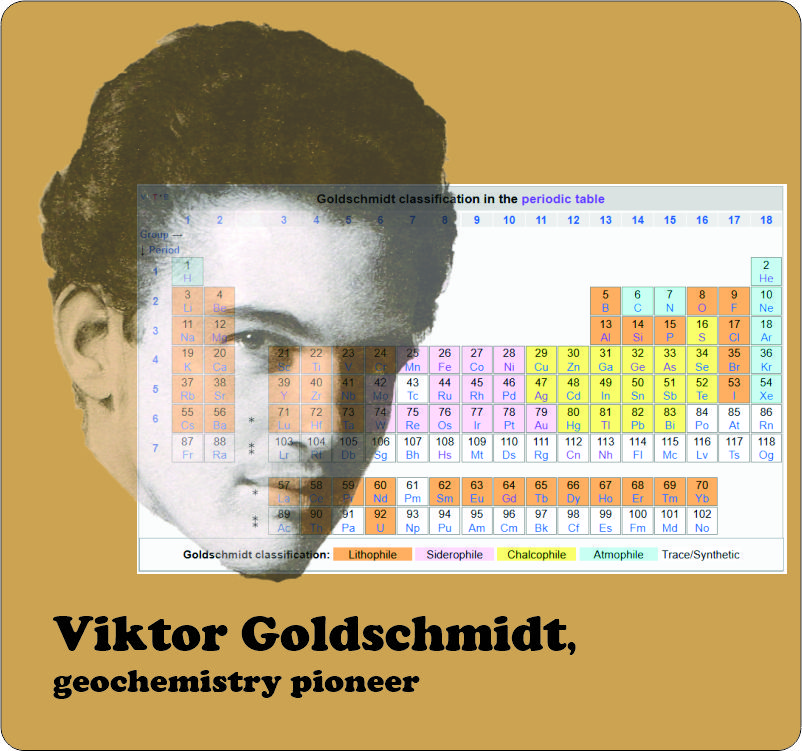
Cathleen holds up her tablet again. “Speaking of abundance graphs, here’s another one I built for my Astronomy class. I divided each element’s atom count in Earth’s crust by its atom count in the Universe. I color-coded the points according to Goldschmidt’s classification scheme. The lines mark the average ratio for each class. Compared to the Universe, oxide‑formers are ten times more concentrated in the crust than sulfide‑formers are, 150 times more concentrated than iron‑mixers, 900 times more than gases. I see the numbers but I don’t feel comfortable with them. Kareem, what do I tell my students?”

“Happy to explain the what, but Susan will have to explain the why. Goldschmidt started as a mineralogist, invented Geochemistry while bouncing around between Sweden, Norway and Germany until he barely escaped from the Nazis and was smuggled into England. He pioneered using crystallographic and thermodynamic analysis in geology. His scheme slotted each chemical element into one of those five classes. For example, he lumped the five lightest inert gases together with hydrogen, nitrogen and carbon into what he called the Atmophile class because they mostly stay in the atmosphere.”

“Carbon?”

“Yeah, that one’s iffy because coal and limestone. His reasoning involved carbon monoxide, carbon dioxide and methane which don’t show up in rocks. There are other edge cases, like radon which ought to count as a gas but shows up in rocks and basements because it’s locked where it was generated as part of uranium’s decay sequence. We mostly find uranium in oxide minerals so Goldschmidt put it and radon into his Lithophile class of metals that occur in oxides. That’s opposed to mercury, silver and a dozen or so other elements that generally show up in sulfide minerals — that’s his Chalcophile class. There’s another dozen or so that dissolve into molten iron so they’re Siderophiles. We don’t see much of those in Earth’s crust because they were swept down to the core as the molten planet differentiated. Finally, there’s a whole batch of radioactives that huddle together as Other. But why those elements do those things, I dunno. Susan, your turn.”

“It’s a lovely application of Pearson’s Hard‑Soft Acid‑Base theory. Hard chemical thingies have a high charge‑to‑volume ratio. Also, their charge is tightly bound so it doesn’t polarize. Oxide, carbonate and fluoride ions are Hard, and so are alkali and alkali metal ions like sodium and calcium. Uranium’s Hard when it’s at high oxidation state like in a uranyl ion UO22+. (Eddie, stop snickering, that’s its proper name.) Soft thingies are just the reverse — big thingies with mushy electron clouds. Iodide is Soft and so are mercury, silver and gold ions. Bulk metals are extremely Soft, chemically speaking, because their electron clouds are so diffuse. The point is, Hard thingies combine best with Hard thingies, Soft thingies with Soft.”

“So the Lithophiles are Hard metals that make Hard‑Hard stony oxides. I suppose that extends to fluorides and carbonates?”

“Sure.”

“Then the sulfide ores, Goldschmidt’s Chalcogens, are Soft‑Soft compounds. The Siderophile metals combine with each other better than anyone else, and the Atmophiles don’t combine with anything. Cool.”

“Ah‑HAH! Then on my graph the Hard oxides are most common in the crust because they’re light and so float above the heavier Soft sulfides and the ultra‑Soft metals that sink to the core. Our planet is layered by Hardness.”

“Does the same logic apply to asteroids?”

“Sort of.”

~~ Rich Olcott

The Road to Gold

Cathleen and Susan share a look.
 ”A conclusion way too far, Kareem.”
  ”Yep, you’ve overbounded your steps.”

Kareem tosses in a couple of chips. “Huh? What did I skip over? Where?”

Cathleen sees his bet and raises. “When you said that the Psyche asteroid’s gold content would be similar to what we dig up on Earth, you skipped many orders of magnitude in applying the Cosmological Principle.”

“I didn’t realize I’d done that. What’s the Cosmological Principle?”

“There’s several ways to state it, but they boil down to, ‘We’re not special in the Universe.‘ We think that fundamental constants and physical laws determined here on Earth have the same values and work the same way everywhere. Astrophysics just wouldn’t work as well as it does if the electron charge or Newton’s Laws of Motion were different a million lightyears away from us.”

“Wait, what about that galaxy that’s going to collide with us even though everything’s supposed to be flying away?”

“Fair question. The un‑boiled Principle includes some qualification clauses, especially the one that says, ‘when averaged over a large enough volume.’ How big a volume depends on what you’re studying. For motions of galaxies and such you have to average over a couple hundred million lightyears. Physical constants measured locally seem to be good out to the edge of the Observable Universe. Elemental abundances are somewhere in‑between — the very oldest, farthest‑away galaxies have less of the heavy stuff than we do around here. <pulls her tablet from her purse> Which brings me to this chart I built for one of my classes.”

“You’re going to have to explain that.”

“Sure. Both graphs are about element abundance. We get the numbers from stellar and galactic spectra so we’re averaging the local Universe out to a few hundred thousand lightyears. Left‑to‑right we’ve got hydrogen, helium, lithium and so on out to uranium in the big graph, out to iron in the small one. Up‑and‑down we’ve got atom count for each element, divided by the number of iron atoms so iron scores at 1.0. The range is huge, 31 000 hydrogens per single iron atom, all the way down to 17 rhenium atoms per billion irons. I needed this logarithmic scale to make the points I wanted to make in class.”

Vinnie sweetens the pot. “You’ve got that nice zig‑zag going in the little graph, Cathleen, but things get weird around iron and the big graph has that near‑constant series starting around 60. Why the differences?”

<lays down Q‑J‑10‑9‑8, all hearts, pulls in the chips> “Perfect straight line, Vinnie. The different behaviors come from nuclear cookery at different stages of a star’s life. Most new‑born stars start by fusing hydrogen nuclei, protons, to produce helium nuclei, alpha particles. Those two swamp everything else. As the star evolves to higher temperatures, proton‑addition processes generate successively more massive nuclei. Carbon starts a new pattern, because alpha‑addition processes it initiates generate the sawtooth pattern you picked up on — an alpha has two protons so each alpha fusion contributes to the atomic number peak two units along the line.”

“What happens with iron?”

“What happens when you put a blow torch to a red‑hot metal ball?”

“The ball melts.”

“Why?”

“Cause the extra energy’s too much for what holds the ball together.”

“Well, there you go. The forces that hold an atomic nucleus together have their limits, too. Iron and its next‑but‑one neighbor nickel are right on the edge of stability for alpha reactions. The alpha process in the core of a normal star can’t make anything heavier.”

“So how do we get the heavy guys?”

“Novas, supernovas and beyond. Those events are so energetic and so chaotic there’s non‑zero probability for any kind of atom to form and evolve to something stable before it can break down. Massive atoms just have a lower probability so there’s less of them when things settle down. Gold, for instance, at only 330 atoms per billion atoms of iron. The explosions spray heavy atoms throughout their neighborhood.”

Kareem antes the next pot. “So you’re saying my mistake was to assume that asteroid Psyche’s composition would match whole‑Universe heavy‑element statistics?”

“Well, that was his first mistake, right, Susan?”

~~ Rich Olcott