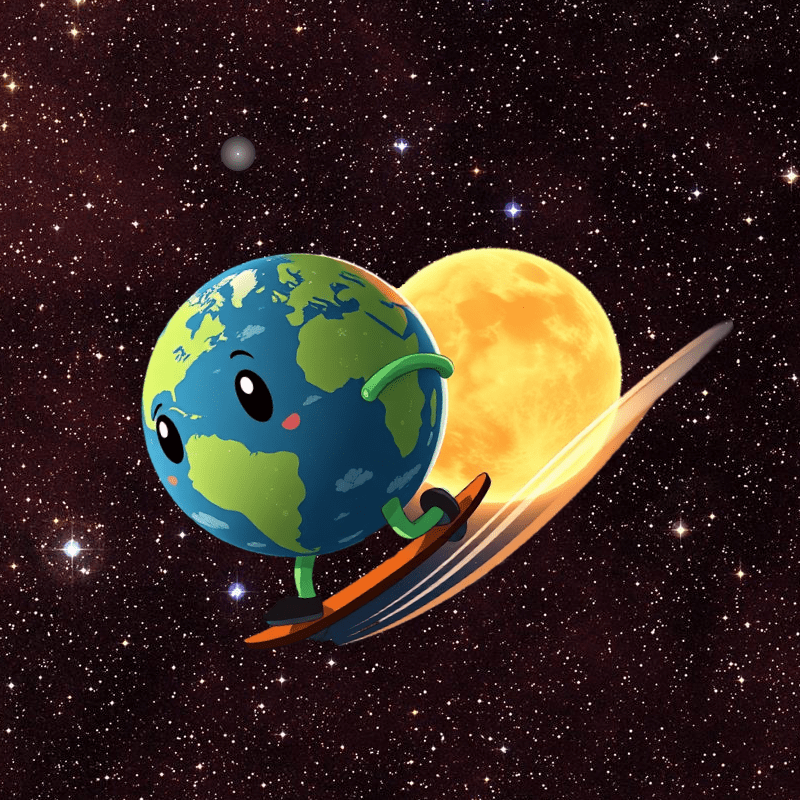
A Cosmological Horse Race

A crisp Fall day, perfect for a brisk walk around the park. I see why the geese are huddled at the center of the lake — Mr Feder, not their best friend, is on patrol again. Then he spots me. “Hey, Moire, I gotta question!”

“Of course you do, Mr Feder. What is it?”

“Some guy on TV said Einstein proved gravity goes at the speed of light and if the Sun suddenly went away it’d take eight minutes before we went flying off into space. Did Einstein really say that? Why’d he say that? Was the TV guy right? And what would us flying across space feel like?”

“I’ll say this, Mr Feder, you’re true to form. Let’s see… Einstein didn’t quite prove it, the TV fellow was right, and we’d notice being cold and in the dark well before we’d notice we’d left orbit. As to why, that’s a longer story. Walk along with me.”

“Okay, but not too fast. What’s not quite about Einstein’s proving?”

“Physicists like proofs that use dependable mathematical methods to get from experimentally-tested principles, like conservation of energy, to some result they can trust. We’ve been that way since Galileo used experiments to overturn Aristotle’s pure‑thought methodology. When Einstein linked gravity to light the linkage was more like poetry. Beautiful poetry, though.”

“What’s so beautiful about something like that?”

“All the rhymes, Mr Feder, all the rhymes. Both gravity and light get less intense with the square of the distance. Gravity and light have the same kinds of symmetries—”

“What the heck does that mean?”

“If an object or system has symmetry, you can execute certain operations on it yet make no apparent difference. Rotate a square by 90° and it looks just the same. Gravity and light both have spherical symmetry. At a given distance from a source, the field intensity’s the same no matter what direction you are from the source. Because of other symmetries they both obey conservation of momentum and conservation of energy. In the late 1890s researchers found Lorentz symmetry in Maxwell’s equations governing light’s behavior.”

“You’re gonna have to explain that Lorentz thing.”

Lorentz symmetry has to do with phenomena an observer sees near an object when their speed relative to the object approaches some threshold. Einstein’s Special Relativity theory predicted that gravity would also have Lorentz symmetry. Observations showed he was right.”

“So they both do Lorentz stuff. That makes them the same?”

“Oh, no, completely different physics but they share the same underlying structure. Maxwell’s equations say that light’s threshold is lightspeed.”

“Gravity does lightspeed, too, I suppose.”

“There were arguments about that. Einstein said beauty demands that both use the same threshold. Other people said, ‘Prove it.’ The strongest argument in his favor at the time was rough, indirect, complicated, and had to do with fine details of Earth’s orbit around the Sun. Half a century later pulsar timing data gave us an improved measurement, still indirect and complicated. This one showed gravity’s threshold to be with 0.2% of lightspeed.”

“Anything direct like I could understand it?”

“How about a straight‑up horse race? In 2017, the LIGO facility picked up a gravitational signal that came in at the same time that optical and gamma ray observatories recorded pulses from the same source, a colliding pair of neutron stars in a galaxy 130 million lightyears away. A long track, right?”

“Waves, not horses, but how far apart were the signals?”

“Close enough that the measured speed of gravity is within 10–15 of the speed of light.”

“A photo-finish.”

“Nice pun, Mr Feder. We’re about 8½ light-minutes away from the Sun so we’re also 8½ gravity-minutes from the Sun. As the TV announcer said, if the Sun were to suddenly dematerialize then Earth would lose the Sun’s orbital attraction 8½ minutes later. We as individuals wouldn’t go floating off into space, though. Earth’s gravity would still hold us close as the whole darkened, cooling planet leaves orbit and heads outward.”

“I like it better staying close to home.”
~ Rich Olcott
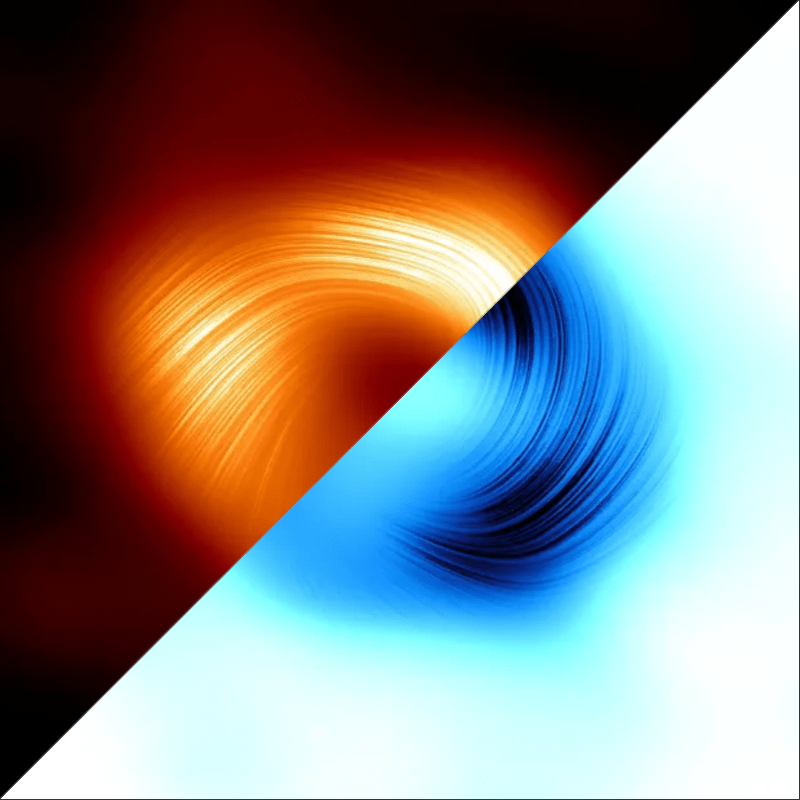
A High-contrast Image

Vinnie clomps into my office. “Morning, Sy. I knew you weren’t busy ’cause there’s music playing.”

“Well, you’re right, I am between assignments. Yesterday another client called to say they’re cancelling my contract because their Federal grant was cut off. They had to let three grad students go, too. That was a project with good prospects for generating a couple of successful businesses. These zealots are eating our seed corn, Vinnie, and they’re burning down the silo.”

“I know the feeling, Sy. There’s a lot less charter flying to do these days. Nobody wants to do meetings when they don’t know what the rules will be next week.”

<deep sigh>
 <deep sigh>

“Oh, yeah, Sy. Why I came up here — what’s with white holes? Cal asked me about ’em ’cause a little squib in one of his astronomy magazines didn’t tell us much so now I’m curious.”

“Okay, tell me something you know about black holes.”

“We can’t see one, but we can see light from its accretion disc.”

“Fair enough. Something else.”

“A black hole’s what you get when a right‑size star collapses.”

“I like that ‘right‑size’ qualification. Too small or too big doesn’t work. White holes almost certainly can’t happen from a star collapse. What else?”

“I heard that ‘almost.’ Uhh… once you pass inside the Event Horizon, you can’t get out.”

“You can’t get inside a white hole’s Event Horizon.”

“Okay, that’s weird. Like it’s got a hard crust like black holes don’t?”

“Nope. A white hole’s Event Horizon’s a mathematical abstraction just like a black hole’s. Not a hard surface, just a boundary where time starts playing games.”

“Wait, we talked about time and the Event Horizon some time ago. If I remember right, we worked out that cause‑and‑effect runs parallel to time. Outside the Event horizon time’s not locked to any specific orientation in space. We can cause things to happen in any direction. Inside the Event Horizon’s sphere, both time and cause‑and‑effect point further in. You can’t make anything happen further out than wherever you are in there which is why light can’t escape, right?”

“Mostly. Anything inside the Horizon is bound to spiral inward toward the singularity. The journey could be slow or fast. There’s some disagreement on how long it would take, though — could be forever, could be forever near enough. Some current models say the Horizon’s geometric center is the infinitely distant future. Other models say, no, for a stellar‑collapse black hole it’s only beyond the age of the Universe.”

“Why not … oh, because the real black hole was born at a definite time so it can’t have an infinite future.”

“That’s about the size of it — both directions either finite or infinite. Physicists love to propose symmetries like that but I’m not willing to bet either way.”

“Black hole/white hole sounds like symmetry.”

“In a way it isn’t, in a way it is. Both varieties are solutions for Einstein’s equation about spacetime under—”

“Hold it, no equations, you know I hate those things. Anyway, how can two different holes solve one equation?”

“Solve x=√9.”

“Gotta be x=3.”

“Or minus‑3. They’re both right answers, right?”

“Mmm, yeah. Okay, that was arithmetic, not an equation, but why’d you give it to me at all?”

“To demonstrate plus‑or‑minus symmetry. Einstein’s equation tells how mass warps spacetime. The answers relate to square‑roots of summed squares like Pythagoras’ c=√(a²+b²). If you pick positive square roots the warping describes a black hole. The negative square roots give the warping for a white hole which behaves differently. Both kinds depend on intense gravitational fields arising from a singularity but a white hole’s cause‑and‑effect arrow points outward.”

“So that’s why you’re locked out? You can’t cause anything further in than you are?”

“Exactly. But it gets deeper. A black hole’s singularity, the one you can’t avoid if you’re inside its Event Horizon, is in the distant future. A white hole’s singularity, the one you can’t get to anyway, is in the distant past.”

“That’s why you said they can’t come from star collapses — the stars died too recent.”

“Mm-hm. If white holes exist at all, they probably were born in the Big Bang.”

~ Rich Olcott

A Carefully Plotted Tale

<chirp, chirp> “Moire here.”

“Hello, Mr Moire. Remember me?”

“Yes, I do, Walt. I hope your people were satisfied with what you brought them from our last meeting.”

“They were, which is why I’m calling. Buy you pizza at Eddie’s, fifteen minutes?”

“Make it twenty.”


We’re at the rear‑corner table, Walt facing both doors, naturally. “So, what’s the mysterious question this time?”

“Word on the street is that the CPT Law’s being violated. We want to know who’s involved, and what’s their connection with ChatGPT.”

Good thing I’ve just bit into my pizza so I can muffle my chuckle in my chewing. “What do you know about anti‑matter?”

“Inside‑out atoms — protons outside whizzing around electrons in the nucleus.”

“Common misconception. One proton has the mass of 1800 electrons. An atom built as you described would be unstable — the thing would fly apart. You’ve got anti‑matter’s charges arranged right but not the particles. Anti‑matter has negative anti‑protons in the nucleus and positrons, positive electrons, on the outside.”

<writing rapidly in his notebook> “You can do that? Just flip the sign on a particle?”

“No, positrons and such are respectable particles in their own right, distinct from their anti‑partners. Electric charge comes built into the identity. What’s important is, an anti‑atom behaves exactly like a normal atom does. Maxwell’s Equations and everything derived from them, including quantum mechanics, work equally well for either charge structure.”

“There’s a bit of Zen there — change but no‑change.”

“Nice. Physicists call that sort of thing a symmetry. In this case it’s charge symmetry, often written as C.”

“The C in CPT?”

“Exactly.”

“What about the P and T?”

“When someone says something is symmetrical, what do you think of first?”

“Right side’s a reflection of left side. Symmetrical faces look better but they’re usually less memorable.”

“Interesting choice of example. Anyway, reflection symmetry is important in common physical systems.”

“Classical Greek and Cambodian architecture; the Baroque aesthetic without the decorative frills.”

“I suppose so. Anyway, we call reflection symmetry Parity, or P for short.”

“And T?”

“Time.”

“Time’s not symmetrical. It’s always past‑to‑future.”

“Maybe, maybe not. In all our physical laws that deal with a small number of particles, you can replace t for time with –t and get the same results except for maybe a flipped sign. Newton’s Laws would run the Solar System in reverse just as well as they do forward.”

“But … Ah, ‘small number of particles,’ that’s your out. If your system has a large number of particles, you’re in chaos territory where randomness and entropy have to increase. Entropy increase is the arrow for one‑way time.”

“Good quote.”

“I’ve been in some interesting conversations. You’re not my only Physics source. So CPT is about Charge AND Parity AND Time symmetries. But you can’t simply add them together.”

“You multiply them. Technically, each of them is represented by a mathematical operator—”

“Step away from the technically.”

“Understood. This’ll be simpler. If a system’s atoms have positive nuclei, set C=1, otherwise set C=1. If the system’s naturally‑driven motion is counterclockwise set P=1, otherwise P=1. If time is increasing, set T=1, otherwise set T=1. Okay?”

“Go on.”

“You can summarize any system’s CPT state by multiplying the prevailing symmetry values. The product will be either +1 or 1. The CPT Law says that in any universe where quantum mechanics and relativity work, one CPT state must hold universe‑wide.”

“Make it real for me.”

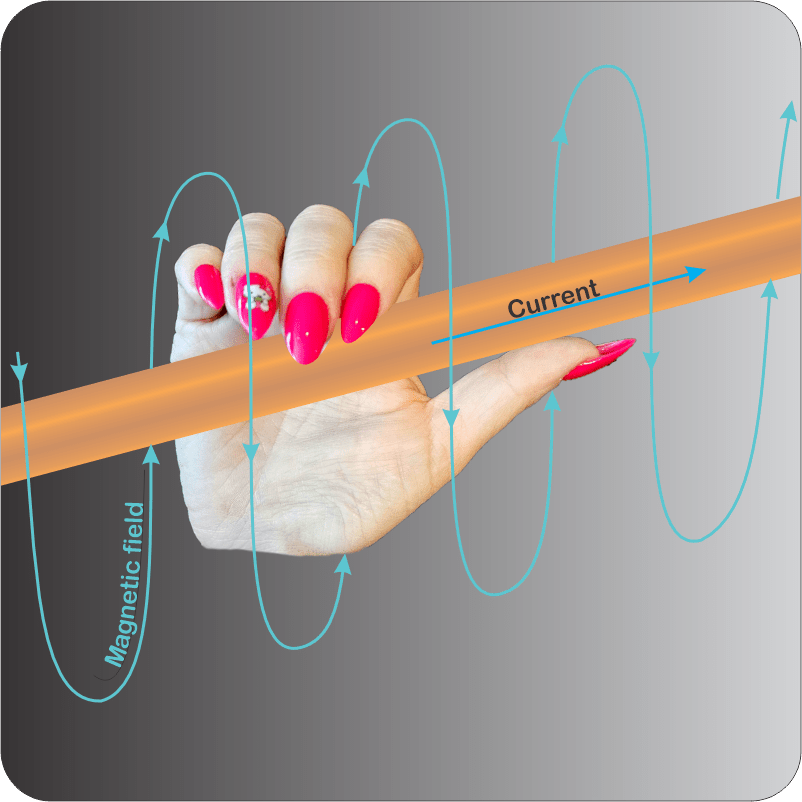
“You know the Right-hand Rule for electromagnetism?”

“Grab the wire with your right hand, thumb pointing along the current. Your fingers wrap in the direction of the spiraling magnetic field.”

“Perfect. Suppose C*P*T=+1 for this case. Now reverse the charge, making C=1. What happens?”

“Ssss… The magnetic spin flips orientation. That’s a reflection operation so P=1. The C*P*T calculation is (+1)*(1)*(1)=+1, no change.”

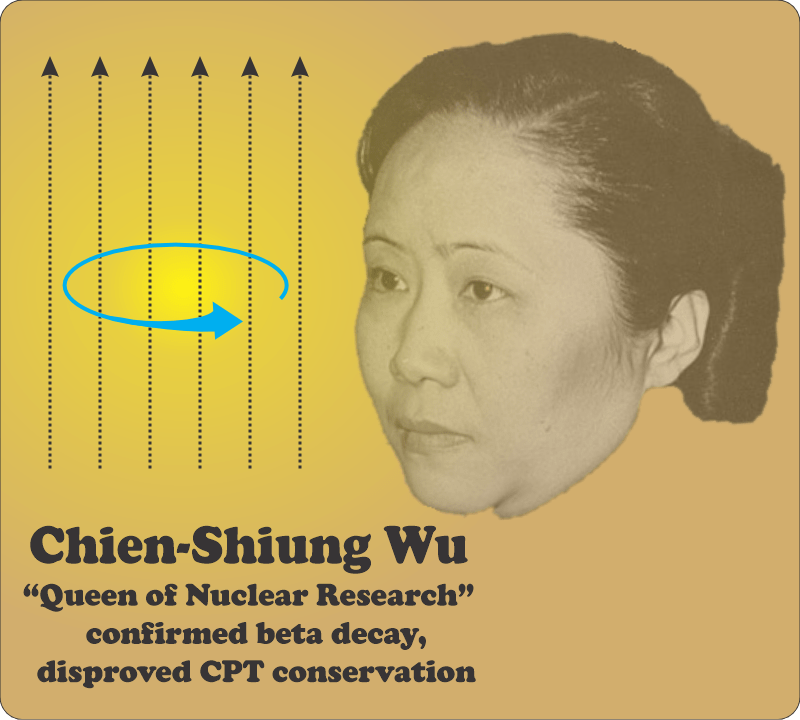
“The CPT Law in action. The CPT violation you’ve heard about is only observed in rare weak‑force‑mediated radioactive decays of a carefully prepared nucleus. That was a 1956 Nobel‑winning discovery, though the right person didn’t win it.”

“1956. Decades before A.I.”

“Yup, ChatGPT is off the hook. For that.”

“Bye.”

“Don’t mention it.”

~ Rich Olcott

  • Thanks to Caitlin, the hand model.

Five More Alternate Universes?

I unlock my office door and there’s Vinnie inside, looking out the window. “Your 12th‑floor view’s pretty nice, Sy. From above the tree tops you can see leaf buds just starting to show their early green colors.”

“What are you doing here, Vinnie? I thought you were charter‑flying to Vancouver.”

“The guy canceled. Said with all the on‑again, off‑again tariffs there’s no sense traveling to make a deal when he doesn’t know what he’s dealing with. So I got some time to think.”

“And you came here so it’s something physics‑technical.”

“Yeah, some. I notice colors a lot when I’m flying. Some of those trees down there this time of year are exactly the same bright yellow‑green as some of the rice paddies I’ve flown over. But all the trees get the same hard dark green by August before they go every different color when the chlorophyll fades away.”

I’ve noticed that. So you came here to talk about spectra?”

“Some other time. This time I want to talk about dark matter.”

“But we call it dark matter precisely because it doesn’t do light. All our normal matter is made of atoms and the atoms are made of electrons and nuclei and each nucleus is made of protons and neutrons and protons and neutrons are made of quarks. Electrons and quarks carry electrical charge. Anything with electrical charge is subject to electromagnetism, one way or another. Dark matter doesn’t notice electromagnetism. If dark matter had even the slightest interaction with light’s electromagnetic field, we wouldn’t be able to see galaxies billions of lightyears away.”

“Calm down, Sy, breath a couple times. Stay with me here. From your stuff and what else I’ve read, all we know about dark matter is a lot of things it isn’t or doesn’t do. The only force we know it respects is gravity so it attracts itself and also normal matter and they all clump up to make galaxies and such, right?”

<a bit reluctantly and on a rising note> “Mm‑hnn…?”

“I read your three‑part series about the Bullet Cluster, where we think two galaxy clusters went though each other and their gas clouds gave off a lot of X‑rays that didn’t match where the stars were or where the gravity was so the astronomers blame dark matter for the gravity, right?”

“That’s pretty much it. So?”

“So the other thing I got from that series was maybe there’s friction between dark matter and other dark matter, like it doesn’t just slide past itself. If dark matter is particles, maybe they’re sorta sticky and don’t bounce off each other like billiard balls. That doesn’t make sense if all they do is gravity.”

“I see where you’re going. You’re thinking that maybe dark matter feels some kind of force that’s not gravity or electromagnetism.”

“That’s it! We’ve got light photons carrying electromagnetic forces to hold our molecules and rocks together. Could there be dark photons carrying some dark‑sticky force to connect up dark molecules and dark rocks and stuff?”

“That’s an interesting—”

“I ain’t done yet, Sy. It gets better. I’ve read a bunch of articles saying there’s about five times as much dark matter in the Universe as normal matter. You physicists love symmetry, suppose it’s exactly five times as much. There’d be six kinds of force, one called electromagnetism and a different snooty force each for five kinds of dark matter and that’ll add up to the 25% we can’t see. Like, a purple dark force for purple dark rocks, naturally they’re not really purple, and a yellow dark force and so on.”

“You’re proposing that each kind of dark matter responds only to its own special force, so no cross‑communication?”

“Yup, gravity’s the only thing they’d all agree on. That bein’ the case, the galaxies would hold six times as many stars as we think, except 5/6 of them are invisible to our 1/6. Five alternate universes sharing space with ours. Cozy, huh?”

“Clever, Vinnie, except for the evidence that most galaxies are embedded in huge nearly‑spherical halos of dark matter. The halos would have collapsed long ago if only gravity and stickiness were in play.”

“Dang.”

~ Rich Olcott

Sectorial Setbacks

<chirp, chirp> “Moire here.”

“Moire, you were holding out on me. Eddie’s, fifteen minutes.”

“Not so fast, Walt. That wasn’t me holding out, that was you leaving too soon. From now on you’re paying quite a bit more. And it’ll be thirty minutes.”

“So we’re negotiating, hmm?”

“That’s about the size of it. You still interested?”

“My people are, they sent me back here. Oh well. Thirty minutes.”


Thirty-three minutes later I walk into Eddie’s. Walt’s already gotten a table. He beckons, points to the freshly‑served pizza, raises an eyebrow.

“Apology accepted. What made your people unhappy?”

“You told me flat‑out that the Sun’s gravity couldn’t affect those zonal harmonics. Do you have anything to back that up?”

“Symmetry. Zonal harmonics and latitude are about north‑south. Each Jn is a pole‑to‑pole variation pattern. The only way solar gravity can tilt Jupiter’s north‑south axis is to exert torque along the zonal harmonics. Jupiter’s equator is within 3° of edge‑on to the Sun.” <showing an image on Old Reliable’s screen> “Here’s what the Sun sees looking at J10, for instance. Solar pull on any northern zone segment, say, would be counteracted by an equal pull on the corresponding southern segment of the same zone. No net torque, no tilt. J0‘s the only exception. It’s simply a sphere that doesn’t vary across the whole planet. The Sun’s pull along J0‘s arc can’t tilt Jupiter.”

“Okay, so the zonal picture’s too simple. Just one set of waves, running up and down the planet—”

“No, not running. One way to characterize a wave is by how its components change with time. You’re thinking like ocean waves that move from place to place as time goes by. There’s also standing waves like on a guitar string, where individual points move but the peaks and valleys don’t. There’s time‑only waves like how the day length here changes through the year. And there’s static waves where time’s not even in the equation. Jupiter’s stripes don’t move, they’re peaks and valleys in a static wave pattern. By definition, the zonal harmonic system is static like that. But you’re right, it’s only part of the picture.”

“Give me the part the Sun’s gravitational field does play with.”

“That’d be two parts — sectorial and radial harmonics. Sectorial is zonal’s perpendicular twin. Zonal wave patterns show variation along the polar axis; sectorial wave patterns Cm vary around it. I’m keeping it non‑technical for you but Cm‘s actually cos(m*x) where x is the longitude.”

“Just don’t let it go any farther.”

“I’ll try not to. My point is that each sector pattern can be labeled with a positive integer just like we did with the zones.”

“If the Jn arcs aren’t affected by solar gravity, why would I care about these Cms?”

“You wouldn’t, except for the fact that mass distribution across Jupiter’s sectors is probably lumpy. We know the Great Red Spot holds its position in the southern hemisphere and the planet’s magnetic field points way off to the side. Maybe those features mark off‑center mass deficits and concentrations. Suppose a particular sectorial wave’s peak sits directly over a mass lump or hole. Everything under that harmonic’s influence is tugged back and forth by solar gravity each time the wave traverses the day side. Juno in its N‑S path just isn’t an efficient sensor for those tugs. Good sectorial sensing would require an orbiter on an E‑W path, preferably right over the equator.  Any orbital wobbles we’d see could be fed into a sectorial gravity map. Cross that with the zonal map and we’d be able to locate underlying mass variations by latitude and longitude.”

“Not a good idea. Gravity’s not the only field in play. You’ve just mentioned Jupiter’s magnetic field. I’ve read it’s stronger than any other planet’s. If your E‑W orbiter’s built with even a small amount of iron, you’d have a hard time deciding which field was responsible for any observed irregularities.”

“Good point. The idea’s even worse than you think, though. Jupiter’s sulfur‑coated moon—”

“Io. Yes, your induction‑heating idea might even be real. What about it?”

“I haven’t written yet about the high‑voltage Io‑to‑Jupiter bridge made of sulfur, oxygen and hydrogen ions. Jupiter’s magnetism plays a complicated game with them but the result is a chaotic sheet of radiating plasma around the planet’s equator. An E‑W orbiter in there would be tossed about like a paper boat on the ocean.”

~~ Rich Olcott

White Noise And Red

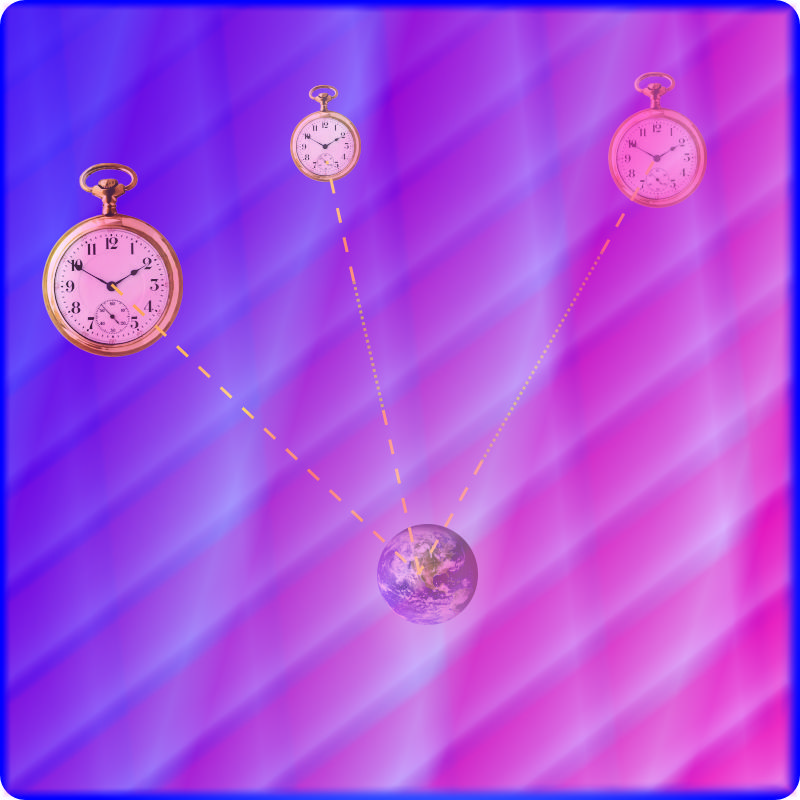
“That point’s kinda weak, Sy. The NANOGrav team says 15 years of pulsar timing data let them hear the Universe humming. What’s the difference if they call it a hum or a rumble or a warble?”

“Not much, Vinnie. Matter of taste and scale, I guess. As a human I think of a ‘hum‘ as something in the auditory range, roughly 60‑120 cycles per second. Whatever these folks have found, it rumbles in years per cycle. Scaled to the Sun’s ten‑billion‑year lifetime I suppose that’d be a supersonic screech.”

“Whatever they’ve found? We don’t know?”

“Not yet, Al. The team likes one hypothesis but it’ll take years to collect enough data for firm support or refutation.”

“In addition to the 15 years‑worth they’ve got already? Why not just add more antennas?”

“What they’re following changes so slowly they need a long baseline to have confidence that jiggles they see are real. Part of this paper is about conclusions the team reached after they stuck a few extra years of old data onto the front of their time series.”

“You can do that?”

“Sure. The series is just a big database, like a spreadsheet with a page for each pulsar and a row on that page for each blink. The row captures the recorded time for the blink’s peak, but also a bunch of other data like measures related to pulse width and asymmetry, the corrected peak time, identifiers for the reporting observatory and reference time standard—”

Corrected time? Looks suspicious. What did they correct for?”

“Of course you’re suspicious, Vinnie, but so are they and so are other astronomers. You don’t want to make a big announcement like this unless you’ve checked everything for error sources. For instance, Earth moving around the Sun means we’re a little closer to a particular pulsar at one time of year, further away six months later.”

“So you correct the timings to what they’d be at the Sun’s center, right?”

“That’s just for starters. Jupiter and the Sun orbit around their common center of gravity on an 11.8‑year cycle. The researchers had to pull data from the Juno mission to correct for the Sun’s personal waltz. Of course the Solar System is moving relative to the stellar background, another correction. Then maybe the pulsar itself is part of a binary, happens a lot, and it’s probably moving through the sky, too — lots of careful corrections. That’s step one.”

“Then what?”

“Use each pulsar’s corrected timings to build a mathematical model of its idealized behavior. Once you know what’s ‘normal‘, you can start talking about jiggles that deviate from normal.”

“Reminds me of the ephemeris trick — sort of build an artificial pulsar to compare against.”

“Exactly the same idea, Vinnie, and by the way, ephemerides are still used but not to define the length of a second. Step three is statistical analysis: compare all possible deviation histories, every pulsar against every other pulsar.”

“Sounds like a lot of work, even for a computer. So what did they find?”

“Well, what they observed was that the pulsar timings we received weren’t as absolutely regular as they would have been with a static gravitational field. The overall picture resembled fog in a noisy room, waves of every size skittering in every direction and messing up reception. When the researchers broke that picture down by frequency, the waves shorter than 21 months or so added up to just white noise, complete randomness.”

“A hiss, not a hum. What about the longer waves?”

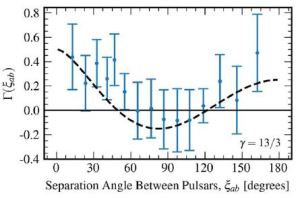
Fig 1(c) from Agazie, el al (2023).

“Red noise — jiggles heavy‑loaded on longer wavelengths out to the 16‑year maximum their data’s good for so far. But that’s not all. When they plotted jiggle correlation between pulsars separated at different angles across the sky, the curve mostly matched a prediction for the gravitational wave pattern that would be generated by a large number of randomly distributed independent sources.”

“Lots of sources, which would be…?”

“We don’t know. One hypothesis is that they’re pairs of supermassive black holes orbiting each other at the centers of merged galaxies. But I’ve read another paper giving a dozen other explanations. Everyone’s waiting for more data.”

~~ Rich Olcott

Symmetry And The Loopholes

“So, we’ve got geometry symmetry and relativity symmetry. Is that it, Sy?”

“Hardly, Al. There’s scores of them. Mathematics has a whole branch devoted to sorting and classifying the operations and how they group together. Shall I list a few dozen?”

“Ah, no, don’t bother, thanks. You got one I’d recognize?”

“How about charge symmetry? Flip an electron’s negative charge and you’ve got a positron that has exactly the same mass and the same interaction with light waves. OK, positrons move opposite to electrons in a magnetic field which is how their existence was confirmed, but charge is s a fundamental symmetry for normal matter.”

“Oh, right, charge is a piece of that CPT symmetry you hung your anti‑Universe story on. Which reminds me, you never said what the ‘P’ stands for.”

“Parity, as in Charge‑Parity‑Time. Before you ask, ‘parity‘ is left-right symmetry. Parity symmetry says you can replace ‘clockwise‘ with ‘counterclockwise‘ in a system and the equations describing the system will give perfectly good predictions. Time symmetry is about time running forward or backward. The equations are happy either way. The CPT theorem says the three symmetries are solidly tied together — you can’t flip one without the other two tagging along. If some process emits particle X with clockwise spin, there’s some equivalent process that soaks up an anti-X if it’s spinning counterclockwise. Very firm theorem, lots of laboratory evidence for it from electromagnetism and the nuclear strong force. But.”

“But?”

“But Chien‑Shiung Wu did an experiment that showed the nuclear weak force doesn’t always obey CPT rules. Her worked proved we live in a handed Universe. She should have gotten a Nobel for that, but it was last century and the Nobel Committee was men‑only. Two theory guys copped the prize that should have gone to the three of them. The theory guys protested but the Committee ignored Wu anyway. Sometimes things aren’t fair.”

“Tell me about it. So the theory’s got a loophole?”

“Apparently, but to my knowledge no‐one’s found it. Some string theories claim to hint at an explanation but that’s not much help, considering.”

“Huh. Could the loophole maybe be an example of symmetry breaking?”

“Very good question. I think it’s a qualified probably but that’s a guess.”

“Sy, I think that’s the wishy-washiest you’ve ever been.”

“One of my rules is, when you’re going out on a limb be sure you’re properly roped to the tree. In this case I’m generalizing from a single sample.”

“You’re gonna tell me, right?”

   Professor Higgs presents
       the Higgs Bozo.

“Just the bare outline because I don’t want to get into the deep weeds. Back in the 1960s Physics was in trouble because the nuclear strong force particles that bind the nucleus together were found to have mass and move slowly. Strong‑force theory at the time said they should be massless and move at lightspeed. The theory depended on part of the potential energy varying with the symmetry of a circle. Then Higgs—”

“The Higgs Boson guy?”

“That’s him. Anyway, he published a three‑page paper showing that those binding particles aren’t controlled solely by the nuclear strong force. Because they have a charge they also engage with the electromagnetic field. Electromagnetism is a lot weaker than the strong force, but it’s strong enough to deform the theory’s circle into an ellipse. Breaking the circular symmetry in effect gives the particles mass and slows them down.”

“So where’s the boson come in? I thought it’s what makes mass for everything.”

“Absolutely not, probably. The protons and neutrons have plenty of mass on their own, thank you very much. It’s only those strong-force particles that gain mass, less than 1% of the nucleus total. But the whole story is a great example of how making a system less symmetrical, even a little bit, can completely change how it operates. We think that’s what drove the Big Bang’s story. The early Universe was so dense and hot it was a perfectly symmetrical quark soup — chaos all the way down. Space expansion opened successive symmetry loopholes that permitted layers of structure formation.”

<looking at hands> “I don’t feel unsymmetrical.”

“Trust me, deep down you are.”

~~ Rich Olcott

Reflection, Rotation And Spacetime

“Afternoon, Al.”

“Hiya, Sy. Hey, which of these two scones d’ya like better?”

“”Mm … this oniony one, sorta. The other is too vegetable for me ‑ grass, I think, and maybe asparagus? What’s going on?”

“Experimenting, Sy, experimenting. I’m going for ‘Taste of Spring.’ The first one was spring onion, the second was fiddlehead ferns. I picked ’em myself.”

“Very seasonal, but I’m afraid neither goes well with coffee. I’ll take a caramel scone, please, plus a mug of my usual mud.”

“Aw, Sy, caramel’s a winter flavor. Here you go. Say, while you’re here, maybe you could clear up something for me?”

“I can try. What’s the something?”

“After your multiverse series I got out my astronomy magazines to read up on the Big Bang. Several of the articles said that we’ve gone through several … um, I think they said ‘epochs‘ … separated by episodes of symmetry breaking. What’s that all about?”

“It’s about a central notion in modern Physics. Name me some kinds of symmetry.”

“Mmm, there’s left‑right, of course, and the turning kind like a snowflake has. Come to think — I like listening to Bach and Vivaldi when I’m planet‑watching. I don’t know why but their stuff reminds me of geometry and feels like symmetry.”

“Would it help to know that the word comes from the Greek for ‘same measure‘? Symmetry is about transformations, like your mirror and rotation operations, that affect a system but don’t significantly change to its measurable properties. Rotate that snowflake 60° and it looks exactly the same. Both the geometric symmetries you named are two‑dimensional but the principle applies all over the place. Bach and the whole Baroque era were just saturated with symmetry. His music was so regular it even looked good on the page. Even buildings and artworks back then were planned to look balanced, as much mass and structure on the left as on the right.”

“I don’t read music, just listen to it. Why does Bach sound symmetric?”

“There’s another kind of symmetry, called a ‘translation‘ don’t ask why, where the transformation moves something along a line within some larger structure. That paper napkin dispenser, for instance. It’s got a stack of napkins that all look alike. I pull one off, napkins move up one unit but the stack doesn’t look any different.”

“Except I gotta refill it when it runs low, but I get your drift. You’re saying Bach takes a phrase and repeats it over and over and that sounds like translational symmetry along the music’s timeline.”

“Yup, maybe up or down a few tones, maybe a different register or instrument. The repeats are the thing. Play his Third Brandenberg Concerto next time you’re at your telescope, you’ll see what I mean.”

“Symmetry’s not just math then.”

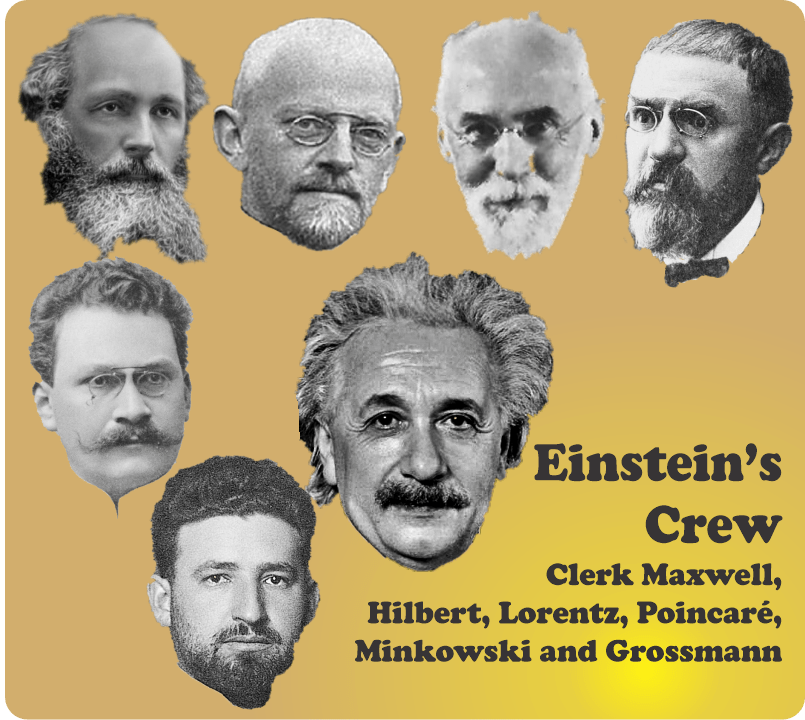
“Like I said, it’s everywhere. You’ve seen diagrams of DNA’s spiral staircase. It combines translation with rotation symmetry, does about 10 translation steps per turn, over and over. The Universe has a symmetry you don’t see at all. No‑one did until Lorentz and Poincaré revised Heaviside’s version of Maxwell’s electromagnetism equations for Minkowski space. Einstein, Hilbert and Grossman used that work to give us and the Universe a new symmetry.”

“Einstein didn’t do the math?”

“The crew I just named were world‑class in math, he wasn’t. Einstein’s strengths were his physical intuition and his ability to pick problems his math buddies would find interesting. Look, Newton’s Universe depends on absolute space and time. The distance between two objects at a given time is always the same, no matter who’s measuring it or how fast anyone is moving. All observers measure the same duration between two incidents regardless. Follow me?”

“Makes sense. That’s how things work hereabouts, anyway.”

“That’s how they work everywhere until you get to high speeds or high gravity. Lorentz proved that the distances and durations you measure depend on your velocity relative to what you’re measuring. Extreme cases lead to inconsistent numbers. Newton’s absolute space and time are pliable. To Einstein such instability was an abomination. Physics needs a firm foundation, a symmetry between all observers to support consistent measurements throughout the Universe. Einstein’s Relativity Theory rescued Physics with symmetrical mathematical transformations that enforce consistency.”

~~ Rich Olcott

Making Things Simpler

“How about a pumpkin spice gelato, Mr Moire?”

“I don’t think so, Jeremy. I’m a traditionalist. A double‑dip of pistachio, please.”

“Coming right up, sir. By the way, I’ve been thinking about the Math poetry you find in the circular and hyperbolic functions. How about what you’d call Physics poetry?”

“Sure. Starting small, Physics has symmetries for rhymes. If you can pivot an experiment or system through some angle and get the same result, that’s rotational symmetry. If you can flip it right‑to‑left that’s parity symmetry. I think of a symmetry as like putting the same sound at the end of each line in rhymed verse. Physicists have identified dozens of symmetries, some extremely abstract and some fundamental to how we understand the Universe. Our quantum theory for electrons in atoms is based on the symmetries of a sphere. Without those symmetries we wouldn’t be able to use Schrodinger’s equation to understand how atoms work.”

“Symmetries as rhymes … okaaayy. What else?”

“You mentioned the importance of word choice in poetry. For the Physics equivalent I’d point to notation. You’ve heard about the battle between Newton and Leibniz about who invented calculus. In the long run the algebraic techniques that Leibniz developed prevailed over Newton’s geometric ones because Leibniz’ way of writing math was far simpler to read, write and manipulate — better word choice. Trying to read Newton’s Principia is painful, in large part because Euler hadn’t yet invented the streamlined algebraic syntax we use today. Newton’s work could have gone faster and deeper if he’d been able to communicate with Euler‑style equations instead of full sentences.”

“Oiler‑style?”

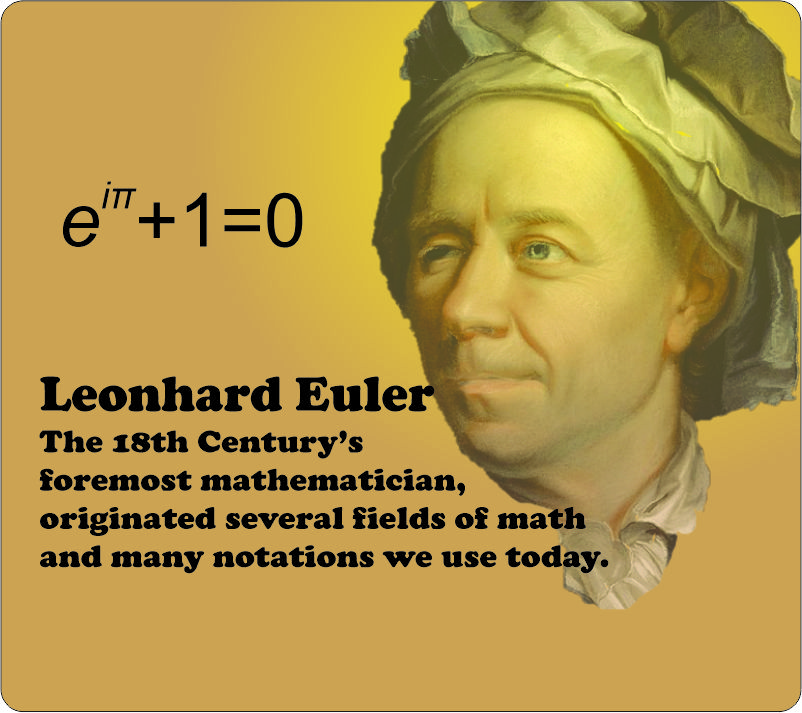
“Leonhard Euler, though it’s pronounced like ‘oiler‘. Europe’s foremost mathematician of the 18th Century. Much better at math than he was at engineering or court politics — both the Russian and Austrian royal courts supported him but they decided the best place for him was the classroom and his study. But while he was in there he worked like a fiend. There was a period when he produced more mathematics literature than all the rest of Europe. Descartes outright rejected numbers involving ‑1, labeled them ‘imaginary.’ Euler considered ‑1 a constant like any other, gave it the letter i and proceeded to build entire branches of math based upon it. Poor guy’s vision started failing in his early 30s — I’ve often wondered whether he developed efficient notational conventions as a defense so he could see more meaning at a glance.”

“He invented all those weird squiggles in Math and Physics books that aren’t even Roman or Greek letters?”

“Nowhere near all of them, but some important ones he did and he pointed the way for other innovators to follow. A good symbol has a well‑defined meaning, but it carries a load of associations just like words do. They lurk in the back of your mind when you see it. π makes you think of circles and repetitive function like sine waves, right? There’s a fancy capital‑R for ‘the set of all real numbers‘ and a fancy capital‑Z for ‘the set of all integers.’ The first set is infinitely larger than the second one. Each symbol carries implications abut what kind of logic is valid nearby and what to be suspicious of. Depends on context, of course. Little‑c could be either speed‑of‑light or a triangle’s hypotenuse so defining and using notation properly is important. Once you know a symbol’s precise meaning, reading an equation is much like reading a poem whose author used exactly the right words.”

“Those implications help squeeze a lot of meaning into not much space. That’s the compactness I like in a good poem.”

“It’s been said that a good notation can drive as much progress in Physics as a good experiment. I’m not sure that’s true but it certainly helps. Much of my Physics thinking is symbol manipulation. Give me precise and powerful symbols and I can reach precise and powerful conclusions. Einstein turned Physics upside down when he wrote the thirteen symbols his General Relativity Field Equation use. In his incredibly compact notation that string of symbols summarizes sixteen interconnected equations relating mass‑energy’s distribution to distorted spacetime and vice‑versa. Beautiful.”

“Beautiful, maybe, but cryptic.”

~~ Rich Olcott

The Gelato Model

“Eddie, this ginger gelato’s delicious — not too sweet and just the right amount of ginger bite.”

“Glad you like it, Anne.”

On the way down here, Sy was telling me about how so many things in the Universe run on the same mathematics if you look at them with the right coordinate system. Sy, how do you pick ‘the right coordinate system?”

“The same way you pick the right property to serve as a momentum in Newton’s Equation of Motion — physical intuition. You look for things that fit the system. Sometimes that puts you on the road to understanding, sometimes not. Eddie, you keep track of your gelato sales by flavor. How are they doing?”

“Pistachio’s always a good seller, Sy, but ginger has been coming on strong this year.”

“In motion terns, pistachio’s momentum is constant but ginger is gaining momentum, right?”

“S’what I said.”

“Measured in dollars or trayfuls?”

“In batches. I make it all in-house. I’m proud of that. Dollars, too, of course, but that’s just total for all flavors.”

“Batches all the same size?”

“Some are, some not, depending. If I had a bigger machine I could make more but I do what I can.”

“There you go, Anne, each gelato flavor is like a separate degree of freedom. Eddie’s tracked sales since he started so we can take that date as the origin. Measuring change along any degree in either batches or dollars we have perfectly respectable coordinates although the money view of the system is fuzzier. Velocity is batches per unit time, there’s even a speed limit, and ginger has accelerated. Sound familiar?”

“Sounds like you’re setting up a Physics model.”

“Call it gelato trend physics, but I don’t think I can push the analogy much further. The next step would be to define a useful momentum like Newton did with his Law of Motion.”

F=ma? That’s about acceleration, isn’t it?”

“Probably not in Newton’s mind. Back in his day they were arguing about which was conserved, energy or momentum. It was a sloppy argument because no‑one agreed on crisp definitions. People could use words like ‘quantity of motion‘ to refer to energy or momentum or even something else. Finally Newton defined momentum as ‘mass times velocity‘, but first he had to define ‘mass‘ as ‘quantity of matter‘ to distinguish it from weight which he showed is a force that’s indirectly related to mass.”

“So is it energy or momentum that’s conserved?”

“Both, once you’ve got good definitions of them. But my point is, our car culture has trained us to emphasize acceleration. Newton’s thinking centered on momentum and its changes. In modern terms he defined force as momentum change per unit time. I’m trying to think of a force‑momentum pair for Eddie’s gelato. That’s a problem because I can’t identify an analog for inertia.”

“Inertia? What’s that got to do with my gelato?”

“Not much, and that’s the problem. Inertia is resistance to force. Who can resist gelato? If it weren’t for inertia, the smallest touch would be enough to send an object at high speed off to forever. The Universe would be filled with dust because stars and planets would never get the chance to form. But here we are, which I consider a good thing. Where does inertia come from? Newton changed his mind a couple of times. To this day we only have maybe‑answers to that question.”

“You know we want to know, Sy.”

“Einstein’s favorite guess was Mach’s Principle. There’s about a dozen different versions of the basic idea but they boil down to matter interacting with the combined gravitational and electromagnetic fields generated by the entire rest of the Universe.”

“Wow. Wait, the stars are far away and the galaxies are much, much further away. Their fields would be so faint, how can they have any effect at all?”

“You’re right, Anne, field intensity per star does drop with distance squared. But the number of stars goes up with distance cubed. The two trends multiply together so the force trends grow linearly. It’s a big Universe and size matters.”

“So what about my gelato?”

“We’ll need more research, Eddie. Another scoop of ginger, Anne?”

~~ Rich Olcott