Why No Purple?

<ding/ding/ding> <yawn> “Who’s texting me at this time of night?”

This better be good.

At this hour? Of course you did, Teena. What’s going on?

Well, I’m awake. What’s the question?

Whoa! That’s not really an either‑or proposition. Energy is continuous, but the energy differences that atoms/molecules respond to are stepwise. You get continuous white light from hot objects like stars and welding torches.
If white light passes a hydrogen atom, the atom will only absorb certain specific frequencies (frequency is a measure of energy).

Yes, except they don’t bounce off, they pass by.

Mostly, though the usual sequence read ‘upward’ in energy is radio, microwave, infrared, red, orange, yellow, green, blue, violet, ultraviolet, X-rays, gamma rays.
White is an even mixture of all frequencies.

Mmm?

Ah, what you’re really looking at is variation in fuel/air mixture (and possibly which fuel — I’ll get to that).
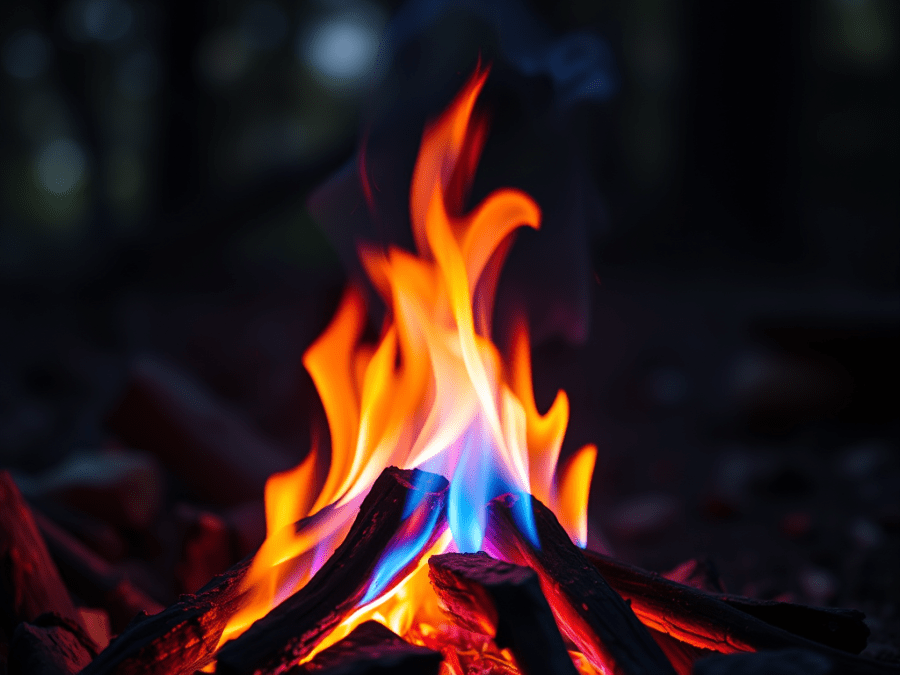
A rich methane mixture (not much oxygen, like a shuttered Bunsen burner) doesn’t get very hot, has lots of unburnt carbon particles and looks orange. Add more oxygen and the flame gets hotter, no more soot particles, just isolated CO, CO2, and water molecules, each of which gets excited to flame temp and then radiates light but only at its own characteristic frequencies. Switch to acetylene fuel and the flame gets hotter still because C2H2+O2 reactions give off more energy per molecule than CH4+O2. Now you’re in plasma temperature range, where free electrons can emit whatever frequency they feel like.

Sunsets are a whole other thing — the sun’s white light is transformed in various ways as it filters through dust and such in the atmosphere. Anyway, no flame or atom/molecule excitation in a sunset

Yes, but in each of these cases the *source* is different — soot particles, excited molecules, plasma.

The campfire has several different processes going on. Close in, the heated wood emits various gases. The gases reacting with O2 *are* the flame, generally orange to yellow from excited molecules but you can get blue where the local ventilation forms a jet and brings in extra oxygen for an efficient flame. Further out it’s back to red-hot soot.

To your original question — this is a hypothesis, but I suspect the particular atoms and molecules emitted from untreated burning wood simply don’t have any strong emissions lines in the green region. I know there aren’t for any hydrogen atoms — look up “Balmer series” in wikipedia.

*spectra
Right.
As you said, you could throw in copper or sodium salts to get those blue and golden colors.

G’night, Teena.
Now get to bed.

~ Rich Olcott

  • Thanks to Alex, who wrote much of this.
Why Those Curtains Ripple

I’m in the scone line at Cal’s Coffee when suddenly there’s a too‑familiar poke at my back, a bit right of the spine and just below the shoulder blade. I don’t look around. “Morning, Cathleen.”

“Morning, Sy. Your niece Teena certainly likes auroras, doesn’t she?”

“She likes everything. She’s the embodiment of ‘unquenchable enthusiasm.’ At that age she’s allowed.”

“It’s a gift at any age. Some of the kids in my classes, they just can’t see the wonders no matter how I try. I show them aurora photos and they say, ‘Oh yes, red and green in the sky‘ and go back to their phone screens. Of course there’s no way to get them outside late at night at a location with minimal light pollution.”

“I feel your pain.”

“Thanks. By the way, your aurora write-ups have been all about Earth’s end of the magnetic show. When you you going to do the rest of the story?”

“How do you mean?”

“Magnetism on the Sun, how a CME works, that sort of thing.”

“As a physicist I know a lot about magnetism, but you’re going to have to educate me on the astronomy.”

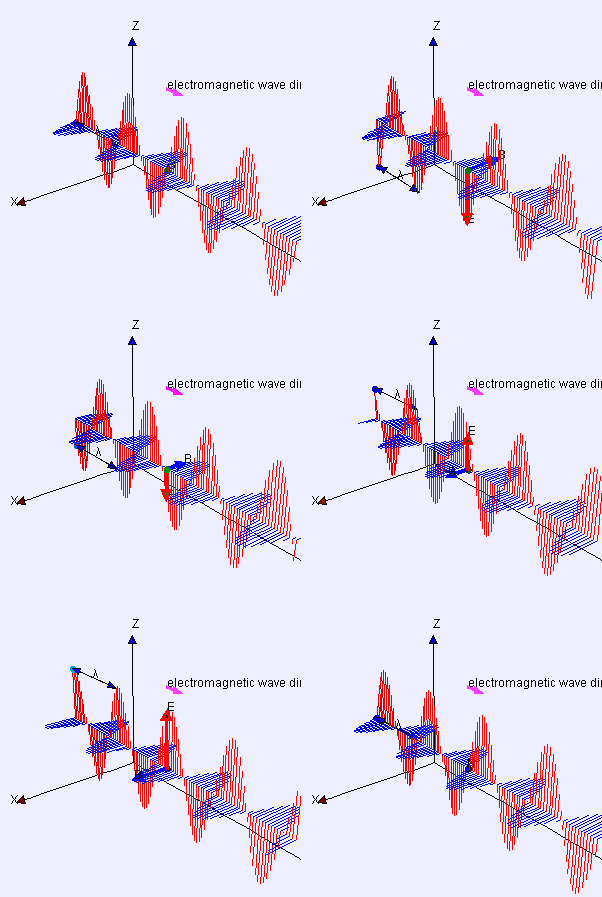
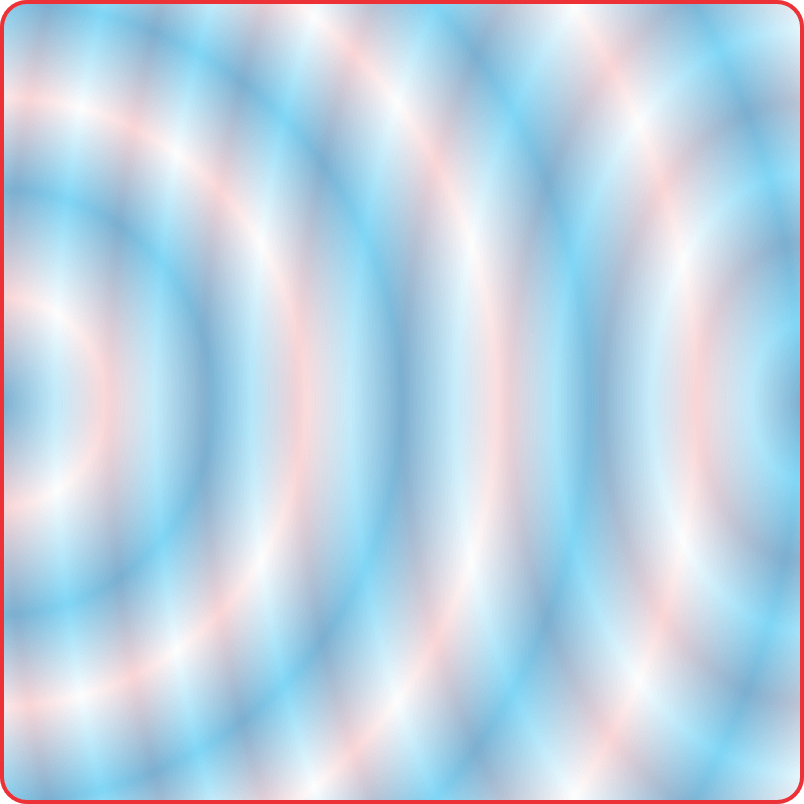
Plane‑polarized Lorentz (electromagnetic) wave
 Electric (E) component is red
 Magnetic (B) component is blue
(Image by Loo Kang Wee and Fu-Kwun Hwang from Wikimedia Commons)
Licensed under CC ASA3.0 Unported

“Deal. You go first.”

<displaying an animation on Old Reliable> “We’ll have to flip between microscopic and macroscopic a couple times. Here’s the ultimate micro — a single charged particle bouncing up and down somewhere far away has generated this Lorentz‑force wave traveling all alone in the Universe. The force has two components, electric and magnetic, that travel together. Neither component does a thing until the wave encounters another charged particle.”

“An electron, right?”

“Could be but doesn’t have to be. All the electric component cares about is how much charge the particle’s carrying. The magnetic component cares about that and also about its speed and direction. Say the Lorentz wave is traveling east. The magnetic component reaches out perpendicular, to the north and south. If the particle’s headed in exactly the same direction, there’s no interaction. Any other direction, though, the particle’s forced to swerve perpendicular to both the field and the original travel. Its path twists up- or downward.”

“But if the particle swerves, won’t it keep swerving?”

“Absolutely. The particle follows a helical path until the wave gives out or a stronger field comes along.”

“Wait. If a Lorentz wave redirects charge motion and moving charges generate Lorentz waves, then a swerved particle ought to mess up the original wave.”

“True. It’s complicated. You can simplify the problem by stepping back far enough that you don’t see individual particles any more and the whole assembly looks like a simple fluid. We’ve known for centuries how to do Physics with water and such. Newton invented hydrodynamics while battling the ghost of Descartes to prove that the Solar System’s motion was governed by gravity, not vortices in an interplanetary fluid. People had tried using Newton‑style hydrodynamics math to understand plasma phenomena but it didn’t work.”

<grinning> “I don’t imagine it would — all that twistiness would have thrown things for a loop.”

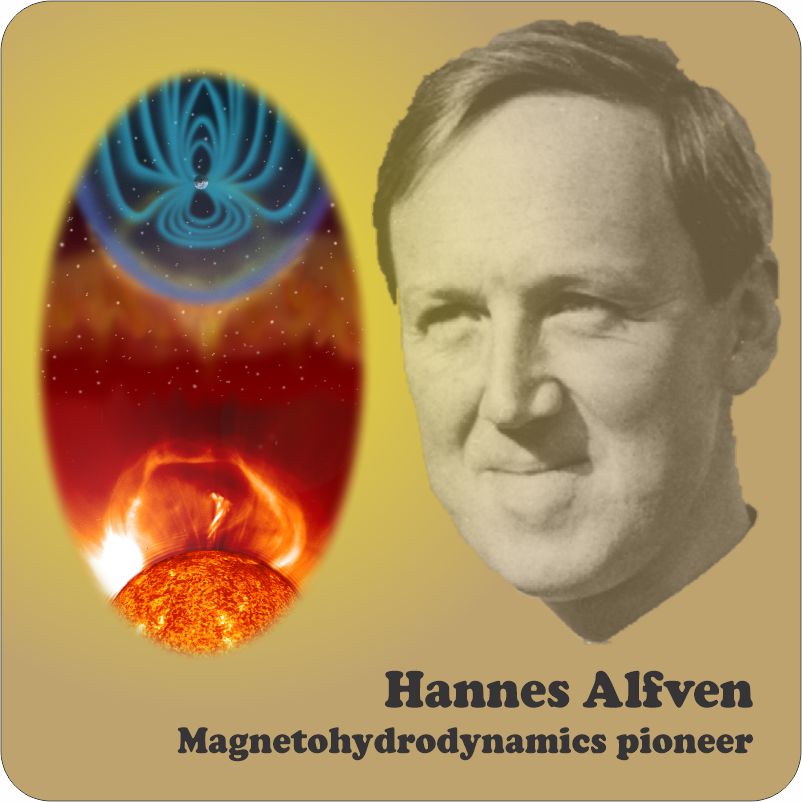
“Haha. Well, in the early 1940s Swedish physicist Hannes Alfven started developing ideas and techniques, extending hydrodynamics to cover systems containing charged particles. Their micro‑level electromagnetic interactions have macro‑level effects.”

“Like what?”

“Those aurora curtains up there. Alfven showed that in a magnetic field plasmas can self‑organize into what he called ‘double layers’, pairs of wide, thin sheets with positive particles on one side against negative particles in the other. Neither sheet is stable on its own but the paired‑up structure can persist. Better yet, plasma magnetic fields can support coherent waves like the ones making that curtain ripple.”

“Any plasma?”

“Sure.”

“Most of the astronomical objects I show my students are associated with plasmas — the stars themselves, of course, but also the planetary nebulae that survive nova explosions, the interstellar medium in galactic star‑forming regions, the Solar wind, CMEs…”

“Alfven said we can’t understand the Universe unless we understand magnetic fields and electric currents.”

~ Rich Olcott

Colors Made of Air

Teena’s whirling around in the night with her head thrown back. “I LUVV AURORAS!! They’re SO beautiful beautiful beautiful!”

“Yes, they are, Teena. They’re beautiful and magical, and for me it’s even better because they’re Physics at work right in front of us. Well, above us.”

“Oh, Sy, give it a rest.”

“No, really, Sis. I look at a rainbow and I’m dazzled by its glory against the rainclouds but I’m also aware that each particular glimpse of pure color comes to me by refraction through one individual droplet. Better yet, I appreciate the geometry that presents the entire spectrum in perfectly circular arcs. Marvels supported by underlying marvels. These curtains are another example of beauty emerging from hidden sources.”

“What do you mean?”

“Remember Teena’s teacher’s magnetic force lines that were organized and revealed by iron filings? Auroras are a bit like that, except one level deeper. Again we don’t see magnetic fields directly. What we do see is light coming to us from oxygen and nitrogen atoms that are bombarded by rampaging charged particles.”

“Wait, Uncle Sy, we learned that charges make magnetic fields when they move.”

“That, too. It works both ways, which is why they call it electromagnetism. A magnetic field steers protons and electrons which make their own field to push back on the first one. But my point is, the colors in each curtain and the curtains themselves tell us about the current state of the atmosphere and Earth’s magnetic field.”

“Okay, I can see how magnetic fields up there could steer charged particles to certain parts of the sky, but how does that tell us about the atmosphere? What do the colors have to do with it? Is this more rainbows and geometry?”

“Definitely not. Sis. Rainbows are sunlight refracted through water droplets. Aurora light’s emitted by atoms in our own atmosphere. Each color is like a fingerprint of a specific atom in specific circumstances. The uppermost reds, for instance come from oxygen atoms that rarely touch another atom of any kind. They’re at 150 or more kilometers altitude, way above the stratosphere. There aren’t many of them that far up which is why the curtain tops sort of fade away into infinity.”

“Oooo, now it’s going green and yellow!”

“Mm-hm, the bombardment’s reaching further now. Excited oxygen atoms emit green lower down in the atmosphere where collisions happen more often and don’t give the red‑emitters a chance to do their thing. The in‑between yellow isn’t really there — it’s what your eye tells you when it sees pure red and pure green overlapping.”

“Why do the curtains have that sharp lower edge, Sy? Surely we don’t run out of oxygen there.”

“Quite the reverse. That level’s about 100 kilometers up. It’s where the atmosphere gets so thick that collisions drain away an excited atom’s energy before it gets a chance to shine.”

“But why are there curtains at all? Why not simply fill the sky with a smooth color wash?”

“Mars gets auroras like that, or at least Perseverance just spotted one. We don’t, thanks to our well‑ordered magnetic field. Mars’ field is lumpy and too weak to funnel incoming charged particles to special spots like our poles. Actually, those curtains are just segments of rings that go all around Earth’s magnetic axis. The rings usually lurk about 2/3 of the way to our poles but a really strong solar event like this one can push them closer to the Equator.”

“Mars gets auroras? Uncle Sy, how about other planets?”

“Them, too, but theirs mostly don’t look like ours. You’d have to be able to see X‑rays on Mercury, for instance. Venus gets a general green glow for the same reason that Mars does. Jupiter is Texas for the Solar System — everything’s bigger there, including auroras in every color from X‑ray to infrared. Strong ordered field, so I’m sure there’s curtains up there.”

Sis yanks out her writer’s‑companion notebook and scribbles without looking down…
  ”Curtains made of colors
   Colors made of air.

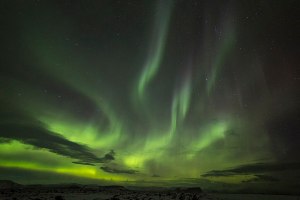
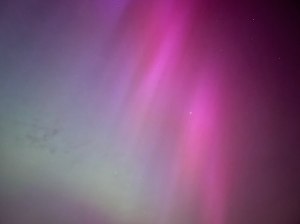
Aurora, photo by Bellezzasolo
licensed under CC BY-SA 4.0

~ Rich Olcott

Sky Lights

“Mom! Uncle Sy! Come outside NOW before it goes away!”

“Whah— oooh!”
 ”An aurora! Thanks for calling us.”

“Glowing curtains rippling across the sky! Spotlights shining down through them! Where do those come from?”

“From the Sun, Teena.”

“C’mon, Sy. The Sun’s 93 million miles away. Even if that bright streak up there is as much as 10 miles across, which I doubt, the beam from the Sun would be only a teeny‑tiny fraction of a degree wide. Not even magnetars send out anything that narrow.”

“Didn’t say it’s a beam, Sis. The whole display comes from the Sun as single package. Sort of. Sometimes.”

“Even for you, little brother, that’s a new level of weasel‑wording.”

“Well, it’s complicated.”

“So unravel it. Start from the beginning.”

“Okay. The Sun’s covered in plasma—”

“Eww!”

“Not that kind of plasma, Teena. This is mostly hydrogen atoms except they’re so hot that the electrons and protons break away from each other and travel separately. What have they told you in school about magnets?”

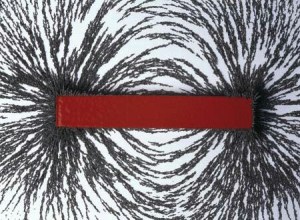
“Not much. Umm … electric currents push on magnets and that’s how motors work, and magnets push on electrons and that’s how a generator works. Oh, and Mr Cox laid a sheet of paper on top of a magnet and sprinkled iron filings on it so we could see the lines of force, but when I asked him what made the magnetism ’cause I didn’t see any wires he started talking about electrons in iron atoms and then the bell rang and I had to go to Spanish class.”

The shape of the bar magnet’s field, disclosed by iron filings chaining together.

<sigh> “The clock rules, doesn’t it? Anyway, he was on the right track, but I want to get back to those lines of force. Were they there before he sprinkled on those filings?”

“Mmm … Mom would say, ‘That’s a good question,’ but how could you know? I’m gonna say they were.”

“Your Mom would be right, but sorry, you’re wrong. With no iron filings in the picture, the magnetic field is nice and smooth, everywhere just the same or maybe only a little bit stronger or weaker than neighboring points. No lines. Conditions change when you put the first bit of iron anywhere in the field. As Mr Cox was probably saying when the bell interrupted, the electrons in the grain’s iron atoms align orbitals with the magnetic field. The alignment affects the surrounding field and that pulls in other iron bits that change the field even more.”

“But wouldn’t that make just a solid iron blob?”

“No, because a magnetic field has both strength and direction. Once the first particle points along the field, the iron bits it recruits rotate to point mostly in the same direction. You wind up with a chain of specks tracing out where they’ve acted together to alter the field. The chain’s surrounded by spaces where the field’s been stressed.”

“And then lotsa chains make lotsa lines, yeah!”

“I see where you’re headed, Sy. You’re going to claim that the vertical lines we see in the curtains trace out the Sun’s magnetic field.”

“Not quite, Sis. There’s only one magnetic field, a combination of Earth’s field, the Sun’s field, and the magnetic fields contained in whatever the Sun throws our way. Way out here Earth’s field is about ten thousand times stronger than the Sun’s is, but the fields inside a CME can range up to 10% or 20% of Earth’s. The moving curtains up there are the result of a magnetic tussle between us and a CME or maybe a flare’s outflow.”

“But there aren’t any iron filings up there, Uncle Sy!”

“True, but there are free charged particles in the ionosphere thanks to UV radiation from the Sun. A free electron caught in a magnetic field whips into a tight spiral. Its field gets neighbor particles spiraling. Pretty soon you wind up with a chain of them spiraling together, lining up like the filings do.”

“The spotlights?”

“Probably ion blobs embedded in the CME, but that’s a guess.”

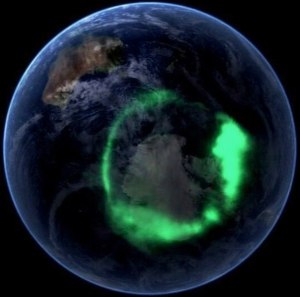
Aurora, photo by W.carter
licensed under CC BY-SA 4.0

~ Rich Olcott

Old Sol And The Pasta Pot

<chirp, chirp> “Excuse me, folks, it’s my niece. Hello, Teena.”

“Hi, Uncle Sy. What’s a kme?”

“Sorry, I don’t know that word. Spell it.”

“I’ve never seen it written down. Brian says the Sun’s specially active and gonna spit out a kme that’ll bang into Earth and knock us out of our orbit.”

“Ah, that’s a C‑M‑E, three separate letters. It stands for Coronal Mass Ejection. As usual, Brian’s got some of it right and much of it wrong. The right part is that the Sun’s at the peak of its 11‑year activity cycle so there’s lots of sunspots and flares—”

“He said flares, too. They’re super bright and could cook an Astronaut and it’d happen so fast we won’t have any warning.”

“Once again, partially right but mostly wrong. Here, let me give you to Cathleen who can set you straight. Cathleen, did you catch the conversation’s drift?”

<phone‑pass pause> “Hello, Teena. I gather you’re upset about solar activity?”

“Hi, Dr O’Meara. Yes, my sorta‑friend Brian likes to scare me with what he brings back from going down YouTube rabbit holes. I don’t really believe him but. You know?”

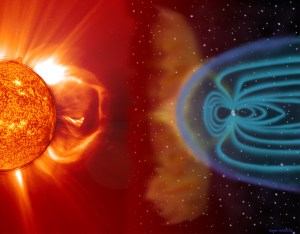
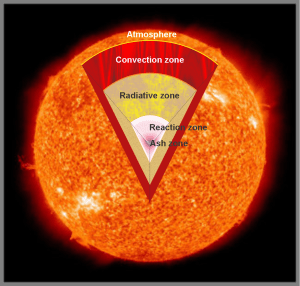
“I understand. Rabbit holes do tend to collect rubbish. Here, let me send you a diagram I use in my classes.” <another pause> “Did you get that?”

“Mm‑hm. Brian showed me a picture like that without the cut‑out part because he was all about the bright flashes.”

“Of course he was. I’ll skip the details, but the idea is that the Sun generates its heat and light energy deep in the reaction zone. Various processes carry that energy up through other zones until it hits the Sun’s atmosphere. You’ve watched water boil on the stove, surely.”

“Oh, yes. Mom put me in charge of doing the pasta last year. I don’t care what they say, a watched pot does eventually boil if there’s enough heat underneath it. I experimented.”

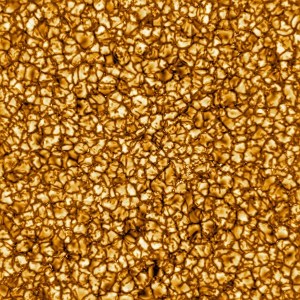
“Wonderful. That process, heat rising into a fluid layer, works the same way on the Sun as it does in your pasta pot. Heat ascends through the fluid but it doesn’t do that uniformly. No, the continuous fluid separates into distinct cells, they’re called Bénard cells, where hot fluid comes up the center, spreads out and cools across the top and then flows down the cell’s outer boundary.”

“That’s what I see happen in the pot with low water and low heat just before the bubbling starts.”

“Right, bubbling will disturb what had been a stable pattern. The cells in the Sun’s surface, they’re called granules, continually rise up to the surface and crowd out neighbors that have cooled off enough to sink or disappear.”

“Funny to say something on the Sun is cool.”

“Relatively cool, only 4000K compared to 6000K. But the Sun has bubbles, too. The granules run about 1500 kilometers wide and last only a quarter‑hour. There’s evidence they’re in top of a supporting layer of supergranules 20 times wider. Or maybe the plasma’s magnetic field is patchy. Anyhow, the surface motion is chaotic. Occasionally, especially concentrated heat or magnetic structure punches out between the granules. There’s a sudden huge release of superhot plasma, a blast of electromagnetic energy radiating out at all frequencies — that’s one of Brian’s flares. Lasts about as long as the granules.”

“That’s what could cook an astronaut?”

“Not really, The radiation’s pretty spread out by the time it’s travelled 150 million kilometers to us. The real danger is from high‑energy particle storms that travel along the Sun’s magnetic field lines. Space crews need to take shelter from them but particle masses travel slower than light so there’s several hours notice.”

“So what about the CMEs?”

“They’re big bubbles of plasma mass that the Sun throws off a few times a year on average. Maybe they come from ultra‑flares but we just don’t know. Their charged particles and magnetic fields can mess up our electronic stuff, but don’t worry about their mass. If a CME’s entire mass hit us straight on, it’d be only a millionth of a millionth of Earth’s mass. We’d roll on just fine.”

~ Rich Olcott

To Fly on Another World

“Uncle Sy, why is PV=nRT the Ideal Gas Equation? Is it because it’s so simple but makes sense anyway?”

“It is ideal that way, Teena, but it’s simply an equation about gases that are ideal. Except there aren’t any. Real gases come close but don’t always follow the rule.”

“Why not? Are they sneaky?”

“Your kind of question. We like to think of gas particles as tiny ping‑pong balls that just bounce off of each other like … ping‑pong balls. That’s mostly true most of the time for most kinds of gas. One exception has to do with stickiness. Water’s one of the worst cases because its H2O molecules like to chain up. When two H2Os collide, if they’re pointed in the right directions they share a hydrogen atom like a bridge and stick together. If that sort of stickiness happens a lot then the quantity measure n acts like it’s less than we’d expect. That makes the PV product smaller.”

“I bet that doesn’t happen much when the gas is really hot. Two particles might stick and then BANG! another particle hits ’em and breaks it up!”

“Good thinking and that’s true. But there’s another kind of exception that holds even at high temperatures. A well‑behaved gas is mostly empty space because the ping‑pong balls are far apart unless they’re actually colliding. But suppose you squeeze out nearly all of the empty space and then try to squeeze some more.”

“Oh! The pressure gets even bigger than the equation says it should because you can’t squeeze the particles any smaller than they are, right?”

“Exactly.”

“Well, if the equation has these problems, why do we even use it at all?”

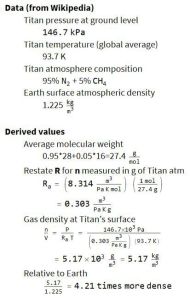
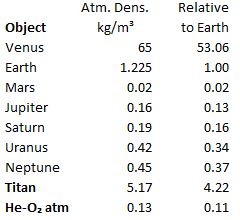
“Because it’s good enough, enough of the time, and we know when not to use it. I’ll give you an example. One of my clients wanted to know air density at ground level on Saturn’s moon Titan and all the planets that have an atmosphere.” <showing Old Reliable’s screen> “I found the planet data I needed in NASA’s Planetary Science website, but I had to do my own calculation for Titan. The pressure’s not crazy high and the temperature’s chilly but not quite cold enough to liquify nitrogen so the situation’s in‑range for the Ideal Gas Equation.”

“What’s a Pa?”

“That’s the symbol for a pascal, the unit of pressure. kPa is kilopascals, just like kg is kilograms. Earth’s atmospheric pressure is about 100 kPa.”

“Reliable says Wikipedia says Titan’s air is mostly nitrogen like Earth’s air is. Titan’s just a moon so it has to be smaller than Earth so its gravity must be smaller, too. Why is its atmosphere so much denser?”

“The cold. Titan’s air is 200 kelvins colder than Earth’s average temperature. You’re right, an individual gas particle feels a smaller pull of gravity on Titan, but it doesn’t have much kinetic energy to push its neighbors away so they all crowd closer together.”

“Why in the world does your client want to know that density number?”

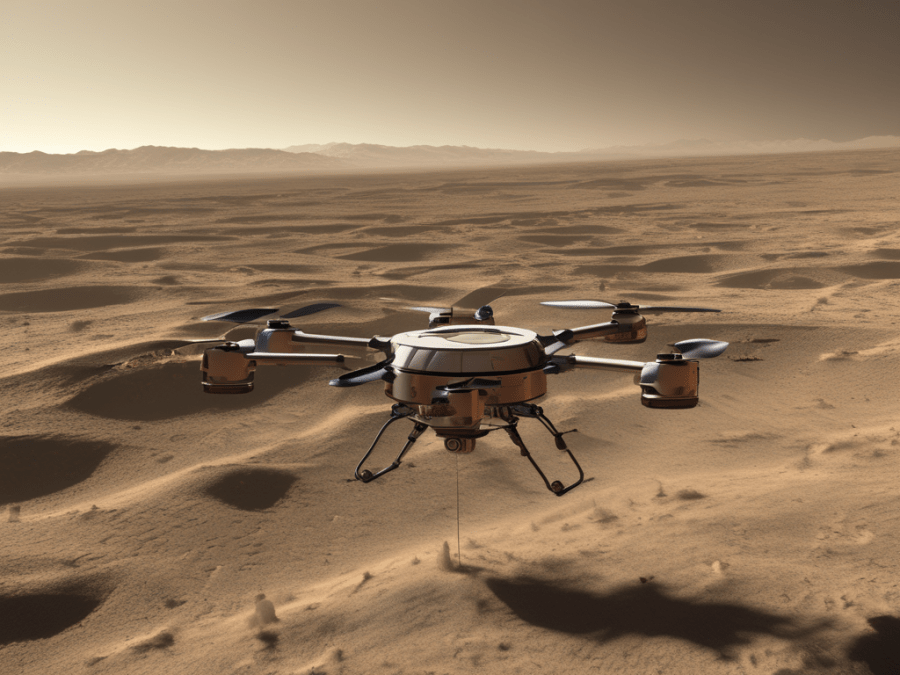
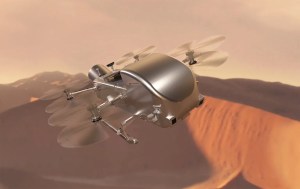
“Clients rarely give me reasons. I suspect this has to do with designing a Titan‑explorer aircraft.”

“Ooo! Wait, what does that have to do with air density?”

“It has to do with how hard the machine has to work to push itself up. It’ll probably have horizontally spinning blades that push the air downwards, like helicopters do. With a setup like that, the lift depends on the blade’s length, how fast it’s spinning, and how dense the air is. If the air is dense, like on Titan, the designers can get the lifting thrust they need with short blades or a slow spin. On Mars the density’s only 2% of Earth’s so Ingenuity‘s rotors were 4 feet across and spun about ten times faster than they’d have to on Earth.”

“What about on our helium‑oxygen Earth?”

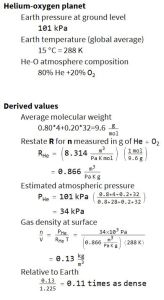
“That’s pretty much the same calculation. Give me a sec.” <tapping on Old Reliable’s screen> “Gas density would be a tenth of Earth’s, but a HeO‑copter would have to work against full‑Earth gravity. Huge blades rotating at supersonic speeds. Probably not a practical possibility.”

“Aw.”

“Yeah.”

~ Rich Olcott

The Ideal Gas Game

“But Uncle Sy, you never did answer my real question!”

“What question was that, Teena?”

“About the helium planet. With oxygen. Oh, I guess I never did get around to asking that part of it. You side‑tracked us into how a helium‑oxygen atmosphere would be unstable unless it was really cold or the planet had more gravity than Earth so the helium wouldn’t fly away. But what I wanted to know was, what would it be like before the helium left? Like, could we fly a plane there?”

“Mmm, let’s get a leetle more specific. You asked about swapping all of Earth’s atmospheric nitrogen with helium. Was that one helium atom for each nitrogen molecule or each nitrogen atom?”

“What difference would that make?”

“Mass, to begin with. A helium atom weighs about 1/3 of a nitrogen atom, 1/7 of a nitrogen molecule. The atmospheric pressure we feel is the weight of all the air molecules above us. Swap out 80% of those molecules for something lighter, pressure goes down whether we swap helium for molecules or helium for atoms. We could calculate either one. But the change would be much harder to calculate for the atom‑for‑atom swap.”

“Why?”

“Mmm, have you gotten into equations yet in school?”

“You mean algebra, like 3x+7=8x+2? Yeah, they’re super‑easy.”

“This won’t even be as complicated as that. Here’s a famous Physics equation called The Ideal Gas Law — PV=nRT. Each letter stands for one quantity. Two adjacent quantities are multiplied together, okay? The pressure in a container is P, the container’s volume is V, T is the absolute temperature, and n is a measure of how much gas is in there.”

“You skipped R.”

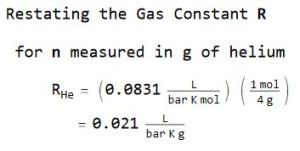
“Yes, I did. It’s a constant number. Its job is to make all the units come out right. For instance, if the pressure’s in atmospheres, the volume’s in liters, n is in grams of helium and the temperature is in kelvins, then R is 0.021. Suppose you’re holding a balloon filled with helium and it’s at room temperature. What can you say about the gas?”

“Umm, all the nRT stuff doesn’t change so P times V, whatever it is, doesn’t change either.”

“If we let it fly upward until the pressure was only half what it is here…?”

“Then V would double. The balloon would get twice as big. Unless it burst, right?”

“You got the idea. Okay, now let’s fiddle with the right-hand side. Suppose we double the amount of helium.”

P times V must get bigger but we don’t know which one.”

“Why not both?”

“Wooo… Each one could get some bigger… Oh, wait, I’m holding the balloon so the pressure’s not going to change so the balloon gets twice bigger.”

“Good thinking. One more thing and we can get back to your difference question. The Ideal Gas Law doesn’t care what kind of gas you’re working with. All the n quantity really cares about is how many particles are in the gas. A particle can be anything that moves about independently of anything else — helium atom or nitrogen molecule, doesn’t matter. If you change the definition of what n is measuring, all that happens is you have to adjust R so the units come out right. Then the equation works fine. Next step—”

“Wait, Uncle Sy, I want to think this atom‑or‑molecule thing through for myself. I’m gonna ignore R times T because both of them stay the same. So if we swap one atom of helium for one molecule of nitrogen, the number of particles doesn’t change and PV doesn’t change. But if we swap one atom of helium for each atom of nitrogen then n doubles and so does PV. But if we do that for the whole atmosphere then we can’t say that the pressure won’t change because the atmosphere could just expand and that’s the V but the pressures are all different as you go higher up anyway. Oh, wait, T changes, too, because it’s cold up there. It’s complicated, isn’t it?”

“It certainly is. Can we stick to just the simple atom‑for‑molecule swap?”

“Uh‑huh.”

~~ Rich Olcott

  • Thanks again, Xander, and happy birthday. Your question was deeper than I thought.

A Fleeting Shadowed Sky

“Hey, Uncle Sy, I’ve got a what‑if for you.”

“What’s that, Teena?”

“Suppose we switched Earth’s air molecules with helium. No, wait, except for the oxygen molecules. I know we need them.”

“First off, a helium-oxygen atmosphere wouldn’t last very long, not on the geological time scale. That’s an unstable situation.”

“Why, would the helium burn up like I’ve seen hydrogen do?”

“No, helium doesn’t burn. Helium atoms are smug. They’re happy with exactly the electrons they have. They don’t give, take or share electrons with oxygen or anything else. No, the issue is that helium’s so light.”

“What difference does that make?”

“The oxygen and helium won’t stay mixed together.”

“The air’s oxygen and nitrogen molecules are all mixed together. They told us that in Science class.”

“That’s correct. But oxygen and nitrogen molecules weigh nearly the same. It would take eight balloon‑fulls of helium to match the weight of one balloon‑full of oxygens. Suppose you had a bunch of equal‑weighted marbles, say red ones and blue ones. Pretend you pour them into a big bucket and stir them around like an atmosphere does. Which color would wind up on top?”

“Both, they’d stay mixed together.”

“Uh-huh. Now replace the blue marbles with marble‑sized ping‑pong balls and stir well.”

“The heavy marbles slide to the bottom. The light balls need to be somewhere so they get bullied up to the top.”

“Exactly. That’s what the oxygen molecules would do — sink down toward the ground and shove the helium atoms up to the top of the atmosphere. Funny thing though — the shoving happens faster than the sinking.”

“Why’s that?”

“It’s the mass thing again. At any given temperature, helium atoms in a gas zip around four times faster than oxygen molecules do. Anyway, the helium atoms that arrive up top won’t stay there.”

“Where else would they go?”

“Anywhere else, basically. Have you heard the phrase, ‘escape velocity‘?”

“It has something to do with rockets, doesn’t it?”

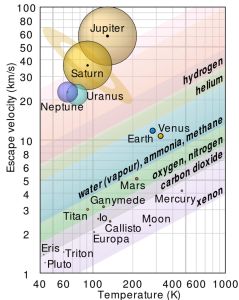
“Well, them, too. The general idea is that once you reach a certain threshold speed relative to a planet or something, you’re going too fast for its gravity to pull you back down. There’s a formula for calculating the speed. The fun thing is, the speed depends on the mass of what you’re escaping from and your distance from the object’s center, but it doesn’t depend on your own mass. It applies to everything from rockets to gas molecules.”

“And we were just talking about helium being zippy. Is it zippy enough to escape Earth?”

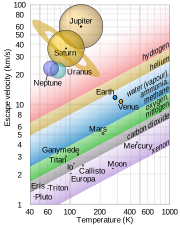
“Good thinking! That’s exactly where I was going. The answer is, ‘Maybe.’ It depends on temperature. Warm molecules are zippy, cold molecules not so much. At the same temperature, light molecules are zippier than heavy ones. There’s a chart that shows thresholds for different molecules escaping from different planets. Earth could hold onto its helium atoms, but only if our atmosphere were more than a hundred degrees colder than it is. Warm as we are, bye‑bye helium.”

“How long would that take?”

“That’s a complicated question with lots of ‘It depends’ in the answer. Probably the most important has to do with water.”

“I didn’t say anything about water, just helium and oxygen.”

“I know, but much of Earth’s weather is driven by water vaporizing or condensing or just carrying heat from place to place. Water‑powered hurricanes and even big thunderstorms stir up the atmosphere enough to swoosh helium up to bye‑bye territory. On the other hand, suppose our helium‑Earth is dry. The atmosphere’s layers would be mostly stable, light atoms would be slow to rise. We’d have a very odd‑looking sky.”

“No clouds.”

“Pretty much. But it wouldn’t be blue, either.”

“Would it be pink? I like pink.”

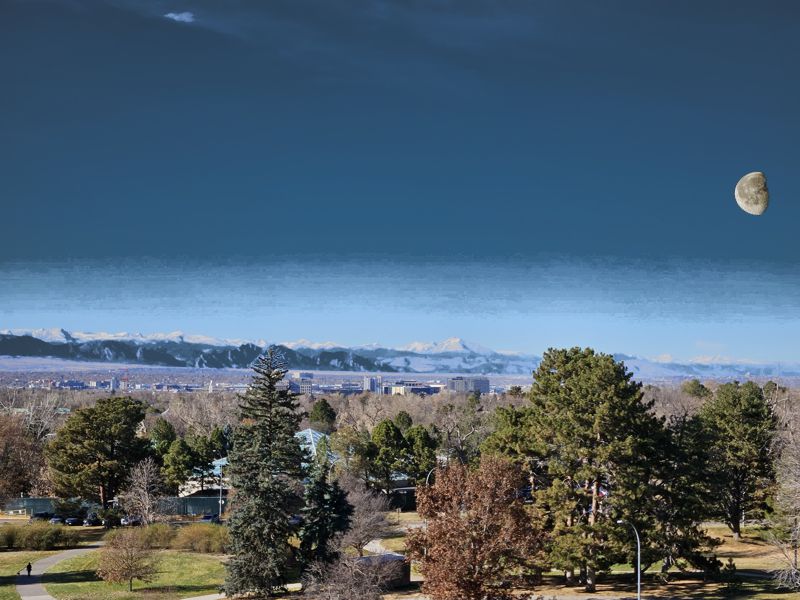
“Sorry, sweetie, it’d be dark dark blue, some lighter near the horizon. Light going past an atomic or molecular particle can scatter from its temporarily distorted electron cloud. Nitrogen and oxygen molecules distort more easily than helium atoms do. Earth skies are blue thanks to sunlight scattered by oxygen and nitrogen. Helium skies wouldn’t have much of that.”

~ Rich Olcott

  • Thanks again to Xander, who asked a really good helium question.

In Which Tone of Voice?

“Oh. OH! Wow, Uncle Sy, this changes everything!”

“Which ‘this,’ Teena?”

The resonator thing. Our music teacher, Ms Searcy, has been going on about us singing too much in our heads. I thought she’s been saying we’re thinking about the music too much and should just let the singing happen.”

“Sounds very Zen.”

“I’m too young to know Zen stuff. But now I think maybe she’s saying we’re using those head resonators you just told me about — singing with our sinuses and nasal cavities instead of somewhere else. She’s never been clear on what we can do about that.”

“You’re probably right. No music teacher since Harold Hill would try to get away with ‘think the music.’ I’m sure Ms Searcy’s complaint is about head tones as opposed to chest tones. If so, she’s got a good excuse for being unclear.”

“How can I have chest tones when you said vibrations come from my voice box and that’s above my chest?”

“Sound wave energy is about molecules colliding against any neighboring molecules. Up, down left, right — none of those matter. When air from your lungs makes your vocal cords buzz against each other, much of that buzzing goes up through your throat and head resonators. However, some of the buzz energy travels into your chest cavity. That’s your biggest resonator and it’s where your lowest tones come from.”

“I guess Ms Searcy wants us to send even more buzzing there, but how do we do that?”

“That’s a hard question. People have been interested in it since they started teaching singing and oratory to other people. We learned one part of the answer in medieval times when we began studying anatomy up close and personal. For instance, your voice box, which I really ought to call your larynx now we’re getting into detail, relates to about a dozen different muscles.”

“What’re the other parts?”

“The easiest part was kinesiology — figuring out what action each muscle supports. The hardest part was teaching a student how to feel and control the right muscles to make their voice do exactly what they want.”

“How can that be hard? I can flex my arm and leg muscles any time I want.”

“Can you make your larynx move up and down in your throat?”

“Easy.”

“That motion depends on a chain of muscles running between the back of your tongue and the top of your chest. One way to send buzzes downward is to activate the muscles that pull the larynx in that direction. Shorter distance makes for more efficient buzz transmission. It can also help to pull your head back a little. That tenses those pulled‑down tissues and improves transmission even more.”

<slightly deeper voice> “Like this?”

“That’s the idea. Learning to do that without having to pay attention to it is part of vocal training. Now, can you spread your toes out?”

“That’s weird. I can on my right foot but not my left.”

“Very common. Each foot has little tiny muscles, called intrinsic muscles, buried deep inside. Some people can control the whole set, some not so much. Your larynx has two pairs of intrinsic muscles that govern how your vocal cords work together. Some voice teachers claim the intrinsic muscles inside the larynx are the key to proper voice technique. Unfortunately, you can’t see them or get a feel for controlling them other then ‘keep trying things until you get it right and remember what you did.’ That’s Ms Searcy’s strategy. It’d be much harder with helium.”

“That’s right! Our voices with the balloons were all head tones. How come?”

“The speed of sound.”

“That’s a sideways answer, Uncle Sy.”

“Okay, this is more direct. We’ve said resonance was about waves whose wavelength just fit across a cavity. Picture two waves, the same number of waves per second, but the wave in helium travels about 3½ times faster than the one in air. The helium wave stretches about 3½ times farther between peaks. Whatever peaks per second your vocal cords make, in helium your chest cavity is 3½ times too small to resonate. Your head cavities, though, can resonate to overtones of those frequencies.”

“Squeaky overtones.”

~ Rich Olcott

When Sounds Rebound

<chirp chirp> “Moire here.”

“Hi, Uncle Sy.”

“Hi, Teena, How was the birthday party?”

“Pretty fun. We had balloons but Mom wouldn’t let us fly them into the sky.”

“Because animals might eat them when they come down, I suppose.”

“Yeah, that’s what she said. What we did was we untied the knotty part so we could breathe in the helium and sing squeaky Happy Birthdays. It didn’t make much difference to my voice but Brian’s came out weird ’cause his voice is breaking anyway. It was almost a yodel.”

“I thought you didn’t like Brian any more.”

“That was last month, Uncle Sy. He ‘poligized on accounta he’s still learning social skills. We had fun playing with the sounds.”

“Sure you did. Do you remember the slide whistle I gave you once?”

“That was a long time ago. It was fun until Brian bent the slider and it didn’t work any more.”

“No surprise. How’d you make it give a high note?”

“I’d push the slider all the way in. Slider-out made a low note, but Brian could make a high note even there if he blew really hard.”

“Well, he would. It all has to do with resonant cavities.”

“I don’t have any cavities! Mom makes sure I brush and floss every day. And what’s resonant?”

“You don’t have dental cavities but there are other kinds. ‘Cavity‘ is another word for ‘hole‘ and some of them are important. You breathe through two nasal cavities that join up to be your posterior nasal cavity and that connects to sinus cavities in your skull and down to your voice box and lungs. Your mouth cavity resonates with all those cavities and vibrations from your voice box to make your speaking sounds.”

“That’s twice you used that ‘resonate‘ word I don’t know.”

“Break it down. ‘–son–‘ means ‘sound,’ like ‘sonic.’ Then—”

“‘Re–‘ means ‘again‘ like ‘rebuild‘ so resonate is sounding again like an echo.”

“Right. Except a resonant cavity is picky about what sounds it works with. Here, I’m sending you a video. Did you get it?”

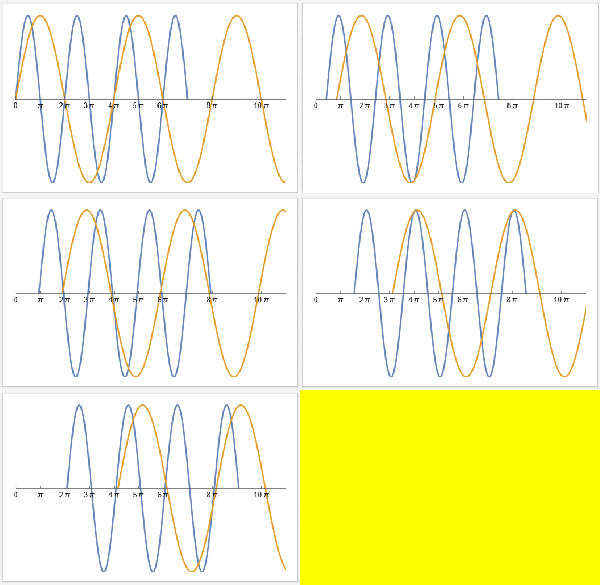
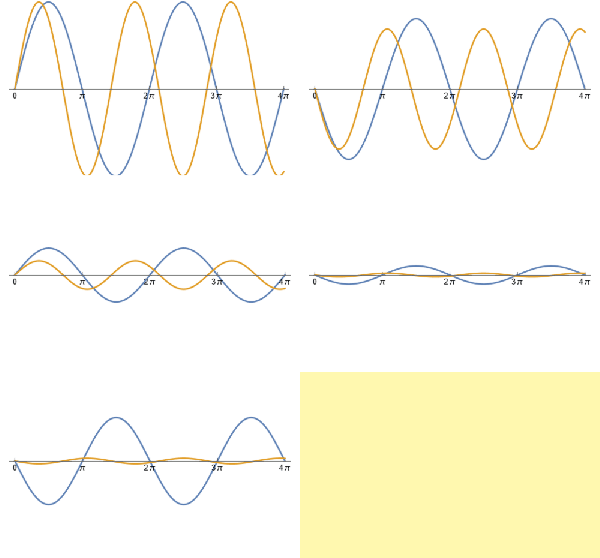
“Yeah, I see a couple of wiggly lines. Wait, the blue line stays the same size but the orange line gets littler until it’s all gone and then the picture goes yellow and starts over.”

“What happens over on the right‑hand side?”

“The blue line bounces back from zero but the orange line waves all over the place. Is that how sound works?”

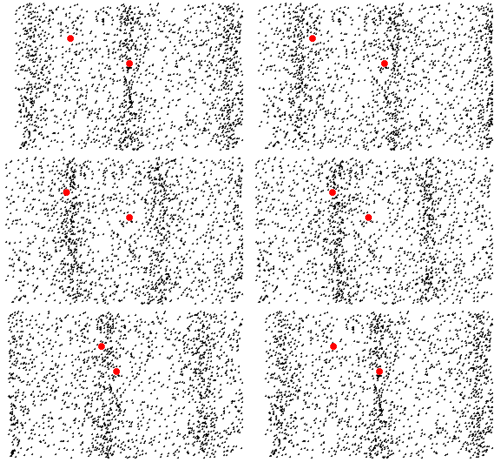
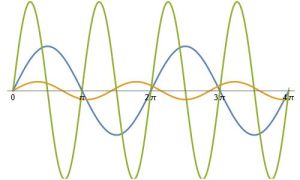
“Sort of. The air molecules in a sound wave don’t go up‑and‑down, they go to‑and‑fro. The wiggly lines are a graph of where the energy is. Where the molecules bunch together they bang into each other more often than in the in‑between places. In open air the energy pushes along even though the molecules stay pretty much where they are. In a resonant cavity, sounds are trapped like the blue line if they have just the right wavelength. A cavity’s longest trappable wavelength is its lowest note, called its fundamental. The energy in the fundamental is sustained as long as new energy’s coming in.”

“What happens to the orange line?”

“It doesn’t get a chance to build up. The energy in those waves spreads out until the wave just isn’t any more.”

“Aww, poor wavey. Wait, what about when Brian blows extra‑hard and gets that high note?”

“He gives the commotion inside the whistle enough energy to excite a second trapped wave with twice the number of crowded places. That’s called an overtone of the fundamental. Sometimes you want to do that, sometimes you don’t.”

“Brian always did on the whistle.”

“Well, he would. The resonant cavity thing also explains why Brian’s voice breaks and how talking works. Your windpipe is a resonating cavity. Brian’s windpipe has grown just large enough that sometimes it resonates in his new fundamental and sometimes switches to some other fundamental or overtone. Talking depends on tuning the resonances inside your mouth cavity. Try saying ‘ooo‑eee‘ while holding your lips steady in ‘ooo‘ position. On ‘eee‘ your tongue rises up to squeeze out the low‑pitched long waves in ‘ooo‘, right?”

oooeeeoooeeeooo

  • Thanks to Xander, whose question inspired this story arc.

~ Rich Olcott