Eclipse Correction

From: Robin Feder <rjfeder@fortleenj.com>
To: Sy Moire <sy@moirestudies.com>
Subj: Bad diagram

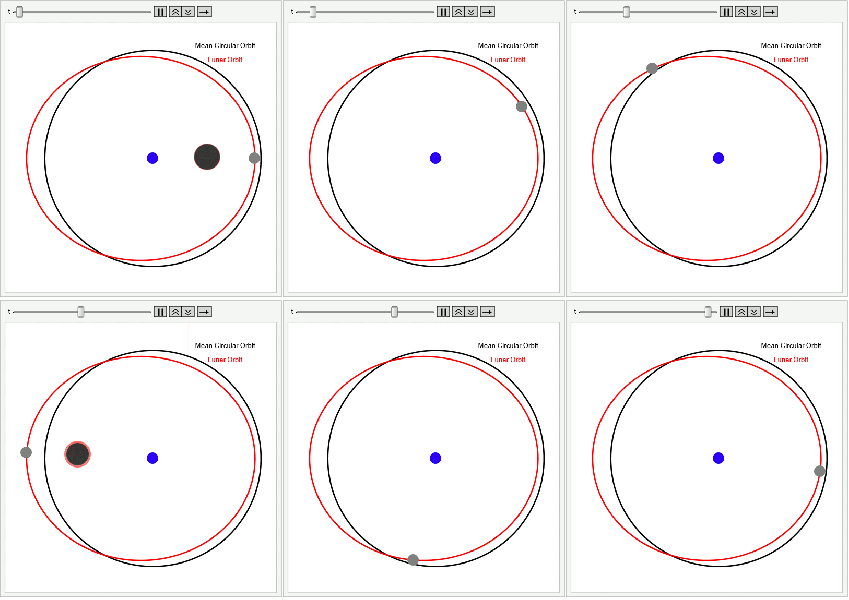
My Dad said I should write you about the bad video that is in your “Elliptically Speaking” post. It shows a circle around a blue dot that’s supposed to be the Earth, and an oval shape that’s supposed to be the Moon’s orbit around the Earth, and blinking thingies that are supposed to show what eclipses look like. I took a screen shot of the video to show you. But the diagram is all wrong because it has two places where the Moon is far away from the Earth and two places where the Moon is closer and that’s wrong. All the orbit pictures I can find in my class books show there’s only one of each. Please fix this. Sincerely, Robin Feder


From: Sy Moire <sy@moirestudies.com>
To: Robin Feder <rjfeder@fortleenj.com>
Subj: Bad Diagram

You’re absolutely correct. That’s a terrible graphic and I’ll have to apologize to Cathleen, Teena and all my readers. Thanks for drawing my attention to my mistake. When I built that animation I was thinking too much about squashed circles and not enough about orbits. I’ve revised the animation, moving the Earth and its circle sideways a bit. Strictly speaking, Earth and the Moon both orbit around their common center of gravity. Also, the COG should be at one focus of an ellipse. An ellipse has two foci located on either side of the figure’s center. However, both of those corrections for the Earth‑Moon system are so small at this scale that you wouldn’t be able to see them. I drew my oval (not a true ellipse) out of scale to make the effect more visible.

Moving the oval so that there’s only one close place and one far place (astronomers call them perigee and apogee) meant that I also had to move the blinking eclipse markers. I think the new locations do a better job of showing why we have both annular and total eclipses. You just have to imagine the Sun being beyond the Moon in each special location so that the eclipse shadow meets the Earth.

I’ve swapped out the bad diagram on the website. Here’s a screenshot of the better diagram I’ve put in its place.

Please remember to use proper eclipse-viewing eyewear when you look at this October’s annular eclipse. And give my regards to your Dad.

~~ Rich Olcott

  • Thanks to Ric Werme for gently pointing out my bogus graphic.

Elliptically Speaking

“Oh. I have one other eclipse question, Dr O’Brien.”

“What’s that, Teena?”

“Well, I found a list of solar eclipses—”

“An interesting place to start, especially for a 10‑year‑old.”

“And it had three kinds of eclipse — total, partial and annual. ‘Total‘ must be when the Moon covers up the whole Sun like when I wink my eye tight. ‘Partial‘ sounds like when I only squinch up my eye like this. I guess that happens when we’re just on the edge of an eclipse track so we still see part of the Sun like we see just part of the Moon most of the time. But my eye wide open is like there’s no eclipse at all. There’s no fourth way to hold my eye left over for ‘annual.’ Besides, ‘annual‘ means ‘every year.’ Is there some special kind of eclipse that comes every year but we don’t see it?”

Cathleen doesn’t quite hide a smile. “Sorry, dear, I think you’ve misread a word. It’s not ‘annual,’ it’s ‘annular.’ They’re very similar and they both came from Latin but they came from different Latin words and have different meanings today. ‘Annual‘ means ‘yearly,’ just as you said. ‘Annular‘ means ‘ring‑shaped‘, like a circle with a hole in the middle.”

“A ring‑shaped eclipse? Is there a big hole in the Moon we only see sometimes?”

“Quite the reverse. The Moon and its shadow are compact, no holes even in an annular eclipse. What we see in those eclipses is a ring of the Sun’s light around the outside of a black disk of Moon‑shadow. The bright ring is called an ‘annulus‘ and you must be very careful to use the special dark glasses to look at it.”

“But … Uncle Sy said the reason we’re so lucky we can see eclipses is that the Moon is just the right size to match the size of the Sun. Does the Moon get smaller for an annular eclipse?”

“Hold up your thumb. Now move your arm out until your thumb just covers my head. Can’t see me at all, can you? Now move your arm out just a little farther until you can see my hair but not my face. Got it? Your thumb didn’t change size, did it?”

“No, it just looked smaller and I could see more of you past it.”

“Right. That’s how an annular eclipse works.”

<drawing Old Reliable from its holster> “Excuse me, Cathleen, I think this might help.”

“What are all those circles, Uncle Sy, and why does it blink?”

“It’s like a map of space. The blue disk represents Earth and the gray disk represents the Moon. If the Moon were always the same distance from Earth it’d follow the black circle, but it doesn’t. It follows the red line which isn’t a true circle. It’s a special shape of squashed circle, called an ellipse. Very few moons or planets follow a truly circular orbit — their track is almost always elliptical to some degree. Now you tell me what the blinky things are about and don’t say it’s when the Moon stops in its orbit because it doesn’t. The animation motion pauses to call attention to when the eclipses happen.”

“Okayyy… Oh! They’re what we’d see in an eclipse, right? The red … ellipse?… brings the Moon closer to us or farther away. When it’s close like over there it’s like my thumb covering Dr O’Brien’s whole head and we don’t see any of the Sun and that’s a total eclipse, right? When we have an eclipse if the Moon’s outside of that circle like on the side, it’s like my thumb farther away and that’s why your picture has the orange ring, it’s an annulus, right?”

“You broke the code, Teena, Well done!”

“I think it’s silly to have two words like eclipse and ellipse that sound so much alike but they’re so different. Like annual and annulus.”

“Sorry about that, sweetie, but we pretty much have to take the language as we find it. English has a long and complicated history. Sometimes I’m surprised it works at all. Sometimes it doesn’t and that makes problems.”

~~ Rich Olcott

Eclipse Vectors

“I think I understand why we have eclipse seasons, Dr O’Meara, but why do the two eclipses in a season travel in such different directions?”

“Put this question on top of Teena’s, Cathleen. Everyone knows the Sun rises in the East because the Earth rotates towards the East. But it seems like eclipses fly eastward even faster than the Earth turns. If that’s true, why?”

“As an Astronomy educator, Sy, I wish ‘everyone’ were truly everyone. You wouldn’t believe the arguments I get from some students when I’m trying to teach 21st Century material. Why are they even in my class?”

“We can only wonder. You and the Flatties, Kareem and the 6000‑year Earthers, poor Jennifer over in Public Health having to cope with the anti‑vaxxers; these contrarians seem to be everywhere. They’re excellent models of Orwellian doublethink — they happily use their science‑dependent smart phones, internet and GPS while they’re trashing Science. Split brains? I dunno.”

“C’mon, Uncle Sy, that’s boring grown‑up stuff. What about my eclipses? Why do they go north or south like that? Does it have to do with those angles that were drawn too big?”

“Sorry, sweetie. Dr O’Meara showed us that the Moon can only make an eclipse if it’s near the Solar System’s plane where Earth’s center stays. The angle of the Moon’s orbital plane only matters when the Moon is away from there.”

“Earth’s center is the Equator! All the eclipses should go on the Equator. But they don’t. That’s wrong.”

“The Equator’s around Earth’s center, Teena, but so are other circles. Think of your globe at home. Does the North Pole point straight up?”

“Noo‑oh … you mean the tilt? Mom said that was about Winter and Summer.”

“Well, she’s not wrong. In the northern hemisphere we have Summer when the North Pole tilts toward the Sun, Winter when it tilts away. That’s only part of the story, though. In Spring and Fall the tilt is broadside to the Sun. Not as hot as Summertime, not as cold as Winter. Those three gyroscopes give us eclipse seasons. But they do more. Look at these diagrams.”

“Sorry, I don’t understand what you’re showing me.”

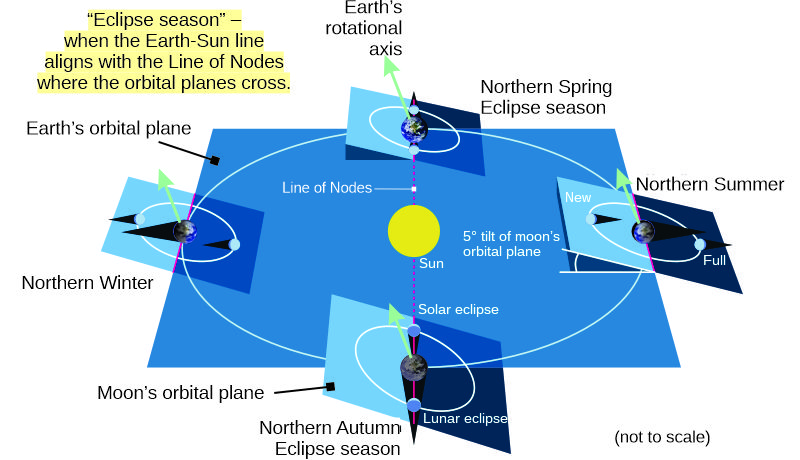
“No worries. In the upper one, the Earth’s in the rear. The North Pole is the green arrow. The Equator’s the yellow band. Pole and Equator are both tilted 23°. The Sun is in front, shining at the Earth. The Earth orbits the Sun counterclockwise so it’s moving to our left. Moving in that direction gives the northern hemisphere more and more daylight so it’s northern Springtime going towards Summer. Okay?”

“Yyyes….”

“Good. The sketch shows eclipse conditions, when the Moon and its shadow are in Earth’s orbital plane. The only places on Earth that can see the eclipse are on the red band. That’s another circle where the plane intersects the Earth’s surface. What direction does that band point on Earth?”

<chortle> “It goes northeast, just like I noticed on that map! Okay, let me think about the other picture… The North Pole’s a gyroscope and doesn’t change direction so we’re looking at us from the other side … Yeah! That red band goes southeast on Earth. Perfect! … Umm, everything’s upside‑down for Bindi in Australia, so does she … Wait, in the upper picture when it’s Springtime for us it’s Autumn for her so her Autumn eclipses go northeast, just like our Springtime ones do! And her Spring’s the bottom picture and her Springtime eclipses go southeast like our Autumn ones, right?”

“Smart girl! I’m going to tell your Mom about your thinking and she’ll be so proud of you. Now, Cathleen, how about speedy eclipses going east faster than the Earth does?”

“It’s not the eclipse going fast, Sy, it’s the Moon. Relative to the Sun‑Earth line, the Moon in its orbit is traveling eastward at just under 3700 kilometers per hour. Meanwhile, a point on Earth’s Equator is heading in the same direction at just under 1700 kph. Places away from the Equator move even slower. The Moon and its shadow win the race going away.”

~~ Rich Olcott

  • Thanks again to Naomi Pequette for her expertise and eclipse‑related internet links.

Eclipse Seasons

“C’mon in, Sy.”

“Morning, Cathleen. You know my niece Teena.”

“Hi, Teena. What brings you here to my office?”

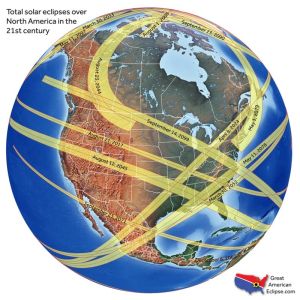
“I’m working on a school project about eclipses, Dr O’Meara, and I noticed something weird. Uncle Sy said you could explain it to me. You know how an eclipse isn’t in just one place, the Moon writes its shadow along a track?”

“Of course, dear, I do teach Astronomy.”

“Sorry, I was just giving context.” <Cathleen and I give each other a look.> “Anyhow, I found this picture of lots of eclipse tracks and see how they weave together almost like cloth?”

“Oh, it’s better than that, Teena. Look at the dates. Is there a pattern there, too?”

“Oooh, the Springtime ones go northeast and the Fall ones go southeast. Hey, I don’t see any in the Summer or Winter! Why is that?”

“It’s complicated, because it’s the result of several kinds of motion all going on at once. Have you ever played with a gyroscope?”

“Uh-huh, Uncle Sy gave me one for my birthday last year. He said that 10 years was old enough I could make it spin without hitting someone’s eye with the string. He was mostly right and I promise I really wasn’t aiming at Brian.”

<another look> “Well … okay. What’s a gyroscope’s special thing?”

“Once you start it spinning it tries to stay pointing in the same direction, except mine acts dizzy a little. Uncle Sy says the really good ones they put in satellites don’t get hardly get dizzy at all.”

“Good, you know gyroscope behavior. Planets spin, too, though a lot slower than your gyroscope. Do you know about planets?”

“Oh yes, when I was small and we looked at the eclipse my Mom and Uncle Sy explained about how we live on a planet that goes round the Sun and sometimes the Moon gets in the way and makes a shadow on us but when the Earth turns so we’re facing away from the Sun we’re in Earth’s shadow.”

“Nice. Well, here’s a diagram about how eclipses happen. It shows four Earth‑images at special points in its orbit. Each Earth has Moon‑images at two special points in the Moon’s orbit. There’s also an arrow coming out of each Earth’s North Pole to show the axis that the Earth spins on. We’ve got three circular motions and each one acts like your gyroscope.”

Adapted from a graphic by Nela, licensed under CCA-SA 4.0

“Does the Moon spin, too?”

“We talked about this a couple years ago, sweetie. The Moon always keeps one face towards the Earth so it spins once each month as it orbits around the Earth. Dr O’Meara’s just using a single circle to cover both, okay?”

“Okay. So there’s three gyroscopes, four really but one’s hiding. The picture says that all three point in different directions, right, and they stay that way?”

“Perfect.”

“Excuse me, but those angles don’t look right. The Earth axis is pointed too close or something.”

“Sharp, Sy. You’re partially correct. Actually, that axis is at a proper 23° angle from the perpendicular to Earth’s orbital plane. It’s the lunar orbital plane and its axis that are off. They’re supposed to be at a 5° angle to Earth’s plane but they’re drawn at 15° to highlight that important line where the two planes meet. The gyroscopes keep that line steady all year.”

“What’s so important about the line?”

“If the Moon is too far above or below Earth’s plane, its shadow is too far above or below Earth to make an eclipse. Eclipses only happen when the line runs through the Sun AND when the Moon is close to the line. The line only runs through the Sun in the Spring and Fall, in this century anyway, so those are our eclipse seasons.”

“Why not every century?”

“A century ago, the eclipses came a few months earlier. The gyroscopes slowly drag the line around Earth’s solar orbit, shifting when the eclipse seasons arrive. If you want a New Year eclipse you’ll have to wait a long, long time.”

~~ Rich Olcott

  • Thanks to Naomi Pequette, Peak Nova Solutions, whose “Eclipses” presentation inspired this post.

Significant Twinkles

Cathleen’s got a bit of fire in her eye. “Good exposition, Jeremy, but only just barely on‑assignment. You squeezed in your exoplanet search material at the very end. <sigh> Okay, for our next presentation we have two of our freshmen, Madison and C‑J.”

“Hello, everybody, I’m Madison. I fell in love with Science while watching Nova and Star Trek with my family. Doctor O’Meara’s Astronomy class is my first step into the real thing. C‑J?”

“Hi, I’m C‑J, like she said. What started me on Astronomy was just looking at the night sky. My family’s ranch is officially in dark sky country, but really it’s so not dark. Jeremy’s also from the High Plateau and we got to talking. We see a gazillion stars up there, probably more stars than the Greeks did because they were looking up through humid sea-level air. On a still night our dry air’s so clear you can read by the light of those stars. I want to know what’s up there.”

“Me, too, but I’m even more interested in who‘s up there living on some exoplanet somewhere. How do we find them? We’ve just heard about spectroscopy and astrometry. C‑J and I will be talking about photometry, measuring the total light from something. You can use it even with light sources that are too dim to pick out a spectrum. Photometry is especially useful for finding transits.”

“A transit is basically an eclipse, an exoplanet getting between us and its star—”

“Like the one we had in 2017. It was so awesome when that happened. All the bird and bug noises hushed and the corona showed all around where the Sun was hiding. I was only 12 then but it changed my Universe when they showed us on TV how the Moon is exactly the right size and distance to cover the Sun.”

“Incredible coincidence, right? Almost exactly 100% occultation. If the Moon were much bigger or closer to us we’d never see the corona’s complicated structure. We wouldn’t have that evidence and we’d know so much less about how the Sun works. But even with JWST technology we can’t get near that much detail from other stars.”

“Think of trying to read a blog post on your computer, but your only tool is a light meter that gives you one number for the whole screen. Our nearest star, Alpha Centauri, is 20% larger than our Sun but it’s 4.3 lightyears away. I worked out that at that distance its image would be about 8½ milliarcseconds across. C‑J found that JWST’s cameras can’t resolve details any finer than 8 times that. All we can see of that star or any star is the light the whole system gives off.”

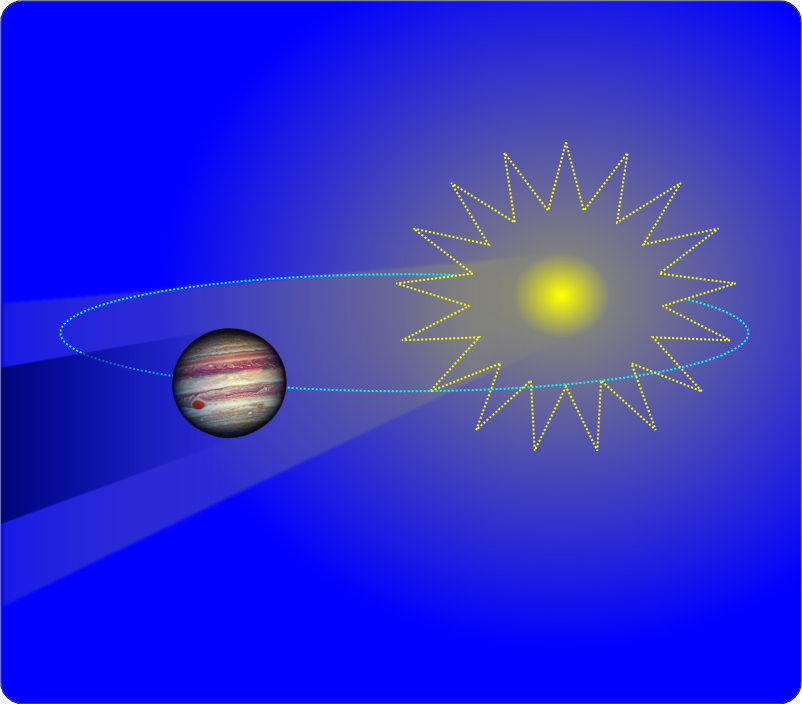
“So here’s where we’re going. We can’t see exoplanets because they’re way too small and too far away, but if an exoplanet transits a star we’re studying, it’ll block some of the light. The question is, how much, and the answer is, not very. Exoplanets block starlight according to their silhouette area. Jupiter’s diameter is about a tenth the Sun’s so it’s area is 1% of the Sun’s. When Jupiter transits the Sun‑‑‑”

“From the viewpoint of some other solar system, of course—”

“Doesn’t matter. Jupiter could get in between the Sun and Saturn; the arithmetic works out the same. The maximum fraction of light Jupiter could block would be its area against the Sun’s area and that’s still 1%.”

“Well, it does matter, because of perspective. If size was the only variable, the Moon is so much smaller than the Sun we’d never see a total eclipse. The star‑planet distance has to be much smaller than the star‑us distance, okay?”

“Alright, but that’s always the way with exoplanets. Even with a big planet and a small star, we don’t expect to measure more than a few percent change. You need really good photometry to even detect that.”

“And really good conditions. Everyone knows how atmospheric turbulence makes star images twinkle—”

“Can’t get 1% accuracy on an image that’s flickering by 50%—”

“And that’s why we had to get stable observatories outside the atmosphere before we could find exoplanets photometrically.”

~~ Rich Olcott

A Nightcap And Secrets

“A coffee nightcap, Sy? It’s decaf so Teena can have some.”

“Sounds good, Sis.”

“Why didn’t Mr Einstein like entanglement, Uncle Sy? Thanks, Mom. A little more cream in it, please.”

“I’ll bet it has to do with the instant-effect aspect, right, Sy?”

“Thanks, Sis, and you’re right as usual. All of Relativity theory rests on the claim that nothing, not light or gravity or causality itself, can travel faster than light in a vacuum. There’s good strong arguments and evidence to support that, but Einstein himself proved that entanglement effects aren’t constrained to lightspeed. Annoyed him no end.”

“Well, your coin story‘s very nice, but it’s just a story. Is there evidence for entanglement?”

“Oh, yes, though it was fifty years after Einstein’s entanglement paper before our technology got good enough to do the experiments. Since then a whole industry of academics and entrepreneurs has grown up to build and apply devices that generate entangled systems.”

“Systems?”

“Mm-hm. Most of the work has been done with pairs of photons, but people have entangled pairs of everything from swarms of ultra‑cold atoms to electrons trapped in small imperfect diamonds. It’s always a matter of linking the pair members through some shared binary property.”

“Binary! I know what that is. Brian has a computer toy he lets me play with. You tell it where to drive this little car and it asks for decisions like left‑right or go‑stop and they’re all yes or no and the screen shows your answer as ‘0’or ‘1’ and that’s binary, right?”

“Absolutely, Teena. The entangled thingies are always created in pairs, remember? Everything about each twin is identical except for that one property, like the two coin metals, so it’s yes, no, or some mixture. Cars can’t do mixtures because they’re too big for quantum.”

“What kinds of properties are we talking about? It’s not really gold and silver, is it?”

“No, you’re right about that, Sis. Transmutation takes way too much power. Entangled quantum states have little or no energy separation which is one reason the experiments are so hard. Photons are the easiest to work with so that’s where most of the entanglement work has been done. Typically the process splits a laser beam into two rays that have contrasting polarizations, say vertical and horizontal. Or the researchers might work with particles like electrons that you can split into right‑ and left‑handed spin. Whatever, call ’em ones and zeroes, you’ve got a bridge between quantum and computing.”

“Brian says binary can do secret codes.”

“He’s right about that. Codes are about hiding information. Entanglement is real good at hiding quantum information behind some strict rules. Rule one is, if you inspect an entangled particle, you break the entanglement.”

“Sounds reasonable. When you measure it you make it part of a big system and it’s not quantum any more.”

“Right, Sis. Rule two, an entanglement only links pairs. No triples or broadcasts. Rule three is for photons — you can have two independent ways to inspect a property, but you need to use the same way for both photons or you’ve got a 50% chance of getting a mismatch.”

“Oho! I see where the hiding comes in. Hmm… From what I’ve read, encryption’s big problem is guarding the key. I think those three rules make a good way to do that. Suppose Rocky and Bullwinkle want to protect their coded messages from Boris Badinoff. They share a series of entangled photon pairs. and they agree to a measurement protocol based on the published daily prices for a series of stocks — for each photon in a series, measure it with Method 1 if the corresponding price is an odd number, Method 2 if it’s even. Rocky measures his photon. If he measures a ‘1’ then Bullwinkle sees a ‘0’ for that photon and he knows Rocky saw a ‘1.’ Rocky encrypts his message using his measured bit string. Bullwinkle flips his bit string and decrypts.”

“Brilliant. Even if Boris knows the proper sequence of measurements, if he peeks at an entangled photon that breaks the entanglement. When Bullwinkle decodes gibberish Rocky has to build another key. Your Mom’s a very smart person, Teena.”

~ Rich Olcott

Tiramisu And Gemstones

“Sis, you say there’s dessert?”

“Of course there is, Sy. Teena, please bring in the tray from the fridge.”

“Tiramisu! You did indeed go above and beyond. Thank you, Teena. Your Mom’s question must be a doozey.”

“I’ll let you enjoy a few spoonfulls before I hit you with it.” <minutes with spoon noises and yumming> “Okay. tell me about entanglement.”

“Whoa! What brought that on?”

“I’ve seen the word bandied about in the popular science press—”

“And pseudoscience—”

“Well, yes. I’m writing something where the notion might come in handy if it makes sense.”

“How can you tell what’s pseudoscience?”

“Good question, Teena. I look for gee-whiz sentences, especially ones that include weasely words like ‘might‘ and ‘could.’ Most important, does the article make or quote big claims that can’t be disproven? I’d want to see pointers to evidence strong enough to match the claims. A respectable piece would include comments from other people working in the same field. Things like that.”

“What your Mom said, and also has the author used a technical term like ‘energy‘ or ‘quantum‘ but stretched it far away from its home base? Usually when they do that and you have even an elementary idea what the term really means, it’s pretty clear that the author doesn’t understand what they’re writing about. That goes double for a lot of what you’ll see on YouTube and social media in general. It’s just so easy to put gibberish up there because there’s no‑one to contradict a claim, or if there is, it’s too late because the junk has already spread. ‘Entanglement‘ is just the latest buzzword to join the junk‑science game.”

“So what can you tell us about entanglement that’s non‑junky?”

“First thing is, it’s strictly a microscopic phenomenon, molecule‑tiny and smaller. Anything you read about people or gemstones being entangled, you can stop reading right there unless it’s for fun.”

“Weren’t Rapunzel and the prince entangled?

“They and all the movie’s other characters were tangled up in the story, yes, but that’s not the kind of entanglement your Mom’s asking about. This kind seems to involve something that Einstein called ‘spooky action at a distance‘. He didn’t like it.”

“‘Seems to‘?”

“Caught me, Sis, but it’s an important point. You make a system do something by acting on it, right? We’re used to actions where force is transmitted by direct contact, like hitting a ball with a bat. We’ve known how direct contact works with solids and fluids since Newton. We’ve extended the theory to indirect contact via electric and other fields thanks to Maxwell and Einstein and a host of other physicists. ‘Action at a distance‘ is about making something happen without either direct or indirect contact and that’s weird.”

“Can you give us an example?”

“How about an entanglement story? Suppose there’s a machine that makes coins, nicely packaged up in gift boxes. They’re for sweethearts so it always makes the coins in pairs, one gold and one silver. These are microscopic coins so quantum rules apply — every coin is half gold and half silver until its box is opened, at which point it becomes all one pure metal.”

“Like Schrödinger’s asleep‑awake kitty‑cat!”

“Exactly, Teena. So Bob buys a pair of boxes, keeps one and gives the other to Alice before he flies off in his rocket to the Moon. Quantum says both coins are both metals. When he lands, he opens his box and finds a silver coin. What kind of coin does Alice have?”

“Gold, of course.”

“For sure. Bob’s coin‑checking instantly affected Alice’s coin a quarter‑million miles away. Spooky, huh?”

“But wait a minute. Alice’s coin doesn’t move. It’s not like Bob pushed on it or anything. The only thing that changed was its composition.”

“Sis, you’ve nailed it. That’s why I said ‘seems to‘. Entanglement’s not really action at a distance. No energy or force is exerted, it’s simply an information thing about quantum properties. Which, come to think of it, is why there’s no entanglement of people or gemstones. Even a bacterium has billions and billions of quantum‑level properties. Entanglement‑tweaking one or two or even a thousand atoms won’t affect the object as a whole.”

~~ Rich Olcott

Dinner Rolls And Star Dust

“MAH-ahm! Uncle Sy’s here! Hi, Uncle Sy, dinner’s almost ready. I’ve saved up some questions for you”

“Hi, Teena, let’s have—”

“Now Teena, we said we’d hold the questions until after the meal. Hi, Sy.”

“Hi, Sis. Smells wonderful. One of Mom’s recipes?”

“Nope, I’m experimenting. Mom’s pasta sauce, though. You toss the salad and we’ll dig in.”

<later> “Wow. Sis, that lasagna was amazing. Five different meats, I think, and four different cheeses? Every mouthful was a new experience. A meal that Mom would’ve been proud of.”

“Six meats, you missed one. Full credit — Teena did the dinner rolls, from scratch, and she composed the salad.”

“Well, young lady, I think your grandma would be proud of you, too. You’ve earned questions. I may stay awake long enough to answer them.”

“Yay.”

“First the dishes, guys, then to the living room.”

“Sure, Sis. And you get a question, too.”

“As a matter of fact…”

<later> “Okay, Teena, question number one.”

“Alright. Umm. Brian tries to annoy me by saying over and over that the Sun’s gonna supernova into a black hole. That’s not true, is it?”

“You can tell Brian that the Sun’s way too small to make either a supernova or a black hole. Yes, the Sun will collapse in something like five billion years, but when that happens it’ll only be a garden‑variety nova. When things calm down there’ll be a white dwarf in the middle of our Solar System, not a black hole. Supernovas come from really big stars and they leave neutron stars behind or sometimes just emptiness. To get a black hole you need a star at least half again bigger than ours. D’ya think that’ll shut Brian down?”

“No-o, because there’s other things he says to annoy me.”

“Like what?”

“That our galaxy’s gonna collide with another one and we’ll all burn up in the explosion.”

“He’s got a thing for disasters, doesn’t he? Well, he’s partially right but mostly wrong. Yes, galaxy Andromeda is on a collision course with the Milky Way. But that collision won’t be anything like what he’s talking about. Remember those bird flocks we talked about?”

“Oh that was so long ago. What was the word? Mur, mur .. something?”

“Murmuration. That was your favorite word back then.”

“Oh, yes. It still is, now that I remember it.” <Sis and I give each other a look.> “What do birds have to do with galaxies?”

“Imagine two flocks colliding. Think there’ll be feathers all over the place?”

“No, the flocks would pass right through each other, except maybe some birds from one flock might fly off with the other one.”

“That’s pretty much what will happen with us and Andromeda. Stars in each galaxy are lightyears apart, hundreds of star‑widths apart, like cars miles apart on a highway. Star‑star collisions during a galaxy collision will be very rare. The galaxy’s own shapes will be distorted and gravity will pull stars from one galaxy to the other, but that’s about the extent of it. Anyway, that’s also about five billion years into the future. So Brian’s off on that prediction, too. Anything else?”

“Actually, yes. He says we’re made of stardust. I thought we’re made of atoms.”

“Indeed we are, but the atoms come from stars. Quick story about how stars work. The oldest and most common kind of atom is hydrogen. Back at the beginning of the Universe that’s all there was. If you shove hydrogen atoms together with enough heat and pressure, like inside stars, they combine to form heavier atoms like carbon and oxygen. You’re made of hydrogen and carbon and oxygen and such, but all your atoms except hydrogen were cooked up inside stars.”

“But how did they get inside me?”

“Remember those novas and supernovas? Doesn’t matter which kind of star collapses, half or more of its atoms spray into the Universe. They become star dust adrift in the winds of space, waiting to become part of another solar system and whatever’s in it. Brian’s right on this one, you are made of star dust.”

“Whooo, that’s awesome!”

“My question’s after dessert, Sy.”

~~ Rich Olcott

  • Thanks to the young Museum visitors who asked these questions.

Space Potatoes

“Uncle Sy, what’s the name of the Moon face that’s just a sliver?”

“It’s called a crescent, Teena, and it’s ‘phase,’ not ‘face’. Hear the z-sound?”

“Ah-hah, one of those spelling things, huh?”

“I’m afraid so. What brought that question up?”

“I was telling Bratty Brian about the Moon shadows and he said he saw a cartoon about something that punched a hole in the Moon and left just the sliver.”

“Not going to happen, Sweetie. Anything as big as the Moon, Mr Newton’s Law of Gravity says that it’ll be round, mostly, except for mountains and things.”

“Cause there’s something really heavy in the center?”

“No, and that’s probably what shocked people the most back in those days. They had Kings and Emperors, remember, and a Pope who led all the Christians in Europe. People expected everything to have some central figure in charge. That’s why they argued about whether the center of the Universe was the Earth or the Sun. Mr Newton showed that you don’t need anything at all at the center of things.”

“But then what pulls the things together?”

“The things themselves and the rules they follow. Remember the bird murmuration rules?”

“That was a long time ago, Uncle Sy. Umm… wasn’t one rule that each bird in the flock tries to stay about the same distance from all its neighbors?”

“Good memory. That was one of the rules. The others were to fly in the same general direction as everybody else and to try stay near the middle of the flock. Those three rules pretty much kept the whole flock together and protected most of the birds from predators. Mr Newton had simpler rules for rocks and things floating in space. His first rule was. ‘Keep going in the direction you’ve been going unless something pulls you in another direction.’ We call that inertia. The second rule explained why rocks fly differently than birds do.”

“Rocks don’t fly, Uncle Sy, they fall down.”

“Better to think of it as flying towards other things. Instead of the safe‑distance rule, Mr Newton said, ‘The closer two things are, the harder they pull together.’ Simple, huh?”

“Oh, like my magnet doggies.”

“Yes, exactly like that, except gravity always attracts. There’s no pushing away like magnets do when you turn one around. Suppose that back when the Solar System was being formed, two big rocks got close. What would happen?”

“They’d bang together.”

“And then?”

“They’d attract other rocks and more and more. Bangbangbangbang!”

“Right. What do you suppose happens to the energy from those bangs? Remember, we’re out in space so there’s no air to carry the sound waves away.”

“It’d break the rocks into smaller rocks. But the energy’s still there, just in smaller pieces, right?”

“The most broken-up energy is heat. What does that tell you?”

“The rock jumble must get … does it get hot enough to melt?”

“It can So now suppose there’s a blob of melted rock floating in space, and every atom in the melted rock is attracted to every other atom. Pretend you’re an atom out at one end of the blob.”

“I see as many atoms to one side as to the other so I’m gonna pull in towards the middle.”

“And so will all the other atoms. What shape is that going to make the blob?”

“Ooooh. Round like a planet. Or the Sun. Or the Moon!”

“So now tell me what would happen if someone punched a hole in the Moon?”

“All the crumbles at the crescent points would get pulled in towards the middle. It wouldn’t be a crescent any more!”

“Exactly. Mind you, if it doesn’t melt it may not be spherical. Melted stuff can only get round because molten atoms are free to move.”

“Are there not-round things in space?”

“Lots and lots. Small blobs couldn’t pull themselves spherical before freezing solid. They could be potato‑shaped, like the Martian moons Phobos and Deimos. Some rocks came together so gently that they didn’t melt. They just stuck together, like Asteroid Bennu where our OSIRIS-REx spacecraft sampled.”

“Space has surprising shapes, huh?”

“Space always surprises.”

~~ Rich Olcott

  • Thanks to Xander and Alex who asked the question.

Shadow Play

“Uncle Sy! Uncle Sy! You’re back! Didja see the red moon?”

“Hi, Teena. Good to be home. No, I didn’t get to see the red moon. Where I was it didn’t even get red.”

“I saw it! I saw it! Mommie put me to bed early so I could wake up to see it earrrly in the morning. I saw the red part but the Moon looked smaller than it does coming up from behind the houses and they said it was going to be sooo big but it wasn’t. Anyway, I didn’t stay awake. Why was it red?”

“Was it really red red like your favorite crayon?”

“Mm-no, more like orange-y red.”

“Sunset color, right?”

“Uh-huh. Was it sunset on the Moon?”

“Sort of. The sunsets we see on Earth are red mostly because our air absorbs the Sun’s blue light when we’re looking across the atmosphere. Only the red light gets through to our eyes. Remember the solar eclipse we saw, when the Moon came exactly between us and the Sun? Moon eclipses are inside out from that. We come between the Moon and the Sun. The only light getting past us has gone across our atmosphere just like sunset light does so it’s orange‑y red like a sunset.”

“Oooh … does the Sun ever get between us and the Moon?”

“Don’t worry, Sweetie. We’re far, far from the Sun. Mr Newton’s Laws of Motion say that we and the Moon will be waltzing out here for a long, long time.”

“Whee, we’re dancing around the Sun! MOMmie, Uncle Sy’s here!”

“Hi, Sis. You saw the eclipse, then.”

“Mm-hm. I realized while I was watching it that lunar phase shadows work differently from eclipses.”

“Oh? How so?”

“The shadow shapes are different, for one. The edge of the lunar phase shadow always passes through both poles. In a solar eclipse the shadow only reaches the poles at totality, and in a lunar eclipse there’s this almost straight shadow arc that marches across the whole face.”

“Interesting. You said ‘for one,’ so what else?”

“Eclipse shadows move in the wrong direction. Starting from a full moon, the shadow comes in from the right until you get to new moon, then it falls away to the left until you get back to full moon. Agreed?”

“I always get confused. I’ll take your word for it.”

“I looked it up. In two places. Anyhow, in both kinds of eclipse the shadow creeps from left to right. Just backwards from the lunar phases. I wonder if that has anything to do with ancient societies thinking that an eclipse is somehow evil.”

“Mommie, you know you’re not supposed to use words I don’t know unless you’re keeping secrets. What’s lunar faces?”

“Sorry, Teena, not secret. Lunar means Moon. Sy, can you show her phases on Old Reliable?”

“Sure. Here’s a quick sketch, Teena. Pretend that the little ball is the Moon going around the Earth. The Sun is off to the right. You know the Moon goes around the Earth and it always keeps the same side towards us, right?”

“That’s the Man In The Moon except it’s really mountains and stuff pointing at us.”

“That’s what the little triangle shows, like it’s his nose. See how sometimes it’s in the light and sometimes it’s in shadow? The big ball is what we see when the Moon is in each position. When the Man is facing straight towards the Sun we call that the Full Moon phase. When he’s completely in shadow that’s the New Moon phase. There’s names for other special positions, and all of the special positions are phases, OK?”

“I suppose you have a logical explanation for the shadows?”

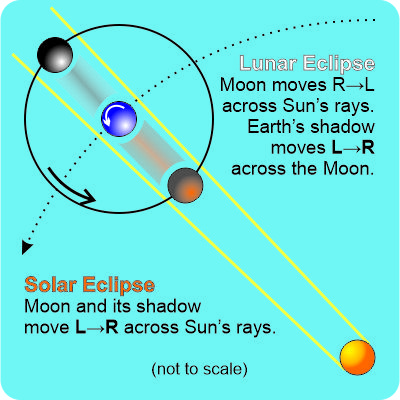
“Sure, Sis. It’s all about where the shadow’s being cast and how the shadow caster is moving at the time. This diagram tells the story. Nearly everything in the Solar System runs counterclockwise—”

“Widdershins.”

“… Right. Every orbit runs left‑to‑right half the time, right‑to‑left the other half. The two kinds of eclipse happen in opposite halves. The geometry works out that we see both eclipse shadows move left‑to‑right. See?”

“Cool.”

~~ Rich Olcott

  • Thanks to Alex for the question, and to Lori for the shadow observation, which I hadn’t seen discussed before.