Titan’s Atmosphere Is A Gas

One year ago I kicked off these weekly posts with some speculations about how Life might exist on Saturn’s moon Titan. My surmises were based on reports from NASA’s Cassini-Huygens mission, plus some Physical Chemistry expectations for Titan’s frigid non-polar mix of liquid ethane and methane. Titan offers way more fun than that.

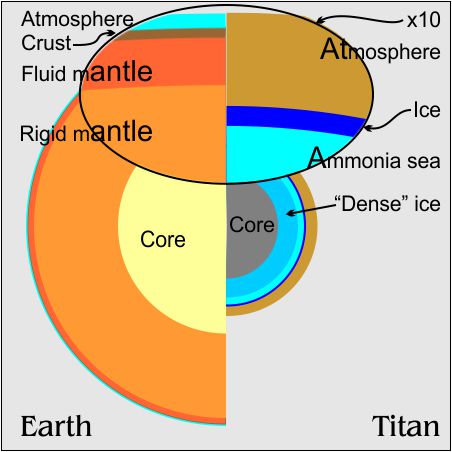
The environment on Titan is different from everything we’re used to on Earth. For instance, the atmosphere’s weird.earth-vx-titanTitan’s atmosphere is heavy-duty compared with Earth’s — 6 times deeper and about 1½ times the surface pressure. When I read those numbers I thought, “Huh? But Titan’s diameter is only 40% as big as Earth’s and its surface gravity is only 10% of ours. How come it’s got such a heavy atmosphere?”
Wait, what’s gravity got to do with air pressure? (I’m gonna use “air pressure” instead of “surface atmospheric pressure” because typing.) Earth-standard sea level air pressure is 14.7 pounds of force per square inch. That 14.7 pounds is the total weight of the air molecules above each square inch of surface, all the way out to space.

(Fortunately, air’s a hydraulic fluid so its pressure acts on sides as well as tops. Otherwise, a football’s shape would be even stranger than it is.)

Newton showed us that weight (force) is mass times the the acceleration of gravity. Gravity on Titan is 1/10 as strong as Earth’s, so an Earth-height column of air on Titan should weigh about 1½ pounds.

But Titan’s atmosphere (measured to the top of each stratosphere) goes out 6 times further than Earth’s. If we built out that square-inch column 6 times taller, it’d weigh only 9 pounds on Titan, well shy of the 22 pounds the Huygens lander measured. Where does the extra weight come from?

My first guess was, heavy molecules. If gas A has molecules that are twice as heavy as gas B’s, then a given volume of A would weigh twice as much as the same volume of B. An atmosphere composed of A will press down on a planet’s surface twice as hard as an atmosphere composed of B.

Good guess, but doesn’t apply. Earth’s atmosphere is 78% N2 (molecular weight 28) and 21% O2 (molecular weight 32) plus a teeny bit of a few other things. Their average molecular weight is about 29. Titan’s atmosphere is 98% N2 so its average molecular weight (28) is virtually equal to Earth’s. So no, those tarry brown molecules that block our view of Titan’s surface aren’t numerous enough to account for the high pressure.

My second guess is closer to the mark, I think. I remembered the Ideal Gas Law, the one that says, “pressure times volume equals the number of molecules times a constant times the absolute temperature.” In symbols, P·V=n·R·T.

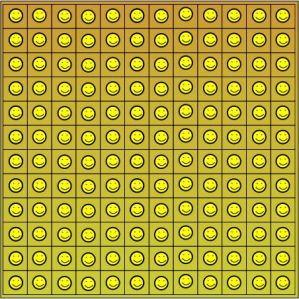
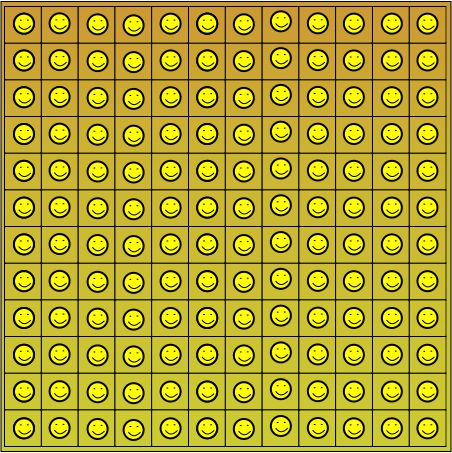
Visualize one gas molecule, Fred, bouncing around in a cube sized to match the average volume per molecule, V/n=R·T/P. If Fred goes outside his cube in any direction he’s likely to bang into an adjacent molecule. If Fred has too much contact with his neighbors they’ll all stick together and become a liquid or solid.

The equation tells us that if the pressure doesn’t change, the size of Fred’s cube rises with the temperature. Just for grins I calculated the cube’s size for standard Earth conditions: (22.4 liters/mole)×(1 cubic meter/1000 liters)×(1 mole/6.02×1023 molecules)=37.2×10⁻²⁷ cubic meter/molecule. The cube root of that is the length of the cube’s edge — 3.3 nanometers, about 8.3 times Fred’s 0.40-nanometer diameter.

titan-boxes
Fred and neighbors

Earth-standard surface temperature is about 300°K (absolute temperatures are measured in Kelvins). Titan’s surface temperature is only 94°K. On Titan that cube-edge would be 8.3*(94/300)=2.6 times Fred’s diameter — if air pressure were Earth-standard.

But really Titan’s air pressure is 1.5 times higher because its column is so tall and contains so much gas. The additional pressure squeezes Fred’s cube-edge down to 2.6*(1/1.5)=1.8 times his diameter. Still room enough for Fred to feel well-separated from his neighbors and continue acting like a proper gas.

The primary reason Titan’s atmosphere is so dense is that it’s chilly up there. Also, there’s a lot of Freds.

~~ Rich Olcott

– For the technorati… The cube-root of the Van der Waals volume for N2. And yeah, I know I’m almost writing about Mean Free Path but I think the development’s simpler this way.
Superluminal Superman

Comic book and movie plotlines often make Superman accelerate up to lightspeed and travel backward in time.  Unfortunately, well-known fundamental Physics principles forbid that.  But suppose Green Lantern or Dr Strange could somehow magic him past the Lightspeed Barrier.  Would that let him do his downtimey thing?

Light_s hourglass
Light’s Hourglass

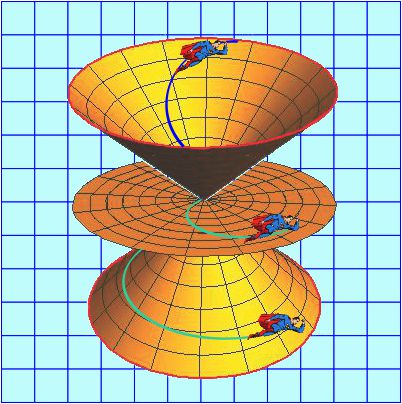
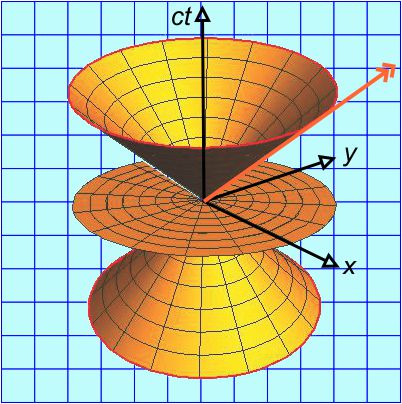
A quick review of Light’s Hourglass.  According to Einstein we live in 4D spacetime.  At any moment you’re at a specific time t relative to some origin time t=0 and a specific 3D location (x,y,z) relative to a spatial origin (0,0,0).  Your spacetime address is (ct,x,y,z) where c is the speed of light.  This diagram shows time running vertically into the future, plus two spatial coordinates x and y.  Sorry, I can’t get z into the diagram so pretend it’s zero.

The two cones depict all the addresses which can communicate with the origin using a flash of light.  Any point on either cone is at just the right distance d=√(++) to match the distance that light can travel in time t.  The bottom cone is in the past, which is why we can see the light from old stars.  The top cone is in the future, which is why we can’t see light from stars that aren’t born yet.

If he obeys the Laws of Physics as we know them, Superman can travel anywhere he wants to inside the top cone.  He goes upward into the future at the rate of one second per second, just like anybody.  On the way, he can travel in space as far from (ct,0,0,0) as he likes so long as it’s not farther than the distance that light can travel the same route at his current t.

From our perspective, the Hourglass is a stack of circles (spheres in 3D space) centered on (ct,0,0,0).  From Supey’s perspective at time t he’s surrounded by a figure with radius ct that Physics won’t let him break through.  That’s his Lightspeed Barrier, like the Sonic Barrier but 900,000 times faster.

Suppose Green Lantern has magicked Supey up to twice lightspeed along the x-axis.  At moment t, he’s at (ct,2ct,0,0), twice as far as light can get.  In the diagram he’s outside the top cone but above the central disk.

Now GL pours on the power to accelerate Superman.  Each increment gets the Man of Steel closer to that disk.  He’s always “above” it, though, because he’s still moving into the future.  Only if he were to get to infinite speed could he reach the disk.

However, at infinite speed he’d go anywhere/everywhere instantaneously which would be confusing to even his Kryptonian intellect.  On the way he might run into things (stars, black holes,…) with literally zero time to react.

But the plotlines have Tall-Dark-and-Muscular flying into the past, breaching that disk and traveling downwards into the bottom cone.  Can GL make that happen?

Enter the Lorentz correction.  If you have rest mass m0 and you’re traveling at speed v, your effective mass is m=m0/√[1-(v/c)²]. That raises a couple of issues when you exceed lightspeed.

Suppose GL decelerates Superluminal Supey down towards lightspeed.  The closer he approaches c from higher speeds, the smaller that square root gets and the greater the effective mass.  It’s the same problem Superman faced when accelerating up to lightspeed.  That last mile per second down to c requires an infinite amount of braking energy — the Lightspeed Barrier is impermeable in both directions.

The other problem is that if v>c there’s a negative number inside that square root.    Above lightspeed, your effective mass becomes Bombelli-imaginary.  Remember Newton’s famous F=m·a?  Re-arrange it to a=F/m.  A real force applied to an object with imaginary mass produces an imaginary acceleration.  “Imaginary” in Physics generally means “perpendicular in some sense” and remember we’re in 4D here with time perpendicular to space.

GL might be able to shove Superman downtime, but he’d have to

  1. squeeze inward at hiper-lightspeed with exactly the same force along all three spatial dimensions, to make sure that “perpendicular” is only along the time axis
  2. start Operation Squish at some time in his own future to push towards the past.

Nice trick.  Would Superman buy in?

~~ Rich Olcott

Superman flying at lightspeed? Umm… no

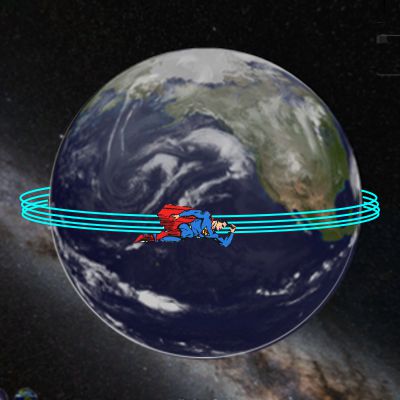
Back when I was in high school I did a term paper for some class (can’t remember which) ripping the heck out of Superman physics.  Yeah, I was that kind of kid.  If I recall correctly, I spent much of it slamming his supposed vision capabilities — they were fairly ludicrous even to a HS student and that was many refreshes of the DC universe ago.FTL SupermanBut for this post let’s consider a trope that’s been taken off the shelf again and again since those days, even in the movies.  This rendition should get the idea across — Our Hero, in a desperate effort to fix a narrative hole the writers had dug themselves into, is forced to fly around the Earth at faster-than-light speeds, thereby reversing time so he can patch things up.
So many problems…  Just for starters, the Earth is 8000 miles wide, Supey’s what, 6’6″?, so on this scale he shouldn’t fill even a thousandth of a pixel.  OK, artistic license.  Fine.

Second problem, only one image of the guy.  If he’s really passing us headed into the past we should see two images, one coming in feet-first from the future and the other headed forward in both space and time.  Oh, and because of the Doppler effect the feet-first image should be blue-shifted and the other one red-shifted.

Of course both of those images would be the wrong shape.  The FitzGerald-Lorentz Contraction makes moving objects appear shorter in the direction of motion.  In other words, if the Man of Steel were flying just shy of the speed of light then 6’6″ tall would look to us more like a disk with a short cape.

Tall-Dark-And-Muscular has other problems to solve on his way to the past.  How does he get up there in the first place?  Back in the day, DC explained that he “leaped tall buildings in a single bound.”   That pretty much says ballistic high-jump, where all the energy comes from the initial impulse.  OK, but consider the rebound effects on the neighborhood if he were to jump with as much energy as it would take to orbit a 250-lb man.  People would complain.

Remember Einstein’s famous E=mc²?  That mass m isn’t quite what most people think it is.  Rather, it’s an object’s rest mass m0 modified by a Lorentz correction to account for the object’s kinetic energy.   In our hum-drum daily life that correction factor is basically 1.00000…   When you get into the lightspeed ballpark it gets bigger.

Here’s the formula with the Lorentz correction in red: m=m0/√[1-(v/c)2].  The square root nears zero as Superman’s velocity v approaches lightspeed c.  When the divisor gets very small the corrected mass gets very large.  If he got to the Lightspeed Barrier (where v=c) he’d be infinitely massive.

So you’ve got an infinite mass circling the Earth about 7 times a second — ocean tides probably couldn’t keep up, but the planet would be shaking enough to fracture the rock layers that keep volcanoes quiet.  People would complain.

Of course, if he had that much mass, Earth and the entire Solar System would be orbiting him.

On the E side of Einstein’s equation, Superman must attain that massive mass by getting energy from somewhere.  Gaining that last mile/second on the way to infinity is gonna take a lot of energy.

But it’s worse.  Even at less than lightspeed, the Kryptonian isn’t flying in a straight line.  He’s circling the Earth in an orbit.  The usual visuals show him about as far out as an Earth-orbiting spacecraft.  A GPS satellite’s stable 24-hour orbit has a 26,000 mile radius so it’s going about 1.9 miles/sec.  Superman ‘s traveling about 98,000 times faster than that.  Physics demands that he use a powered orbit, continuously expending serious energy on centripetal acceleration just to avoid flying off to Vega again.

The comic books have never been real clear on the energy source for Superman’s feats.  Does he suck it from the Sun?  I sure hope not — that’d destabilize the Sun and generate massive solar flares and all sorts of trouble.

Not even the DC writers would want Superman to wipe out his adopted planet just to fix up a plot point.

~~ Rich Olcott

Light’s hourglass

Terry Pratchett’s anthropomorphic character Death (who always speaks in UPPER CASE with a voice that sounds like tombstones falling) has a thing about hourglasses.  So do physicists, but theirs don’t have sand in them.  And they don’t so much represent Eternity as describe it.  Maybe.

The prior post was all about spacetime events (an event is the combination of a specific (x,y,z) spatial location with a specific time t) and how the Minkowski diagram divides the Universe into mutually exclusive pieces:

  • “look but don’t touch” — the past, all the spacetime events which could have caused something to happen where/when we are
  • “touch but don’t look” — the future, the events where/when we can cause something to happen
  • “no look, no touch” — the spacelike part that’s so far away that light can’t reach us and we can’t reach it without breaching Einstein’s speed-of-light constraint
  • “here and now” — the tiny point in spacetime with address (ct,x,y,z)=(0,0,0,0)

Light_s hourglassLast week’s Minkowski diagram was two-dimensional.  It showed time running along the vertical axis and Pythagorean distance d=√(x²+y²+z²) along the horizontal one.  That was OK in the days before computer graphics, but it  loaded many different events onto the same point on the chart.  For instance, (0,1,0,0), (0,-1,0,0), (0,0,1,0) and (0,0,0,1) (and more) are all at d=1.

This chart is one dimension closer to what the physicists really think about.  Here we have x and y along distinct axes.  The z axis is perpendicular to all three, and if you can visualize that you’re better at it than I am.  The xy plane (and the xyz cube if you’re good at it) is perpendicular to t.

That orange line was in last week’s diagram and it means the same thing in this one.  It contains events that can use light-speed somehow to communicate with the here-and-now event.  But now we see that the line into the future is just part of a cone (or a hypercone if you’re good at it).

If we ignite a flash of light at time t=0, at any positive time t that lightwave will have expanded to a circle (or bubble) with radius d=c·t. The circles form the “future” cone.

Another cone extends into the past.  It’s made up of all the events from which a flash of light at time at some negative t would reach the here-and-now event.

The diagram raises four hotly debated questions:

  • Is the pastward cone actually pear-shaped?  It’s supposed to go back to The Very Beginning.  That’s The Big Bang when the Universe was infinitesimally small.  Back then d for even the furthest event from (ct,0,0,0) should have been much smaller than the nanometers-to-lightyears range of sizes we’re familiar with today.  But spacetime was smaller, too, so maybe everything just expanded in sync once we got past Cosmic Inflation.  We may never know the answer.
  • What’s outside the cones?  You think what you see around you is right now?  Sorry.  If the screen you’re reading this on is a typical 30 inches or so distant, the light you’re seeing left the screen 2½ nanoseconds ago.  Things might have changed since then.  We can see no further into the Universe than 14 billion lightyears, and even that only tells us what happened 14 billion years ago.  Are there even now other Earth-ish civilizations just 15 billion lightyears away from us?  We may never know the answer.
  • How big is “here-and-now”?  We think of it as a size=zero mathematical point, but there are technical grounds to think that the smallest possible distance is the Planck length, 1.62×10⁻³⁵ meters.  Do incidents that might affect us occur at a smaller scale than that?  Is time quantized?  We may never know the answers.
  • Do the contents of the futureward cone “already” exist in some sense, or do we truly have free will?  Einstein thought we live in a block universe, with events in future time as fixed as those in past time.  Other thinkers hold that neither past not future are real.  I like the growing block alternative, in which the past is real and fixed but the future exists as maybes.  We may never know the answer.

~~ Rich Olcott