Seesaw to The Stars

I look around the playground. “Where’s the seesaw, Teena?”

“They took it away. That’s good ’cause I hated that thing!”

“Why’s that, Sweetie?”

“I never could play right on it. Almost never. Sometimes there’d be a kid my size on the other end and that worked OK, but a lot of times a big kid got on the other end and bounced me up in the air. The first time I even fell off and they laughed.”

“Well, I can understand that. I’m sure you’ve been nicer than that to the littler kids.”

“Uh-huh, except for Bratty Brian, but he liked it when I bounced him. He called it ‘going to the Moon’.”

“I can understand that, too. If things go just right you come off your seat and float like an astronaut for a moment. I bet he held onto the handles tight.”

“Yeah, I just wasn’t ready for it the first time.”
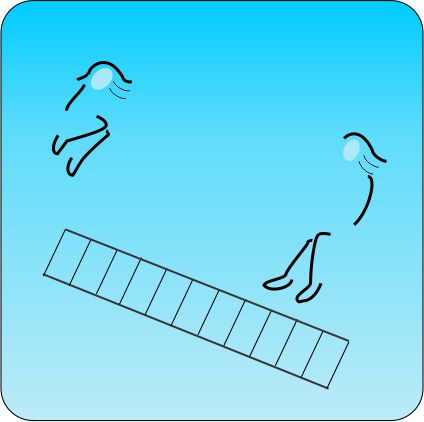
“Y’know, there’s another way that Brian’s bounces were like a rocket trip to somewhere. They went through the same phases of acceleration and deceleration.”

“Uncle Sy, you know you’re not allowed to use words like that around me without ‘splaining them.”

“Mmm, they both have to do with changing speed. Suppose you’re standing still. Your speed is zero, right? When you start moving your speed isn’t zero any more and we say you’ve accelerated. When you slow down again we say you’re decelerating. Make sense?”

“So when Bratty Brian gets on the low end of the seesaw he’s zero. When I squinch down at my end he accelerates –“

“Right, that’s like the boost phase of a rocket trip.”

“… And when he’s floating at the very top –“

“Like astronauts when they’re coasting, sort of but not really.”

“… And then they decelerate when they land. Bratty Brian did, too. I guess deceleration is like acceleration backwards. But why such fancy words?”

“No-one paid much attention to acceleration until Mr Newton did. He changed Physics forever when he said that all accelerations involve a force of some kind. That thought led him to the whole idea of gravity as a force. Ever since then, when physicists see something being accelerated they look for the force that caused it and then they look for what generated the force. That’s how we learned about electromagnetism and the forces that hold atoms together and even dark matter which is ultra-mysterious.”

“Ooo, I love mysteries! What did Mr Newton tell us about this one?”

“Nothing, directly, but his laws gave us a clue about what to look for. Tell me what forces were in play during Brian’s ‘moon flight’.”

“Let’s see. He accelerated up and then he accelerated down. I guess while he was on the seesaw seat at the beginning the up-acceleration came from an up-force from his end of the board. And the down-acceleration came from gravity’s force. But the gravity force is there all along, isn’t it?”

“Good point. What made the difference is that your initial force was greater than gravity’s so Brian went up. When your force stopped, gravity’s force was all that mattered so Brian came back down again.”

“So it’s like a tug-of-war, first I won then gravity won.”

“Exactly. Now how about the forces when you were on the merry-go-round?”

“OK. Gravity’s always there so it was pulling down on me. The merry-go-round was pushing up?”

“Absolutely. A lot of people think that’s weird, but whatever we stand on pushes up exactly as hard as gravity pulls us down. Otherwise we’d sink into the ground or fly off into space. What about other forces?”

“Oh, yeah, Mr Newton’s outward force pushed me off until … holding the handles made the inward force to keep me on!”
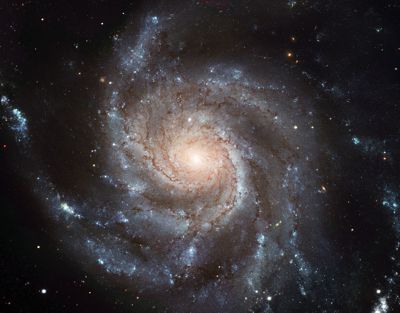
“Nice job! Now think about a galaxy, millions of stars orbiting around like on a merry-go-round. They feel an outward force like you did, and they feel an inward force from gravity so they all stay together instead of flying apart. But…”

“But?”

“Mr Newton’s rules tell us how much gravity the stars need to stay together. The astronomers tell us that there aren’t enough stars to make that much gravity. Dark matter supplies the extra.”

~~ Rich Olcott
Conversation of Energy

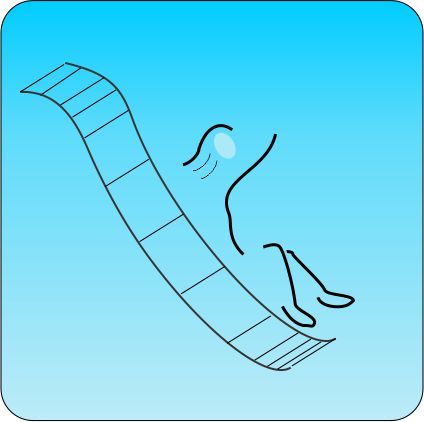
Teena’s next dash is for the slide, the high one, of course. “Ha-ha, Uncle Sy, beat you here. Look at me climbing up and getting potential energy!”

“You certainly did and you certainly are.”

“Now I’m sliding down all kinetic energy, wheee!” <thump, followed by thoughtful pause> “Uncle Sy, I’m all mixed up. You said momentum and energy are like cousins and we can’t create or destroy either one but I just started momentum coming down and then it stopped and where did my kinetic energy go? Did I break Mr Newton’s rule?”

“My goodness, those are good questions. They had physicists stumped for hundreds of years. You didn’t break Mr Newton’s Conservation of Momentum rule, you just did something his rule doesn’t cover. I did say there are important exceptions, remember.”

“Yeah, but you didn’t say what they are.”

“And you want to know, eh? Mmm, one exception is that the objects have to be big enough to see. Really tiny things follow quantum rules that have something like momentum but it’s different. Uhh, another exception is the objects can’t be moving too fast, like near the speed of light. But for us the most important exception is that the rule only applies when all the energy to make things move comes from objects that are already moving.”

“Like my marbles banging into each other on the floor?”

“An excellent example. Mr Newton was starting a new way of doing science. He had to work with very simple systems and and so his rules were very simple. One Sun and one planet, or one or two marbles rolling on a flat floor. His rules were all about forces and momentum, which is a combination of mass and speed. He said the only way to change something’s momentum was to push it with a force. Suppose when you push on a marble it goes a foot in one second and has a certain momentum. If you push it twice as hard it goes two feet in one second and has twice the momentum.”

“What if I’ve got a bigger marble?”

“If you have a marble that’s twice as heavy and you give it the one-foot-per-second speed, it has twice the momentum. Once there’s a certain amount of momentum in one of Mr Newton’s simple systems, that’s that.”

“Oh, that’s why I’ve got to snap my steelie harder than the glass marbles ’cause it’s heavier. Oh!Oh!And when it hits a glass one, that goes faster than the steelie did ’cause it’s lighter but it gets the momentum that the steelie had.”

“Perfect. You Mommie will be so proud of you for that thinking.”

“Yay! So how are momentum and energy cousins?”

“Cous… Oh. What I said was they’re related. Both momentum and kinetic energy depend on both mass and speed, but in different ways. If you double something’s speed you give it twice the momentum but four times the amount of kinetic energy. The thing is, there’s only a few kinds of momentum but there are lots of kinds of energy. Mr Newton’s Conservation of Momentum rule is limited to only certain situations but the Conservation of Energy rule works everywhere.”

“Energy is bigger than momentum?”

“That’s one way of putting it. Let’s say the idea of energy is bigger. You can get electrical energy from generators or batteries, chemical energy from your muscles, gravitational energy from, um, gravity –“

“Atomic energy from atoms, wind energy from the wind, solar energy from the Sun –“

“Cloud energy from clouds –“

“Wait, what?”

“Just kidding. The point is that energy comes in many varieties and they can be converted into one another and the total amount of energy never changes.”

“Then what happened to my kinetic energy coming down the slide? I didn’t give energy to anything else to make it start moving.”

“Didn’t you notice the seat of your pants getting hotter while you were slowing down? Heat is energy, too — atoms and molecules just bouncing around in place. In fact, one of the really good rules is that sooner or later, every kind of energy turns into heat.”

“Big me moving little atoms around?”

“Lots and lots of them.”

~~ Rich Olcott

Conversation of Momentum

Teena bounces out of the sandbox, races over to the playground’s little merry-go-round and shoves it into motion. “Come help turn this, Uncle Sy, I wanna go fast!” She leaps onto the moving wheel and of course she promptly falls off. The good news is that she rolls with the fall like I taught her to do.

“Why can’t I stay on, Uncle Sy?”

“What’s your new favorite word again?”

“Mmmo-MMENN-tumm. But that had to do with swings.”

“Swings and lots of other stuff, including merry-go-rounds and even why you should roll with the fall. Which, by the way, you did very well and I’m glad about that because we don’t want you getting hurt on the playground.”

“Well, it does hurt a little on my elbow, see?”

“Let me look … ah, no bleeding, things only bend where they’re supposed to … I think no damage done but you can ask your Mommie to kiss it if it still hurts when we get home. But you wanted to know why you fell off so let’s go back to the sandbox to figure that out.”

<scamper!> “I beat you here!”

“Of course you did. OK, let’s draw a big arc and pretend that’s looking down on part of the merry-go-round. I’ll add some lines for the spokes and handles. Now I’ll add some dots and arrows to show what I saw from over here. See, the merry-go-round is turning like this curvy arrow shows. You started at this dot and jumped onto this dot which moved along and then you fell off over here. Poor Teena. So you and your momentum mostly went left-to-right.”

“But that’s not what happened, Uncle Sy. Here, I’ll draw it. I jumped on but something tried to push me off and then I did fall off and then I rolled. Poor me. Hey, my arm doesn’t hurt any more!”

“How about that? I’ve often found that thinking about something else makes hurts go away. So what do you think was trying to push you off? I’ll give you a hint with these extra arrows on the arc.”

“That looks like Mr Newton’s new directions, the in-and-out direction and the going-around one. Oh! I fell off along the in-and-out direction! Like I was a planet and the Sun wasn’t holding me in my orbit! Is that what happened, I had out-momentum?”

“Good thinking, Teena. Mr Newton would say that you got that momentum from a force in the out-direction. He’d also say that if you want to stand steady you need all the forces around you to balance each other. What does that tell you about what you need to do to stay on the merry-go-round?”

“I need an in-direction force … Hah, that’s what I did wrong! I jumped on but I didn’t grab the handles.”

“Lesson learned. Good.”

“But what about the rolling?”

“Well, in general when you fall it’s nearly always good to roll the way your body’s spinning and only try to slow it down. People who put out an arm or leg to stop a fall often stress it and and maybe even tear or break something.”

“That’s what you’ve told me. But what made me spin?”

“One of Mr Newton’s basic principles was a rule called ‘Conservation of Momentum.’ It says that you can transfer momentum from one thing to another but you can’t create it or destroy it. There are some important exceptions but it’s a pretty good rule for the cases he studied. Your adventure was one of them. Look back at the picture I drew. You’d built up a lot of going-around momentum from pushing the merry-go-round to get it started. You still had momentum in that direction when you fell off. Sure enough, that’s the direction you rolled.”

“Is that the ‘Conversation of Energy’ thing that you and Mommie were talking about?”

“Conservation. It’s not the same but it’s closely related.”

“Why does it even work?”

“Ah, that’s such a deep question that most physicists don’t even think about it. Like gravity, Mr Newton described what inertia and momentum do, but not how they work. Einstein explained gravity, but I’m not convinced that we understand mass yet.”

~~ Rich Olcott

A Momentous Occasion

<creak> Teena’s enjoying her new-found power in the swings. “Hey, Uncle Sy? <creak> Why doesn’t the Earth fall into the Sun?”

“What in the world got you thinking about that on such a lovely day?”

“The Sun gets in my eyes when I swing forward <creak> and that reminded me of the time we saw the eclipse <creak> and that reminded of how the planets and moons are all floating in space <creak> and the Sun’s gravity’s holding them together but if <creak> the Sun’s pulling on us why don’t we just fall in?” <creak>

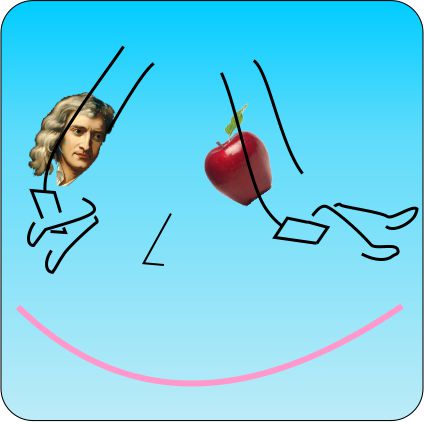
“An excellent question, young lady. Isaac Newton thought about it long and hard back when he was inventing Physics.”

“Isaac Newton? Is he the one with all the hair and a long, skinny nose and William Tell shot an arrow off his head?”

“Well, you’ve described his picture, but you’ve mixed up two different stories. William Tell’s apple story was hundreds of years before Newton. Isaac’s apple story had the fruit falling onto his head, not being shot off of it. That apple got him thinking about gravity and how Earth’s gravity pulling on the apple was like the Sun’s gravity pulling on the planets. When he was done explaining planet orbits, he’d also explained how your swing works.”

“My swing works like a planet? No, my swing goes back and forth, but planets go round and round.”

“Jump down and we can draw pictures over there in the sandbox.”

<thump!! scamper!> “I beat you here!”

“Of course you did. OK, what’s your new M-word?”

“Mmmo-MMENN-tummm!”

“Right. Mr Newton’s Law of Inertia is about momentum. It says that things go in a straight line unless something interferes. It’s momentum that keeps your swing going.”

“B-u-u-t, I wasn’t going in a straight line, I was going in part of a circle.”

“Good observing, Teena, that’s exactly right. Mr Newton’s trick was that a really small piece of a circle looks like a straight line. Look here. I’ll draw a circle … and inside it I’ll put a triangle… and between them I’ll put a hexagon — see how it has an extra point halfway between each of the triangle’s points? — and up top I’ll put the top part of whatever has 12 sides. See how the 12-thing’s sides are almost on the circle?”

“Ooo, that’s pretty! Can we do that with a square, too?”

“Sure. Here’s the circle … and the square … and an octagon … and a 16-thing. See, that’s even closer to being a circle.”

“Ha-ha — ‘octagon’ — that’s like ‘octopus’.”

“For good reason. An octopus has eight arms and an octagon has eight sides. ‘Octo-‘ means ‘eight.’ So anyway, Mr Newton realized that his momentum law would apply to something moving along that tiny straight line on a circle. But then he had another idea — you can move in two directions at once so you can have momentum in two directions at once.”

“That’s silly, Uncle Sy. There’s only one of me so I can’t move in two directions at once.”

“Can you move North?”

“Uh-huh.”

“Can you move East?”

“Sure.”

“Can you move Northeast?”

“Oh … does that count as two?”

“It can for some situations, like planets in orbit or you swinging on a swing. You move side-to-side and up-and-down at the same time, right?”

“Uh-huh.”

“When you’re at either end of the trip and as far up as you can get, you stop for that little moment and you have no momentum. When you’re at the bottom, you’ve got a lot of side-to-side momentum across the ground. Anywhere in between, you’ve got up-down momentum and side-to-side momentum. One kind turns into the other and back again.”

“So complicated.”

“Well, it is. Newton simplified things with revised directions — one’s in-or-out from the center, the other’s the going-around angle. Each has its own momentum. The swing’s ropes don’t change length so your in-out momentum is always zero. Your angle-momentum is what keeps you going past your swing’s bottom point. Planets don’t have much in-out momentum, either — they stay about their favorite distance from the Sun.”

“Earth’s angle-momentum is why we don’t fall in?”

“Yep, we’ve got so much that we’re always falling past the Sun.”

~~ Rich Olcott