Going from Worse to Bad

Al delivers coffees to our table, then pauses. “Why methane?”

Susan Kim looks up from her mocha latte. “Sorry?”

“Why all the fuss about methane all of a sudden? I thought carbon dioxide was the baddie. Everybody’s switching from coal to natural gas which they say is just methane and now that’s a bad thing, too. I’m confused. You’re a chemist, unconfuse me.”

“You’re right, there’s mixed message out there. Here’s the bottom line. Methane’s bad, but coal’s a worse bad.”

“OK, but why?”

“Pass me a paper napkin so I can write down the chemical reactions. When we look at them in detail there’s all kinds of complicated reaction paths, but the overall processes are pretty simple. The burnable part of coal is carbon. In an efficient coal‑fired process what happens is
  C + O2 → CO2 + energy.
The C is carbon, of course and O2 is an oxygen molecule, two atoms linked together. Carbon atoms weigh 12 and each oxygen atoms weighs 16, so 12 grams of carbon produces 12+(2×16)=44 grams of CO2. Scaling up, 12 tons of carbon produces 44 tons of CO2 and so on. The energy scales up, too. and that’s what heats the boilers that make the steam that spins the turbines that make electricity.”

“I heard a couple of weasel words but go on to methane.”

“You caught them, eh? They’re important weasels and we’ll get to them. OK, methane is CH4 and its overall burn equation is
  CH4 + 2O2 → CO2 + 2H2O + energy.
Oxidizing those hydrogens releases about twice as much energy per carbon as the coal reaction does.”

“Already I see one big advantage for methane — more bang per CO2. So about those weasels…”

“Right. Well, coal isn’t just pure burnable carbon. It’s 350‑million‑year‑old trees and ferns and animal carcasses and swamp muck and mineral sediments, all pressure‑baked together. There’s sulfur and nitrogen in there, mixed in with nasty elements like mercury and arsenic.”

“The extras go up the smokestack along with the CO2, huh? Bad, for sure.”

“The good news is that coal-burning power plants are under the gun to clean up those emissions. The bad news is that effective mitigation technologies themselves cost energy. That lowers the net yield. But the inefficiency gets worse. Think coal trains.”

“Yeah, half the time I get held up on the way home by one of those hundred‑car strings, either full-up heading to the power plant or empties going back for another load.”

“Mm-hm. Transporting coal takes energy, and so does mining it and crushing it and pre‑treating to get rid of dirt and then taking care of the ashes. Even less net energy output per ton of smokestack CO2, even worse inefficiency. See why coal’s on its way out?”

“I guess all that didn’t matter when it was cheap to dig up and there wasn’t much competition.”

“You put your finger on it, Al. Coal got its foot in the door with steam engines 300 years ago when about the only other things you could burn were wood and whale oil. Crude oil got big in the mid‑1800s but it had to be refined and that made it expensive. Cheap natural gas wasn’t really a thing until fracking came along 50 years ago, but that brought a different set of issues.”

“Yeah, I’ve seen videos of people lighting their kitchen sink water on fire. And wasn’t there an earthquake thing in Oklahoma?”

“That was an interesting situation. Oklahoma’s in the middle of the continent, not a place you’d expect earthquakes, but they began experiencing flurries of shallow ones in 2011. The fracking process starts with water pumped at high pressure into gas-bearing strata to loosen things up. People suspected fracking was connected to the earthquakes. It was, but only indirectly. When fracked gas comes out of a well, water does, too. The rig operators pump that expelled water down old oil wells. Among other things, the state’s Corporation Commission is in charge of their hydrocarbon production. When the Commission ordered a 60% cut in the waste‑water down‑pumping, the earthquake rate dropped by 90%. Sometimes regulations are good things, huh?”

~~ Rich Olcott

Hyperbolas But Not Hyperbole

Minus? Where did that come from?”

<Gentle reader — If that question looks unfamiliar, please read the preceding post before this one.>

Jim’s still at the Open Mic. “A clever application of hyperbolic geometry.” Now several of Jeremy’s groupies are looking upset. “OK, I’ll step back a bit. Jeremy, suppose your telescope captures a side view of a 1000‑meter spaceship but it’s moving at 99% of lightspeed relative to you. The Lorentz factor for that velocity is 7.09. What will its length look like to you?”

“Lorentz contracts lengths so the ship’s kilometer appears to be shorter by that 7.09 factor so from here it’d look about … 140 meters long.”

“Nice, How about the clocks on that spaceship?”

“I’d see their seconds appear to lengthen by that same 7.09 factor.”

“So if I multiplied the space contraction by the time dilation to get a spacetime hypervolume—”

“You’d get what you would have gotten with the spaceship standing still. The contraction and dilation factors cancel out.”

“How about if the spaceship went even faster, say 99.999% of lightspeed?”

“The Lorentz factor gets bigger but the arithmetic for contraction and dilation still cancels. The hypervolume you defined is always gonna be just the product of the ship’s rest length and rest clock rate.”

His groupies go “Oooo.”

One of the groupies pipes up. “Wait, the product of x and y is a constant — that’s a hyperbola!”

“Bingo. Do you remember any other equations associated with hyperbolas?”

“Umm… Yes, x2–y2 equals a constant. That’s the same shape as the other one, of course, just rotated down so it cuts the x-axis vertically.”

Jeremy goes “Oooo.”

Jim draws hyperbolas and a circle on the whiteboard. That sets thoughts popping out all through the crowd. Maybe‑an‑Art‑major blurts into the general rumble. “Oh, ‘plus‘ locks x and y inside the constant so you get a circle boundary, but ‘minus‘ lets x get as big as it wants so long as y lags behind!”

Another conversation – “Wait, can xy=constant and x2–y2=constant both be right?”
  ”Sure, they’re different constants. Both equations are true where the red and blue lines cross.”

A physics student gets quizzical. “Jim, was this Minkowski’s idea, or Einstein’s?”

“That’s a darned good question, Paul. Minkowski was sole author of the paper that introduced spacetime and defined the interval, but he published it a year after Einstein’s 1905 Special Relativity paper highlighted the Lorentz transformations. I haven’t researched the history, but my money would be on Einstein intuitively connecting constant hypervolumes to hyperbolic geometry. He’d probably check his ideas with his mentor Minkowski, who was on the same trail but graciously framed his detailed write‑up to be in support of Einstein’s work.”

One of the astronomy students sniffs. “Wait, different observers see the same s2=(ct)2d2 interval between two events? I suppose there’s algebra to prove that.”

“There is.”

“That’s all very nice in a geometric sort of way, but what does s2 mean and why should we care whether or not it’s constant?”

“Fair questions, Vera. Mmm … you probably care that intervals set limits on what astronomers see. Here’s a Minkowski map of the Universe. We’re in the center because naturally. Time runs upwards, space runs outwards and if you can imagine that as a hypersphere, go for it. Light can’t get to us from the gray areas. The red lines, they’re really a hypercone, mark where s2=0.”

From the back of the room — “A zero interval?”

“Sure. A zero interval means that the distance between two events exactly equals lightspeed times light’s travel time between those events. Which means if you’re surfing a lightwave between two events, you’re on an interval with zero measure. Let’s label Vera’s telescope session tonight as event A and her target event is B. If the A–B interval’s ct difference is greater then its d difference then she can see Bif the event is in our past but not beyond the Cosmic Microwave Background. But if a Dominion fleet battle is approaching us through subspace from that black dot, we’ll have no possible warning before they’re on us.”

Everyone goes “Oooo.”

~~ Rich Olcott

Thinking in Spacetime

The Open Mic session in Al’s coffee shop is still going string. The crowd’s still muttering after Jeremy stuck a pin in Big Mike’s “coincidence” balloon when Jim steps up. Jim’s an Astrophysics post‑doc now so we quiet down expectantly. “Nice try, Mike. Here’s another mind expander to play with. <stepping over to the whiteboard> Folks, I give you … a hypotenuse. ‘That’s just a line,’ you say. Ah, yes, but it’s part of some right triangles like … these. Say three different observers are surveying the line from different locations. Alice finds her distance to point A is 300 meters and her distance to point B is 400. Applying Pythagoras’ Theorem, she figures the A–B distance as 500 meters. We good so far?”

A couple of Jeremy’s groupies look doubtful. Maybe‑an‑Art‑Major shyly raises a hand. “The formula they taught us is a2+b2=c2. And aren’t the x and y supposed to go horizontal and vertical?”

“Whoa, nice questions and important points. In a minute I’m going to use c for the speed of light. It’s confusing to use the same letter for two different purposes. Also, we have to pay them extra for double duty. Anyhow, I’m using d for distance here instead of c, OK? To your next point — Alice, Bob and Carl each have their own horizontal and vertical orientations, but the A–B line doesn’t care who’s looking at it. One of our fundamental principles is that the laws of Physics don’t depend on the observer’s frame of reference. In this situation that means that all three observers should measure the same length. The Pythagorean formula works for all of them, so long as we’re working on a flat plane and no-one’s doing relativistic stuff, OK?”

Tentative nods from the audience.

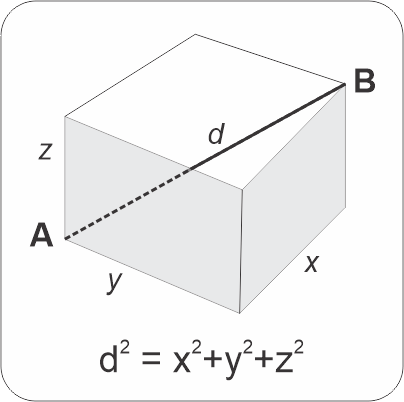
“Right, so much for flat pictures. Let’s up our game by a dimension. Here’s that same A–B line but it’s in a 3D box. <Maybe‑an‑Art‑Major snorts at Jim’s amateur attempt at perspective.> Fortunately, the Pythagoras formula extends quite nicely to three dimensions. It was fun figuring out why.”

Jeremy yells out. “What about time? Time’s a dimension.”

“For sure, but time’s not a length. You can’t add measurements unless they all have the same units.”

“You could fix that by multiplying time by c. Kilometers per second, times seconds, is a length.” His groupies go “Oooo.”

“Thanks for the bridge to spacetime where we have four coordinates — x, y, z and ct. That makes a big difference because now A and B each have both a where and a when — traveling between them is traveling in space and time. Computationally there’s two paths to follow from here. One is to stick with Pythagoras. Think of a 4D hypercube with our A–B line running between opposite vertices. We’re used to calculating area as x×y and volume as x×y×z so no surprise, the hypercube’s hypervolume is x×y×z×(ct). The square of the A–B line’s length would be b2=(ct)2+d2. Pythagoras would be happy with all of that but Einstein wasn’t. That’s where Alice and Bob and Carl come in again.”

“What do they have to do with it?”

“Carl’s sitting steady here on good green Earth, red‑shifted Alice is flying away at high speed and blue‑shifted Bob is flashing toward us. Because of Lorentz contractions and dilations, they all measure different A–B lengths and durations. Each observer would report a different value for b2. That violates the invariance principle. We need a ruggedized metric able to stand up to that sort of punishment. Einstein’s math professor Hermann Minkowski came up with a good one. First, a little nomenclature. Minkowski was OK with using the word ‘point‘ for a location in xyz space but he used ‘event‘ when time was one of the coordinates.”

“Makes sense, I put events on my calendar.”

“Good strategy. Minkowski’s next step quantified the separation between two events by defining a new metric he called the ‘interval.’ Its formula is very similar to Pythagoras’ formula, with one small change: s2=(ct)2–d2. Alice, Bob and Carl see different distances but they all see the same interval.”

Minus? Where did that come from?”

~~ Rich Olcott

Maybe It’s Just A Coincidence

Raucous laughter from the back room at Al’s coffee shop, which, remember, is situated on campus between the Physics and Astronomy buildings. It’s Open Mic night and the usual crowd is there. I take a vacant chair which just happens to be next to the one Susan Kim is in. “Oh, hi, Sy. You just missed a good pitch. Amanda told a long, hilarious story about— Oh, here comes Cap’n Mike.”

Mike’s always good for an offbeat theory. “Hey, folks, I got a zinger for you. It’s the weirdest coincidence in Physics. Are you ready?” <cheers from the physicists in the crowd> “Suppose all alone in the Universe there’s a rock and a planet and the rock is falling straight in towards the planet.” <turns to Al’s conveniently‑placed whiteboard> “We got two kinds of energy, right?”

Potential Energy    Kinetic Energy

Nods across the room except for Maybe-an-Art-major and a couple of Jeremy’s groupies. “Right. Potential energy is what you get from just being where you are with things pulling on you like the planet’s gravity pulls on the rock. Kinetic energy is what potential turns into when the pulls start you moving. For you Physics smarties, I’m gonna ignore temperature and magnetism and maybe the rock’s radioactive and like that, awright? So anyway, we know how to calculate each one of these here.”

PE = GMm/R    KE = ½mv²

“Big‑G is Newton’s gravitational constant, big‑M is the planet’s mass, little‑m is the rock’s mass, big‑R is how far apart the things are, and little‑v is how fast the rock’s going. They’re all just numbers and we’re not doing any complicated calculus or relativity stuff, OK? OK, to start with the rock is way far away so big‑R is huge. Big number on the bottom makes PE’s fraction tiny and we can call it zero. At the same time, the rock’s barely moving so little‑v and KE are both zero, close enough. Everybody with me?”

More nods, though a few of the physics students are looking impatient.

“Right, so time passes and the rock dives faster toward the planet Little‑v and kinetic energy get bigger. Where’s the energy coming from? Gotta be potential energy. But big‑R on the bottom gets smaller so the potential energy number gets, wait, bigger. That’s OK because that’s how much potential energy has been converted. What I’m gonna do is write the conversion as an equation.

GMm/R=½mv²

“So if I tell you how far the rock is from the planet, you can work the equation to tell me how fast it’s going and vice-versa. Lemme show those straight out…”

v=(2GM/R)    R=2GM/v²

Some physicist hollers out. “The first one’s escape velocity.”

“Good eye. The energetics are the same going up or coming down, just in the opposite direction. One thing, there’s no little‑m in there, right? The rock could be Jupiter or a photon, same equations apply. Suppose you’re standing on the planet and fire the rock upward. If you give it enough little‑v speed energy to get past potential energy equals zero, then the rock escapes the planet and big‑R can be whatever it feels like. Big‑R and little‑v trade off. Is there a limit?”

A couple of physicists and an astronomy student see where this is going and start to grin.

“Newton physics doesn’t have a speed limit, right? They knew about the speed of light back then but it was just a number, you could go as fast as you wanted to. How about we ask how far the rock is from the planet when it’s going at the speed of light?”

R=2GM/

Suddenly Jeremy pipes up. “Hey that’s the Event Horizon radius. I had that in my black hole term paper.” His groupies go “Oooo.”

“There you go, Jeremy. The same equation for two different objects, from two different theories of gravity, by two different derivations.”

“But it’s not valid for lightspeed.”

“How so?”

“You divided both sides of your conversion equation by little‑m. Photons have zero mass. You can’t divide by zero.”

Everyone in the room goes “Oooo.”

~~ Rich Olcott

A Diamond in The Sky with Lucy

Mid-afternoon coffee-and-scone time. As I step into his coffee shop Al’s quizzing Cathleen about something in one of his Astronomy magazines. “This Lucy space mission they just sent up, how come it looks like they’re shooting at either side of Jupiter instead of hitting it straight-on? And it’s got this crazy butterfly orbit that crosses the whole Solar System a couple of times. What sense does that make?”

Planned path of Lucy‘s mission to study Trojan asteroids (black dots).
After diagrams by NASA and Southwest Research Institute

“It shoots to either side because there’s interesting stuff out there. We think the Solar System started as a whirling disk of dust that gradually clumped together. The gravity from Jupiter’s clump scarfed up the lion’s share of the leftovers after the Sun coalesced. The good news is, not all of Jupiter’s hoard wound up in the planet. Some pieces made it to Jupiter’s orbit but then collected in the Trojan regions ahead and behind it. Looking at that material may teach us about the early Solar System.”

“Way out there? Why not just fall into Jupiter like everything else did?”

I do Physics, I can’t help but cut in. “It’s the many‑body problem in its simplest case, just the Sun, Jupiter and an asteroid in a three‑body interaction—”

Cathleen gives me a look. “Inappropriate physicsplaining, Sy, we’re talking Astronomy here. Al’s magazine is about locating and identifying objects in space. These asteroids happen to cluster in special locations roughly sixty degrees away from Jupiter.”

“But Al’s question was, ‘Why?‘ You told him why we’re sending Lucy to the Trojans, but Physics is why they exist and why that mission map looks so weird.”

“Good point, go ahead. OK with you, Al?”

“Sure.”

I unholster Old Reliable, my tricked‑out tablet, and start sketching on its screen. “OK, orange dot’s Jupiter, yellow dot’s the Sun. Calculating their motion is a two-body problem. Gravity pulls them together but centrifugal force pulls them apart. The forces balance when the two bodies orbit in ellipses around their common center of gravity. Jupiter’s ellipse is nearly a circle but it wobbles because the Sun orbits their center of gravity. Naturally, once Newton solved that problem people turned to the next harder one.”

“That’s where Lucy comes in?”

“Not yet, Al, we’ve still got those Trojan asteroids to account for. Suppose the Jupiter‑Sun system’s gravity captures an asteroid flying in from somewhere. Where will it settle down? Most places, one body dominates the gravitational field so the asteroid orbits that one. But suppose the asteroid finds a point where the two fields are equal.”

“Oh, like halfway between, right?”

“Between, Al, but not halfway.”

“Right, Cathleen. The Sun/Jupiter mass ratio and Newton’s inverse‑square law put the equal‑pull point a lot closer to Jupiter than to the Sun. If the asteroid found that point it would hang around forever or until it got nudged away. That’s Lagrange’s L1 point. There are two other balance points along the Sun‑Jupiter line. L2 is beyond Jupiter where the Sun’s gravity is even weaker. L3 is way on the other side of the Sun, a bit inside Jupiter’s orbit.”

“Hey, so those 60° points on the orbit, those are two more balances because they’re each the same distance from Jupiter and the Sun, right?”

“There you go, Al. L4 leads Jupiter and L5 runs behind. Lagrange published his 5‑point solution to the three‑body problem in 1762, just 250 years ago. The asteroids found Jupiter’s Trojan regions billions of years earlier.”

“We astronomers call the L4 cluster the Trojan camp and the L5 cluster the Greek camp, but that’s always bothered me. It’d be OK if we called the planet Zeus, but Jupiter’s a Roman god. Roman times were a millennium after classical Greece’s Trojan War so the names are just wrong.”

“I hadn’t thought about that, Cathleen, but you’re right. Anyway, back to Al’s diagram of Lucy’s journey. <activating Old Reliable’s ‘Animate’ function> Sorry, Al, but you’ve been misled. The magazine’s butterfly chart has Jupiter standing still. Here’s a stars-eye view. It’s more like the Trojans will come to Lucy than the reverse.”

~~ Rich Olcott