Now And Then

“Alright, I suppose there’s no going down below the Universe’s Year Zero, but what about the other direction? Do you physics guys have a handle on Time’s Top?”

“That’d be Cosmology, Mr Feder. We physicists avoid theorizing about stuff we can’t check against data. Well, except for string theory. The far past leaves clues that astronomers like Cathleen can gather. Sad to say, though, we barely have a handle on Now.”

Cathleen grins. Al and Mr Feder go, “Whaaat?”

“No, really. One of Einstein’s insights was that two observers randomly and independently flying through space won’t be able to agree on whether two external events occurred simultaneously. They can’t even agree on what time it is now.”

“Oh, yeah, I know about that. I’ve read about how the GPS system needs to make corrections to account for what relativity does to the satellite timings.”

“You’re right, Al, but that’s a different issue. Some of that relativistic correction has to do with space compression because of Earth’s mass. The simultaneity problem is strictly about rapid motion and geometry.”

“Wait — geometry?”

“Relativistic geometry, which is a bit different from the kind that Descartes built.”

“Whoa, Sy, slow down there. Descartes was the ‘I think therefore I am‘ guy, right? What’s that got to do with geometry?”

“I guess I got a little ahead of myself there, didn’t I? OK. Yeah, Al, same Descartes. Grew up Catholic in France, was a professional mercenary soldier in the Thirty Years War, wound up fighting first on the Catholic French side and later on fought on the Protestant Dutch side but cross‑over was common, both directions. He realized he was in an ostensibly religious war that was really about who ruled over whom. That may have had something to do with him becoming a professional philosopher who rejected all religious dogmas in favor of what he could learn solely from logic and his own senses. That’s where his famous mantra came from — he started by proving to himself that he existed.”

“Logic led to geometry, I suppose.”

“Indeed, but a new kind, one that required a few innovations that Descartes developed. On the one hand, mathematicians traditionally expressed algebraic problems in words and some of them were doozies, like saying ‘the zenzizenzizenzic‘ where we’d just say x8. We got that simple but <ahem> powerful notation from Descartes. On the geometry side, he’d ditch all the confusing line-ending markers in a diagram like this one. Instead, he’d label the whole line representing a known quantity with a front-of-the-alphabet letter like a or b or c. A line representing an unknown quantity would get its label from the alphabet-trailers like x, y and z. Then he used the same character conventions and his new power notation to write and manipulate algebraic expressions. Those notational inventions were foundational for his bridge between algebraic and geometrical problems. Draw your problem with lines and curves, transform it to algebraic equations, solve that problem exactly, transform it back to geometry and you’re done. Or vice-versa.”

The mesolabe instrument (in red).

“That goes back to Descartes, huh?”

“Mm-hm. His big innovation, though, arose from a borrow from an early Greek gadget called a mesolabe. He proposed an idealized version that would let someone break a line into exact fractions or compare a length against a unit length. That broke the rules of classical Geometry but setting his mesolabe’s Y‑angle to 90° prompted him to name points by their distance along the x– and y‑axes. That’s the nub of the Cartesian coordinate system — a rectangular grid of numbered straight lines that go on forever. Graph paper, right? Wrap the grid around the Earth and you’ve got latitudes and longitudes. Add more numbered grid lines perpendicular to either grid and you’ve got z‑axis coordinates. Three coordinates let you name any point in space. Newton and all the physicists who came after him until the dawn of the 20th Century assumed Descartes’ nice, stable coordinate system.”

“20th Century — that’s when Einstein came on the scene. He broke that system?”

“Sure did. You’ve heard about bent space?”

“Who hasn’t?”

“Well, fasten your seat belts, it’s going to be a fun ride.”

~~ Rich Olcott
The Bottom of Time

“Cathleen, one of my Astronomy magazines had an article, claimed that James Webb Space Telescope can see back to the Big Bang. That doesn’t seem right, right?”

“You’re right, Al, it’s not quite right. By our present state of knowledge JWST‘s infrared perspective goes back only 98% of the way to the Bang. Not quite the Bottom of Time, but close.”

“Whaddaya mean, ‘Bottom of Time‘? I’ve heard people talking about how weird it musta been before the Big Bang. And how can JWST see back in time anyway? Telescopes look across space, not time.”

“So many questions, Mr Feder, and some hiding behind others. That’s his usual mode, Cathleen. Care to tag-team?”

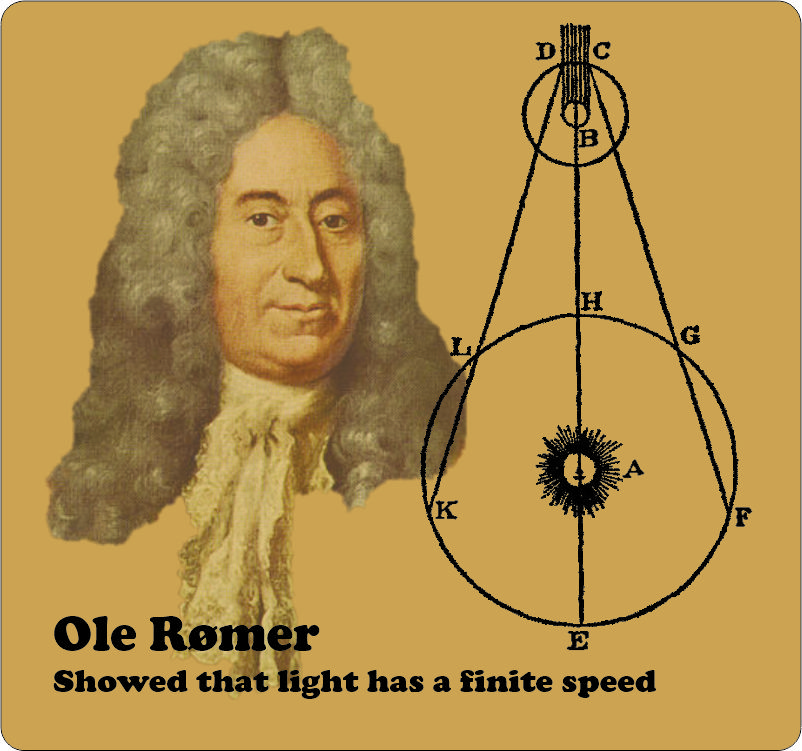
“You’re on, Sy. Well, Mr Feder. The ‘look back in time‘ part comes from light not traveling infinitely fast. We’ve known that for three centuries, ever since Rømer—”

“Roamer?”

“Ole Rømer, a Danish scientist who lived in Newson’s time. Everyone knew that Jupiter’s innermost large moon Io had a dependably regular orbit, circling Jupiter every 49½ hours like clockwork. Rømer was an astronomer when he wasn’t tutoring the French King’s son or being Copenhagen’s equivalent of Public Safety Commissioner. He watched Io closely, kept notes on exactly when she ducked behind Jupiter and when she reappeared on the other side. His observed timings weren’t quite regular, generally off by a few minutes. Funny thing was, the irregularities correlated with the Earth‑Jupiter distance — up to 3½ minutes earlier than expected when Earth in its orbit was closest to Jupiter, similarly late when they were far apart. There was a lot of argument about how that could be, but Rømer, Huygens, even Newton, all agreed that the best explanation was that we only see Io’s passage events after light has taken its time to travel from there to here.”

“Seems reasonable. Why should people argue about that?”

“The major sticking point was the speed that Huygens calculated from Rømer’s data. We now know it’s 186000 miles or 300000 kilometers or one lightsecond per second. Different ways of stating the same quantity. Huygens came up with a somewhat smaller number but still. The establishment pundits had been okay with light transmission being instantaneous. Given definite numbers, though, they had trouble accepting the idea that anything physical could go that fast.”

“Tag, my turn. Flip that distance per time ratio upside down — for every additional lightsecond of distance we’re looking at events happening one second farther into the past. That’s the key to JWST‘s view into the long‑ago. Al, you got that JWST‘s infrared capabilities will beat Hubble‘s vis‑UV ones for distance. Unless there’s something seriously wrong with Einstein’s assumption that lightspeed’s an absolute constant throughout spacetime, we expect JWST to give us visibility to the oldest free photons in the Universe, just 379000 years upward from the Big Bang.”

“Wait, I heard weaseling there. Free photons? Like you gotta pay for the others?”

“Ha, ha, Mr Feder. During those first 379000‑or‑so years, we think the Universe was so hot and so dense that no photon’s wave had much of a chance to spread out before it encountered a charged something and got absorbed. At last, things cooled down enough for atoms to form and stay in one piece. Atoms are neutral. Quantum rules restrict their interaction to only photons that have certain wavelengths. The rest of the photons, and there’s a huge number of them, were free to roam the expanding Universe until they happen to find a suitable absorber. Maybe someone’s eye or if we’re lucky, a sensor on JWST or some other telescope.”

Thanks for this to George Derenburger

“What about before the 300‑and‑something thousand years? Like, before Year Zero? Musta been weird, huh?”

“Well, there’s a problem with that question. You’re assuming there was a Year Minus‑One, but that’s just not the case.”

“Why not? Arithmetic works that way.”

“But the Universe doesn’t. Stephen Hawking came up with a good way to think about it. What on Earth is south of the South Pole?”

“Eeayahh … nope. Can’t get any further south than that.”

“Well, there you are, so to speak. Time’s bottom is Year Zero and you can’t get any further down than that. We think.”

~~ Rich Olcott

The Red Advantage

“OK, Cathleen, I get that JWST and Hubble rate about the same for sorting out things that are close together in the sky, and I get that they look at different kinds of light so it’s hard to compare sensitivity. Let’s get down to brass tacks. Which one can see farther?”

“An excellent question, Mr Feder. I’ve spent an entire class period on different aspects of it.”

“Narrow it down a little, I ain’t got all day.”

“You asked for it — a quick course on cosmological redshift. Fasten your seat belt. You know what redshift is, right?”

“Yeah, Moire yammers on about it a lot. Waves stretch out from something moving away from you.”

I bristle. “It’s important! And some redshifts don’t have anything to do with motion.”

“Right, Sy. Redshift in general has been a crucial tool for studying everything from planetary motion to the large‑scale structure of the Universe. Your no‑motion redshift — you’re thinking of gravitational redshift, right?”

“Mm-hm. From a distance, space appears to be compressed near a massive object, less compressed further away. Suppose we send a robot to take up a position just outside a black hole’s event horizon. The robot uses a green laser to send us its observations. Space dilates along the beam’s path out of the gravity well. The expanding geometry stretches the signal’s wavelength into the red range even though the robot’s distance from us is constant.”

“So, that’s gravitational redshift and there’s the Doppler redshift that Mr Feder referred to—”

“Is that what its name is? With p‘s? I always heard it as ‘doubler’ effect and wondered where that came from.”

“It came from Christian Doppler’s name, Al. Back in the 1840s he was investigating a star. He noticed that its spectrum was the overlap of two spectra slightly shifted with respect to each other. Using wave theory he proposed that the star was a binary and that the shifted spectra arose from one star coming towards us and the other moving away. Later work confirmed his ideas and the rest is history. So it’s Doppler, not doubler, even though the initial observation was of a stellar doublet.”

“So what’s this cosmo thing?”

“Cosmological redshift. It shows up at large distances. On the average, all galaxies are moving away from us, but they’re moving away from each other, too. That was Hubble’s big discovery. Well, one of them..”

“Wait, how can that be? If I move away from Al, here, I’m moving toward Sy or somebody.”

“We call it the expansion of the universe. Have you ever made raisin bread?”

“Nah, I just eat it.”

“Ok, then, just visualize how it’s made. You start with a flat lump of dough, raisins close together, right? The loaf rises as the yeast generates gas inside the lump. The dough expands and the raisins get further apart, all of them. There’s no pushing away from a center, it’s just that there’s an increasing amount of bubbly dough between each pair of neighboring raisins. That’s a pretty good analogy to galactic motion — the space between galaxies is expanding. The general motion is called Hubble flow.”

“So we see their light as redshifted because of their speed away from us.”

“That’s part of it, Al, but there’s also wave‑stretching because space itself is expanding. Suppose some far‑away galaxy, flying away at 30% of lightspeed, sent out a green photon with a 500‑nanometer wavelength. If the Doppler effect were the only one in play, our relative speeds would shift our measurement of that photon out to about 550 nanometers, into the yellow. Space expansion at intermediate stations along its path can cumulatively dilate the wave by further factors out into the infrared or beyond. Comparing two galaxies, photons from the farther one will traverse a longer path through expanding space and therefor experience greater elongation. Hubble spotted one object near its long‑wavelength limit with a recognizable spectrum feature beyond redshift factor 11.”

“Hey, that’s the answer to Mr Feder’s question!”

“So what’s the answer, smart guy?”

JWST will be able to see farther, because its infrared sensors can pick up distant light that’s been stretched beyond what Hubble can handle.”

~~ Rich Olcott

Lord Rayleigh Resolves

Mr Feder just doesn’t quit. “But why did they make JWST so big? We’re getting perfectly good pictures from Hubble and it’s what, a third the size?”

Al’s brought over a fresh pot and he’s refilling our coffee mugs. “Chalk it up to good old ‘because we can.’ Rockets are bigger than in Hubble‘s day, robots can do more remote stuff by themselves, it all lets us make a bigger scope.”

Cathleen smiles. “There’s more to it than that, Al. It’s really about catching photons. You’re nearly correct, Mr Feder, the diameter ratio is 2.7. But photons aren’t captured by a line across the primary mirror, they’re captured by the mirror’s entire area. The important JSWT:Hubble ratio is between their areas. JWST beats Hubble there by a factor of 7.3. For a given source and the same time interval, we’d expect JWST to be that much more sensitive than Hubble.”

“Well,” I break in, “except that the two use photon detectors that are sensitive to different energy ranges. The two scopes often won’t even be looking at the same kinds of object. Hubble‘s specialized for visible and UV light. It’s easy to design detectors for that range because electrons in solid‑state devices respond readily to the high‑energy photons. The infrared light photons that JWST‘s designed for don’t have enough energy to kick electrons around the same way. Not really a fair comparison, although everything I’ve read says that JWST‘s sensitivity will be way up there.”

Mr Feder is derisive. “‘Way up there.’ Har, har, de-har. I suppose you’re proud of that.”

“Not really, it just happened. But Cathleen, I’m surprised that you as an astronomer didn’t bring up the other reason the designers went big for JWST.”

“True, but it’s more technical. You’re thinking of resolution and Rayleigh’s diffraction limit, aren’t you?”

“Bingo. Except Rayleigh derived that limit from the Airy disk.”

“Disks in the air? We got UFOs now? What’re you guys talking about?”

Portrait of Sir George Airy
licensed under the Creative Commons
Attribution 4.0 International license.

“No UFOs, Mr Feder, I’ll try to be non‑technical. Except for the big close objects like the Sun and its planets, telescopes show heavenly bodies as circular disks accompanied by faint rings. In the early 1800s an astronomer named George Airy proved that the patterns are an illusion produced by the telescope. His math showed that even the best possible apparatus will force lightwaves from any small distant light source to converge to a ringed circular disk, not a point. The disk’s size depends on the ratio between the light’s wavelength and the diameter of the telescope’s light‑gathering aperture. How am I doing, Al?”

“Fine so far.”

“Good. Rayleigh took that one step further. Suppose you’re looking at two stars that are very close together in the sky. You’d expect to see two Airy patterns. However, if the innermost ring from one star overlaps the other star’s disk, you can’t resolve the two images. That’s the basis for Rayleigh’s resolvability criterion — the angle between the star images, measured in arc‑seconds, has to be at least 252000 times the wavelength divided by the diameter.”

After a diagram by cmglee
licensed under the Creative Commons
Attribution 3.0 International license.

“But blue light’s got a shorter wavelength than red light. Doesn’t that say that my scope can resolve close-together blue stars better than red stars?”

“Sure does, except stars don’t emit just one color. In visible light the disk and rings are all rimmed with reddish and bluish fuzz. The principle works just fine when you’re looking at a single wavelength. That gets me to the answer to Mr Feder’s question. It’s buried in this really elegant diagram I just happen to have on my laptop. Going across we’ve got the theoretical minimum angle for resolving two stars. Going up we’ve got aperture diameters, running from the pupil of your eye up to radio telescope coalitions that span continents. The colored diagonal bands are different parts of the electromagnetic spectrum. The red bars mark each scope’s sensor wavelength range. Turns out JWST‘s size compared to Hubble almost exactly compensates for the longer wavelengths it reports on.”

~~ Rich Olcott