Three Phases of Ever

“So if the Universe isn’t in a steady state and it’s not heading for a Big Crunch, I guess it’s getting bigger forever, huh?”

“Careful, Jeremy, the Universe expansion could maybe reach a stopping point if it happened to hold exactly the right amount of mass‑energy. The expansion could just stop when forces balance out.”

“What forces, Mr Moire? There’s gravity pulling everything together so what’s pushing them apart?”

“That is an excellent question, one that we don’t yet have an answer for. We’re about where Newton was with gravity. There was a lot of observational evidence, he had a name for it and knew how to calculate its effects, but he didn’t know how it worked. That’s us with Einstein’s Cosmological Constant.”

“Observational evidence — we can actually see things accelerate?”

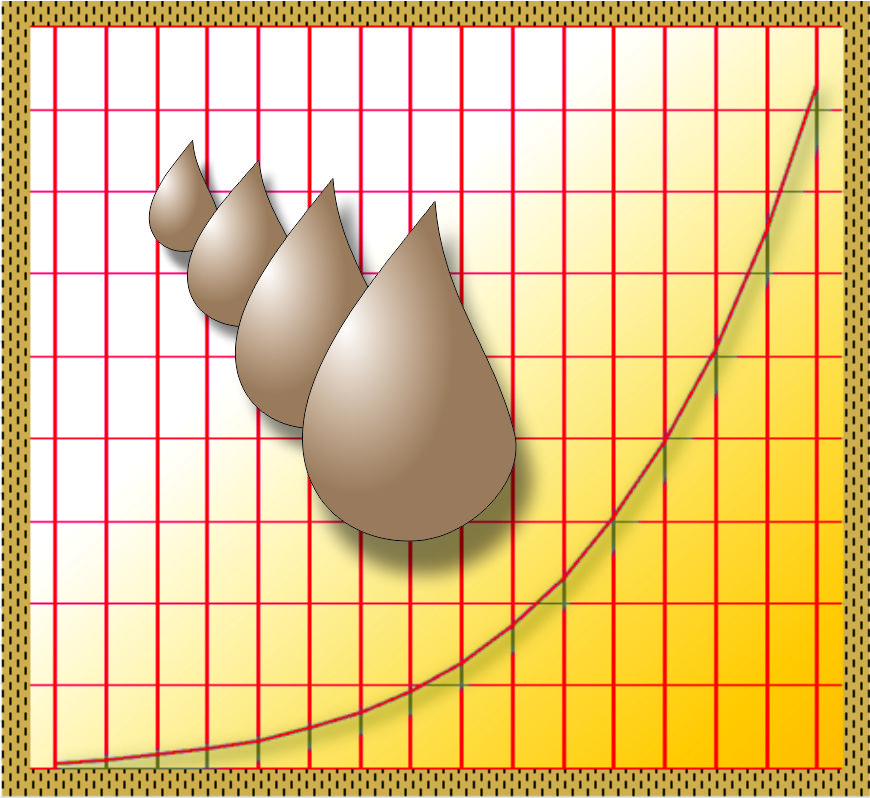
“Not any one object speeding up. Human lifetimes are too short to measure acceleration in galaxies a hundred thousand lightyears across. No, we use the same strategy that Hubble used — measure many galaxies at different distances from us and graph recession speed against distance. During the century since Hubble we’ve greatly improved our estimates of astronomical speeds and distances. Dividing the known speed of light into a galaxy’s measured distance tells us time since it emitted the photons we see. Our findings confirm Hubble’s general conclusion — on average, older photons come from galaxies that fly away faster. Hubble thought that the relation was linear but our fine‑tuned numbers show otherwise. The data says that after the first few seconds the Universe stretched at a steady rate for only the first ⅔ of its life. The stretch has been accelerating since then.”

“Why wasn’t it accelerating since the beginning? Did someone cut in the afterburner?”

“More like turned one off. The evidence and theory we have so far indicate the Universe has seen a succession of phases dominated by different processes. You’ve probably heard of inflation—”

“Have I? You should see what they want for a burger these days!”

“Not that sort of inflation, but I know how you feel. No, I’m referring to cosmic inflation, very early in the Big Bang sequence, when the Universe expanded by a factor of 1026 within a tiny fraction of a second. It was driven by enormously powerful radiation‑linked effects we don’t understand that finally ran out of steam and let lower‑energy processes take over.”

“How’d that happen?”

“We don’t know. The general principle is that one process so dominates what’s going on in a phase that nothing else matters, until for some reason it stops mattering and we’re in a new phase with a different dominant process. The early Universe was controlled by radiative processes until things cooled off enough for particles to form and persist. That changed the game. Gravity dominated the next 8 billion years. Particles clumped together, atoms then dust then solar systems into larger and larger structures with bigger spaces between them. About 5 billion years ago the game changed again.”

“So early on there weren’t even atoms, huh? Wow. What was the next game‑changer?”

“Thanks to Einstein and Friedmann’s work we’ve got at least a guess.”

“Friedmann?”

“Alexander Friedmann. He was a Russian physicist, used Einstein’s General Relativity results to derive three equations that together model the dynamics of the overall scale of the Universe using just a few estimates for current conditions. His equations give acceleration as the difference of two terms. The positive term is simply proportional to Einstein’s Constant. The negative term depends on both average mass density and pressure. Take a moment to think.”

“Umm… Positive is acceleration, negative is deceleration, density and pressure go down … If the negative term gets smaller than the positive one, acceleration increases, right?”

“It does, and we think the constant term has been increasingly dominant for 5 billion years. Something else to consider — the equation’s result is in terms of scale change divided by current scale. What’s it mean if that ratio’s a positive constant?”

“Change by a constant positive percentage … that’s exponential growth!”

“I thought you’d recognize it. Einstein’s Constant implies the scale of the Universe grows at an exponentially accelerating rate. We’re now in the Cosmological Constant phase.”

In Russian, Aleksandr Aleksandrowitsch Fridman

~~ Rich Olcott

Not Crunch Time

A familiar knock on my office door. “C’mon in, Jeremy, the door’s open.”

“Got a few minutes, Mr Moire?”

The second serious-sounding visitor today. I push my keyboard aside again. “Sure, what’s up?”

“I read your ‘Tops of Time‘ post and then I watched one of Katie Mack’s End of Everything‘ YouTube videos and now I’m confused. And worried.”

“I can understand that. Clearing up the confusion should be easy. Then I’ll do what I can about the worry part, okay?”

“That’d be great, sir.”

“So, imagine an enormous sheet of graph paper, and then imagine Puerto Rico laid down on top of that. You could use the graph paper to describe the latitude and longitude of any place on the island, right?”

“Sure, probably.”

“I happen to know that Playa Jobos is the northernmost point of the island. Does north stop there?”

“Nosir. The island stops there, but north keeps going.”

“Well, there you are.”

“Wait … oh, you’re saying that time by itself keeps going forever but what’s in the Universe might not and that’s what Dr Mack is talking about?”

“That’s the idea. More precisely, the ‘tops‘ I wrote about are different ways that spacetime’s time coordinate could play out in the future, or maybe not. Mack’s ‘end of everything‘ is about the future history of physical stuff laid on top of our mathematical spacetime constructs. Does that clarify things?”

“Mmm, yessir, but what about the ‘maybe not‘ you said?”

“This gets metaphysical, but cosmology often skates on that edge. Descartes and others maintained that space has meaning only when there are separate objects. If there was only one thing in the Universe you’d have nothing to compare sizes against and there’d be no point in measuring distances away from it. That’d be even more the case if there’s nothing. Same thing for time and events. From that perspective, if somehow the Universe emptied out then space and time sort of stop.”

“Just sort‑of stop, like Puerto Rico stops at that Playa place. Really they keep on going, I think, even if no‑one’s there to measure anything.”

“A perfectly reasonable position when there’s no evidence either way. Anyhow, a few of Mack’s scenarios wind up in that situation, right?”

“Umm… there’s the Big Crunch that reverses the Big Bang.”

“That one was popular before we got good data. The idea was that the Big Bang pushed everything apart but eventually gravity will slow outward momentum and pull everything back together again. The notion probably came from humanity’s experience with dirt falling back down after an explosion. The problems with that scheme are that the Big Bang wasn’t an explosion, outward momentum isn’t a thing and besides, we’ve got increasingly good data showing that between‑galaxy distances are getting wider, not shrinking. The last five billion years that’s sped up.”

“Wait, not an explosion? All the videos show it that way.”

“Chalk it up to artistic license. It’s hard to show everything moving away from everything else without making it look like the viewpoint’s simply diving into a static arrangement. No, an explosion comes out of a center and that’s not the Bang. Remember that huge piece of graph paper? Make it a balloon, tack Puerto Ricos all over it, then pump in some air. There’s no center, but every islander thinks their island is the center and every other island is running away from them. Really, all that’s happening is that the stretching rubber is creating new inter‑island space everywhere.”

“And that’s Universe expansion?”

“Mm-hm. Also known as Hubble Flow. We’ve looked very hard for a center of motion, haven’t found one.”

“If everything’s moving, why isn’t that momentum?”

“It is momentum, but only pairwise. For any two galaxies you can calculate mass times speed same as always. For really distant objects you’ve got to use a relativistic version. Anyway, in the cosmological context you’ve got to ask, momentum relative to what? Everyone has this picture that things came from a common center and will fall back there. The way Hubble expansion works, though, there’s no particular go‑back place.”

“Everything’s speeding up and going everywhere so no Big Crunch then.”

“Not on the original model, anyway.”

~~ Rich Olcott

Time Is Where You Find It

A familiar footstep in the hall outside my office, “C’mon in, Vinnie, the door’s open.”

“Got a few minutes, Sy?”

More than just “a minute.” This sounds serious so I push my keyboard aside. “Sure, what’s up?”

“I’ve been thinking about different things, putting ’em together different ways. I came up with something, sorta, that I wanted to run past you before I brought it to one of Cathleen’s ‘Crazy Theories‘ parties.”

“Why, Vinnie, you’re being downright diffident. Spill it.”

“Well, it’s all fuzzy. First part goes way back to years ago when you wrote that there’s zero time between when a photon gets created and when it gets used up. But that means that create and use-up are simultaneous and that goes against Einstein’s ‘No simultaneity‘ thing which I wonder if you couldn’t get around it using time tick signals to sync up two space clocks.”

“That’s quite a mix and I see why you say it’s fuzzy. Would you be surprised if I used the word ‘frame‘ while clarifying it?”

“I’ve known you long enough it wouldn’t surprise me. Go ahead.”

“Let’s start with the synchronization idea. You’re not the first to come up with that suggestion. It can work, but only if the two clocks are flying in formation, exactly parallel course and speed.”

“Hah, that goes back to our first talk with the frame thing. You’re saying the clocks have to share the same frame like me and that other pilot.”

“Exactly. If the ships are zooming along in different inertial frames, each will measure time dilation in the other. How much depends on their relative velocities.”

“Wait, that was another conversation. We were pretending we’re in two spaceships like we’re talking about here and your clock ran slower than mine and my clock ran slower than yours which is weird. You explained it with equations but I’ve never been good with equations. You got a diagram?”

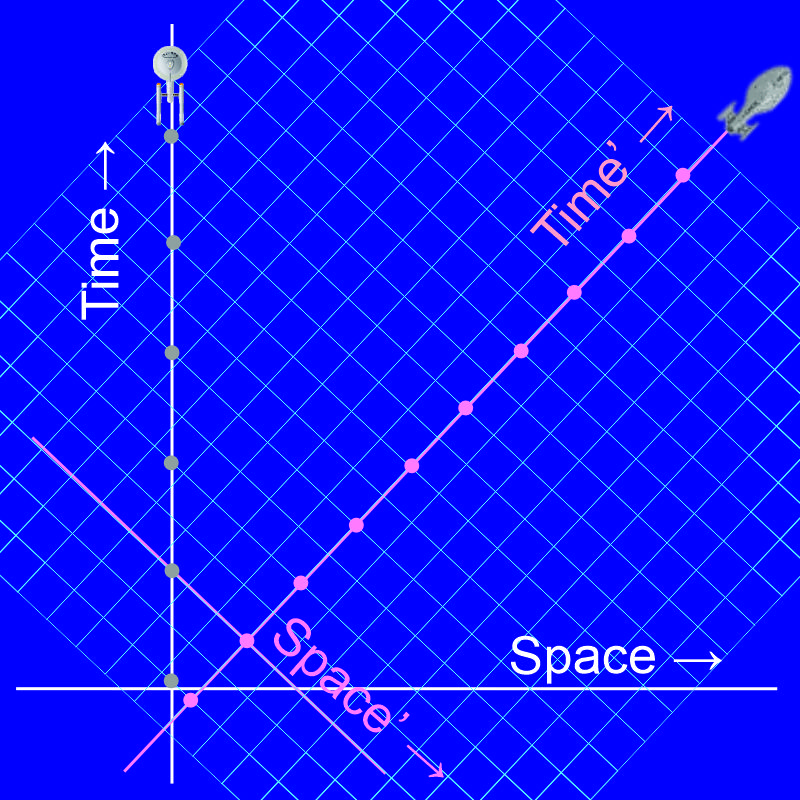
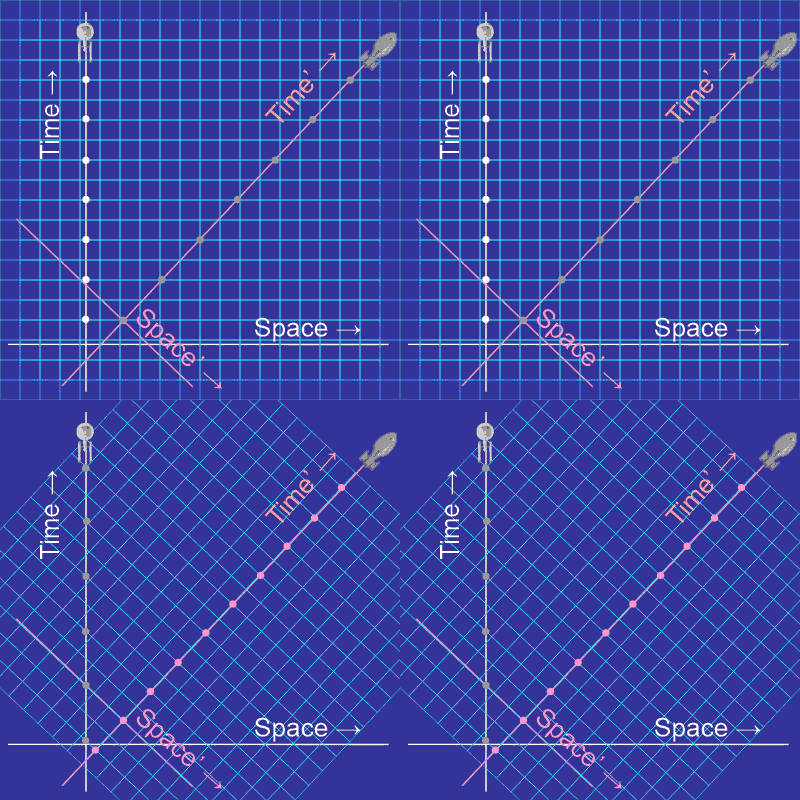
“Better than that, I’ve got a video. It flips back and forth between inertial frames for Enterprise and Voyager. We’ll pretend that they sync their clocks at the point where their tracks cross. I drew the Enterprise timeline vertical because Enterprise doesn’t move in space relative to Enterprise. The white dots are the pings it sends out every second. Meanwhile, Voyager is on a different course with its own timeline so its inertial frame is rotated relative to Enterprise‘s. The gray dots on Voyager‘s track show when that ship receives the Enterprise pings. On the Voyager timeline the pings arrive farther apart than they are on the Enterprise timeline so Voyager perceives that Enterprise is falling farther and farther behind.”

“Gimme a sec … so Voyager says Enterprise‘s timer is going slow, huh?”

“That’s it exactly. Now look at the rotated frame. The pink dots show when Voyager sends out its pings. The gray dots on Enterprise‘s track show when the pings arrive.”

“And Enterprise thinks that Voyager‘s clock is slow, just backwards of the other crew. OK, I see you can’t use sync pulses to match up clocks, but it’s still weird.”

“Which is where Lorentz and Minkowski and Einstein come into the picture. Their basic position was that physical events are real and there should be a way to measure them that doesn’t depend on an observer’s frame of reference. Minkowski’s ‘interval‘ metric qualifies. After converting time and location measurements to intervals, both crews would measure identical spacetime separations. Unfortunately, that wouldn’t help with clock synchronization because spacetime mixes time with space.”

“How about the photons?”

“Ah, that’s a misquotation. I didn’t say the time is zero, I said ‘proper time‘ and that’s different. An object’s proper time is measured by its clock in its inertial frame while traveling time t and distance d between two events. Anyone could measure t and d in their inertial frame. Minkowski’s interval is defined as s=[(ct)²‑d²]. Proper time is s/c. Intuitively I think of s/c as light’s travel time after it’s done traversing distance d. In space, photons always travel at lightspeed so their interval and proper time are always zero.”

“Photon create and use-up aren’t simultaneous then.”

“Only to photons.”

~~ Rich Olcott

The Threshold of Stuffiness

<chirp chirp> “Moire here.”

“Hi, Sy, it’s Susan Kim. I read your humidifier piece and I’ve got your answer for you.”

“Answer? I didn’t know I’d asked a question.”

“Sure you did. You worked out that your humidifier mostly keeps your office at 45% relative humidity by moisturizing incoming air that’s a lot drier than that. As a chemist I like how you brought in moles to check your numbers. Anyway, you wondered how to figure the incoming airflow. I’ve got your answer. It’s a scaling problem.”

“Mineral scaling? No, I don’t think so. The unit’s mostly white plastic so I wouldn’t see any scaling, but it seems to be working fine. I’ve been using de-ionized water and following the instructions to rinse the tank with vinegar every week or so.”

“Nope, not that kind of scale, Sy. You’ve got a good estimate from a small sample and you wondered how to scale it up, is all.”

“Sample? How’d I take a sample?”

“You gave us the numbers. Your office is 1200 cubic feet, right, and it took 88 milliliters of water to raise the relative humidity to where you wanted it, right, and the humidifier used a 1000 milliliters of water to keep it there for a day, right? Well, then. If one roomful of air requires 88 milliliters, then a thousand milliliters would humidify (1000/88)=11.4 room changes per day.”

“Is that a good number?”

“I knew you’d ask. According to the ventilation guidelines I looked up, ‘Buildings occupied by people typically need between 5 and 10 cubic feet per minute per person of fresh air ventilation.‘ You’re getting 11.4 roomfuls per day, times your office volume of 1200 cubic feet, divided by 1440 minutes per day. That comes to 9.5 cubic feet per minute. On the button if you’re alone, a little bit shy if you’ve got a client or somebody in there. I’d say your building’s architect did a pretty good job.”

“I like the place, except for when the elevators act up. All that figuring must have you thirsty. Meet me at Al’s and I’ll buy you a mocha latte.”

“Sounds like a plan.”


“Hi, folks. Saw you coming so I drew your usuals, mocha latte for Susan, black mud for Sy. Did I guess right?”

“Al, you make mocha lattes better than anybody.”

“Thanks, Susan, I do my best. Go on, take a table.”

“Susan, I was thinking while I walked over here. My cousin Crystal doesn’t like to wear those N95 virus masks because she says they make her short of breath. Her theory is that they trap her exhaled CO2 and those molecules get in the way of the O2 molecules she wants to breathe in. What does chemistry say to that theory?”

“Hmm. Well, we can make some estimates. N95 filtration is designed to block 95% of all particles larger than 300 nanometers. A couple thousand CO2 molecules could march abreast through a mesh opening that size no problem. An O2 molecule is about the same size. Both kinds are so small they never contact the mesh material so there’s essentially zero likelihood of differential effect.”

“So exhaled CO2 isn’t preferentially concentrated. Good. How about the crowd‑out idea?”

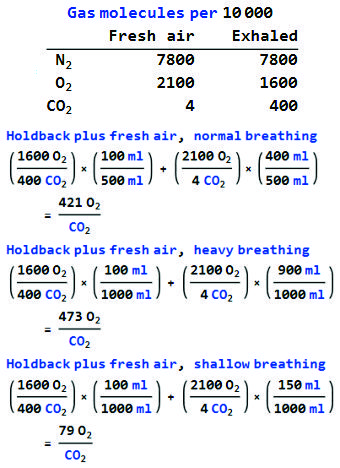
“Give me a second. <tapping on phone> Not supported by the numbers, Sy. There’s one CO2 for every 525 O2‘s in fresh air. Exhaled air is poorer in O2, richer in CO2, but even there oxygen has a 4‑to‑1 dominance.”

“But if the mask traps exhaled air…”

“Right. The key number is the retention ratio, what fraction of an exhaled breath the mask holds back. A typical exhale runs about 500 milliliters, could be half that if you’ve got lung trouble, twice or more if you’re working hard. This mask looks about 300 milliliters just sitting on the table, but there’s probably only 100 milliliters of space when I’m wearing it. It’s just arithmetic to get the O2/CO2 ratio for each breathing mode, see?”

“Looks good.”

“Even a shallow breather still gets 79 times more O2 than CO2. Blocking just doesn’t happen.”

“I’ll tell Crys.”

~ Rich Olcott