Tiramisu And Gemstones

“Sis, you say there’s dessert?”

“Of course there is, Sy. Teena, please bring in the tray from the fridge.”

“Tiramisu! You did indeed go above and beyond. Thank you, Teena. Your Mom’s question must be a doozey.”

“I’ll let you enjoy a few spoonfulls before I hit you with it.” <minutes with spoon noises and yumming> “Okay. tell me about entanglement.”

“Whoa! What brought that on?”

“I’ve seen the word bandied about in the popular science press—”

“And pseudoscience—”

“Well, yes. I’m writing something where the notion might come in handy if it makes sense.”

“How can you tell what’s pseudoscience?”

“Good question, Teena. I look for gee-whiz sentences, especially ones that include weasely words like ‘might‘ and ‘could.’ Most important, does the article make or quote big claims that can’t be disproven? I’d want to see pointers to evidence strong enough to match the claims. A respectable piece would include comments from other people working in the same field. Things like that.”

“What your Mom said, and also has the author used a technical term like ‘energy‘ or ‘quantum‘ but stretched it far away from its home base? Usually when they do that and you have even an elementary idea what the term really means, it’s pretty clear that the author doesn’t understand what they’re writing about. That goes double for a lot of what you’ll see on YouTube and social media in general. It’s just so easy to put gibberish up there because there’s no‑one to contradict a claim, or if there is, it’s too late because the junk has already spread. ‘Entanglement‘ is just the latest buzzword to join the junk‑science game.”

“So what can you tell us about entanglement that’s non‑junky?”

“First thing is, it’s strictly a microscopic phenomenon, molecule‑tiny and smaller. Anything you read about people or gemstones being entangled, you can stop reading right there unless it’s for fun.”

“Weren’t Rapunzel and the prince entangled?

“They and all the movie’s other characters were tangled up in the story, yes, but that’s not the kind of entanglement your Mom’s asking about. This kind seems to involve something that Einstein called ‘spooky action at a distance‘. He didn’t like it.”

“‘Seems to‘?”

“Caught me, Sis, but it’s an important point. You make a system do something by acting on it, right? We’re used to actions where force is transmitted by direct contact, like hitting a ball with a bat. We’ve known how direct contact works with solids and fluids since Newton. We’ve extended the theory to indirect contact via electric and other fields thanks to Maxwell and Einstein and a host of other physicists. ‘Action at a distance‘ is about making something happen without either direct or indirect contact and that’s weird.”

“Can you give us an example?”

“How about an entanglement story? Suppose there’s a machine that makes coins, nicely packaged up in gift boxes. They’re for sweethearts so it always makes the coins in pairs, one gold and one silver. These are microscopic coins so quantum rules apply — every coin is half gold and half silver until its box is opened, at which point it becomes all one pure metal.”

“Like Schrödinger’s asleep‑awake kitty‑cat!”

“Exactly, Teena. So Bob buys a pair of boxes, keeps one and gives the other to Alice before he flies off in his rocket to the Moon. Quantum says both coins are both metals. When he lands, he opens his box and finds a silver coin. What kind of coin does Alice have?”

“Gold, of course.”

“For sure. Bob’s coin‑checking instantly affected Alice’s coin a quarter‑million miles away. Spooky, huh?”

“But wait a minute. Alice’s coin doesn’t move. It’s not like Bob pushed on it or anything. The only thing that changed was its composition.”

“Sis, you’ve nailed it. That’s why I said ‘seems to‘. Entanglement’s not really action at a distance. No energy or force is exerted, it’s simply an information thing about quantum properties. Which, come to think of it, is why there’s no entanglement of people or gemstones. Even a bacterium has billions and billions of quantum‑level properties. Entanglement‑tweaking one or two or even a thousand atoms won’t affect the object as a whole.”

~~ Rich Olcott
Metrological Extremes

Al’s coffee shop smells festive. “Hiya, Sy. Can I interest you in a peppermint latte this morning?”

Adapted from a YouTube video contributed by NPL(UK)

“You know me better than that, Al. My usual black mud, please. Hmm… What flavor’s hiding under the chocolate frosting on the scone rack?”

“Strawberry.”

“In that case I’ll take two. Your latest artwork behind the cash register is more a scroll than a poster.”

“You noticed. Yeah, it’s very cool but I don’t understand a couple things.”

“Oh? Like what?”

“Like what’s NPL, for starters, but mostly what the poster’s even about. I get that it’s science-y and my Physics and Astronomy customers chuckle at it, but…”

“Well, for starters, NPL is the United Kingdom’s National Physical Laboratory. In USA terms they’re a little bit like a mixture of NIST and what used to be Bell Labs with a side order of DARPA. They were early supporters of high‑precision instrumentation, computer and network tech, lots of cutting‑edge stuff until they were privatized and the company that mostly bought them lost a whole lot of money. Now they’re back to a government plus academy structure but they’re still a going concern, one of the major drivers behind the SI conventions.”

“You wrote about that a while ago, din’tcha?”

“Did a whole series that started with revising the official mass standard and wound up at the full set of Système International basic and derived units. Pretty boring until you realize that precise measurement has been crucial to practically all manufacturing since the introduction of mass production. And it’s important to use a consistent set of units. One of NASA’s worst black eyes was the Mars Climate Orbiter failure when one team used Imperial feet‑and‑pounds units and everyone else was on the metric system.”

“I gotta use both sets. Most of my baking supplies come in pounds, but the coffee beans and some of the flavorings come in kilograms. I gotta use my computer to resize a recipe.”

“That’s the thing with the metric system. It’s all about powers of ten. No dividing by 12 or is it 16 or even 5280 to get to a different size range — just move the decimal and you’re done. I don’t know why people have so much trouble with it.”

“It’s something new, Sy.”

“Yeah, but it’s not been new since the 1800s. It’s a long time since doctors prescribed by the scruple or minim. All there’s been for generations is milligrams and microliters. Gas prices being what they are these days I’m surprised the oil companies haven’t been pushing to sell by the liter — price per unit volume would drop by nearly a quarter.”

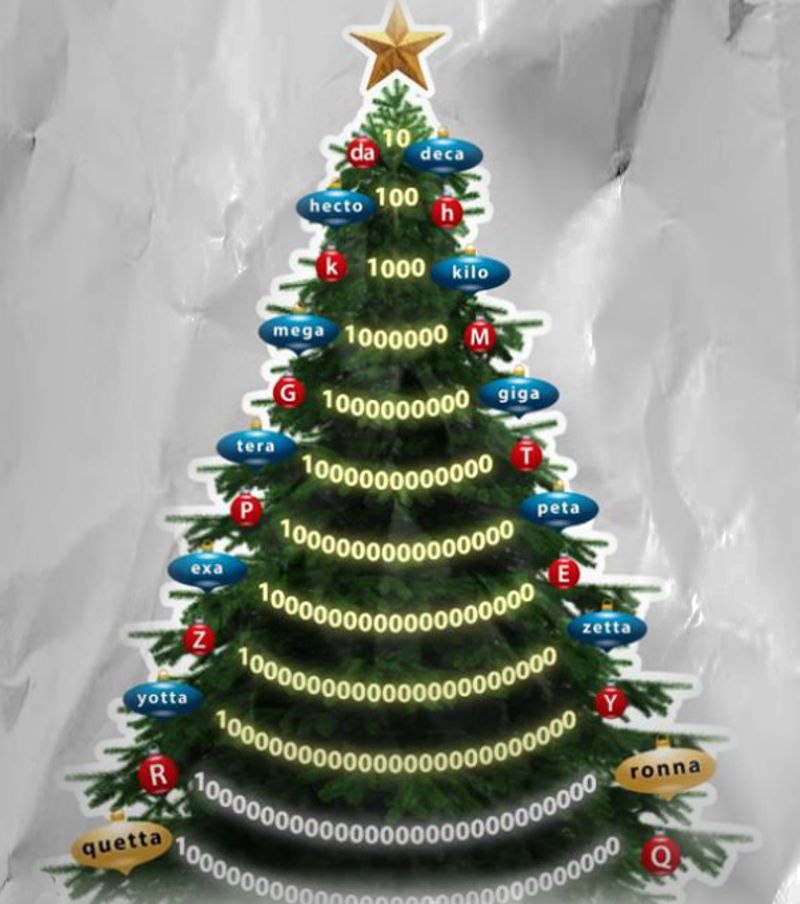
“I see ‘milli’ and ‘micro’ ornaments on one of those Christmas trees. Is that what they’re about?”

“That’s the ‘divide by a thousand’ tree. You already know ‘milli’ as the first cut‑down from grams or whatever the unit is. Divide by another thousand, you’ve got ‘micro’, which is one millionth or 10‑6. You’ve seen the ‘nano’ prefix by now — it’s 10‑9 and I like the nano‑nine connection. The ornaments on that tree display the prefixes for smaller and smaller subdivisions. The gold ones near the bottom are new this year. ‘Quecto’ is 10‑30, which would take you 30 digits if you wrote the number out.”

“So I guess the other tree is ‘multiply by a thousand.‘ Yup, there’s the ‘kilo’ for a thousand grams. Someone once told me I get about ten thousand beans in a kilogram bag.”

“Ten beans to a gram, then. That makes each bean a tenth of a gram or 100 milligrams. See how easy? Try figuring that in ounces.”

“Nice. Hey, I recognize ‘mega’ next to … a million. Counting’s hard without the commas in there.”

“Some people use spaces. You probably remember ‘giga’ and ‘tera’ from gigabytes and terabytes, you being a computer user.”

“Gigabucks, too. I read the news, you know. Politicians and CEOs play in the billions. But who needs numbers as big as ‘quetta’? That’s what, 1030?”

“Scientists and computer storage managers, mostly. Jupiter’s just shy of two quettagrams, and civilization’s on the path to generating a ronnabyte of data.”

~~ Rich Olcott

Dinner Rolls And Star Dust

“MAH-ahm! Uncle Sy’s here! Hi, Uncle Sy, dinner’s almost ready. I’ve saved up some questions for you”

“Hi, Teena, let’s have—”

“Now Teena, we said we’d hold the questions until after the meal. Hi, Sy.”

“Hi, Sis. Smells wonderful. One of Mom’s recipes?”

“Nope, I’m experimenting. Mom’s pasta sauce, though. You toss the salad and we’ll dig in.”

<later> “Wow. Sis, that lasagna was amazing. Five different meats, I think, and four different cheeses? Every mouthful was a new experience. A meal that Mom would’ve been proud of.”

“Six meats, you missed one. Full credit — Teena did the dinner rolls, from scratch, and she composed the salad.”

“Well, young lady, I think your grandma would be proud of you, too. You’ve earned questions. I may stay awake long enough to answer them.”

“Yay.”

“First the dishes, guys, then to the living room.”

“Sure, Sis. And you get a question, too.”

“As a matter of fact…”

<later> “Okay, Teena, question number one.”

“Alright. Umm. Brian tries to annoy me by saying over and over that the Sun’s gonna supernova into a black hole. That’s not true, is it?”

“You can tell Brian that the Sun’s way too small to make either a supernova or a black hole. Yes, the Sun will collapse in something like five billion years, but when that happens it’ll only be a garden‑variety nova. When things calm down there’ll be a white dwarf in the middle of our Solar System, not a black hole. Supernovas come from really big stars and they leave neutron stars behind or sometimes just emptiness. To get a black hole you need a star at least half again bigger than ours. D’ya think that’ll shut Brian down?”

“No-o, because there’s other things he says to annoy me.”

“Like what?”

“That our galaxy’s gonna collide with another one and we’ll all burn up in the explosion.”

“He’s got a thing for disasters, doesn’t he? Well, he’s partially right but mostly wrong. Yes, galaxy Andromeda is on a collision course with the Milky Way. But that collision won’t be anything like what he’s talking about. Remember those bird flocks we talked about?”

“Oh that was so long ago. What was the word? Mur, mur .. something?”

“Murmuration. That was your favorite word back then.”

“Oh, yes. It still is, now that I remember it.” <Sis and I give each other a look.> “What do birds have to do with galaxies?”

“Imagine two flocks colliding. Think there’ll be feathers all over the place?”

“No, the flocks would pass right through each other, except maybe some birds from one flock might fly off with the other one.”

“That’s pretty much what will happen with us and Andromeda. Stars in each galaxy are lightyears apart, hundreds of star‑widths apart, like cars miles apart on a highway. Star‑star collisions during a galaxy collision will be very rare. The galaxy’s own shapes will be distorted and gravity will pull stars from one galaxy to the other, but that’s about the extent of it. Anyway, that’s also about five billion years into the future. So Brian’s off on that prediction, too. Anything else?”

“Actually, yes. He says we’re made of stardust. I thought we’re made of atoms.”

“Indeed we are, but the atoms come from stars. Quick story about how stars work. The oldest and most common kind of atom is hydrogen. Back at the beginning of the Universe that’s all there was. If you shove hydrogen atoms together with enough heat and pressure, like inside stars, they combine to form heavier atoms like carbon and oxygen. You’re made of hydrogen and carbon and oxygen and such, but all your atoms except hydrogen were cooked up inside stars.”

“But how did they get inside me?”

“Remember those novas and supernovas? Doesn’t matter which kind of star collapses, half or more of its atoms spray into the Universe. They become star dust adrift in the winds of space, waiting to become part of another solar system and whatever’s in it. Brian’s right on this one, you are made of star dust.”

“Whooo, that’s awesome!”

“My question’s after dessert, Sy.”

~~ Rich Olcott

  • Thanks to the young Museum visitors who asked these questions.

The Frame Game

A familiar footstep outside my office, “C’mon in, Vinnie, the door’s open.”

“Hi, Sy, how ya doin’?”

“Can’t complain. Yourself?”

“Fine, fine. Hey, I been thinking about something you said while Al and us were talking about rockets and orbits and such. You remember that?”

“We’ve done that in quantity. What statement in particular?”

“It was about when you’re in the ISS, you still see like 88% of Earth’s gravity. But I seen video of those astronauts just floating around in the station. Seems to me those two don’t add up.”

“Hah! We’re talking physics of motion here. What’s the magic word?”

“You’re saying it’s frames? I thought black holes did that.”

“Black holes are an extreme example, but frame‑thinking is an essential tool in analyzing any kind of relative motion. Einstein’s famous ‘happy thought‘ about a man in a free‑falling elevator—”

“Whoa, why is that a happy thought? I been nervous about elevators ever since that time we got stuck in one.”

“At least it wasn’t falling, right? Point is, the elevator and whoever’s in it agree that Newton’s First Law of Motion is valid for everything they see in there.”

“Wait, which Law is that?”

“‘Things either don’t move or else they move at a steady pace along a straight line.’ Suppose you’re that guy—”

“I’d rather not.”

“… and the elevator is in a zero‑gravity field. You take something out of your pocket, put it the air in front of you and it stays there. You give it a tap and it floats away in a straight line. Any different behavior means that your entire frame — you, the elevator and anything else in there — is being accelerated by some force. Let’s take two possibilities. Case one, you and the elevator are resting on terra firma, tightly held by the force of gravity.”

“I like that one.”

“Case two, you and the elevator are way out in space, zero‑gravity again, but you’re in a rocket under 1-g acceleration. Einstein got happy because he realized that you’d feel the same either way. You’d have no mechanical way to distinguish between the two cases.”

“What’s that mean, mechanical?”

“It excludes sneaky ways of outside influence by magnetic fields and such. Anyhow, Einstein’s insight was key to extending Newton’s First Law to figuring acceleration for an entire frame. Like, for instance, an orbiting ISS.”

“Ah, you’re saying that floating astronauts in an 88% Earth-gravity field is fine because the ISS and the guys share the frame feeling that 88% but the guys are floating relative to that frame. But down here if we could look in there we’d see how both kinds of motion literally add up.”

“Exactly. It’s just much easier to think about only one kind at a time.”

“Wait. You said the ISS is being accelerated. I thought it’s going a steady 17500 miles an hour which it’s got to do to stay 250 miles up.”

“Is it going in a straight line?”

“Well, no, it’s going in a circle, mostly, except when it has to dodge some space junk.”

“So the First Law doesn’t apply. Acceleration is change in momentum, and the ISS momentum is constantly changing.”

“But it’s moving steady.”

“But not in a straight line. Momentum is a vector that points in a specific direction. Change the direction, you change the momentum. Newton’s Second Law links momentum change with force and acceleration. Any orbiting object undergoes angular acceleration.”

“Angular acceleration, that’s a new one. It’s degrees per second per second?”

“Yup, or radians. There’s two kinds, though — orbiting and spinning. The ISS doesn’t spin because it has to keep its solar panels facing the Sun.”

“But I’ve seen sci-fi movies set in something that spins to create artificial gravity. Like that 2001 Space Odyssey where the guy does his running exercise inside the ship.”

“Sure, and people have designed space stations that spin for the same reason. You’d have a cascade of frames — the station orbiting some planet, the station spinning, maybe even a ballerina inside doing pirouettes.”

“How do you calculate all that?”

“You don’t. You work with whichever frame is useful for what you’re trying to accomplish.”

“Makes my head spin.”

~~ Rich Olcott