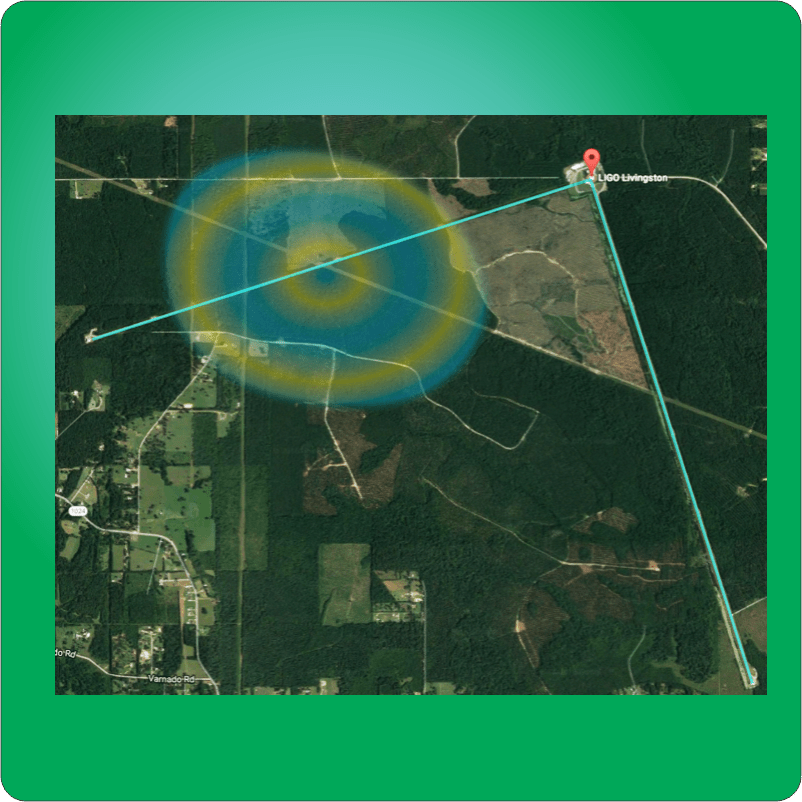
Not A Hum, A Rumble

Vinnie taps on the magazine. “Sy, you’ve done it again. We ask you one question, you spend a lot of time talking about something else entire. They got this article here” <tap> “says the NANOGrav team captured the hum of the Universe. Al and me, we ask you about that and you get us discussing pulsars. Seems to me,” <tap tap> “that if you got a pulsar and the pulses got only a 3% duty cycle they’d sound more like clicks and,” <taptaptaptap> “if it’s a 10 millisecond pulsar that’s a hundred per second and they’d be more like a low‑pitched buzz, nothing like a hum.”

“One more short detour, Vinnie, sorry. Remember when we discussed the VLA, the Very Large Array of radio telescopes in northern New Mexico?”

“Sorta. I do remember visiting the place, out in the desert miles away from anywhere. They’ve got a couple dozen dish antennas each as wide as a four‑lane road, all spread out along railroad tracks. Big dishes for catching weak signals I understand, but I forget why there’s lots of dishes instead of one huge one or how that even works.”

“One reason is simple mechanics. A huge dish would try to sail away in the desert wind. VLA admins even have to safe‑mount those 25‑meter ones when things get gusty. But the real reason goes to how the array works as one big instrument. Here’s a hint — the dishes can be miles apart and lightspeed isn’t infinite.”

“Ah, that joggled my memory. It’s about when a signal comes in from some nova or something, each dish registers it with a slightly different arrival time and then the computers play match‑up games with all the time differences to figure exactly what angle the signal came from, right?”

“Roughly. The VLA’s multi‑dish design is about being able to resolve signal sources that are close together in the sky so yeah, slightly different angles. The Event Horizon Telescope team used the same strategy and a collection of radio dishes all over the world to produce those orange‑ring images of supermassive black holes. NANOGrav and the other Pulsar Timing Arrays sort of the flip the strategy.”

“At last we get to NANOGrav. Wait, they use lots of antennas to send signals to a star?”

“Nothing like that, Al. No, they use just a few antennas but they track the timing of many pulsars. About 70 at last count.”

“But we know what the timing is, to nanoseconds you said.”

“One word, Vinnie. ‘Frames‘.”

“Aw geez, Sy. Again?”

“Mm-hm. In the pulsar’s frame, it’s majestically rotating at a steady pace, tens or hundreds of times per second relative to its neighbors. Its beam proudly announces its presence on an absolutely regular schedule save for a small but steady slow‑down. In our frame, though, things can happen to a pulse as it heads our way.”

“Like what?”

“It might pass through a molecular cloud. We know those exist. Photons in the right wavelength ranges could interact with cloud components. That’d delay them, stretch the pulse, might even create interference between successive pulses. On the theory side, some cosmologists think the Universe may hold objects like cosmic strings or curvature‑induced domain walls that could delay, deflect or otherwise mess up a pulse. The best possibility, though, is that a gravitational wave could cross the path of a pulse en route to us.”

“Why is that a good thing?”

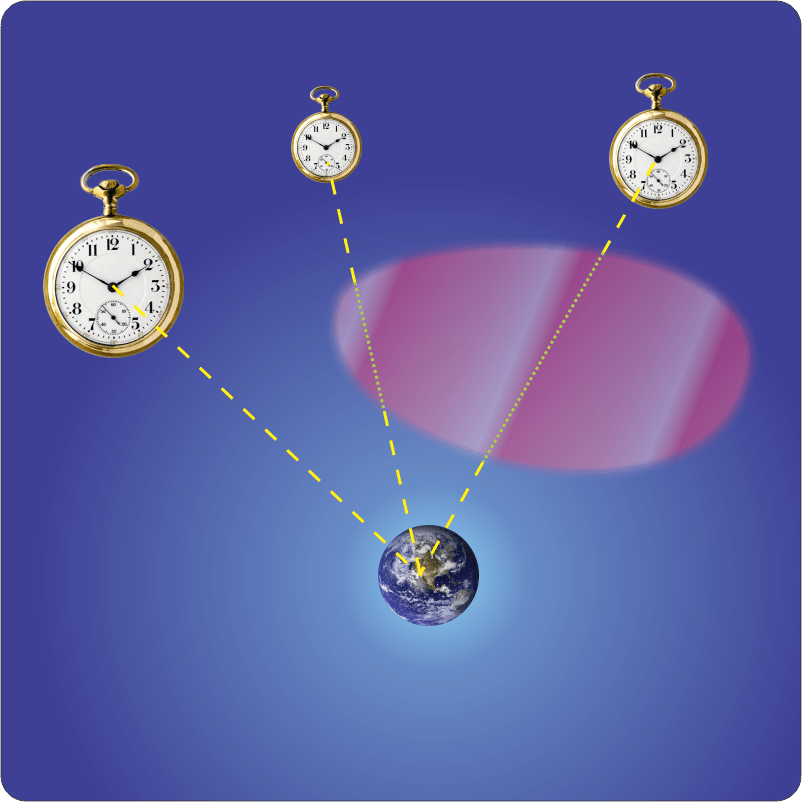
“Because they’d interact to alter that pulse’s timing. Gravitational waves stretch and squeeze time as they squeeze and stretch space. If a wave crosses a traveling pulse, the pulse will get here either early or late depending. Better yet, if we track enough pulsars scattered across the sky we might even see a parade of offset timings as the wave encounters different pulse beams. Hasn’t happened yet, though. The NANOGrav reports so far are about the background variation as waves from everywhere traverse the paths we’re watching.”

“The article says a hum.”

“Hum sounds come in waves per second. The gravitational background happens in waves per decade, such a low frequency even elephants couldn’t hear it.”

“OK, it’s rumble, not a hum. But why either one?”

~~ Rich Olcott

Inspecting A Pulsar

“C’mon, Sy, LIGO detects those black hole collisions by tracking how its mirrors move when a gravitational wave passes by. How can NANOGrav detect those waves from pulsar twinkles?”

“Not twinkles, Vinnie, definitely not twinkles. Astronomers hate twinkles. That shifting, wavering light we find so charming messes up the precise measurements they want to make. We didn’t get really good astrometry and light curves until we lifted observatories into orbit where atmospheric turbulence can’t distort the starlight. Fortunately there’s less twinkling at longer wavelengths down in the radio range. When a grad student named Jocelyn Bell discovered pulsars glinting in the radio range half a century ago everyone panicked.”

“What’s so scary about stars acting funny? They’re a long way away.”

“True, but it was how they acted funny. The glints were so regular that everyone first thought they were man‑made signals and probably from Russia or one of their allies. This was back in the 1960s, during the Cold War, a decade after Sputnik and right after the Cuban Missile Crisis. Lots of paranoia. But then Bell and her thesis adviser found that the first two signals were definitely coming from two different but consistent points up in the sky and that ruled out Earth‑centered sources.”

“Aliens?”

“Yeah, that was one of the hypotheses. In fact, the researchers even called the first source LGM‑1 for ‘Little Green Men.'”

“HAW!”

“Hey, astronomers make jokes, too. But when they found the second source that idea pretty much went away except that the conspiracy crowd still loves it.”

“What do the signals look like?”

“Just the question I’d expect from a telescope hobbyist like you, Al. They look like flashes from an airport beacon — nothing, then a blink then more nothing until another blink. Typically the blink intervals for different sources range between milliseconds and tens of seconds. Early researchers determined that each star’s blinks are regular to well within a millisecond which was the best we could do for accurate timing back then. Until we got really good laser clock tech, the pulsars were the steadiest timepieces we knew of.”

“What’s a blink look like?”

“That was a critical question. Bell had to scan literally miles of high‑speed strip‑chart paper to get a good handle on it. In general the plots of signal strength against time were triangles, about 40 milliseconds wide at half‑height. Bell’s first pulsar’s triangles used 3% of her strip‑chart recorder’s output, which meant that 97% of the paper was wasted space but research works that way sometimes.”

“Couldn’t be something with a bright side and a dark side, then, or you’d get half and half.”

“Exactly, Vinnie. The pulsar’s shiny spot must be a small fraction of its circumference. Another number from Bell’s charts gave us an additional clue to the spot’s size. LGM-1 blinks every 1.3373 seconds, regular as clockwork. That’s about a million times faster than the Sun spins, but suppose LGM-1 is a star about the Sun’s size. If the spot’s at the star’s equator, it’d have to be moving eleven times faster than light.”

“Not likely.”

“Mm-hm. So this pulsar and all the others that blink at anything near that rate must be made of collapsed matter, probably a neutron star.”

“Wait, why can’t it be something smaller like a shiny planet or something?”

“Gyroscopes, Al. The heavier the spinner, the better it maintains a constant spin. Earth’s pretty big, by our standards, but we need to adjust civil time by a leap second every few years to match our planet’s speed‑ups and slow‑downs. These guys don’t do that, they just slow a few nanoseconds or less per year. Rapid rotation says that pulsars must have small geometry but nanosecond regularity says they must have enormous mass. Neutron stars meet both qualifications because they pack a solar mass into the volume of a small planet.”

“Okay, but why do they spin so fast?”

Angular momentum, Vinnie, radius times speed — always conserved, right? Say a star with a month‑long rotational period collapses. Its radius shrinks about a million‑fold. Every atom in that collapsing star now runs a tighter travel radius and must speed up to compensate. The whole star spins up.”

~~ Rich Olcott

LIGO And NANOGrav

Afternoon coffee time, but Al’s place is a little noisier than usual. “Hey, Sy, come here and settle this.”

“Settle what, Al? Hi, Vinnie.”

<waves magazine> “This NANOGrav thing, they claim it’s a brand‑new kind of gravity wave. What’s that about?”

“Does it really say, ‘gravity wave‘? Let me see that. … <sigh> Press release journalism at its finest. ‘Gravity waves’ and ‘gravitational waves’ are two entirely different things.”

“I kinda remember you wrote about that, but it was so long ago I forget how they’re different.”

“Gravity waves happen in a fluid, like air or the ocean. Some disturbance, like a heat spike or an underwater landslide, pushes part of the fluid upward relative to a center of gravity. Gravity acts to pull that part down again but in the meantime the fluid’s own internal forces spread the initial up‑shift outwards. Adjacent fluid segments pull each other up and down and that’s a gravity wave. The whole process keeps going until friction dissipates the energy.”

“Gravitational waves don’t do that?”

“No, because gravitational waves temporarily modify the shape of space itself. The center doesn’t go up and down, it…” <showing a file on Old Reliable> “Here, see for yourself what happens. It’s called quadrupolar distortion. Mind you, the effects are tiny percentagewise which is why the LIGO apparatus had to be built kilometer‑scale in order to measure sub‑femtometer variations. The LIGO engineers took serious precautions to prevent gravity waves from masquerading as gravitational waves.”

“Alright, so now we’ve almost got used to LIGO machines catching these waves from colliding black holes and such. How are NANOGrav waves different?”

“Is infrared light different from visible light?”

“The Hubble sees visible but the Webb sees infrared.”

“Figures you’d have that cold, Al. What I think Sy’s getting at is they’re both electromagnetic even though we only see one of them. You’re gonna say the same for these new gravitational waves, right, Sy?”

“Got it in one, Vinnie. There’s only one electromagnetic field in the Universe but lots of waves running through it. Visible light is about moving charge between energy levels in atoms or molecules which is how the visual proteins in our eyes pick it up. Infrared can’t excite electrons. It can only waggle molecule parts which is why we feel it as heat. Same way, there’s only one gravitational field but lots of waves running through it. The LIGO devices are tuned to pick up drastic changes like the <ahem> massive energy release from a black hole collision.”

“You said ‘tuned‘. Gravitational waves got frequencies?”

“Sure. And just like light, high frequencies reflect high‑energy processes. LIGO detects waves in the kilohertz range, thousands of peaks per second. NANOGrav’s detection range is sub‑nanohertz, where one cycle can take years to complete. Amazingly low energy.”

“How can they detect anything that slow?”

“With really good clocks and a great deal of patience. The new reports are based on fifteen years of data, half a billion seconds counted out in nanoseconds.”

“Hey, wait a minute. LIGO’s only half‑a‑dozen years old. Where’d they get the extra data from, the future?”

“Of course not. Do you remember us working out how LIGO works? The center sends out a laser pulse along two perpendicular arms, then compares the two travel times when the pulse is reflected back. Light’s distance‑per‑time is constant, right? When a passing gravitational wave squeezes space along one arm, the pulse in that arm completes its round trip faster. The two times don’t match any more and everyone gets excited.”

“Sounds familiar.”

“Good. NANOGrav also uses a timing‑based strategy, but it depends on pulsars instead of lasers. Before you ask, a pulsar is a rotating neutron star that blasts a beam of electromagnetic radiation. What makes it a pulsar is that the beam points away from the rotation axis. We only catch a pulse when the beam points straight at us like a lighthouse or airport beacon. Radio and X‑ray observatories have been watching these beasts for half a century but it’s only in the past 15 years that our clocks have gotten good enough to register timing hiccups when a gravitational wave passes between us and a pulsar.”

~ Rich Olcott

Y2K plus 25 plus 2½

Mike reminded me of the task we took on mid‑year in 1997, 27½ years ago. If I recall correctly, that’s when the IT department we worked for got serious about New Year’s Day 2000.

This was an outgrowth of our disaster preparedness project. Some context: large corporation, HQ and most of the manufacturing in New Jersey, the rest in Memphis. The good news: the IT center was in Memphis where I lived. The bad news: Memphis is on the eastern edge of Tornado Alley’s range from Oklahoma across central Arkansas. Most of the twisters seem to dodge north or south around the city, but you never know.

True story — The Memphis plant had an Uninterruptible Power Supply (UPS) facility housed in a separate structure behind the computer room. The UPS held a ton of lead‑acid batteries and power conditioning equipment, plus an automated diesel generator outside. One thunderstormy afternoon a lightning bolt took out the power line to the building. Everything went dark. The UPS kicked in within milliseconds and our IT equipment kept running just fine — until a second lightning bolt took out the generator. The utility’s linemen, bless ’em, had us powered back up a few hours later and just minutes before Management’s deadline for declaring a disaster.

“Declare a disaster” means you kick over to your spare copy “in The Cloud,” right? Not in those days. The Cloud (which really is market‑ese for “somebody else’s computer”) isn’t a viable operation without telecomm speeds a hundred times faster than the comm lines we had in the 1990s. Back then Disaster Recovery (DR) was a multi-step process:

  • Backup your essential programs and data onto tape
  • Truck the tapes to a secure distant storage vault
  • When/if a disaster is declared, move operations to an offsite DR center that offers comparable IT facilities (computers, data storage, network connections, etc.)
    • Truck the tapes to the DR center. People, too, if necessary.
    • Read the tapes onto DR center storage.
    • Pray that your backups in fact had all the stuff you need and that the data’s sufficiently up‑to‑date for business requirements.

Clunky, huh? But the process gave us practice in cloning our systems and thinking about risks. That’s where our Y2K prep started.

The real “Y2K problem” wasn’t the 2‑digit‑year design flaw, it was the impossibility of doing reliable date logic or calculations when the dates in question might be in either century. Did “X” happen before or after a deadline? No way to know when “12” is all you’ve got to work with. Fixing the problem was a multi‑prong challenge:

  • Revise the data structure to hold a four‑digit year.
  • Revise the stored data with the right four‑digit year numbers.
  • Revise the programs that handle the data but…
  • Don’t break the programs that you revise.

Most of the program updates weren’t particularly challenging, it’s just that there were so many of them. Some enterprises knew their own software well enough that they did that work in‑house. Others shipped the work overseas, a tremendous boon to India’s fledgling software industry. Still others said, “Our competitive advantage is our product line and marketing team, not our home‑grown programs. We’ll convert to an industry‑standard replacement even though we’ll have to change how we’ve been doing business.”

Whichever strategy was chosen, the devil was in the testing. No way could new code or data structures be checked out with live data on our production system.

We needed a testbed, a sandbox, “System 2K,” whatever you want to call it, that was isolated from the live systems we made our money from. It had to have no‑leaks portals for programmer access, code revisions and artificial test‑case data. Most importantly, its system clock had to be adjustable to any future date.

That’s where my team came in. Using what we’d learned from our DR practice runs, we cloned our running system and bolted on some tricksy infrastructure. Don’t ask about technical details, that’s a quarter‑century ago and I don’t remember them.

But I’m proud to say that New Year’s Day 2000 was boring.

~ Rich Olcott

  • Thanks to Mike Newsom, whose comment inspired this post, and to Bob, Susie, Ralph, Tom, Doug, Mick, Don, Roy and the rest of the project team.

The Big Skip?

Suddenly Vinnie gets a grin all over his face. “Tell me something, Cathleen. Suppose I’m a pilot in a shuttle craft like in Star Trek. Tell me how conditions change as I dive down into Jupiter.”

“Hmm .. okay. Mind you, it’ll be a dangerous flight. You’ll fly through an atmosphere that’s mostly molecular hydrogen which is notorious for sneaking into metallic materials and weakening them. I recommend investing in a Starfleet‑grade force shield to keep the atmosphere completely away from your hull. While you’re in the stratosphere high above the cloud decks you’ll see a deep blue sky pretty much the same as Earth’s stratosphere. Try to avoid the thin gray clouds in the upper troposphere — their greasy hydrocarbons will fog your windshield. You want to stick to clear air as much as possible so dodge around the white ammonia‑ice zones. You can drop a couple hundred kilometers more before you hit the top of a brownish ammonium sulfides band.”

“Once I’m that deep there’s clear air underneath the white deck, right?”

“We just don’t know. Unlikely, but if you do want to fly beneath a zone you’ll have to traverse the jetstream separating it from your band. Pick the pole‑ward zone — jetstreams on that side seem to host fewer thunderstorms. Strap in for the jump, because the jetstreams sustain windspeeds 2‑3 times what we get in a Category 5 hurricane. Things’ll get muddier when you drop beneath the brown clouds.”

“Brown as mud, uh-huh.”

“No, I mean literal mud, maybe. First there’s a water‑ice layer and below that there may be a layer of clay‑ish or silicate droplets which may include water of crystallization. I like to visualize clouds of opal, but of course there’d be no sunlight to see them by. A bit lower and you’ll fly through helium rain. Get past all that and you’re about 20% of the way down, about two Earth diameters.”

“That’s where I bump into something?”

“No, that’s the transition zone where heat and pressure convert molecular H₂ into a metallic fluid of protons embedded in a conducting ocean of electrons. Sy, how do you suppose that would affect Vinnie’s aerodynamics?”

“Destructively. If his shuttle’s skin doesn’t rupture he’d be floating rather than sinking. Net density of an intact hull and everything inside would be less than the prevailing density outside where protons are crammed together. Even powered descent would be tough.”

“Sy, that’s exactly what my crazy idea needs! Cathleen, when’s your next Crazy Theory seminar?”

“Not until next term, some time in the Fall. C’mon, Vinnie, out with it!”

Magnetism and wind map by NASA/JPL-Caltech/SwRI/John E. Connerney. Great Red Spot image added by the author.

“All right. That diagram you showed us with the red and blue spots in Jupiter’s off‑center magnetic field? It got me thinking. You get magnetism from moving charge, right, and they say Earth’s field comes from swirls in the molten iron deep underneath our crust. Jupiter doesn’t have iron so much, but you say it’s got electrons in liquid metallic hydrogen and that oughta be able to swirl, too. Maybe Jupiter has a shallow major swirl on that one side.”

“And just what do you suggest would cause a swirl like that?”

“Al was talking the other day about ‘the grand tack hypothesis‘ where Jupiter waltzed in across the inner Solar System before it waltzed back out and settled down where it’s at. Suppose while it was waltzing it hit a planetoid, maybe the size of Io. The little guy couldn’t sink and wouldn’t stick because metallic hydrogen’s liquid so it’d skip across the surface and shoot away and maybe became a moon. That’d raise a swirl like I’m talking about. See, on the map a line crossing the line between the magnetic red and blue spots could be the skip path.”

<silence>

“Hey, and the Great Red Spot, see how it’s like opposite to where I guess the hit was, that’d be like a through-planet resonance like on Mars where that Hellas meteor strike is opposite the Tharsis Bulge.”

<long pause>

“I dunno, Cathleen, Io’s so weird, do you suppose…”

“I dunno, Sy. Io has that magnetic bridge to Jupiter…”

~ Rich Olcott