Not Silly-Season Stuff, Maybe

“Keep up the pace, Mr Feder, air conditioning is just up ahead.”

“Gotta stop to breathe, Moire, but I got just one more question.”

“A brief pause, then. What’s your question?”

“What’s all this about LK99 being a superconductor? Except it ain’t? Except maybe it is? What is LK99, anyway, and how do superconductors work? <puffing>”

“So many question marks for just one question. Are you done?”

“And why do news editors care?”

“There’s lots of ways we’d put superconductivity to work if it didn’t need liquid‑helium temperatures. Efficient electric power transmission, portable MRI machines, maglev trains, all kinds of advances, maybe even Star Trek tricorders.”

“Okay, I get how zero‑resistance superconductive wires would be great for power transmission, but how do all those other things have anything to do with it?”

“They depend on superconductivity’s conjoined twin, diamagnetism.”

Dia—?”

“Means ‘against.’ It’s sort of an application of Newton’s Third Law.”

“That’s the one says, ‘If you push on the Universe it pushes back,’ right?”

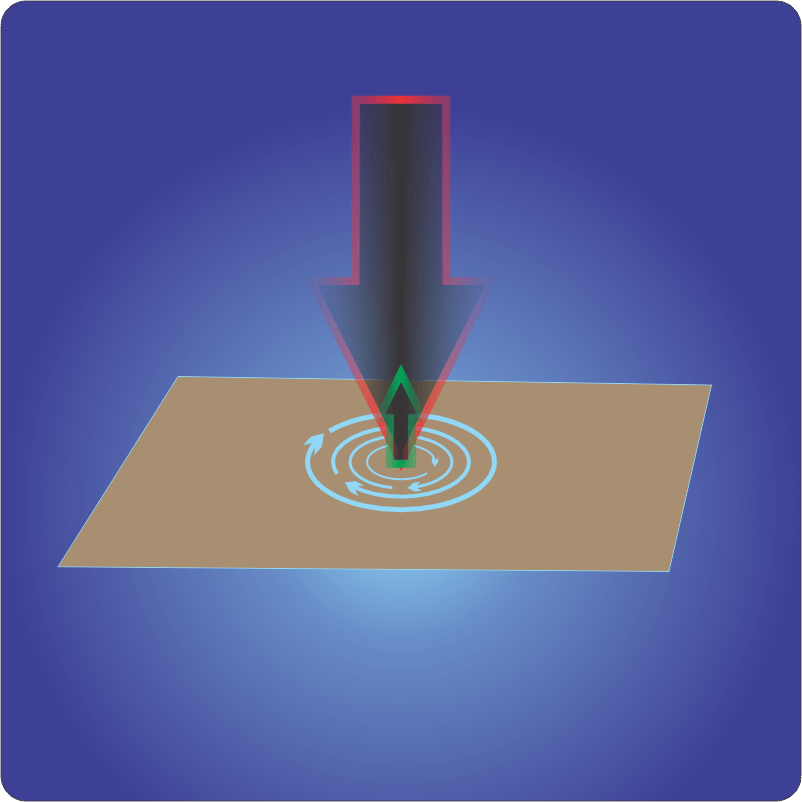
“Very good, Mr Feder. In electromagnetism that’s called Lenz’ Law. Suppose you bring a magnet towards some active conductor, say a moving sheet of copper. Or maybe it’s already carrying an electric current. Either way, the magnet’s field makes charge carriers in the sheet move perpendicular to the field and to the prevailing motion. That’s an eddy current.”

“How come?”

“Because quantum and I’m not about to get into that in this heat. Emil Lenz didn’t propose a mechanism when he discovered his Law in 1834 but it works. What’s interesting is what happens next. The eddy current generates its own magnetic field that opposes your magnet’s field. There’s your push‑back and it’s called diamagnetism.”

“I see where you’re going, Moire. With a superconductor there’s zero resistance and those eddy currents get big, right?”

“In theory they could be infinite. In practice they’re exactly strong enough to cancel out any external magnetic field, up to a limit that depends on the material. A maglev train’s superconducting pads would float above its superconducting track until someone loads it too heavily.”

“What about portable MRI you said? It’s not like someone’s gonna stand on one.”

“A portable MRI would require a really strong magnet that doesn’t need plugging in. Take that superconducting sheet and bend it into a doughnut. Run your magnet through the hole a few times to start a current. That current will run forever and so will the magnetic field it generates, no additional power required. You can make the field as strong as you like, again within a limit that depends on the material.”

“Speaking of materials, what’s the limit for that LK99 stuff?”

“Ah, just in time! Ahoy, Susan! Out for a walk yourself, I see. We’re on our way to Al’s for coffee and air conditioning. Mr Feder’s got a question that’s more up your Chemistry alley than my Physics.”

“LK99, right? It’s so newsy.”

“Yeah. What is it? Does it superconduct or not?”

“Those answers have been changing by the week. Chemically, it’s basically lead phosphate but with copper ions replacing some of the lead ions.”

“They can do that?”

“Oh yes, but not as neatly as we’d like. Structurally, LK99’s an oxide framework in the apatite class — a lattice of oxygens with phosphorus ions sitting in most of the holes in the lattice, lead ions in some of the others. Natural apatite minerals also have a sprinkling of hydroxides, fluorides or chlorides, but the reported synthesis doesn’t include a source for any of those.”

“Synthesis — so the stuff is hand‑made?”

“Mm‑hm, from a series of sold‑state reactions. Those can be tricky — you grind each of your reactants to a fine powder, mix the powders, seal them in a tube and bake at high temperature for hours. The heat scrambles the lattices. The atoms can settle wherever they want, mostly. I think that’s part of the problem.”

“Like maybe they don’t?”

“Maybe. There are uncontrollable variables — grinding precision, grain size distribution, mixing details, reaction tube material, undetected but critical impurities — so many. That’s probably why other labs haven’t been able to duplicate the results. Superconductivity might be so structure‑sensitive that you have to prepare your sample j‑u‑s‑t right.”

~~ Rich Olcott
Loud Enough Was Good Enough

“Okay, Moire, enough with the strings. I got another question.”

“Of course you do, Mr Feder, but step along more quickly, please. In this heat the sooner I get back to the air conditioning the better I’ll like it.”

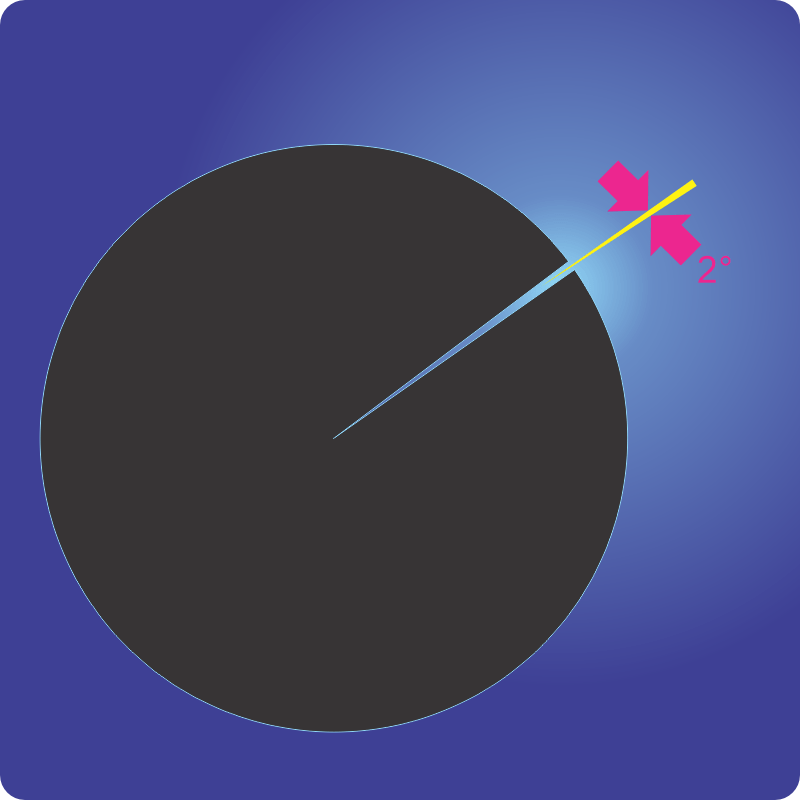
“Alright,” <puffing> “why all this fuss about the Voyager 2 spacecraft missing its target by two degrees? Earth’s pretty big, two degrees I can barely see on a protractor. Should be an easy hit.”

“Can you see the Moon?”

“Sure, if there’s no clouds in front of it. Sometimes even in the daytime.”

“A full Moon is only half a degree wide, ¼ of your two degrees.”

“No!”

“Yes.”

“But when it’s just rising it’s huge, takes up half the sky.”

“Check that carefully some evening. Hold up your hand at arm’s length. Your little finger’s about one degree wide. The Moon will be half as wide as that no matter where it is in the sky, we’ve talked about this. You can see half a degree easy and probably a lot less than that. Tycho Brahe, the last great pre‑telescope astronomer, was able to make measurements as small as 1/150 of a degree.”

“Okay, I guess two degrees is a little bigger than I was thinking. But still, Earth’s pretty big, there’s no excuse for Voyager 2 missing it by two degrees.”

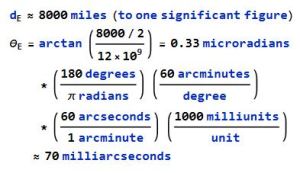
“A two‑degree angle is huge when it extends across astronomical distances.” <drawing Old Reliable from its holster, tapping screen> “From Voyager 2‘s perspective at 12 billion miles out the short leg of a two‑degree isosceles triangle spans 419 million miles. That’s over twice the width of Earth’s orbit! Poor Voyager could be pointing past Mars away from us.”

“Big distances from a small angle make a long triangle, got it. What did NASA have to do to get things pointed right again?”

“I consider it a technological miracle. At Voyager‘s distance, Earth’s 8000‑mile diameter spans only 70 milliarcseconds. And before you ask, a milliarcsecond is a thousandth of 1/60 of 1/60 of a degree, about 3 billionths of the way across your little finger. Pretty darn small. Frankly, I’m amazed that Voyager 2 has been able to keep its antenna pointed at us so accurately for so long using tech that dates back to the mid‑70s and earlier. Our tax dollars working hard.”

“Amazing, yeah — something like that’s gotta have a kajillion moving parts. A lubrication nightmare in space I bet.”

“Not as many as you might think. The only parts that move on purpose are small things like its gyroscopes, its tracking optics and the valves on its attitude‑adjustment thrusters.”

“Wait, how’d they point the antenna towards us in the first place? I figured that was on gears.”

“Way too much play in a gear train for this level of accuracy. No, the antenna’s solidly fixed to the rest of the structure. Voyager 2‘s Attitude and Articulation Control System adjusts the whole probe as a unit using propellant bursts through its choice of little thrusters. The mass of a single burst is so small compared to the spacecraft mass that the AACS can manage milliarcsecond‑level orientation control.”

“I heard they finally got it talking to us again. How’d they manage that if it was pointed the wrong way?”

“The key is it was only mostly pointing the wrong way.”

“Like the guy’s ‘mostly dead’ in Princess Bride?”

“Mr Feder, you know that movie?”

“Hey, it’s got the greatest sword fight ever, plus the two‑cups poison challenge and the part where the pirate keeps insulting the prince. What’s not to like? Whaddaya mean, mostly the wrong way?”

Voyager 2‘s antenna is parabolic, the best shape for transmitting a tight beam. Best doesn’t mean perfect — 50% of the beam’s power stays within a degree or so either side of the center but the rest leaks out to the sides. The same pattern applies to signal reception. Optimal reception happens when the antenna is pointing right at you. If it’s aimed off‑center, reception is worse. Our normal transmission power level wasn’t high enough to punch though the two-degree offset penalty but NASA’s extra-high-power ‘shout’ worked.”

“Caught the flash outta the corner of its eye, huh?”

~~ Rich Olcott

Little Strings And Big Ones

It’ll be another hot day so I’m walking the park early. No geese in the lake — they’ve either flown north or else they’re attacking a farmer’s alfalfa field. A familiar voice shatters the quiet. “Wait up, Moire, I got questions.”

“Good morning, Mr Feder. First question, but please pick up your pace, I want to get back to the air conditioning.”

“I thought string theory was about little teeny stuff but this guy said about cosmic strings. How can they be teeny and cosmic?”

“They can’t. Totally different things, probably. Next question.”

“C’mon, Moire, that wasn’t even an answer, just opened up a bunch more questions.”

“It’s a tangled path but the track mostly started in the late 18th Century. Joseph Fourier derived the equation for how heat progresses along a uniform metal bar. Turned out the equation’s general solution was the sum of an infinite series of sine waves.”

“Sign waves? Like a protest rally?”

“Haha. No, s‑i‑n‑e, a mathematical function where something regularly and smoothly deviates about some central value. Anyhow, mathematicians soon realized that Fourier’s cute trick for his heat equation could be applied to equations for everything from sound waves to signal processing to pretty much all of Physics. Economics, even. Any time you use the word ‘frequency‘ you owe something to Fourier.”

“If he ain’t got it in writing from the Patent Office, I ain’t paying nothing.”

“It’s not the kind of thing you can patent, and besides, he lived in France and died almost two centuries ago. Be generous with your gratitude, at least. Let’s move on. Fourier’s Big Idea was already <ahem> in the air early in the 20th Century when Bohr and the Physics gang were looking at atoms. No surprise, they extended the notion to describe how electronic charge worked in there.”

“I’m waiting for the strings.”

“The key is that an atom’s a confined system like a guitar string that only vibrates between the bridge and whatever fret you’re pressing on. Sound waves traveling in open space can have any wavelength, but if you pluck a confined guitar string the only wavelengths you can excite are whole number multiples of its active length. No funny fractions like π/73 of the length no matter how hard or soft you pluck the string. Atoms work the same way — charge is confined around the nucleus so only certain wave sizes and shapes are allowed.”

“You said ‘strings.’ We getting somewhere finally?”

“Closing in on it. String theory strings aren’t just teeny. If your body were suddenly made as large as the Observable Universe, string theory is about what might happen inside a box a billion times smaller than your size now.”

“Really tight quarters, got it, so only certain vibrations are allowed.”

“Mm-hm, except it’s not really vibration, it would be something that acts mathematically like vibration. Go back to your guitar string. Plucking gives it up‑down motion, strumming moves it side‑to‑side. Two degrees of freedom. The math says whatever’s going on in a string theory box needs 8 or 11 or maybe 25 degrees of freedom, depending on the theory. At the box‑size scale if there’s structure at all it looks nothing like a string.”

“Then how about the big cosmic strings? What’s confining them?”

“Nothing, and I mean that literally. If they exist they’re bounded by different flavors of empty space. It goes back to what we think happened right after the Big Bang during rapid space expansion. Whatever forces drove the process were probably limited by lightspeed. Local acceleration in one region wouldn’t immediately affect events in regions lightyears away. Nearly adjacent parts of the Universe could have been evolving at very different rates. Have you ever watched the whirlpools that form when a fast‑moving stream of water meets a slower‑moving one?”

“Fort Lee had a storm‑sewer pipe that let into the Hudson River. You got crazy whirlpools there after a hard rain.”

“Whirlpools are one kind of topological defect. They die away in water because friction dissipates the angular momentum. Hiding behind a whole stack of ifs and maybes, some theorists think collisions between differently‑evolving spacetime structures might generate long‑lived defects like cosmic strings or sheets.”

~~ Rich Olcott

White Noise And Red

“That point’s kinda weak, Sy. The NANOGrav team says 15 years of pulsar timing data let them hear the Universe humming. What’s the difference if they call it a hum or a rumble or a warble?”

“Not much, Vinnie. Matter of taste and scale, I guess. As a human I think of a ‘hum‘ as something in the auditory range, roughly 60‑120 cycles per second. Whatever these folks have found, it rumbles in years per cycle. Scaled to the Sun’s ten‑billion‑year lifetime I suppose that’d be a supersonic screech.”

“Whatever they’ve found? We don’t know?”

“Not yet, Al. The team likes one hypothesis but it’ll take years to collect enough data for firm support or refutation.”

“In addition to the 15 years‑worth they’ve got already? Why not just add more antennas?”

“What they’re following changes so slowly they need a long baseline to have confidence that jiggles they see are real. Part of this paper is about conclusions the team reached after they stuck a few extra years of old data onto the front of their time series.”

“You can do that?”

“Sure. The series is just a big database, like a spreadsheet with a page for each pulsar and a row on that page for each blink. The row captures the recorded time for the blink’s peak, but also a bunch of other data like measures related to pulse width and asymmetry, the corrected peak time, identifiers for the reporting observatory and reference time standard—”

Corrected time? Looks suspicious. What did they correct for?”

“Of course you’re suspicious, Vinnie, but so are they and so are other astronomers. You don’t want to make a big announcement like this unless you’ve checked everything for error sources. For instance, Earth moving around the Sun means we’re a little closer to a particular pulsar at one time of year, further away six months later.”

“So you correct the timings to what they’d be at the Sun’s center, right?”

“That’s just for starters. Jupiter and the Sun orbit around their common center of gravity on an 11.8‑year cycle. The researchers had to pull data from the Juno mission to correct for the Sun’s personal waltz. Of course the Solar System is moving relative to the stellar background, another correction. Then maybe the pulsar itself is part of a binary, happens a lot, and it’s probably moving through the sky, too — lots of careful corrections. That’s step one.”

“Then what?”

“Use each pulsar’s corrected timings to build a mathematical model of its idealized behavior. Once you know what’s ‘normal‘, you can start talking about jiggles that deviate from normal.”

“Reminds me of the ephemeris trick — sort of build an artificial pulsar to compare against.”

“Exactly the same idea, Vinnie, and by the way, ephemerides are still used but not to define the length of a second. Step three is statistical analysis: compare all possible deviation histories, every pulsar against every other pulsar.”

“Sounds like a lot of work, even for a computer. So what did they find?”

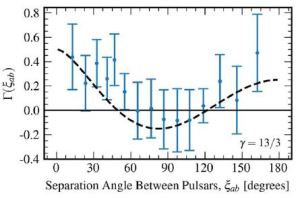
“Well, what they observed was that the pulsar timings we received weren’t as absolutely regular as they would have been with a static gravitational field. The overall picture resembled fog in a noisy room, waves of every size skittering in every direction and messing up reception. When the researchers broke that picture down by frequency, the waves shorter than 21 months or so added up to just white noise, complete randomness.”

“A hiss, not a hum. What about the longer waves?”

Fig 1(c) from Agazie, el al (2023).

“Red noise — jiggles heavy‑loaded on longer wavelengths out to the 16‑year maximum their data’s good for so far. But that’s not all. When they plotted jiggle correlation between pulsars separated at different angles across the sky, the curve mostly matched a prediction for the gravitational wave pattern that would be generated by a large number of randomly distributed independent sources.”

“Lots of sources, which would be…?”

“We don’t know. One hypothesis is that they’re pairs of supermassive black holes orbiting each other at the centers of merged galaxies. But I’ve read another paper giving a dozen other explanations. Everyone’s waiting for more data.”

~~ Rich Olcott