A Complex Question

A familiar footstep in the hall outside my office. “Door’s open, Vinnie, c’mon in.”

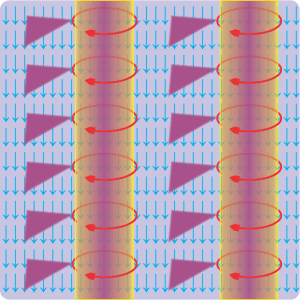
“Hi, Sy. Brought you something.” <lays a card on my desk> “So the question is, what’s the area inside the semicircle?”

<thoughtful pause> “Zero.”

“Dang, that’s both you and Larry say it’s zero. I don’t see it. ‘Splain, okay?”

“Larry gave you this?’

“Yeah. Can’t be zero area, it’s right there all spread out. How do you figure zero?”

“Start with the diagonal lines. The ‘a‘ line has a length of one unit, right?”

“The picture says so, but what’s i about on line ‘b‘?”

“That’s a special number, defined to be the solution x of the equation x²+1=0. Taking square roots, x=i and i²+1=0. I know you hate equations, but bear with me.”

<grumble> “Okay, go ahead.”

“If we had the radius r, the area would be ½πr². Line c is the diameter so the radius is r=c/2. We can get c by solving the triangle. We know it’s a right triangle because all three vertices touch a semicircle, right?”

“Geometry I remember; it was algebra gave me fits.”

“Then you remember good old Pythagoras and his a²+b²=c² formula, which we can use here because it’s a right triangle. Plugging in the known lengths we get c²=1²+i²=i²+1. Look familiar?”
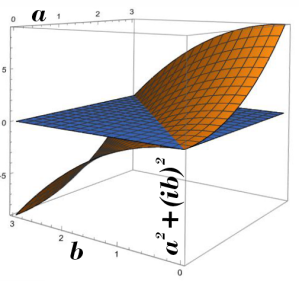
“Yeahhh, i²+1=0 from the definition so is zero. What if b was 3?”

“We’d have c²=1²+(3i)²=1+9=1–9=–8. If both a and b are 3, then c²=3²+(3i)²=9+9=9–9 and we’re back to c²=0. It’s just arithmetic, but enhanced with i and its special rules.”

“Wait. If c²=0 then c=0 and c‘s the diameter and if that’s zero then so’s the radius and the area. The whole thing shrinks to a point but it can’t ’cause it’s right there spread out in the picture. Is this sort of thing why they told us x²–1=0 has a solution but x²+1=0 doesn’t?”

“It’s closely related, because i is involved. Incidentally, they lied to you in that algebra class. They showed you that famous quadratic equation ax²+bx+c=0, right, along with the magic b²–4ac formula. If that formula is positive you’ve got two roots, they said, but if it’s negative there’s no root.”

“Sounds familiar. Where’s the lie?”

“The first part’s true: with 1=0 you’ve got a=1,b=0,c=–1 with two roots x=1 and x=–1. The lie is in the second part: with x²+1=0 you’ve got a=1,b=0,c=+1 with two roots x=i and x=–i. All of those are perfectly good solutions.”

“But i‘s not a number! I can’t have i apples and I can’t write a check for i dollars. Why even play with it?”

“The i‑numbers are numbers, just not counting numbers. They’ve been part of mainstream math ever since the early Renaissance. Algebra was almost a blood sport at the time. Academics in Italy used to issue public challenges to solve problems that they’d already solved secretly. There were duels to settle questions of priority. Bombelli systematized i‑number arithmetic while working out one limited class of cubic equations. Cardano compiled solutions from multiple authors, including Bombelli, into his book Ars Magna. Then he systematically added his own solutions to a catalog of cubic and quartic equations. The Old Guard refused to believe in either i‑numbers or negative numbers, but Cardano showed you can’t escape them if you’re doing serious algebra.”

“Not even negative numbers?”

“Nope. The negatives weren’t widely accepted until the Venetian trading houses forced the issue — negatives are implicit in the merchants’ newly‑invented double‑entry bookkeeping. i‑numbers weren’t considered respectable for hundreds of years.”
“Then what happened?”

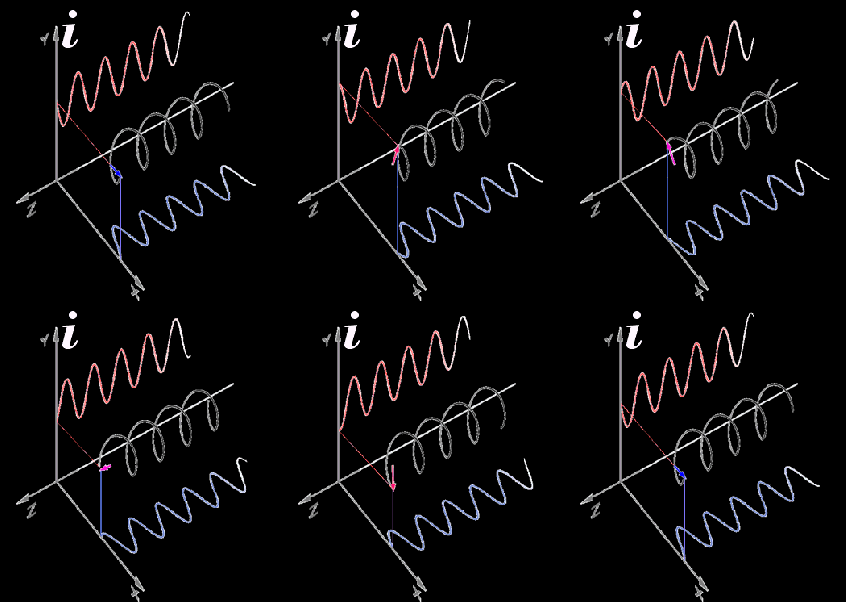
“Several advances. Euler connected i with trigonometry. Add Descarte‘s coordinate system, Fourier‘s wave analysis and Leibniz‘ notational innovations. For example, plotting an i‑number helix in 3D gives you these sine waves. When I think ‘i‑axis‘ I think ‘perpendicular to other coordinates‘.”

“Like Las Vegas.”

“Similar.”

Cardano image by R. Cooper
from Wellcome Trust
under the CCA International license
  • Thanks to Lloyd Boyer who raised several good points.

~~ Rich Olcott

Cal’s Gallery

“Goodness, Cal, you’ve redone your interior decorations.”

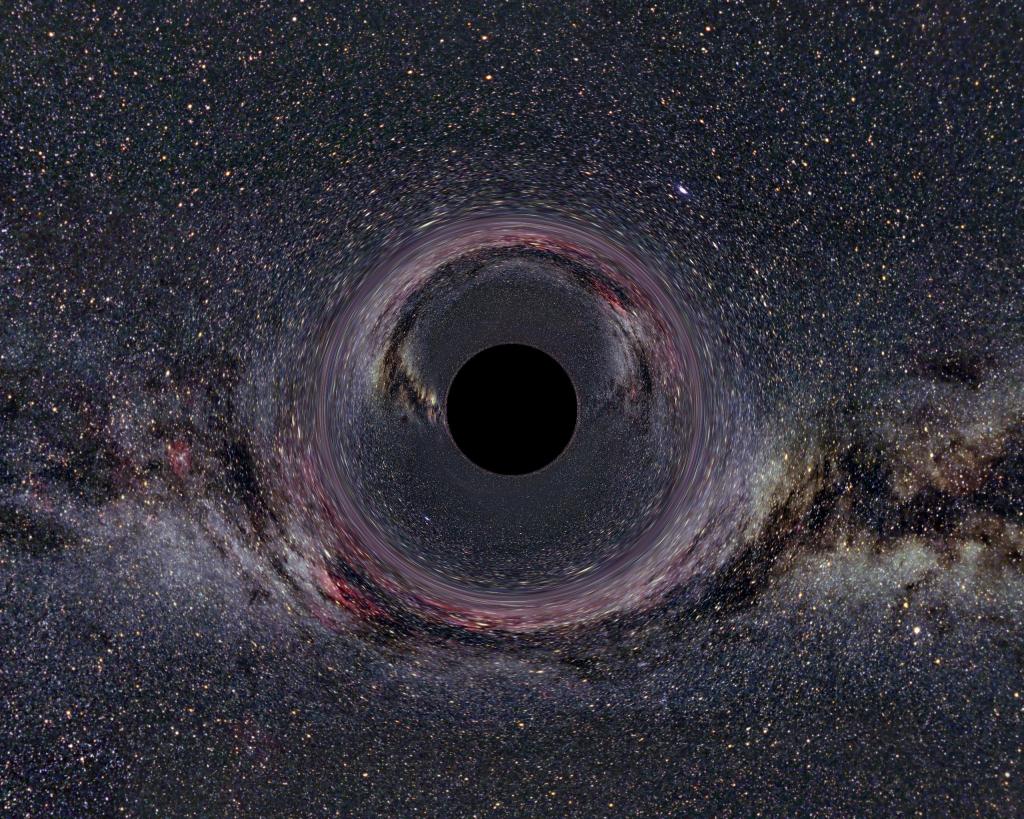
“I got tired of looking at the blank wall opposite the cash register, Sy. Check out the gallery. Way at the end here’s the earliest one I’ve got, goes back to 2005.”

“Yeah, ray-marching each background pixel as it passed through the distorting gravity field. That was heavy-duty computer graphics back then.”


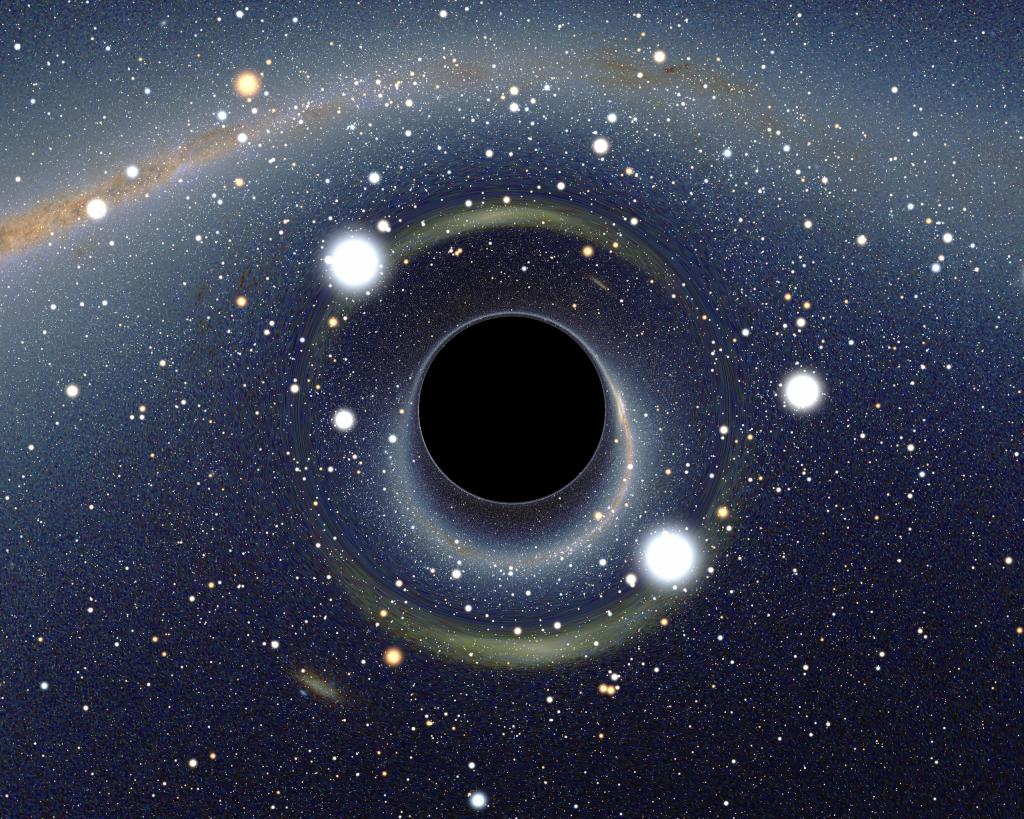
“Here’s another one from a year later. I like it better because you can pair up stars and stuff that show up on both sides of the Einstein ring.”


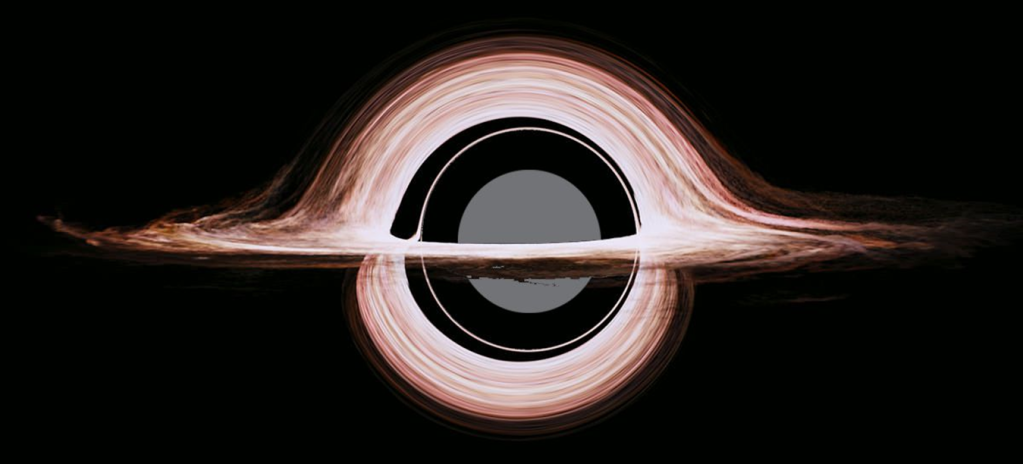
“This one’s famous, comin’ from the Interstellar movie. Funny, I can’t think of any black hole pictures before Interstellar that paid much attention to the accretion disk.”

“There certainly was a lot of that in the specialist literature, but you’re probably right for what leaked out to the pop‑sci press. Most of the published imagery was about how the gravity field distorts the figures behind it. That perpendicular handle was certainly a surprise.”


“This one’s famous, too. It shows what made the first good evidence that black holes are a thing, back in 1965. That ball to the right is a blue supergiant. See how its solar wind is feeding into X-1’s accretion disk? NASA’s picture is from 2017 so it’s not really historical or anything.”


“Now this one is historical, Cal. That image was released in 2019 from data collected in 2017.”

“I knew you’d recognize it, Sy. You’ve written about it enough.”


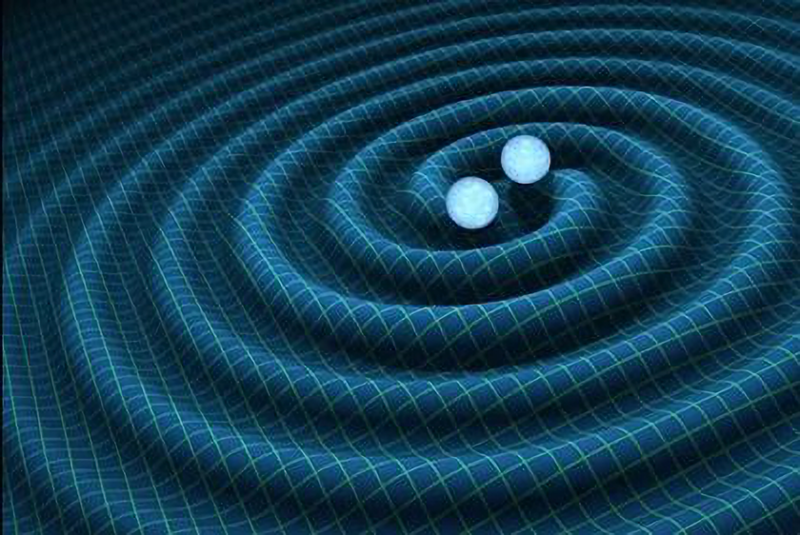
<sly grin> “Whaddya think of this one, Sy, the gravitational waves from those two black holes that LIGO told us about?”

“You knew I wouldn’t like it.”

The final waltz of two black holes” – click for video
Credit: R. Hurt – Caltech / JPL

“It’s just another trampoline picture, right?”

“No, it’s worse than that. Gravitational waves travel at lightspeed. Massive objects like people and 30‑solar‑mass black holes can’t get up to a fraction of a percent of lightspeed without expending an enormous amount of energy. The waves travel outward much faster than objects can orbit each other, even up to the end. Those waves winding outward should be nearly straight.”


“Whoa, Cal, this one isn’t a poster, it’s a monitor screen.”

“I bought a new bigger flat‑screen for home so I brought the old small one here for videos. I like how this movie shows the complicated shape flattening out when you get above the disk. The Interstellar movie made everyone think the disk is some weird double‑handled ring but the handle’s aren’t really there.”

“Mm‑hm, very nice gravity‑lens demonstration. Notice how the ring’s bright in whichever side’s coming toward us whether we’re above or below it?”

Circling over a black hole structure” — Click for video
Credit: NASA’s Goddard Space Flight Center/Jeremy Schnittman

“No, I hadn’t. Cool. How come?”

“It’s called relativistic Doppler beaming. Time distortion is significant in the close‑in parts of the ring. That affects how we see the flow. In the hole’s frame of reference the brightness and rotation speed are the same all around. In our frame the moving‑closer particles look brighter because they emit more photons per unit of our time. Another one of those unexpected phenomena where physicists say, ‘Of course!’ as soon as they see it but not before.”

~~ Rich Olcott

The Ultimate Pinhole Camera

Neither Kareem nor I are much for starting conversations. We’re more the responder type so the poker hands we dealt went pretty quickly. Cathleen had a topic, though. “Speaking of black holes and polarized radio waves, I just read a paper claiming to have developed a 3‑dimensional movie of an event wider than Mercury’s orbit, all from the flickering of a single pixel.”

Eddie bets big, for him. Ten chips. “That’s a lot to ask from just a dot. And what’s polarization got to do with it?”

Cal folds but pipes up anyway. “What was the event?”

“You know Sagittarius A*, the supermassive black hole in the middle of our galaxy?”

“Yeah, one of those orange‑ring pictures.”

“Mm‑hm. Based on radio‑wave emissions from its accretion disk. That image came from a 2‑day Event Horizon Telescope study in 2017. Well, four days after that data was taken, the Chandra satellite observatory saw an X‑ray flare from the same region. The ALMA radio telescope team immediately checked the location. ALMA has excellent signal‑to‑noise and time‑resolution capabilities but it’s only one observatory, not world‑wide like the EHT. The EHT can resolve objects a hundred thousand times closer together than ALMA’s limit. But the team did a lot with what they had.”

Vinnie tends to bet big, maybe because he’s always skeptical. Fifteen chips. “You said ‘claiming‘ like there’s doubt. People don’t trust the data?”

“In science there’s always doubt. In this case, no‑one doubts the data — ALMA’s been providing good observations for over a decade. The doubt’s in the completely new AI‑driven data reduction technique the team used. Is what they did valid? Could their results have been affected by a ‘hallucination’ bug?”

Vinnie doesn’t let go. “What did they do, what have people been doing, and what’s hallucination?”

Susan reluctantly shoves fifteen chips into the pot. “Hallucination is an AI making up stuff. I just encountered that in a paper I’m reviewing. There’s a long paragraph that starts off okay but midway it goes off on a tangent quoting numbers that aren’t in the data. I don’t believe the submitting authors even read what they sent in.”

Kareem drops out of the betting but stays in the conversation. “For a lot of science, curve‑fitting’s a standard practice. You optimize a model’s parameters against measured data. X‑ray crystallography, for example. The atoms in a good crystal are arranged in a regular lattice, right? We send a narrow beam of X‑rays at the crystal and record the intensity reflected at hundreds of angles by the atoms in different lattice planes. Inside the computer we build a parameterized model of the crystal where the parameters are the x‑, y‑ and z‑coordinates of each atom. We have computer routines that convert a given set of configuration parameters into predicted reflection intensity at each observation angle. Curve‑fitting programs cycle through the routines, adjusting parameters until the predictions match the experimental data. The final parameter values give us the atomic structure of the crystal.”

“There’s a lot of that in astrophysics and cosmology, too. This new AI technique stands that strategy on its head. The researchers started with well‑understood physics outside of the event horizon — hot rotating accretion disk, strong magnetic field mostly perpendicular to that, spacetime distortion thanks to General Relativity — and built 50,000 in‑computer examples of what that would look like from a distance.”

“Why so many?”

“The examples had to cover one or two supposed flares of different sizes and brightness at different points in their orbits, plus noise from the accretion disk’s radiation, all from a range of viewpoint angles. Mind you, each example’s only output was a single signal intensity and polarization angle (that’s two dimensions) for that specific set of disk and flare configuration parameters. The team used the example suite to train an AI specialized for assembling 2‑dimensional visual data into a 3‑dimensional model. The AI identified significant patterns in those 50,000 simulated signals. Then the team confronted the trained AI with 100 minutes of real single‑pixel data. It generated this…”

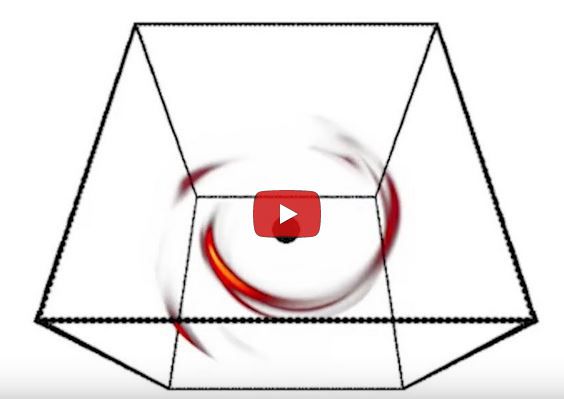
Click through to video, from Levis, et al.

“Curve‑fitting but we don’t know the curves!”

“True, Sy, but the AI does.”

“Maybe.”

~ Rich Olcott

A Non-political Polarizing Topic

Vinnie gets the deck next, but first thing he does is plop a sheet of paper onto the table. “Topic is black holes, of course. Everybody’s seen this, right?”

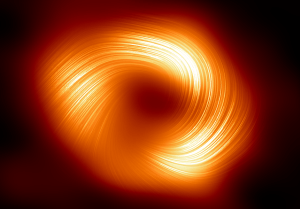
“Sure, it’s the new view of the Milky Way’s super-massive black hole with the extra lines. So deal already.”

“Hold your horses, Cal.” <Vinnie starts dealing.> “I’m looking for explanations. Where’d those lines come from? They swirl across the accretion disk like so much rope, right? Why aren’t they just going straight in orderly‑like? The whole thing just don’t make sense to me.”

Susan bets a few chips. “I saw a similar pop‑sci article, Vinnie. It said the lines trace out polarization in the light waves the Event Horizon Telescope captured. Okay, radio waves — same thing just longer wavelength. Polarized radio waves. I’ve measured concentrations of sugar and amino acid solutions by how much the liquid rotates polarized light, but the light first went through a polarizing filter. How does a black hole make polarized waves?”

Kareem matches Susan’s bet. “Mm‑hm. We use polarized light passing through thin sections of the rocks we sample to characterize the minerals in them. But like Susan says, we don’t make polarized light, we use a filter to subtract out the polarization we don’t want. You’re the physicist, Sy, how does the black hole do the filtering?”

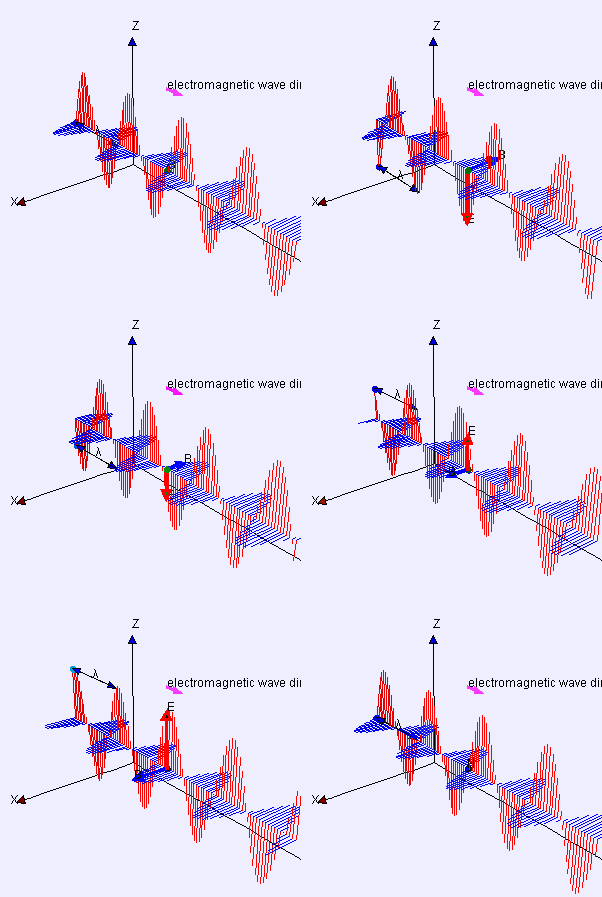
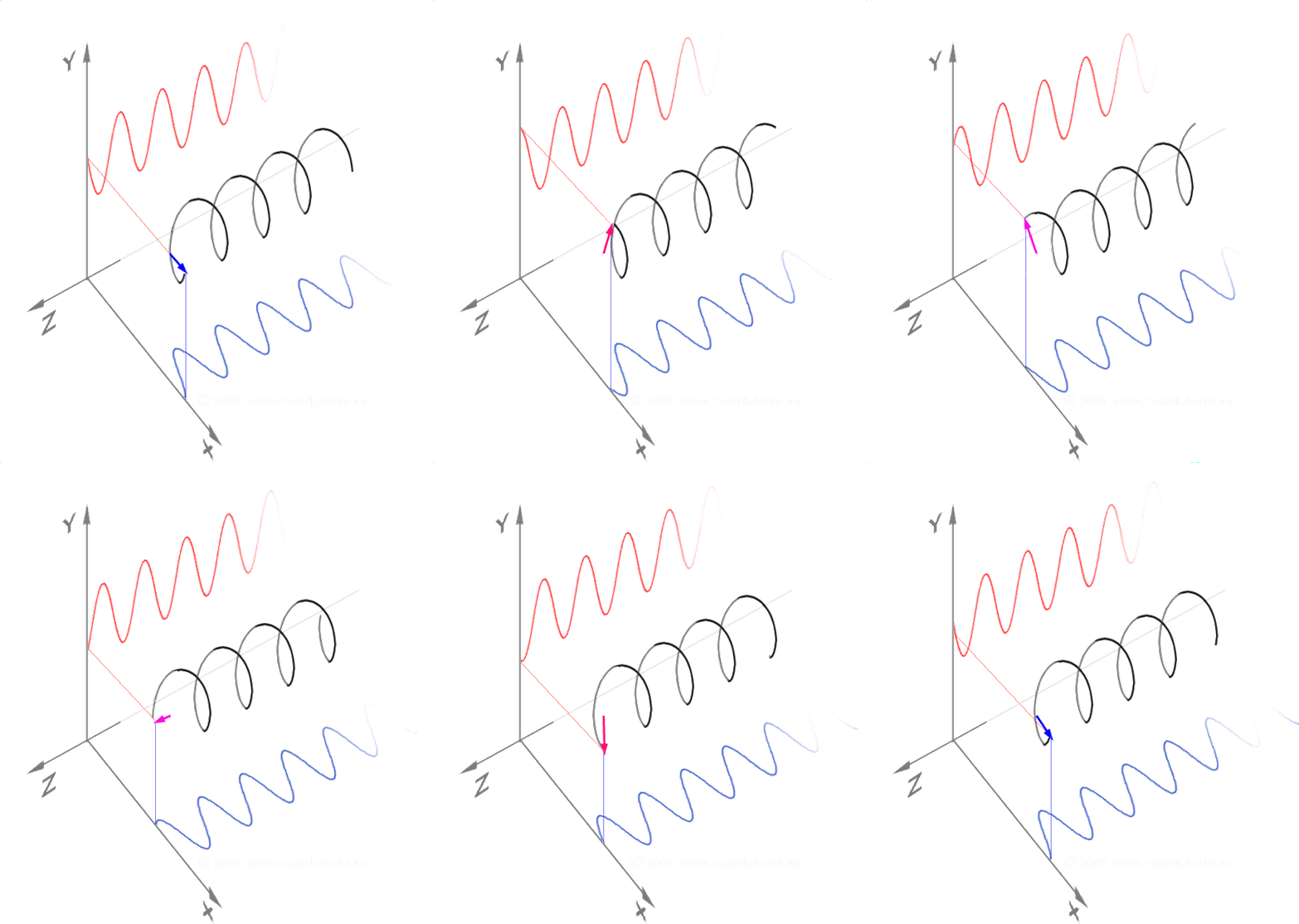
Plane‑polarized electromagnetic wave
 Electric (E) field is red
 Magnetic (B) field is blue
(Image by Loo Kang Wee and Fu-Kwun Hwang from Wikimedia Commons)

My hand’s good so I match the current ante. “It doesn’t. There’s no filtering, the light just comes out that way. I’d better start with the fundamentals.” <displaying Old Reliable> “Does this look familiar, Vinnie?”

“Yeah, Sy, you’ve used it a lot. That blue dot in the back’s an electron, call it Alice, bobbing straight up and down. That’s the polarization it’s puttin’ on the waves. The red lines are the force that another electron, call it Bob, feels at whatever distance away. Negative‑negative is repelling that so Bob goes down where the red line goes up but you get the basic idea.”

“The blue lines are important here.”

“I’m still hazy on those. They twist things, right?”

“That’s one way to put it. Hendrik Lorentz put it better when he wrote that Bob in this situation experiences one force with two components. There’s the red‑line charge‑dependent component, plus the blue‑line component that depends on the charge and Bob’s motion relative to Alice. If the two are moving in parallel—”

“The same frame, then. I knew frames would get into this somehow.”

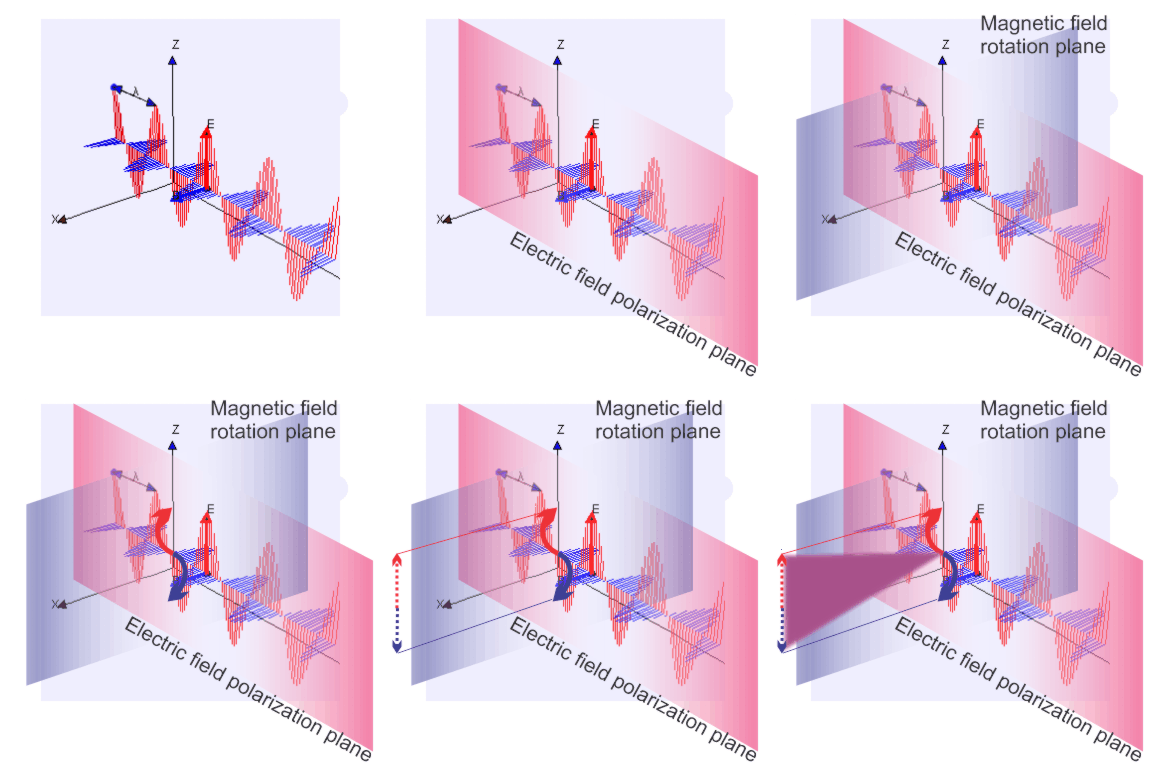
“It’s hard to avoid frames when motion’s the subject. Anyway, if the two electrons are moving in parallel, the blue‑line component has zero effect. If the two are moving in different directions, the blue‑line component rotates Bob’s motion perpendicular to Alice’s red‑line polarization plane. How much rotation depends on the angle between the two headings — it’s a maximum when Bob’s moving perpendicular to Alice’s motion.”

“Wait, if this is about relative motion, then Bob thinks Alice is twisting, too. If she thinks he’s being rotated down, then he thinks she’s being rotated up, right? Action‑reaction?”

“Absolutely, Vinnie. Now let’s add Carl to the cast.”

“Carl?”

Alice and Bob’s electromagnetic interaction
begets motion that generates new polarized light.

“Distant observer at right angles to Alice’s polarization plane. From Carl’s point of view both electrons are just tracking vertically. Charges in motion generate lightwaves so Carl sees light polarized in that plane.”

Cathleen’s getting impatient, makes her bet with a rattle of chips. “What’s all this got to do with the lines in the EHT image?”

“The hole’s magnetic field herds charged particles into rotating circular columns. Faraday would say each column centers on a line of force. Alice and a lot of other charged particles race around some column. Bob and a lot of other particles vibrate along the column and emit polarized light which shows up as bright lines in the EHT image.”

“But why are the columns twisted?”

“Orbit speed in the accretion disk increases toward its center. I’d bet that’s what distorts the columns. Also, I’ve got four kings.”

“That takes this pot, Sy.”

~~ Rich Olcott