
This park bench is perfectly situated for watching the summer solstice sun setting across the lake. I’m enjoying the view when <bomPAH-dadadadaDEEdah> blares from my phone. Number 710‑555‑1701 on the caller‑ID display evokes memories of a sultry stare and pointed ears…. “Good evening, Ms Baird. What’s new in the 23rd century?”
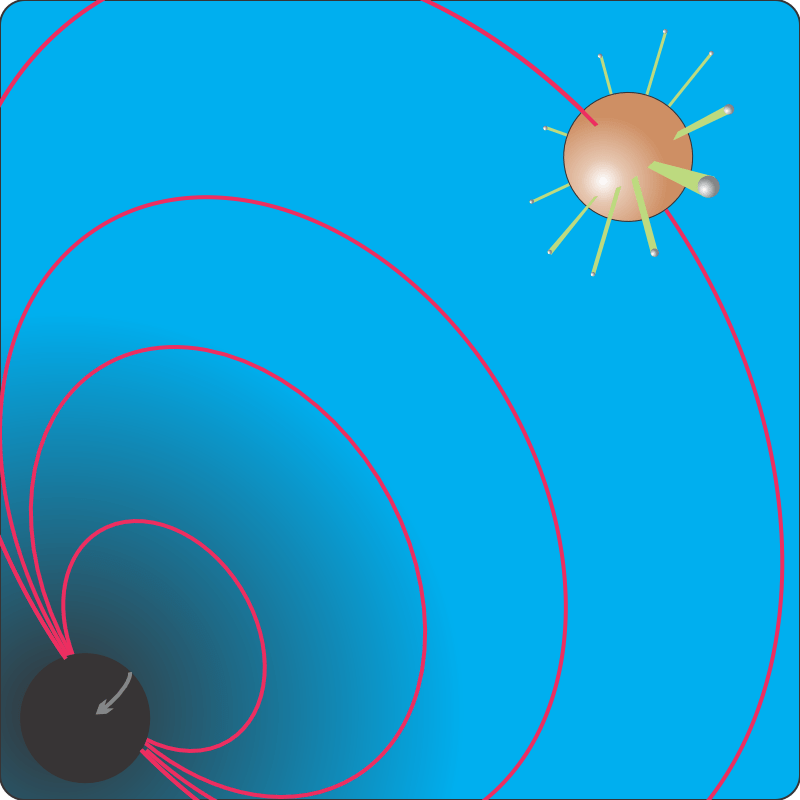
“Not much that I can tell you about, considering the Prime Directive. We’re taking a second shot at Project Lonesome. You may recall we’d identified an isolated black hole we called Lonesome. We were going to use two orbiting planetoids, Pine and Road, to generate electricity from its spinning electromagnetic field. Star Fleet’s anti‑matter synthesizers need that power.”
“Yes, I remember. Three‑body gravitational instability cost you Pine and your rank. Have you recovered the rank?”
“I’m only up to Lieutenant Commander so far, but part of the deal was that I’m back on Invigilator for a second shot at Lonesome. This time we’ve simplified the design. We had to, we only have Road to work with.”
“If I recall correctly, the idea was that the rotating field would induce electrical currents within conducting tractor beams strung between Pine and Road. How are you going to do that with only one orbiter? Relativity would be a challenge if you string something down to Lonesome.”
“We’re not stupid, Mr Moire, and we’re quite familiar with Relativity’s effects. I’ll give you an example your science is ready for. General Relativity says that time runs more slowly the deeper you go into a gravity well, yes?”
“Indeed. Our GPS time‑signal calibrations include an Einstein correction for reduced Earth gravity at satellite height. We have a movie, Interstellar, where gravitational time dilation was a major plot element.”
“A classic film. Even now we watch it occasionally. Consider this: on its own timeline, a star within its gravity well is younger than remote measurements say it is. The more massive the star, the greater the difference between experienced and apparent age.”
“Ooo, nice.”
“Counteracting gravitational discrepancies was a major challenge when we were developing transporter technology. Physics just doesn’t like teleporting a material object between different timescales, even through subspace. We finally gave up on that approach. What worked was transcribing the object into a subspace signal between pattern buffers. In the receiving environment we rebuild from the buffered signal and amorphous matter. Sometimes roundabout is the best path.”
“I’m with Bones on that—”
“Who?”
“Doctor Leonard McCoy.”
“Never heard of him. Must have been before my time.”
“Anyway, he’ll refuse to use transporters, convinced they’ll spray his atoms all over the Universe.”
“Way, way before my time, then. These days they’re as safe as your airplanes. Safer.”
“So what’s the new design?”
“The plan is to site ten plants around Road‘s equator. Each plant will have a free‑standing AM production facility teamed with two conductive tractor/pressor beams locked onto a floating plate of gamma‑phase bixonate. I’m allowed to give you those details because it’ll be a century before you’ll have bixonate production technology, much less gamma restructuring capability.”
“Why the special material?”
“At the nanoscale level, gamma bixonate’s surface is an array of corner‑cube mirrors that perfectly reflect electron waves back to their source. Meanwhile, the jagged edges between nano‑cubelets topologically obstruct local coherent magnetic fields. The combination is key to my Project Lonesome architecture. The power production cycle starts with injecting pulses of spin‑up electrons into one beam’s center where they’re trapped and streamed upwards. The black hole’s rotating magnetic field accelerates the electrons until they hit the bixonate nano‑cubelets that reflect them down the other beam. The reflection operation also flips the electron spin state so now the field accelerates them downward towards the factory’s energy receptors.”
“Double the acceleration effect.”
“Mm‑hm. We expect to achieve energies in the high exa‑electronvolt range, about a billion times what your CERN instrument can do. That’s plenty for AM synthesis.”
“One question.”
“Yes?”
“Have your engineers considered Lenz’ Law? Your immense electric currents will generate their own magnetic fields in opposition to the black hole’s. The induced fields will squirt Lone right out of the system.”
A sudden shocked pause, then the connection drops.
~ Rich Olcott
- Thanks to Xander for a deeper Time question.

