


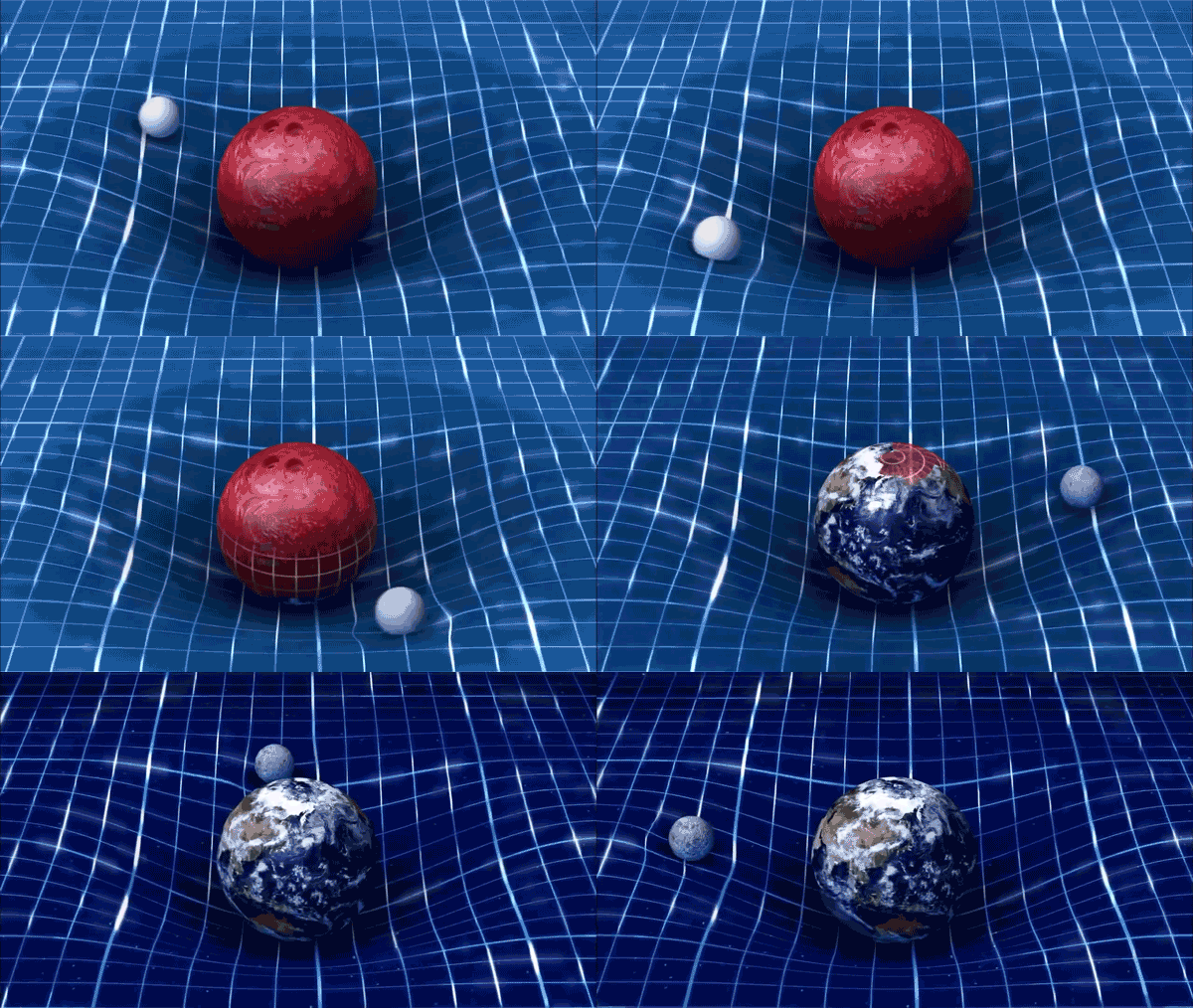
If you’re reading this post, you’ve undoubtedly seen at least one diagram like the above — a black hole or a planet or a bowling ball makes a dent in a rubber sheet and that’s supposed to explain Gravity. But it doesn’t, and neither does this spirally screen-grab from Brian Greene’s presentation on Stephen Colbert’s Late Show: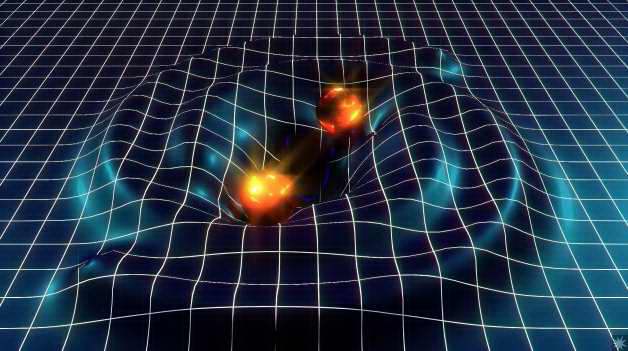
<Blush> I have to admit that the graphic I used a couple of weeks ago is just as bad.
Gravitational waves don’t make things go up and down like ocean waves, and they’re definitely not like that planet on a trampoline — after all, there’s nothing “below” to pull things downward so there can’t be a dent. And gravitational waves don’t do spirals, much.
 Of all the wave varieties we’re familiar with, gravitational waves are most similar to (NOT identical with!!) sound waves. A sound wave consists of cycles of compression and expansion like you see in this graphic. Those dots could be particles in a gas (classic “sound waves”) or in a liquid (sonar) or neighboring atoms in a solid (a xylophone or marimba).
Contrary to rumor, there can be sound in space, sort of. Any sizable volume of “empty” space contains at least a few atoms and dust particles. A nova or similar sudden event can sweep particles together and give rise to successive waves that spread as those local collections bang into particles further away. That kind of activity is invoked in some theories of spiral galaxy structure and the fine details of Saturn’s rings.
In a gravitational wave, space itself is compressed and stretched. A particle caught in a gravitational wave doesn’t get pushed back and forth. Instead, it shrinks and expands in place. If you encounter a gravitational wave, you and all your calibrated measurement gear (yardsticks, digital rangers, that slide rule you’re so proud of) shrink and expand together. You’d only notice the experience if you happened to be comparing two extremely precise laser rangers set perpendicular to each other (LIGO!). One would briefly register a slight change compared to the other one.
Light always travels at 186,000 miles per second but in a compressed region of space those miles are shorter.  Einstein noticed that implication of his Theory of General Relativity and in 1916 predicted that the path of starlight would be bent when it passed close to a heavy object like the Sun. The graphic shows a wave front passing through a static gravitational structure. Two points on the front each progress at one graph-paper increment per step. But the increments don’t match so the front as a whole changes direction. Sure enough, three years after Einstein’s prediction, Eddington observed just that effect while watching a total solar eclipse in the South Atlantic.
Unlike the Sun’s steady field, a gravitational wave is dynamic. Gravitational waves are generated by changes in a mass configuration. The wave’s compression and stretching forces spread out through space.
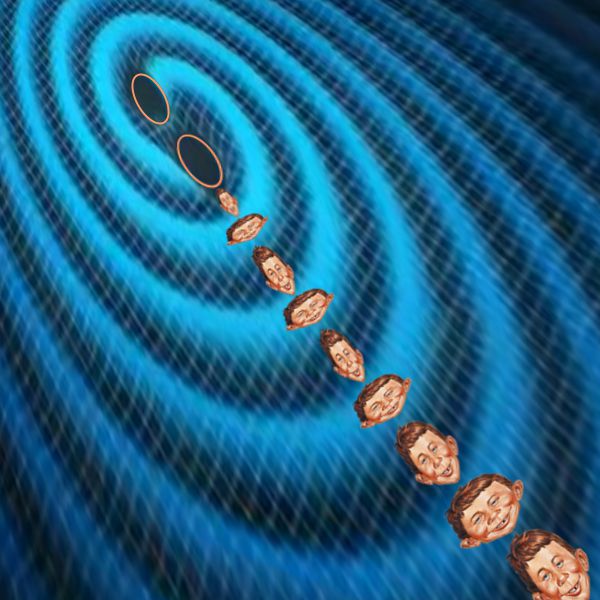
Here’s a simulation of the gravitational forces generated by two black holes orbiting into a collision. The contours show the net force felt at each point in the region around the pair.
 We’re being dynamic here, so the simulation has to include the fact that changes in the mass configuration aren’t felt everywhere instantaneously. Einstein showed that space transmits gravitational waves at the speed of light, so I used a scaled “speed of light” in the calculation. You can see how each of the new features expands outward at a steady rate.
Even near the violent end, the massive objects move much more slowly than light speed. The variation in their nearby field quickly smooths out to an oval and then a circle about the central point, which is why the calculated gravity field generates no spiral like the ones in the pretty pictures.
Oh, and those “gravity well” pictures? They’re not showing gravitational fields, they’re really gravitational potential energy diagrams, showing how hard it’d be to get away from somewhere. In the top video, for example, the satellite orbits the planet because it doesn’t have enough kinetic energy to get out of the well. The more massive the attractor, the tighter it curves space around itself and the deeper the well.
~~ Rich Olcott

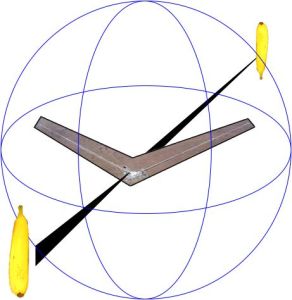 The second question is harder. The best the aLIGO team could do was point to a “banana-shaped region” (their words, not mine) that covers about 1% of the sky. The team marshaled a world-wide collaboration of observatories to scan that area (a huge search field by astronomical standards), looking for electromagnetic activities concurrent with the event they’d seen. Nobody saw any. That was part of the evidence that this collision involved two black holes. (If one or both of the objects had been something other than a black hole, the collision would have given off all kinds of photons.)
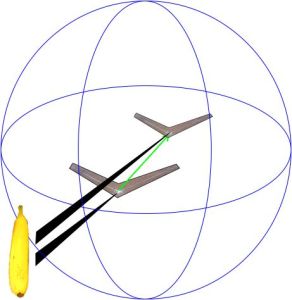 In contrast, a LIGO facility is (roughly speaking) omni-directional. When a LIGO installation senses a gravitational pulse, it could be coming down from the visible sky or up through the Earth from the other hemisphere — one signal doesn’t carry the “which way?” information. The diagram above shows that situation. (The “chevron” is an image of the LIGO in Hanford WA.) Models based on the signal from that pair of 4-km arms can narrow the source field to a “banana-shaped region,” but there’s still that 180o ambiguity.
 The great “if only” is that the VIRGO installation in Italy was not recording data when the Hanford WA and Livingston LA saw that September signal. With three recordings to reconcile, the aLIGO+VIRGO combination would have had enough information to slice that banana and localize the event precisely.

 Nonetheless, mathematicians and cryptographers have forged ahead, calculating π to more than a trillion digits. Here for your enjoyment are the 99 digits that come after digit million….
 Back to π. The Greeks knew that the circumference of a circle (c) divided by its diameter (d) is π. Furthermore they knew that a circle’s area divided by the square of its radius (r) is also π. Euclid was too smart to try calculating the area of the visible sky in his astronomical work. He had two reasons — he didn’t know the radius of the horizon, and he didn’t know the height of the sky. Later geometers worked out the area of such a spherical cap. I was pleased to learn that π is the ratio of the cap’s area to the square of its chord, s2=r2+h2.
 Astrophysicists and cosmologists look at much bigger figures, ones so large that curvature has to be figured in. There are three possibilities

 We can investigate things that take longer than an instrument’s characteristic time by making repeated measurements, but we can’t use the instrument to resolve successive events that happen more quickly than that. We also can’t resolve events that take place much closer together than the instrument’s characteristic length.
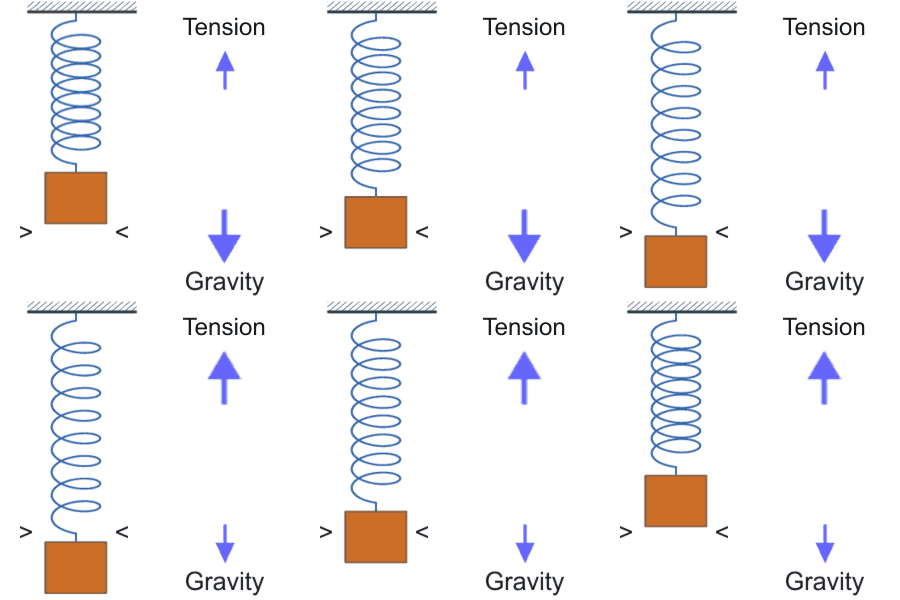 A wave happens in a system when a driving force and a restoring force take turns overshooting an equilibrium point AND the away-from-equilibrium-ness gets communicated around the system. The system could be a bunch of springs tied together in a squeaky old bedframe, or labor and capital in an economic system, or the network of water molecules forming the ocean surface, or the fibers in the fabric of space (whatever those turn out to be).
 An isolated black hole is surrounded by an intense gravitational field and a corresponding compression of spacetime. A pair of black holes orbiting each other sends out an alternating series of tensions, first high, then extremely high, then high…
 Almost a century later, James Clerk Maxwell (the bearded fellow at left) wrote down his electromagnetism equations that explain how light works. Half a century later, Einstein did the same for gravity.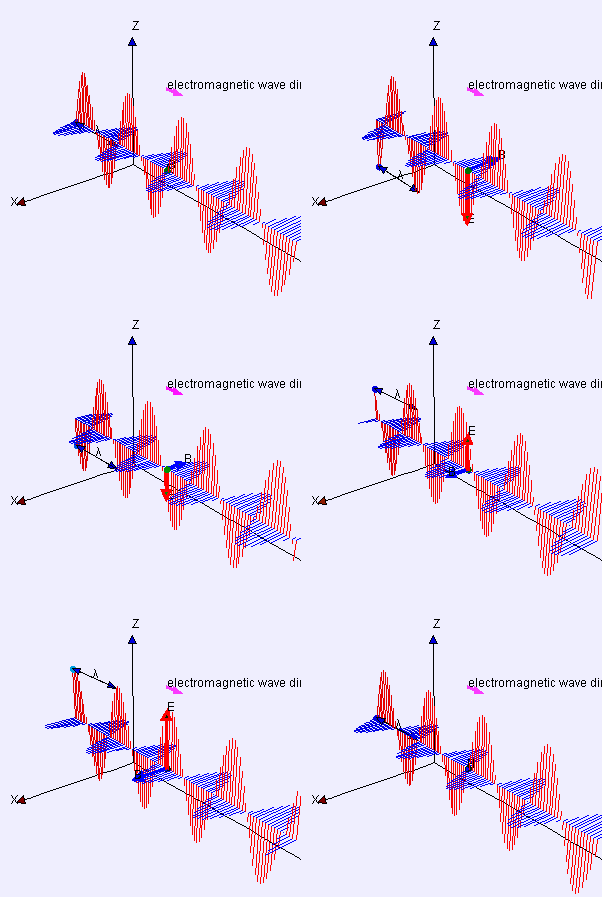
 Gravitodynamics is completely unlike electrodynamics. Gravity’s transverse “force” doesn’t act to move a whole mass up and down like Maxwell’s picture at left. Instead, as shown by Einstein’s picture, gravitational waves stretch and compress while leaving the center of mass in place. I put “force” in quotes because what’s being stretched and compressed is space itself. See
 The experiment consists of shooting laser beams out along both arms, then comparing the returned beams.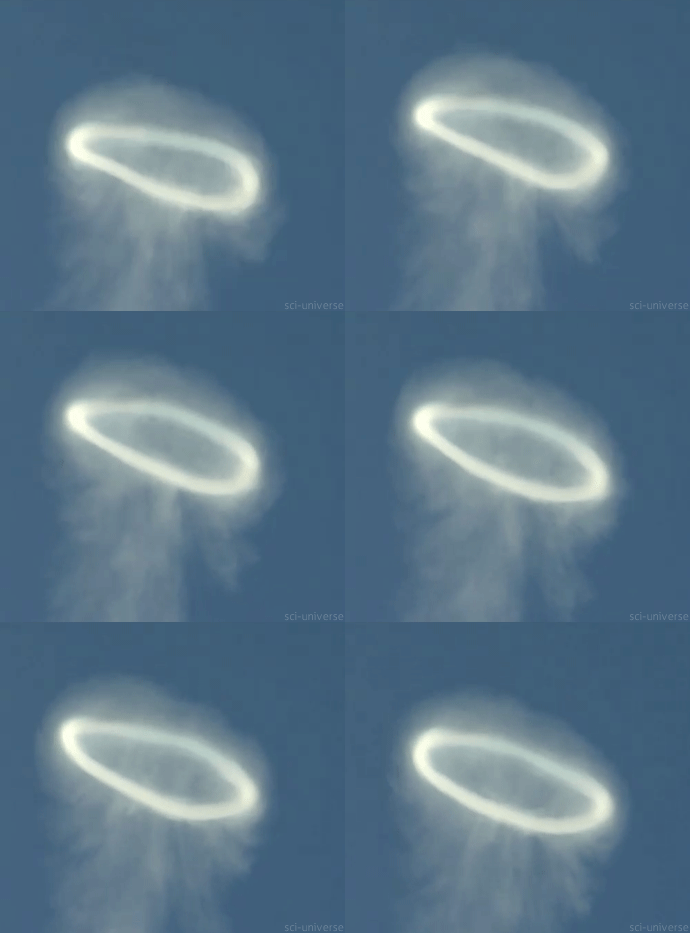
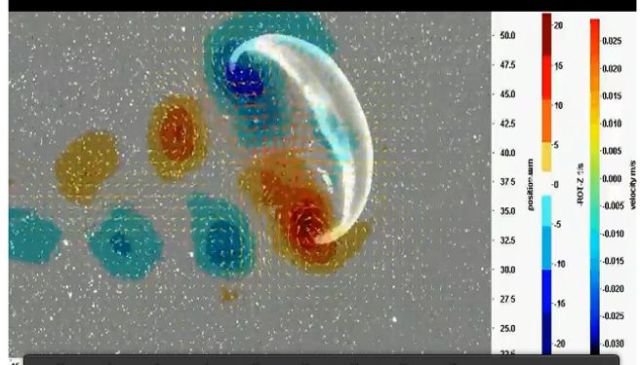
 Grammie always grimaced when Grampie lit up one of his cigars inside the house. We kids grinned though because he’d soon be blowing smoke rings for us. Great fun to try poking a finger into the center, but we quickly learned that the ring itself vanished if we touched it.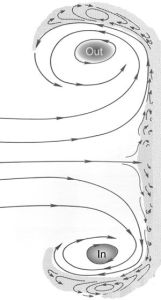

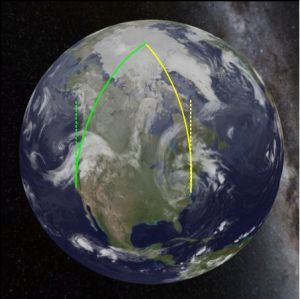 For instance, suppose Fred and Ethel collaborate on a narwhale research project. Fred is based in San Diego CA and Ethel works out of Norfolk VA. They fly to meet their research vessel at the North Pole. Fred’s plane follows the green track, Ethel’s plane follows the yellow one. At the start of the trip, they’re on parallel paths going straight north (the dotted lines). After a few hours, though, Ethel notices the two planes pulling closer together.
 The line rotates as a unit — every skater completes a 360o rotation in the same time. Similarly, everywhere on Earth a day lasts for exactly 24 hours.
 Now suppose our speedy skater hits a slushy patch of ice. Her end of the line is slowed down, so what happens to the rest of the line? It deforms — there’s a new center of rotation that forces the entire line to curl around towards the slow spot. Similarly, that blob near the Equator in the split-Earth diagram curls in the direction of the slower-moving air to its north, which is counter-clockwise.
 See that little guy on the bridge, suspended halfway between all the way down and all the way up? That’s us on the cosmic size scale.
 So that’s the size range of the Universe, from 1.6×10⁻³⁵ up to 2.6×1026 meters. What’s a reasonable way to fix a half-way mark between them?
 Hard Science Ain't Hard
