The Prints of Darkness

There’s a commotion in front of Al’s coffee shop. Perennial antiestablishmentarian Change-me Charlie’s set up his argument table there and this time the ‘establishment’ he’s taking on is Astrophysics. Charlie’s an accomplished chain-yanker and he’s working it hard. “There’s no evidence for dark matter, they’ve never found any of the stuff and there’s tons of no-dark-matter theories to explain the evidence.”

Big Cap’n Mike’s shouts from the back of the crowd. “What they’ve been looking for and haven’t found is particles. By my theory dark matter’s an aspect of gravity which ain’t particles so there’s no particles for them to find.”

Astronomer-in-training Jim spouts off right in Charlie’s face. “Dude, you can’t have it both ways. Either there’s no evidence to theorize about, or there’s evidence.”

Physicist-in-training Newt Barnes takes the oppo chair. “So what exactly are we talking about here?”

“That’s the thing, guy, no-one knows. It’s like that song, ‘Last night I saw upon the stair / A little man who wasn’t there. / He wasn’t there again today. / Oh how I wish he’d go away.‘ It’s just buzzwords about a bogosity. Nothin’ there.”

I gotta have my joke. “Oh, it’s past nothing, it’s a negative.”

“Come again?”

“The Universe is loaded with large rotating but stable structures — solar systems, stellar binaries, globular star clusters, galaxies, galaxy clusters, whatever. Newton’s Law of Gravity accounts nicely for the stability of the smallest ones. Their angular momentum would send them flying apart if it weren’t for the gravitational attraction between each component and the mass of the rest. Things as big as galaxies and galaxy clusters are another matter. You can calculate from its spin rate how much mass a galaxy must have in order to keep an outlying star from flying away. Subtract that from the observed mass of stars and gas. You get a negative number. Something like five times more negative than the mass you can account for.”

“Negative mass?”

“Uh-uh, missing positive mass to combine with the observed mass to account for the gravitational attraction holding the structure together. Zwicky and Rubin gave us the initial object-tracking evidence but many other astronomers have added to that particular stack since then. According to the equations, the unobserved mass seems to form a spherical shell surrounding a galaxy.”

“How about black holes and rogue planets?”

Newt’s thing is cosmology so he catches that one. “No dice. The current relative amounts of hydrogen, helium and photons say that the total amount of normal matter (including black holes) in the Universe is nowhere near enough to make up the difference.”
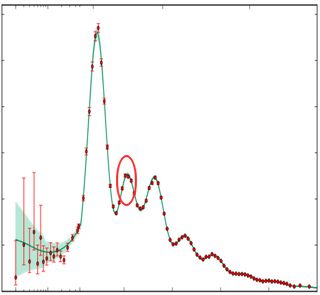
“So maybe Newton’s Law of Gravity doesn’t work when you get to big distances.”

“Biggest distance we’ve got is the edge of the observable Universe. Jim, show him that chart of the angular power distribution in the Planck satellite data for the Cosmological Microwave Background.” <Jim pulls out his smart-phone, pulls up an image.> “See the circled peak? If there were no dark matter that peak would be a valley.”

Charlie’s beginning to wilt a little. “Ahh, that’s all theory.”
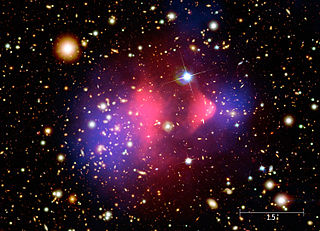
The Bullet Cluster ( 1E 0657-56 )

<Jim pulls up another picture.> “Nope, we’ve got several kinds of direct evidence now. The most famous one is this image of the Bullet Cluster, actually two clusters caught in the act of colliding head-on. High-energy particle-particle collisions emit X-rays that NASA’s Chandra satellite picked up. That’s marked in pink. But on either side of the pink you have these blue-marked regions where images of further-away galaxies are stretched and twisted. We’ve known for a century how mass bends light so we can figure from the distortions how much lensing mass there is and where it is. This picture does three things — it confirms the existence of invisible mass by demonstrating its effect, and it shows that invisible mass and visible mass are separate phenomena. I’ve got no pictures but I just read a paper about two galaxies that don’t seem to be associated with dark matter at all. They rotate just as Newton would’ve expected from their visible mass alone. No surprise, they’re also a lot less dense without that five-fold greater mass squeezing them in.”

“You said three.”

“Gotcha hooked, huh?

~~ Rich Olcott

Fierce Roaring Beast

A darkish day calls for a fresh scone so I head for Al’s coffee shop. Cathleen’s there with some of her Astronomy students. Al’s at their table instead of his usual place behind the cash register. “So what’s going on with these FRBs?”

She plays it cool. “Which FRBs, Al? Fixed Rate Bonds? Failure Review Boards? Flexible Reed Baskets?”

Jim, next to her, joins in. “Feedback Reverb Buffers? Forged Razor Blades?
Fennel Root Beer?”

I give it a shot. “Freely Rolling Boulders? Flashing Rapiers and Broadswords? Fragile Reality Boundary?”

“C’mon, guys. Fast Radio Bursts. Somebody said they’re the hottest thing in Astronomy.”

Cathleen, ever the teacher, gives in. “Well, they’re right, Al. We’ve only known about them since 2007 and they’re among the most mystifying objects we’ve found out there. Apparently they’re scattered randomly in galaxies all over the sky. They release immense amounts of energy in incredibly short periods of time.”

“I’ll say.” Vinnie’s joins the conversation from the next table. “Sy and me, we been talking about using the speed of light to measure stuff. When I read that those radio blasts from somewhere last just a millisecond or so, I thought, ‘Whatever makes that blast happen, the signal to keep it going can’t travel above lightspeed. From one side to the other must be closer than light can travel in a millisecond. That’s only 186 miles. We got asteroids bigger than that!'”

“300 kilometers in metric.” Jim’s back in. “I’ve played with that idea, too. The 70 FRBs reported so far all lasted about a millisecond within a factor of 3 either way — maybe that’s telling us something. The fastest way to get lots of energy is a matter-antimatter annihilation that completely converts mass to energy by E=mc².  Antimatter’s awfully rare 13 billion years after the Big Bang, but suppose there’s still a half-kilogram pebble out there a couple galaxies away and it hits a hunk of normal matter. The annihilation destroys a full kilogram; the energy release is 1017 joules. If the event takes one millisecond that’s 1020 watts of power.”

“How’s that stand up against the power we receive in an FRB signal, Jim?”

“That’s the thing, Sy, we don’t have a good handle on distances. We know how much power our antennas picked up, but power reception drops as the square of the source distance and we don’t know how far away these things are. If your distance estimate is off by a factor of 10 your estimate of emitted power is wrong by a factor of 100.”

“Ballpark us.”

<sigh> “For a conservative estimate, say that next-nearest-neighbor galaxy is something like 1021 kilometers away. When the signal finally hits us those watts have been spread over a 1021-kilometer sphere. Its area is something like 1049 square meters so the signal’s power density would be around 10-29 watts per square meter. I know what you’re going to ask, Cathleen. Assuming the radio-telescope observations used a one-gigahertz bandwidth, the 0.3-to-30-Jansky signals they’ve recorded are about a million million times stronger than my pebble can account for. Further-away collisions would give even smaller signals.”

Looking around at her students, “Good self-checking, Jim, but for the sake of argument, guys, what other evidence do we have to rule out Jim’s hypothesis? Greg?”

“Mmm… spectra? A collision like Jim described ought to shine all across the spectrum, from radio on up through gamma rays. But we don’t seem to get any of that.”

“Terry, if the object’s very far away wouldn’t its shorter wavelengths be red-shifted by the Hubble Flow?”

“Sure, but the furthest-away one we’ve tagged so far is nearer than z=0.2. Wavelengths have been stretched by 20% or less. Blue light would shift down to green or yellow at most.”

“Fran?”

“We ought to get even bigger flashes from antimatter rocks and asteroids. But all the signals have about the same strength within a factor of 100.”

“I got an evidence.”

“Yes, Vinnie?”

“That collision wouldn’t’a had a chance to get started. First contact, blooie! the gases and radiation and stuff push the rest of the pieces apart and kill the yield. That’s one of the problems the A-bomb guys had to solve.”

Al’s been eaves-dropping, of course. “Hey, guys. Fresh Raisin Bread, on the house.”

~~ Rich Olcott

Friendly Resting Behemoths

A Three-dog Night Would Be So Cool

“So we’ve got three fundamentally different messengers from the stars, Mr Feder.  The past couple of years have given us several encouraging instances of receiving two messengers from the same event.  If we ever receive all three messengers from the same event, that might give us what we need to solve the biggest problem in modern physics.”

“That’s a pretty deep statement, Moire.  Care to unpack it?  The geese here would love to hear about it.”

“Lakeside is a good place for thoughts like this.  The first messenger was photons.  We’ve been observing starlight photons for tens of thousand of years.  Tycho Brahe and Galileo took it to a new level a few centuries ago with their careful observation, precision measurements and Galileo’s telescope.”

“That’s done us pretty good, huh?”

“Oh sure, we’ve charted the heavens and how things move, what we can see of them.  But our charts imply there’s much we can’t see.  Photons only interact with electric charge.  Except for flat-out getting absorbed if the wavelength is right, photons don’t care about electrically neutral material and especially they don’t care about dark matter.”

“So that’s why we’re interested in the other messengers.”

“Exactly.  Even electrically neutral things have mass and interact with the gravitational field.  You remember the big news a few years ago, when our brand-new LIGO instruments caught a gravitational wave signal from a couple of black holes in collision.  Black holes don’t give off photons, so the gravitational wave messenger was our only way of learning about that event.”

“No lightwave signal at all?”

“Well, there was a report of a possible gamma-ray flare in that patch of sky, but it was borderline-detectable.  No observatory using lower-energy light saw anything there.  So, no.”

“You’re gonna tell me and the geese about some two-messenger event now, right?”

“That’s where I’m going, Mr Feder.  Photons first.  Astronomers have been wondering for decades about where short, high-energy gamma-ray bursts come from.  They seem to happen randomly in time and space.  About a year ago the Fermi satellite’s gamma-ray telescope detected one of those bursts and sent out an automated ‘Look HERE’ alert to other observatories.  Unfortunately, Fermi‘s resolution isn’t wonderful so its email pointed to a pretty large patch of sky.  Meanwhile back on Earth and within a couple of seconds of Fermi‘s moment, the LIGO instruments caught an unusual gravitational wave signal that ran about a hundred times slower than the black-hole signals they’d seen.  Another automated ‘Look HERE’ alert went out.  This one pointed to a small portion of that same patch of sky.  Two messengers.”

“Did anyone find anything?”

“Seventy other observatories scrutinized the overlap region at every wavelength known to Man.  They found a kilonova, an explosion of light and matter a thousand times brighter than typical novae.  The gravitational wave evidence indicated a collision between two neutron stars, something that had never before been recorded.  Photon evidence from the spewed-out cloud identified a dozen heavy elements theoreticians hadn’t been able to track to an origin.  Timing details in the signals gave cosmologists an independent path to resolving a problem with the Hubble Constant.  And now we know where those short gamma-ray bursts come from.”

“Pretty good for a two-messenger event.  Got another story like that?”

“A good one.  This one’s neutrinos and photons, and the neutrinos came in first.  One neutrino.”

One neutrino?”

“Yup, but it was a special one, a super-high-powered neutrino whose incoming path our IceCube observatory could get a good fix on.  IceCube sent out its own automated ‘Look HERE’ alert.  The Fermi team picked up the alert and got real excited because the alert’s coordinates matched the location of a known and studied gamma-ray source.  Not a short-burster, but a flaring blazar.  That neutrino’s extreme energy is evidence for blazars being one of the long-sought sources of cosmic rays.”

“Puzzle solved, maybe.  Now what you said about a three-messenger signal?”grebe messenger pairs“Gravitational waves are relativity effects and neutrinos are quantum mechanical.  Physicists have been struggling for a century to bridge those two domains.  Evidence from a three-messenger event could provide the final clues.”
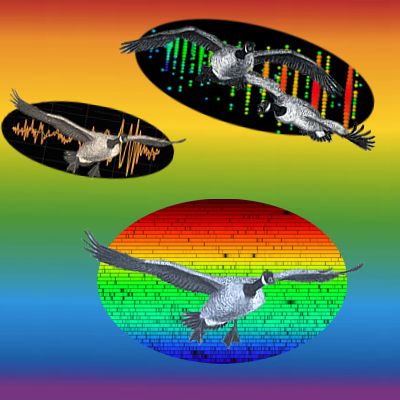
“I’ll bet the geese enjoyed hearing all that.”

“They’re grebes, Mr Feder.”

~~ Rich Olcott

Heavenly Messengers

A gorgeous Fall day, a little bit cool-ish, perfect for a brisk walk in the park.  I’m striding along the lake-bound path when there’s a breathless shout behind me.  “Hey, Moire, wait up!  I got questions!”

“Hello, Mr Feder.  What’s the topic this time?  And keep up, please, I’ve got geese to watch.”

“I been reading in the business pages <puff, puff> about all the money different countries are putting into ‘multi-messenger astronomy.’  <puff>  What’s that about, anyway?  Who’s sending messages and ain’t the Internet good enough?”

“It’s not who, Mr Feder, it’s what — stars, galaxies, black holes, the Universe.  And the messages are generally either ‘Here I am‘ or ‘Something interesting just happened‘.  The Internet just doesn’t reach that far and besides, no kitten pictures.”

“Pretty simple-sounding messages, so why the big bucks for extra message-catchers?”

“Fair question.  It has to do with what kind of information each messenger carries.  Photons, for instance.”

“Yeah, light-waves, the rainbow.”

“Way more than the rainbow.  Equating light-waves to just the colors we see is like equating sound-waves to just the range from A4 through F4# on a piano.”

“Hey, that’s less than an octave.”

“Yup, and electromagnetism’s scale is hugely broader than that.  Most of the notes, or colors, are way out of our range.  A big tuba makes a deep, low-frequency note but a tiny piccolo makes a high note.  Photon characteristics also scale with the size of where they came from.  Roughly speaking, the shorter the light’s wave-length, the smaller the process it came out of and the smaller its target will be.  Visible light, for instance, is sent and received by loosely-held charge sloshing inside an atom or molecule.  Charge held tight to a nucleus gives rise to higher-energy photons, in the ultra-violet range or beyond.”

“Like how beyond?”

“X-rays can rip electrons right out of a molecule.  Gamma rays are even nastier and involve charge activity inside a nucleus, like during a nuclear reaction.”

“How about in the other direction?  Nothing?”

“Hardly.  Going that way is going to bigger scales.  Infra-red is about parts of molecules vibrating against each other, microwave is about whole molecules rotating.  When your size range gets out to feet-to-miles you’re looking at radio waves that probably originated from free electrons or ions slammed back and forth by electric or magnetic fields.”

“So these light ranges are like messengers that clue us in on what’s going on out there?  Different messengers, different kindsa clues?”

“You got the idea.  Add in that what happens to the light on the way here is also important.  Radio and microwave photons with their long wavelengths swerve around dust particles that block out shorter-wavelength ones.  Light that traversed Einstein-bent space lets us measure the masses of galaxies.  Absorption and polarization at specific wavelengths tell us what species are out there and what they’re doing.  Blue-shifts and red-shifts tell us how fast things are moving towards and away from us.  And of course, atmospheric distortions tell us we’ve got to put satellite observatories above the atmosphere to see better.”

“One messenger, lots of effects.”

“Indeed, but in the past few years we’ve added two more, really important messengers.  Photons are good, but they’re limited to just one of the four fundamental forces.”

“Hey, there’s gotta be more than that.  This is a complicated world.”

“True, but physicists can account for pretty much everything at the physical and chemical level with only four — electromagnetism, gravity, the strong force that holds nuclei together and the weak force that’s active in nuclear transformation processes.  Photons do electromagnetism and that’s all.”

“So you’re saying we’ve got a line on two of the others?”

“Exactly.  IceCube and its kin record the arrival of high-energy neutrinos.  In a sense they are to the weak force what photons are to electromagnetism.  We don’t know whether gravitation works through particles, but LIGO and company are sensitive to changes in the gravitational field that’s always with us.  Each gives us a new perspective on what’s happening out there.”

“So if you get a signal from one of the new messengers at the same time you get a photon signal…”

“Oh, look, the geese are coming in.”

Heavenly messengers

~~ Rich Olcott

“Hot Jets, Captain Neutrino!”

“Hey, Cathleen, while we’re talking IceCube, could you ‘splain one other thing from that TV program?”

“Depends on the program, Al.”

“Oh, yeah, you weren’t here when we started on this.  So I was watching this program and they were talking about neutrinos and how there’s trillions of them going through like my thumbnail every second and then IceCube saw this one neutrino that they’re real excited about so what I’m wondering is, what’s so special about just that neutrino? How do they even tell it apart from all the others?”

“How about the direction it came from, Cathleen?  We get lotsa neutrinos from the Sun and this one shot in from somewhere else?”

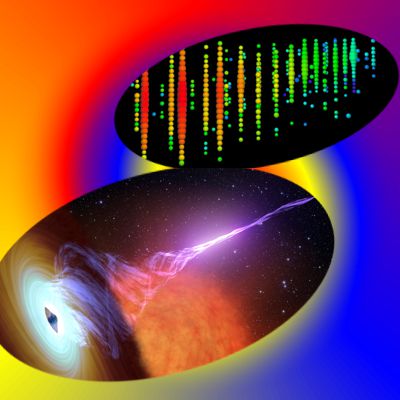
SMBH jet and IceCube
Images from NASA and JPL-Caltech

“An interesting question, Vinnie.  The publicity did concern its direction, but the neutrino was already special.  It registered 290 tera-electron-volts.”

“Ter-what?”

“Sorry, scientific shorthand — tera is ten-to-the-twelfth.  A million electrons poised on a million-volt gap would constitute a Tera-eV of potential energy.  Our Big Guy had 290 times that much kinetic energy all by himself.”

“How’s that stack up against other neutrinos?”

“Depends on where they came from.  Neutrinos from a nuclear reactor’s uranium or plutonium fission carry only about 10 Mega-eV, wimpier by a factor of 30 million.  The Sun’s primary fusion process generates neutrinos peaking out at 0.4 MeV, 25 times weaker still.”

“How about from super-accelerators like the LHC?”

“Mmm, the LHC makes TeV-range protons but it’s not designed for neutrino production.  We’ve got others that have been pressed into service as neutrino-beamers. It’s a complicated process — you send protons crashing into a target.  It spews a splatter of pions and K-ons.  Those guys decay to produce neutrinos that mostly go in the direction you want.  You lose a lot of energy.  Last I looked the zippiest neutrinos we’ve gotten from accelerators are still a thousand times weaker than the Big Guy.”

I can see the question in Vinnie’s eyes so I fire up Old Reliable again.  Here it comes… “What’s the most eV’s it can possibly be?”  Good ol’ Vinnie, always goes for the extremes.

“You remember the equation for kinetic energy?”

“Sure, it’s E=½ m·v², learned that in high school.”

“And it stayed with you.  OK, and what’s the highest possible speed?”

“Speed o’ light, 186,000 miles per second.”

“Or 300 million meters per second, ’cause that’s Old Reliable’s default setting.  Suppose we’ve got a neutrino that’s going a gnat’s whisker slower than light.  Let’s apply that formula to the neutrino’s rest mass which is something less than 1.67×10-36 kilograms…”Speedy neutrino simple calculation“Half an eV?  That’s all?  So how come the Big Guy’s got gazillions of eV’s?”

“But the Big Guy’s not resting.  It’s going near lightspeed so we need to apply that relativistic correction to its mass…Speedy neutrino relativistic calculation“That infinity sign at the bottom means ‘as big as you want.’  So to answer your first question, there isn’t a maximum neutrino energy.  To make a more energetic neutrino, just goose it to go even closer to the speed of light.”

“Musta been one huge accelerator that spewed the Big Guy.”

“One of the biggest, Al.”  Cathleen again.  “That’s the exciting thing about what direction the particle came from.”

“Like the North Pole or something?”

“Much further away, much bigger and way more interesting.  As soon as IceCube caught that neutrino signal, it automatically sent out a “Look in THIS direction!” alert to conventional observatories all over the world.  And there it was — a blazar, 5.7 billion lightyears away!”

“Wait, Cathleen, what’s a blazar?”

“An incredibly brilliant but highly variable photon source, from radio frequencies all the way up to gamma rays and maybe cosmic rays.  We think the thousands we’ve catalogued are just a fraction of the ones within range.  We’re pretty sure that each of them depends on a super-massive black hole in the center of a galaxy.  The current theory is that those photons come from an astronomy-sized accelerator, a massive swirling jet that shoots out from the central source.  When the jet happens to point straight at us, flash-o!”

Duck!

“I wouldn’t worry about a neutrino flood.  The good news is IceCube’s signal alerted astronomers to check TXS 0506+056, a known blazar, early in a new flare cycle.”

“An astrophysical fire alarm!”

~~ Rich Olcott

Cube Roots

Cathleen steps into at Al’s for her morning coffee-and-scone.  “Heard you guys talking neutrinos so I’ll bet Al got you started with something about IceCube.  Isn’t it an awesome project?  Imagine instrumenting a cubic kilometer of ice, and at the South Pole!”

“Ya got me, Cathleen.  It knocked me out that anyone would even think of building it.  Where did the idea come from, anyhow?”

“I don’t know specifically, but it’s got a lot of ancestors, going back to the Wilson Cloud Chamber in the 1920s.”

“Oh, the cloud chamber!  Me and my brother did one for the Science Fair — used dry ice and some kind of alcohol in a plastic-covered lab dish if I remember right, and we set it next to one of my Mom’s orange dinner plates.  Spooky little ghost trails all over the place.”

“That’s basically what the first ones were.  An incoming particle knocks electrons out of vapor molecules all along its path.  The path is visible because the whole thing is so cold that other vapor molecules condense to form micro-droplets around the ions.  Anderson’s cloud chambers were good enough to get him a Nobel Prize for discovering the positron and muon.  But table-top devices only let you study low-energy particles — high-energy ones just shoot through the chamber and exit before they do anything interesting.”

“So the experimenters went big?”

“Indeed, Sy, massive new technologies, like bubble chambers holding thousands of gallons of liquid hydrogen or something else that reacts with neutrinos.  But even those experiments had a problem.”

“And that was…?”

FirstNeutrinoEventAnnotated 2
Adapted from public domain image
courtesy of Argonne National Laboratory

“They all depended on photography to record the traces.  Neutrino-hunting grad students had to measure everything in the photos, because neutrinos don’t make traces — you only find them by finding bigger particles that were disturbed just so.  The work got really intense when the astrophysicists got into the act, trying to understand why the Sun seemed to be giving off only a third of the neutrinos it’s supposed to.  Was the Sun going out?”

“Wait, Cathleen, how’d they know how many neutrinos it’s supposed to make?”

“Wow, Vinnie, you sure know how to break up a narrative, but it’s a fair question.  OK, quick answer.  We know the Sun’s mostly made of hydrogen and we know how much energy it gives off per second.  We’ve figured out the nuclear reactions it must be using to generate that energy.  The primary process combines four hydrogen nuclei  to make a helium nucleus.  Each time that happens you get a certain amount of energy, which we know, plus two neutrinos.  Do the energy arithmetic, multiply the number of heliums per second by two and you’ve got the expected neutrino output.”

“So is the Sun going out?”

“As usual, Al cuts to the chase.  No, Al, it’s still got 5 billion years of middle age ahead of it.  The flaw in the argument was that we assumed that our detectors were picking up all the neutrinos.”

“My mutations!”

“Yes, Vinnie.  Our detector technology at the time only saw electron neutrinos.  The Sun’s reactions emit electron neutrinos.  But the 93-million mile trip to Earth gave those guys plenty of time to oscillate through muon neutrino to tau neutrino and back again.  All we picked up were the ones that had gone through an integer number of cycles.”

“We changed technology, I take it?”

“Right again, Sy.  Instead of relying on nuclear reactions initiated by electron neutrinos, we went so spark chambers — crossed grids of very fine electrified wire in a box of argon gas.  Wherever a passing neutrino initiated an ionization, zap! between the two wires closest to that point.  Researchers could computerize the data reduction.  Turns out that all three neutrino flavors are pretty good at causing ionizations so the new tech cleared up the Solar Paradox, but only after we solved a different problem — the new data was point-by-point.  Working back from those points to the traces took some clever computer programming.”

“Ah, I see the connection with IceCube.  It doesn’t register traces, either, just the points where those sensors see the Cherenkov flashes.  It’s like a spark chamber grown big.”

“Cubic-kilometer big.”

~~ Rich Olcott

Einstein’s Revenge

Vinnie’s always been a sucker for weird-mutant sci-fi films so what Jennie says gets him going.  “So you got these teeny-tiny neutrinos and they mutate?  What do they do, get huge and eat things?”

“Nothing that interesting, Vinnie — or uninteresting, depending on what you’re keen on.  No, what happens is that each flavor neutrino periodically switches to another flavor.”

“Like an electron becomes a muon or whatever?”

“Hardly.  The electron and muon and tau particles themselves don’t swap.  Their properties differ too much —  the muon’s 200 times heaver than the electron and the tau’s sixteen times more massive than that.  It’s their associated neutrinos that mutate, or rather, oscillate.  What’s really weird, though, is how they do that.”

“How’s that?”

“As I said, they cycle through the three flavors.  And they cycle through three different masses.”

“OK, that’s odd but how is it weird?”

“Their flavor doesn’t change at the same time and place as their mass does.”Neutrino braid with sines

“Wait, what?”

“Each kind of neutrino, flavor-wise, is distinct — it reacts with a unique set of particles and yields different reaction products to what the other kinds do.  But experiments show that the mass of each kind of neutrino can vary from moment to moment.  At some point, the mass changes enough that suddenly the neutrino’s flavor oscillates.”

“That makes me think each mass could be a mix of three different flavors, too.”

“Capital, Vinnie!  That’s what the math shows.  It’s two different ways of looking at the same coin.”

“The masses oscillate, too?”

“Oh, indeed.  But no-one knows exactly what the mass values are nor even how the mass variation controls the flavors.  Or the other way to.  We know two of the masses are closer together than to the third but that’s about it.  On the experimental side there’s loads of physicists and research money devoted to different ways of measuring how neutrino oscillation rates depend on neutrino energy content.”

“And on the theory side?”

“Tons of theories, of course.  Whenever we don’t know much about something there’s always room for more theories.  The whole object of experiments like IceCube is to constrain the theories.  I’ve even got one I may present at Al’s Crazy Theory Night some time.”

“Oh, yeah?  Let’s hear it.”

“It’s early days, Al, so no flogging it about, mm?  Do you know about beat frequencies?”

“Yeah, the piano tuner ‘splained it to me.  You got two strings that make almost the same pitch, you get this wah-wah-wah effect called a beat.  You get rid of it when the strings match up exact.”  He grabs a few glasses from the counter and taps them with a spoon until he finds a pair that’s close.  “Like this.”

“Mm-hmm, and when the wah-wahs are close enough together they merge to become a note on their own.  You can just imagine how much more complicated it gets when there are three tones close together.”

I see where she’s going and bring up a display on Old Reliable —an overlay of three sine waves.   “Here you go, Jennie.  The red line is the average of the three regular waves.”Three sines on Old Reliable“Thanks, Sy.  Look, we’ve got three intervals where everything syncs up.  See the new satellite peaks half-way in between?  There’s more hidden pattern where things look chaotic in the rest of the space.”

“Yeah, so?”

“So, Vinnie, my crazy theory is that like a photon’s energy depends on its wave frequency in the electromagnetic field, a neutrino is a combination of three weak-field waves of slightly different frequency, one for each mass.  When they sync up one way you’ve got an electron neutrino, when they sync up a different way you’ve got a muon neutrino, and a third way for a tau neutrino.”

I’ve got to chuckle.  “Nothing against your theory, Jennie, though you’ve got some work ahead of you to flesh it out and test it.  I just can’t help thinking of Einstein and his debates with Bohr.  Bohr maintained that all we can know about the quantum realm are the averages we calculate.  Einstein held that there must be understandable mechanisms underlying the statistics.  Field-based theories like yours are just what Einstein ordered.”

“I could do worse.”Neutrino swirl around Einstein

~~ Rich Olcott

The Neapolitan Particle

“Welcome back, Jennie.  Why would anyone want to steer an ice cube?

“Thanks, Jeremy, it’s nice to be back..  And the subject’s not an ice cube, it’s IceCube, the big neutrino observatory in the Antarctic.”

“Then I’m with Al’s question.  Observatories have this big dome that rotates and inside there’s a lens or mirror or whatever that goes up and down to sight on the night’s target.  OK, the Hubble doesn’t have a dome and it uses gyros but even there you’ve got to point it.  How does IceCube point?”

“It doesn’t.  The targets point themselves.”

“Huh?”

“Ever relayed a Web-page?”

“Sure.”

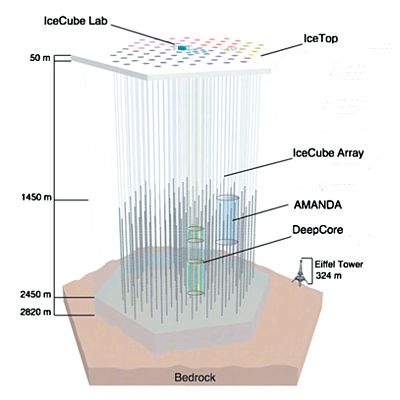
“Guess what?  You don’t know where the page came from, you don’t know where it’s going to end up.  But it could carry a tracking bug to tell someone at some call-home server when and where the page had been opened.  IceCube works the same way, sort of.  It has a huge 3D array of detectors to record particles coming in from any direction.  A neutrino can come from above, below, any side, no problem — the detectors it touches will signal its path.”

IceCube architecture
Adapted from a work by Francis Halzen, Department of Physics, University of Wisconsin

“How huge?”

“Vastly huge.  The instrument is basically a cubic kilometer of ultra-clear Antarctic ice that’s ages old.  The equivalent of the tracking bugs is 5000 sensors in a honeycomb array more than a kilometer wide.  Every hexagon vertex marks a vertical string of sensors going down 2½ kilometers into the ice.  Each string has a couple of sensors near the surface but the rest of them are deeper than 1½ kilometers.  The sensors are looking for flashes of light.  Keep track of which sensor registered a flash when and you know the path a particle took through the array.”

icecube event 3“Why should there be flashes? I thought neutrinos didn’t interact with matter.”

“Make that, they rarely interact with matter.  Even that depends on what particle the neutrino encounters and what flavor neutrino it happens to be at the moment.”

That gets both Al and me interested.  His “Neutrinos come in flavors?” overlaps my “At the moment?”

“I thought that would get you into this, Sy.  Early experiments detected only 1/3 of the neutrinos we expected to come from the Sun.  Unwinding all that was worth four Nobel prizes and counting.  The upshot’s that there are three different neutrino flavors and they mutate.  The experiments caught only one.”

Vinnie’s standing behind us.  “You’re going to tell us the flavors, right?”

“Hoy, Vinnie, Jeremy’s question was first, and it bears on the others.  Jeremy, you know that blue glow you see around water-cooled nuclear fuel rods?”

“Yeah, looks spooky.  That’s neutrinos?”

“No, that’s mostly electrons, but it could be other charged particles.  It has to do with exceeding the speed of light in the medium.”

“Hey, me and Sy talked about that.  A lightwave makes local electrons wiggle, and how fast the wiggles move forward can be different from how fast the wave group moves.  Einstein’s speed-of-light thing was about the wave group’s speed, right, Sy?”

“That’s right, Vinnie.”

“So anyhow, Jeremy, a moving charged particle affects the local electromagnetic field.  If the particle moves faster than the surrounding atoms can adjust, that generates light, a conical electromagnetic wave with a continuous spectrum.  The light’s called Cherenkov radiation and it’s mostly in the ultra-violet, but enough leaks down to the visible range that we see it as blue.”

“But you said it takes a charged particle.  Neutrinos aren’t charged.  So how do the flashes happen in IceCube?”

“Suppose an incoming high-energy neutrino transfers some of its momentum to a charged particle in the ice — flash!  Even better, the flash pattern provides information for distinguishing between the neutrino flavors.  Muon neutrinos generate a more sharp-edged Cherenkov cone than electron neutrinos do.  Taus are so short-lived that IceCube doesn’t even see them.”Leptons

“I suppose muon and tau are flavors?”

“Indeed, Vinnie.  Any subatomic reaction that releases an electron also emits an electron-flavored neutrino.  If the reaction releases the electron’s heavier cousin, a muon, then you get a muon-flavored neutrino.  Taus are even heavier  and they’ve got their own associated neutrino.”

“And they mutate?”

“In a particularly weird way.”

~~ Rich Olcott

Rhythm Method

A warm Summer day.  I’m under a shady tree by the lake, watching the geese and doing some math on Old Reliable.  Suddenly a text-message window opens up on its screen.  The header bar says 710-555-1701.  Old Reliable has never held a messaging app, that’s not what I use it for.  The whole thing doesn’t add up.  I type in, Hello?

Hello, Mr Moire.  Remember me?

Suddenly I do.  That sultry knowing stare, those pointed ears.  It’s been a yearHello, Ms Baird.  What can I do for you?

Another tip for you, Mr Moire.  One of my favorite star systems — the view as you approach it at near-lightspeed is so ... meaningful.  Your astronomers call it PSR J0337+1715.

So of course I head over to Al’s coffee shop after erasing everything but that astronomical designation.  As I hoped, Cathleen and a few of her astronomy students are on their mid-morning break.  Cathleen winces a little when she sees me coming.  “Now what, Sy?  You’re going to ask about blazars and neutrinos?”

I show her Old Reliable’s screen.  “Afraid not, Cathleen, I’ll have to save that for later.  I just got a message about this star system.  Recognize it?”

“Why, Sy, is that a clue or something?  And why is the lettering in orange?”

“Long story.  But what can you tell me about this star system?”

“Well, it’s probably one of the most compact multi-component systems we’re ever going to run across.  You know what compact objects are?”

“Sure.  When a star the size of our Sun exhausts most of its hydrogen fuel, gravity wins its battle against heat.  The star collapses down to a white dwarf, a Sun-full of mass packed into a planet-size body.  If the star’s a bit bigger it collapses even further, down to a neutron star just a few miles across.  The next step would be a black hole, but that’s not really a star, is it?”

“No, it’s not.  Jim, why not?”

“Because by definition a black hole doesn’t emit light.  A black hole’s accretion disk or polar jets might, but not the object itself.”

“Mm-hm.  Sy, your ‘object’ is actually three compact objects orbiting  around each other.  There’s a neutron star with a white dwarf going around it, and another white dwarf swinging around the pair of them.  Vivian, does that sound familiar?”

“That’s a three-body system, like the Moon going around the Earth and both going around the Sun.  Mmm, except really both white dwarfs would go around the neutron star because it’s heaviest and we can calculate the motion like we do the Solar System.”

“Not quite.  We can treat the Sun as motionless because it has 99% of the mass.  J0337+1715’s neutron star doesn’t dominate its system as much as the Sun does ours.  That outermost dwarf has 20% of its system’s mass.  Phil, what does that suggest to you?”

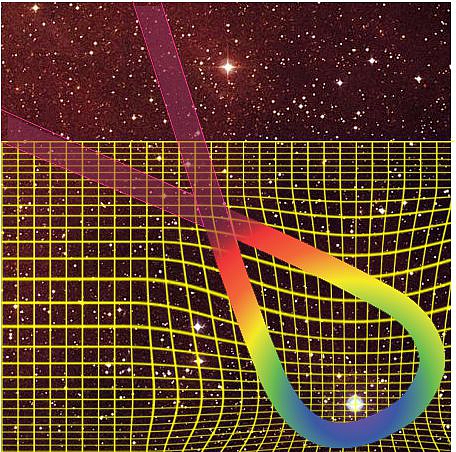
“It’d be like Pluto and Charon.  Charon’s got 10% of their combined mass and so Pluto and Charon both orbit a point 10% of the way out from Pluto.  From Earth we see Pluto wobbling side to side around that point.  So the neutron star must wobble around the point 20% outward towards the heavy dwarf.  Hey, star-wobble is how we find exoplanets.  Is that what this is about, Mr Moire?  Did someone measure its red-shift behavior?”PSR J0337+1715Cathleen saves me from answering.  “Not quite.  The study Sy’s chasing is actually a cute variation on red-shift measurements.  That ‘PSR‘ designation means the neutron star is a pulsar.  Those things emit electromagnetic radiation pulses with astounding precision, generally regular within a few dozen nanoseconds.  If we receive slowed-down pulses then the object’s going away; sped-up and it’s approaching, just like with red-shifting.  The researchers  derived orbital parameters for all three bodies from the between-pulse durations.  The heavy dwarf is 200 times further out than the light one, for instance.  Not an easy experiment, but it yielded an important result.”
My ears perk up.  “Which was…?”

“The gravitational force between the pulsar and each dwarf was within six parts per million of what Newton’s Laws prescribe.  That observation rules out whole classes of theories that tried to explain galaxies and galaxy clusters without invoking dark matter.”

Cool, huh?

Uh-huh.

~~ Rich Olcott

Gravity’s Real Rainbow

Some people are born to scones, some have scones thrust upon them.  As I stepped into his coffee shop this morning, Al was loading a fresh batch onto the rack.  “Hey, Sy, try one of these.”

“Uhh … not really my taste.  You got any cinnamon ones ready?”

“Not much for cheddar-habañero, huh?  I’m doing them for the hipster trade,” waving towards all the fedoras on the room.  “Here ya go.  Oh, Vinnie’s waiting for you.”

I navigated to the table bearing a pile of crumpled yellow paper, pulled up a chair.  “Morning, Vinnie, how’s the yellow writing tablet working out for you?”

“Better’n the paper napkins, but it’s nearly used up.”

“What problem are you working on now?”

“OK, I’m still on LIGO and still on that energy question I posed way back — how do I figure the energy of a photon when a gravitational wave hits it in a LIGO?  You had me flying that space shuttle to explain frames and such, but kept putting off photons.”

“Can’t argue with that, Vinnie, but there’s a reason.  Photons are different from atoms and such because they’ve got zero mass.  Not just nearly massless like neutrinos, but exactly zero.  So — do you remember Newton’s formula for momentum?”

“Yeah, momentum is mass times the velocity.”

“Right, so what’s the momentum of a photon?”

“Uhh, zero times speed-of-light.  But that’s still zero.”

“Yup.  But there’s lots of experimental data to show that photons do carry non-zero momentum.  Among other things, light shining on an an electrode in a vacuum tube knocks electrons out of it and lets an electric current flow through the tube.  Compton got his Nobel prize for that 1923 demonstration of the photoelectric effect, and Einstein got his for explaining it.”

“So then where’s the momentum come from and how do you figure it?”

“Where it comes from is a long heavy-math story, but calculating it is simple.  Remember those Greek letters for calculating waves?”

(starts a fresh sheet of note paper) “Uhh… this (writes λ) is lambda is wavelength and this (writes ν) is nu is cycles per second.”

“Vinnie, you never cease to impress.  OK, a photon’s momentum is proportional to its frequency.  Here’s the formula: p=h·ν/c.  If we plug in the E=h·ν equation we played with last week we get another equation for momentum, this one with no Greek in it:  p=E/c.  Would you suppose that E represents total energy, kinetic energy or potential energy?”

“Momentum’s all about movement, right, so I vote for kinetic energy.”

“Bingo.  How about gravity?”

“That’s potential energy ’cause it depends on where you’re comparing it to.”

light-in-a-gravity-well“OK, back when we started this whole conversation you began by telling me how you trade off gravitational potential energy for increased kinetic energy when you dive your airplane.  Walk us through how that’d work for a photon, OK?  Start with the photon’s inertial frame.”

“That’s easy.  The photon’s feeling no forces, not even gravitational, ’cause it’s just following the curves in space, right, so there’s no change in momentum so its kinetic energy is constant.  Your equation there says that it won’t see a change in frequency.  Wavelength, either, from the λ=c/ν equation ’cause in its frame there’s no space compression so the speed of light’s always the same.”

“Bravo!  Now, for our Earth-bound inertial frame…?”

“Lessee… OK, we see the photon dropping into a gravity well so it’s got to be losing gravitational potential energy.  That means its kinetic energy has to increase ’cause it’s not giving up energy to anything else.  Only way it can do that is to increase its momentum.  Your equation there says that means its frequency will increase.  Umm, or the local speed of light gets squinched which means the wavelength gets shorter.  Or both.  Anyway, that means we see the light get bluer?”

“Vinnie, we’ll make a physicist of you yet.  You’re absolutely right — looking from the outside at that beam of photons encountering a more intense gravity field we’d see a gravitational blue-shift.  When they leave the field, it’s a red-shift.”

“Keeping track of frames does make a difference.”

Al yelled over, “Like using tablet paper instead of paper napkins.”

~~ Rich Olcott