A Brief History of Atmospheres

miller-ureyLong ago in a far-away career, I taught a short-course about then-current theories on the origin of life.  The lab portion of the course centered on the 1952 Miller-Urey experiment the first demonstration that amino acids could be produced abiotically.

Imagine my surprise when I learned that Miller’s original lab apparatus is on exhibit at the Denver Museum of Nature and Science, where I volunteer now.

The diagram’s notes describe the basic experiment.  Load up the system with whatever gases you think might have been in the primeval atmosphere.  Start cooling water running through the condenser (double-wall tubing below the upper sphere) and gently heat the water sample you’ve put in the bottom sphere.  Vapors travel up the tube into the top sphere where there’s a spark arcing between two electrodes (the black lines at 45º).  Water vapor passing by sweeps any gas-spark reaction products back down to the bottom sphere.

Let the whole thing stew for a while (Miller ran his for a week, we let ours go for two), then draw off and analyze a sample of the solution in the bottom sphere.  In Stanley’s day his analytical techniques found 5 amino acids.  In 1971 (I think) we found (I think) 8 or 9.  More recent work-ups of Miller’s sealed original samples found 25, including all 20 considered essential to life.  So yeah, if you supply enough energy to a methane-ammonia-water system (Miller added hydrogen to that; we didn’t, for safety reasons) you can make the building blocks for proteins.

The experiment has been repeated probably thousands of times by different researchers in the last half-century.  Some replications were duplicates of Miller’s, some started with recipes derived from other theories about what Earth’s early atmosphere looked like.

And there’s the problem.  In Miller’s day we thought that Earth’s atmosphere was basically comet-tail concentrate.  That’d be mostly water vapor along with a couple of volatiles like methane and ammonia.  Later on we realized that much of our atmosphere is volcano belch — a hodgepodge of carbon dioxide, carbon monoxide, methane, hydrogen, sulfur gases, nitrogen, argon, helium, various acids, multiple kinds of rock dust….  Some of that is left-overs from Earth’s initial stages; some has been generated by subsequent geological processes like serpentinization, which can generate both methane and hydrogen.

If you’re running a Miller experiment you’re free to load the apparatus with whatever mixture you think other scientists might think is reasonable for an Earth on the verge of Biology.  No oxygen, though — the chemistry of ancient rocks rules out significant atmospheric O2 before about 3½ billion years ago.

Now the researchers are playing variations on the theme, asking whether conditions on (or within) Titan could also generate complex compounds that given a billion years could self-organize into anything we’d recognize as life.  So what did Titan’s atmosphere look like a few billion years ago?

That’s a toughie, because we don’t have on-the-ground (or out-of-the-ground) data like we have for Earth.  We’ll have to make do with theory, which starts with this chart.

solar_system_escape_velocity_vs_surface_temperature-svg
Molecular escape velocities

At any given temperature you can calculate the average energy per gas molecule (any kind of gas).  Combine that with the known mass of a specific kind of molecule and you can compute its speed.

On any given world you can calculate the minimum speed (the escape velocity) that an object (rocket, rock or gas molecule) needs to have in order to overcome the world’s gravitational pull.

The chart combines both calculations for some important molecules for worlds in the Solar System that have atmospheres.  For instance, Earth’s average temperature (give or take a few dozen degrees) is  300ºK=27ºC≈80ºF.  From the chart, hydrogen and helium should be able to (and do) leave our atmosphere quickly.  However, Earth’s gravity is sufficient to hold onto its original dowry of the heavier species.  By contrast, the four massive planets would have to warm up by hundreds of degrees before they lose even the light gases.

Sure enough, Titan’s atmosphere is mostly nitrogen.  The astronomers measure its methane and hydrogen content in parts per thousand but those concentrations aren’t the same going from top to bottom of Titan’s atmosphere.  Therein lies an intriguing tale, but it’ll have to wait for the next post.

~~ Rich Olcott

Fifty Shades of Ice

earth-vs-titan-sea

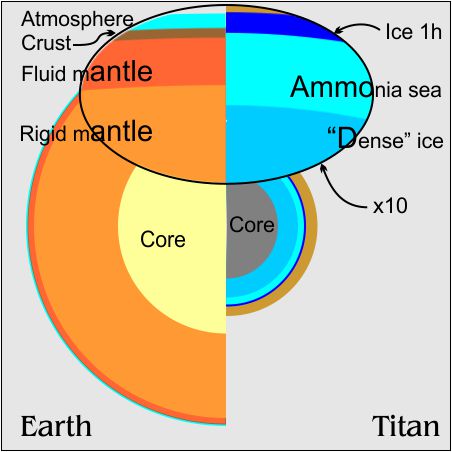
This week we dip a little deeper into Titan’s weirdness trove.  Check the diagram.  Two kinds of ice??!?  What’s that about?

diamond-and-ice
Carbon allotropes
and water polymorphs

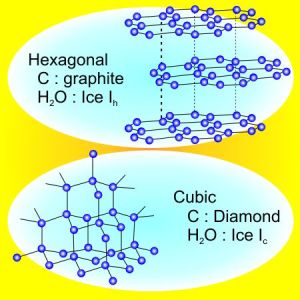
As everyone knows, diamonds and pencil lead (graphite, and I loved learning that graphite is an actual dug-from-the-ground mineral whose name came from the Greek verb “to write”) are both pure carbon, mostly.  Same atoms, just arranged differently.

Graphite‘s carbon atoms are laid out in sheets of hexagons.  Adjacent sheets are bonded together but not as strongly as are the atoms within each sheet.  Sheets can slide past each other, which is why we use graphite as a lubricant and why pencils can write and erasers can unwrite.

Diamond‘s atoms are also laid out in sheets of (rumpled) hexagons, but now the bonds between sheets are identical to the bonds within a sheet.  Turn your head sideways and you’ll see that sheets run vertical, too.  In fact, each carbon atom participates in four sheets, three vertical and one horizontal.  All that symmetrical bonding makes diamond one of the hardest substances we know of.

Neighboring carbon atoms form bonds by sharing electrons between their positive nuclei.  Neighboring water molecules (H2O) don’t share electrons but they do tend to line up with their somewhat positive hydrogen atoms pointing towards nearby somewhat negative oxygens.  That’s a loose rule in liquid water but it dominates when the molecules freeze into ice.

Most of the ice on Earth has an Ice-Ih structure, where the oxygen atoms are arranged in the same pattern as the carbons are in graphite.  Water’s hexagonal sheets aren’t quite flat, but the 6-fold symmetry gives us snowflakes.  There’s a hydrogen atom between each pair of oxygens, but it’s not half-way between.  Instead, each oxygen tightly holds its own two hydrogens while it pulls at further-away hydrogens owned by two neighboring oxygens.

But water molecules have other ways to arrange themselves.  A small fraction of Earth’s ice has a diamond-like Ice-Ic structure with each oxygen participating in four hexagon sheets.  Again, hydrogens are on the lines between them.

Water’s such a versatile molecule that it doesn’t stop with two polymorphs.  Ice scientists recognize seventeen distinct crystalline varieties, plus three where the molecules don’t line up neatly.  (None of them is Vonnegut’s “Ice-nine.”)  Each polymorph exists in a  unique temperature and pressure range; each has its own set of properties.  As you might expect, ices formed at high pressure are denser than liquid water.  Fortunately, Ice-Ih is lighter than water and so ice cubes and icebergs float.

As cold as Titan is and as high as the pressure must be under 180 miles of Ice-Ih and watery ammonia sea (even at 10% of Earth’s gravity), it’s quite likely* that there’s a thick layer of Ice-something around Titan’s rocky core.

clathratesThe primary reason we think Titan is so wet is that Titan’s density is about halfway between rock and water.  We know there are other light molecules on Titan — ammonia, methane, etc.  We don’t know how much of each.  Those compounds don’t have water’s complex phase behavior but many can dissolve in it.  That’s why that hypothetical “Ammonia sea” is in the top diagram.
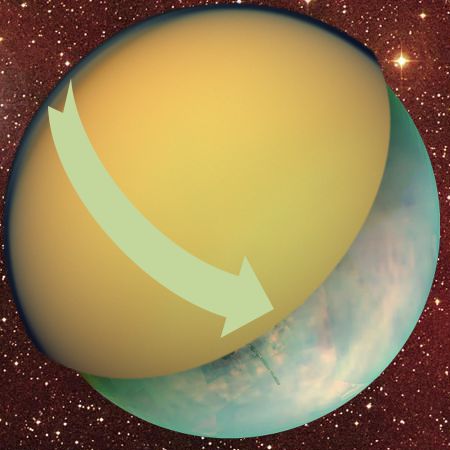
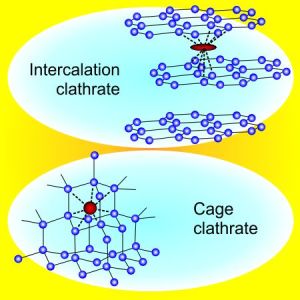
But wait, there’s more.  Both graphite and water ice are known to form complex polymorphs, clathrates, that host other molecules.  This diagram gives a hint of how that can happen.  Frozen water under pressure forms a large number of more-or-less ordered cage clathrate structures that can host  Titan’s molecular multitude.

At Titan’s temperatures ice rocks would be about as hard as granite.  Undoubtedly they’ll have surprising chemistry and interesting histories.  We can expect clathrate geology on Titan to be as complex as silicate geology is on Earth.

Geochemist heaven, except for the space suits.

~~ Rich Olcott

* – A caveat: we know a great deal about Earth’s structure because we live here and have been studying it scientifically for centuries. On the other hand, most of what we think we know about Titan’s interior comes from mathematical models based on gravitational observations from the Cassini mission, plus 350 photos relayed back from the Huygens lander, plus experiments in Earth-bound chemistry labs. Expect revisions on some of this stuff as we learn more.

The Titanic Winds of Titan (And Venus)

Last week we saw that the atmosphere of Saturn’s moon Titan wasn’t quite as weird as we thought.  But there another way it’s really weird, completely unlike Earth but yet very much like Venus.  Titan’s a superrotater, a world whose atmosphere circles the planet much faster than its surface does.

Let’s start with a relatively simple Earthside phenomenon, a hurricane.  Warm air rises, right?  When the warmth comes from bathtub-temperature sea-water, it’s wet warm air.  As the air rises it cools and releases the moisture as rain.  But the air can’t just keep rising forever or we’d squirt out all our atmosphere. So where does it go?

From a physicist’s perspective, that’s the key question.   If we can track/predict the path of a small parcel of air molecules through a weather system, then we’ve got at least a rough understanding of how that system works.

For the past half-century, atmosphere physicists have been engaged on a project grandly entitled the General Circulation Model (GCM), a software mash-up of the Ideal Gas Law, Newton’s Laws of motion, thermodynamic data for solid/liquid/gas transformations, the notoriously difficult Navier-Stokes equations for viscous fluids, and careful data management for input streams from thousands of disparate sources.  Oh, and it’s important that the Earth is a rotating spheroid rather than a flat plane.

hurricane-en-svg
How a tropical cyclone works
Illustration by Kevin Song, from Wikimedia Commons

Kevin Song’s diagram summarizes much of what we know about hurricanes.  An air packet rises until it hits the tropopause (the top edge of the troposphere), then expands horizontally.  While the packet’s spreading out, the planet’s rotation generates Coriolis “forces” that bend straight-line radial paths into the spirals we’ve seen so often in satellite photos.

A hurricane may look big on your weathercaster’s screen, but it’s less than 0.1% of Earth’s surface area.  Nonetheless, many of the same principles that drive a hurricane underlie global weather patterns.

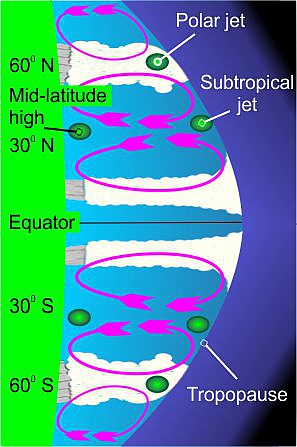
wind-cells-and-jets-2Air warmed by the equatorial Sun rises, only to sink as it heads poleward.  Our packet loops between the Equator and about 30ºN (see the diagram).

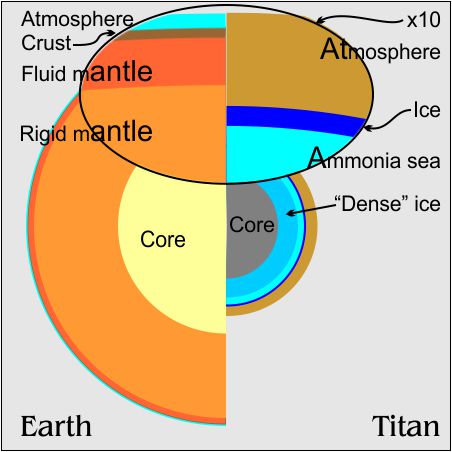
Actually that loop is a slice through a big doughnut that stretches all the way around the Earth.  Another doughnut lies southward just below the Equator.  Two more pairs of doughnuts reside polewards of those as indicated by the other arrows in the diagram.  The doughnuts act like a set of interlocking gears, each reinforcing and moderating the motion of its neighbors.

Thanks to the same geometric phenomenon that spins a hurricane, air packets in these doughnuts don’t loop back to the points they started from.  The Earth turns under the packets as they journey, so each packet takes a spiraling tour around the planet.

Because of all those doughnuts, on average Earth wears a set of cloud-top necklaces.  Regions within 15º of the Equator are rain-forested, as are the Canadian and Siberian forested belts near 60ºN.  The world’s most prominent deserts cluster beneath the dry downdrafts near the 30º latitudes.  Jupiter, “the Easter egg planet,” gets its pink and blue bands from similar doughnuts except that Jupiter has room for many more of them.

Those green circles in the diagram are important, too.  They also represent Earth-circling doughnuts, but ones whose winds flow parallel to Earth’s surface rather than perpendicular to it.  The ones close to the surface give rise to the trade winds.  The high-altitude ones are the jet streams that steer storm systems and give the weathercasters something to talk about, especially in the wintertime.

Jet streams flow briskly — 60 to 200 mph, on a par with a middling hurricane.  Here’s a benchmark: Earth’s equatorial circumference is 25,000 miles, so Ecuadorian palm trees circle the planet at (25000 miles/24 hours)=1041 mph.  Our jet streams go about 15% of that.  Theory and GCM agree that the jets are powered by the Coriolis effect — spiraling air packets in the primary donuts cooperate to push jet stream air packets like oars on a galley ship.  That adds up.

Titan and Venus can’t possibly work that way.  Both of them rotate much more slowly than Earth (Titan about 30 mph, Venus only 4), so Coriolis forces are negligible.  But Titan’s jet streams do 75 mph and Venus’ race at 185.  What powers them?  The physicists are still arguing.

~~ Rich Olcott

Titan’s Atmosphere Is A Gas

One year ago I kicked off these weekly posts with some speculations about how Life might exist on Saturn’s moon Titan. My surmises were based on reports from NASA’s Cassini-Huygens mission, plus some Physical Chemistry expectations for Titan’s frigid non-polar mix of liquid ethane and methane. Titan offers way more fun than that.

The environment on Titan is different from everything we’re used to on Earth. For instance, the atmosphere’s weird.earth-vx-titanTitan’s atmosphere is heavy-duty compared with Earth’s — 6 times deeper and about 1½ times the surface pressure. When I read those numbers I thought, “Huh? But Titan’s diameter is only 40% as big as Earth’s and its surface gravity is only 10% of ours. How come it’s got such a heavy atmosphere?”

Wait, what’s gravity got to do with air pressure? (I’m gonna use “air pressure” instead of “surface atmospheric pressure” because typing.) Earth-standard sea level air pressure is 14.7 pounds of force per square inch. That 14.7 pounds is the total weight of the air molecules above each square inch of surface, all the way out to space.

(Fortunately, air’s a hydraulic fluid so its pressure acts on sides as well as tops. Otherwise, a football’s shape would be even stranger than it is.)

Newton showed us that weight (force) is mass times the the acceleration of gravity. Gravity on Titan is 1/10 as strong as Earth’s, so an Earth-height column of air on Titan should weigh about 1½ pounds.

But Titan’s atmosphere (measured to the top of each stratosphere) goes out 6 times further than Earth’s. If we built out that square-inch column 6 times taller, it’d weigh only 9 pounds on Titan, well shy of the 22 pounds the Huygens lander measured. Where does the extra weight come from?

My first guess was, heavy molecules. If gas A has molecules that are twice as heavy as gas B’s, then a given volume of A would weigh twice as much as the same volume of B. An atmosphere composed of A will press down on a planet’s surface twice as hard as an atmosphere composed of B.

Good guess, but doesn’t apply. Earth’s atmosphere is 78% N2 (molecular weight 28) and 21% O2 (molecular weight 32) plus a teeny bit of a few other things. Their average molecular weight is about 29. Titan’s atmosphere is 98% N2 so its average molecular weight (28) is virtually equal to Earth’s. So no, those tarry brown molecules that block our view of Titan’s surface aren’t numerous enough to account for the high pressure.

My second guess is closer to the mark, I think. I remembered the Ideal Gas Law, the one that says, “pressure times volume equals the number of molecules times a constant times the absolute temperature.” In symbols, P·V=n·R·T.

Visualize one gas molecule, Fred, bouncing around in a cube sized to match the average volume per molecule, V/n=R·T/P. If Fred goes outside his cube in any direction he’s likely to bang into an adjacent molecule. If Fred has too much contact with his neighbors they’ll all stick together and become a liquid or solid.

The equation tells us that if the pressure doesn’t change, the size of Fred’s cube rises with the temperature. Just for grins I calculated the cube’s size for standard Earth conditions: (22.4 liters/mole)×(1 cubic meter/1000 liters)×(1 mole/6.02×1023 molecules)=37.2×10⁻²⁷ cubic meter/molecule. The cube root of that is the length of the cube’s edge — 3.3 nanometers, about 8.3 times Fred’s 0.40-nanometer diameter.

titan-boxes
Fred and neighbors

Earth-standard surface temperature is about 300°K (absolute temperatures are measured in Kelvins). Titan’s surface temperature is only 94°K. On Titan that cube-edge would be 8.3*(94/300)=2.6 times Fred’s diameter — if air pressure were Earth-standard.

But really Titan’s air pressure is 1.5 times higher because its column is so tall and contains so much gas. The additional pressure squeezes Fred’s cube-edge down to 2.6*(1/1.5)=1.8 times his diameter. Still room enough for Fred to feel well-separated from his neighbors and continue acting like a proper gas.

The primary reason Titan’s atmosphere is so dense is that it’s chilly up there. Also, there’s a lot of Freds.

~~ Rich Olcott

– For the technorati… The cube-root of the Van der Waals volume for N2. And yeah, I know I’m almost writing about Mean Free Path but I think the development’s simpler this way.

Squeezing past Newton’s infinity

One of the most powerful moments in musical theater — Philip Quast Quastin his Les Miz role of Inspector Javert, praising the stars for the steadfastness and reverence for law that they signify for him.  The performance is well worth a listen.

Javert’s certitude came from Newton’s sublimely reliable mechanics — the notion that every star’s and planet’s motion is controlled by a single law, F~(1/r2).  The law says that the attractive force between any pair of bodies is inversely proportional to the square of the distance between their centers.  But as Javert’s steel-clad resolve hid a fatal spark of mercy towards Jean Valjean, so Newton’s clockworks hold catastrophe at their axles.

Newton’s gravity law has a problem.  As the distance approaches zero, the predicted force approaches infinity.  The law demands that nearby objects accelerate relentlessly at each other to collide with infinite force, after which their combined mass attracts other objects.  In time, everything must collapse in a reverse of The Big Bang.

Victor Hugo wrote Les Misérables about 180 years after Newton published his Principia.  A decade before Hugo’s book, Professeur Édouard Roche (pronounced rōsh) solved at least part of Newton’s problem.

Roche realized that Newton had made an important but crucial simplification.  Early in the Principia, he’d proven that for many purposes you can treat an entire object as though all of its mass were concentrated at a single point (the “center of mass”).  But in real gravity problems every particle of one object exerts an attraction for every particle of the other.

That distinction makes no difference when the two objects are far apart.  However, when they’re close together there are actually two opposing forces in play:

  • gravity, which preferentially affects the closest particles, and
  • tension, which maintains the integrity of each structure.
contact_binary_1
Binary star pair demonstrating Roche lobes, image courtesy of Cronodon.com

Roche noted that the gravity fields of any pair of objects must overlap.  There will always be a point on the line between them where a particle will be tugged equally in either direction.  If two bodies are close and one or both are fluid (gases and plasmas are fluid in this sense), the tension force is a weak competitor.  The partner with the less intense gravity field will lose material across that bridge to the other partner. Binary star systems often evolve by draining rather than collision.

Now suppose both bodies are solid.  Tension’s game is much stronger.  Nonetheless, as they approach each other gravity will eventually start ripping chunks off of one or both objects.  The only question is the size of the chunks — friable materials like ices will probably yield small flakes, as opposed to larger lumps made from silicates and other rocky materials.  Roche described the final stage of the process, where the less-massive body shatters completely.  The famous rings of Saturn and the less famous rings of Neptune, Uranus and Jupiter all appear to have been formed by this mechanism.

Roche was even able to calculate how close the bodies need to be for that final stage to occur. The threshold, now called the Roche Limit, depends on the size and mass of each body. You can get more detail here.

Klingon3And then there’s spaghettification.  That’s a non-relativistic tidal phenomenon that occurs near an extremely dense body like a neutron star or a black hole.  Because these objects pack an enormous amount of mass into a very small volume, the force of gravity at a close-in point is significantly greater than the force just a little bit further out. Any object, say a Klingon Warbird that ignored peril markings on a space map (Klingons view warnings as personal challenges), would find itself stretched like a noodle between high gravity on the side near the black hole and lower gravity on the opposite side.  (In this cartoon, notice how the stretching doesn’t care which way the pin-wheeling ship is pointed.)

Nature abhors singularities.  Where a mathematical model like Newton’s gravity law predicts an infinity, Nature generally says, “You forgot something.”  Newton assumed that objects collide as coherent units.  Real bodies drain, crumble, or deform to slide together.  Look to the apparent singularities to find new physics.

~~ Rich Olcott

Bilayer membranes - Earth-standard and reversed

The basis for life on Titan — maybe

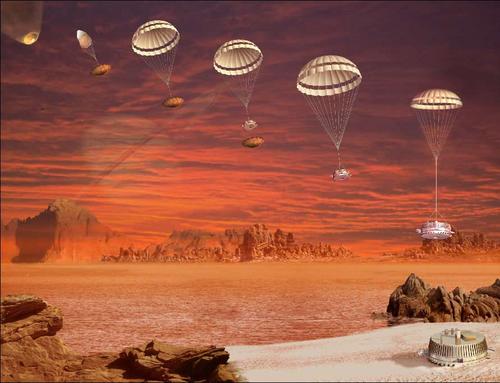
When the Huygens probe flashed us those images of lakes on Saturn’s moon Titan, people chattered that maybe there’s life in those hydrocarbon “waters.”

Huygens descending on Titan (image courtesy NASA/JPL-Caltech)

If there is life there, we might not even recognize it as such. Not just because of the frigid temperatures and other reasons laid out in en.wikipedia.org/wiki/Life_on_Titan, but for a couple of reasons having to do with the physical chemistry of solvents.

Water is a polar solvent, good at dissolving salts and other substances in which centers of positive and negative charge are in different parts of the molecule. Conversely, water molecules interact so strongly with each other that interspersed hydrocarbons and other non-polar molecules are forced away and out of solution. Hence the existence of oil slicks … and cell membranes.

Every kind of life on Earth, or at least everything that a biologist would be willing to call life, is composed of units whose integrity depends upon hydrocarbon moieties (molecules that contain significant amounts of hydrocarbon structure) being forced together in escape from a polar environment.

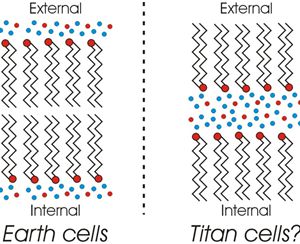
For bacteria and multi-cellular life forms, the boundary between interior and exterior is the cell membrane (see diagram), two layers of two-tailed molecules laid tail-to-tail with their non polar (black) hydrocarbon chains sandwiched between negative (red) polar groups that face out of and into the polar (red and blue) cell. Bilayer membranes - Earth-standard and reversedFurthermore, our cellular life also depends upon a whole collection of two-layer membranes that isolate different metabolic functions within the cell — respiration over here, protein construction over there, and so forth.

By some definitions we have smaller kinds of life, too: viruses and phages. Many viruses (e.g., herpes) have a non-polar fatty coating. Others make do with proteins to hide their DNA.  However, biochemistry tells us that these structural proteins are almost certainly held together in large part by patches of non-polar regions with precisely matching shapes.

However, Titan’s surface is dominated by a hydrocarbon solvent, a liquid mix of methane and ethane, that behaves very differently from water. Critically, hydrocarbon solvents do not dissolve water and other polar materials. The amino acids from which we build our proteins, the nucleic acids from which we build our RNA and DNA, even the carbohydrate groups from which plants build sugars and cellulose — all are essentially insoluble in hydrocarbons.

If lightning or some other process were to generate some nucleic acids in a Titan lake (as in the Miller-Urey experiment, see en.wikipedia.org/wiki/Miller_experiment), those molecules would immediately aggregate and fall as a sludgy solid onto the lake floor. There’d be no opportunity for those small molecules to interact with each other, much less find some amino acids to tie together to produce a protein. Life as we know it could not begin.

Well, how about a non-polar kind of life? The properties of hydrocarbon solvents permit two possibilities, both of which are very strange from an Earth-life perspective.

The easier one to visualize turns that double-layered cell membrane inside out. A Titanic cell membrane could be a sandwich with a layer of polar stuff between two non-polar layers. Given that structure, the cell’s internal non-polar metabolic processes could operate in isolation from the non-polar outside, just as our cell membranes isolate our watery internal cellular metabolism from our watery outside. A reversed cell membrane on a Titanic cell would wrap around some very interesting biochemistry.

But things could be even stranger. All hydrocarbons can intermix in all proportions with all hydrocarbons. That’s why petroleum crude is such a complex mix, and why different crudes break out differently at the refinery.  Any non-polar molecule can slide in between any other hydrocarbon molecules with very little effort.  On Titan, then, non-polar materials can diffuse freely throughout those ethane seas.

Moreover, liquid hydrocarbons have very low surface tension compared to water.  At the surface of a pool or droplet of water, those H2O molecules cling to each other so tightly that another object must exert force to get between them and into the bulk liquid.  The threshold force, measured by the surface tension, is so high for water that pond skaters and similar bugs can live their lives on a pond rather than in it.  In contrast, surface tension for a liquid hydrocarbon is only one-third that of water.

What’s important here is that surface tension is the force that works to minimize the surface to-volume ratio of a blob of liquid.  The form with the smallest possible ratio is a sphere.  Sure enough, small droplets of water are spherical.  Hydrocarbon fluids, with their much lower surface tension, tend to accept looser forms.  Water on a tarry surface beads up; oil on a wet surface spreads out.  Scientists think that water’s powerful sphere forming propensity was crucial in creating proto-cells during Earth-life’s early stages.

Suppose that Titan’s hydrocarbon life doesn’t depend on nearly-spherical cells.  Maybe Titan life has no cell boundary as we know it. Titan’s “biology” could be one titanic (in both senses) “cell” with different metabolic processes isolated by geography rather than by membranes the way Earth life does it.

Maybe the lakes closest to Titan’s equator generate long-chain hydrocarbons.  Maybe another set of lakes links those molecules to form complex benzenes and graphenes that catalyze reactions in still other lakes.

Maybe Titan’s rivers and streams carry information the way our nerve cells do.

Maybe Titan thinks.

I wonder what Titan thought of the Huygens probe.

~~ Rich Olcott