Al was carrying his coffee pot past our table. “Refills? Hey, I heard you guys talking about Tabby’s Star. Have you seen the latest?”
“Ohmigawd, there’s more?”
“Yeah, Cathleen. They’ve finally found something that’s periodic.”
“Catch us up, Al. Cathleen said that the dimmings are irregular.”
“They’ve been, Sy. But remember Cathleen’s chart that showed big dips in 2011 and 2013, about 750 days apart? Well, guess what?”
“They’ve seen more dips at 750-day intervals, in 2015 and 2017.”
“Well, not quite. Nobody was looking in 2015. But Kickstarter funding let the team buy observing time in 2017. A dip came in right on schedule. Here’s the picture. [shows smartphone around]”
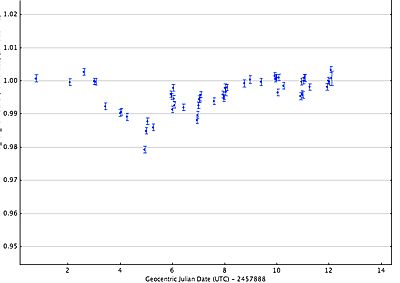
14-28 May 2017
Image from Dr Boyajian’s blog
Cathleen snorted. “Damn shame we need crowd-funding to support Science these days.”
“True,” I agreed, “but the good news is that the support is there. Suddenly you’re scribbling on the back of that envelope. So what does this chart tell us?”
“I’m sure every astronomer out there will tell you, ‘It’s too soon to say anything for sure.‘ This is raw data, which means it’s hasn’t gone through the usual clean-up process to account for instrumental issues, long-term trending, things like that. The timing is great, though. The bottom of this dip is at 18May2017. The first dip bottomed out 2267 days earlier on 4March2011. Counting the 2015 case that no-one saw, there’d be three intervals from first to most recent. 2267÷3 makes the average 756 days. Add 756 to the first date and we’re at 28Mar2013, right in the midst of that year’s complex mess. It does fit together.”
“So whatever’s causing it has a 756-day orbit?”
“Could be. I know your next question. If the eclipsing material were in our Solar System, it’d be a bit outside the 687-day orbit of Mars. But we’ve already ruled out causes near our solar system. Tabby’s Star is about 1½ times our Sun’s mass. That 756-day orbit around Tabby, if it is one, is maybe 30% wider than the orbit of Mars. But.”
[both] “But?”
“But the dip profiles don’t match up from one cycle to the next. This dip’s only 2% or so, a tenth of the ones in 2011 and 2013. Of course, the 2013 event spanned multiple dips so Heaven knows which one we should match to. Even 2011 and 2017 don’t look the same. The usual quick-and-dirty way to compare dips is to pair up widths at half depth. That statistic for 2011 is about a day. This one is twice that or more. If the absorber is orbiting the star, it’s changing shape and can’t be a planet.”
“So what do we got, Sy?”
“Damifino, Al. Everything Cathleen just told us points to something like an enormous comet loaded with loose rocks that go flying along random paths away from the star.”
“Sorry, Sy, the infrared data rules out the comet dust that would have to be spewed out along with the rocks. Besides, someone calculated just how much rocky material would be required to reproduce the dimming we’ve seen already. You’d need a ‘comet’ somewhere between Earth-size and Jupiter-size, and maybe more than one, and with that much mass the rocks wouldn’t fly apart very well. Oh, and there’s that long-term fading, which the comet idea doesn’t account for.”
“So we’re down to…”
[sigh] “The explanation of last resort, which astronomers are very reluctant to talk about because journalists tend to go overboard. Maybe, just maybe, we’re witnessing an advanced civilization at work, constructing a Dyson sphere around a star 1500 light years away. People have talked about such things for decades. Think about it — the Sun sends out light in all directions. Earth intercepts only a billionth of that. If we could completely surround the Sun with solar panels we’d have access to a billion times more energy than if we covered our own planet with panels. Better yet, it’s all renewable and producing 24 hours a day. But even with advanced technology, panels around Tabby’s Star would still radiate in the infrared and we don’t see that.”
My smartphone chirped that same odd ringtone and it was that same odd number, 710-555-1701. “Hello, Ms Baird.”
“The Universe is not only stranger than you imagine, Mr Moire, it’s stranger than you can imagine.”
~~ Rich Olcott

 “You’ll have to unravel that for me.”

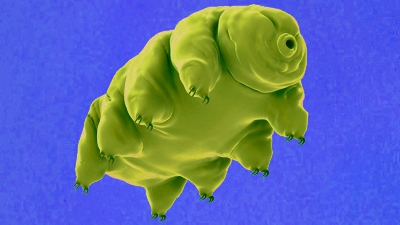 “If they’re so small, why are they called bears?”
 “Yup, and that’s one way astronomers can classify planets. Earth’s in the Goldilocks Zone for liquid water, essential for life as we know it. Saturn’s moon Titan might support some other kind of life in its
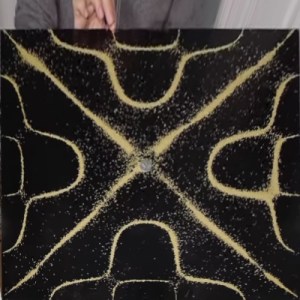
 The underlying physics is straightforward. The string produces a stable tone only if its motion has nodes at both ends, which means the vibration has to have a whole number of nodes, which means you have to pluck halfway between two of the nodes you want. If you pluck it someplace like 39¼:264.77 then you excite a whole lot of frequencies that fight each other and die out quickly.
 Add a few more planets in a random configuration and stability goes out the window — but then something interesting happens. It’s
 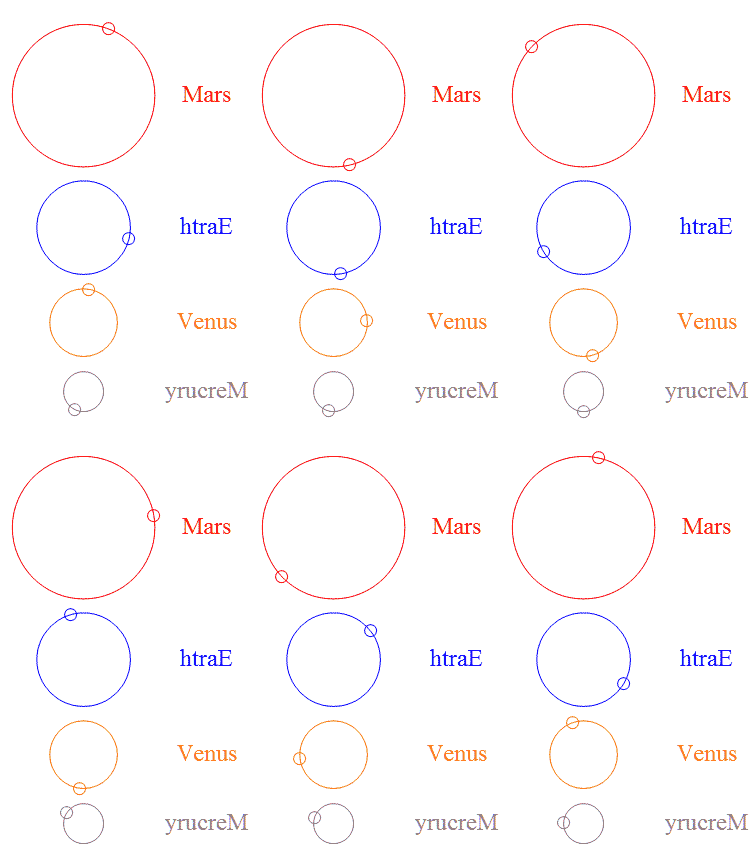 The usual rings-around-the-Sun diagram doesn’t show the specialness of the orbits we’ve got. This chart shows the four innermost planets in their “ideal” orbits, properly scaled and with approximately the right phases. I used artistic license to emphasize the gear-like action by reversing Earth’s and Mercury’s direction. Earth and Mars are never near each other, nor are Earth and Venus.



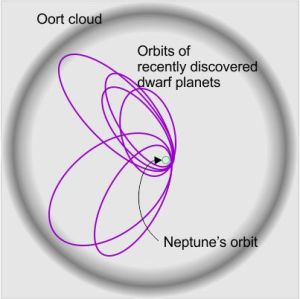


 This video, from an Orbits Table display at the Denver Museum of Nature and Science, shows a different Plutonian weirdness. We’re circling the Solar System at about 50 times Earth’s distance from the Sun (50 AU). Reading inward, the white lines represent the orbits of Neptune, Uranus, Saturn and Jupiter. The Asteroid Belt is the small greenish ring close to the Sun. The four terrestrial planets are even further in. The Kuiper Belt is the greenish ring that encloses the lot.
 Before you get any further in this post, follow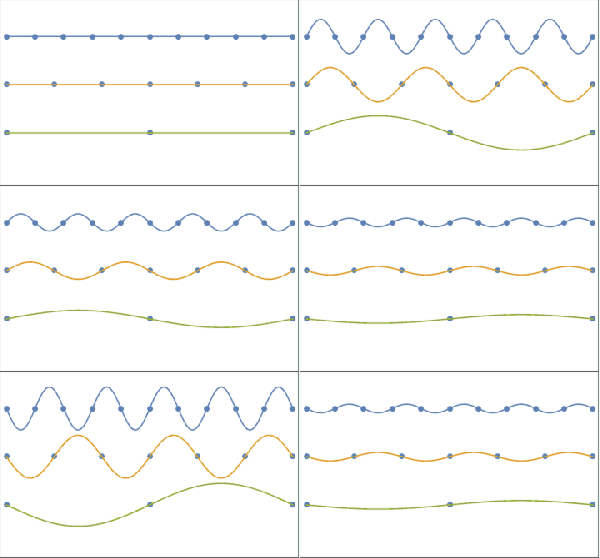
 This photo, part of the LAMP exhibit at the Denver Museum of Nature and Science, shows why. It’s a model of a cratered Moon lit by sunlight.