Yardsticks

“Hi, Cathleen, meet Mr Richard Feder, of Fort Lee NJ. He’s got a question that’s more in your Astronomy bailiwick than mine. Have a strawberry scone.”

“Mmm, still warm from Al’s oven. Thanks, Sy. Hello and what’s your question, Mr Feder?”

“Hiya. So if the James Webb Space Telescope is gonna be a million miles behind the Moon, won’t the Moon block its signals to us?”

“Oh dear, he said ‘miles.’ Sy, you’d better get out Old Reliable to look up numbers and do unit conversions. Mr Feder, I don’t think in miles.”

“Huh? What do you use instead, like paces or something?”

“Depends on what objects I’m considering and why I’m thinking about them. There are so many useful ratios out there it’s often easier to use ratios than huge numbers one can’t wrap one’s head around. Jupiter’s radius, for instance, is eleven times Earth’s, and the Sun is ten times wider still. Diameter and circumference follow the same ratios, of course. Square those ratios for relative surface area, cube them for relative volume. Who needs miles or kilometers?”

“Those numbers right, Moire?”

“Mmm … 6371 kilometers or 3959 miles for Earth, 71492 kilometers or 42441 miles for Jupiter, 695700 kilometers or 432300 miles for the Sun. The Jupiter/Earth ratio’s 11.2, the Sun/Jupiter ratio’s 9.73. The lady knows what she’s talking about.”

“Here’s a few fun factoids. The Moon’s distance is 10 times Earth’s Equator which is 100 times the International Space Station’s altitude. For that matter, if you wrapped a string around Earth’s Equator, it’d be just long enough to reach up to a GPS satellite and back. But all those are near‑Earth measurements where it makes sense to think in miles or kilometers. That’s too cumbersome for the bigger picture.”

“What else you got?”

“Within the Solar System I generally use one or the other of two convenient yardsticks. They measure the same distances, of course, but they have different applications. One is the nominal radius of Earth’s orbit, about 150 million kilometers.’

“That’s 93 million miles, Mr Feder.”

“I knew that one, Moire.”

“Anyway, we call that distance an Astronomical Unit. It’s handy for locating bodies relative to the Sun. Parker Solar Probe has gotten within a tenth of an AU of the Sun, for instance, and Neptune’s about 30 AU out. The Oort Cloud begins near 2000 AU and may extend a hundred times as far.”

“I ain’t even gonna ask what the Oort‐thing is, but I’m glad it’s a long way away.”

“We think it’s where long‑period comets come from.”

“Far away is good then. So what’s your other yardstick?”

“Lightspeed.”

“186 thousand miles per second, Mr Feder.”

“Yeah, yeah.”

“It’s also 300 thousand kilometers per second, and one light‑second per second, and one light‑year per year. Within the Solar System my benchmarks are that Earth is 500 light-seconds from the Sun, and Pluto was 4½ light-hours away from us when New Horizons sent back those marvelous images. The Sun’s nearest star system, Alpha Centauri, is 4⅓ light‑years away, and when you compare hours to years that gives you an idea of how small we are on the interstellar scale.”

“Cathleen, when you mentioned New Horizons that reminded me of the JWST. We’ve gotten off the track from Mr Feder’s question. Why isn’t the Moon going to block those signals?”

“Because it’ll never be in the way.” <sketching on a paper napkin> “There’s a bunch of moving parts here so hold on. The Earth orbits the Sun and the Moon orbits the Earth once a month, right? The L2 point doesn’t orbit the Earth. It orbits the Sun, staying exactly behind Earth so yeah, once a month the Moon could maybe get between Earth and L2. But JWST won’t be at L2, it’ll be in a wide orbit around that point and mostly perpendicular to the orbits of the Earth and Moon.”

“How wide?”

“It’ll vary depending on what they need, but it’s big enough to keep the spacecraft’s solar panels in the sunlight.”

“Solar panels? I thought the IR sensors needed cold cold cold.”

“They do. JWST protects its cold side with a hot side featuring a pretty pink Kapton parasol.”

~~ Rich Olcott

Hyperbolas But Not Hyperbole

Minus? Where did that come from?”

<Gentle reader — If that question looks unfamiliar, please read the preceding post before this one.>

Jim’s still at the Open Mic. “A clever application of hyperbolic geometry.” Now several of Jeremy’s groupies are looking upset. “OK, I’ll step back a bit. Jeremy, suppose your telescope captures a side view of a 1000‑meter spaceship but it’s moving at 99% of lightspeed relative to you. The Lorentz factor for that velocity is 7.09. What will its length look like to you?”

“Lorentz contracts lengths so the ship’s kilometer appears to be shorter by that 7.09 factor so from here it’d look about … 140 meters long.”

“Nice, How about the clocks on that spaceship?”

“I’d see their seconds appear to lengthen by that same 7.09 factor.”

“So if I multiplied the space contraction by the time dilation to get a spacetime hypervolume—”

“You’d get what you would have gotten with the spaceship standing still. The contraction and dilation factors cancel out.”

“How about if the spaceship went even faster, say 99.999% of lightspeed?”

“The Lorentz factor gets bigger but the arithmetic for contraction and dilation still cancels. The hypervolume you defined is always gonna be just the product of the ship’s rest length and rest clock rate.”

His groupies go “Oooo.”

One of the groupies pipes up. “Wait, the product of x and y is a constant — that’s a hyperbola!”

“Bingo. Do you remember any other equations associated with hyperbolas?”

“Umm… Yes, x2–y2 equals a constant. That’s the same shape as the other one, of course, just rotated down so it cuts the x-axis vertically.”

Jeremy goes “Oooo.”

Jim draws hyperbolas and a circle on the whiteboard. That sets thoughts popping out all through the crowd. Maybe‑an‑Art‑major blurts into the general rumble. “Oh, ‘plus‘ locks x and y inside the constant so you get a circle boundary, but ‘minus‘ lets x get as big as it wants so long as y lags behind!”

Another conversation – “Wait, can xy=constant and x2–y2=constant both be right?”
  ”Sure, they’re different constants. Both equations are true where the red and blue lines cross.”

A physics student gets quizzical. “Jim, was this Minkowski’s idea, or Einstein’s?”

“That’s a darned good question, Paul. Minkowski was sole author of the paper that introduced spacetime and defined the interval, but he published it a year after Einstein’s 1905 Special Relativity paper highlighted the Lorentz transformations. I haven’t researched the history, but my money would be on Einstein intuitively connecting constant hypervolumes to hyperbolic geometry. He’d probably check his ideas with his mentor Minkowski, who was on the same trail but graciously framed his detailed write‑up to be in support of Einstein’s work.”

One of the astronomy students sniffs. “Wait, different observers see the same s2=(ct)2d2 interval between two events? I suppose there’s algebra to prove that.”

“There is.”

“That’s all very nice in a geometric sort of way, but what does s2 mean and why should we care whether or not it’s constant?”

“Fair questions, Vera. Mmm … you probably care that intervals set limits on what astronomers see. Here’s a Minkowski map of the Universe. We’re in the center because naturally. Time runs upwards, space runs outwards and if you can imagine that as a hypersphere, go for it. Light can’t get to us from the gray areas. The red lines, they’re really a hypercone, mark where s2=0.”

From the back of the room — “A zero interval?”

“Sure. A zero interval means that the distance between two events exactly equals lightspeed times light’s travel time between those events. Which means if you’re surfing a lightwave between two events, you’re on an interval with zero measure. Let’s label Vera’s telescope session tonight as event A and her target event is B. If the A–B interval’s ct difference is greater then its d difference then she can see Bif the event is in our past but not beyond the Cosmic Microwave Background. But if a Dominion fleet battle is approaching us through subspace from that black dot, we’ll have no possible warning before they’re on us.”

Everyone goes “Oooo.”

~~ Rich Olcott

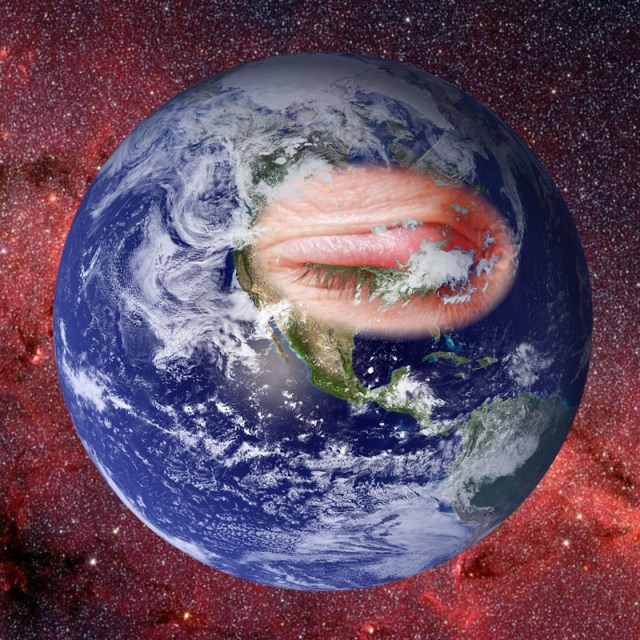
Earth’s Closed Eye

Question in the chat box, Maria, and I paraphrase to preserve anonymity — ‘So the Arecibo telescope won’t work any more. Why should we care? There’s lots of other telescopes that could so the same job.‘”

“But profesora, there aren’t. Arecibo is special in many ways. First, it is a very good telescope. That means it has high sensitivity and high resolution. Compare two radio telescopes with different‑size dishes and the same kinds of antennas and everything else. The one with the bigger dish is more sensitive because it can capture more photons. Arecibo’s 300‑meter dish used to be the largest in the world. China activated their FAST instrument five years ago. Its 500‑meter dish should make it more than 200 times as sensitive as Arecibo, but it doesn’t because neither telescope is designed to use the entire dish surface at once except for looking straight up. Their active areas are about the same.”

Is FAST another one of those goofy acronyms?

“Of course. It stands for ‘Five‑hundred‑meter Aperture Spherical radio Telescope‘ but in Chinese its name is Tianyan, which means ‘Heaven Eye.’ I think that is more pretty. FAST and Arecibo overlap their wavelength ranges, although FAST can receive some longer wavelengths and Arecibo can receive some shorter ones. Oh, there is also a big Russian radio telescope, RATAN‑600, with an even bigger diameter. But it is a ring, not a disk, so not as sensitive as Arecibo or FAST.”

A ring? Why did they build it that way?

“Because of the other thing you need in a good telescope, resolution. If you have good resolution in an image, you can see points that are very close together. The how‑close limit angle comes from dividing the light wavelength by the dish diameter. The diameter of RATAN’s ring is 600 meters, so RATAN’s resolving power is twice as good as Arecibo’s 300‑meter disk. RATAN doesn’t need to be sensitive, though, because it is used mostly for looking close at the Sun, not at stars and galaxies. That is OK because RATAN is so far north.”

What difference does that make?

“No telescope can see what is below its horizon. RATAN is at 43° north, almost 1400 miles north of Arecibo. It has a good view of the northern sky but cannot see down to the Equator where many asteroids and all the planets are.”

Sorry, Maria, that’s not quite correct. Earth is tilted relative to the orbital plane by 23° so even Arecibo only sees the northern portion of planetary orbits. While I’ve got the mic I’ll add some background on RATAN‑600. RATAN is the acronym for ‘Academy of Sciences Radio Telescope’ in Russian. It was built in the Cold War era when that part of the world was the USSR. Although I don’t believe it’s ever been publicly confirmed, many people think that RATAN‑600‘s original purpose was detection of ICBMs coming in over the North Pole. However, over the decades it has been a productive source of information for the solar physics community. Back to you, Maria.

“That is good to know, profesora. Thank you. So, Arecibo is — was —special because of its sensitivity and its resolution. It is also about 500 miles further south than FAST. But Arecibo has one additional feature that FAST cannot have — radar. Arecibo has high-powered transmitters that can send out terawatt pulses to things in the Solar System that are closer than Saturn. The dish gathers echoes that give us detailed knowledge of those objects. For instance, Arecibo’s radar echoes from Mercury showed us that the planet is not tidally locked to the Sun. We used to think Mercury’s day was 88 days long, like its year, but now we know it rotates in only 59 days.”

Why can’t the Chinese just add transmitters to FAST?

“The Chinese designers gave FAST a light‑weight antenna carriage to hang over its dish. Arecibo’s 900‑ton carriage can handle massive transmitters, but FAST’s cannot. There is one other radio telescope with radar, at Goldstone, California, but it has less than one‑millionth the power of Arecibo’s transmitters. Without Arecibo’s sensitivity, resolution, location and high-powered radar capability we cannot find near‑Earth asteroids on track to hit us.”

~~ Rich Olcott

Author’s note — Early in the morning of 1 December, after I completed last week’s and this post, the National Science Foundation reported that Arecibo’s central instrument platform has fallen onto the dish as a result of further cable failures.
“Vale, nostri servi boni et fidelis”
Farewell, our good and faithful servant.

Arecibo ¡que lástima!

Hello, Astronomy video class. I’ve made room in the syllabus schedule for a quick talk from someone with a personal connection to a timely topic. You may know we’ve lost one of Astronomy’s premier radio telescopes, Puerto Rico’s Arecibo Observatory. I’ve asked Maria to fill us in on the what and the why. If you have a question, type it into your chat window and I’ll relay it to her. Maria, you’re on.”

“Thank you, profesora. Yes, I do know Arecibo because I have worked there. I grew up in Hatillo, a small city on the north coast about half an hour away from the Observatory. My teacher of science in high school, somehow he got me a summer job there. Sometimes I worked in the gift shop, sometimes I helped the guided tours, but my best thing was running errands because then I could visit the science offices and chat with people about what they were doing. There I fell in love with Astronomy and that is why I came here to study.

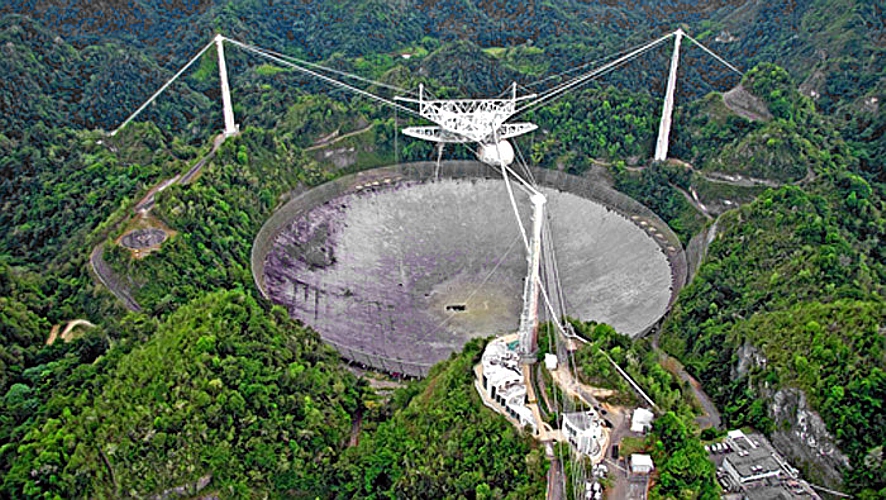
“When people think of Arecibo they think of the big 300 meter dish, about 1000 feet across. Sharing my screen for you… there. This picture I got from Wikipedia:

The Arecibo Observatory
photo by JidoBG, licensed under the Creative Commons Attribution-Share Alike 4.0 International

“The installation sits in very rough mountains. They are so rough because they are mostly limestone that slowly dissolves in water. The water seeps in through cracks to attack the rock and make cliffs and holes and caves. The Arecibo observatory is where it is because water eroded a cavern close to the surface. The topmost material fell into the empty space to make a huge round sinkhole like very few other places in the world.”

Question from the chat, Maria. Did the rock actually dissolve into that convenient smooth reflector shape?

“¡Por Dios no! The circular shape, yes, but the sinkhole floor is nearly flat. The dish itself is many aluminum panels fixed to a floating steel grid. Here is a picture Mr Phil Perillat took from beneath the dish. I don’t know Mr Perillat’s title but he is always very busy keeping things running.

“Above you see the grid, five meters or more above the ground. The grid is supported by concrete all around the edges. Coming down from the grid you see cables leading to those round concrete piers. These cables pull the grid down into its curved shape which is actually a piece of a sphere.”

A sphere, not a parabola?

“No, profesora, and that is important. A fixed dish with a parabola shape like most telescope mirrors always would aim straight up. It would see targets at the top of the sky but for only a few minutes as the Earth turns through the day. With a sphere‑shaped dish and the antennas mounted where the center of the sphere would be, then the whole sky is in focus. The scientists aim the telescope by moving the antennas to point at different parts of the dish like you look at different parts of one of those funny mirrors in, sorry I don’t know the word, una casa de la diversión.”

A funhouse.”

“Thank you. The antenna carriage is so complicated because it must look at different parts of the dish. Here you see the carriage:

The Arecibo receiver mounting and dome
Photo by Phil Perillat, National Astronomy and Ionosphere Center

“The antennas point downward from inside that dome. When motors swing the dome along that crescent‑shaped arc, the antennas scan along an arc of the dish. More motors can rotate the arc around that circular track. By swinging and rotating together, the antennas can follow the reflection of any object that moves through the sky.”

All those motors and tracks and antennas must be heavy.”

“Yes, 900 tons hanging 500 feet above the grid. Eighteen cables hold it up. Each is many strands of steel braided together. Compressed air blows through the braids to prevent corrosion, but the storms won out in the end. Three cables have failed and it is too dangerous for repair. So sad.”

~~ Rich Olcott

Author’s note — Early in the morning of 1 December, after I completed this and next week’s posts, the National Science Foundation reported that Arecibo’s central instrument platform had fallen onto the dish as a result of further cable failures.
“Vale, nostri servi boni et fidelis”
Farewell, our good and faithful servant.

Zeroing In on Water

<chirp, chirp> “Moire here.”

“Hi, Sy, it’s me, Vinnie. I just heard this news story about finding water on the Moon. I thought we did that ten years ago. You even wrote about it.”

“The internet never forgets, does it? That post wasn’t quite right but it wasn’t wrong, either.”

“How can it be both?”

“There’s an old line in Science — ‘Your data’s fine but your conclusions are … nuts.’ They use a different word in private. Suppose you land on a desert island and find a pirate’s treasure chest. Should the headlines say you’d found a treasure?”

“Naw, the chest might be empty or full of rocks or something.”

“Mm-hm. So, going back to that post… I was working from some reports on NASA’s Lunar Reconnaissance Orbiter. Its LAMP instrument mapped how strongly different Moon features reflected a particular frequency of ultraviolet light. That frequency’s called ‘Lyman‑alpha.’ Astronomers care about it because it’s part of starlight, it’s reflected by rock, and it’s specifically absorbed by hydrogen atoms. Sure enough, LAMP found some places, typically in deepshadow craters, that absorbed a lot more Lymanalpha than other places.”

“And you wrote about how hydrogen atoms are in water molecules and the Moon’s deep crater floors near the poles are sheltered from sunlight that’d break up water molecules so LAMP’s dark spots are where there’s water. And you liked how using starlight to find water on the Moon was poetical.”

“Uhh… right. All that made a lot of sense at the time and it still might be true. Scientists leapt to the same hopeful conclusion when interpreting data from the MESSENGER mission to Mercury. That one used a neutron spectrometer to map emissions from hydrogen atoms interacting with incoming cosmic rays. There again, the instrument identified hydrogen collected in shaded craters at the planet’s poles. Two different detection methods giving the same positive indication at the same type of sheltered location. The agreement seemed to settle the matter. The problem is that water isn’t geology’s only way or even its primary way to accumulate hydrogen atoms.”

“What else could it be? Hydrogen ions in the solar wind grab oxide ions from Moon rock and you’ve got water, right?”

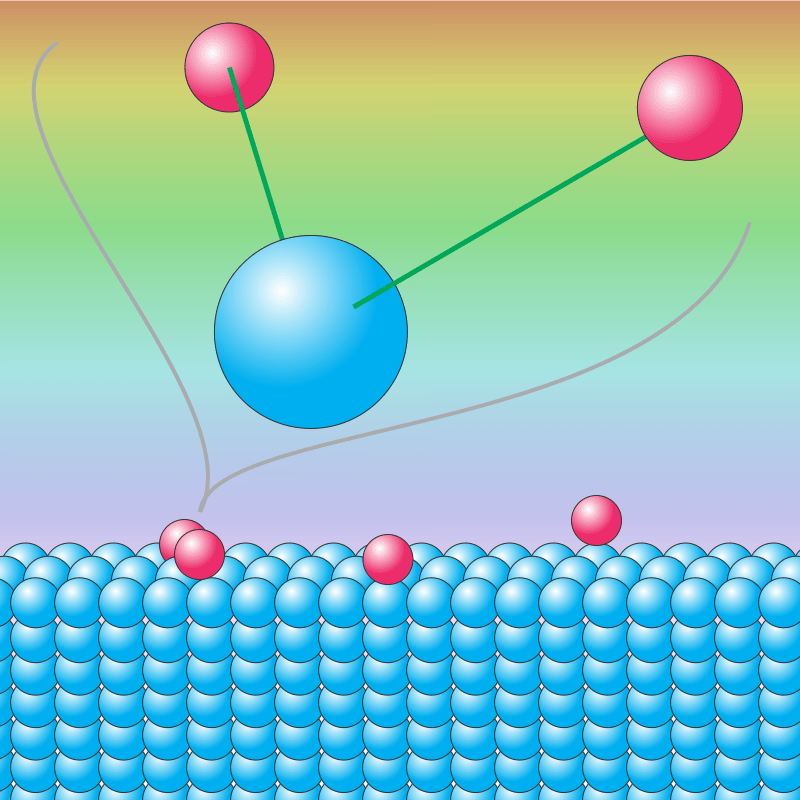
“But the hydrogens arrive one at a time, not in pairs. Any conversion would have to be at least a two‑step process. The Moon’s surface rocks are mostly silicate minerals. They’re a lattice of negative oxide ions that’s decorated inside with an assortment of positive metal ions. The first step in the conversion would be for one hydrogen ion to link up with a surface oxide to make a hydroxide ion. That species has a minus‑one charge instead of oxide’s minus‑two so it’s a bit less tightly bound to its neighboring metal ions. Got that?”

“Gimme a sec … OK, keep going.”

“Some time later, maybe a century maybe an eon, another hydrogen ion comes close enough to attack our surface hydroxide if it hasn’t been blasted apart by solar UV light. Then you get a water molecule. On balance and looking back, we’d expect most of the surface hydrogen to be hydroxide ions, not water, but both kinds would persist better in shadowed areas.”

“OK, two kinds of hydrogen. But how do we tell the difference?”

“We evaluate processes at lower‑energies. Lyman‑alpha photons pack over 10 electronvolts of energy, enough to seriously disturb an atom and blow a molecule apart. O‑H and H‑O‑H interact differently with light in the infra‑red range that just jiggles molecules instead of bopping them. For instance, atom pairs can stretch in‑out. Different kinds of atom bind together more‑or‑less tightly. That means each kind of atom pair resonates at its own stretch energy, generally around 6 microns or 0.41 electronvolts. NASA’s Cassini mission had a mapping spectrometer that could see down into that range. It found O‑H stretching activity all over the Moon’s surface.”

“But that could be either hydroxyls or water.”

“Exactly. The new news is that sensors aboard NASA’s airborne SOFIA mission map light even deeper into the infra‑red. It found the 3‑micron, 0.21‑electronvolt signal for water’s V‑shape scissors motion. That’s the water that everybody’s excited about.”

“Lots of it?”

“Thinly spread, probably, but stay tuned.”

~~ Rich Olcott

Presbyopic Astronomy

Her phone call done, Cathleen returns to the Spitzer Memorial Symposium microphone with her face all happiness. “Good news! Jim, the grant came through. Your computer time and telescope access are funded. Woo-hoo!!”

<applause across the audience and Jim grins and blushes>

Cathleen still owns the mic. “So I need to finish up this overview of Spitzer highlights. Where was I?”

Maybe-an-Art-major tries to help. “The middle ground of our Universe.”

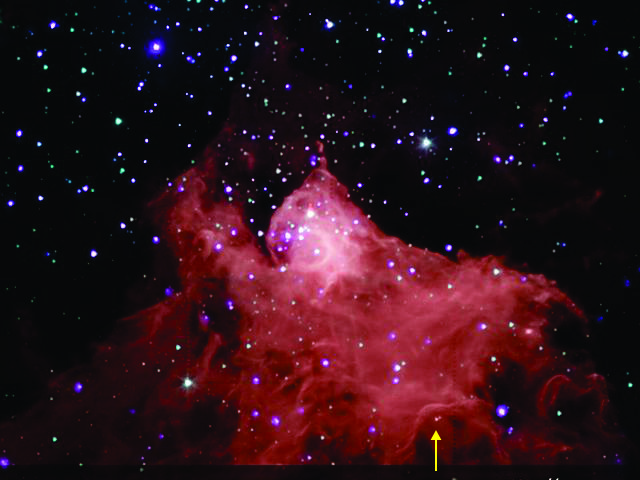
“Ah yes, thanks. So we’ve looked at close-by stars but Spitzer showed us a few more surprises lurking in the Milky Way. This, for instance — most of the image is colorized from the infra‑red, but if you look close you can see Chandra‘s X‑ray view, colorized purple to highlight young stars.”

The Cepheus-B molecular cloud
X-ray: NASA/CXC/PSU/K. Getman et al.; IRL NASA/JPL-Caltech/CfA/J. Wang et al

<hushed general “oooo” from the audience>

“Giant molecular clouds like this are scattered throughout the Milky Way, mostly in the galaxy’s spiral arms. As you see, this cloud’s not uniform, it has clumps and voids. By Earth standards the cloud is still a pretty good vacuum. The clumps are about 10-15 of our atmosphere’s density, but that’s still a million times more dense than our Solar System’s interplanetary space. The clumps appear to be where new stars are born. The photons and other particles from a newly-lit star drive the surrounding dust away. My arrow points to one star with a particularly nice example of that — see the C-shape around the star?”

The maybe-an-Art-major pipes up. “How about that one just a little below center?”

“Uh-huh. There’s so much activity in that dense region that the separate shockwaves collide to create hot spots that’ll generate even more stars in the future. The clouds are mostly held together by their own gravity. They last for tens of millions of years, so we think of them as huge roiling stellar nurseries.”

“Like my kid’s day care center but bigger.”

“Mm-mm, but let’s turn to the Milky Way’s center, home of that famous black hole with the mass of four million Suns and this remarkable structure, a double-helix of warm dust.”

False-color infra-red image of the Double-Helix Nebula
The double helix nebula.
Credit: NASA/JPL-Caltech/M. Morris (UCLA)

Vinnie blurts out, “That’s a jet from a black hole! One of Newt’s babies.”

Newt can’t resist breaking into Cathleen’s pitch. “Maybe it’s a jet, Vinnie. Yes, it’s above the central galactic plane and perpendicular to it, but the helix doesn’t quite point to the central black hole.”

“So take another picture that follows it down.”

“We’d love to, but we can’t. Yet. That image came from a long-wavelength instrument that only operated during Spitzer‘s initial 5-year cold period. Believe me, there are bunches of astronomers who can’t wait for the James Webb Space Telescope‘s far-IR instruments to get into position and start doing science. Meanwhile, we’ve got just the one image and a few earlier ones from an even less-capable spacecraft. This thing may be a lit-up part of a longer structure that twists down to the black hole or at least its accretion disk. We just don’t know.”

Cathleen takes control again. “The next image comes from outside our galaxy — far outside.”

Spitzer visualization of Galaxy MACS 1149-JD1
Credit: NASA/ESA/STScI/W. Zheng (JHU), and the CLASH team

The maybe-an-Art-major snorts, “Pointillism derivative!”

“No, it’s pixels from a starfield image with a very low signal-to-noise ratio. That red blotch in the center is one of the most distant objects ever observed, gracefully named MACS 1149-JD1. It’s a galaxy 13.2 billion lightyears away. That’s so far away that the expansion of the Universe has stretched the galaxy’s emitted photons by a factor of 10.2. Spectrum-wise, 1149-JD1’s ultra-violet light skipped right past the visible range and down into the near infra-red. Intensity-wise, that galaxy’s about 5200 times further away than the Andromeda galaxy. Assuming the two are about the same overall brightness, 1149-JD1 would be about 27 million times fainter than Andromeda.”

“How can we even see anything that dim?”

“We couldn’t, except for a fortunate coincidence. Right in line between us and 1149-JD1 there’s a massive galaxy cluster whose gravity acts like a lens to focus 1149-JD1’s light.”

The seminar’s final words, from maybe-an-Art-major — “A distant light, indeed.”

~~ Rich Olcott

The Fourth Brother’s Quest

Newt Barnes is an informed and enthusiastic speaker in Cathleen’s “IR, Spitzer and the Universe” memorial symposium. Unfortunately Al interrupts him by bustling in to refresh the coffee urn.

After the noise subsides, Newt picks up his story. “As I was saying, it’s time for the Spitzer‘s inspirational life story. Mind you, Spitzer was designed to inspect very faint infra-red sources, which means that it looks at heat, which means that its telescope and all of its instruments have to be kept cold. Very cold. At lift-off time, Spitzer was loaded with 360 liters of liquid helium coolant, enough to keep it below five Kelvins for 2½ years.”

“Kelvins?”

“Absolute temperature. That’d be -268°C or -450°F. Very cold. The good news was that clever NASA engineers managed to stretch that coolant supply an extra 2½ years so Spitzer gave us more than five years of full-spectrum IR data.”

<mild applause>

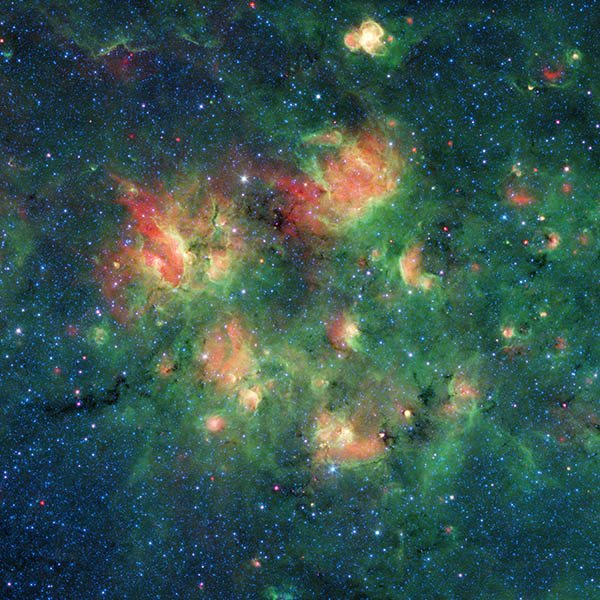
“Running out of coolant would have been the end for Spitzer, except it really marked a mid-life transition. Even without the liquid helium, Spitzer is far enough from Earth’s heat that the engineers could use the craft’s solar arrays as a built-in sunshield. That kept everything down to about 30 Kelvins. Too warm for Spitzer‘s long-wavelength instruments but not too warm for its two cameras that handle near infra-red. They chugged along just fine for another eleven years and a fraction. During its 17-year life Spitzer produced pictures like this shot of a star-forming region in the constellation Aquila…”

NASA/JPL-Caltech/Milky Way Project.

The maybe-an-Art-major goes nuts, you can’t even make out the words, but Newt barrels on. “Here’s where I let you in on a secret. The image covers an area about twice as wide as the Moon so you shouldn’t need a telescope to spot it in our Summertime sky. However, even on a good night you won’t see anything like this and there are several reasons why. First, the light’s very faint. Each of those color-dense regions represents a collection of hundreds or thousands of young stars. They give off tons of visible light but nearly all of that is blocked by their dusty environment. Our nervous system’s timescale just isn’t designed for capturing really faint images. Your eye acts on photons it collects during the past tenth of a second or so. An astronomical sensor can focus on a target for minutes or hours while it accumulates enough photons for an image of this quality.”

“But you told us that Spitzer can see through dust.”

“That it can, but not in visible colors. Spitzer‘s cameras ignored the visible range. Instead, they gathered the incoming infrared light and separated it into three wavelength bands. Let’s call them long, medium and short. In effect, Spitzer gave us three separate black-and-white photos, one for each band. Back here on Earth, the post-processing team colorcoded each of those photos — red for long, green for medium and blue for short. Then they laid the three on top of each other to produce the final image. It’s what’s called ‘a falsecolor image’ and it can be very informative if you know what to look for. Most published astronomical images are in fact enhanced or colorcoded like this in some way to highlight structure or indicate chemical composition or temperature.”

“What happened after the extra extra years?”

“Problems had just built up. Spitzer doesn’t orbit the Earth, it orbits the Sun a little bit slower than Earth does. It gets further away from us every minute. It used to be able to send us its data almost real-time, but now it’s so far away a 2hour squirt-cast drains its batteries. Recharging the batteries using Spitzer‘s solar arrays tilts the craft’s antenna away from Earth — not good. Spitzer‘s about 120° behind Earth now and there’ll come a time when it’ll be behind the Sun from us, completely out of communication. Meanwhile back on Earth, the people and resources devoted to Spitzer will be needed to run the James Webb Space Telescope. NASA decided that January 30 was time to pull the plug.”

Cathleen takes the mic. “Euge, serve bone et fidélis. Well done, thou good and faithful servant.”

~~ Rich Olcott

A Tale of Four Brothers

Jim hands the mic to Cathleen, who announces, “Bio-break time. Please be back here in 15 minutes for the next speaker. Al will have fresh coffee and scones for us.” <a quarter-hour later> “Welcome back, everyone, to the next session of our ‘IR, Spitzer and the Universe‘ memorial symposium. Our next speaker will turn our focus to the Spitzer Space Telescope itself. Newt?”

“Thanks, Cathleen. Let’s start with a portrait of Spitzer. I’m putting this up because Spitzer‘s general configuration would fit all four of NASA’s Great Observatories…

A NASA artist’s impression of Spitzer against an IR view of the Milky Way’s dust

“Each of them was designed to be carried into space by one of NASA’s space shuttles so they had to fit into a shuttle’s cargo bay — a cylinder sixty feet long and fifteen feet in diameter. Knock off a foot or so each way to allow for packing materials and loading leeway.”

<voice from the crowd> “How come they had to be in space? It’d be a lot cheaper on the ground.”

“If you’re cynical you might say that NASA had built these shuttles and they needed to have some work for them to do. But the real reasons go back to Lyman Spitzer (name sound familiar?). Right after World War II he wrote a paper listing the benefits of doing Astronomy outside of our atmosphere. We think Earth’s atmosphere is transparent, but that’s only mostly true and only at certain wavelengths. Water vapor and other gases block out great swathes of the infrared range. Hydrogen and other atoms absorb in the ultraviolet and beyond. Even in the visible range we’ve got dust and clouds. And of course there’s atmospheric turbulence that makes stars twinkle and astronomers curse.”

“So he wanted to put telescopes above all that.”

“Absolutely. He leveraged his multiple high-visibility posts at Princeton, constantly promoting government support of high-altitude Astronomy. He was one of the Big Names behind getting NASA approved in the first place. He lived to see the Hubble Space Telescope go into service, but unfortunately he died just a couple of years before its IR companion was put into orbit.”

“So they named it after him?”

“They did, indeed. The Spitzer was the fourth and final product of NASA’s ‘Great Observatories’ program designed to investigate the Universe from beyond Earth’s atmosphere. The Hubble Space Telescope was first. It was built to observe visible light but it also gave NASA experience doing unexpected inflight satellite repairs. <scattered chuckles in the audience. The maybe-an-Art-major nudges a neighbor for a whispered explanation.> The Atlantis shuttle put Hubble into orbit in 1990. Thirty years later it’s still producing great science for us.”

<The maybe-an-Art-major yells out> “And beautiful pictures!”

“Yes, indeed. OK, a year later Atlantis put Compton Gamma Ray Observatory into orbit. Its sensors covered a huge range of the spectrum, about twenty octaves as Jim would put it, from hard X-rays on upward. In its nine years of life it found nearly 300 sources for those high-energy photons that we still don’t understand. It also detected some 2700 gamma ray bursts and that’s something else we don’t understand other than that they’re way outside our intergalactic neighborhood.”

“Only nine years?”

“Sad, right? Yeah, one of its gyroscopes gave out and NASA had to bring it down. Some people fussed, ‘It’ll come down on our heads and we’re all gonna die!‘ but the descent stayed under control. Most of the satellite burned up on re-entry and the rest splashed harmlessly into the Indian Ocean.”

<quiet snuffle>

“Cheer up, it gets better. A month and a half after Compton‘s end, the Columbia shuttle put Chandra X-Ray Observatory into orbit. Like Hubble, Chandra‘s still going strong and uncovering secrets for us. Chandra was first to record X-rays coming from the huge black hole at the Milky Way’s core. Chandra data from the Bullet Cluster helped confirm the existence of dark matter. Thanks to Chandra we understand Jupiter’s X-ray emissions well enough to steer the Juno spacecraft away from them. The good stuff just keeps coming.”

“Thanks, that helps me feel better.”

“Good, because it’s time for the Spitzer‘s inspirational life story.”

~~ Rich Olcott

A Far And Dusty Traveler

Cathleen takes the mic. “Quick coffee and scone break, folks, then Jim will continue our ‘IR, Spitzer And The Universe‘ symposium.” <pause> “OK, we’re back in business. Jim?”

“Thanks, Cathleen. Well, we’ve discussed finding astronomical molecules with infra-red. Now for a couple of other IR applications. First up — looking at things that are really far away. Everyone here knows that the Universe is expanding, right?”

<general murmur of assent, although the probably-an-Art-major looks startled>

“Great. Because of the expansion, light from a far-away object gets stretched out to longer wavelengths on its way to us. Say a sodium atom shot a brilliant yellow-gold 590-nanometer photon at us, but at the time the atom was 12.5 million lightyears away. By the time that wave reaches us it’s been broadened to 3540 nanometers, comfortably into the infra-red. Distant things are redder, sometimes too red to see with an optical telescope. The Spitzer Space Telescope‘s infra-red optics let us see those reddened photons. And then there’s dust.”

<voice from the crowd> “Dust?”

Cosmic dust, pretty much all the normal matter that’s not clumped into stars and planets. Some of it is leftovers from early times in the Universe, but much of it is stellar wind. Stars continuously spew particles in their normal day-to-day operation. There’s a lot more of that when one explodes as a nova or supernova. Dust particles come in all sizes but most are smaller than the ones in tobacco smoke.”

<same voice> “If they’re so small, why do we care about them?”

“Two reasons. First, there’s a lot of them. Maybe only a thousand particles per cubic kilometer of space, but there’s a huge number of cubic kilometers in space and they add up. More important is what the dust particles are made of and where we found them. Close inspection of the dust is like doing astronomical archaeology, giving us clues about how stars and galaxies evolved.”

<Vinnie, skeptical as always> “So what’s infra-red got to do with dust?”

“Depends on what kind of astronomy you’re interested in. Dust reflects and emits IR light. Frequency patterns in the light can tell us what that dust made of. On the other hand there’s the way that dust doesn’t interact with infra-red.”

<several voices> “Wait, what?”

The Milky Way from Black Rock Desert NV
By Steve Jurvetson via Flickr, Wikimedia Commons, CC BY 2.0

“If Al’s gotten his video system working … ah, he has and it does. Look at this gorgeous shot of the Milky Way Galaxy. See all the dark areas? That’s dust blocking the visible light. The scattered stars in those areas are simply nearer to us than the clouds. We’d like to study what’s back beyond the clouds, especially near the galaxy’s core. That’s a really interesting region but the clouds block its visible light. Here’s the neat part — the clouds don’t block its infra-red light.”

<other voices> “Huh?” “Why wouldn’t they?”

“It’s the size of the waves versus the size of the particles. Take an extreme case — what’s the wavelength of Earth’s ocean tides?”

<Silence, so I speak up.> “Two high tides a day, so the wavelength is half the Earth’s circumference or about 12’500 miles.”

“Right. Now say you’re at the beach and you’re out there wading and the water’s calm. Would you notice the tide?”

“No, rise or fall would be too gentle to affect me.”

“Now let’s add a swell whose peak-to-peak wavelength is about human-height scale.”

“Whoa, I’d be dragged back and forth as each wave passes.”

“Just for grins, let’s replace that swell with waves the same height but only a millimeter apart. Oh, and you’re wearing SCUBA equipment.”

“Have mercy! Well, I should be able to stand in place because I wouldn’t even feel the peaks and troughs as separate waves, just a foamy massage. Thanks for the breathing assistance, though.”

“You’re welcome, and thanks for helping with the thought experiment. Most cosmic dust particles are less than 100 nanometers across. Infra-red wavelengths run 100 to 1000 times longer than that. Infra-red light from those cloud-hidden stars just curves around particles that can stop visible lightwaves cold. Spitzer Space Telescope and its IR-sensitive kin provide deeper and further views than visible light allows.”

~~ Rich Olcott

Above The Air, Below The Red

Vinnie and I walk into Al’s coffee shop just as he sets out a tray of scones. “Odd-looking topping on those, Al. What is it?”

“Dark cherry and dark chocolate, Sy. Something about looking infra-red. Cathleen special-ordered them for some Astronomy event she’s hosting in the back room. Carry this tray in there for me?”

Vinne grabs the tray and a scone. “Sure, Al. … Mmm, tasty. … Hi, Cathleen. Here’s your scones. What’s the event?”

“It’s a memorial symposium for the Spitzer Space Telescope, Vinnie. Spitzer‘s been an infra-red workhorse for almost 17 years and NASA formally retired it at the end of January.”

“What’s so special about infra-red? It’s just light, right? We got the Hubble for that.”

“A perfect cue for Jim’s talk. <to crowd> Grab a scone and settle down, everyone. Welcome to our symposium, ‘IR , Spitzer And The Universe.’ Our first presentation today is entitled ‘What’s So Special About Infra-red?‘ Jim, you’re on.”

“Thanks, Cathleen. This is an introductory talk, so I’ll keep it mostly non-technical. So, question for everybody — when you see ‘IR‘, what do you think of first?”

<shouts from the crowd> “Pizza warmer!” “Invisible light!” “Night-vision goggles!”

“Pretty much what I expected. All relevant, but IR’s much more than that. To begin with, many more colors than visible light. We can distinguish colors in the rainbow because each color’s lightwave has a different frequency. Everybody OK with that?”

<general mutter of assent>

“OK. Well, the frequency at the violet end of the visible spectrum is a bit less than double the frequency at the red end. In music when you double the frequency you go up an octave. The range of colors we see from red to violet is less than an octave, about like going from A-natural to F-sharp on the piano. The infra-red spectrum covers almost nine octaves. An 88-key piano doesn’t even do eight.”

<voice from the crowd, maybe an Art major> “Wow, if we could see infra-red think of all the colors there’d be!”

“But you’d need a whole collection of specialized eyes to see them. With light, every time you go down an octave you reduce the photon’s energy capacity by half. Visible light is visible because its photons have just enough energy to cause an electronic change in our retinas’ photoreceptor molecules. Five octaves higher than that, the photons have enough energy to knock electrons right out of a molecule like DNA. An octave lower than visible, almost nothing electronic.”

<Vinnie’s always-skeptical voice> “If there’s no connecting with electrons, how does electronic infra-red detection work?”

“Two ways. A few semiconductor configurations are sensitive to near- and mid-infra-red photons. The Spitzer‘s sensors are grids of those configurations. To handle really low-frequency IR you have to sense heat directly with bolometer techniques that track expansion and contraction.”

<another skeptical voice> “OK then, how does infra-red heating work?”

“Looks like a paradox, doesn’t it? Infra-red photons are too low-energy to make a quantum change in a molecule’s electronic arrangement, but we know that the only way photons can have an effect is by making quantum changes. So how come we feel infra-red’s heat? The key is, photons can interact with any kind of charged structure, not just electrons. If a molecule’s charges aren’t perfectly balanced a photon can vibrate or rotate part of a molecule or even the whole thing. That changes its kinetic energy because molecular motion is heat, right? Fortunately for the astronomers, gas vibrations and rotations are quantized, too. An isolated water molecule can only do stepwise changes in vibration and rotation.”

“Why’s that fortunate?”

“Because that’s how I do my research. Every kind of molecule has its own set of steps, its own set of frequencies where it can absorb light. The infra-red range lets us do for molecules what the visual range lets us do for atoms. By charting specific absorption bands we’ve located and identified interstellar clouds of water, formaldehyde and a host of other chemicals. I just recently saw a report of ‘helonium‘, a molecular ion containing helium and hydrogen, left over from when the Universe began. Infra-red is so cool.”

“No, it’s warm.”

Image suggested by Alex

~~ Rich Olcott