Yardsticks

“Hi, Cathleen, meet Mr Richard Feder, of Fort Lee NJ. He’s got a question that’s more in your Astronomy bailiwick than mine. Have a strawberry scone.”

“Mmm, still warm from Al’s oven. Thanks, Sy. Hello and what’s your question, Mr Feder?”

“Hiya. So if the James Webb Space Telescope is gonna be a million miles behind the Moon, won’t the Moon block its signals to us?”

“Oh dear, he said ‘miles.’ Sy, you’d better get out Old Reliable to look up numbers and do unit conversions. Mr Feder, I don’t think in miles.”

“Huh? What do you use instead, like paces or something?”

“Depends on what objects I’m considering and why I’m thinking about them. There are so many useful ratios out there it’s often easier to use ratios than huge numbers one can’t wrap one’s head around. Jupiter’s radius, for instance, is eleven times Earth’s, and the Sun is ten times wider still. Diameter and circumference follow the same ratios, of course. Square those ratios for relative surface area, cube them for relative volume. Who needs miles or kilometers?”

“Those numbers right, Moire?”

“Mmm … 6371 kilometers or 3959 miles for Earth, 71492 kilometers or 42441 miles for Jupiter, 695700 kilometers or 432300 miles for the Sun. The Jupiter/Earth ratio’s 11.2, the Sun/Jupiter ratio’s 9.73. The lady knows what she’s talking about.”

“Here’s a few fun factoids. The Moon’s distance is 10 times Earth’s Equator which is 100 times the International Space Station’s altitude. For that matter, if you wrapped a string around Earth’s Equator, it’d be just long enough to reach up to a GPS satellite and back. But all those are near‑Earth measurements where it makes sense to think in miles or kilometers. That’s too cumbersome for the bigger picture.”

“What else you got?”

“Within the Solar System I generally use one or the other of two convenient yardsticks. They measure the same distances, of course, but they have different applications. One is the nominal radius of Earth’s orbit, about 150 million kilometers.’

“That’s 93 million miles, Mr Feder.”

“I knew that one, Moire.”

“Anyway, we call that distance an Astronomical Unit. It’s handy for locating bodies relative to the Sun. Parker Solar Probe has gotten within a tenth of an AU of the Sun, for instance, and Neptune’s about 30 AU out. The Oort Cloud begins near 2000 AU and may extend a hundred times as far.”

“I ain’t even gonna ask what the Oort‐thing is, but I’m glad it’s a long way away.”

“We think it’s where long‑period comets come from.”

“Far away is good then. So what’s your other yardstick?”

“Lightspeed.”

“186 thousand miles per second, Mr Feder.”

“Yeah, yeah.”

“It’s also 300 thousand kilometers per second, and one light‑second per second, and one light‑year per year. Within the Solar System my benchmarks are that Earth is 500 light-seconds from the Sun, and Pluto was 4½ light-hours away from us when New Horizons sent back those marvelous images. The Sun’s nearest star system, Alpha Centauri, is 4⅓ light‑years away, and when you compare hours to years that gives you an idea of how small we are on the interstellar scale.”

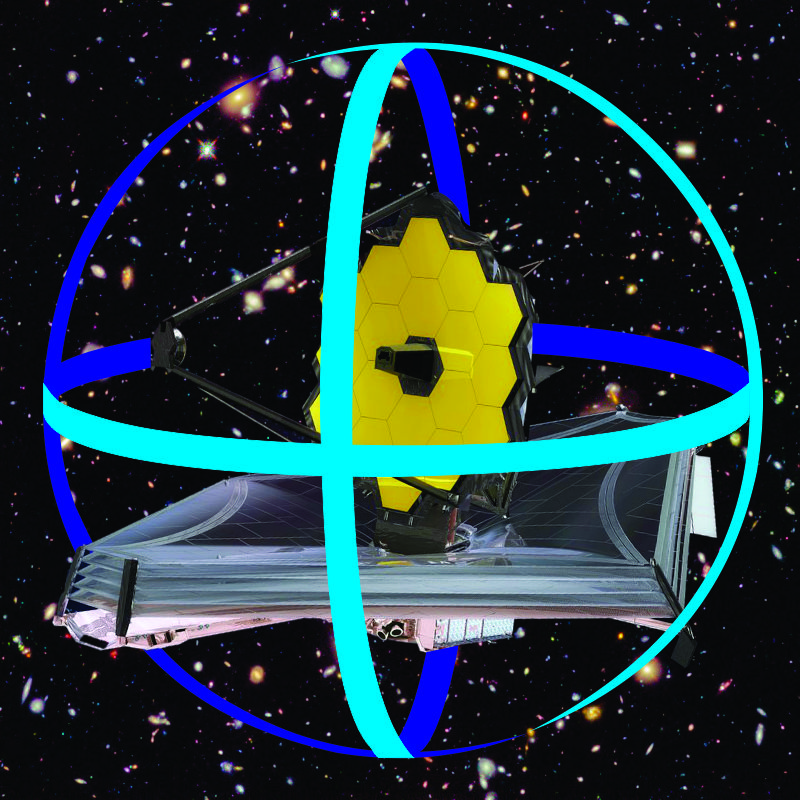
“Cathleen, when you mentioned New Horizons that reminded me of the JWST. We’ve gotten off the track from Mr Feder’s question. Why isn’t the Moon going to block those signals?”

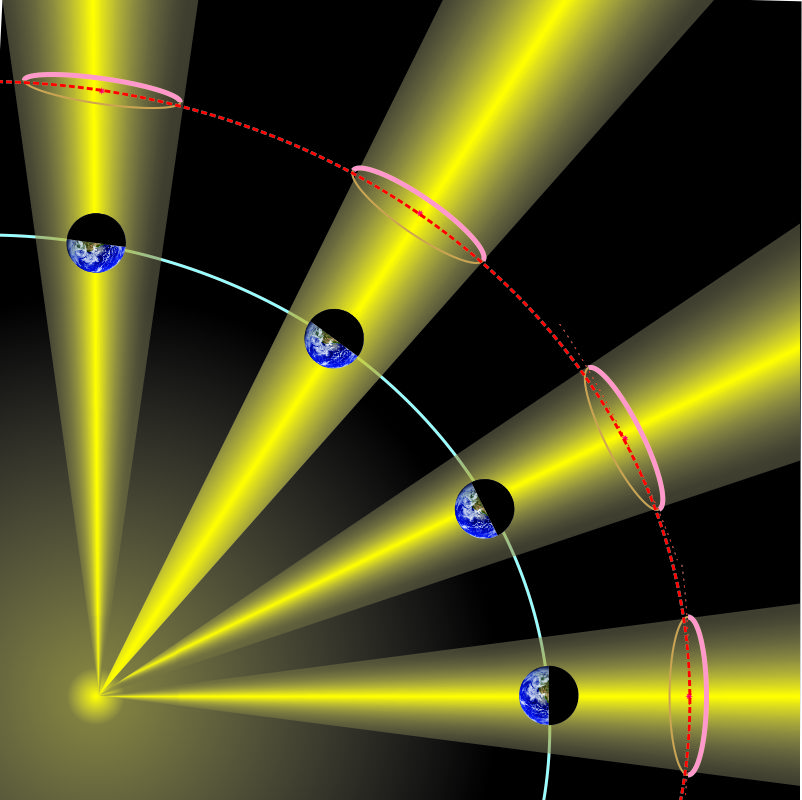
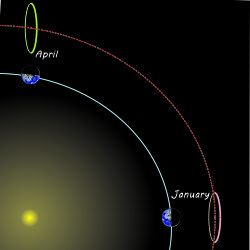
“Because it’ll never be in the way.” <sketching on a paper napkin> “There’s a bunch of moving parts here so hold on. The Earth orbits the Sun and the Moon orbits the Earth once a month, right? The L2 point doesn’t orbit the Earth. It orbits the Sun, staying exactly behind Earth so yeah, once a month the Moon could maybe get between Earth and L2. But JWST won’t be at L2, it’ll be in a wide orbit around that point and mostly perpendicular to the orbits of the Earth and Moon.”

“How wide?”

“It’ll vary depending on what they need, but it’s big enough to keep the spacecraft’s solar panels in the sunlight.”

“Solar panels? I thought the IR sensors needed cold cold cold.”

“They do. JWST protects its cold side with a hot side featuring a pretty pink Kapton parasol.”

~~ Rich Olcott

The Venetian Blind Problem

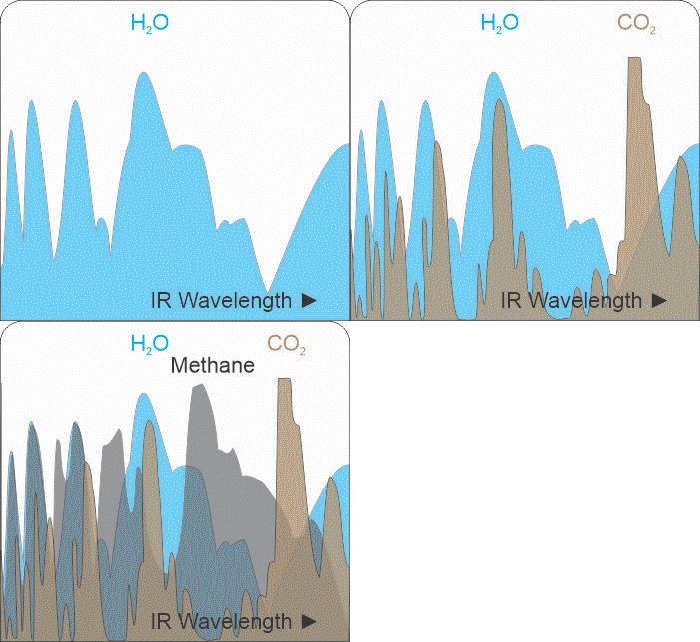
Susan Kim gives me the side‑eye. “Sy, I get real suspicious when someone shows me a graph with no axis markings. I’ve seen that ploy used too often by people pushing a bias — you don’t know what happens offstage either side and you don’t know whether an effect was large or small. Your animated chart was very impressive, how that big methane infrared absorption peak just happens to fill in the space between CO2 and H2O peaks. But how wide is the chart compared to the whole spectrum? Did you cherry‑pick a region that just happens to make your point?”

“Susan, how could you accuse me of such underhanded tactics? But I confess — you’re right, sort of. <more tapping on Old Reliable’s keyboard> The animation only covered the near‑IR wavelengths from 1.0 to 5.0 micrometers. Here’s the whole strip from 0.2 micrometers in the near UV, out to 70 micrometers in the far IR. Among other things, it explains the James Webb Space Telescope, right, Al?”

Spectrum of Earth’s atmosphere. Adapted
under the Creative Commons 3.0 license
from Robert Wohde’s work
with the HITRAN2004 spectroscopic database,

“I know the Webb’s set up for IR astronomy from space, Sy. Wait, does this graph say there’s too much water vapor blocking the galaxy’s IR and that’s why they’re putting the scope like millions of miles away out there?”

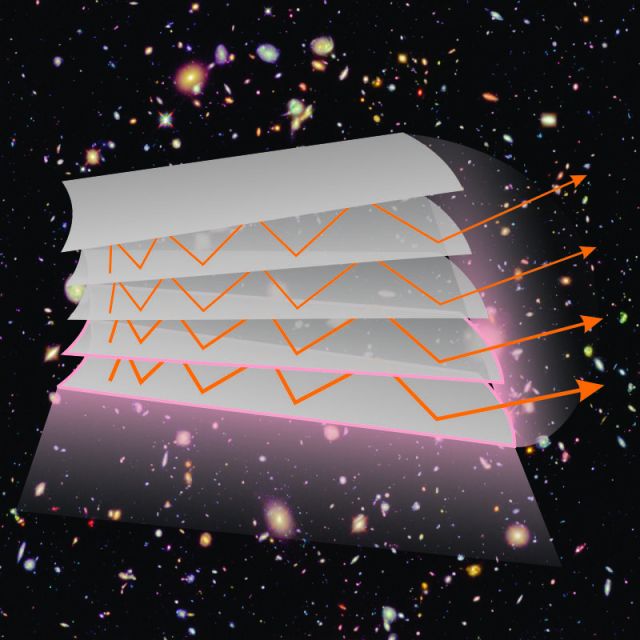
“Not quite. The mission designers’ problem was the Sun’s heat, not Earth’s water vapor. The solution was to use Earth itself to shield the device from the Sun’s IR emissions. The plan is to orbit the Webb around the Earth‑Sun L2 point, about a million miles further out along the Sun‑Earth line. Earth’s atmosphere being only 60 miles thick, most of it, the Webb will be quite safe from our water molecules. No, our steamy atmosphere’s only a problem for Earth‑based observatories that have to peer through a Venetian blind with a few missing slats at very specific wavelengths.”

“Don’t forget, guys, the water spectrum is a barrier in both directions. Wavelengths the astronomers want to look at can’t get in, but also Earth’s heat radiation at those wavelengths can’t get out. Our heat balance depends on the right amount of IR energy making it out through where those missing slats are. That’s where Sy’s chart comes in — it identifies the wavelengths under threat by trace gases that aren’t so trace any more.”

“And we’re back to your point, Susan. We have to look at the whole spectrum. I heard one pitch by a fossil fuel defender who based his whole argument on the 2.8‑micrometer CO2 peak. ‘It’s totally buried by water’s absorption,‘ he claimed. ‘Can’t possibly do us any further damage.’ True, so far as it goes, but he carefully ignored CO2‘s other absorption wavelengths. Pseudoscience charlatan, ought to be ashamed of himself. Methane’s not as strong an absorber as CO2, but its peaks are mostly in the right places to do us wrong. Worse, both gas concentrations are going up — CO2 is 1½ times what it was in Newton’s day, and methane is 2½ times higher.”

“Funny how they both go up together. I thought the CO2 thing was about humanity burning fossil fuels but you said methane operations came late to that game.”

“Right on both counts, Al. Researchers are still debating why methane’s risen so bad but I think they’re zeroing in on cow gas — belches and farts. By and large, industry has made the world’s population richer over the past two centuries. People who used to subsist on a grain diet can now afford to buy meat so we’ve expanded our herds. Better off is good, but there’s an environmental cost.”

Al gets a far-away look. “Both those gases have carbon in them, right? How about we burn methane without the carbon in, just straight hydrogen?”

Susan gets excited. “Several groups in our lab are working on exactly that possibility, Al. The 2H2+O2→2H2O reaction yields 30% more energy per oxygen atom than burning methane. We just need to figure out how to use hydrogen economically.”

~~ Rich Olcott

It’s A Trap!

Late morning, no-one else in his coffee shop so Al pulls up a chair. “OK, Susan, so coal’s a mess for ash and air pollution but also each carbon from coal gives us less energy than a carbon from methane. So why the muttering against switching to natural gas?”

“Big-ticket reasons, Al. One, natural gas isn’t pure methane. Mostly methane, sure, but depending on the source you get a whole collection of other things in the mix — heavier hydrocarbons like propane and butane, stinky sulfides and amines, even helium and mercury. Gas from a well has to be purified before you’d want it piped to your house.”

“Piped. Oh, yeah, pipelines. Probably a lot more efficient than coal transport but I see how they get problems, too.”

“Indeed they do. Pipelines break and leak and some idiots even use them for target practice. The worst kind of waste.”

“Yeah, when the oil gets out and ruins the land or someone’s water supply.”

“That’s bad locally, all right, but it’s when methane leaks out that the global damage starts.”

“Global?”

“Mm-hm, because methane’s a gas and mixes in with the rest of the atmosphere. If a pipeline or a truck or anything springs a leak in, say, Chicago, the methane molecules can go anywhere.”

“So?”

“So a couple of things. A decade in the atmosphere oxidizes most methane molecules to, guess what, CO2, the same problematic CO2 we get from burning coal. But before it degrades, methane’s an even bigger heat‑trapper than CO2 is.”

“Whaddaya mean, heat‑trapper?”

“Do you want to take this, Sy? It’s more Physics than Chemistry and besides, my mocha latte’s getting cold.”

“Hmm, there’s a bunch of moving parts in this. Al, you owe Susan a warm-up while I think.”

“Here ya go, Susan.”

“Thanks, Al. I’ll get you guys started. Why did my coffee get cold?”

“Good one, Susan. Al, it’s a universal principle — left to itself, energy spreads out. Heat finds ways to travel from a concentrated, high‑temperature source to low‑temperature absorbers. The exceptions occur when some extra process expends energy to pump heat in the other direction. So, that coffee naturally lost heat to the table by conduction, to the air by convection and to the general environment by radiation. The only thing that can stop those processes is perfect insulation. That’s the thing about the atmosphere.”

“Whoa, that’s a jump or three too fast.”

“OK, let’s follow a sunbeam aimed in the Earth’s direction. Its photons carry a wide range of energies, ultraviolet down to far infrared. On the way in, a UV photon hits an atmospheric ozone molecule and gets absorbed. No more UV photon but now the molecule is in an excited state. It calms down by joggling its neighbor molecules, that’s heat transfer, and maybe emitting a longer wavelength photon or two. Ozone filters out incoming UV and in the process spreads out the photon’s concentrated energy. What’s left in the sunbeam is visible and infrared light that gets down to us. You with me?”

“Makes sense so far.”

“Good. Next stage is that the visible and IR light heat the Earth, which then re-radiates the energy as infrared light mostly at longer wavelengths. The problem is that not all the IR gets out. Water molecules absorb some wavelengths in that range. Every absorption event means more heat distribution into the atmosphere when the molecule relaxes. Ocean evaporation maintains a huge number of IR‑blocking water molecules in the atmosphere.”

“I heard that ‘some‘ weasel‑word. Other wavelengths still make it through, right?”

I unholster Old Reliable, tap a few keys. “Here’s water’s absorption pattern in the mid‑to‑far‑infrared. A high peak means absorption centered at that wavelength. This is scaled per molecule per unit area, so double the molecules gives you double the absorption.”

Spectrum profiles from M. Etminan, et al., doi:10.1002/2016GL071930

“Lots of blank space between the peaks, though.”

“Which is where CO2 and methane get into the game. It’s like putting green and blue filters in front of a red one. With enough of those insulating molecules up there there’s no blank space and lots of imbalance from trapped heat.”

“Methane’s worse.”

“Lots worse.”

~~ Rich Olcott

Going from Worse to Bad

Al delivers coffees to our table, then pauses. “Why methane?”

Susan Kim looks up from her mocha latte. “Sorry?”

“Why all the fuss about methane all of a sudden? I thought carbon dioxide was the baddie. Everybody’s switching from coal to natural gas which they say is just methane and now that’s a bad thing, too. I’m confused. You’re a chemist, unconfuse me.”

“You’re right, there’s mixed message out there. Here’s the bottom line. Methane’s bad, but coal’s a worse bad.”

“OK, but why?”

“Pass me a paper napkin so I can write down the chemical reactions. When we look at them in detail there’s all kinds of complicated reaction paths, but the overall processes are pretty simple. The burnable part of coal is carbon. In an efficient coal‑fired process what happens is
  C + O2 → CO2 + energy.
The C is carbon, of course and O2 is an oxygen molecule, two atoms linked together. Carbon atoms weigh 12 and each oxygen atoms weighs 16, so 12 grams of carbon produces 12+(2×16)=44 grams of CO2. Scaling up, 12 tons of carbon produces 44 tons of CO2 and so on. The energy scales up, too. and that’s what heats the boilers that make the steam that spins the turbines that make electricity.”

“I heard a couple of weasel words but go on to methane.”

“You caught them, eh? They’re important weasels and we’ll get to them. OK, methane is CH4 and its overall burn equation is
  CH4 + 2O2 → CO2 + 2H2O + energy.
Oxidizing those hydrogens releases about twice as much energy per carbon as the coal reaction does.”

“Already I see one big advantage for methane — more bang per CO2. So about those weasels…”

“Right. Well, coal isn’t just pure burnable carbon. It’s 350‑million‑year‑old trees and ferns and animal carcasses and swamp muck and mineral sediments, all pressure‑baked together. There’s sulfur and nitrogen in there, mixed in with nasty elements like mercury and arsenic.”

“The extras go up the smokestack along with the CO2, huh? Bad, for sure.”

“The good news is that coal-burning power plants are under the gun to clean up those emissions. The bad news is that effective mitigation technologies themselves cost energy. That lowers the net yield. But the inefficiency gets worse. Think coal trains.”

“Yeah, half the time I get held up on the way home by one of those hundred‑car strings, either full-up heading to the power plant or empties going back for another load.”

“Mm-hm. Transporting coal takes energy, and so does mining it and crushing it and pre‑treating to get rid of dirt and then taking care of the ashes. Even less net energy output per ton of smokestack CO2, even worse inefficiency. See why coal’s on its way out?”

“I guess all that didn’t matter when it was cheap to dig up and there wasn’t much competition.”

“You put your finger on it, Al. Coal got its foot in the door with steam engines 300 years ago when about the only other things you could burn were wood and whale oil. Crude oil got big in the mid‑1800s but it had to be refined and that made it expensive. Cheap natural gas wasn’t really a thing until fracking came along 50 years ago, but that brought a different set of issues.”

“Yeah, I’ve seen videos of people lighting their kitchen sink water on fire. And wasn’t there an earthquake thing in Oklahoma?”

“That was an interesting situation. Oklahoma’s in the middle of the continent, not a place you’d expect earthquakes, but they began experiencing flurries of shallow ones in 2011. The fracking process starts with water pumped at high pressure into gas-bearing strata to loosen things up. People suspected fracking was connected to the earthquakes. It was, but only indirectly. When fracked gas comes out of a well, water does, too. The rig operators pump that expelled water down old oil wells. Among other things, the state’s Corporation Commission is in charge of their hydrocarbon production. When the Commission ordered a 60% cut in the waste‑water down‑pumping, the earthquake rate dropped by 90%. Sometimes regulations are good things, huh?”

~~ Rich Olcott

Hyperbolas But Not Hyperbole

Minus? Where did that come from?”

<Gentle reader — If that question looks unfamiliar, please read the preceding post before this one.>

Jim’s still at the Open Mic. “A clever application of hyperbolic geometry.” Now several of Jeremy’s groupies are looking upset. “OK, I’ll step back a bit. Jeremy, suppose your telescope captures a side view of a 1000‑meter spaceship but it’s moving at 99% of lightspeed relative to you. The Lorentz factor for that velocity is 7.09. What will its length look like to you?”

“Lorentz contracts lengths so the ship’s kilometer appears to be shorter by that 7.09 factor so from here it’d look about … 140 meters long.”

“Nice, How about the clocks on that spaceship?”

“I’d see their seconds appear to lengthen by that same 7.09 factor.”

“So if I multiplied the space contraction by the time dilation to get a spacetime hypervolume—”

“You’d get what you would have gotten with the spaceship standing still. The contraction and dilation factors cancel out.”

“How about if the spaceship went even faster, say 99.999% of lightspeed?”

“The Lorentz factor gets bigger but the arithmetic for contraction and dilation still cancels. The hypervolume you defined is always gonna be just the product of the ship’s rest length and rest clock rate.”

His groupies go “Oooo.”

One of the groupies pipes up. “Wait, the product of x and y is a constant — that’s a hyperbola!”

“Bingo. Do you remember any other equations associated with hyperbolas?”

“Umm… Yes, x2–y2 equals a constant. That’s the same shape as the other one, of course, just rotated down so it cuts the x-axis vertically.”

Jeremy goes “Oooo.”

Jim draws hyperbolas and a circle on the whiteboard. That sets thoughts popping out all through the crowd. Maybe‑an‑Art‑major blurts into the general rumble. “Oh, ‘plus‘ locks x and y inside the constant so you get a circle boundary, but ‘minus‘ lets x get as big as it wants so long as y lags behind!”

Another conversation – “Wait, can xy=constant and x2–y2=constant both be right?”
  ”Sure, they’re different constants. Both equations are true where the red and blue lines cross.”

A physics student gets quizzical. “Jim, was this Minkowski’s idea, or Einstein’s?”

“That’s a darned good question, Paul. Minkowski was sole author of the paper that introduced spacetime and defined the interval, but he published it a year after Einstein’s 1905 Special Relativity paper highlighted the Lorentz transformations. I haven’t researched the history, but my money would be on Einstein intuitively connecting constant hypervolumes to hyperbolic geometry. He’d probably check his ideas with his mentor Minkowski, who was on the same trail but graciously framed his detailed write‑up to be in support of Einstein’s work.”

One of the astronomy students sniffs. “Wait, different observers see the same s2=(ct)2d2 interval between two events? I suppose there’s algebra to prove that.”

“There is.”

“That’s all very nice in a geometric sort of way, but what does s2 mean and why should we care whether or not it’s constant?”

“Fair questions, Vera. Mmm … you probably care that intervals set limits on what astronomers see. Here’s a Minkowski map of the Universe. We’re in the center because naturally. Time runs upwards, space runs outwards and if you can imagine that as a hypersphere, go for it. Light can’t get to us from the gray areas. The red lines, they’re really a hypercone, mark where s2=0.”

From the back of the room — “A zero interval?”

“Sure. A zero interval means that the distance between two events exactly equals lightspeed times light’s travel time between those events. Which means if you’re surfing a lightwave between two events, you’re on an interval with zero measure. Let’s label Vera’s telescope session tonight as event A and her target event is B. If the A–B interval’s ct difference is greater then its d difference then she can see Bif the event is in our past but not beyond the Cosmic Microwave Background. But if a Dominion fleet battle is approaching us through subspace from that black dot, we’ll have no possible warning before they’re on us.”

Everyone goes “Oooo.”

~~ Rich Olcott

A Diamond in The Sky with Lucy

Mid-afternoon coffee-and-scone time. As I step into his coffee shop Al’s quizzing Cathleen about something in one of his Astronomy magazines. “This Lucy space mission they just sent up, how come it looks like they’re shooting at either side of Jupiter instead of hitting it straight-on? And it’s got this crazy butterfly orbit that crosses the whole Solar System a couple of times. What sense does that make?”

Planned path of Lucy‘s mission to study Trojan asteroids (black dots).
After diagrams by NASA and Southwest Research Institute

“It shoots to either side because there’s interesting stuff out there. We think the Solar System started as a whirling disk of dust that gradually clumped together. The gravity from Jupiter’s clump scarfed up the lion’s share of the leftovers after the Sun coalesced. The good news is, not all of Jupiter’s hoard wound up in the planet. Some pieces made it to Jupiter’s orbit but then collected in the Trojan regions ahead and behind it. Looking at that material may teach us about the early Solar System.”

“Way out there? Why not just fall into Jupiter like everything else did?”

I do Physics, I can’t help but cut in. “It’s the many‑body problem in its simplest case, just the Sun, Jupiter and an asteroid in a three‑body interaction—”

Cathleen gives me a look. “Inappropriate physicsplaining, Sy, we’re talking Astronomy here. Al’s magazine is about locating and identifying objects in space. These asteroids happen to cluster in special locations roughly sixty degrees away from Jupiter.”

“But Al’s question was, ‘Why?‘ You told him why we’re sending Lucy to the Trojans, but Physics is why they exist and why that mission map looks so weird.”

“Good point, go ahead. OK with you, Al?”

“Sure.”

I unholster Old Reliable, my tricked‑out tablet, and start sketching on its screen. “OK, orange dot’s Jupiter, yellow dot’s the Sun. Calculating their motion is a two-body problem. Gravity pulls them together but centrifugal force pulls them apart. The forces balance when the two bodies orbit in ellipses around their common center of gravity. Jupiter’s ellipse is nearly a circle but it wobbles because the Sun orbits their center of gravity. Naturally, once Newton solved that problem people turned to the next harder one.”

“That’s where Lucy comes in?”

“Not yet, Al, we’ve still got those Trojan asteroids to account for. Suppose the Jupiter‑Sun system’s gravity captures an asteroid flying in from somewhere. Where will it settle down? Most places, one body dominates the gravitational field so the asteroid orbits that one. But suppose the asteroid finds a point where the two fields are equal.”

“Oh, like halfway between, right?”

“Between, Al, but not halfway.”

“Right, Cathleen. The Sun/Jupiter mass ratio and Newton’s inverse‑square law put the equal‑pull point a lot closer to Jupiter than to the Sun. If the asteroid found that point it would hang around forever or until it got nudged away. That’s Lagrange’s L1 point. There are two other balance points along the Sun‑Jupiter line. L2 is beyond Jupiter where the Sun’s gravity is even weaker. L3 is way on the other side of the Sun, a bit inside Jupiter’s orbit.”

“Hey, so those 60° points on the orbit, those are two more balances because they’re each the same distance from Jupiter and the Sun, right?”

“There you go, Al. L4 leads Jupiter and L5 runs behind. Lagrange published his 5‑point solution to the three‑body problem in 1762, just 250 years ago. The asteroids found Jupiter’s Trojan regions billions of years earlier.”

“We astronomers call the L4 cluster the Trojan camp and the L5 cluster the Greek camp, but that’s always bothered me. It’d be OK if we called the planet Zeus, but Jupiter’s a Roman god. Roman times were a millennium after classical Greece’s Trojan War so the names are just wrong.”

“I hadn’t thought about that, Cathleen, but you’re right. Anyway, back to Al’s diagram of Lucy’s journey. <activating Old Reliable’s ‘Animate’ function> Sorry, Al, but you’ve been misled. The magazine’s butterfly chart has Jupiter standing still. Here’s a stars-eye view. It’s more like the Trojans will come to Lucy than the reverse.”

~~ Rich Olcott

Galaxies Fluffy And Faint

Cathleen’s at the coffee shop’s baked goods counter. “A lemon scone, please, Al.”

I’m next in line. “Lemon sounds good to me, too. It’s a warm day.”

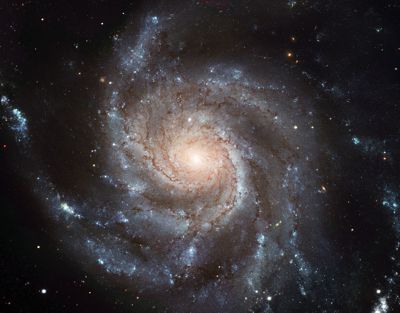
The Pinwheel Galaxy, NGC 5457
Credit: ESA/Hubble

“Sure thing, Sy. Hey, got a question for you, Cathleen, you bein’ an Astronomer and all. I just saw an Astronomy news item about a fluffy galaxy and they mentioned a faint galaxy. Are they the same and why the excitement?”

“Not the same, Al. It’ll be easier to show you in pictures. Sy, may I borrow Old Reliable?”

“Sure, here.”

“Thanks. OK, Al, here’s a classic ‘grand design‘ spiral galaxy, NGC 5457, also known as The Pinwheel. Gorgeous, isn’t it?”

“Sure is. Hey, I’ve wondered — what does ‘NGC‘ stand for, National Galaxy Collection or something?”

“Nope. The ‘G‘ doesn’t even stand for ‘Galaxy‘. It’s ‘New General Catalog‘. Anyway, here’s NGC 2775, one of our prettiest fluffies. Doesn’t look much like the Pinwheel or Andromeda, does it?”

NGC 2775
Credit: NASA / ESA / Hubble / J. Lee / PHANGS-HST Team / Judy Schmidt

“Nah, those guys got nice spiral arms that sort of grow out of the center. This one looks like there’s an inside edge to all the complicated stuff. And it’s got what, a hundred baby arms.”

“The blue dots in those ‘baby arms’ are young blue stars. They’re separated by dark lanes of dust just like the dark lanes in classic spirals. The difference is that these lanes are much closer together. The grand design spirals are popular photography subjects in your astronomy magazines, Al, but they’re only about 10% of all spirals. I’ll bet your news item was about 2775 because we’re just coming to see how mysterious this one is.”

“What’s mysterious about it?”

“That central region. It’s huge and smooth, barely any visible dust lanes and no blue dots. It’s bright in the infra‑red, which is what you’d expect from a population of old red stars. In the ultra‑violet, though, it’s practically empty — just a small dot at the center. UV is high‑energy light. It generally comes from a young star or a recent nova or a black hole’s accretion disk. The dot is probably a super-massive back hole. but its image is just a tiny fraction of the smooth region’s width. With a billion red stars in the way it’s hard to see how the black hole’s gravity field could have cleaned up all the dust that should be in there. Li’l Fluffy here is just begging for some Astrophysics PhD candidates to burn computer time trying to explain it.”

NGC 1052-DF2
Credit: NASA, ESA, and P. van Dokkum (Yale University)

“What about Li’l Faint?”

“That’s probably this one, NGC 1052-DF2. Looks a bit different, doesn’t it?

“I’ll say. It’s practically transparent. Is it a thing at all or just a smudge on the lens?”

“Not a smudge. We’ve got multiple images in different wavelength ranges from multiple observatories, and there’s another similar object, NGC 1052-DF4, in the same galaxy group. We even have measurements from individual stars and clusters in there. The discovery paper claimed that DF2 is so spread out because it lacks the dark matter whose gravity compacts most galaxies. That led to controversy, of course.”

“Is there anything in Science that doesn’t? What’s this argument?”

“It hinges on distance, Sy. The object is about as wide as the Milky Way but we see only 1% as many stars. Does their mass exert enough gravitational force to hold the structure together? There’s a fairly good relationship between a galaxy’s mass and its intrinsic brightness — more stars means more emitting surface and more mass. We know how quickly apparent brightness drops with distance. From other data the authors estimated DF2 is 65 lightyears away and from its apparent brightness they back‑calculated its mass to be just about what you’d expect from its stars alone. No dark matter required to prevent fly‑aways. Another group using a different technique estimated 42 lightyears. That suggested a correspondingly smaller luminous mass and therefore a significant amount of dark matter in the picture. Sort of. They’re still arguing.”

“But why does it exist at all?”

“That’s another question.”

~~ Rich Olcott

  • Thanks to Oriole for suggesting this topic.

Space Potatoes

“Uncle Sy, what’s the name of the Moon face that’s just a sliver?”

“It’s called a crescent, Teena, and it’s ‘phase,’ not ‘face’. Hear the z-sound?”

“Ah-hah, one of those spelling things, huh?”

“I’m afraid so. What brought that question up?”

“I was telling Bratty Brian about the Moon shadows and he said he saw a cartoon about something that punched a hole in the Moon and left just the sliver.”

“Not going to happen, Sweetie. Anything as big as the Moon, Mr Newton’s Law of Gravity says that it’ll be round, mostly, except for mountains and things.”

“Cause there’s something really heavy in the center?”

“No, and that’s probably what shocked people the most back in those days. They had Kings and Emperors, remember, and a Pope who led all the Christians in Europe. People expected everything to have some central figure in charge. That’s why they argued about whether the center of the Universe was the Earth or the Sun. Mr Newton showed that you don’t need anything at all at the center of things.”

“But then what pulls the things together?”

“The things themselves and the rules they follow. Remember the bird murmuration rules?”

“That was a long time ago, Uncle Sy. Umm… wasn’t one rule that each bird in the flock tries to stay about the same distance from all its neighbors?”

“Good memory. That was one of the rules. The others were to fly in the same general direction as everybody else and to try stay near the middle of the flock. Those three rules pretty much kept the whole flock together and protected most of the birds from predators. Mr Newton had simpler rules for rocks and things floating in space. His first rule was. ‘Keep going in the direction you’ve been going unless something pulls you in another direction.’ We call that inertia. The second rule explained why rocks fly differently than birds do.”

“Rocks don’t fly, Uncle Sy, they fall down.”

“Better to think of it as flying towards other things. Instead of the safe‑distance rule, Mr Newton said, ‘The closer two things are, the harder they pull together.’ Simple, huh?”

“Oh, like my magnet doggies.”

“Yes, exactly like that, except gravity always attracts. There’s no pushing away like magnets do when you turn one around. Suppose that back when the Solar System was being formed, two big rocks got close. What would happen?”

“They’d bang together.”

“And then?”

“They’d attract other rocks and more and more. Bangbangbangbang!”

“Right. What do you suppose happens to the energy from those bangs? Remember, we’re out in space so there’s no air to carry the sound waves away.”

“It’d break the rocks into smaller rocks. But the energy’s still there, just in smaller pieces, right?”

“The most broken-up energy is heat. What does that tell you?”

“The rock jumble must get … does it get hot enough to melt?”

“It can So now suppose there’s a blob of melted rock floating in space, and every atom in the melted rock is attracted to every other atom. Pretend you’re an atom out at one end of the blob.”

“I see as many atoms to one side as to the other so I’m gonna pull in towards the middle.”

“And so will all the other atoms. What shape is that going to make the blob?”

“Ooooh. Round like a planet. Or the Sun. Or the Moon!”

“So now tell me what would happen if someone punched a hole in the Moon?”

“All the crumbles at the crescent points would get pulled in towards the middle. It wouldn’t be a crescent any more!”

“Exactly. Mind you, if it doesn’t melt it may not be spherical. Melted stuff can only get round because molten atoms are free to move.”

“Are there not-round things in space?”

“Lots and lots. Small blobs couldn’t pull themselves spherical before freezing solid. They could be potato‑shaped, like the Martian moons Phobos and Deimos. Some rocks came together so gently that they didn’t melt. They just stuck together, like Asteroid Bennu where our OSIRIS-REx spacecraft sampled.”

“Space has surprising shapes, huh?”

“Space always surprises.”

~~ Rich Olcott

  • Thanks to Xander and Alex who asked the question.

Shadow Play

“Uncle Sy! Uncle Sy! You’re back! Didja see the red moon?”

“Hi, Teena. Good to be home. No, I didn’t get to see the red moon. Where I was it didn’t even get red.”

“I saw it! I saw it! Mommie put me to bed early so I could wake up to see it earrrly in the morning. I saw the red part but the Moon looked smaller than it does coming up from behind the houses and they said it was going to be sooo big but it wasn’t. Anyway, I didn’t stay awake. Why was it red?”

“Was it really red red like your favorite crayon?”

“Mm-no, more like orange-y red.”

“Sunset color, right?”

“Uh-huh. Was it sunset on the Moon?”

“Sort of. The sunsets we see on Earth are red mostly because our air absorbs the Sun’s blue light when we’re looking across the atmosphere. Only the red light gets through to our eyes. Remember the solar eclipse we saw, when the Moon came exactly between us and the Sun? Moon eclipses are inside out from that. We come between the Moon and the Sun. The only light getting past us has gone across our atmosphere just like sunset light does so it’s orange‑y red like a sunset.”

“Oooh … does the Sun ever get between us and the Moon?”

“Don’t worry, Sweetie. We’re far, far from the Sun. Mr Newton’s Laws of Motion say that we and the Moon will be waltzing out here for a long, long time.”

“Whee, we’re dancing around the Sun! MOMmie, Uncle Sy’s here!”

“Hi, Sis. You saw the eclipse, then.”

“Mm-hm. I realized while I was watching it that lunar phase shadows work differently from eclipses.”

“Oh? How so?”

“The shadow shapes are different, for one. The edge of the lunar phase shadow always passes through both poles. In a solar eclipse the shadow only reaches the poles at totality, and in a lunar eclipse there’s this almost straight shadow arc that marches across the whole face.”

“Interesting. You said ‘for one,’ so what else?”

“Eclipse shadows move in the wrong direction. Starting from a full moon, the shadow comes in from the right until you get to new moon, then it falls away to the left until you get back to full moon. Agreed?”

“I always get confused. I’ll take your word for it.”

“I looked it up. In two places. Anyhow, in both kinds of eclipse the shadow creeps from left to right. Just backwards from the lunar phases. I wonder if that has anything to do with ancient societies thinking that an eclipse is somehow evil.”

“Mommie, you know you’re not supposed to use words I don’t know unless you’re keeping secrets. What’s lunar faces?”

“Sorry, Teena, not secret. Lunar means Moon. Sy, can you show her phases on Old Reliable?”

“Sure. Here’s a quick sketch, Teena. Pretend that the little ball is the Moon going around the Earth. The Sun is off to the right. You know the Moon goes around the Earth and it always keeps the same side towards us, right?”

“That’s the Man In The Moon except it’s really mountains and stuff pointing at us.”

“That’s what the little triangle shows, like it’s his nose. See how sometimes it’s in the light and sometimes it’s in shadow? The big ball is what we see when the Moon is in each position. When the Man is facing straight towards the Sun we call that the Full Moon phase. When he’s completely in shadow that’s the New Moon phase. There’s names for other special positions, and all of the special positions are phases, OK?”

“I suppose you have a logical explanation for the shadows?”

“Sure, Sis. It’s all about where the shadow’s being cast and how the shadow caster is moving at the time. This diagram tells the story. Nearly everything in the Solar System runs counterclockwise—”

“Widdershins.”

“… Right. Every orbit runs left‑to‑right half the time, right‑to‑left the other half. The two kinds of eclipse happen in opposite halves. The geometry works out that we see both eclipse shadows move left‑to‑right. See?”

“Cool.”

~~ Rich Olcott

  • Thanks to Alex for the question, and to Lori for the shadow observation, which I hadn’t seen discussed before.

Listen to The Rock Music

“Kareem, how did we learn this stuff about the Earth’s insides? I mean, clouds and winds hundreds of miles down?”

“Fair question, Eddie. Jules Verne’s Voyage to The Center of The Earth couldn’t happen, because hollow volcanic tubes don’t go near far enough down. Drilling’s not useful for exploring the mantle — we’ve only gotten about six miles through the seafloor crust and that’s still probably a dozen miles up from where the mantle starts. Forget what you’ve seen in the comics or a movie, we won’t in our lifetimes have a sub‑like vehicle that can melt through rock, withstand million‑atmosphere pressures and swim through superheated lava. So what we do is oscillate, triangulate and calulate.”

“I’ll bite. Oscillate? Triangulate?”

“How we do earthquake chasing, Sy. For thousands of years, humanity experienced a quake as a local jolt. It wasn’t until the 1850s that we realized each quake incident has multiple components: a sudden rupture somewhere, the resulting shock that travels through the Earth to other locations, and maybe aftershocks from follow‑on ruptures. The shock is a whole train of waves. We used to record them on those big cylindrical seismograph drums with oscillating pens, but most stations have gone digital since the early 90s. More accurate data, easier to handle but less picturesque.”

“True. The TV weather guys love pics of the big cylinder with all the wiggly lines. How about the triangulations?”

“Suppose you feel an earthquake shock. How do you find out where the rupture occurred and how big it was?”

“Hard to do from one location. A really big one far away would give you the same blip as a small one close by. And you probably wouldn’t know how deep it was or what direction it came from. I guess you’d need to compare notes with some far‑away observers. The one closest to the rupture would have received the strongest signal.”

“Yeah, Sy, and if everybody kept track of when they felt the jolt then you could draw a map with the different times and that’d zero in on it. Uhh … three places and you’ve got it.”

The IRIS Global Seismic Network as of 2021.

“Three points makes a triangle, Eddie, you’ve just described triangulation. It’s a general principle — the more points of view you have to work with, the better the image. Seismic tomography is all about merging well‑characterized data from lots of stations. That’s why we built an international Global Seismic Network, 152 identically‑equipped stations. Here’s a map.”

“How ’bout that, Sy? Lotsa triangles, all over the world.”

“Reminds me of Feynman’s insight that an electron doesn’t take just one path from A to B, it takes all possible paths. Earthquake shocks must go around the Earth and through the Earth, so each of those stations could hear multiple wave trains from a strong‑enough earthquake. These days it’s all digital, I suppose, and tied together with high‑precision time‑ticks. Kareem, they must be able to localize within a millimeter.”

“Not really, Sy. There’s a complication the early seismologists discovered even with primitive timing and recording equipment. The waves don’t all travel at the same speed. Depending on what’s in the way some of them even stop.”

“Wait, these shocks are basically sound waves. Does sound go fast or slow or stop depending on where it is in the Earth?”

“Sonic physics, Sy. The stiffer the material the faster sound travels. About 1½ kilometer/second in water, 3 in stone and 6 in metals but those numbers vary with composition, temperature and pressure. Especially pressure, like millions of atmospheres near the center. In the early 1900s Mohorovičić saw two signals from the same quake. One P‑wave/S‑wave pair came direct through the crust, the second followed a bent path through some different material. That was our first clue that crust and mantle are distinct but they’re both solid.”

P‑wave? S‑wave?”

“Like Push‑wave and Shake‑wave, Eddie. S‑waves shake side‑to‑side but fluids don’t shake so they block S‑waves. P‑waves pass right through. S‑waves traversing the LLSVP ‘clouds’ mean the regions are probably solid, but the waves don’t go as fast as a solid should carry them. It’s a strange world down there.”

~~ Rich Olcott