Comets, Asteroids And Water

“So what about the article, Cal?”

“What article?”

“The article about NASA’s Psyche mission to Psyche, the article in the magazine that you came in here ranting about. What did it say?”

“Not much, actually. It was mostly gee‑whizzery about how the Psyche asteroid is solid metal and probably worth trillions because of its gold and stuff. It’s a new mag, probably desperate for eyeball grabbers so I’m not making bets on it but is any of that possible?”

Kareem, our geologist, takes the bait. “You guys know I specialize in old rocks because they tell us Earth’s early geochemistry. I want to identify when in our history liquid water gave life a chance to start up. That’s why I keep up with asteroid news. Asteroids are the oldest rocks around, far older than what we’ve been able to dig up from the ancient cratons in Canada and Australia. Cratonic rocks max out at around 4 billion years but asteroids and Earth as a planet go back a half‑billion years more. We’ve learned a lot from asteroid‑sourced meteorites, but they’re just a tease. The cooking they get on their way through the atmosphere can burn out part of any water they had. That’s why I followed the Hayabusa2 and OSIRIS‑REx missions so closely — they brought us fresh samples from asteroids that should date back to the Solar System’s birth.”

“How about comets, Kareem? They’re ice‑balls. Those gorgeous tails they spout when they warm up, they’re all water and CO2 and like that. Earth coulda got our water from comets.”

“Good point, Al — sorry, I mean Cal — except for two things. First, asteroids are a lot closer to Earth than comets. The densest part of the asteroid belt courses twice as wide as Earth’s orbit, about a hundred million miles outward from us. Short‑period comets generally drop in from the Kuiper Belt, which is about fifteen times wider. Long‑period comets hang out a thousand times farther out.”

“Yeah, but they do head in our direction every so often and a billion years is a long time. What’s your second thing?”

“Isotopes. You know about light hydrogen and heavy hydrogen, right? They’re both hydrogen, one proton and one electron, but the heavy kind carries a neutron along with the proton in its nucleus. Their chemistry is the same unless speed is a factor. At any given temperature, the lighter atom moves about 40% faster than its heavier cousin. Water molecules containing only light hydrogens evaporate faster than their heavier neighbors because the speedy atoms are primed to rip their molecule loose from the surrounding liquid or ice.”

“Wait, water evaporates from ice?”

“Mm-hm, except technically it’s called sublimation when ice is involved. That was a crucial process in the Solar System’s history. Five billion years ago we were this big disk of gas and dust. When the Sun finally got dense enough to light up, its radiated heat energy baked volatile components like water and such out of the metals and silicates in the rocky inner system. That’s why Earth had to import our water once we cooled off. Volatility is relative, of course. Eventually the volatiles condensed back to solid form in the ice belts near and beyond Uranus and Neptune. That’s your cometary ice balls.”

“But now you’re gonna say that ancient ice evap–, sublimated, too.”

“Sure. It’s a continual process. Sometimes a released molecule docks back on again, but mostly not. Anyhow, the light water molecules happily bounced off into the Universe whenever they could. The heavy ones stayed put. Cometary ice gradually became roughly twice as heavy‑enriched as the rest of the Solar System including us.”

“So when you look at Earth water…”

“It can’t have come from comets which is why we’re looking at asteroids.”

“Ah, but does asteroid water match Earth’s?”

“Mostly, Sy. We’ve found a few meteorites with a high heavy‑hydrogen content, but so few that they’d be <ahem> swamped by the water from all the other meteorites. Most meteorite isotopes match what we have on Earth. You’re drinking asteroid water.”

Comet Hale-Bopp Credit: E. Kolmhofer, H. Raab; Johannes-Kepler-Observatory, Linz, Austria, CC BY-SA 3.0, Wikimedia Commons
Asteroid Bennu Credit: NASA/Goddard/University of Arizona

~~ Rich Olcott

Eclipse Correction

From: Robin Feder <rjfeder@fortleenj.com>
To: Sy Moire <sy@moirestudies.com>
Subj: Bad diagram

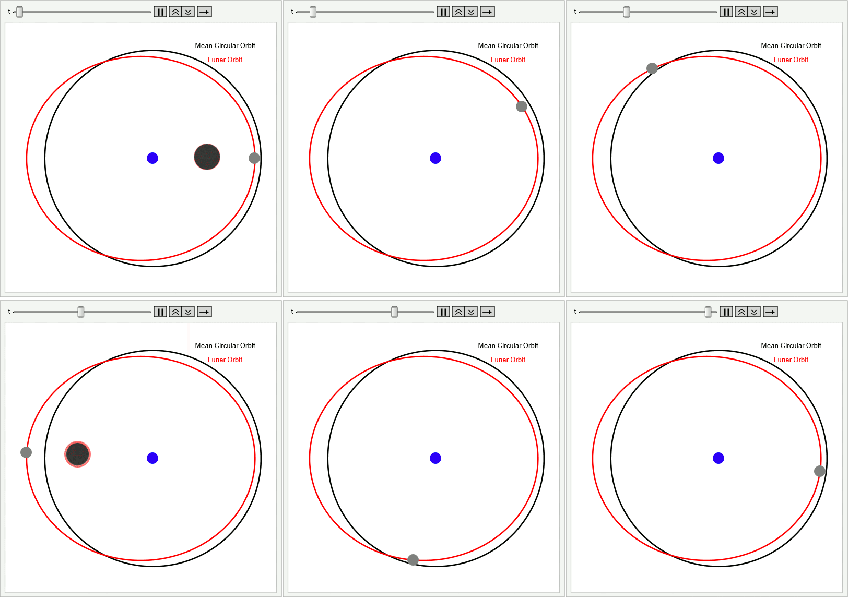
My Dad said I should write you about the bad video that is in your “Elliptically Speaking” post. It shows a circle around a blue dot that’s supposed to be the Earth, and an oval shape that’s supposed to be the Moon’s orbit around the Earth, and blinking thingies that are supposed to show what eclipses look like. I took a screen shot of the video to show you. But the diagram is all wrong because it has two places where the Moon is far away from the Earth and two places where the Moon is closer and that’s wrong. All the orbit pictures I can find in my class books show there’s only one of each. Please fix this. Sincerely, Robin Feder


From: Sy Moire <sy@moirestudies.com>
To: Robin Feder <rjfeder@fortleenj.com>
Subj: Bad Diagram

You’re absolutely correct. That’s a terrible graphic and I’ll have to apologize to Cathleen, Teena and all my readers. Thanks for drawing my attention to my mistake. When I built that animation I was thinking too much about squashed circles and not enough about orbits. I’ve revised the animation, moving the Earth and its circle sideways a bit. Strictly speaking, Earth and the Moon both orbit around their common center of gravity. Also, the COG should be at one focus of an ellipse. An ellipse has two foci located on either side of the figure’s center. However, both of those corrections for the Earth‑Moon system are so small at this scale that you wouldn’t be able to see them. I drew my oval (not a true ellipse) out of scale to make the effect more visible.

Moving the oval so that there’s only one close place and one far place (astronomers call them perigee and apogee) meant that I also had to move the blinking eclipse markers. I think the new locations do a better job of showing why we have both annular and total eclipses. You just have to imagine the Sun being beyond the Moon in each special location so that the eclipse shadow meets the Earth.

I’ve swapped out the bad diagram on the website. Here’s a screenshot of the better diagram I’ve put in its place.

Please remember to use proper eclipse-viewing eyewear when you look at this October’s annular eclipse. And give my regards to your Dad.

~~ Rich Olcott

  • Thanks to Ric Werme for gently pointing out my bogus graphic.

Elliptically Speaking

“Oh. I have one other eclipse question, Dr O’Brien.”

“What’s that, Teena?”

“Well, I found a list of solar eclipses—”

“An interesting place to start, especially for a 10‑year‑old.”

“And it had three kinds of eclipse — total, partial and annual. ‘Total‘ must be when the Moon covers up the whole Sun like when I wink my eye tight. ‘Partial‘ sounds like when I only squinch up my eye like this. I guess that happens when we’re just on the edge of an eclipse track so we still see part of the Sun like we see just part of the Moon most of the time. But my eye wide open is like there’s no eclipse at all. There’s no fourth way to hold my eye left over for ‘annual.’ Besides, ‘annual‘ means ‘every year.’ Is there some special kind of eclipse that comes every year but we don’t see it?”

Cathleen doesn’t quite hide a smile. “Sorry, dear, I think you’ve misread a word. It’s not ‘annual,’ it’s ‘annular.’ They’re very similar and they both came from Latin but they came from different Latin words and have different meanings today. ‘Annual‘ means ‘yearly,’ just as you said. ‘Annular‘ means ‘ring‑shaped‘, like a circle with a hole in the middle.”

“A ring‑shaped eclipse? Is there a big hole in the Moon we only see sometimes?”

“Quite the reverse. The Moon and its shadow are compact, no holes even in an annular eclipse. What we see in those eclipses is a ring of the Sun’s light around the outside of a black disk of Moon‑shadow. The bright ring is called an ‘annulus‘ and you must be very careful to use the special dark glasses to look at it.”

“But … Uncle Sy said the reason we’re so lucky we can see eclipses is that the Moon is just the right size to match the size of the Sun. Does the Moon get smaller for an annular eclipse?”

“Hold up your thumb. Now move your arm out until your thumb just covers my head. Can’t see me at all, can you? Now move your arm out just a little farther until you can see my hair but not my face. Got it? Your thumb didn’t change size, did it?”

“No, it just looked smaller and I could see more of you past it.”

“Right. That’s how an annular eclipse works.”

<drawing Old Reliable from its holster> “Excuse me, Cathleen, I think this might help.”

“What are all those circles, Uncle Sy, and why does it blink?”

“It’s like a map of space. The blue disk represents Earth and the gray disk represents the Moon. If the Moon were always the same distance from Earth it’d follow the black circle, but it doesn’t. It follows the red line which isn’t a true circle. It’s a special shape of squashed circle, called an ellipse. Very few moons or planets follow a truly circular orbit — their track is almost always elliptical to some degree. Now you tell me what the blinky things are about and don’t say it’s when the Moon stops in its orbit because it doesn’t. The animation motion pauses to call attention to when the eclipses happen.”

“Okayyy… Oh! They’re what we’d see in an eclipse, right? The red … ellipse?… brings the Moon closer to us or farther away. When it’s close like over there it’s like my thumb covering Dr O’Brien’s whole head and we don’t see any of the Sun and that’s a total eclipse, right? When we have an eclipse if the Moon’s outside of that circle like on the side, it’s like my thumb farther away and that’s why your picture has the orange ring, it’s an annulus, right?”

“You broke the code, Teena, Well done!”

“I think it’s silly to have two words like eclipse and ellipse that sound so much alike but they’re so different. Like annual and annulus.”

“Sorry about that, sweetie, but we pretty much have to take the language as we find it. English has a long and complicated history. Sometimes I’m surprised it works at all. Sometimes it doesn’t and that makes problems.”

~~ Rich Olcott

Eclipse Vectors

“I think I understand why we have eclipse seasons, Dr O’Meara, but why do the two eclipses in a season travel in such different directions?”

“Put this question on top of Teena’s, Cathleen. Everyone knows the Sun rises in the East because the Earth rotates towards the East. But it seems like eclipses fly eastward even faster than the Earth turns. If that’s true, why?”

“As an Astronomy educator, Sy, I wish ‘everyone’ were truly everyone. You wouldn’t believe the arguments I get from some students when I’m trying to teach 21st Century material. Why are they even in my class?”

“We can only wonder. You and the Flatties, Kareem and the 6000‑year Earthers, poor Jennifer over in Public Health having to cope with the anti‑vaxxers; these contrarians seem to be everywhere. They’re excellent models of Orwellian doublethink — they happily use their science‑dependent smart phones, internet and GPS while they’re trashing Science. Split brains? I dunno.”

“C’mon, Uncle Sy, that’s boring grown‑up stuff. What about my eclipses? Why do they go north or south like that? Does it have to do with those angles that were drawn too big?”

“Sorry, sweetie. Dr O’Meara showed us that the Moon can only make an eclipse if it’s near the Solar System’s plane where Earth’s center stays. The angle of the Moon’s orbital plane only matters when the Moon is away from there.”

“Earth’s center is the Equator! All the eclipses should go on the Equator. But they don’t. That’s wrong.”

“The Equator’s around Earth’s center, Teena, but so are other circles. Think of your globe at home. Does the North Pole point straight up?”

“Noo‑oh … you mean the tilt? Mom said that was about Winter and Summer.”

“Well, she’s not wrong. In the northern hemisphere we have Summer when the North Pole tilts toward the Sun, Winter when it tilts away. That’s only part of the story, though. In Spring and Fall the tilt is broadside to the Sun. Not as hot as Summertime, not as cold as Winter. Those three gyroscopes give us eclipse seasons. But they do more. Look at these diagrams.”

“Sorry, I don’t understand what you’re showing me.”

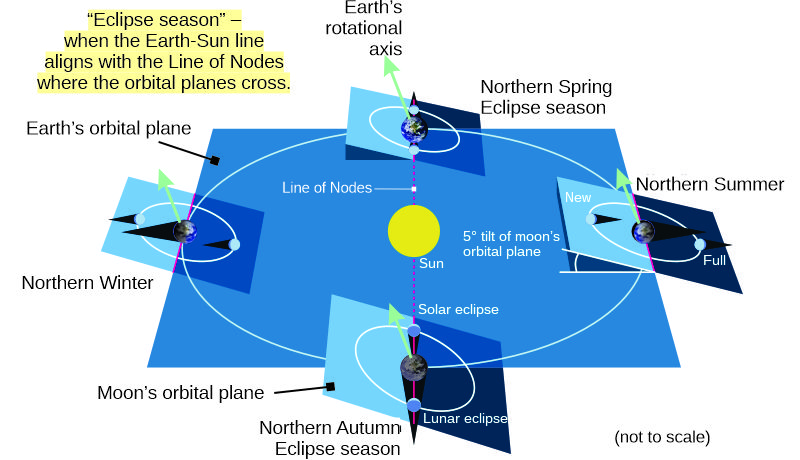
“No worries. In the upper one, the Earth’s in the rear. The North Pole is the green arrow. The Equator’s the yellow band. Pole and Equator are both tilted 23°. The Sun is in front, shining at the Earth. The Earth orbits the Sun counterclockwise so it’s moving to our left. Moving in that direction gives the northern hemisphere more and more daylight so it’s northern Springtime going towards Summer. Okay?”

“Yyyes….”

“Good. The sketch shows eclipse conditions, when the Moon and its shadow are in Earth’s orbital plane. The only places on Earth that can see the eclipse are on the red band. That’s another circle where the plane intersects the Earth’s surface. What direction does that band point on Earth?”

<chortle> “It goes northeast, just like I noticed on that map! Okay, let me think about the other picture… The North Pole’s a gyroscope and doesn’t change direction so we’re looking at us from the other side … Yeah! That red band goes southeast on Earth. Perfect! … Umm, everything’s upside‑down for Bindi in Australia, so does she … Wait, in the upper picture when it’s Springtime for us it’s Autumn for her so her Autumn eclipses go northeast, just like our Springtime ones do! And her Spring’s the bottom picture and her Springtime eclipses go southeast like our Autumn ones, right?”

“Smart girl! I’m going to tell your Mom about your thinking and she’ll be so proud of you. Now, Cathleen, how about speedy eclipses going east faster than the Earth does?”

“It’s not the eclipse going fast, Sy, it’s the Moon. Relative to the Sun‑Earth line, the Moon in its orbit is traveling eastward at just under 3700 kilometers per hour. Meanwhile, a point on Earth’s Equator is heading in the same direction at just under 1700 kph. Places away from the Equator move even slower. The Moon and its shadow win the race going away.”

~~ Rich Olcott

  • Thanks again to Naomi Pequette for her expertise and eclipse‑related internet links.

Eclipse Seasons

“C’mon in, Sy.”

“Morning, Cathleen. You know my niece Teena.”

“Hi, Teena. What brings you here to my office?”

“I’m working on a school project about eclipses, Dr O’Meara, and I noticed something weird. Uncle Sy said you could explain it to me. You know how an eclipse isn’t in just one place, the Moon writes its shadow along a track?”

“Of course, dear, I do teach Astronomy.”

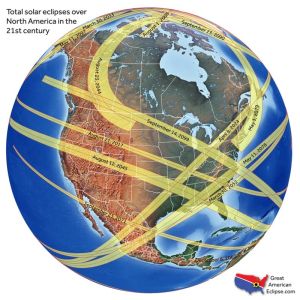
“Sorry, I was just giving context.” <Cathleen and I give each other a look.> “Anyhow, I found this picture of lots of eclipse tracks and see how they weave together almost like cloth?”

“Oh, it’s better than that, Teena. Look at the dates. Is there a pattern there, too?”

“Oooh, the Springtime ones go northeast and the Fall ones go southeast. Hey, I don’t see any in the Summer or Winter! Why is that?”

“It’s complicated, because it’s the result of several kinds of motion all going on at once. Have you ever played with a gyroscope?”

“Uh-huh, Uncle Sy gave me one for my birthday last year. He said that 10 years was old enough I could make it spin without hitting someone’s eye with the string. He was mostly right and I promise I really wasn’t aiming at Brian.”

<another look> “Well … okay. What’s a gyroscope’s special thing?”

“Once you start it spinning it tries to stay pointing in the same direction, except mine acts dizzy a little. Uncle Sy says the really good ones they put in satellites don’t get hardly get dizzy at all.”

“Good, you know gyroscope behavior. Planets spin, too, though a lot slower than your gyroscope. Do you know about planets?”

“Oh yes, when I was small and we looked at the eclipse my Mom and Uncle Sy explained about how we live on a planet that goes round the Sun and sometimes the Moon gets in the way and makes a shadow on us but when the Earth turns so we’re facing away from the Sun we’re in Earth’s shadow.”

“Nice. Well, here’s a diagram about how eclipses happen. It shows four Earth‑images at special points in its orbit. Each Earth has Moon‑images at two special points in the Moon’s orbit. There’s also an arrow coming out of each Earth’s North Pole to show the axis that the Earth spins on. We’ve got three circular motions and each one acts like your gyroscope.”

Adapted from a graphic by Nela, licensed under CCA-SA 4.0

“Does the Moon spin, too?”

“We talked about this a couple years ago, sweetie. The Moon always keeps one face towards the Earth so it spins once each month as it orbits around the Earth. Dr O’Meara’s just using a single circle to cover both, okay?”

“Okay. So there’s three gyroscopes, four really but one’s hiding. The picture says that all three point in different directions, right, and they stay that way?”

“Perfect.”

“Excuse me, but those angles don’t look right. The Earth axis is pointed too close or something.”

“Sharp, Sy. You’re partially correct. Actually, that axis is at a proper 23° angle from the perpendicular to Earth’s orbital plane. It’s the lunar orbital plane and its axis that are off. They’re supposed to be at a 5° angle to Earth’s plane but they’re drawn at 15° to highlight that important line where the two planes meet. The gyroscopes keep that line steady all year.”

“What’s so important about the line?”

“If the Moon is too far above or below Earth’s plane, its shadow is too far above or below Earth to make an eclipse. Eclipses only happen when the line runs through the Sun AND when the Moon is close to the line. The line only runs through the Sun in the Spring and Fall, in this century anyway, so those are our eclipse seasons.”

“Why not every century?”

“A century ago, the eclipses came a few months earlier. The gyroscopes slowly drag the line around Earth’s solar orbit, shifting when the eclipse seasons arrive. If you want a New Year eclipse you’ll have to wait a long, long time.”

~~ Rich Olcott

  • Thanks to Naomi Pequette, Peak Nova Solutions, whose “Eclipses” presentation inspired this post.

Big Spin May Make Littler Spins

“Sorry, Vinnie, if there’s anything to your ‘Big Skip‘ idea you can’t blame Jupiter’s Great Red Spot on Io.”

“Come again, Cathleen? Both you and Sy were acting intrigued.”

“That was before I looked up a few numbers. You suggested that a long‑ago grazing collision between Io and Jupiter could account for Jupiter’s weird off‑center magnetic field, its Great Red Spot and Io’s heat and paltry waterless atmosphere. The problem is, there’s two big pieces of evidence against you. The first is Io’s orbit. It’s almost a perfect circle, eccentricity 0.0041, less than half the average of the other Galilean moons. A true circle has zero eccentricity compared to a parabola at 1.0.”

“So why is that evidence against the idea?”

“There’s virtually zero probability that a chaotic skip would send Io directly into such a perfect orbit. Okay, repetitive tugs from Ganymede’s and Europa’s gravity fields could conceivably have acted together to circularize and synchronize Io’s behavior but that would take millions of years.”

“So it’d take a while. Who’s in a hurry?”

“Your idea is, because of the second piece of evidence. Jupiter is a fluid planet, gaseous‑fluid much of the way in, liquid‑fluid most of the rest, right? Lots of up‑and‑down circulation due to outward heat flow from Jupiter’s core, plus twisty Coriolis winds at all levels powered by the planet’s rotation. All that commotion would smear out any trace of your grazing collision, probably within a hundred thousand years. The scars from Shoemaker-Levy’s impact on Jupiter were gone within months. Circularization’s too slow, smearing’s too fast, idea’s pfft.”

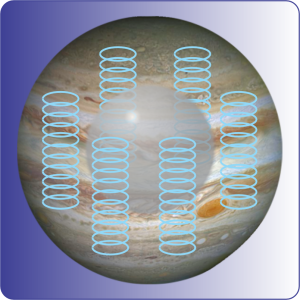
“Oh well, another beautiful picture bites the dust.” Vinnie glances up and to the left, the thing he does when he’s visualizing stuff. (On him, a quick glance up and to the right is a bluff tell but he knows I know which makes things interesting.) “Okay, so we’re thinking about how Jupiter’s weird atmosphere and how its equator rotates faster than its poles. That cylinder spinning inside a spinning cylinder idea looks nice for an explanation but I can think of a different way it could happen. How about like a roller bearing?”

“Hmm?”

“Big spinning columns deep inside all around the planet. Think about what goes on in between those cylinders you talked about — two layers flowing at different speeds right next to each other. There’s gonna be all kinds of watchacallit – turbulence – in there, trying to match things up but it can’t. Sooner or later twisters are gonna grow up to be north‑south columns.”

“He’s got a point, Cathleen. His columns would reduce between‑layer friction at the cost of increased between‑column friction. Depending on conditions that could give a lower‑energy, more stable configuration.”

“Spoken like a true physicist, Sy. Columns may be part of the story, but not all of it. There’s mostly‑for evidence but also really‑against evidence.”

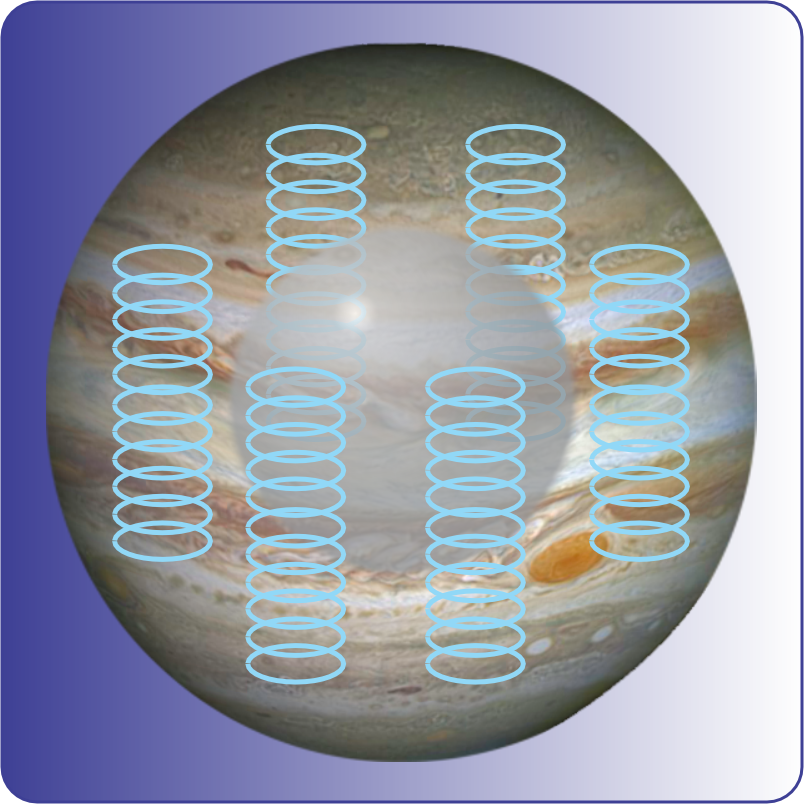
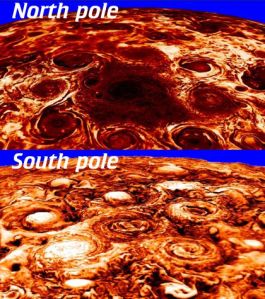
Adapted from images by NASA/JPL-Caltech/SwRI/ASI/INAF/JIRAM

“Give us the ‘mostly‑for,’ make us feel good.”

“You guys.” <drawing tablet from her purse, tapping screen> “Alright, here’s a couple of images that Juno sent us when it orbited over Jupiter’s poles.”

“Sure looks like what was in my mind. I’ve seen that before somewhere…. Yeah, Al had that poster up behind his cash register like five years ago.”

“Impressive memory, Vinnie. Anyway, those vortices are similar to your idea, except look at these images critically.”

“Wait, different whirlpool counts top and bottom.”

“Right. These columns obviously don’t go all the way through. They must extend only partway inward until they’re blocked at some lower level.”

“Why can’t I have my columns all the way through if they’re outside the blocking level?”

“You could and there may be something like that inside the Sun, but that’s probably not the case for Jupiter.”

“Why not?”

“That’s the ‘really‑against’ evidence — the Great Red Spot and Jupiter’s off‑center magnetism. Something’s powerful enough to cause those two massive phenomena. That something would disrupt your ring‑in‑a‑ring rotation, at least down to the level where the disrupter lives. Your columns could only operate in some layer deeper than the disrupter’s level but above whatever’s blocking the polar columns. If there is such a layer.”

“Geez. Well, a guy can still hope.”

“But that’s not Science.”

~~ Rich Olcott

Three Feet High And Rising

“Bless you, Al, for your air conditioning and your iced coffee.”

“Hiya, Susan. Yeah, you guys do look a little warm. What’ll you have, Sy and Mr Feder?”

“Just my usual mug of mud, Al, and a strawberry scone. Put Susan’s and my orders on Mr Feder’s tab, he’s been asking us questions.”

“Oh? Well, I suppose, but in that case I get another question. Cold brew for me, Al, with ice and put a shot of vanilla in there.”

“So what’s your question?”

“Is sea level rising or not? I got this cousin he keeps sending me proofs it ain’t but I’m reading how NYC’s talking big bucks to build sea walls around Manhattan and everything. Sounds like a big boondoggle.” <pulling a crumpled piece of paper from his pocket and smoothing it out a little> “Here’s something he’s sent me a couple times.”

“That’s bogus, Mr Feder. They don’t tell us moon phase or time of day for either photo. We can’t evaluate the claim without that information. The 28‑day lunar tidal cycle and the 24‑hour solar cycle can reinforce or cancel each other. Either picture could be a spring tide or a neap tide or anything in‑between. That’s a difference of two meters or more.”

“Sy. the meme’s own pictures belie its claim. Look close at the base of the tower. The water in the new picture covers that sloping part of the base that was completely above the surface in the old photo. A zero centimeter rise, my left foot.”

“Good point, Susan. Mind if I join the conversation from a geologist’s perspective? And yes, we have lots of independent data sources that show sea levels are rising in general.”

“Dive right in, Kareem, but I thought you were an old‑rocks guy.”

“I am, but I study old rocks to learn about the rise and fall of land masses. Sea level variation is an important part of that story. It’s way more complicated than what that photo pretends to deny.”

“Okay, I get that tides go up and down so you average ’em out over a day, right? What’s so hard?”

“Your average will be invalid two weeks later, Mr Feder, like Sy said. To suppress the the Sun’s and Moon’s cyclic variations you’d have to take data for a full year, at least, although a decade would be better.”

“I thought they went like clockwork.”

“They do, mostly, but the Earth doesn’t. There’s several kinds of wobbles, a few of which may recently have changed because Eurasia weighs less.”

“Huh?”
 ”Huh?”
  ”Huh?”

“Mm-hm, its continental interior is drying out, water fleeing the soil and going everywhere else. That’s 10% of the planet’s surface area, all in the Northern hemisphere. Redistributing so much water to the Southern hemisphere’s oceans changes the balance. The world will spin different. Besides, the sea’s not all that level.”

“Sea level’s not level?”

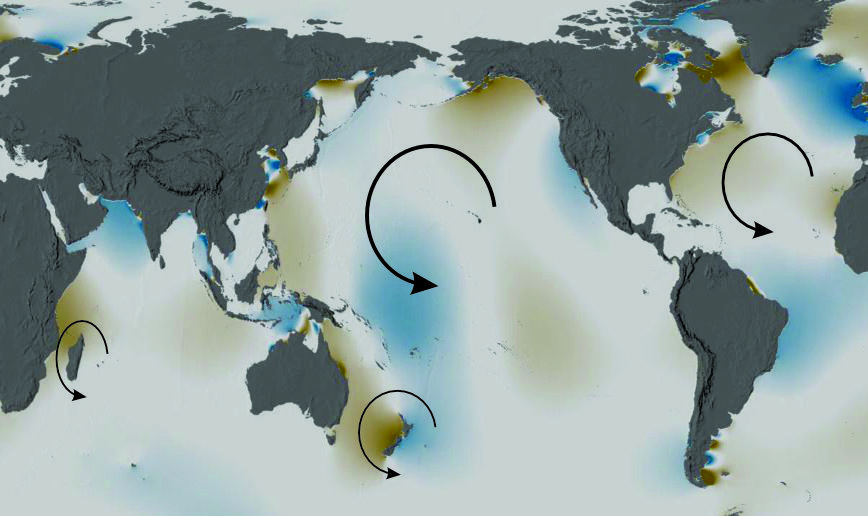
“Nope. Surely you’ve sloshed water in a sink or bathtub. The sea sloshes, too, counterclockwise. Galileo thought sloshing completely accounted for tides, but that was before Newton showed that the Moon’s gravity drives them. NASA used satellite data to build a fascinating video of sea height all over the world. The sea on one side of New Zealand is always about 2 meters higher than on the opposite side but the peak tide rotates. Then there’s storm surges, tsunamis, seiche resonances from coastal and seafloor terrain, gravitational irregularities, lots of local effects.”

Adapted from a video by NASA’s Scientific Visualization Studio

Susan, a chemist trained to consider conservation of mass, perks up. “Wait. Greenland and Antarctica are both melting, too. That water plus Eurasia’s has to raise sea level.”

“Not so much. Yes, the melting frees up water mass that had been locked up as land-bound ice. But on the other hand, it also counteracts sea rise’s major driver.”

“Which is?”

“Expansion of hot water. I did a quick calculation. The Mediterranean Sea averages 1500 meters deep and about 15°C in the wintertime. Suppose it all warms up to 35°C. Its sea level would rise by about 3.3 meters, that’s 10 feet! Unfortunately, not much of Greenland’s chilly outflow will get past the Straits of Gibraltar.”

~~ Rich Olcott

Loud Enough Was Good Enough

“Okay, Moire, enough with the strings. I got another question.”

“Of course you do, Mr Feder, but step along more quickly, please. In this heat the sooner I get back to the air conditioning the better I’ll like it.”

“Alright,” <puffing> “why all this fuss about the Voyager 2 spacecraft missing its target by two degrees? Earth’s pretty big, two degrees I can barely see on a protractor. Should be an easy hit.”

“Can you see the Moon?”

“Sure, if there’s no clouds in front of it. Sometimes even in the daytime.”

“A full Moon is only half a degree wide, ¼ of your two degrees.”

“No!”

“Yes.”

“But when it’s just rising it’s huge, takes up half the sky.”

“Check that carefully some evening. Hold up your hand at arm’s length. Your little finger’s about one degree wide. The Moon will be half as wide as that no matter where it is in the sky, we’ve talked about this. You can see half a degree easy and probably a lot less than that. Tycho Brahe, the last great pre‑telescope astronomer, was able to make measurements as small as 1/150 of a degree.”

“Okay, I guess two degrees is a little bigger than I was thinking. But still, Earth’s pretty big, there’s no excuse for Voyager 2 missing it by two degrees.”

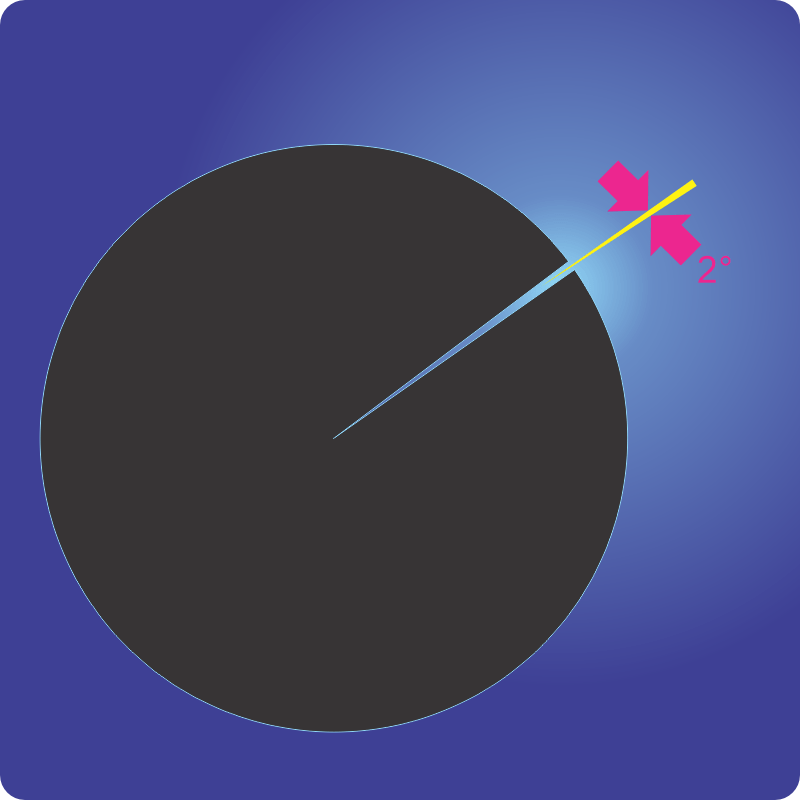
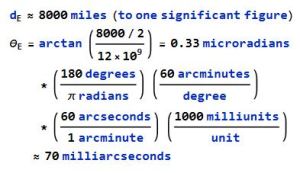
“A two‑degree angle is huge when it extends across astronomical distances.” <drawing Old Reliable from its holster, tapping screen> “From Voyager 2‘s perspective at 12 billion miles out the short leg of a two‑degree isosceles triangle spans 419 million miles. That’s over twice the width of Earth’s orbit! Poor Voyager could be pointing past Mars away from us.”

“Big distances from a small angle make a long triangle, got it. What did NASA have to do to get things pointed right again?”

“I consider it a technological miracle. At Voyager‘s distance, Earth’s 8000‑mile diameter spans only 70 milliarcseconds. And before you ask, a milliarcsecond is a thousandth of 1/60 of 1/60 of a degree, about 3 billionths of the way across your little finger. Pretty darn small. Frankly, I’m amazed that Voyager 2 has been able to keep its antenna pointed at us so accurately for so long using tech that dates back to the mid‑70s and earlier. Our tax dollars working hard.”

“Amazing, yeah — something like that’s gotta have a kajillion moving parts. A lubrication nightmare in space I bet.”

“Not as many as you might think. The only parts that move on purpose are small things like its gyroscopes, its tracking optics and the valves on its attitude‑adjustment thrusters.”

“Wait, how’d they point the antenna towards us in the first place? I figured that was on gears.”

“Way too much play in a gear train for this level of accuracy. No, the antenna’s solidly fixed to the rest of the structure. Voyager 2‘s Attitude and Articulation Control System adjusts the whole probe as a unit using propellant bursts through its choice of little thrusters. The mass of a single burst is so small compared to the spacecraft mass that the AACS can manage milliarcsecond‑level orientation control.”

“I heard they finally got it talking to us again. How’d they manage that if it was pointed the wrong way?”

“The key is it was only mostly pointing the wrong way.”

“Like the guy’s ‘mostly dead’ in Princess Bride?”

“Mr Feder, you know that movie?”

“Hey, it’s got the greatest sword fight ever, plus the two‑cups poison challenge and the part where the pirate keeps insulting the prince. What’s not to like? Whaddaya mean, mostly the wrong way?”

Voyager 2‘s antenna is parabolic, the best shape for transmitting a tight beam. Best doesn’t mean perfect — 50% of the beam’s power stays within a degree or so either side of the center but the rest leaks out to the sides. The same pattern applies to signal reception. Optimal reception happens when the antenna is pointing right at you. If it’s aimed off‑center, reception is worse. Our normal transmission power level wasn’t high enough to punch though the two-degree offset penalty but NASA’s extra-high-power ‘shout’ worked.”

“Caught the flash outta the corner of its eye, huh?”

~~ Rich Olcott

White Noise And Red

“That point’s kinda weak, Sy. The NANOGrav team says 15 years of pulsar timing data let them hear the Universe humming. What’s the difference if they call it a hum or a rumble or a warble?”

“Not much, Vinnie. Matter of taste and scale, I guess. As a human I think of a ‘hum‘ as something in the auditory range, roughly 60‑120 cycles per second. Whatever these folks have found, it rumbles in years per cycle. Scaled to the Sun’s ten‑billion‑year lifetime I suppose that’d be a supersonic screech.”

“Whatever they’ve found? We don’t know?”

“Not yet, Al. The team likes one hypothesis but it’ll take years to collect enough data for firm support or refutation.”

“In addition to the 15 years‑worth they’ve got already? Why not just add more antennas?”

“What they’re following changes so slowly they need a long baseline to have confidence that jiggles they see are real. Part of this paper is about conclusions the team reached after they stuck a few extra years of old data onto the front of their time series.”

“You can do that?”

“Sure. The series is just a big database, like a spreadsheet with a page for each pulsar and a row on that page for each blink. The row captures the recorded time for the blink’s peak, but also a bunch of other data like measures related to pulse width and asymmetry, the corrected peak time, identifiers for the reporting observatory and reference time standard—”

Corrected time? Looks suspicious. What did they correct for?”

“Of course you’re suspicious, Vinnie, but so are they and so are other astronomers. You don’t want to make a big announcement like this unless you’ve checked everything for error sources. For instance, Earth moving around the Sun means we’re a little closer to a particular pulsar at one time of year, further away six months later.”

“So you correct the timings to what they’d be at the Sun’s center, right?”

“That’s just for starters. Jupiter and the Sun orbit around their common center of gravity on an 11.8‑year cycle. The researchers had to pull data from the Juno mission to correct for the Sun’s personal waltz. Of course the Solar System is moving relative to the stellar background, another correction. Then maybe the pulsar itself is part of a binary, happens a lot, and it’s probably moving through the sky, too — lots of careful corrections. That’s step one.”

“Then what?”

“Use each pulsar’s corrected timings to build a mathematical model of its idealized behavior. Once you know what’s ‘normal‘, you can start talking about jiggles that deviate from normal.”

“Reminds me of the ephemeris trick — sort of build an artificial pulsar to compare against.”

“Exactly the same idea, Vinnie, and by the way, ephemerides are still used but not to define the length of a second. Step three is statistical analysis: compare all possible deviation histories, every pulsar against every other pulsar.”

“Sounds like a lot of work, even for a computer. So what did they find?”

“Well, what they observed was that the pulsar timings we received weren’t as absolutely regular as they would have been with a static gravitational field. The overall picture resembled fog in a noisy room, waves of every size skittering in every direction and messing up reception. When the researchers broke that picture down by frequency, the waves shorter than 21 months or so added up to just white noise, complete randomness.”

“A hiss, not a hum. What about the longer waves?”

Fig 1(c) from Agazie, el al (2023).

“Red noise — jiggles heavy‑loaded on longer wavelengths out to the 16‑year maximum their data’s good for so far. But that’s not all. When they plotted jiggle correlation between pulsars separated at different angles across the sky, the curve mostly matched a prediction for the gravitational wave pattern that would be generated by a large number of randomly distributed independent sources.”

“Lots of sources, which would be…?”

“We don’t know. One hypothesis is that they’re pairs of supermassive black holes orbiting each other at the centers of merged galaxies. But I’ve read another paper giving a dozen other explanations. Everyone’s waiting for more data.”

~~ Rich Olcott

Not A Hum, A Rumble

Vinnie taps on the magazine. “Sy, you’ve done it again. We ask you one question, you spend a lot of time talking about something else entire. They got this article here” <tap> “says the NANOGrav team captured the hum of the Universe. Al and me, we ask you about that and you get us discussing pulsars. Seems to me,” <tap tap> “that if you got a pulsar and the pulses got only a 3% duty cycle they’d sound more like clicks and,” <taptaptaptap> “if it’s a 10 millisecond pulsar that’s a hundred per second and they’d be more like a low‑pitched buzz, nothing like a hum.”

“One more short detour, Vinnie, sorry. Remember when we discussed the VLA, the Very Large Array of radio telescopes in northern New Mexico?”

“Sorta. I do remember visiting the place, out in the desert miles away from anywhere. They’ve got a couple dozen dish antennas each as wide as a four‑lane road, all spread out along railroad tracks. Big dishes for catching weak signals I understand, but I forget why there’s lots of dishes instead of one huge one or how that even works.”

“One reason is simple mechanics. A huge dish would try to sail away in the desert wind. VLA admins even have to safe‑mount those 25‑meter ones when things get gusty. But the real reason goes to how the array works as one big instrument. Here’s a hint — the dishes can be miles apart and lightspeed isn’t infinite.”

“Ah, that joggled my memory. It’s about when a signal comes in from some nova or something, each dish registers it with a slightly different arrival time and then the computers play match‑up games with all the time differences to figure exactly what angle the signal came from, right?”

“Roughly. The VLA’s multi‑dish design is about being able to resolve signal sources that are close together in the sky so yeah, slightly different angles. The Event Horizon Telescope team used the same strategy and a collection of radio dishes all over the world to produce those orange‑ring images of supermassive black holes. NANOGrav and the other Pulsar Timing Arrays sort of the flip the strategy.”

“At last we get to NANOGrav. Wait, they use lots of antennas to send signals to a star?”

“Nothing like that, Al. No, they use just a few antennas but they track the timing of many pulsars. About 70 at last count.”

“But we know what the timing is, to nanoseconds you said.”

“One word, Vinnie. ‘Frames‘.”

“Aw geez, Sy. Again?”

“Mm-hm. In the pulsar’s frame, it’s majestically rotating at a steady pace, tens or hundreds of times per second relative to its neighbors. Its beam proudly announces its presence on an absolutely regular schedule save for a small but steady slow‑down. In our frame, though, things can happen to a pulse as it heads our way.”

“Like what?”

“It might pass through a molecular cloud. We know those exist. Photons in the right wavelength ranges could interact with cloud components. That’d delay them, stretch the pulse, might even create interference between successive pulses. On the theory side, some cosmologists think the Universe may hold objects like cosmic strings or curvature‑induced domain walls that could delay, deflect or otherwise mess up a pulse. The best possibility, though, is that a gravitational wave could cross the path of a pulse en route to us.”

“Why is that a good thing?”

“Because they’d interact to alter that pulse’s timing. Gravitational waves stretch and squeeze time as they squeeze and stretch space. If a wave crosses a traveling pulse, the pulse will get here either early or late depending. Better yet, if we track enough pulsars scattered across the sky we might even see a parade of offset timings as the wave encounters different pulse beams. Hasn’t happened yet, though. The NANOGrav reports so far are about the background variation as waves from everywhere traverse the paths we’re watching.”

“The article says a hum.”

“Hum sounds come in waves per second. The gravitational background happens in waves per decade, such a low frequency even elephants couldn’t hear it.”

“OK, it’s rumble, not a hum. But why either one?”

~~ Rich Olcott