Traces of Disparity

Cathleen’s an experienced teacher — she knows when off-topic class discussion is a good thing, and when to get back to the lesson plan. “My challenge question remains — why isn’t Earth’s atmosphere some average of the Mars and Venus ones? Thanks to Jeremy and Newt and Lenore we have reason to expect the planets to resemble each other, but in fact their atmospheres don’t. Maria, tell us what you’ve found about how Earth compares with the others.”

“Yes, Profesora. I found numbers for many of the gasses on each planet and put them into this chart. One thing Earth is right in the middle, most things not.”
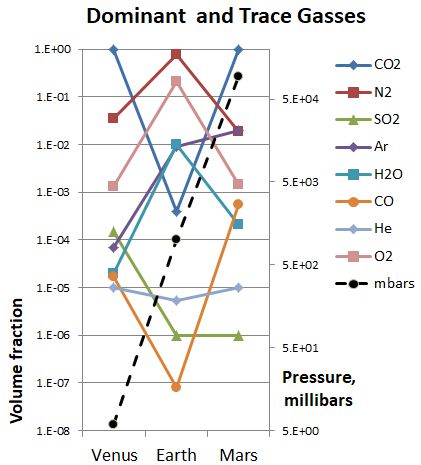
“That’s a complicated chart. Read it out to us.”

“Of course. I had to make the vertical scales logarithmic to get the big numbers and small numbers on the same chart. First is the pressure which is the black dotted line. Venus pressure at the surface is nearly 100 times ours but Mars pressure is a bit less than 1/100th of ours. Does that count as Earth being in the middle?”

“That’d be a geometric average. It could be significant, we’ll see. Go on.”

“The gas that is almost the same everywhere is helium, the grey diamonds. That surprised me, because I thought the giant planets got all of that.”

Al’s been listening in. Nothing else going on in his coffee shop, I guess. “I’ll bet most of that helium came from radioactive rocks, not from space. Alpha particles, right, Cathleen?”

Cathleen takes unexpected interruptions in stride. “Bad bet, Al. Uranium and other heavy elements do emit alphas which pick up electrons to become helium atoms. You probably remembered Cleve and Langlet, who first isolated helium from uranium ore. However, the major source of atmospheric alphas is the solar wind. Solar wind interception and atmosphere mass are both proportional to planetary surface area so a constant concentration like this is reasonable. Continue, Maria.”

“The major gasses follow a pattern — about the same fractions on Venus and Mars but much higher or lower than on Earth. Look at carbon dioxide, nitrogen, even oxygen.”

Astronomer-in-training Jim has been doing some mental arithmetic. “Our atmosphere is 100 times denser than on Mars, and Venus is another factor of 100 beyond that. That’s a factor of 104 between them — for every molecule of CO2 on Mars there’s 10,000 on Venus. Oh, but Venus has four times Mars’ surface area so make that 40,000.”

“Good points, both of you. Jim’s approximation leads into something we can learn from Maria’s trace gas numbers. Why do you suppose the concentration of SO2 is about the same for Earth and Mars but 100 times higher on Venus, but the reverse is true for argon? Where do they each come from?”

Jeremy finally has something he can contribute. “Volcanoes! They told us in Geology class that most of our SO2 comes from volcanoes. Before the Industrial Revolution, I mean, when we started burning high-sulfur coal and fuel oils and made things worse. Venus has to be the same. Except for the industry, of course.”

“Probably correct, Jeremy. From radar mapping of Venus we know that it has over 150 large volcanoes. We don’t know how many of them are active, but the Venus Express spacecraft sent back evidence of active vulcanism. In fact, Venus’ SO2 score would probably be even higher if much of its production didn’t oxidize to SO3. That combines with water to form the clouds of sulfuric acid that hide the planet’s surface and reflect sunlight so brightly.”

Maria’s hand is up again. “I don’t understand argon’s purple diamonds, profesora. I know it’s one of the inert gasses so it doesn’t have much chemistry and can’t react into a mineral like CO2 and SO2 can. Shouldn’t argon be about the same on all three planets, like helium?”

“Mm-hm, argon does have a simple chemistry, but its radiochemistry isn’t so simple. Nearly 100% of natural argon is the argon-40 isotope created by radioactive decay of potassium-40. Potassium is tied up in the rocks, so the atmospheric load of argon-40 depends on rocky surface erosion. Not much erosion, not much argon.”

Al’s on tenterhooks. “All this is nice, but you still haven’t said why Earth’s atmosphere is so different.”

~~ Rich Olcott

The Still of The Night

Lenore raises her hand. “Maybe it’s my Chemistry background, but to me that protosolar disk model for the early Solar System looks like a distillation process. You heat up a mixture in the pot and then run the resulting vapors through a multi-stage condenser. Different components of the mixture collect at different points in the condenser depending on the local temperature or maybe something about the condenser’s surface. I got some fun correlations from data I dug up related to that idea.”

“Interesting perspective, Lenore You’re got the floor.”

“Thanks, Professor. Like Newt said, hydrogen and helium atoms are so light that even a low-energy photon or solar wind particle can give them a healthy kick away from the Sun and they wind up orbiting where the gas planets grew up. But there was more sorting than that. Check out this chart.”

“What’re the bubbles?”

“Each bubble represents one planet. I’ve scaled the bubble to show what fraction of the planet is its nickel-iron core. Mercury, for instance, is two-thirds core; the other third is its silicate crust and that’s why its overall density is up there between iron and silicates. Then you go through Venus and Earth, all apparently in the zone where gravity’s inward pull on heavy dust particles is balanced by the solar wind’s intense outward push. From the chart I’d say that outbound metallic and rocky materials are mostly gone by the asteroid belt. Big Jupiter grabs most of the the hydrogen and helium; its little brothers get the leavings. Mars looks like it’s right on the edge of the depletion zone — the numbers suggest that its core, if it has one, is only 12% of its mass.”

Jeremy’s ears prick up. “If it has one?”

“Yeah, the sources I checked couldn’t say for sure whether or not it does. That’s part of why we sent the Insight lander up there. Its seismic data should help decide the matter. With such a small iron content the planet could conceivably have cooled like silicate raisin bread. It might have isolated pockets of iron here and there instead of gathered in at the center.”

“Weird. So the giant planets are all — wait, what’s Saturn doing with a density below water’s?”

“You noticed that. Theoretically, if you could put Saturn on a really big pool of water in a gravity field it’d float.”

Meanwhile, astrophysicist-in-training Newt Barnes has been inspecting the chart. “Uranus and Neptune don’t fit the pattern, Lenore. If it’s just a matter of ‘hydrogen flees farthest,’ then those two ought to be as light as Saturn, maybe lighter.”

“Yeah, that bothered me, too. Uranus and Neptune are giant planets like Jupiter and Saturn, but they’re not ‘gas giants,’ they’re ‘ice giants.’ All four of them seem to have a junky nickel-iron-silicate core, maybe 1-to-10 times Earth’s mass, but aside from that the gas giants are mainly elemental hydrogen and helium whereas Uranus and Neptune are mostly compounds of oxygen, nitrogen and carbon with hydrogen.”

“How’d all those light atoms get so far out beyond the big guys?”

“Not a clue. Can you help, Professor?”

Cathleen draws ellipses on Al’s whiteboard. “Maybe they did, maybe they didn’t — the jury’s still out. We’re used to our nice neat modern Solar System where almost everything follows nearly circular orbits. It took a while to evolve there starting from the chaotic protosolar disk. Many of the early planetesimals probably had narrow elliptical orbits if they had an orbit at all, considering how often they collided with each other. Astromechanics modelers have burned years of computer time trying to account for what we know of the planets, asteroids, comets and the Kuiper and Oort formations we’ve barely begun to learn about. Some popular ‘Jumping Jupiter‘ models show Jupiter and Saturn migrating in towards the Sun and out again, playing hob with Uranus, Neptune and maybe a third ice giant before that one was ejected from the system altogether. It’s entirely possible that the ice giants grew up Sunward of the hydrogen-rich gas giants. We just don’t know.”

“That’s a challenge.”

“Yes, and my challenge question remains — why isn’t Earth’s atmosphere some average of the Mars and Venus ones?”

~~ Rich Olcott

Helios versus Mars, Planetary Version

Al waves me over the moment I step through the door of his coffee shop.  “Sy, ya gotta squeeze into the back room.  The grad students are holding another Crazy Theory contest and they’re having a blast.  I don’t know enough science to keep up with ’em but you’d love it.  Here’s your coffee.”

“Thanks, Al.  I’ll see what’s going on.”

The Crazy Theory contest is a hallowed Al’s Coffee Shop tradition — a “seminar” where grad students present their weirdest ideas in competition.  Another tradition (Al is strong on this one) is that the night’s winner has to sweep up the thrown spitballs and crumpled paper napkins at the end of the presentations.  I weave my way in just as the girl at the mic finishes her pitch with, “… and that’s why Spock and horseshoe crabs both have green blood!”

Some in the crowd start chanting “Amanda!  Amanda!  Amanda!”  She’s already reaching for the Ceremonial Broom when Jim steps up to the mic and waves for quiet.  “Wanna hear how the Sun oxidized Mars and poisoned it for us?”

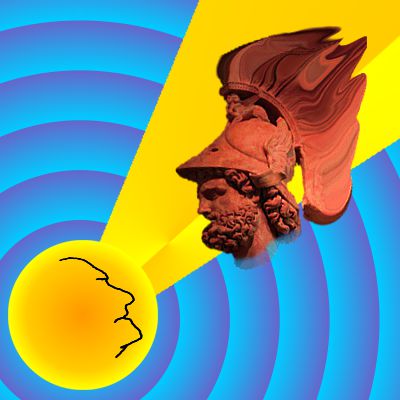
Helios and Mars
Helios and Mars
Mars image adopted from photo by Mark Cartwright
Creative Commons license
Attribution-NonCommercial-ShareAlike

Voice from the crowd — <“The Sun did what?”>

“You remember titration from school chem lab?”

.——<“Yeah, you put acid in a beaker and you drip in a base until the solution starts to turn red.”>

“What color is Mars?”

.——<“Red!”>

“Well, there you are.”

.——<“Horse-hockey!  What’s that got to do with the Sun or what you said about poison?”>

“Look at what our rovers and orbiters found on Mars — atmosphere only 1% of Earth’s but even that’s mostly CO2, no liquid water at the surface, rust-dust everywhere, soil’s loaded with perchlorate salts.  My Crazy Theory can explain all of that.”

.——<“Awright, let’s hear it!”>

“Titration’s all about counting out chemical species.  Your acid-base indicator pinked when you’d neutralized your sample’s H+ ions by adding exactly the right number of OH ions to turn them all into H2O, right?  So think about Mars back in the day when it had liquid water on the ground and water vapor in the atmosphere.  Along comes solar radiation, especially the hard ultra-violet that blows apart stratospheric H2O molecules.  ZOT!  Suddenly you’ve got two free hydrogen atoms and an oxygen floating around.  Then what happens?”

It’s a tough crowd.  <“We’re dying to hear!  Get on with it!”>

“The hydrogens tie up as an H2 molecule.  The escape velocity on Mars is well below the speed of H2 molecules at any temperature above 40K, so those guys abandon Mars for the freedom of Space.  Which leaves the oxygen atom behind, hungry for electrons and ready to oxidize anything it can get close to.”

They’re starting to come along.  <“Wouldn’t the oxygen form O2 and fly away too?”>

“Nowhere near as quickly.  An O2 molecule is 16 times heavier than an H2 molecule.  At a given temperature it moves 1/4 as fast and mostly stays on-planet where it can chew up the landscape.”

.——<“How could an atom do that?”>

“It’s a chain process.  First step for the O is to react with something else in the atmosphere — make an oxidizing molecule like ozone or hydrogen peroxide.  That diffuses down to ground level where it can eat rocks.”

.——<“Wait, ‘eat rocks’!!?!  How does that happen?”>

“Look, most rocks are basically lattices of double-negative oxide ions with positive metal ions tucked in between to balance the charge.  Surface oxide ions can’t be oxidized by an ozone molecule, but they can transmit electron demand down to the metal ions immediately underneath.  An iron2+ ion gets oxidized to iron3+, one big step towards rust-dust.  The charge change disrupts the existing oxide lattice pattern and that piece of the rock erodes a little.”

.——<“What about the poison?”>

“Back when Mars had oceans, they had to have lots of chloride ions floating around to be left behind when the ocean dried up.  Ozone converts chloride to perchlorate, ClO4, which is also a pretty good oxidizer.  Worse, it’s the right size and charge to sneak into your thyroid gland and mess it up.  Poison for sure.  Chemically, solar radiation raised the oxidation state of the whole planet.”

One lonely voice — “Nice try, Jim” — but then the chant returns…

.——<“Amanda!  Amanda!  Amanda!”>

~~ Rich Olcott

Three atop A Crosshatch

“Hey, Sy, what you said back there, ‘three and a fraction‘ ways to link atoms together…”

“Yeah, Vinnie?”

“What’s that about?  How do fractions come in when you’re counting?”

“Well, I was thinking about how atoms in separate molecules can interact short of reacting and forming new molecular orbitals.  I figure that as a fraction.”

Charge sharing ain’t the whole story?”

“It would be except that sharing usually isn’t equal.  It depends on where the atoms are in the Periodic Table.”

“What’s it got to do with the Periodic Table?”

“The Table’s structure reflects atom structures — how many shells are active in a base-state atom of each element and how many units of charge are in its outermost shell.  Hydrogen and Helium are in Row 1 because the 1-node shell is the only active one in those atoms.  The atoms from Lithium to Neon in Row 2 have charge activating both the 1-node shell and the 2-node shell, and so on.”

“What’s that get us?”

“It gets us a feel for how the atoms behave.  You know I’m all about dimensions, right?”

“Ohhh, yeah.”

“OK, we’ve got a two-dimensional table here.  Going across, each atom’s nucleus has one more proton than its buddy to the left.  What’s that going to do to the electronic charge?”

“Gonna pull it in closer.”

“Wait, Vinnie, there’s an extra electron in there, too.  Won’t that cancel out the proton, Sy?”

“Good thinking, Eddie.  Yes, it does, but only partially.  The atoms do get smaller as you go across, but it’s irregular because negative-negative repulsion within a shell works to expand it almost as much as negative-positive attraction contracts it.”

“Bet things get bigger as you go down the Table, though.”

“Mostly, Vinnie, because each row down adds a shell that’s bigger than the shrinking inner shells.”

“Mostly?”

“The bigger shells with more nodes have more complex charge patterns than just balls and dumbbells.  Those two rows below the main table actually squinch into the lowest two boxes in the third column.  In those elements, some of the activated patterns barely shield the nucleus.  The atoms to their right in the main table are almost identical in size to the elements above them.”

“So I can guess an atom’s size.  So what?”

“So that and the charge give you a handle on the element’s properties and chemistry.  Up there in the top right corner you’ve got the atoms with the highest ratio of nuclear charge to size.  If given the opportunity to pull charge from atoms to their left and below them, what do you suppose happens?”

“You get lop-sided bonds, I guess.”

“Exactly.  In water, for instance, the Oxygen pulls charge towards itself and away from the Hydrogen atoms.  That makes each O-H bond a little dipole, positive-ish at the hydrogen end and negative-ish at the oxygen end.”

“Won’t the positive-ish ends pull on the negative-ish parts of next-door molecules?”

“You’ve just invented hydrogen bonding, Eddie.  That’s exactly what happens in liquid water.  Each molecule can link up like that with many adjacent ones and build a huge but floppy structure.  It’s floppy because hydrogen bonds are nowhere near as strong as orbital-sharing bonds.  Even so, the energy required to move through liquid H2O or to vaporize it is much greater than for liquid methane (CH4), ammonia (NH3) or any similar molecule.”

“Can that pull-away action go all the way?”

“You’ve just invented ionic bonding, Vinnie.  The elements in the Oxygen and Fluorine columns can extract charge completely away from many of those far to the left and below them.  Fluorine steals charge from Lithium, for instance.  Fluoride ions are net negative, lithium ions are net positive.  Opposites attract, same as always, but now it’s  entire ions that attract each other and you get crystals.”

“That’s your and-a-fraction?”

“Not quite, Vinnie.  There’s one more, Van der Waals forces.  They come from momentary polarizations as electron chaos sloshes back and forth in neighboring molecules.  They’re why solids are solid even without ionic or hydrogen bonding.”

“Geez, look at the time.  Rosalie’s got my dinner waiting.  Bye, guys, everybody out!”

~~ Rich Olcott

The Mastery of The Pyramids

“Hard to believe, Sy.”

“What’s hard to believe, Vinnie?”

“What you said back there, about all molecules being tetrahedron-shaped.”

“Whoa, that’s not what I said.  What I did say was that the tetrahedron is the fundamental structural building block for most of the Universe’s molecules. To put a finer point on it, it’s the building block for most kinds of molecules.”

“What kinds are you leaving out?”

“Molecular hydrogen, for instance.  It’s probably the most common molecule in the Universe but it’s got only two atoms and two electrons and it doesn’t do tetrahedra.  I was talking about almost all the other flavors.  Molecules can have all kinds of shapes, from spherical to long and skinny.  Say, Eddie, do your kids play with Legos?”

“Geez, yes.  My feet find blocks all over the house.  Only thing worse is glitter.”

“You can build just about any shape from those rectangular blocks, right?  Pegs on one block plug into holes on other blocks and pretty soon you’ve got a rocket ship or something.  Atoms can work the same way.  Four bonding orbitals pointing out to those pyramid corners, ready to share with whatever comes along.”

“Not just with hydrogen like with that CH4 stuff?”

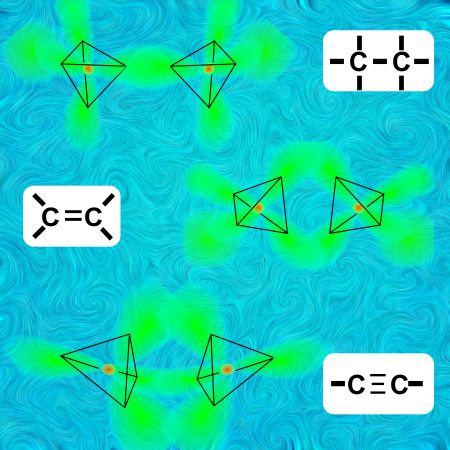
“Depends on the atom, but in general, yeah.  Except for the outermost columns of the Periodic Table, most of the elements in the upper rows can be persuaded to share at least one bond with most of the others.  Carbon’s the champ that links with practically everything.”Tetrahedral bonding

“Even carbon?”

“Especially carbon, Vinnie.  Linking to carbon is carbon’s best thing.  It’s even got three and a fraction different ways to do it.  Here’s a sketch.  It boils down to the different ways you can have two tetrahedra match up points.”

“Lemme look at this for a minute… OK, that point-to-point one at the top —”

“It’s called a single bond.”

“Whatever, you’re saying that could be like two –CH3 pieces tied together.”

“Mm-hm.  The –CH3‘s are methyl groups, and with two of them you’ve got ethane.  Or link a methyl to a –CH2CH3 and you’ve got propane, or link it to an –OH to get methyl alcohol.  At least in principle you can pop a methyl onto any other atom or molecule that started off with only one unit of charge in an unshared orbital.”

“So it’s like my daughter’s bead necklace where she can pop it apart and add all different kinds of beads.”

“Exactly, Eddie, except her beads probably have their two links in a straight line.  These atoms support four links at 109° angles to each other.”

“That picture reminds me of one of my kids’ toys that’s like a top spinning on top of another top.  Is there anything that locks the two sides together so they can’t do that?”

“One way is if the two sides are each linked to bulky groups that get in each other’s way.  Hydrogens don’t much.  Scientists have measured methyl group rotation rates above 10 million cycles per second.”

“Hey, I’m still looking over here.  These other diagrams say that the tetrahedron things can link along an edge —”

“That’d be a double bond, Vinnie.”

“Looks to me like those double-bond shapes are locked in.  No rotation there, right?”

“Right.  In fact, rotational stability across a double bond is so strong that different arrangements operate like different compounds.  Switching A\B:C\D to A\B:D\C can be the difference between a useful med and something that’s inert or even toxic.”

“And I suppose when they match up whole triangles that’s a triple bond?”

“You got it.”

“Well, that can’t spin, for sure.”

“Nah, Vinnie, that’s like the atom-in-a-field thing, no difference between x- and y- axes.  Spinning like crazy except you can’t see it.”

“Eddie’s right, Vinnie.  The four atoms in a triple-bond structure are in a line.  The charge of three electron pairs mushes into a barrel-shaped region between the two carbons.”

“All that pent-up charge, I bet it’s reactive as hell.”

“Uh-huh.  With hydrogen atoms at both ends that’s acetylene gas.  Let that stuff touch copper and you get explosive decomposition.”

“So that’s why they say don’t run acetylene through copper tubing or brass fittings.”

“Believe it, Vinnie.  Believe it.”

~~ Rich Olcott

To Bond Or Not To Bond, That Is The Question

Vinnie’s pushing pizza crumbs around his plate, watching them clump together.  “These molecular orbitals gotta be pretty complicated.  How do you even write them down?”

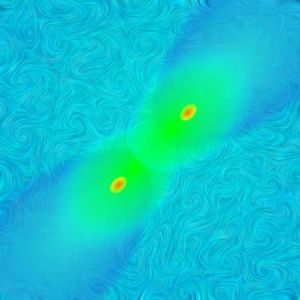
“Combinations.  There’s a bunch of different strategies, but they all go back to Laplace’s spherical harmonics.  Remember, he showed that every possible distribution around a central attractor could be described as a combination of his patterns.  Turn on a field, like from another atom, and you just change what combination is active.  Here’s a sketch of the simplest case, two hydrogen atoms — see how the charge on each one bulges toward the other?  The bulge is a combination of a spherical orbital and a dumbbell one.  The molecular orbitals are combinations of orbitals from both atoms, describing how the charges overlap, or not.”Hydrogen molecule

“What’s that blue in the other direction?”

“Another possible combination.  You can combine atomic orbitals with pluses or minuses.  The difference is that the minus combination will always have an additional node in between.  Extra nodes mean higher energy, harder to activate. When the molecule’s in the lowest energy state, charge will be between the atoms where that extra node isn’t.”

“So the overlapped charge here is negative, right, and it pulls the two positive nucleusses —”

“Nuclei”

“Whatever, it pulls ’em together.  Why don’t they just merge?”

“Positive-positive repulsion counts, too.  At the equilibrium bond distance, the nuclei repel each other exactly as much as the shared charge pulls them together.”

Eddie’s still hovering by our table.  “You said that there’s this huge number of possible atomic orbitals.  Wouldn’t there be an even huger number of molecular orbitals?”

“Sure.  The trick is in figuring out which of them are lowest-energy and activated and how that relates to the molecule’s configuration.  Keep track of your model’s total energy as you move the atoms about, for instance, and you can predict the equilibrium distance where the energy is a minimum.  In principle you can calculate configuration changes as two molecules approach each other and react.”

“Looks like a lot of work.”

“For sure, Eddie.  Even a handful of atoms has lots of atomic orbitals to keep track of.  That can burn up acres of compute time.”

Vinnie pushes three crumbs into a triangle.  “You got three distances, you can figure their angles.  So you got the whole shape of the thing.”

“Right, but like Eddie said, that’s a lot of computer work.  Chemists had to come up with shortcuts.  As a matter of fact, they had the shortcuts way before the computers came along.”

“They used, like, abacuses?”

“Funny, Vinnie.  No, no math at all.  And it’s why they still show school-kids those Bohr diagrams.”

“Crazy Eights.”

“Eddie, you got games on the brain.  But yeah, eights.  Or better, quartets of pairs.  One thing I’ve not mentioned yet is that even though they’ve got the same charge, electrons are willing to pair up.”

“How come?”

“That’s the thing of it, Vinnie.  There’s a story about Richard Feynman, probably the foremost physicist of the mid-20th Century.  Someone asked him to explain the pairing-up without using math.  Feynman went into his office for a week, came back out and said he couldn’t do it.  The math demands pairing-up, but outside of the math all we can say is experiments show that’s how it works.”

“HAH, that’s the reason for the ‘two charge units per orbital’ rule!”

“Exactly, Eddie.  It’s how charge can collect in that bonding molecular orbital in the first place.  It’s also the reason that helium doesn’t form molecules at all.  Imagine two helium atoms, each with two units of charge.  Suppose they come close to each other like those hydrogens did.  Where would the charge go?”

“OK, you got two units going into that in-between space, ahh, and the other two activating that blue orbital and pulling the two atoms apart.  So that adds up to zero?”

“Uh-huh.  They just bounce off and away.”

“Cool.”

“Hey, I got a question.  Your sketch has a ball orbital combining with a dumbbell.  But they’ve got different node counts, one and two.  Can you mix things from different shells?”

“Sure, Vinnie, if there’s enough energy.  The electron pair-up can release that much.”

“Cool.”

~~ Rich Olcott

  • A friend pointed out that I’m doing my best to avoid saying the word “electron.” He’s absolutely right.  At least in this series I’m taking Bohr’s side in his debate with Einstein — electrons in atoms don’t act like little billiard balls, they act like statistical averages, smeared-out ones at that.  It’s closer to reality to talk about where the charge is so that’s how I’m writing it.

A better idea for Life on Titan

Oh, I do love it when a theoretician comes in from the dugout and turns the game around.  Billy Beane did that for the Oakland baseball team (see Moneyball, the book or the movie).  Now a team led by James Stevenson in Dr Paulette Clancy’s lab at Cornell has done it for the scientific game of “What’s Life?”

Yeah, we’ve all seen the functional criteria: metabolism, self-regulation, growth, responsiveness, reproduction.  But structurally, everyone since Robert Hooke has known that living organisms are made of cells.  For the past 60 years we’ve known that those cells wear a cell membrane, a flexibly fluid two-layer construction of partly-oily molecules designed to separate watery cell contents from watery outside.

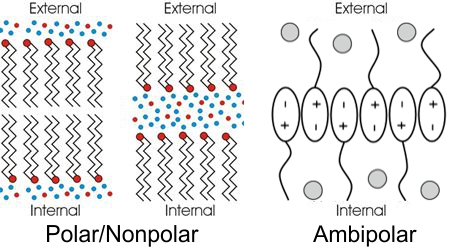
The standard membrane model is on the left in these sketches.  The zigzags represent long (15-20 carbons) hydrocarbon chains (the oily part); the red circles they’re bonded to stand for phosphate-containing groups that prefer a watery environment.  The polka dots are salts and other molecules floating in water.  The whole thing depends on  “oil and water don’t mix.”

ambipolar
Alternative membrane structures
(diagram on the right adapted from the Stevenson paper)

But Titan’s liquid environment is hydrocarbons, non-polar and therefor inhospitable to dissolved salts.  In a year-ago post I followed other people in proposing that cells living in Titan’s lakes might use an inverted membrane structure (the middle sketch).  It’d separate oily inside from oily outside by interposing a thin layer of watery.

That might work on worlds whose temperature range matches ours.  Stevenson and his team pointed out that it’s seriously unworkable on cold worlds like Titan (surface temp -290ºF).  The watery parts would be frozen granite-hard and the oily parts would be stiff as high-grade candle wax.  If there are living cells on Titan, they can’t use either two-layer membrane design as they move, grow and do those other life-ish things.

conga-line
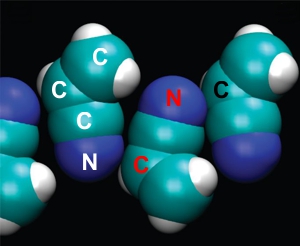
Acrylonitrile molecules
in ambipolar array
(adapted from Stevenson)

Stevenson’s team asked the next question, “What else might work?”  They decided to investigate single-layer structures with no salty component at all.  Such membranes could be held together by electric forces between charges that are slightly separated within the same ambipolar molecule (right-most sketch of the three above). For instance, a nitrogen atom holds onto its electrons more tightly than a carbon atom does, so a bonded C≡N pair will be slightly negative on the N side, slightly positive on the C side.

And to avoid the candle-wax problem the tails on those molecules would have to be short.

Titan’s atmosphere is 98% nitrogen and most of the rest is methane and hydrogen, so the group looked at nine ambipolar nitrogen-carbon-hydrogen molecules with short tails.  For each compound they asked, “Would a membrane made of this stuff be stable on Titan?  If so, would that membrane be flexible?”

Those questions are hard to answer experimentally (-290ºF is cold) so the team resorted to advanced molecular dynamics simulation programs that they just happened to have lying around because that’s what the authors do in their day-jobs.

Basically, what the programs do is arrange some virtual molecules (including solvent) in a starting configuration, then let them move around step-by-step under the influence of their mutual attractions and repulsions.  Meanwhile, the programs keep track of the total energy (and a few other things) for the entire assemblage.  Run the simulation until things settle down (if they do); see what virtually happens.

acrylonitrile-azotosome
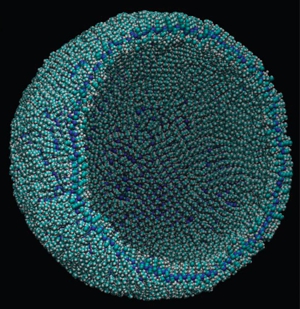
Virtual acrylonitrile vesicle
(also from Stevenson)

In many (not all) of the computer runs, the molecules under test did indeed form a more-or-less regular membrane floating in the “solvent.”  Only some were “stable,” with calculated energies indicating they’d hold together for days or longer.  Some would even be able to form hollow spheres (vesicles) at least as large as a small virus.  Significantly, “flexibility” values for the stable membranes are in the same range as Earthly cell membranes.

It’s an exciting paper if you’re interested in alien life forms.  Among other things, it suggests that astronomers can’t limit their surveys to planets that exhibit signs of atmospheric O2.

But Life also depends on information storage and transfer.  Earth uses DNA, a huge polar molecule unsuited to Life on Titan.  How might Titan’s Life handle that problem?

~~ Rich Olcott

Life and energy on Titan, maybe

Say you’re an astrobiologist tasked with designing a world that would be able to support life we’d be able to recognize as such.  What absolute essentials would you need to include?

Abundant liquid water?  Biologists have found algae thriving inside desert rocks, moistened only by dew seeping in through microscopic pores.  A comfortable temperature?  We’ve found bacteria living in environments as cold as 5ºF and as warm as 250ºF.  A solid surface to grow on?  Arthur C Clarke (A Meeting with Medusa) wrote about complex life-forms floating in the 3,000-mile-deep atmosphere of Jupiter.  OK, that’s science fiction, but Clarke’s the guy who invented geostationary satellites for telecommunications and GPS.gibbs-energies

Many scientists would say that the obvious essential is a source of chemical energy.  I’d add, “and an efficient mechanism to convert the source energy to a form that can be transported within an organism.”  To my knowledge, all life-forms now on Earth have met the second prerequisite by using the ATP molecule for intra-cellular energy transport.  But life has been amazingly creative in finding ways to build those ATPs.  The tall diagram lists some biologic energy sources in decreasing order of how much energy is released.

All the Biology textbooks tell us that Earth’s energy cycle starts with the Sun.  Solar photons energize plant photosynthesis which creates loads of ATP molecules.  Some of them power a multistep process which combines CO2 and H2O to release O2 and create carbohydrates (CH2O)x.  (Glucose, for instance, is (CH2O)6.  Guess where the term “carbohydrate” came from.)  Earth’s biologic carbon cycle completes when other life “burns” carbohydrates to exploit the energy stored therein.  On this chart, “burn” means “combine with O2” and usually doesn’t involve fire.

Notice that “Make (CH2O)x” is at the bottom of the chart — that process absorbs a lot of energy per carbon atom.  Conversely, “Burn (CH2O)x” releases energy which is why we like sugar too much.

In the past couple of decades we’ve learned that’s not the only way, or maybe even the dominant way, that Earth-life makes its ATPs.  Microbes have evolved a surprising number of “front ends” to the energy machinery.  Here in Colorado we’ve got problems in old mines where microbes build ATPs by oxidizing iron pyrite (FeS) to sludgy rust (Fe2O3) and sulfuric acid (H2SO4).  Works great for them, not so good for downstream organisms.

Iron compounds are such a good energy source that many scientists believe (it’s still controversial) that Earth’s hematite and magnetite deposits were laid down half-a-billion years ago by archaea, microorganisms that preceded bacteria.

Way down on the energy-source scale are the methanogens, archaea that use molecular hydrogen to convert CO2 to methane (CH4).  They only live in zero-oxygen environments — peat bogs, ocean-bottom hydrothermal vents and subsurface veins that are perilous to mine.

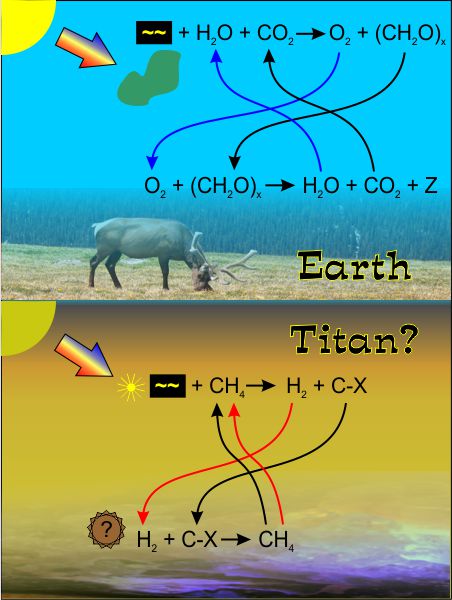
Earthly biology participates in many cyclic processes.  The bi-level diagram below highlights two — oxygen cycling between O2 and oxygen compounds, and carbon cycling between CO2 and living tissues (which contain carbohydrates).

If it weren’t for light-driven photosynthesis ( ~~ is a photon), pretty soon all our O2 would be locked up in the ground where it came from.  In a sense, Earth uses life and carbon to get oxygen back up into the atmosphere.  Astronomers look for O2 in a planetary atmosphere as a sign of life.titan-cycles-2

Maybe Titan does something similar.  Titan’s atmosphere contains methane (CH4) and H2 but the quantities aren’t right.  The purple “Lyman α” and blue “Balmer α” lines on the energy chart denote particularly strong solar photons that can break up C-H bonds and generate H2 in Titan’s upper atmosphere.  We understand the relevant processes pretty well and can calculate how much methane, acetylene (C2H2) and H2 should be up there.

The calculated quantities pretty much match what astronomers found in Titan’s upper atmosphere.  But they’re not what Cassini-Huygens found on the ground.  Acetylene just isn’t there, and a (somewhat precarious) computer simulation indicates that there’s much less ground-side H2 than you’d expect from simple diffusion.  Dr Chris McKay has put those clues and the energy stack together to suggest that something on Titan inhales acetylene and hydrogen and exhales methane.

Something alive, maybe?

~~ Rich Olcott

A Brief History of Atmospheres

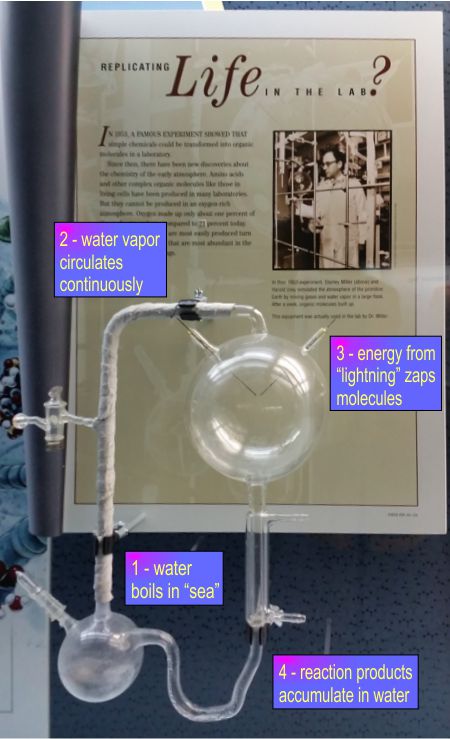
miller-ureyLong ago in a far-away career, I taught a short-course about then-current theories on the origin of life.  The lab portion of the course centered on the 1952 Miller-Urey experiment the first demonstration that amino acids could be produced abiotically.

Imagine my surprise when I learned that Miller’s original lab apparatus is on exhibit at the Denver Museum of Nature and Science, where I volunteer now.

The diagram’s notes describe the basic experiment.  Load up the system with whatever gases you think might have been in the primeval atmosphere.  Start cooling water running through the condenser (double-wall tubing below the upper sphere) and gently heat the water sample you’ve put in the bottom sphere.  Vapors travel up the tube into the top sphere where there’s a spark arcing between two electrodes (the black lines at 45º).  Water vapor passing by sweeps any gas-spark reaction products back down to the bottom sphere.

Let the whole thing stew for a while (Miller ran his for a week, we let ours go for two), then draw off and analyze a sample of the solution in the bottom sphere.  In Stanley’s day his analytical techniques found 5 amino acids.  In 1971 (I think) we found (I think) 8 or 9.  More recent work-ups of Miller’s sealed original samples found 25, including all 20 considered essential to life.  So yeah, if you supply enough energy to a methane-ammonia-water system (Miller added hydrogen to that; we didn’t, for safety reasons) you can make the building blocks for proteins.

The experiment has been repeated probably thousands of times by different researchers in the last half-century.  Some replications were duplicates of Miller’s, some started with recipes derived from other theories about what Earth’s early atmosphere looked like.

And there’s the problem.  In Miller’s day we thought that Earth’s atmosphere was basically comet-tail concentrate.  That’d be mostly water vapor along with a couple of volatiles like methane and ammonia.  Later on we realized that much of our atmosphere is volcano belch — a hodgepodge of carbon dioxide, carbon monoxide, methane, hydrogen, sulfur gases, nitrogen, argon, helium, various acids, multiple kinds of rock dust….  Some of that is left-overs from Earth’s initial stages; some has been generated by subsequent geological processes like serpentinization, which can generate both methane and hydrogen.

If you’re running a Miller experiment you’re free to load the apparatus with whatever mixture you think other scientists might think is reasonable for an Earth on the verge of Biology.  No oxygen, though — the chemistry of ancient rocks rules out significant atmospheric O2 before about 3½ billion years ago.

Now the researchers are playing variations on the theme, asking whether conditions on (or within) Titan could also generate complex compounds that given a billion years could self-organize into anything we’d recognize as life.  So what did Titan’s atmosphere look like a few billion years ago?

That’s a toughie, because we don’t have on-the-ground (or out-of-the-ground) data like we have for Earth.  We’ll have to make do with theory, which starts with this chart.

solar_system_escape_velocity_vs_surface_temperature-svg
Molecular escape velocities

At any given temperature you can calculate the average energy per gas molecule (any kind of gas).  Combine that with the known mass of a specific kind of molecule and you can compute its speed.

On any given world you can calculate the minimum speed (the escape velocity) that an object (rocket, rock or gas molecule) needs to have in order to overcome the world’s gravitational pull.

The chart combines both calculations for some important molecules for worlds in the Solar System that have atmospheres.  For instance, Earth’s average temperature (give or take a few dozen degrees) is  300ºK=27ºC≈80ºF.  From the chart, hydrogen and helium should be able to (and do) leave our atmosphere quickly.  However, Earth’s gravity is sufficient to hold onto its original dowry of the heavier species.  By contrast, the four massive planets would have to warm up by hundreds of degrees before they lose even the light gases.

Sure enough, Titan’s atmosphere is mostly nitrogen.  The astronomers measure its methane and hydrogen content in parts per thousand but those concentrations aren’t the same going from top to bottom of Titan’s atmosphere.  Therein lies an intriguing tale, but it’ll have to wait for the next post.

~~ Rich Olcott

Fifty Shades of Ice

earth-vs-titan-sea

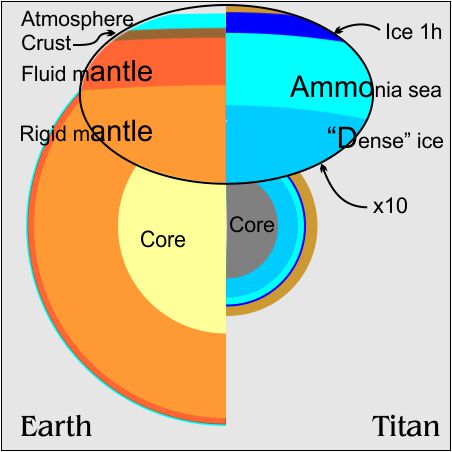
This week we dip a little deeper into Titan’s weirdness trove.  Check the diagram.  Two kinds of ice??!?  What’s that about?

diamond-and-ice
Carbon allotropes
and water polymorphs

As everyone knows, diamonds and pencil lead (graphite, and I loved learning that graphite is an actual dug-from-the-ground mineral whose name came from the Greek verb “to write”) are both pure carbon, mostly.  Same atoms, just arranged differently.

Graphite‘s carbon atoms are laid out in sheets of hexagons.  Adjacent sheets are bonded together but not as strongly as are the atoms within each sheet.  Sheets can slide past each other, which is why we use graphite as a lubricant and why pencils can write and erasers can unwrite.

Diamond‘s atoms are also laid out in sheets of (rumpled) hexagons, but now the bonds between sheets are identical to the bonds within a sheet.  Turn your head sideways and you’ll see that sheets run vertical, too.  In fact, each carbon atom participates in four sheets, three vertical and one horizontal.  All that symmetrical bonding makes diamond one of the hardest substances we know of.

Neighboring carbon atoms form bonds by sharing electrons between their positive nuclei.  Neighboring water molecules (H2O) don’t share electrons but they do tend to line up with their somewhat positive hydrogen atoms pointing towards nearby somewhat negative oxygens.  That’s a loose rule in liquid water but it dominates when the molecules freeze into ice.

Most of the ice on Earth has an Ice-Ih structure, where the oxygen atoms are arranged in the same pattern as the carbons are in graphite.  Water’s hexagonal sheets aren’t quite flat, but the 6-fold symmetry gives us snowflakes.  There’s a hydrogen atom between each pair of oxygens, but it’s not half-way between.  Instead, each oxygen tightly holds its own two hydrogens while it pulls at further-away hydrogens owned by two neighboring oxygens.

But water molecules have other ways to arrange themselves.  A small fraction of Earth’s ice has a diamond-like Ice-Ic structure with each oxygen participating in four hexagon sheets.  Again, hydrogens are on the lines between them.

Water’s such a versatile molecule that it doesn’t stop with two polymorphs.  Ice scientists recognize seventeen distinct crystalline varieties, plus three where the molecules don’t line up neatly.  (None of them is Vonnegut’s “Ice-nine.”)  Each polymorph exists in a  unique temperature and pressure range; each has its own set of properties.  As you might expect, ices formed at high pressure are denser than liquid water.  Fortunately, Ice-Ih is lighter than water and so ice cubes and icebergs float.

As cold as Titan is and as high as the pressure must be under 180 miles of Ice-Ih and watery ammonia sea (even at 10% of Earth’s gravity), it’s quite likely* that there’s a thick layer of Ice-something around Titan’s rocky core.

clathratesThe primary reason we think Titan is so wet is that Titan’s density is about halfway between rock and water.  We know there are other light molecules on Titan — ammonia, methane, etc.  We don’t know how much of each.  Those compounds don’t have water’s complex phase behavior but many can dissolve in it.  That’s why that hypothetical “Ammonia sea” is in the top diagram.

But wait, there’s more.  Both graphite and water ice are known to form complex polymorphs, clathrates, that host other molecules.  This diagram gives a hint of how that can happen.  Frozen water under pressure forms a large number of more-or-less ordered cage clathrate structures that can host  Titan’s molecular multitude.

At Titan’s temperatures ice rocks would be about as hard as granite.  Undoubtedly they’ll have surprising chemistry and interesting histories.  We can expect clathrate geology on Titan to be as complex as silicate geology is on Earth.

Geochemist heaven, except for the space suits.

~~ Rich Olcott

* – A caveat: we know a great deal about Earth’s structure because we live here and have been studying it scientifically for centuries. On the other hand, most of what we think we know about Titan’s interior comes from mathematical models based on gravitational observations from the Cassini mission, plus 350 photos relayed back from the Huygens lander, plus experiments in Earth-bound chemistry labs. Expect revisions on some of this stuff as we learn more.