Back at the beginning of the Plague Era when things were (mostly) shut down, I started posting daily memes to reflect my shelter‑in‑place state of mind. Here’s the first one
The initial day‑count reflected my expectation that the lock-down would last less than a month. Hah!
I gave up on numbers for a while
April rolled around and I went topical
Remember the Great Toilet Paper Shortage?
I’ll never know how many readers got this one, but I like it
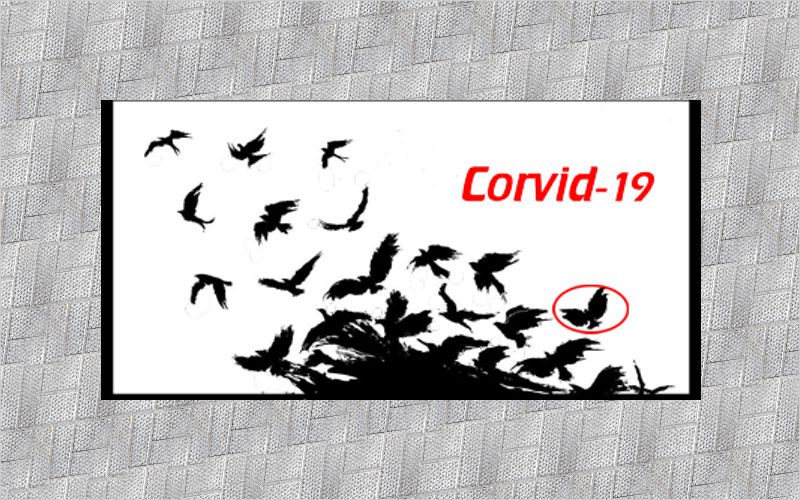
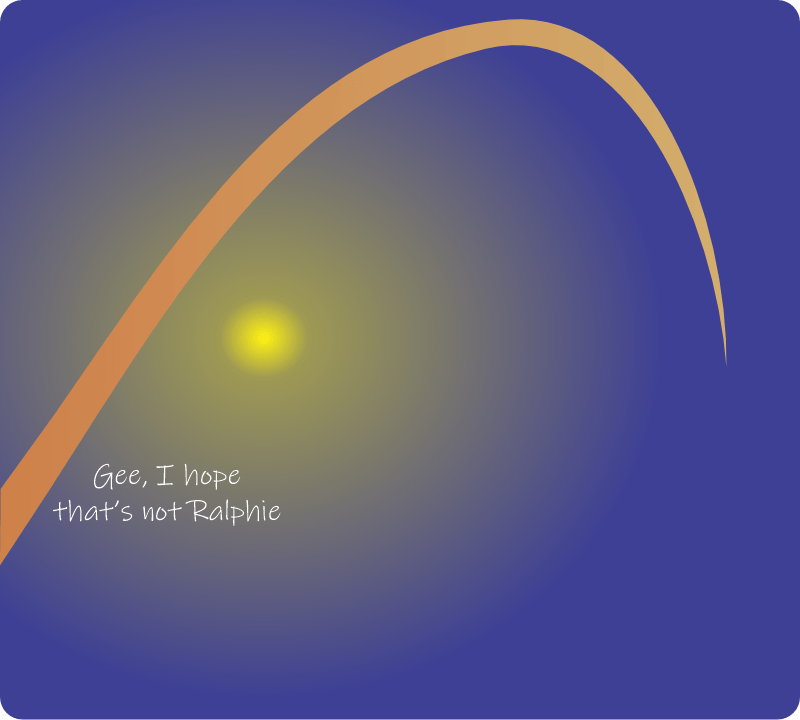
This is a Physics/Astronomy/Cosmology blog so I posted this to stay on‑topic…
This was meant to be satire, but I saw posts from folks actually doing it…
Yes, cabin fever is a thing
It was a time for sudden insights
We all got used to e-meetings
and smart speakers, if only for the conversations
Soon I had to go for higher numbers
Staying at home had its bright side (unless you’re invested in Big Oil)
And its bad‑omen side
The seasons passed and the day count increased…
Ending this retrospective with one of my favorites
A warmish Spring day. I’m under a shady tree by the lake, waiting for the eclipse and doing some math on Old Reliable. Suddenly there’s a text‑message window on its screen. The header bar says 710‑555‑1701. Old Reliable has never held a messaging app, that’s not what I use it for, but the set-up is familiar. I type in, Hello?
Not Lieutenant any more, I’m back up to Commander, Provisional.
Congratulations. Did you invent something again?
Yes, but I can’t discuss it on this channel. I owe you for the promotion. I got the idea from one of your Crazy Theories posts. You and your friends have no clue but you come up with interesting stuff anyway.
You’re welcome, I suppose. Mind you, your science is four centuries ahead of ours but we do the best we can.
I know that, Mr Moire. Which is why I’m sending you this private chuckle.
Private like with Ralphie’s anti‑gravity gadget? I suggested he add another monitoring device in between two of his components. That changed the configuration you warned me about. He’s still with us, no anti‑gravity, but now he blames me.
Good ploy. Sorry about the blaming. Now it’s your guy Vinnie who’s getting close to something.
Vinnie? He’s not the inventor type, except for those maps he’s done with his buddy Larry. What’s he hit on?
His speculation from your Quantum Field Theory discussion that entanglement is somehow involved with ripples in a QFT field, ripples that are too weak to register as a particle peak. He’s completely backwards on entanglement, but those ripples—
Wait, what’s that about entanglement?
Entanglement is the normal state for quantized particles. Our 24th‑Century science says every real and virtual particle in the Universe is entangled with every other particle that shares the same fields. It’s an all‑embracing quantum state. Forget your reductionist 20th‑Century‑style quantum states, this is something … different. Your Hugh Everett and his mentor John Archibald Wheeler had an inking of that fact a century before your time, though of course they didn’t properly understand the implications and drew a ridiculous conclusion. Anyway, when your experimenting physicists say they’ve created an entangled particle pair, they’ve simply extracted two particles from the common state. When they claim to transmit one of the particles somewhere they’re really damping out the local field peak linked to their particle’s anti‑particle’s anti‑peak at the distant location and that puts an anti‑anti‑particle‑particle peak there. Naturally, that happens nearly instantaneously.
I don’t follow the anti‑particle‑anti‑peak part. Or why it’s naturally instantaneous.
I didn’t expect you to or else I wouldn’t have told you about it. The Prime Directive, you know. Which is why the chuckle has to be private, understand?
I won’t tell. I live in “the city that knows how to keep its secrets,” remember?
Wouldn’t do you any good if you did tell and besides, Vinnie wouldn’t think it’s funny. Here’s the thing. As Vinnie guessed, there are indeed sub‑threshold ripples in all of the fundamental fields that support subatomic particles and the forces that work between them. And no, I won’t tell you how many fields, your Standard Model has quite enough complexity to <heh> perturb your physicists. A couple hundred years in your future, humanity’s going to learn how to manipulate the quarks that inhabit the protons and neutrons that make up a certain kind of atom. You’ll jiggle their fields and that’ll jiggle other fields. Pick the right fields and you get ripples that travel far away in space but very little in time, almost horizontal in Minkowski space. It won’t take long for you to start exploiting some of your purposely jiggled fields for communication purposes. Guess what a lovely anachronism you’ll use to name that capability.
‘Jiggled fields’ sounds like communications tech we use today based on the electromagnetic field — light waves traveling through glass fibers, microwave relays for voice and data—
You’re getting there. Go for the next longer wavelength range.
Stan Laurel and Oliver Hardy, two of my favorite fools
The last time I posted in this blog on April 1 was in 2019. That time I was serious. This time I’m honoring a long and semi‑honorable Fool’s Day (or Fools’ Day) tradition in many countries across the world.
If you’re not familiar with the work of Laurel and Hardy, you’ve missed out on a lot of laughter. There’s a reason they had a long career with Hal Roach. Here are a few samples to get you started
Slapstick? Oh, yes, but world‑class slapstick. The 2018 biopic, Stan & Ollie with Steve Coogan and John C. Reilly, recreates some of their pieces as it follows the two after the peak of their career.
Want Science on April Fools’ Day? <HAW> April Fool!
Vinnie’s not in his usual afternoon spot at the table by the coffee shop door. Then I hear him. “Hey, Sy, over here.” He’s at the center table, surrounded by Cal’s usual clientele but they’re passing sheets of paper around. I worm my way through the crowd. ”What’s going on, Vinnie?”
“Me and Larry are both between piloting assignments so we spent the weekend playing with that map software he bought. He’s figured out how to link it with online databases so we can map just about anything all different ways. Hey, you’re into history, right?”
“Some, yes.”
“This one’s about how far countries go back. I kinda thought countries have always just been there, but no. We found a list of when each country got to have their own government independent of somebody else in charge, so we made this map with the oldest countries the darkest. Look how pale most of the world is. Look at us — the USA is the tenth oldest country. I couldn’t believe it.”
“Ah, I know Denmark started with the Vikings soon after the Roman Empire collapsed. Hungary’s history as a kingdom started about the same time. Then there’s a handful of old states defended by mountains — yup, I see Nepal and Switzerland. Andorra, Liechtenstein and San Marino are in the same category, but they’re too small for this map to show them.”
“You missed the Netherlands from 1579 when they broke free from Spain. No mountains. Larry graphed the numbers down in the corner.”
“Mm-hm. I see two waves. The USA and France started the first one in the late 1700s. That took in most of the New World by the mid‑1800s. Then two World Wars and ‘Katie, bar the door!‘ I hadn’t realized how abruptly de‑colonization took place. Wow. All of Africa and most of southeast Asia became free‑standing countries in just half a century. What’s with Russia — missing data?”
“Gotcha, Sy. That was 1991, when the USSR broke up. Bang! Twenty new countries, all near the top of the scale.” <shuffling papers> “Here’s another one you’ll like. Larry has this theory that countries with lots of neighbors get militarized ’cause they’ve always got a war going on somewhere but if you don’t share borders with hardly anyone, no problem. He did up this map to check his theory. See Canada’s light blue ’cause it’s got only us, we’re dark blue ’cause we got Canada and Mexico. Dark green countries got four and so on. Whaddaya see here?”
“Uh-oh.”
“Yeah. Top of the list, 14 each, are Russia and China who are not best buddies with hardly anybody. Brazil’s got 10, but rainforest is probably as good as mountains.”
“Good point.”
“Excuse me, guys, but I’ve got personal counter‑example experience.”
“Hi, Susan. What’s that?”
“I grew up in Korea, right? Only 2 neighbors, China and Japan, but we’ve got a tough history because each of them just used us as a bridge to get to the other one. Tell Larry it makes a difference who you share a border with.”
“I’ll pass the word. Wait a minute…” <more paper shuffling> “Here’s one we did just for you, Ms Chemist.”
“Weird. How do you even read this?”
“We ran into a problem with the standard maps when we colored each country according to how many chemical elements were discovered there. Most of the action mushed into western Europe’s small area when we showed the other countries. Larry tried a bunch of different projections. This one’s like a fish‑eye lens looking down near the North Pole. See, Russia’s spread around the center but Europe’s bigger?”
“Ah, once I know what to look for it snaps in.”
“I cropped it down to the oval ’cause all the blue sea didn’t fit on the page.”
“Understandable. Lesseee… The UK’s on top mostly because of Wollaston’s geochemistry, Humphry Davy’s work on electropositive metals, and Ramsay isolating the inert gases. The USA owes its second‑place status to Seaborg’s isotope factory at UCal Berkeley. One step down, Germany, France and Sweden ran a discovery horse‑race during the 1800s. Russia came on strong with radioactives but that was late in the game.”
“Wait, Susan. How’d the purples get into this? No big labs there.”
“Except for nihonium, it’s mostly right‑place‑right‑time luck. India gets credit because a French astronomer observing an eclipse from there spotted a helium line in the solar spectrum. Later, an Italian recorded the line on Earth and a Scot isolated the gas.”
<breaking through the fourth wall> I, the author of this blog, stand before you both proud and abashed. There may be a word for that combination, just as “pareidolia” is the word for our tendency to see faces in inanimate objects.
Credit: NASA
This particular episode of “proud but abashed” began with an attack of pareidolia when I saw this Perseverence photo (→) that NASA retrieved from Mars.
Look closely at the large rock just to the right of center. See those two closed smiley eyes above chubby cheeks that look like they’re mashed into a pillow? I did, too, and now I can’t unsee them. Not to mention the belly button closer to us but that’s another story. Naturally, the mental image reminded me of the “rock monster” CGI effect (see photo below but it’s better in animation) in the Galaxy Quest movie (a knowing and funny parody of Star Trek; watch it if you haven’t already seen it and besides, Missy Pyle was adorable as Laliari).
Just a little later I saw yet another of those click‑bait “They don’t want you to see…” memes. That completed the circuit for a conceptual spark. As often happens, mischief ensued. It took just a few minutes of work with my digital graphics toolkit to produce this cartoon that I meant to be satirical —
I posted it in a few places. What was interesting was what happened next.
First and best, of course, was that a lot of folks recognized it as a joke. Many flagged it with a Like or HaHa and I’m sure many more just smiled (or not) and scrolled on and that’s okay.
One person wrote (I think he was kidding) “Bird poop.” There were several mentions (I think they were kidding) of “Men In Black” and “Pokémon.”
Then there are the people who took the altered image as faithful reportage and looked for explanations — “it’s a chance reflection off the robot’s metal skin” or “the Sun must have moved and illuminated an area that had been shadowed.” One responder expressed surprise and indignation that NASA would allow distribution (though the cartoon’s header says they hadn’t) of material that could incite panic. They were quite earnest about that.
It’s not the first time I’ve posted a graphic that didn’t get the reception I’d expected. There’s this pie chart (→) that compares readings for the same temperature according to different scales. (Rankine is Fahrenheit-sized degrees counting up from absolute zero. Rømer‘s, the first transferrable temperature scale, ran from zero at the freezing point of brine, up to 60 at the boiling point of water. No-one uses it any more.)
Yeah, I know the chart makes no sense, which is why I thought it was funny. I was sharply criticized for abusing the software. The carpers would start with something like, “A pie chart is supposed to demonstrate the relationship between the whole and a portion of it,” and go on from there. They were quite earnest about that.
Hey, numbers are abstractions. Why have them if we can’t chart them any way we feel like?
Other people assert numeric freedom, so I’m not alone in this. Someone in New Cuyama, California got creative and put up this sign (→). The arithmetic is good, I checked, but I wish they’d used a monospace font to put the numbers in proper columns. Anyway, the sign’s layout naturally led me to create the pie chart you see beneath it.
So — proud to have given some people a smile, but also abashed. Oh, well.
Big Vinnie lumbers into my office, a grin on his face and a sheaf of papers in his hand. “Sy, you gotta see these, you’ll love ’em.”
Vinnie and I go way back, so I string him along a little. “New clients, I suppose? Wealthy ones, with interesting problems?”
“Nah, just goofiness. Me and Larry, don’t think you’ve met him yet, were having pizza in Eddie’s place. Larry’d brought his laptop and we got to playing with some map software he just bought. You ever hear of a GIS?”
“Geographic Information Systems? Sure, they go back a century and a half to the guy who mapped cholera cases in London and traced the source back to a contaminated water pump. You use a GIS to produce mapped visualizations of useful geographically‑distributed statistics.”
“Yeah, that, except we weren’t going for anything useful. Here’s the first one we did. We had a list of states alphabetical‑like. There’s whole blocks that start with the same letter, like eight that start with ‘M.’ We told the mapper to put a different color on any three or more that share a letter. Silly, huh?”
“Mm-hm. I don’t see any pattern to it.”
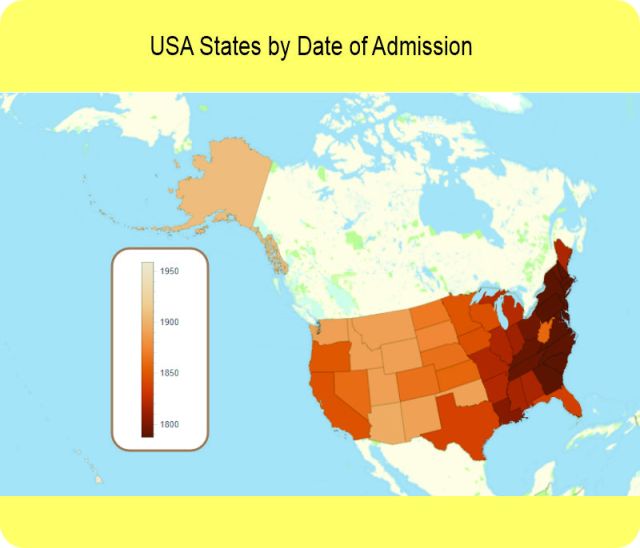
“Right. We didn’t, either, so we went on to build a second map where each state’s colored by the date it entered the Union. We tried a bunch of different color schemes, finally settled on this one.”
“Nice. You can almost see the country growing year‑to‑year. … Ah, Hawai’i’s in there, too, tucked away in the southwest corner. It’s color’s so pale you have to look for it. West Virginia — let me guess, right around 1860 or so, right?”
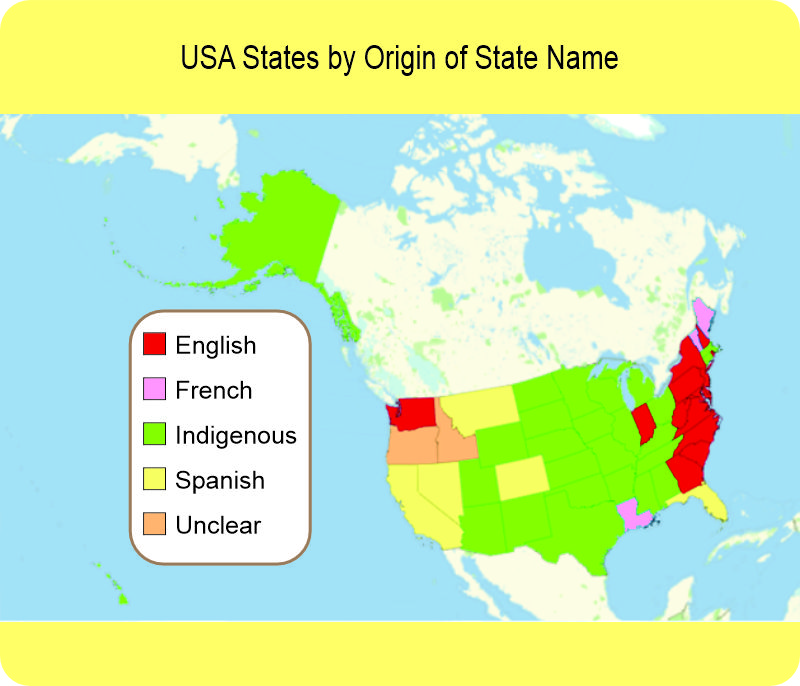
“1863. Those folks rebelled against the Southern rebellion. Anyway, Jeremy was kinda looking over our shoulder and this map lit a fire for him. You know he’s doing an Indigenous History project with Professor Begaye. He ran off and brought back a list of where each state’s name came from. We coded that up, fed it to the program and this came out.”
“Wow. The Europeans pretty much claimed the coasts but look at all the green. It’s like the states acknowledged they were built on Native land. Indiana comes right out and admits it.”
“Yup. Jeremy said it was pretty poor compensation. I understand how he feels.”
“So, did you map anything more than the USA?”
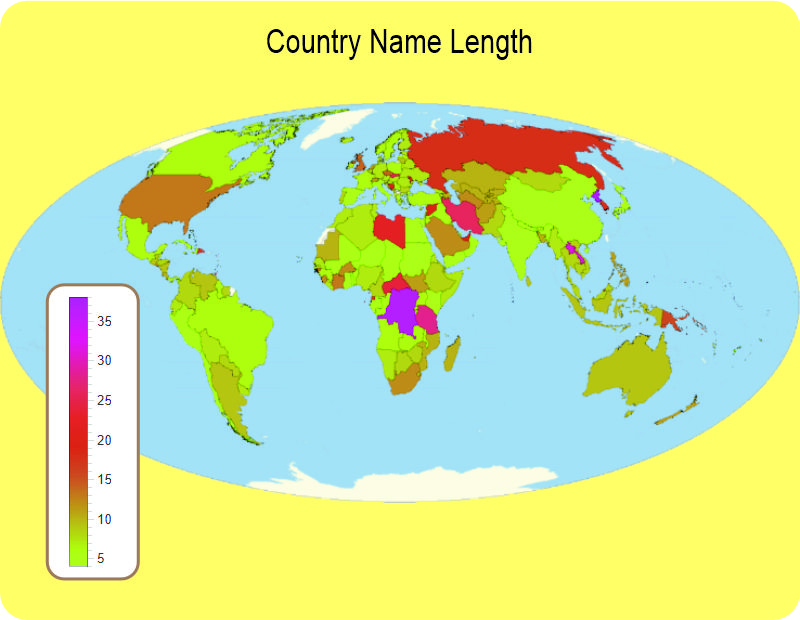
“Of course. Larry wanted more silly so we went with the number of letters in each country’s name.”
“I don’t understand this one. Peru’s green for its short name, naturally, and so are Chad and Cuba, but why are Iran and Iraq different colors? Russia’s name isn’t longer than Saudi Arabia and Madagascar. How can five‑letter Congo be purple for a really long name? Doesn’t make sense.”
“Our name list came from the International Standards Organization. Larry and me, we’re both international charter pilots. We’re often checking ISO files for radio frequencies, airport codes and the like. According to ISO, Iraq is ‘IRAQ‘, but Iran is ‘IRAN (ISLAMIC REPUBLIC OF).’ Russia is ‘RUSSIAN FEDERATION‘ which is longer than the other two. The USA would be redder if it was ‘UNITED STATES OF AMERICA,’ but it’s ‘UNITED STATES‘ and tied with ‘LIECHTENSTEIN‘ and ‘GUINEA‑BISSAU‘ at 13 characters so it’s brown.”
“And Congo?”
“The ISO name is ‘CONGO, THE DEMOCRATIC REPUBLIC OF THE.’ That’s not even the longest. It’s beat by ‘KOREA, DEMOCRATIC PEOPLE’S REPUBLIC OF‘ and ‘MACEDONIA, THE FORMER YUGOSLAV REPUBLIC OF.’ Politics, I suppose, and maybe ego. But I ain’t showed you the coolest map.”
“I’m all eyes.”
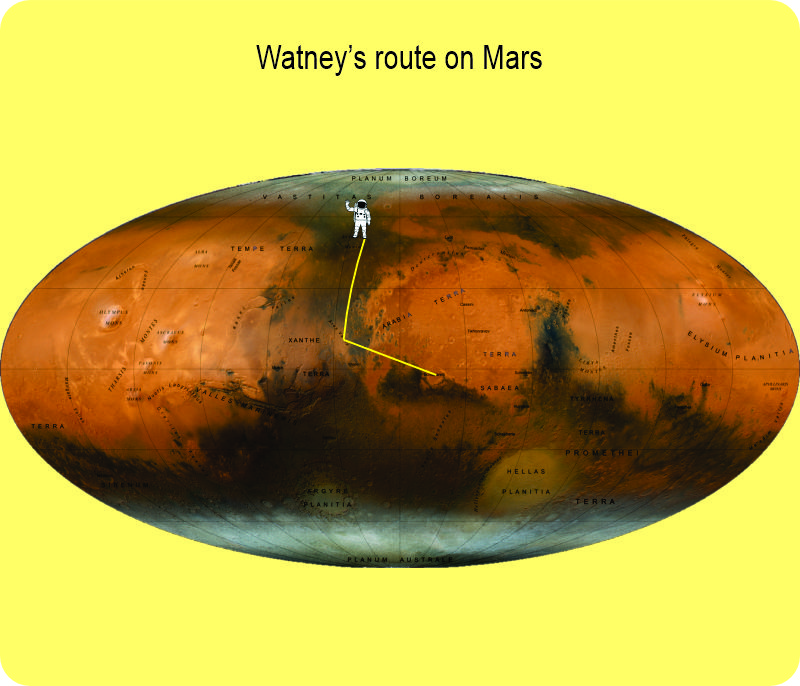
“You’ve read Andy Weir’s book, ‘The Martian‘?”
“Of course. Saw the movie, too. It was a nice change watching a drama that didn’t involve people battling each other physically or emotionally.”
“Uh. Yeah. I just saw it as an adventure story. Whatever. You remember Watney’s epic drive across that red desert to recover parts from the Pathfinder lander and then get to the launch vehicle?”
“Mm‑hm, though I don’t remember the geography.”
“Well, here’s his road map — Aries Base in Acidalia Planitia to Pathfinder in Chryse Planitia to take‑off from Schiaparelli Crater. Cool, huh?”
“Quite cool.”
Mars image credit: EMM/EXI/Dimitra Atri/NYU Abu Dhabi Center for Space Science
The regular Thursday night meeting of the Acme Pizza and Science Society around the big circular table at Pizza Eddie’s. Al comes in, hair afire and ready to bite the heads off tenpenny nails. “This is the last straw!” <flings down yet another astronomy magazine>. “Look at this!”
I pick up the issue. “Looks like the lead article’s about the Psyche mission to the Psyche asteroid. You got a problem with that?”
“Nah, that’s just fine, exciting even. Look at the address label.”
“Ah, I see your objection. Instead of your first name it says ‘A. I.’ like those are your initials. Are they?”
“No. Never had a middle initial until the Navy gave me ‘N‘ for ‘No middle initial‘ and I dropped that soon as I got out.”
“So where’d they get the ‘I’?”
“That’s what chafes my cheeks, Vinnie, people messing with my name. All this stuff going on these days about Artificial Intelligence which everybody calls ‘AI’ which looks too flippin’ much like Al. People have been ribbing me about it since ChatGPT hit the street. They come in here asking me for virtual coffee or wanting to know about my ALgorithms. One guy claimed I parked a driverless coffee machine back of the kitchen. But it’s not just jokes. I get calls asking for programming help with languages I never heard of. My checks have my name as Al but the bank lady gives me grief because I don’t sign them with A. I.”
“You’ve got a good point there. When someone chooses a name, that name’s important to them. I know whole families where everyone has a ‘go‑by‘ name. First class I ever taught, I opened by calling the role so I could tie names to faces. I started out calling out first names but quickly learned that most of the men and half the women went by middle names — this was in the South where that’s common but still. Anyway, I called first and middle names until I got to this one kid. He’d gone through three years of college going by ‘C-M’ until I blew his cover by asking which student was named Clyde and it was him. I don’t think he ever forgave me.”
“I know the feeling, Cathleen. None of the teachers could handle my full name. This magazine’s stupid spell‑checker musta corrected me wrong. I want a new name that doesn’t get messed up.”
“Al’s not your full name?”
“No, it’s Aloysius which I don’t like. No-one can spell it, or say it right if they see it written out. I got named after my Mom’s favorite uncle before I could vote against it. I’ve been going by Al ever since I knew better.”
“We need to figure you a new name that looks different but sounds almost the same so you’ll recognize it when we holler at you, right?”
“That’s about it, Vinnie. Whaddaya got?”
“A negative to begin with. We can rule out Hal, the killer computer in the 2001 movie. Don’t want to see our physicist here walk up for a strawberry scone and get ‘I’m afraid I can’t do that, Sy.’ Haw!”
“How about Sal?”
Eddie waves it away. “My Uncle Salvatore’s already got that. One’s enough.”
I read off Old Reliable’s screen. “Baal was a god worshipped by some of the Old Testament enemy tribes, eventually turned into Beelzebub. That won’t do. And ‘mal‘ means ‘bad‘ in Spanish.”
Resident chemist Susan giggles. “I don’t suppose you’d be happy if I greeted you with a cheery, ‘Hey, Gal‘. Oh, wait, I’ve got a Chemistry thing for us. ‘Cal‘ is the standard abbreviation for ‘calorie,’ one of the old‑time measures of heat energy before everybody settled on the joule. What do you think of ‘Cal‘? Hot and cool and rugged enough for you?”
“Hmm… I like it. ‘Cal’s Coffee‘ even has that market‑winner k’‑kuh sound like Krispy Kreme and Captain Crunch and Crispy Critters. It’s official — from now on, Cal is my official go‑by name. Thanks, Susan.”
She grins. “First time I’ve named an adult. Hi, Cal.” ”Hi, Cal.” ”Hi, Cal.” ”Hi, Cal. Now about that magazine article…”
<bomPAH-dadadadaDEEdah> It’s been a while since Old Reliable blared that unregistered ringtone. Sure enough, the phone function’s caller‑ID display says 710‑555‑1701. “Commander Baird, I presume? Long time no hear.”
<downcast tone with a hint of desperation> “It’s Lieutenant now.”
“Sorry to hear that. What happened?”
“Project Lonesome was a bust. It took us years to assemble those two planetoids but getting them into the right orbits around the black hole was more of a challenge than we planned for. Planetoid Pine got away from us and fell down through the Event Horizon. One big blast of inforon radiation and no more project. We lost a few robot space tugs but all carbon‑based personnel survived. Medical Bay just now pronounced me healthy — it’s amazing what they can do about pervasive sub‑cellular damage these days. The Board of Inquiry decided no‑one was at fault but they down‑ranked me because I was primary advocate for a jinxed project.”
“Well, those 15-minute orbits were a gamble all along. So why this phone call?”
“You know how it is, sitting in Med Bay with nothing much to do. I was poking around and happened to read a few of the files you’re working on—”
“Which ones?”
“The Projects directory.”
“But those are client files I’ve encrypted with the latest technology.”
“Oh, please, Mr Moire, I am calling from the 24th Century. Upton’s algorithm for zeta‑function decryption is ancient history. Don’t worry, your client’s secrets are safe, although one of your clients may not be.”
“Whoa, say what? Which one? What kind of danger? They all seem healthy, look both ways before crossing the street, that sort of thing.”
“One of those projects is extremely dangerous.”
“Which one? The biometrically‑lockable archery bow shouldn’t cause any problems. The electric yoga outfit? I triple‑checked the wiring and insulation specs, they’re safe and reliable. The robot rabbit? Surely not. Does this involve lethal spy‑craft of some sort? I try to avoid military work.”
“No, it’s the perpetual motion machine.”
“Ralphie’s project? Laws of Thermodynamics and all, I told him that’s just not going to work. He insisted I check his blueprints to make sure nothing’s going to blow up. I gave them a quick glance, didn’t see anything dicey.”
“It wouldn’t be obvious, especially not in view of your primitive science—”
“Hey!”
“No offense intended, Mr Moire, but it is primitive from my perspective. Two hundred years make a difference. Consider the state of Earth’s science in 1723 — Graham was still perfecting the pendulum clock.”
“Point taken, reluctantly. So what should I look for, and why?”
“The Prime Directive applies across time periods, too, so I can’t go into detail with you. I’ll just say it’s not any one component, it’s the overall physical arrangement and what will happen when he powers up. Move the boxy bits closer together or further apart by two centimeters and the danger’s gone.”
“But what’s the danger? I can’t just tell him to reconfigure for no reason.”
“Directed gravity, Mr Moire, the sculpting of spacetime. It’s the reason we don’t need safety belts on a starship — we manufacture local gravity that always pulls toward the deck. In fact, directed gravity’s at the heart of warp drive technology. Cochrane stumbled on the effect accidentally but fortunately his lab was in a reinforced hard‑rock tunnel so damage was limited.”
“Anti-gravity? Oh, that’d be so cool. Flying cars at last, and sky‑cycles. Okay, there’d be problems and we’d need an AI-boosted Air Traffic Control agency. The military would be all over the idea. But all that’s way down the road, so to speak. I don’t understand how that puts Ralphie in immediate danger and why would a tunnel help?”
“Not anti-gravity, directed gravity. Gravity’s built into the structure of spacetime. Gravity can’t be blocked, but it can be shifted. The only way to weaken it in one location is to make it stronger somewhere else. Suppose Cochrane had first powered‑up his device on the ground in the open air. Depending on which way it was pointed, either he’d have been crushed between rising magma and down‑falling air, or…”
“I’ll tell Ralphie to re‑configure his gadget. Thanks for the warning.”
Between COVID and the post‑holiday wind‑down, things are slow. Vinnie and I are playing cards on my office side table, except my only deck is missing the heart face cards (long story) so we’re just trying to edge‑stack them. It’s not going well. “Geez, Sy, these towers collapse so quick, it’s boring. What else you got around here?”
“Well, before you arrived I was chasing prime numbers on Old Reliable for a New Year piece. Did you know, for instance, there we’re smack in the middle of a decade-long prime year dearth?”
“Prime year dearth?”
“Prime as in not divisible by any number other than itself and one, dearth as in no year’s name being a prime number since 2017 and the next one isn’t until 2027. In the forty‑four years leading up to 2017 we averaged one prime per 5½ years. On the other hand, after 2029 (also a prime year, by the way) there’s fifty‑two years with only five primes.””
“Is there some rule for how many to expect?”
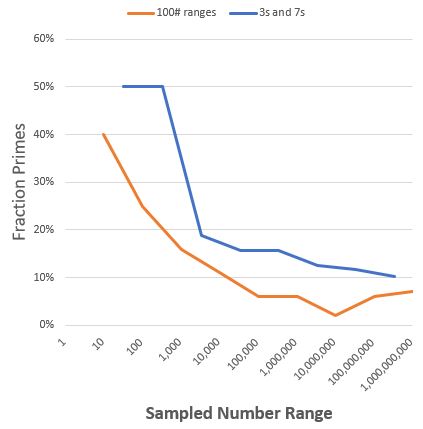
“Sort of. I sampled a series of hundred‑number ranges on up to a billion. The percentage of primes fell off as the numbers got larger, settled in at about 6%.”
“Makes sense — you got a bigger number, you got more little numbers that might divide into it.”
“Mm-hm. Something weird happens around ten million, though. The percentage drops down to only 2% but then it goes right back up to around 6% and stays there. I tried different scan resolutions but couldn’t locate any single especially long non‑prime string. The mathematicians have carried the research a lot further than my little experiment. The Prime Number Theorem gives a general curve that’s good ‘for sufficiently large numbers,’ but a million is a small number on their scale. As a physicist I’m a bit frustrated because the Theorem says, ‘This is the way it is‘ but it doesn’t give a reason. Although there probably isn’t a reason, any more than there’s a reason for 2017 being a prime to begin with.”
“I know what you mean. My car’s Owner Manual is the same way. Uhh… as I recall, you had a post a while ago about primes and 3’s and 7’s.”
“That was for New Year 2016, to be exact. Yeah, I found a collection of primes like 3337 and 733333 that have a string of 3’s or 7’s fronted and trailed by 3’s or 7’s. It wasn’t a bad bet. No primes (except 2 and 5) can have 0, 2, 4, 5, 6 or 8 as a trailing digit, right?”
“Lemme think for a minute. … Right.”
“That list didn’t include scrambled combinations like 37737, so what I did this year was to use Old Reliable to construct a big list of all possible 3’s‑and‑7’s numbers between 3 and a billion.”
“That’s a lot of numbers.”
“Not so many, actually, only about 1000. I told Old Reliable not to sample numbers that have any non‑3‑or‑7 digit buried in them somewhere. That’s a lot of pass‑overs.”
“That’s a lot of checking and skipping.”
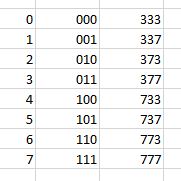
“I used a short cut. It’s easy to build a list of all possible numbers with a certain number of binary digits — just count in binary. The three‑digit binary numbers, for instance, give you every zero‑one combination between 000 is zero and 111 is seven. Then I converted all the zeroes to 3’s and all the ones to 7’s and got every 3’s‑and‑7’s number between a hundred and a thousand with no interlopers. As a bonus that method organizes the overall list by powers of ten, like 333 to 777 in a sublist, 3333 to 7777 in another and so on. I counted the primes in each sublist and charted all the sublist percentages in the same graph as the hundred‑number sampling. Pretty much the same curve, but no dip near 10 million. For the heck of it I played the same game with 1’s and 9’s. Same behavior. Oh well.”
“So that’s how you keep yourself occupied on a slow day, huh? I got a New Year prediction for you.”
“What’s that?”
“I’m gonna bring you a couple fresh decks of playing cards.”
Raucous laughter from the back room at Al’s coffee shop, which, remember, is situated on campus between the Physics and Astronomy buildings. It’s Open Mic night and the usual crowd is there. I take a vacant chair which just happens to be next to the one Susan Kim is in. “Oh, hi, Sy. You just missed a good pitch. Amanda told a long, hilarious story about— Oh, here comes Cap’n Mike.”
Mike’s always good for an offbeat theory. “Hey, folks, I got a zinger for you. It’s the weirdest coincidence in Physics. Are you ready?” <cheers from the physicists in the crowd> “Suppose all alone in the Universe there’s a rock and a planet and the rock is falling straight in towards the planet.” <turns to Al’s conveniently‑placed whiteboard> “We got two kinds of energy, right?”
Potential EnergyKinetic Energy
Nods across the room except for Maybe-an-Art-major and a couple of Jeremy’s groupies. “Right. Potential energy is what you get from just being where you are with things pulling on you like the planet’s gravity pulls on the rock. Kinetic energy is what potential turns into when the pulls start you moving. For you Physics smarties, I’m gonna ignore temperature and magnetism and maybe the rock’s radioactive and like that, awright? So anyway, we know how to calculate each one of these here.”
PE = GMm/RKE = ½mv²
“Big‑G is Newton’s gravitational constant, big‑M is the planet’s mass, little‑m is the rock’s mass, big‑R is how far apart the things are, and little‑v is how fast the rock’s going. They’re all just numbers and we’re not doing any complicated calculus or relativity stuff, OK? OK, to start with the rock is way far away so big‑R is huge. Big number on the bottom makes PE’s fraction tiny and we can call it zero. At the same time, the rock’s barely moving so little‑v and KE are both zero, close enough. Everybody with me?”
More nods, though a few of the physics students are looking impatient.
“Right, so time passes and the rock dives faster toward the planet Little‑v and kinetic energy get bigger. Where’s the energy coming from? Gotta be potential energy. But big‑R on the bottom gets smaller so the potential energy number gets, wait, bigger. That’s OK because that’s how much potential energy has been converted. What I’m gonna do is write the conversion as an equation.
GMm/R=½mv²
“So if I tell you how far the rock is from the planet, you can work the equation to tell me how fast it’s going and vice-versa. Lemme show those straight out…”
v=√(2GM/R)R=2GM/v²
Some physicist hollers out. “The first one’s escape velocity.”
“Good eye. The energetics are the same going up or coming down, just in the opposite direction. One thing, there’s no little‑m in there, right? The rock could be Jupiter or a photon, same equations apply. Suppose you’re standing on the planet and fire the rock upward. If you give it enough little‑v speed energy to get past potential energy equals zero, then the rock escapes the planet and big‑R can be whatever it feels like. Big‑R and little‑v trade off. Is there a limit?”
A couple of physicists and an astronomy student see where this is going and start to grin.
“Newton physics doesn’t have a speed limit, right? They knew about the speed of light back then but it was just a number, you could go as fast as you wanted to. How about we ask how far the rock is from the planet when it’s going at the speed of light?”
R=2GM/c²
Suddenly Jeremy pipes up. “Hey that’s the Event Horizon radius. I had that in my black hole term paper.” His groupies go “Oooo.”
“There you go, Jeremy. The same equation for two different objects, from two different theories of gravity, by two different derivations.”
“But it’s not valid for lightspeed.”
“How so?”
“You divided both sides of your conversion equation by little‑m. Photons have zero mass. You can’t divide by zero.”



















 Hard Science Ain't Hard