Two’s Company, Three Is Perturbing

Vinnie does this thing when he’s near the end of his meal. He mashes his pizza crumbs and mozzarella dribbles into marbles he rolls around on his plate. Mostly on his plate. Eddie hates it when one escapes onto his floor. “Vinnie, you lose one more of those, you’ll be paying extra.”

“Aw, c’mon, Eddie, I’m your best customer.”

“Maybe, but there’ll be a surcharge for havin’ to mop extra around your table.”

Always the compromiser, I break in. “How about you put on less sauce, Eddie?”

Both give me looks you wouldn’t want.
  ”Lower the quality of my product??!?”
    ”Adjust perfection??!?”

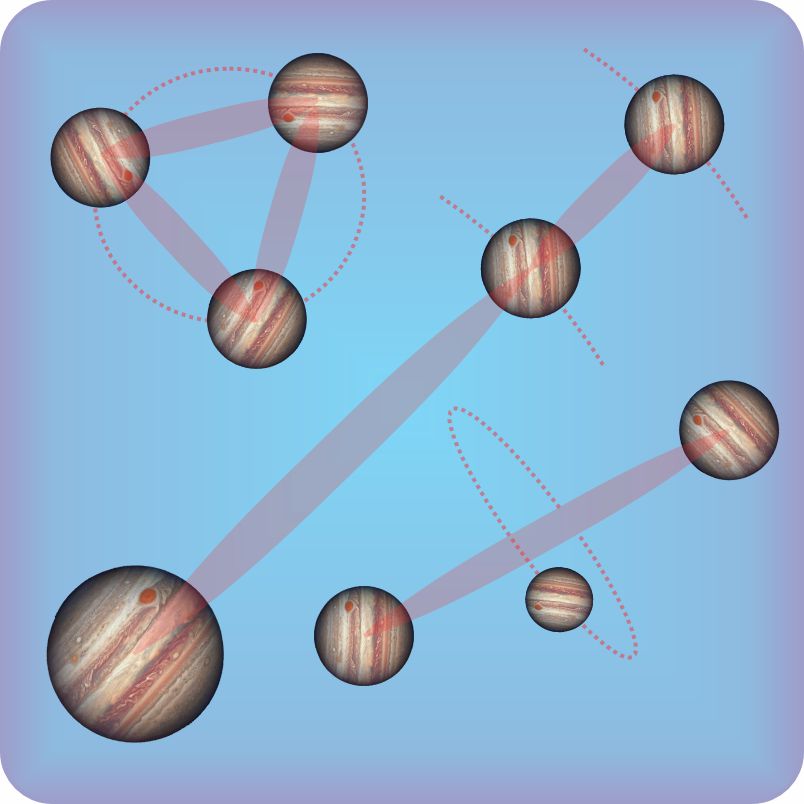
“Looks like we’ve got a three‑body problem here.” Blank looks all around. “You two were just about to go at it until I put in my piece and suddenly you’re on the same side. Two‑way interaction predictable results, three‑way interaction hard to figure. Like when Newton calculated celestial orbits to confirm his Laws of Gravity and Motion. They worked fine for the Earth going around the Sun, not so good for the Moon going around the Earth. The Sun pulls on the Moon just enough to play hob with his two‑body Earth‑Moon predictions.”

“Newton again. So how did he solve it?”

“He didn’t, not exactly anyway.”

“Not smart enough?”

“No, Eddie, plenty smart. Later mathematicians have proven that the three‑body problem simply doesn’t have a general exact solution.”

“Ah-hah, Sy, I heard weaseling — general?”

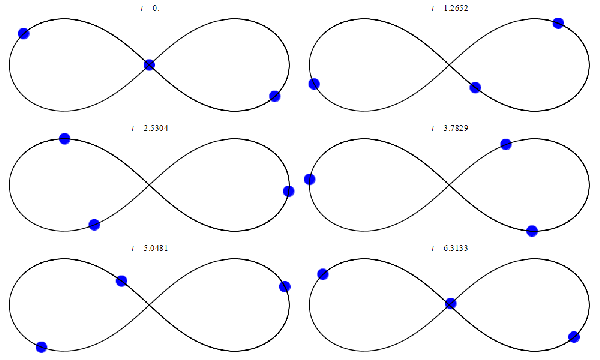
“Alright, Vinnie, there are some stable special cases. Three bodies at relative rest in an equilateral triangle; certain straight‑line configurations; two biggies circling each other and a third, smaller one in a distant orbit around the other two’s center of gravity. There are other specials but none stable in the sense that they wouldn’t be disrupted by a wobbly gravity field from a nearby star or the host galaxy.”

“So if NASA’s mission planners are looking at a four‑body Sun‑Jupiter‑Europa‑Juno situation, what’re they gonna do? ‘Give up’ ain’t an option.”

“Sure not. There’s a grand strategy with variations. The oldest variation goes back to before the Egyptian builders and everybody still uses it. Vinnie, when you fly a client to Tokyo, do you target a specific landing runway?”

“Naw, I aim for Japan, contact ATC Narita when I get close and they vector me in to wherever they want me to land.”

“How about you, Eddie? How do you get that exquisite balance in your flavoring?”

“Ain’t easy, Sy. Every batch of each herb is different — when it was picked, how it was stored, even the weather while it was growing. I start with an average mix which is usually close, then add a pinch of this and a little of that until it’s right.”

“For both of you, the critical word there was ‘close’. Call it in‑flight course adjustments, call it pinch‑and‑taste, everybody uses the ‘tweaking’ strategy. It’s a matter of skill and intuition, usually hard to generalize and even harder to teach in a systematic fashion. Engineers do it a lot, theoretical physicists work hard to avoid it.”

“What’ve they got that’s better?”

” ‘Better’ depends on your criteria. The method’s called ‘perturbation theory’ and strictly speaking, you can only use it for certain kinds of problems. Newton’s, for instance.”

“Good ol’ Newton.”

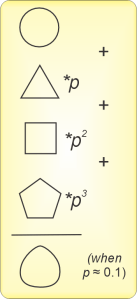
“Of course. Newton’s calculations almost matched Kepler’s planetary observations, but finagling the ‘not quite’ gave Newton headaches. More than 150 years passed before Laplace and others figured out how to treat a distant object as a perturbation of an ideal two‑body situation. It starts with calculating the system’s total energy, which wasn’t properly defined in Newton’s day. A perturbation factor p controls the third body’s contribution. The energy expression lets you calculate the orbits, but they’re the sum of terms containing powers of p. If p=0.1, p2=0.01, p3=0.001 and so on. If p isn’t zero but is still small enough, the p3 term and maybe even the p2 term are too small to bother with.”

“I’ll stick with pinch‑and‑taste.”

“Me and NASA’ll keep course‑correcting.”

~ Rich Olcott
12345 and 8 and 2025

Okay, I’ve got this thing about prime numbers. Some people get all woozy for holiday music as December marches along, but the turning of the year puts me into numeric mode. I’ve done year‑end posts about the special properties of the integer 2016 and integers made up of 3s and 7s. (Sheldon Cooper’s favorite, 73, is just part of an interesting crowd.)

I looked up “2025” in the On-line Encyclopedia of Integer Sequences (the OED of numbers). That number is involved in 1028 different series or families. Sequence A016754, the Central Octagonal Numbers, has some fun visuals. Draw a dot. Then draw eight dots symmetrically around it. You have nine dots. Nine is O2, the second Central Octagonal Number (an octagon enclosing a center, such a surprise). It’s ‘second‘ after O1=1, for that first dot. Now draw another octagon of dots around the core you started, but with two dots on each side. Those 16 dots plus the 9 inside make 25, so O3=25. An octagon with three dots on each side has 24 dots so O4 is 1+8+16+24=49 (see the figure). And so on. If you do the arithmetic, you’ll find that O22, the 22nd Central Octagonal Number, is 2025. Its visual has 22 rings (including the central dot), 168 dots in its outermost ring, for 2025 dots in all.

In case you’re wondering, there is a non-centered series of octagonal numbers that grow out of a dot placed at a vertex of a starter octagon. 2025 isn’t in that series. See the hexagon equivalent in my 2015 post.

Sadly, 2025 isn’t a prime year. Prime‑number years, 2003 and 2011 for example, can be evenly divided by no integer other themselves (and one, of course). 2017 was a prime year, but we won’t see another until 2027. Leap year numbers are divisible by 4 so they can’t ever be prime. That property disqualified 2020 and 2024. It’ll do the same for 2028 and 2032.

Two primes that are as close together as possible, separated only by a single (necessarily even) number, are called twins. There were no twin‑prime years in the 700s, the 900s or the 1500s. The thirteen prime years in the twenty‑first century include three sets of twins, 2027‑2029, 2081‑2083 and 2087‑2089.

If a number’s not prime, then it must be divisible by at least two factors other than itself and one. 2018 and 2019, for example, each have just two factors (2×1009 and 3×673, respectively). Numbers could have more factors, naturally — 2010 is 2×3×5×67 and 2030 is 2×5×7×29, four factors each.

A single factor could be used multiple times — 2024 is 2×2×2×11×23, also written as 23×11×23, for a total of 5 factors. We’re just entering a 6‑factor year (see below) but a formidable factor‑champion is on the horizon. Computer geeks may be particularly fond of the year 2048, known in the trade as 2k (not to be confused with Y2K). The number 2048 has eleven factors, more than any year number of last or this millennium. 2048 is 211, the result of eleven 2s multiplied together. Change just one of those 2s to a 3 and you have 3072 which is a long time from now.

So anyhow, I was poking at 2025, just seeing what was in there. The 5 at the tail‑end is a dead give‑away non‑prime‑wise because the only prime that ends in a 5 is … 5. Another useful trick – add up the digits. If the sum is divisible by 3, so is the number. If the sum is divisible by 9 so is the number. Easy to figure 2+0+2+5=9, so two easy ways to know that 2025‘s not prime.

By the time I got done breaking the number down into all six of its factors, look what a pretty pattern appeared:

Finally, 2025 appears 8 times in this post’s text. Happy New Year.

~~ Rich Olcott

The Trough And The Plateau

Particularly potent pepperoni on Pizza Eddie’s special tonight so I dash to the gelato stand. “Two dips of pistachio in a cup, please, Jeremy, and hurry. Hey, why the glum look?”

“The season’s moving so slowly, Mr Moire. I’m a desert kid, used to bright skies. I need sunlight! We’re getting just a few hours of cloudy daylight each day. It seems like we’re never gonna leave this pattern. Here’s your gelato.”

“Thanks. Sorry about the cloudiness, it’s the wintertime usual around here. But you’re right, we’re on a plateau.”

“Nosir, the Plateau’s the Four Corners area, on the other side of the Rockies, miles and miles away from here.”

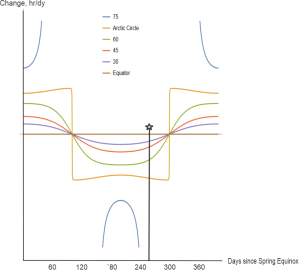
<chuckle> “Not the Colorado Plateau, the darkness plateau. Or the daylight trough, if you prefer. Buck up, we’ll get a daylight plateau starting in a few months.” <unholstering Old Reliable> “Here’s a plot of daylight hours through the year at various northern latitudes. We’re in between the red and green curves. For folks south of the Equator that’d just turn upside‑down, of course. I added a star at today’s date in mid‑December, see. We’re just shy of the winter solstice; the daylight hours are approaching the minimum. You’re feeling stressed because these curves don’t change much day-to-day near minimum or maximum. In a couple of weeks the curve will bend upwards again. Come the Spring equinox, you’ll be shocked at how rapidly the days lengthen.”

“Yeah, my Mom says I’m too impatient. She says that a lot. Okay, above the Arctic Circle they’ve got months‑long night and then months‑long day, I’ve read about that. I hadn’t realized it was a one‑day thing at the Circle. Hey, look at the straight lines leading up to and away from there. Is that the Summer solstice? Those low‑latitude curves look like sine waves. Are they?”

“Summer solstice in the northern hemisphere, Winter solstice for the southerners. The curves are distorted sines. Ready for a surprise?”

<Looks around the nearly empty eatery.> “With business this slow I’m just sitting here so I’m bored. Surprise me, please.”

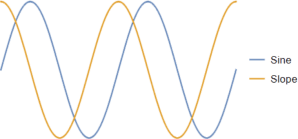
“Sure. One of the remarkable things about a sine wave is, when you graph its slopes you get another sine wave shifted back a quarter. Here, check it out.”

“Huh! When the sine wave’s mid-climb, the slope’s at its peak. When the sine wave’s peaking, the slope’s going through zero on the way down. And they do have exactly the same shape. I see where you’re going, Mr Miore. You’re gonna show me the slopes of the daylight graphs to see if they’re really sine waves.”

“You’re way ahead of me and Old Reliable, Jeremy.” <frantic tapping on OR’s screen> “There, point‑by‑point slopes for each of the graphs. Sorta sine‑ish near the Equator but look poleward.”

“The slopes get higher and flatter until the the Arctic Circle line suddenly drops down to flip its sign. Those verticals are the solstices, right?”

“Right. Notice that even at the Circle the between‑solstice slopes aren’t quite constant so the straight lines you eye‑balled aren’t quite that. North of the Circle the slopes go nuts because of the abrupt shifts between varying and constant sun.”

“How do you get these curves, Mr Moire?”

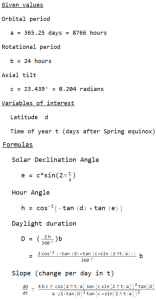
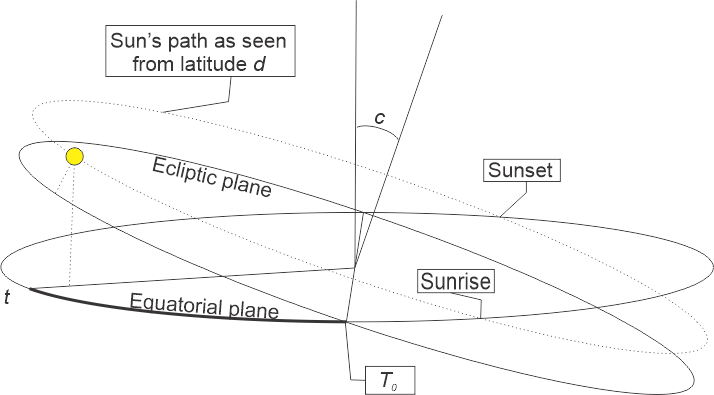
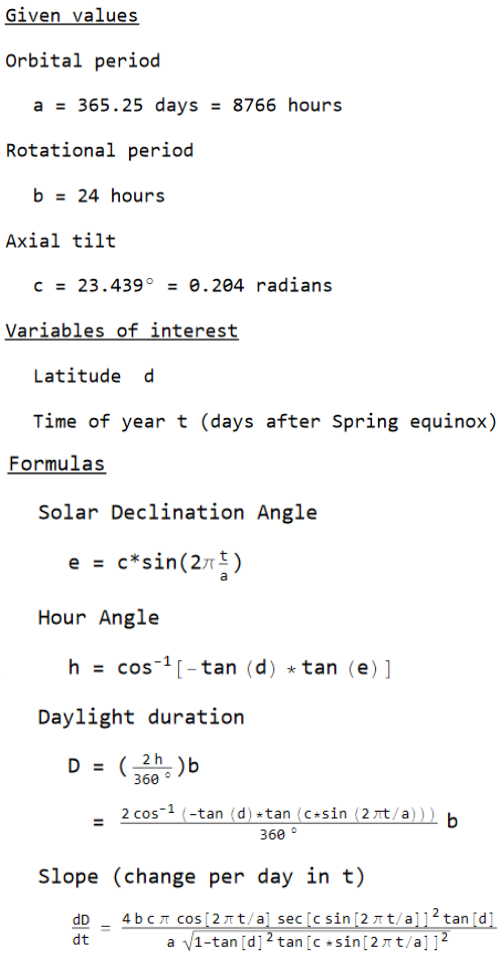
“It’s a series of formulas. Dust off your high school trig. The Solar Declination Angle equation is about the Sun’s height above or below the horizon. It depends on Earth’s year length, its axial tilt and the relative date, t=T‑T0. For these charts I set T0 to the Spring equinox. If the height’s negative the Sun’s below the horizon, okay?”

“Sine function is opposite‑over‑hypotenuse and the height’s opposite alright or we’d burn up, yup.”

“The second formula gives the the Hour Angle between your longitude and whichever longitude has the Sun at its zenith.”

“Why would you want that?”

“Because it’s the heart of the duration formula. When you roll all three formulas together you get one big expression that gives daylight duration in terms of Earth’s constants, time of year and your location. That’s what I plotted.”

“How about the slope curves?”

“Calculus, Jeremy, d/dt of that combined duration function. It’s beyond my capabilities but Old Reliable’s up to it.”

~ Rich Olcott

Competing Curves

It’s still October but there’s a distinct taste of oncoming November in the air — grey, gusty with a moist chill as I step into Cal’s coffee shop. “You’re looking a bit grumpy, Cal.”

“Sure am, Sy. Some lady come in here, wanted pumpkin spice. The nerve! I sell good honest high‑quality coffee, special beans and everything, no goofy flavors. You want peppermint or apple brown betty, go down to the mermaid place. Here’s your mugfull, double‑dark as always. By the way, fair warning — Richard Feder’s in town and looking for you. He’s at that corner table.”

“Thanks, Cal.” <sound of footsteps> “Morning, Mr Feder. How’d things go in Fort Lee?

“Nicely, nicely… I got a question, Moire.”

“Of course you do.”

“I been reading your stuff, you had a graph in one post looks just like the graph in a different post. Here, I printed ’em out. What’s up with that?”

“But they plot entirely different things, brightness against distance in one, atom loss against time in the other, completely different equations.”

“Yeah, yeah, but the shapes are the same I don’t care you say they got different equations. Look, they even both go through the same points at x=2 and 4. What’re you trying to pull here?”

“Not pulling anything. Those two curves are similar, yes, but they’re not identical.” <quickly building charts on Old Reliable> “Here, I’ve laid them both on the same axis. For good measure I’ve extended the x‑axis into a second panel with a stretched‑out y‑axis. What do you see?”

“Well, the orange one goes up and stops but it looks like the blue one’s headed for the sky.”

“It is. But where on the x-axis do those things happen?”

“Zero and one. Okay so the blue line squoze in a little.”

“How about out there at the x=8 end? Looks like they’re close, I’ll grant you, but check the y‑values at at the left of the second panel.”

“Uhh… Looks like blue’s four times higher than orange. Then the orange line flattens out but the blue line not so much.”

“Mm‑hm. So they behave differently at that end, too.”

“Yeah, but what about in the middle here” <jabs finger at Old Reliable’s screen> “where they’re real close and even cross over each other a couple times and you could just draw a straight line?”

“You’ve put your finger on something that challenges every theoretician and research experimentalist who works in a quantitative field. How do you connect the dots? Sure, you can eyeball a straight line through observed points sometimes, there are even statistical techniques for locating the best possible straight line, but is a straight line even appropriate? Sometimes it is, sometimes it’s not, and often we don’t know.”

“How can you not know? Everything starts with a straight line, shortest distance between two points, right?”

“Only if they’re the right points. Real observations are always uncertain. Lenses are never perfect, adjustment screws have a little bit of play, detector pixels are larger than a perfect point would be, whatever. Good experimentalists put enormous amounts of time and care into eliminating or at least controlling for every imaginable error source, but perfect measurements just don’t happen.”

“So it’ll be a fuzzy straight line.”

“For some range of ‘fuzzy’, mm‑hm. Now we get into the theory issues. We’ve already seen the simplest one — range of validity. Your straight‑line approximation might be good enough for some purposes in the x‑range between 2 and 4, but things get out of hand outside of that range.”

“Okay, in graphs. But these two curves both look good. Why choose one over the other?”

“That’s where theory and data collude. Sometimes theories tell us what data to look for, sometimes the data challenges us to develop an explanatory theory, sometimes we just try curve after curve until we find one that works across the full range that experiment can reach but we don’t know why. What’s exciting is when we get to use the data to determine which of several competing theories is the correct one. Or least incorrect.”

“I got other ways to get excited.”

“Of course you do.”

~~ Rich Olcott

Why Physics Is Complex

“I guess I’m not surprised, Sy.”

“At what, Vinnie?”

“That quantum uses these imaginary numbers — sorry, you’d prefer we call them i‑numbers.”

“Makes no difference to me, Vinnie. Descartes’ pejorative term has been around for three centuries so that’s what the literature uses. It’s just that most people pick up the basic idea more quickly without the woo baggage that the real/imaginary nomenclature carries along. So, yes, it’s true that both i‑numbers and quantum mechanics appear mystical, but really quantum mechanics is the weird one. And relativity.”

“Wait, relativity too? That’s hard to imagine, HAW!”

“Were you in the room for Jim’s Open Mic session where he talked about Minkowski’s geometry?”

“Nope, missed that.”

“Ah, okay. Do you remember the formula for the diagonal of a rectangle?”

“That’d be the hypotenuse formula, c²=a²+b². Told you I was good at Geometry.”

“Let’s use ‘d‘ for distance, because we’re going to need ‘c‘ for the speed of light. While we’re at it, let’s replace your ‘a and ‘b‘ with ‘x‘ and ‘y,’ okay?”

“Sure, why not?”

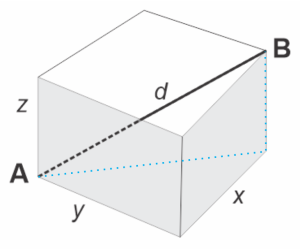
<casting image onto office monitor> “So the formula for the body diagonal of this box is…”

“Umm … That blue line across the bottom’s still √(x²+y²) and it’s part of another right triangle. d‘s gotta be the square root of x²+y²+z².”

“Great. Now for a fourth dimension, time, so call it ‘t.’ Say we’re going for light’s path between A at one moment and B some time t later.”

“Easy. Square root of x²+y²+z²+t².”

“That’s almost a good answer.”

“Almost?”

“The x, y and z are distance but t is a duration. The units are different so you can’t just add the numbers together. It’d be like adding apples to bicycles.”

“Distance is time times speed, so we multiply time by lightspeed to make distance traveled. The formula’s x²+y²+z²+(ct)². Better?”

“In Euclid’s or Newton’s world that’d be just fine. Not so much in our Universe where Einstein’s General Relativity sets the rules. Einstein or Minkowski, no‑one knows which one, realized that time is fundamentally perpendicular to space so it works by i‑numbers. You need to multiply t by ic.”

“But i²=–1 so that makes the formula x²+y²+z²–(ct)².”

“Which is Minkowski’s ‘interval between an event at A and another event at B. Can’t do relativity work without using intervals and complex numbers.”

“Well that’s nice but we started talking about quantum. Where do your i‑numbers come into play there?”

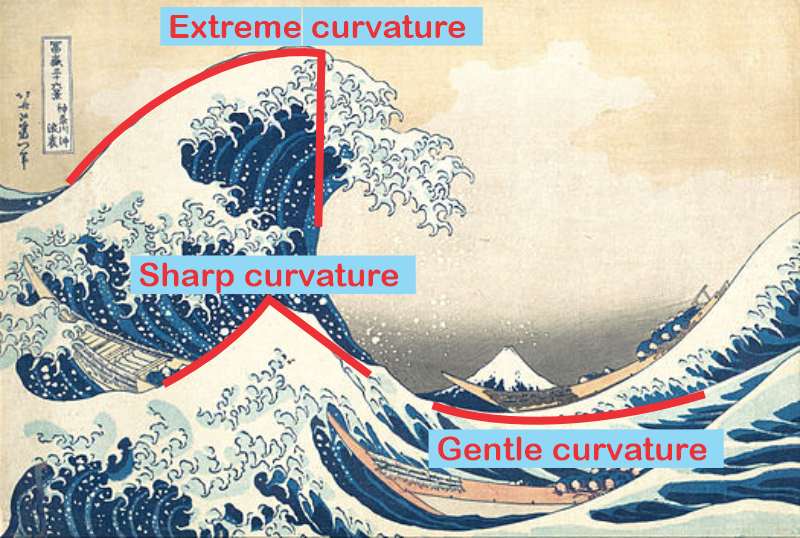
“It goes back to the wave equation— no, I know you hate equations. Visualize an ocean wave and think about describing its surface curvature.”

“Curvature?”

“How abruptly the slope changes. If the surface is flat the slope is zero everywhere and the curvature is zero. Up near the peak the slope changes drastically within a short distance and we say the surface is highly curved. With me?”

“So far.”

“Good. Now, visualize the wave moving past you at some convenient speed. Does it make sense that the slope change per unit time is proportional to the curvature?”

“The pointier the wave segment, the faster its slope has to change. Yeah, makes sense.”

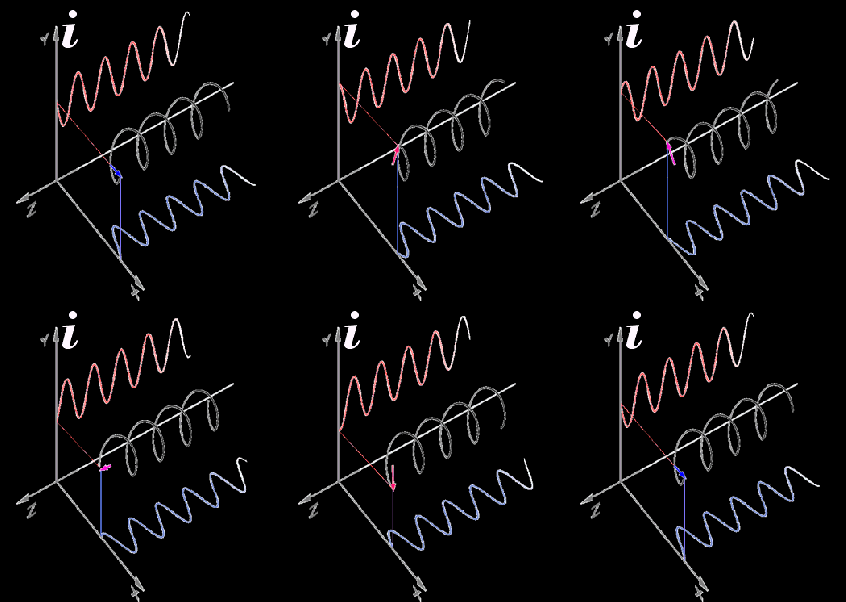
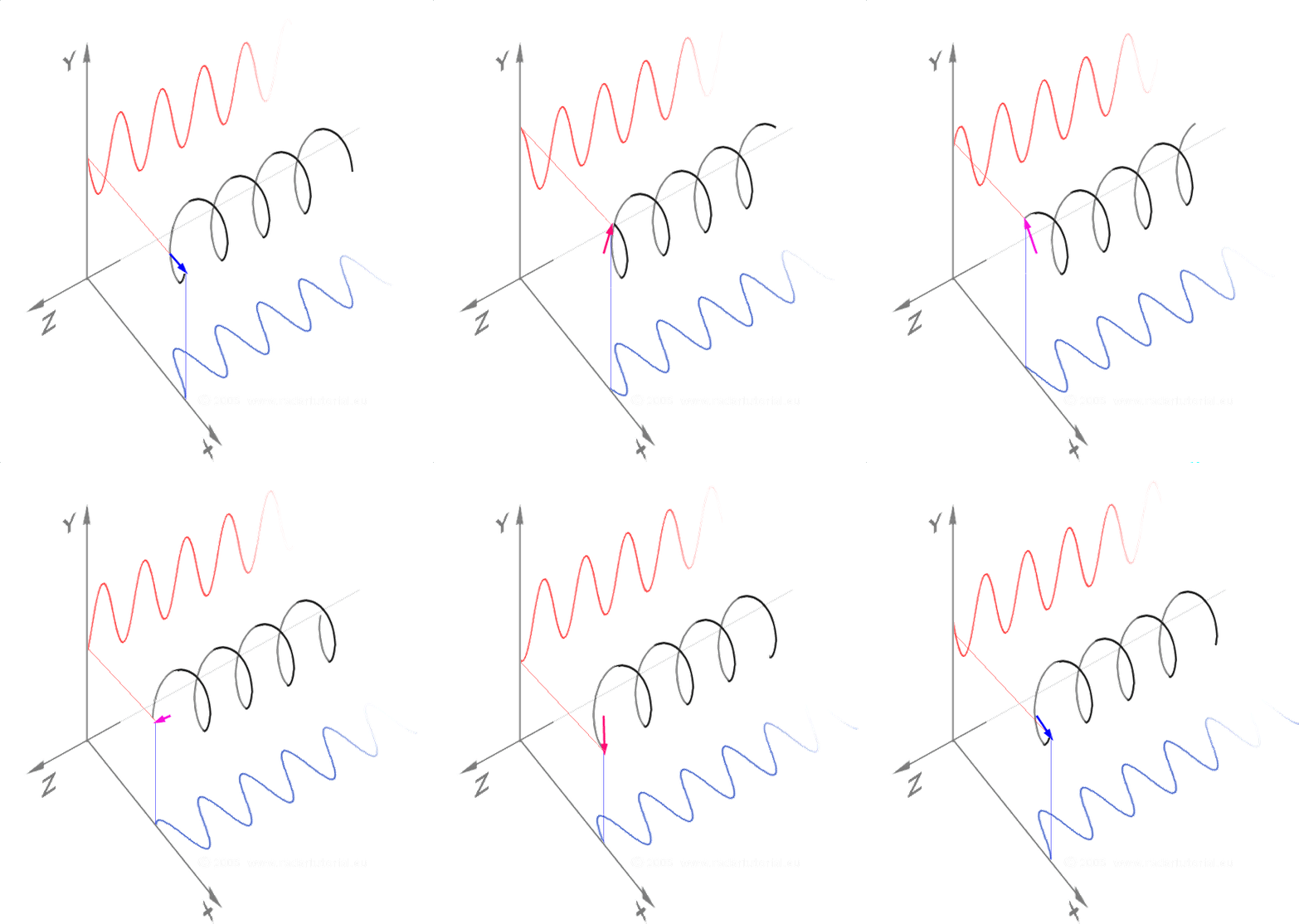
“Which is what the classical wave equation says — ‘time‑change is proportional to space‑change’. The quantum wave equation is fundamental to QM and has exactly the same form, except there’s an i in the proportionality constant and that changes how the waves work.” <casting a video> “The equation’s general solution has a complex exponential factor eix. At any point its value is a single complex number with two components. From the x‑direction, the circle looks like a sine wave. From the i‑direction it also looks like a sine wave, but out of phase with the x‑wave, okay?”

“Out of phase?”

“When one wave peaks, the other’s at zero and vice‑versa. The point is, rotation’s built into the quantum waves because of that i‑component.” <another video> “Here’s a lovely example — that black dot emits a photon that twists and releases the electromagnetic field as it moves along.”

~ Rich Olcott

…With Imaginary Answers

“I’ve got another solution to Larry’s challenge for you, Vinnie.”

“Will I like this one any better, Sy?”

“Probably not but here it is. The a‑line has unit length, right?”

“That’s what the picture says.”

“And the b‑line also has unit length, along the i‑axis.”

“Might as well call it that.”

“And we’ve agreed it’s a right triangle because all three vertices touch the semicircle. A right triangle with two one‑unit sides makes it isosceles, right, so how big is the ac angle?”

“Isosceles right triangle … 45°. So’s the bc angle even though it don’t look like that in the picture.”

“Perfect. Now let me split the triangle in two by drawing in this vertical line.”

“That’s its altitude. I told you I remember Geometry.”

“So you did. Describe the ac triangle.”

“Mm, it’s a right triangle because altitudes work that way. We said the ac angle is 45° which means the top angle is also 45°.”

“What about length ca?”

“Gimme a sec, that’s buried deep. … If the hypotenuse is 1 unit long then each side is √½ units.”

“Vinnie, I’m impressed. So what’s the area of the right half of the semicircle?”

“That’s a quarter‑circle with radius ca which is √½ so the area would be ¼πca² which comes to … π/8.’

“Now play the same game with the b‑side.”

“Aw, geez, I see where you’re going. Everything’s the same except cb has an i in it which is gonna get squared. The area’s ¼πcb² which is … ¼π(i√½)² which is –π/8. Add ’em both together and the total area comes to zero again. … Wait!”

“Yes?”

“You said the i‑axis is perpendicular to everything else.” <sketching on the back of the card> “That’s not really a semicircle, it’s two arcs in different planes that happen to have the same center and match up at one point. The c‑line’s bent. Bo‑o‑o‑gus!”

“I said you wouldn’t like it. But I didn’t quite say ‘perpendicular to everything else‘ because it’s not. The problem is that the puzzle depends on a misleadingly ambiguous diagram. The only perpendicular to i that I worked with was the a‑line. You’ve also got it perpendicular to part of the c‑line.”

“Sy, if these i-number things are ambiguous like that, why do you physics and math guys spend so much time with them? And do they really call them i‑numbers?”

“Ya got me. No, they’re actually called ‘complex numbers,’ because they are complex. The problem is with what we call their components.”

“Components plural?”

“Mm‑hm. Mathematicians put numbers in different categories. There’s the natural numbers — one, two, three on up. Extend that through zero on down and you have the integers. Roll in the integer/integer fractions and you’ve got the rational numbers. Throw in all the irrationals like pi and √2 and you’re got the full number line. They call that category the reals.”

“That’s everything.”

“That’s everything along the real number axis. Complex numbers have two components, one along the real number line, the other along the perpendicular pure i‑number line. A complex number is one number but it has both real and i components.”

“If it’s not real, it’s imaginary, HAW!”

“More correct than you think. That’s exactly what the ‘i‘ stands for. If Descarte had only called the imaginaries something more respectable they wouldn’t have that mysterious woo‑quality and people wouldn’t have as much trouble figuring them out. Complex numbers aren’t mysterious or ambiguous, they’re just different from the numbers you’re used to. The ‘why’ is because they’re useful.”

“What good’s a number with two components?”

“It’s two for the price of one. The real number line is good for displaying a single variable, but suppose one quantity links two variables, x and y. You can plot them using Descartes’ real‑valued planar coordinates. Or you could use complex numbers, z=x+iy and plot them on the complex plane. Interesting things happen in the complex plane. Look at the difference between ex and eix.”

“One grows, the other cycles.”

“Quantum mechanics depends on that cycling.”

~ Rich Olcott

A Complex Question

A familiar footstep in the hall outside my office. “Door’s open, Vinnie, c’mon in.”

“Hi, Sy. Brought you something.” <lays a card on my desk> “So the question is, what’s the area inside the semicircle?”

<thoughtful pause> “Zero.”

“Dang, that’s both you and Larry say it’s zero. I don’t see it. ‘Splain, okay?”

“Larry gave you this?’

“Yeah. Can’t be zero area, it’s right there all spread out. How do you figure zero?”

“Start with the diagonal lines. The ‘a‘ line has a length of one unit, right?”

“The picture says so, but what’s i about on line ‘b‘?”

“That’s a special number, defined to be the solution x of the equation x²+1=0. Taking square roots, x=i and i²+1=0. I know you hate equations, but bear with me.”

<grumble> “Okay, go ahead.”

“If we had the radius r, the area would be ½πr². Line c is the diameter so the radius is r=c/2. We can get c by solving the triangle. We know it’s a right triangle because all three vertices touch a semicircle, right?”

“Geometry I remember; it was algebra gave me fits.”

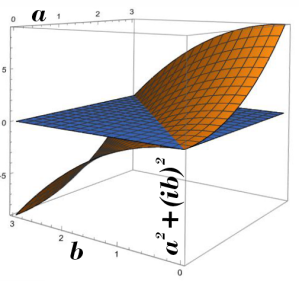
“Then you remember good old Pythagoras and his a²+b²=c² formula, which we can use here because it’s a right triangle. Plugging in the known lengths we get c²=1²+i²=i²+1. Look familiar?”

“Yeahhh, i²+1=0 from the definition so is zero. What if b was 3?”

“We’d have c²=1²+(3i)²=1+9=1–9=–8. If both a and b are 3, then c²=3²+(3i)²=9+9=9–9 and we’re back to c²=0. It’s just arithmetic, but enhanced with i and its special rules.”

“Wait. If c²=0 then c=0 and c‘s the diameter and if that’s zero then so’s the radius and the area. The whole thing shrinks to a point but it can’t ’cause it’s right there spread out in the picture. Is this sort of thing why they told us x²–1=0 has a solution but x²+1=0 doesn’t?”

“It’s closely related, because i is involved. Incidentally, they lied to you in that algebra class. They showed you that famous quadratic equation ax²+bx+c=0, right, along with the magic b²–4ac formula. If that formula is positive you’ve got two roots, they said, but if it’s negative there’s no root.”

“Sounds familiar. Where’s the lie?”

“The first part’s true: with 1=0 you’ve got a=1,b=0,c=–1 with two roots x=1 and x=–1. The lie is in the second part: with x²+1=0 you’ve got a=1,b=0,c=+1 with two roots x=i and x=–i. All of those are perfectly good solutions.”

“But i‘s not a number! I can’t have i apples and I can’t write a check for i dollars. Why even play with it?”

“The i‑numbers are numbers, just not counting numbers. They’ve been part of mainstream math ever since the early Renaissance. Algebra was almost a blood sport at the time. Academics in Italy used to issue public challenges to solve problems that they’d already solved secretly. There were duels to settle questions of priority. Bombelli systematized i‑number arithmetic while working out one limited class of cubic equations. Cardano compiled solutions from multiple authors, including Bombelli, into his book Ars Magna. Then he systematically added his own solutions to a catalog of cubic and quartic equations. The Old Guard refused to believe in either i‑numbers or negative numbers, but Cardano showed you can’t escape them if you’re doing serious algebra.”

“Not even negative numbers?”

“Nope. The negatives weren’t widely accepted until the Venetian trading houses forced the issue — negatives are implicit in the merchants’ newly‑invented double‑entry bookkeeping. i‑numbers weren’t considered respectable for hundreds of years.”

“Then what happened?”

“Several advances. Euler connected i with trigonometry. Add Descarte‘s coordinate system, Fourier‘s wave analysis and Leibniz‘ notational innovations. For example, plotting an i‑number helix in 3D gives you these sine waves. When I think ‘i‑axis‘ I think ‘perpendicular to other coordinates‘.”

“Like Las Vegas.”

“Similar.”

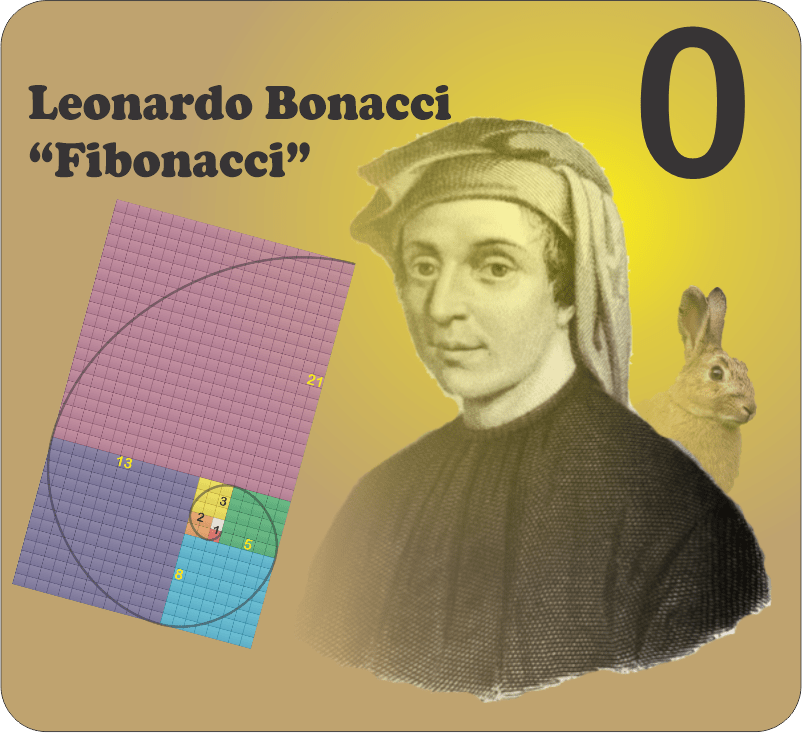
Cardano image by R. Cooper
from Wellcome Trust
under the CCA International license
  • Thanks to Lloyd Boyer who raised several good points.

~~ Rich Olcott

A Spherical Bandstand

“Whoa, Sy, something’s not right. Your zonal harmonics — I can see how latitudes go from pole to pole and that’s all there are. Your sectorial harmonic longitudes start over when they get to 360°, fine. But this chart you showed us says that the radius basically disappears crazy close to zero. The radius should keep going forever, just like x, y and z do.”

“Ah, I see the confusion, Susan. The coordinate system and the harmonic systems and the waves are three different things, um, groups of things. You can think of a coordinate system as a multilevel stage where chords of harmonic musicians can interact to play a composition of wave signals. The spherical system has latitude and longitude levels for the brass and woodwind players, plus one in back for the linear percussion section. Whichever direction the brass and woodwinds point, that’s where the signals go out, but it’s the percussion that determines how far they get. Sure, radius lines extend to infinity but except for R0 radial harmonics damp out pretty quickly.”

“Signals… Like Kaski’s team interpreted Juno‘s orbital twitches as a signal about Jupiter’s gravitational unevenness. Good thing Juno got close enough to be inside the active range for those radial harmonics. How’d they figure that?”

“They probably didn’t, Cathleen, because radial harmonics don’t fit easily into real situations. First problem is scale — what units do you measure r in? There’s an easy answer if the system you’re working with is a solid ball, not so easy if it’s blurry like a protein blob or galaxy cluster.”

“What makes a ball easy?”

“Its rigid surface that doesn’t move so it’s always a node. Useful radial harmonics must have a node there, another node at zero and an integer number of nodes between. Better yet, with the ball’s radius as a natural length unit the r coordinate runs linearly between zero at the center and 1.0 at the surface. Simplifies computation and analysis. In contrast, blurries usually don’t have convenient natural radial units so we scrabble around for derived metrics like optical depth or mixing length. If we’re forced into doing that, though, we probably have worse challenges.”

“Like what?”

“Most real-world spherical systems aren’t the same all the way through. Jupiter, for instance, has separate layers of stratosphere, troposphere, several chemically distinct cloud‑phases, down to helium raining on layers of hydrogen in liquid, maybe slushy or even solid form. Each layer has its own suite of physical properties that put kinks into a radial harmonic’s smooth curve. Same problem with the Sun.”

“How about my atoms? The whole Periodic Table is based on atoms having a shell structure. What about the energy level diagrams for atomic spectra? They show shells.”

“Well, they do and they don’t, Susan. Around the turn of the last Century, Lyman, Balmer, Paschen, Brackett and Pfund—”

“Sounds like a law firm.”

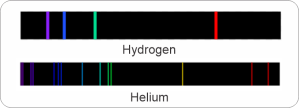
“<ironically> Ha, ha. No, they were experimental physicists who gave the theoreticians an important puzzle. Over a 40‑year period first Balmer and then the others, one series at a time, measured the wavelengths of dozens of lines in hydrogen’s spectrum. ’Okay, smarties, explain those!‘ So the theoreticians invented quantum mechanics. The first shot did a pretty good job for hydrogen. It explained the lines as transitions between discrete states with different energy levels. It then explained the energy levels in terms of charge being concentrated at different distances from the nucleus. That’s where the shell idea came from. Unfortunately, the theory ran into problems for atoms with more than one electron.”

“Give us a second… Ah, I get why. If one electron avoids a node, another one dives in there and that radius isn’t a node any more.”

“Got it in one, Cathleen. Although I prefer to think of electrons as charge clouds rather than particles. Anyhow, when an atom has multiple charge concentrations their behavior is correlated. That opens the door to a flood of transitions between states that simply aren’t options for a single‑electron system. That’s why the visible spectrum of helium, with just one additional electron, has three times more lines than hydrogen does.”

“So do we walk away from spherical harmonics for atoms?”

“Oh, no, Susan, your familiar latitude and longitude harmonics fit well into the quantum framework. These days, though, we mostly use combinations of radial fade‑aways like my Sn00 example.”

~~ Rich Olcott

Jupiter And The Atoms

“Okay, Sy, what’s your third solution?”

“Solution to what, Susan?”

These harmonic thingies. They’re about angles so it makes sense to chart them in polar or spherical coordinates, but when they take on negative values the radius goes the wrong way. You said one solution was to chart the negatives in a different color. That’s confusing, though. Another solution is to square all the values to get everything into positive territory. That’s okay for chemists like me because the peaks and nodes we care about stay in the same places. What’s the third option?”

“One that gets to why these ‘harmonic thingies’ are interesting at all. When Juno‘s orbiting Jupiter, does it feel each of Kaspi’s Jn shapes individually?”

“No, of course not, she just reacts to how they all add togethherrr … Oh! So you’re saying we can handle negative values from one harmonic by adding it to another one that’s more positive and plotting the combination.”

<pointing to paper napkin> “Bingo! Remember this linear plot of J2 where I colored its negative section pink?” <pointing to display on Old Reliable> “When you multiply J2 by C0 you get S220. I added that to four helpings of Sn00 to get this combination.”

“Ah, that negative region in S220‘s middle shaves back the equator on Sn00‘s sphere while the positive part adds bumps top and bottom.” <Susan gives me the side‑eye> “Why’d you pick that 4‑to‑1 ratio, and what’s with those n subscripts instead of numbers?”

“Getting a little ahead of myself. For the moment let’s concentrate on Juno‘s experience with Jupiter’s gravity. One reason I chose that ratio was that it’s pretty easy to see in the picture. In real cases the physical system determines the ratios. Kaspi’s team derived their ratios experimentally. They used math to fit a model to Juno‘s very slightly wobbly orbit. Their model of Jupiter’s gravity field started from the spherical J0 shape. They tweaked that by adding different ratios of J2 through J40, adjusting the ratios until the model’s total gravity field predicted an orbit that matched the real‑world one. J2‘s share was about 15 parts per thousand but most of the rest contributed less than a part per million. Jupiter probably uses multiple mass blobs to make the J2 shape. The point is, the planet’s really a mess but we can analyze the mess in terms of the harmonics.”

“So that’s how you drew what Cal called your wiggle-waggles — you followed Kaski’s Jn recipe and then added some constant to push the polar plot out far enough that the negatives didn’t poke out the wrong side. That constant — what value did you use and why that one?”

“That’s exactly what I did do, Cathleen. Frankly, I don’t even remember what constant I added, just something that was big enough to make the negatives behave nicely, not so large that the peaks vanished by comparison. Calibrating accurately to Jupiter’s J0 would shrink the peaks down to parts‑per‑thousand invisibility. After all, I was more concerned with peak position than peak size.”

“Now we’re back to your 4‑to‑1 ratio. Was that arbitrary, too?”

“No, it wasn’t, Susan. Would it have been closer to Chemistry if I’d labeled that figure as 1s22s22p1?”

“Two electrons in the 1s‑shell, two in the 2s‑shell plus one 2p electron … that’s a boron atom? But you’re showing only one radial shell, not two separate ones.”

“True, but that’s to make another point. There isn’t an electron in the 1s shell, or even a pair of them nicely staying on opposite sides. The atom’s charge, all five electrons‑worth of it, is smeared out as a wave pattern across the entire structure. The Sn00 pattern captures everything that’s spherical. The S220 pattern gets what’s left.”

“But what about the radial nodes? Isn’t that the difference between 1s and 2s, that 2s has a node?”

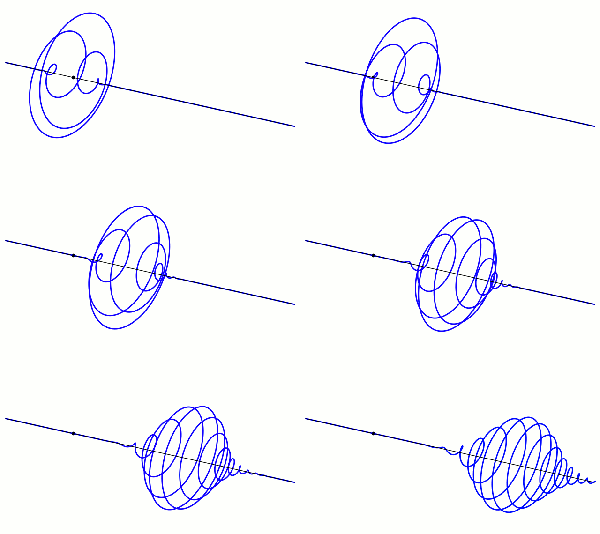
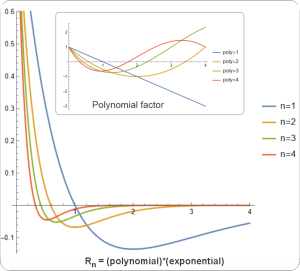
“Oh there are nodes, alright, but they don’t have much effect. Each radial harmonic is the product of two factors — a polynomial and an exponential. The exponential part squeezes the polynomial so hard that adjacent peaks and valleys are barely bumps and dents.”

“So Jupiter and atoms use the same math, huh?”

“So does the Sun.”

~~ Rich Olcott

Shapes And Numbers

I’m nursing my usual mug of eye‑opener in Cal’s Coffee Shop when astronomer Cathleen and chemist Susan chatter in and head for my table. Susan fires the first volley.
“Sy, those spherical harmonics you’ve posted don’t look anything like the atomic orbitals in my Chem text. Shouldn’t they?”
 ”How do you add and multiply shapes together?”
  ”What does the result even mean?”
   ”And what was that about solar seismology?”

“Whoa, have you guys taken interrogation lessons from Mr Feder? One at a time, please. Let’s start with the basics.” <sketching on a paper napkin> “For example, the J2 zonal harmonic depends only on the latitude, not on the longitude or the distance from the center, so whatever it does encircles the axis. Starting at the north pole and swinging down to the south pole, the blue line shows how J2 varies from 1.0 down to some negative decimal. At any latitude, whatever else is going on will be multiplied by the local value of J2.”

“The maximum is 1.0, huh? Something multiplied by a number less than 1 becomes even smaller. But what happens where J2 is zero? Or goes negative?”

“Wherever Jn‘s zero you’re multiplying by zero which makes that location a node. Furthermore, the zero extends along its latitude all around the sphere so the node’s a ring. J2‘s negative value range does just what you’d expect it to — multiply by the magnitude but flip the product’s sign. No real problem with that, but can you see the problem in drawing a polar graph of it?”

“Sure. The radius in a polar graph starts from zero at the center. A negative radius wouldn’t make sense mixed in with positives in the opposite direction.”

“Well it can, Cathleen, but you need to label it properly, make the negative region a different color or something. There are other ways to handle the problem. The most common is to square everything.” <another paper napkin> “That makes all the values positive.”

“But squaring a magnitude less than 1 makes it an even smaller multiplier.”

“That does distort the shapes a bit but it has absolutely no effect on where the nodes are. ’Nothin’ times nothin’ is nothin’,’ like the song says. Many of the Chem text orbital illustrations I’ve seen emphasize the peaks and nodes. That’s exactly what you’d get from a square‑everything approach. Makes sense in a quantum context, because the squared functions model electron charge distributions.”

“Thanks for the nod, Sy. We chemists care about charge peaks and nodes around atoms because they control molecular structures. Chemical bonds and reactions tend to localize near those places.”

“I aim for fairness, Susan. There is another way to handle a negative radius but it needs more context to look reasonable. Meanwhile, we’ve established that at any given latitude each Jn is just a number so let’s look at longitudes.” <a third paper napkin> “Here’s the first two sectorial harmonics plotted out in linear coordinates.”

“Looks familiar.”

“Mm‑hm. Similar principles, except that we’re looking at a full circle and the value at 360° must match the value at 0°. That’s why Cm always has an even node count — with an odd number you’d have -1 facing +1 and that’s not stable. In polar coordinates,” <the fourth paper napkin> “it’s like you’re looking down at the north pole. C0 says ‘no directional dependence,’ but C1 plays favorites. By the way, see how C1‘s negative radii in the 90°‑270° range flip direction to cover up the positives?”

“Ah, I see where you’re going, Sy. Each of these harmonics has a numeric value at each angle around the center. You’re going to tell us that we can multiply the shapes by multiplying their values point by point, one for each latitude for a J and each longitude for a C.”

“You’re way ahead of me as usual, Cathleen. You with us, Susan?”

“Oh, yes. In my head I multiplied your J2 by C0 and got a pz orbital.”

“I’m impressed.”
 ”Me, too.”

“Oh, I didn’t do it numerically. I just followed the nodes. J2 has two latitude nodes, C0 has no longitude nodes. There it is, easy‑peasy.”

~~ Rich Olcott