A Loose-end Lagniappe

<chirp, chirp> “Moire here.”

“We have some loose ends to tie up. Too early for pizza. Coffee at Cal’s?”

“Hello, ‘Walt‘. Fifteen minutes?”

“Confirmed.”


He’s at a back table, facing the door, of course. He points to the steaming mug and strawberry scone beside it on the table. I nod to acknowledge. ”So, Walt, what are these loose ends?”

“My people say that Juno‘s not on a 53‑day orbit any more. NASA’s jiggled it down to 33 days. What’s that do to the numbers you gave me?”

<sliding a folded paper scrap across the table> “I had a hunch you’d want more so I worked up estimates. Juno started with a 53‑day orbit but a Ganymede flyby dropped it to 43 days. A Europa flyby took Juno to a 38‑day orbit. Now it’s swerved by Io and we’re at 33 days. I threw in the 23‑day line for grins, no extra charge.”

“Half the orbit size but no significant change in the close‑in specs. That’s surprising.”

“Not really. It’s like a dog’s butt wagging its tail. At close approach, we call it perijove, Juno is only 76 500 kilometers out from Jupiter’s center. Its orbit thereabouts is pretty much nailed down by the big guy’s central field. But there’s no second attractor to constrain the orbit’s other extreme millions of kilometers out. Do an Oberth burn near perijove or arrange for a gravity tweak from a convenient moon, you get a big difference at the far end.”

“That wraps that.” <reaches for his cane, then settles back to do a Columbo> “Just one more thing, Moire. I came in with a question about the Sun’s effect on Juno. You took care of that pretty quick but spent a load of my time and consultancy budget on these spherical harmonics. How come?”

“As I recall, you and your people kept coming back for more detail. Also, the 225 000‑kilometer radius I got from R2‘s structure was essential in calculating these close‑in numbers. You’re getting your money’s worth. I’ll even throw in a lagniappe.”

“A free gift? I never trust them.”

“Such a mean world you live in, Walt.” <displaying an image on Old Reliable> “Here it is, take it or leave it.”

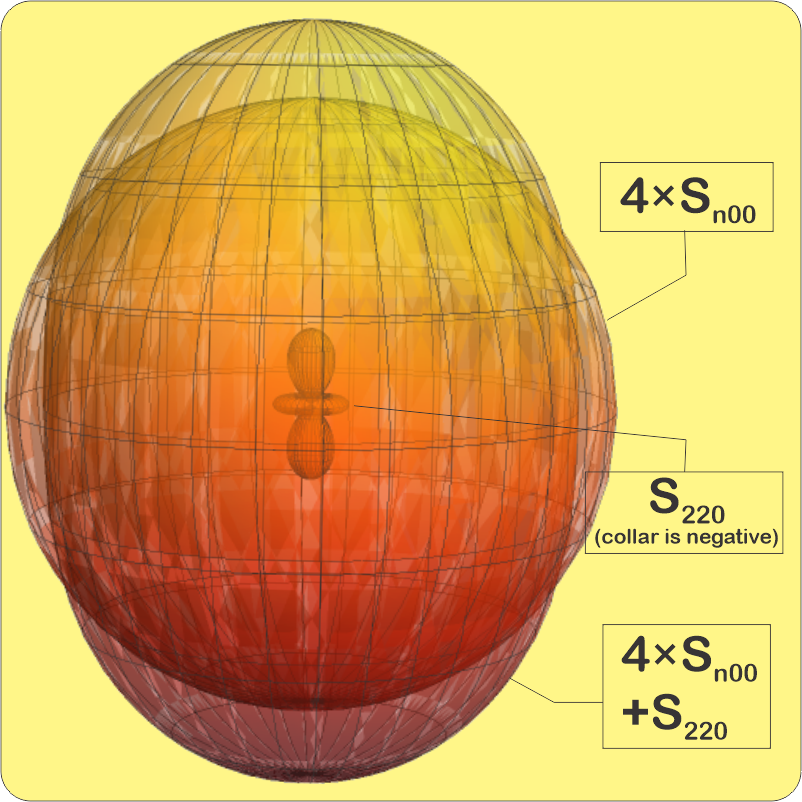
Top: F000 plus a time-varying contribution from F660
Bottom: C0 plus a time-varying contribution from C4

“What is it?”

“It’s a bridge between the physics of light and sound, and the physics of atoms and stars. When I say ‘coordinates,’ what words spring to your mind?”

“Traverse and elevation.”

“Interesting choice. Any other systems?”

“Mm, latitude, longitude and altitude. And x‑y‑z if you’re in a classroom.”

“Way beyond the classroom. You use spreadsheets, right?”

“Doesn’t everyone?”

“Rowscolumnssheets is xyz. On digital screens, pixelslinesluminosity is xyz. Descarte’s rectilinear invention is so deeply embedded in our thinking we don’t even notice it. Perpendicular straight‑line coordinates fit things that are flat or nearly so, not so good for spheres and central‑force problems. Movement there is mostly about rotation, which is why your first two picks were angular instead of linear.”

“Okay, but our choice of coordinates is our choice. What have xyz or your Fnnm to do with natural things?”

“Overtones and resonance. Look at that black line in the movie. It could be a guitar string or a violin string, doesn’t matter. One end’s fixed to the instrument’s bridge, the other end’s under somebody’s finger. All other points on the string are free to move, subject to tension along the string. Then someone adds energy to the string by plucking or bowing it.”

“At one of those peaks or valleys, right?”

“Nope, anywhere, which goes to my point. The energy potentially could contort the string to any shape. Doesn’t happen. The only stable shapes are combinations of sine waves with an integer number of nodes, like C4‘s quartet. Adding even more energy gives you overtones, waves that add in‑between nodes to lower‑energy waves. C0‘s no‑nodes black line could run along x, y or z in any flat system.”

“So you’re going to tell me that your C‘s, J‘s and R‘s support wave structures for spheres.”

“Indeed. All four giant planets have stripes along their J arcs. Solar seismologists have uncovered C, R and maybe J wave structures inside the Sun.”

“Bye.”

“Don’t mention it.”

~ Rich Olcott

Completing The Triad

Walt’s mustache bristles as he gives me the eye. ”You claim three harmonics control how the Sun’s gravity could affect spacecraft orbits around a target planet like Jupiter. You said we don’t have to care about Jupiter’s gravitational zones and isolating the sectors probably isn’t doable. What’s the third?”

Time to twist the screws. ”Three harmonic systems, Walt, all working together and you’ve got their names wrong. They control nothing, they’re a framework for analysis. And Jupiter’s special. Solar gravity doesn’t affect its zonal harmonic arcs but that’s only because Jupiter’s polar axis is nearly perpendicular to its orbital plane. Zonal‑effect N‑S twisting at Jupiter is pennies on a C‑note. Any mission we send to Mars, Saturn or Uranus we’ll care a lot about their zonal harmonics because their axes have more tilt. An 82° tilt for Uranus, can’t get much more tilted than that. Sectorial harmonics may still help us navigate there because Uranus probably has a lot less magnetism than Jupiter.”

That rocks him but he comes back strong. ”The third kind of harmonic?!! C’mon, give!”

“Radial, the center‑out dimension. The gravitational force between bodies depends on center‑to‑center distances so yeah, your people would be interested.”

“I presume radial harmonics have numbers like Jn and Cm do?”

“They do. Sorry, this’ll get technical again but I’ll go as light as I can. Each radial harmonic is the product of two factors. You know about factors, right?”

“Sure, force multipliers.”

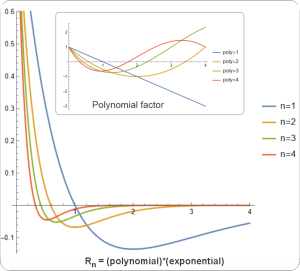
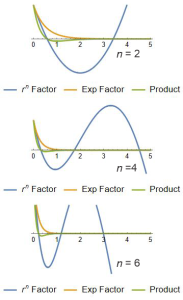
“You would know that kind. More generally, factors are things that get multiplied together. I’ll call the general radial harmonic Rn. It’s the product of two factors. The first is a sum of terms that begin with rn, where r is the distance. For instance, R3‘s first factor would look like a*r³+b*r²+c*r+d, where the a,b,c,d are just some numbers. Different radial harmonics have different exponents in their lead terms. You still with me?”

“Polynomials from high school algebra. Tell me something new.”

“The second factor decreases exponentially with n*r. No matter how large rn gets, when you multiply an rn polynomial by something that decreases exponentially, the (polynomial)×(exponential) product eventually gets really small.”

“Give me a second. … So what you’re saying is, at a big enough distance these radial harmonics just die away.”

“That’s where I was going.”

“How far is ‘enough’?”

“Depends on n. Higher values of n shut down faster.”

“So these Cms and Jns and Rns just add together?” <pauses, squints at me suspiciously> “Is there some reason you used n for both Jn and Rn?”

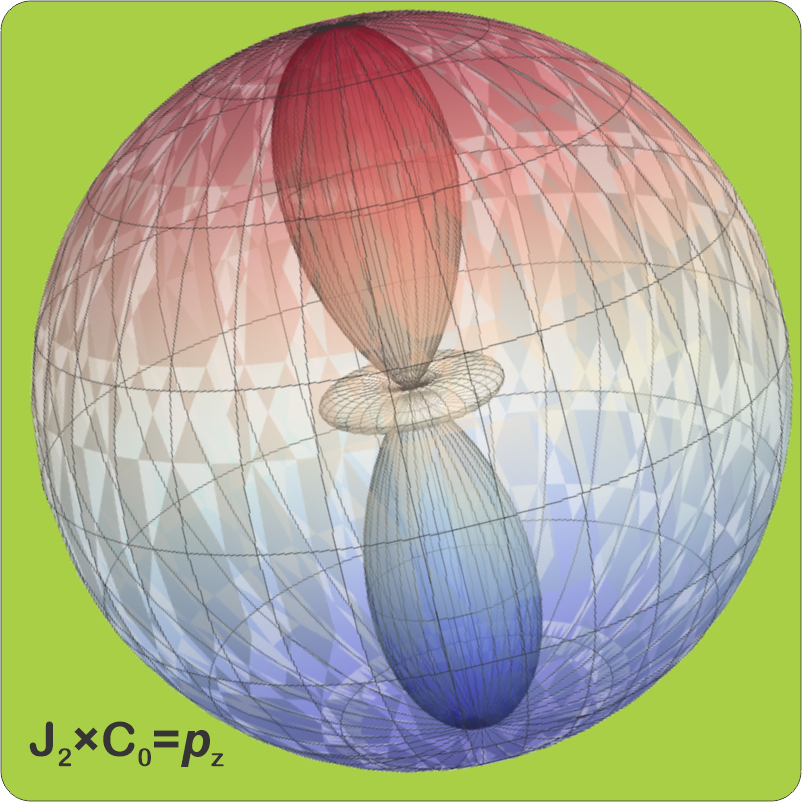
“No but yes, and yes. You combine a C, a J and an R using multiplication to get a full harmonic F, except there are rules. The J and R must belong to the same n. The m can’t be larger than n. From far away we’d model Jupiter’s gravity as F000=R0×J0×C0, which is an infinite sphere — R0 never dies away and J0×C0 says ‘no angular dependence.’ The Sun’s gravity acts along R0 and that’s what keeps Jupiter in orbit. If the problem demands combining full harmonics, you use addition.” <rousing a display on Old Reliable> “Here’s how a particular pair of harmonics combine to increase or decrease spherical gravity in specific directions.”

“But Juno doesn’t see those gravity lumps until it gets close‑in. How close?”

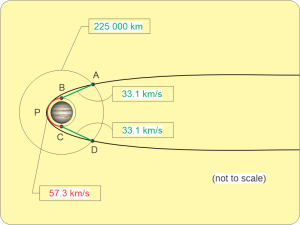
R2‘s down to less than a part per thousand at three planetary radii, call it 225 000 kilometers away from the planet’s center.”

“How much time is it closer than that distance?”

“Complicated question. A precise answer requires some calculus — is your smart phone set up for elliptic integrals?”

“Of course not. A good estimate will do.”

“Okay, here’s the plan. What we’d like is total time spent while Juno travels along the ellipsoidal arc between points A and D where the orbit crosses the 225 000‑km circle. Unfortunately, Juno speeds up approaching point P, slows down going away — calculating the A‑D time is tricky. I’ll assume Juno travels straight lines AB and CD at the A-speed. I’ll also approximate the orbit’s close pass as a semicircle at P‑speed.” <tapping> “I get a 3.6-hour duration, less than 0.3% of the full 53-day orbit. Will that satisfy your people?”

“You’ll know if it doesn’t.”

~~ Rich Olcott

Sectorial Setbacks

<chirp, chirp> “Moire here.”

“Moire, you were holding out on me. Eddie’s, fifteen minutes.”

“Not so fast, Walt. That wasn’t me holding out, that was you leaving too soon. From now on you’re paying quite a bit more. And it’ll be thirty minutes.”

“So we’re negotiating, hmm?”

“That’s about the size of it. You still interested?”

“My people are, they sent me back here. Oh well. Thirty minutes.”


Thirty-three minutes later I walk into Eddie’s. Walt’s already gotten a table. He beckons, points to the freshly‑served pizza, raises an eyebrow.

“Apology accepted. What made your people unhappy?”

“You told me flat‑out that the Sun’s gravity couldn’t affect those zonal harmonics. Do you have anything to back that up?”

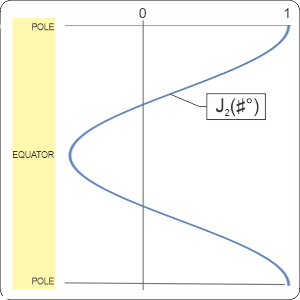
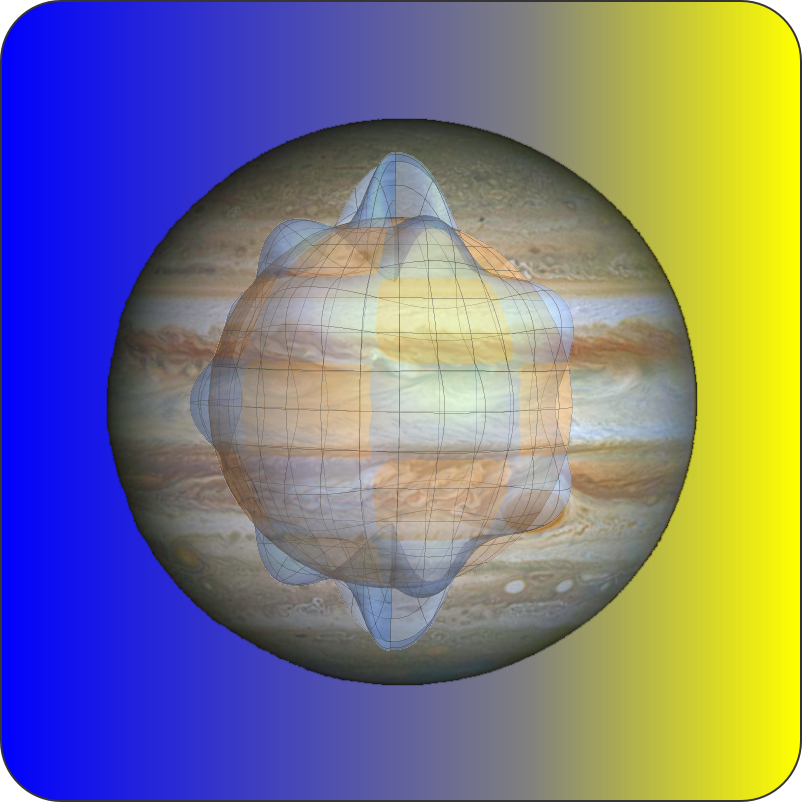
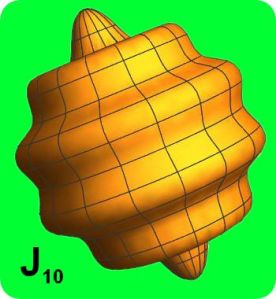
“Symmetry. Zonal harmonics and latitude are about north‑south. Each Jn is a pole‑to‑pole variation pattern. The only way solar gravity can tilt Jupiter’s north‑south axis is to exert torque along the zonal harmonics. Jupiter’s equator is within 3° of edge‑on to the Sun.” <showing an image on Old Reliable’s screen> “Here’s what the Sun sees looking at J10, for instance. Solar pull on any northern zone segment, say, would be counteracted by an equal pull on the corresponding southern segment of the same zone. No net torque, no tilt. J0‘s the only exception. It’s simply a sphere that doesn’t vary across the whole planet. The Sun’s pull along J0‘s arc can’t tilt Jupiter.”

“Okay, so the zonal picture’s too simple. Just one set of waves, running up and down the planet—”

“No, not running. One way to characterize a wave is by how its components change with time. You’re thinking like ocean waves that move from place to place as time goes by. There’s also standing waves like on a guitar string, where individual points move but the peaks and valleys don’t. There’s time‑only waves like how the day length here changes through the year. And there’s static waves where time’s not even in the equation. Jupiter’s stripes don’t move, they’re peaks and valleys in a static wave pattern. By definition, the zonal harmonic system is static like that. But you’re right, it’s only part of the picture.”

“Give me the part the Sun’s gravitational field does play with.”

“That’d be two parts — sectorial and radial harmonics. Sectorial is zonal’s perpendicular twin. Zonal wave patterns show variation along the polar axis; sectorial wave patterns Cm vary around it. I’m keeping it non‑technical for you but Cm‘s actually cos(m*x) where x is the longitude.”

“Just don’t let it go any farther.”

“I’ll try not to. My point is that each sector pattern can be labeled with a positive integer just like we did with the zones.”

“If the Jn arcs aren’t affected by solar gravity, why would I care about these Cms?”

“You wouldn’t, except for the fact that mass distribution across Jupiter’s sectors is probably lumpy. We know the Great Red Spot holds its position in the southern hemisphere and the planet’s magnetic field points way off to the side. Maybe those features mark off‑center mass deficits and concentrations. Suppose a particular sectorial wave’s peak sits directly over a mass lump or hole. Everything under that harmonic’s influence is tugged back and forth by solar gravity each time the wave traverses the day side. Juno in its N‑S path just isn’t an efficient sensor for those tugs. Good sectorial sensing would require an orbiter on an E‑W path, preferably right over the equator.  Any orbital wobbles we’d see could be fed into a sectorial gravity map. Cross that with the zonal map and we’d be able to locate underlying mass variations by latitude and longitude.”

“Not a good idea. Gravity’s not the only field in play. You’ve just mentioned Jupiter’s magnetic field. I’ve read it’s stronger than any other planet’s. If your E‑W orbiter’s built with even a small amount of iron, you’d have a hard time deciding which field was responsible for any observed irregularities.”

“Good point. The idea’s even worse than you think, though. Jupiter’s sulfur‑coated moon—”

“Io. Yes, your induction‑heating idea might even be real. What about it?”

“I haven’t written yet about the high‑voltage Io‑to‑Jupiter bridge made of sulfur, oxygen and hydrogen ions. Jupiter’s magnetism plays a complicated game with them but the result is a chaotic sheet of radiating plasma around the planet’s equator. An E‑W orbiter in there would be tossed about like a paper boat on the ocean.”

~~ Rich Olcott

A Pencil In Space

<chirp, chirp> “Moire here.”

“I have a question I think you’ll find interesting, but it’s best we talk in person. Care for pizza?”

“If you’re buying.”

“Of course. Meet me at Eddie’s, twenty minutes. Bring Old Reliable.”

“Of course.”


Tall fellow, trimmed chevron mustache, erect bearing except when he’s leaning on that cane. “Moire?”

“That’s me. Good to meet you, Mr … ?”

“No names. Call me … Walt.”

We order, find a table away from the kitchen. “So, Walt, what’s this interesting question?”

“Been following this year’s Jupiter series in your blog. Read over the Kaspi paper, too, though most of that was over my head. What I did get was that his conclusions and your conclusions all come from measuring very small orbit shifts which arise from millionths of a g of force. Thing is, I don’t see where any of you take account of the Sun’s gravity. If the Sun’s pull holds Jupiter in orbit, it ought to swamp those micro-g effects. Apparently it doesn’t. Why not?”

“Well. That’s one of those simple questions that entail a complicated answer.”

“I’ve got time.”

“I’ll start with a pedantic quibble but it’ll clarify matters later on. You refer to g as force but it’s really acceleration. The one‑g acceleration at Earth’s surface means velocity changes by 980 meters/second per second of free fall. Drop a one kilogram mass, it’ll accelerate that fast. Drop a 100 kilogram mass, it’ll experience exactly the same acceleration, follow?”

“But the second mass feels 100 times the force.”

“True, but we can’t measure forces, only movement changes. Goes all the way back to Newton defining mass in terms of force and vice‑versa. Anyway, when you’re talking micro‑g orbit glitches you’re talking tiny changes in acceleration. Next step — we need the strength of the Sun’s gravitational field in Jupiter’s neighborhood.”

“Depends on the Sun’s mass and Jupiter’s mass. No, wait, just the Sun’s mass because that’s how it curves spacetime. The force depends on both masses.”

I’m impressed. “And the square of the very large distance between them.” <tapping on Old Reliable’s screen> “Says here the Sun’s field strength out there is 224 nano‑g, which is pretty small.”

“How’s that compare to what else is acting on Juno?”

<more tapping> “Jupiter’s local field strength crushes the Sun’s. At Juno’s farthest point it’s 197 micro‑g but at Juno’s closest point the field’s 22.7 million micro‑g and the craft’s doing 41 km/s during a 30-minute pass. Yeah, the Sun’s field would make small adjustments to Juno’s orbital speed, depending on where everybody is, but it’d be a very slow fluctuation and not the rapid shakes NASA measured.”

“How about side‑to‑side?”

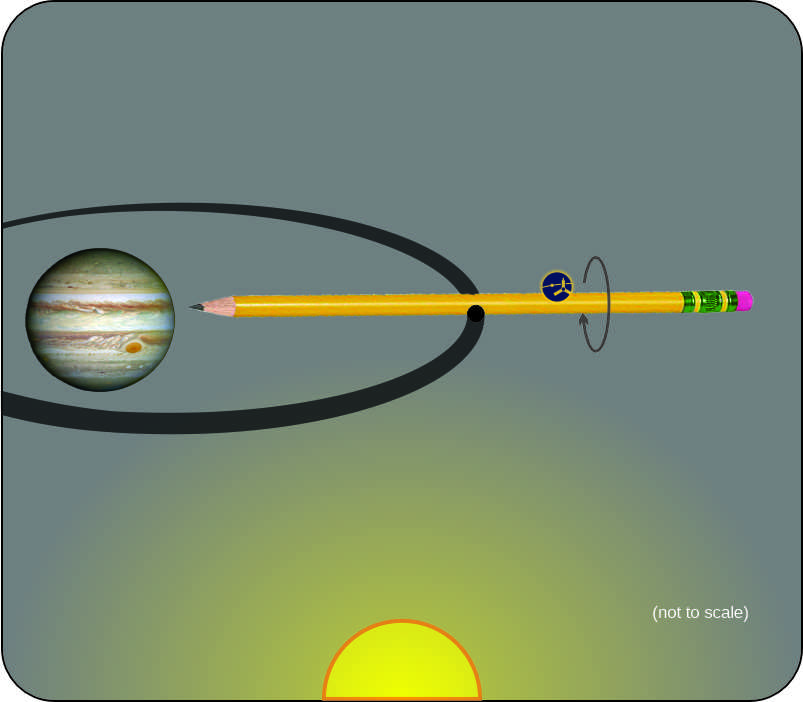
“Good point, but now we’re getting to the structure of Juno’s orbit. Its eccentricity is 98%, a long way from circular. Picture a skinny oval pencil 8 million kilometers long, always pointed at Jupiter while going around it. It’s a polar orbit, rises above Jupiter on the approach, then falls below going away. The Sun’s effect is greatest when the orbit’s at right angles to the Sun‑Jupiter line. The solar field twists the oval away from N‑S on approach, trues it back up on retreat. That changes the angle at which Juno crosses Jupiter’s gravitational wobbles but won’t affect how it experiences the zonal harmonics.”

“Tell me about those zonal things.”

“A zone is a region, like the stripes on Jupiter, that circles a sphere at constant latitude. Technically, zonal harmonic Jn is the nth Legendre polynomial in cos(θ)—”

“Too technical.”

“Gotcha. Okay, each Jn names a shape, a set of gravitational ripples perpendicular to the polar axis. J0‘s a sphere with no ripples. Jupiter’s average field looks like that. A bigger n number means more ripples. Kaspi’s values estimate how much each Jn‘s intensity adds to or subtracts from J0‘s strength at each latitude. The Sun’s field can modify the intensity of J0 but none of the others.”

Walt grabs his cane, stands, drops a C‑note on the table. “This’ll cover the pizza and your time. Forget we had this conversation.” And he’s gone.

“Don’t mention it.”

~~ Rich Olcott

  • Thanks to Will, who asked the question.

Screaming Out Of Space

Cal (formerly known as Al) comes over to our table in his coffee shop. “Lessee if I got this right. Cathleen is smug twice. First time because the new results from Juno‘s data say her hunch is right that Jupiter’s atmosphere moves like cylinders inside each other. Nearly cylinders, anyhow. Second smug because Sy used the Juno data to draw a math picture he says shows the Great Red Spot but I’m lookin’ at it and I don’t see how your wiggle‑waggles show a Spot. That’s a weird map, so why’re you smug about it, Cathleen?”

“The map’s weird because it’s abstract and way different from the maps you’re used to. It’s also weird because of how the data was collected. Sy, you tell him about the arcs.”

“Okay. Umm… Cal, the maps you’re familiar with are two‑dimensional. City maps show you north‑south and east‑west, that’s one dimension for each direction pair. Maps for bigger‑scale territories use latitude for north‑south and longitude for east‑west but the principle’s the same. The Kaspi group’s calculations from Juno‘s orbit data give us a recipe for only a one‑dimensional map. They show how Jupiter’s gravity varies by latitude, nothing about longitude. We could plot that as a rectangle, latitude along the x‑axis, relative strength along the y‑axis. I thought I’d learn more by wrapping the x‑axis around the planet so we could look for correlations with Jupiter’s geography. I found something and that’s why Cathleen’s smug. Me, too.”

“Why latitude but nothing about longitude?”

“Because of the way Juno‘s orbit works. The spacecraft’s not hovering over the planet or even circling it like the ISS circles Earth. NASA wanted to minimize Juno‘s exposure to Jupiter’s intense magnetic and radiation fields. The craft spends most of its 53‑day orbit at extreme distance, up to millions of kilometers out. When it approaches, it screams in at about 41 kilometers per second, that’s 91 700 mph, on a mostly north‑to‑south vector so it sees all latitudes from a few thousand kilometers above the cloud‑tops. Close approach lasts only about three hours, for the whole planet, and then the thing is on its way out again. During that three hours, the planet rotates about 120° underneath Juno so we don’t have a straight vertical N‑S pass down the planet’s face. Gathering useful longitude data’s going to take a lot more orbits.”

“So you’re sayin’ Juno felt gravity glitches at all different angles going pole to pole, but only some of the angles going round and round.”

“Exactly.”

“So now explain the wiggle‑waggles.”

“They represent parts‑per‑million variations in the field pulling Juno towards Jupiter at each latitude. Where the craft is over a more massive region it’s pulled a bit inwards and Sy’s map shows that as a green bump. Over a lighter region Juno‘s free to move outward a little and the map shows a pink dip. Kaspi and company interpret the heaviness just north of the equator to be a dense inward flow of gas all around the planet. Maybe it is. Sy and I think the pink droplet south of the equator could reflect the Great Red Spot lowering the average mass at its latitude. Maybe it is. As always, we need more data, okay? Now I’ve got questions for you, Sy.”

“Shoot.”

“You built your map by multiplying each Jn‑shape by its Kaspi gravitational intensity then adding the multiplied shapes together. But you only used Jn‑shapes with integer names. Is there a J½?”

“Some mathematicians play with fractional J‑thingies but I’ve not followed that topic.”

“Understandable. Next question — the J‘s look so much like sine waves. Why not just use sine‑shapes?”

“I used Jn‑shapes because that’s how Kaspi’s group stated their results. They had no choice in the matter. Jn‑shapes naturally appear in spherical system math. The nice thing about Jn‑shapes is that n provides a sort of wavelength scale. For instance, J35 divides Jupiter’s pole‑to‑pole arc into 36 segments each as wide as Earth’s diameter. Here’s a plot of intensity against n.”

Adapted from Kaspi, Figure 2a

“Left to right, red light to blue.”

“Exactly.”

~ Rich Olcott

Zoning Out over Jupiter

I’m nursing my usual mug of eye‑opener in Cal’s Coffee Shop when astronomer Cathleen and chemist Susan chatter in. “Morning, ladies. Cathleen, prepare to be even more smug.”

“Ooo, what should I be smug about?”

Your Jupiter suggestion. Grab some coffee and a couple of chairs.” <screen‑tapping on Old Reliable> “Ready? First step — purple and violet. You’ll never see violet or purple light coming from a standard video screen.”

“He’s going spectrum‑y on us, right, Cathleen?”

“More like anti‑spectrum‑y, Susan. Purple light doesn’t exist in the spectrum. We only perceive that color when we see red mixed with blue like that second band on Sy’s display. Violet light is a thing in nature, we can see it in flowers and dyes and rainbows beyond blue. Standard screens can’t show violet because their LEDs just emit red, blue and green wavelengths. Old Reliable uses mixtures of those three to fake all its colors. Where are you going with this, Sy?””

“Deeper into Physics. Cast your eyes upon the squiggles to the right. The one in the middle represents the lightwave coming from purple‑in‑the‑middle. The waveform’s jaggedy, but if you compare peaks and troughs you can see its shape is the sum of the red and blue shapes. I scaled the graphs up from 700 nanometers for red and 450 for blue.”

“Straightforward spectroscopy, Sy, Fourier analysis of a complicated linear waveform. Some astronomers make their living using that principle. So do audio engineers and lots of other people.”

“Patience, Cathleen, I’m going beyond linear. Fourier’s work applies to variation along a line. Legendre and Poisson extended the analysis to—”

“Aah, spherical harmonics! I remember them from Physical Chemistry class. They’re what gives shapes to atoms. They’ve got electron shells arranged around the nucleus. Electron charge stays as close to the nucleus as quantum will let it. Atoms absorb light energy by moving charge away from there. If the atom’s in a magnetic field or near other atoms that gives it a z-axis direction then the shells split into wavey lumps going to the poles and different directions and that’s your p-, d– and f-orbitals. Bigger shells have more room and they make weird forms but only the transition metals care about that.”

The angular portion of the lowest-energy spherical harmonics
Credit: Inigo.quilez, under CCA SA 3.0 license

“Considering you left out all the math, Susan, that’s a reasonable summary. I prefer to think of spherical harmonics as combinations of wave shapes at right angles. Imagine a spherical blob of water floating in space. If you tap it on top, waves ripple down to the bottom and back up again and maybe back down again. Those are zonal waves. A zonal harmonic averages over all E‑W longitudes at each N‑S latitude. Or you could stroke the blob on the side and set up a sectorial wave pattern that averages latitudes.”

“How about center‑out radial waves?”

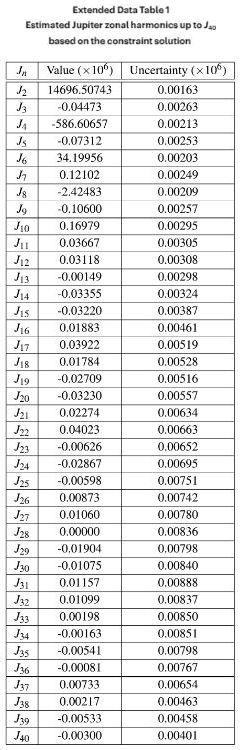
“Susan’s shells do that job. My point was going to be that what sine waves do for characterizing linear things like sound and light, spherical harmonics do for central‑force systems. We describe charge in atoms, yes, but also sound coming from an explosion, heat circulating in a star, gravity shaping a planet. Specifically, Jupiter. Kaspi’s paper you gave me, Cathleen, I read it all the way to the Results table at the tail end. That was the rabbit‑hole.”

“Oh? What’s in the table?”

“Jupiter’s zonal harmonics — J‑names in the first column, J‑intensities in the second. Jn‘s shape resembles a sine wave and has n zeroes. Jupiter’s never‑zero central field is J0. Jn increases or decreases J0‘s strength wherever it’s non‑zero. For Jupiter that’s mostly by parts per million. What’s cool is the pattern you see when you total the dominating Jeven contributions.”

Data from Kaspi, et al.

Cathleen’s squinting in thought. “Hmm… green zone A would be excess gravity from Jupiter’s equatorial bulge. B‘s excess is right where Kaspi proposed the heavy downflow. Ah‑HAH! C‘s pink deficit zone’s right on top of the Great Red Spot’s buoyant updraft. Perfect! Okay, I’m smug.”

~ Rich Olcott

Symmetry And The Loopholes

“So, we’ve got geometry symmetry and relativity symmetry. Is that it, Sy?”

“Hardly, Al. There’s scores of them. Mathematics has a whole branch devoted to sorting and classifying the operations and how they group together. Shall I list a few dozen?”

“Ah, no, don’t bother, thanks. You got one I’d recognize?”

“How about charge symmetry? Flip an electron’s negative charge and you’ve got a positron that has exactly the same mass and the same interaction with light waves. OK, positrons move opposite to electrons in a magnetic field which is how their existence was confirmed, but charge is s a fundamental symmetry for normal matter.”

“Oh, right, charge is a piece of that CPT symmetry you hung your anti‑Universe story on. Which reminds me, you never said what the ‘P’ stands for.”

“Parity, as in Charge‑Parity‑Time. Before you ask, ‘parity‘ is left-right symmetry. Parity symmetry says you can replace ‘clockwise‘ with ‘counterclockwise‘ in a system and the equations describing the system will give perfectly good predictions. Time symmetry is about time running forward or backward. The equations are happy either way. The CPT theorem says the three symmetries are solidly tied together — you can’t flip one without the other two tagging along. If some process emits particle X with clockwise spin, there’s some equivalent process that soaks up an anti-X if it’s spinning counterclockwise. Very firm theorem, lots of laboratory evidence for it from electromagnetism and the nuclear strong force. But.”

“But?”

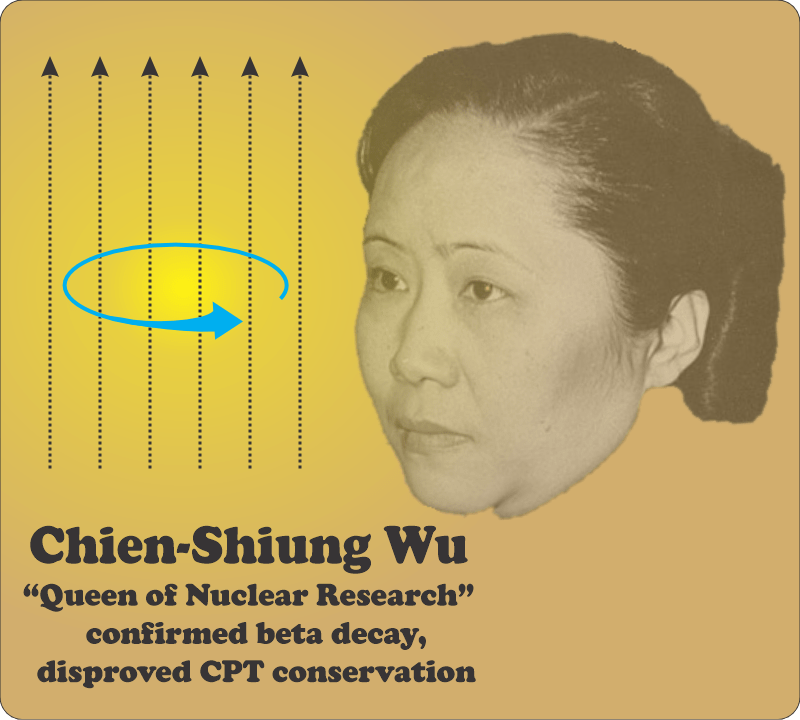
“But Chien‑Shiung Wu did an experiment that showed the nuclear weak force doesn’t always obey CPT rules. Her worked proved we live in a handed Universe. She should have gotten a Nobel for that, but it was last century and the Nobel Committee was men‑only. Two theory guys copped the prize that should have gone to the three of them. The theory guys protested but the Committee ignored Wu anyway. Sometimes things aren’t fair.”

“Tell me about it. So the theory’s got a loophole?”

“Apparently, but to my knowledge no‐one’s found it. Some string theories claim to hint at an explanation but that’s not much help, considering.”

“Huh. Could the loophole maybe be an example of symmetry breaking?”

“Very good question. I think it’s a qualified probably but that’s a guess.”

“Sy, I think that’s the wishy-washiest you’ve ever been.”

“One of my rules is, when you’re going out on a limb be sure you’re properly roped to the tree. In this case I’m generalizing from a single sample.”

“You’re gonna tell me, right?”

   Professor Higgs presents
       the Higgs Bozo.

“Just the bare outline because I don’t want to get into the deep weeds. Back in the 1960s Physics was in trouble because the nuclear strong force particles that bind the nucleus together were found to have mass and move slowly. Strong‑force theory at the time said they should be massless and move at lightspeed. The theory depended on part of the potential energy varying with the symmetry of a circle. Then Higgs—”

“The Higgs Boson guy?”

“That’s him. Anyway, he published a three‑page paper showing that those binding particles aren’t controlled solely by the nuclear strong force. Because they have a charge they also engage with the electromagnetic field. Electromagnetism is a lot weaker than the strong force, but it’s strong enough to deform the theory’s circle into an ellipse. Breaking the circular symmetry in effect gives the particles mass and slows them down.”

“So where’s the boson come in? I thought it’s what makes mass for everything.”

“Absolutely not, probably. The protons and neutrons have plenty of mass on their own, thank you very much. It’s only those strong-force particles that gain mass, less than 1% of the nucleus total. But the whole story is a great example of how making a system less symmetrical, even a little bit, can completely change how it operates. We think that’s what drove the Big Bang’s story. The early Universe was so dense and hot it was a perfectly symmetrical quark soup — chaos all the way down. Space expansion opened successive symmetry loopholes that permitted layers of structure formation.”

<looking at hands> “I don’t feel unsymmetrical.”

“Trust me, deep down you are.”

~~ Rich Olcott

Reflection, Rotation And Spacetime

“Afternoon, Al.”

“Hiya, Sy. Hey, which of these two scones d’ya like better?”

“”Mm … this oniony one, sorta. The other is too vegetable for me ‑ grass, I think, and maybe asparagus? What’s going on?”

“Experimenting, Sy, experimenting. I’m going for ‘Taste of Spring.’ The first one was spring onion, the second was fiddlehead ferns. I picked ’em myself.”

“Very seasonal, but I’m afraid neither goes well with coffee. I’ll take a caramel scone, please, plus a mug of my usual mud.”

“Aw, Sy, caramel’s a winter flavor. Here you go. Say, while you’re here, maybe you could clear up something for me?”

“I can try. What’s the something?”

“After your multiverse series I got out my astronomy magazines to read up on the Big Bang. Several of the articles said that we’ve gone through several … um, I think they said ‘epochs‘ … separated by episodes of symmetry breaking. What’s that all about?”

“It’s about a central notion in modern Physics. Name me some kinds of symmetry.”

“Mmm, there’s left‑right, of course, and the turning kind like a snowflake has. Come to think — I like listening to Bach and Vivaldi when I’m planet‑watching. I don’t know why but their stuff reminds me of geometry and feels like symmetry.”

“Would it help to know that the word comes from the Greek for ‘same measure‘? Symmetry is about transformations, like your mirror and rotation operations, that affect a system but don’t significantly change to its measurable properties. Rotate that snowflake 60° and it looks exactly the same. Both the geometric symmetries you named are two‑dimensional but the principle applies all over the place. Bach and the whole Baroque era were just saturated with symmetry. His music was so regular it even looked good on the page. Even buildings and artworks back then were planned to look balanced, as much mass and structure on the left as on the right.”

“I don’t read music, just listen to it. Why does Bach sound symmetric?”

“There’s another kind of symmetry, called a ‘translation‘ don’t ask why, where the transformation moves something along a line within some larger structure. That paper napkin dispenser, for instance. It’s got a stack of napkins that all look alike. I pull one off, napkins move up one unit but the stack doesn’t look any different.”

“Except I gotta refill it when it runs low, but I get your drift. You’re saying Bach takes a phrase and repeats it over and over and that sounds like translational symmetry along the music’s timeline.”

“Yup, maybe up or down a few tones, maybe a different register or instrument. The repeats are the thing. Play his Third Brandenberg Concerto next time you’re at your telescope, you’ll see what I mean.”

“Symmetry’s not just math then.”

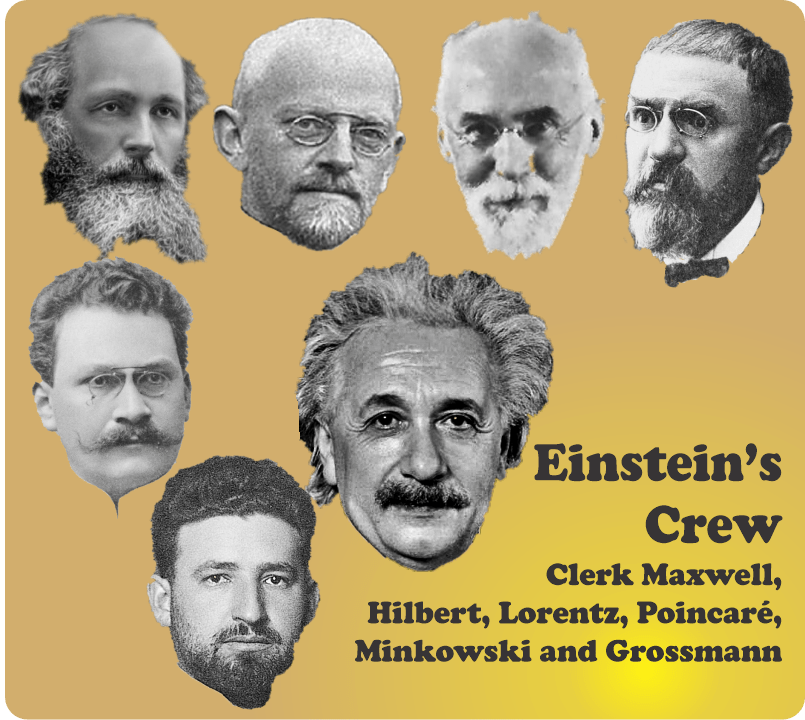
“Like I said, it’s everywhere. You’ve seen diagrams of DNA’s spiral staircase. It combines translation with rotation symmetry, does about 10 translation steps per turn, over and over. The Universe has a symmetry you don’t see at all. No‑one did until Lorentz and Poincaré revised Heaviside’s version of Maxwell’s electromagnetism equations for Minkowski space. Einstein, Hilbert and Grossman used that work to give us and the Universe a new symmetry.”

“Einstein didn’t do the math?”

“The crew I just named were world‑class in math, he wasn’t. Einstein’s strengths were his physical intuition and his ability to pick problems his math buddies would find interesting. Look, Newton’s Universe depends on absolute space and time. The distance between two objects at a given time is always the same, no matter who’s measuring it or how fast anyone is moving. All observers measure the same duration between two incidents regardless. Follow me?”

“Makes sense. That’s how things work hereabouts, anyway.”

“That’s how they work everywhere until you get to high speeds or high gravity. Lorentz proved that the distances and durations you measure depend on your velocity relative to what you’re measuring. Extreme cases lead to inconsistent numbers. Newton’s absolute space and time are pliable. To Einstein such instability was an abomination. Physics needs a firm foundation, a symmetry between all observers to support consistent measurements throughout the Universe. Einstein’s Relativity Theory rescued Physics with symmetrical mathematical transformations that enforce consistency.”

~~ Rich Olcott

Chocolate, Mint And Notation

“But calculus, Mr Moire. Why do they insist we learn calculus? You said that Newton and Leibniz started it but why did they do it?”

“Scoop me a double-dip chocolate-mint gelato, Jeremy, and I’ll tell you about an infamous quarrel. You named Newton first. I expect most Europeans would name Leibniz first.”

“Here’s your gelato. What does geography have to do with it?”

“Thanks. Mmm, love this combination. Part of the geography thing is international history, part of it is personality and part of it is convenience. England and continental Europe have a history of rivalry in everything from the arts to trade to outright warfare. Each naturally tends to favor its own residents and institutions. Some people say that the British Royal Society was founded to compete with the French philosophical clubs. Maybe England’s king appointed Newton as the society’s President to upgrade the rivalry. Dicey choice. From what I’ve read, Newton’s didn’t hate everybody, he just didn’t like anybody. But somehow he ran that group effectively despite his tendency to go full‑tilt against anyone who disagreed with his views.”

“Leibniz did the same thing on the European side?”

“No, quite the opposite. There was no pre‑existing group for him to head up and he didn’t start one. Instead, he served as a sort of Information Central while working as diplomat and counselor for a series of rulers of various countries. He carried on a lively correspondence with pretty much everyone doing science or philosophy. He kept the world up to date and in the process inserted his own ideas and proposals into the conversation. Unlike Newton, Leibniz was a friendly soul, constantly looking for compromise. Their separate calculus notations are a great example.”

“Huh? Didn’t everyone use the same letters and stuff?”

“The letters, yeah mostly, but the stuff part was a long time coming. What’s calculus about?”

“All I’ve seen so far is proofs and recipes for integrating different function types. Nothing about what it’s about.”

Newton approximates arc ABCDEF.

<sigh> “That’s because you’re being taught by a mathematician. Calculus is about change and how to handle it mathematically. That was a hot topic back in the 1600s and it’s still central to Physics. Newton’s momentum‑acceleration‑force perspective led him to visualize things flowing with time. His Laws of Motion made it easy to calculate straight‑line flows but what to do about curves? His solution was to break the curve into tiny segments he called fluxions. He considered each fluxion to be a microscopic straight line that existed for an infinitesimal time interval. A fluxion’s length was its time interval multiplied by the velocity along it. His algebraic shorthand for ‘per time‘ was to put a dot over whatever letter he was using for distance. Velocity along x was . Acceleration is velocity change per time so he wrote that with a double dot like . His version of calculus amounted to summing fluxion lengths across the total travel time.”

“But that only does time stuff. What about how, say, potential energy adds up across a distance?”

“Excellent question. Newton’s notation wasn’t up to that challenge, but Leibniz developed something better.”

“He copied what Newton was doing and generalized it somehow.”

“Uh, no. Newton claimed Leibniz had done that but Leibniz swore he’d been working entirely independently. Two lines of evidence. First, Newton was notoriously secretive about his work. He held onto his planetary orbit calculations for years before Halley convinced him to publish. Second, Leibniz and other European thinkers came to the problem with a different strategy. Descartes invented Cartesian coordinates a half‑century before. That invention naturally led the Europeans to plot anything against anything. Newton’s fluxions combined tiny amounts of distance and time; Leibniz and company split the two dimensions, one increment along each component. Leibniz tried out a dozen different notations for the increment. After much discussion he finally settled on a simple d. The increment along x is dx, but x could be anything quantitative. dy/dx quantifies y‘s change with x.”

“Ah, the increments are the differentials we see in class. But those all come from limit processes.”

“Leibniz’ d symbol and its powerful multi‑dimensional extensions carry that implication. More poetry.”

~~ Rich Olcott
Making Things Simpler

“How about a pumpkin spice gelato, Mr Moire?”

“I don’t think so, Jeremy. I’m a traditionalist. A double‑dip of pistachio, please.”

“Coming right up, sir. By the way, I’ve been thinking about the Math poetry you find in the circular and hyperbolic functions. How about what you’d call Physics poetry?”

“Sure. Starting small, Physics has symmetries for rhymes. If you can pivot an experiment or system through some angle and get the same result, that’s rotational symmetry. If you can flip it right‑to‑left that’s parity symmetry. I think of a symmetry as like putting the same sound at the end of each line in rhymed verse. Physicists have identified dozens of symmetries, some extremely abstract and some fundamental to how we understand the Universe. Our quantum theory for electrons in atoms is based on the symmetries of a sphere. Without those symmetries we wouldn’t be able to use Schrodinger’s equation to understand how atoms work.”

“Symmetries as rhymes … okaaayy. What else?”

“You mentioned the importance of word choice in poetry. For the Physics equivalent I’d point to notation. You’ve heard about the battle between Newton and Leibniz about who invented calculus. In the long run the algebraic techniques that Leibniz developed prevailed over Newton’s geometric ones because Leibniz’ way of writing math was far simpler to read, write and manipulate — better word choice. Trying to read Newton’s Principia is painful, in large part because Euler hadn’t yet invented the streamlined algebraic syntax we use today. Newton’s work could have gone faster and deeper if he’d been able to communicate with Euler‑style equations instead of full sentences.”

“Oiler‑style?”

“Leonhard Euler, though it’s pronounced like ‘oiler‘. Europe’s foremost mathematician of the 18th Century. Much better at math than he was at engineering or court politics — both the Russian and Austrian royal courts supported him but they decided the best place for him was the classroom and his study. But while he was in there he worked like a fiend. There was a period when he produced more mathematics literature than all the rest of Europe. Descartes outright rejected numbers involving ‑1, labeled them ‘imaginary.’ Euler considered ‑1 a constant like any other, gave it the letter i and proceeded to build entire branches of math based upon it. Poor guy’s vision started failing in his early 30s — I’ve often wondered whether he developed efficient notational conventions as a defense so he could see more meaning at a glance.”

“He invented all those weird squiggles in Math and Physics books that aren’t even Roman or Greek letters?”

“Nowhere near all of them, but some important ones he did and he pointed the way for other innovators to follow. A good symbol has a well‑defined meaning, but it carries a load of associations just like words do. They lurk in the back of your mind when you see it. π makes you think of circles and repetitive function like sine waves, right? There’s a fancy capital‑R for ‘the set of all real numbers‘ and a fancy capital‑Z for ‘the set of all integers.’ The first set is infinitely larger than the second one. Each symbol carries implications abut what kind of logic is valid nearby and what to be suspicious of. Depends on context, of course. Little‑c could be either speed‑of‑light or a triangle’s hypotenuse so defining and using notation properly is important. Once you know a symbol’s precise meaning, reading an equation is much like reading a poem whose author used exactly the right words.”

“Those implications help squeeze a lot of meaning into not much space. That’s the compactness I like in a good poem.”

“It’s been said that a good notation can drive as much progress in Physics as a good experiment. I’m not sure that’s true but it certainly helps. Much of my Physics thinking is symbol manipulation. Give me precise and powerful symbols and I can reach precise and powerful conclusions. Einstein turned Physics upside down when he wrote the thirteen symbols his General Relativity Field Equation use. In his incredibly compact notation that string of symbols summarizes sixteen interconnected equations relating mass‑energy’s distribution to distorted spacetime and vice‑versa. Beautiful.”

“Beautiful, maybe, but cryptic.”

~~ Rich Olcott