Zoning Out over Jupiter

I’m nursing my usual mug of eye‑opener in Cal’s Coffee Shop when astronomer Cathleen and chemist Susan chatter in. “Morning, ladies. Cathleen, prepare to be even more smug.”

“Ooo, what should I be smug about?”

“Your Jupiter suggestion. Grab some coffee and a couple of chairs.” <screen‑tapping on Old Reliable> “Ready? First step — purple and violet. You’ll never see violet or purple light coming from a standard video screen.”

“He’s going spectrum‑y on us, right, Cathleen?”
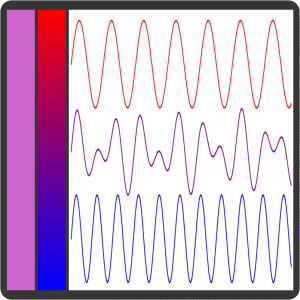
“More like anti‑spectrum‑y, Susan. Purple light doesn’t exist in the spectrum. We only perceive that color when we see red mixed with blue like that second band on Sy’s display. Violet light is a thing in nature, we can see it in flowers and dyes and rainbows beyond blue. Standard screens can’t show violet because their LEDs just emit red, blue and green wavelengths. Old Reliable uses mixtures of those three to fake all its colors. Where are you going with this, Sy?””

“Deeper into Physics. Cast your eyes upon the squiggles to the right. The one in the middle represents the lightwave coming from purple‑in‑the‑middle. The waveform’s jaggedy, but if you compare peaks and troughs you can see its shape is the sum of the red and blue shapes. I scaled the graphs up from 700 nanometers for red and 450 for blue.”

“Straightforward spectroscopy, Sy, Fourier analysis of a complicated linear waveform. Some astronomers make their living using that principle. So do audio engineers and lots of other people.”

“Patience, Cathleen, I’m going beyond linear. Fourier’s work applies to variation along a line. Legendre and Poisson extended the analysis to—”

“Aah, spherical harmonics! I remember them from Physical Chemistry class. They’re what gives shapes to atoms. They’ve got electron shells arranged around the nucleus. Electron charge stays as close to the nucleus as quantum will let it. Atoms absorb light energy by moving charge away from there. If the atom’s in a magnetic field or near other atoms that gives it a z-axis direction then the shells split into wavey lumps going to the poles and different directions and that’s your p-, d– and f-orbitals. Bigger shells have more room and they make weird forms but only the transition metals care about that.”

The angular portion of the lowest-energy spherical harmonics
Credit: Inigo.quilez, under CCA SA 3.0 license

“Considering you left out all the math, Susan, that’s a reasonable summary. I prefer to think of spherical harmonics as combinations of wave shapes at right angles. Imagine a spherical blob of water floating in space. If you tap it on top, waves ripple down to the bottom and back up again and maybe back down again. Those are zonal waves. A zonal harmonic averages over all E‑W longitudes at each N‑S latitude. Or you could stroke the blob on the side and set up a sectorial wave pattern that averages latitudes.”

“How about center‑out radial waves?”

“Susan’s shells do that job. My point was going to be that what sine waves do for characterizing linear things like sound and light, spherical harmonics do for central‑force systems. We describe charge in atoms, yes, but also sound coming from an explosion, heat circulating in a star, gravity shaping a planet. Specifically, Jupiter. Kaspi’s paper you gave me, Cathleen, I read it all the way to the Results table at the tail end. That was the rabbit‑hole.”

“Oh? What’s in the table?”

“Jupiter’s zonal harmonics — J‑names in the first column, J‑intensities in the second. Jn‘s shape resembles a sine wave and has n zeroes. Jupiter’s never‑zero central field is J0. Jn increases or decreases J0‘s strength wherever it’s non‑zero. For Jupiter that’s mostly by parts per million. What’s cool is the pattern you see when you total the dominating Jeven contributions.”

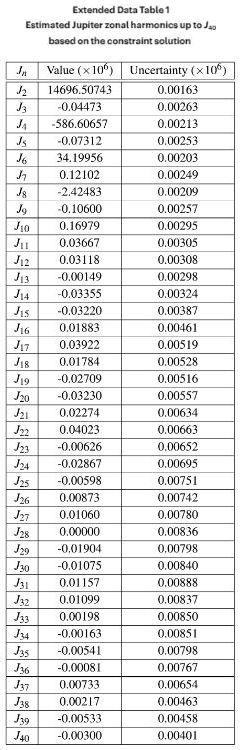
Data from Kaspi, et al.

Cathleen’s squinting in thought. “Hmm… green zone A would be excess gravity from Jupiter’s equatorial bulge. B‘s excess is right where Kaspi proposed the heavy downflow. Ah‑HAH! C‘s pink deficit zone’s right on top of the Great Red Spot’s buoyant updraft. Perfect! Okay, I’m smug.”

~ Rich Olcott
Symmetry And The Loopholes

“So, we’ve got geometry symmetry and relativity symmetry. Is that it, Sy?”

“Hardly, Al. There’s scores of them. Mathematics has a whole branch devoted to sorting and classifying the operations and how they group together. Shall I list a few dozen?”

“Ah, no, don’t bother, thanks. You got one I’d recognize?”

“How about charge symmetry? Flip an electron’s negative charge and you’ve got a positron that has exactly the same mass and the same interaction with light waves. OK, positrons move opposite to electrons in a magnetic field which is how their existence was confirmed, but charge is s a fundamental symmetry for normal matter.”

“Oh, right, charge is a piece of that CPT symmetry you hung your anti‑Universe story on. Which reminds me, you never said what the ‘P’ stands for.”

“Parity, as in Charge‑Parity‑Time. Before you ask, ‘parity‘ is left-right symmetry. Parity symmetry says you can replace ‘clockwise‘ with ‘counterclockwise‘ in a system and the equations describing the system will give perfectly good predictions. Time symmetry is about time running forward or backward. The equations are happy either way. The CPT theorem says the three symmetries are solidly tied together — you can’t flip one without the other two tagging along. If some process emits particle X with clockwise spin, there’s some equivalent process that soaks up an anti-X if it’s spinning counterclockwise. Very firm theorem, lots of laboratory evidence for it from electromagnetism and the nuclear strong force. But.”

“But?”

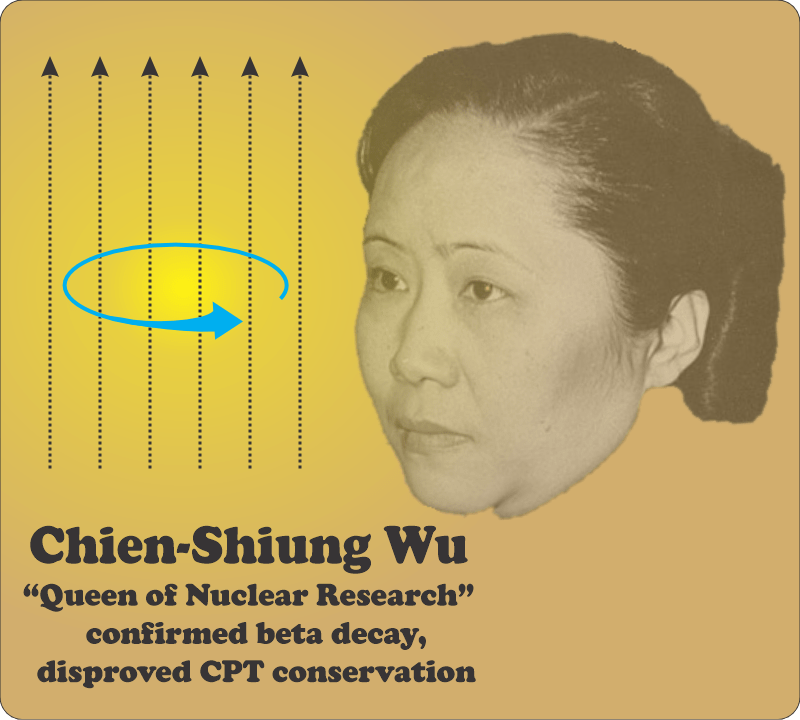
“But Chien‑Shiung Wu did an experiment that showed the nuclear weak force doesn’t always obey CPT rules. Her worked proved we live in a handed Universe. She should have gotten a Nobel for that, but it was last century and the Nobel Committee was men‑only. Two theory guys copped the prize that should have gone to the three of them. The theory guys protested but the Committee ignored Wu anyway. Sometimes things aren’t fair.”

“Tell me about it. So the theory’s got a loophole?”

“Apparently, but to my knowledge no‐one’s found it. Some string theories claim to hint at an explanation but that’s not much help, considering.”

“Huh. Could the loophole maybe be an example of symmetry breaking?”

“Very good question. I think it’s a qualified probably but that’s a guess.”

“Sy, I think that’s the wishy-washiest you’ve ever been.”

“One of my rules is, when you’re going out on a limb be sure you’re properly roped to the tree. In this case I’m generalizing from a single sample.”

“You’re gonna tell me, right?”

   Professor Higgs presents
       the Higgs Bozo.

“Just the bare outline because I don’t want to get into the deep weeds. Back in the 1960s Physics was in trouble because the nuclear strong force particles that bind the nucleus together were found to have mass and move slowly. Strong‑force theory at the time said they should be massless and move at lightspeed. The theory depended on part of the potential energy varying with the symmetry of a circle. Then Higgs—”

“The Higgs Boson guy?”

“That’s him. Anyway, he published a three‑page paper showing that those binding particles aren’t controlled solely by the nuclear strong force. Because they have a charge they also engage with the electromagnetic field. Electromagnetism is a lot weaker than the strong force, but it’s strong enough to deform the theory’s circle into an ellipse. Breaking the circular symmetry in effect gives the particles mass and slows them down.”

“So where’s the boson come in? I thought it’s what makes mass for everything.”

“Absolutely not, probably. The protons and neutrons have plenty of mass on their own, thank you very much. It’s only those strong-force particles that gain mass, less than 1% of the nucleus total. But the whole story is a great example of how making a system less symmetrical, even a little bit, can completely change how it operates. We think that’s what drove the Big Bang’s story. The early Universe was so dense and hot it was a perfectly symmetrical quark soup — chaos all the way down. Space expansion opened successive symmetry loopholes that permitted layers of structure formation.”

<looking at hands> “I don’t feel unsymmetrical.”

“Trust me, deep down you are.”

~~ Rich Olcott

Reflection, Rotation And Spacetime

“Afternoon, Al.”

“Hiya, Sy. Hey, which of these two scones d’ya like better?”

“”Mm … this oniony one, sorta. The other is too vegetable for me ‑ grass, I think, and maybe asparagus? What’s going on?”

“Experimenting, Sy, experimenting. I’m going for ‘Taste of Spring.’ The first one was spring onion, the second was fiddlehead ferns. I picked ’em myself.”

“Very seasonal, but I’m afraid neither goes well with coffee. I’ll take a caramel scone, please, plus a mug of my usual mud.”

“Aw, Sy, caramel’s a winter flavor. Here you go. Say, while you’re here, maybe you could clear up something for me?”

“I can try. What’s the something?”

“After your multiverse series I got out my astronomy magazines to read up on the Big Bang. Several of the articles said that we’ve gone through several … um, I think they said ‘epochs‘ … separated by episodes of symmetry breaking. What’s that all about?”

“It’s about a central notion in modern Physics. Name me some kinds of symmetry.”

“Mmm, there’s left‑right, of course, and the turning kind like a snowflake has. Come to think — I like listening to Bach and Vivaldi when I’m planet‑watching. I don’t know why but their stuff reminds me of geometry and feels like symmetry.”

“Would it help to know that the word comes from the Greek for ‘same measure‘? Symmetry is about transformations, like your mirror and rotation operations, that affect a system but don’t significantly change to its measurable properties. Rotate that snowflake 60° and it looks exactly the same. Both the geometric symmetries you named are two‑dimensional but the principle applies all over the place. Bach and the whole Baroque era were just saturated with symmetry. His music was so regular it even looked good on the page. Even buildings and artworks back then were planned to look balanced, as much mass and structure on the left as on the right.”

“I don’t read music, just listen to it. Why does Bach sound symmetric?”

“There’s another kind of symmetry, called a ‘translation‘ don’t ask why, where the transformation moves something along a line within some larger structure. That paper napkin dispenser, for instance. It’s got a stack of napkins that all look alike. I pull one off, napkins move up one unit but the stack doesn’t look any different.”

“Except I gotta refill it when it runs low, but I get your drift. You’re saying Bach takes a phrase and repeats it over and over and that sounds like translational symmetry along the music’s timeline.”

“Yup, maybe up or down a few tones, maybe a different register or instrument. The repeats are the thing. Play his Third Brandenberg Concerto next time you’re at your telescope, you’ll see what I mean.”

“Symmetry’s not just math then.”

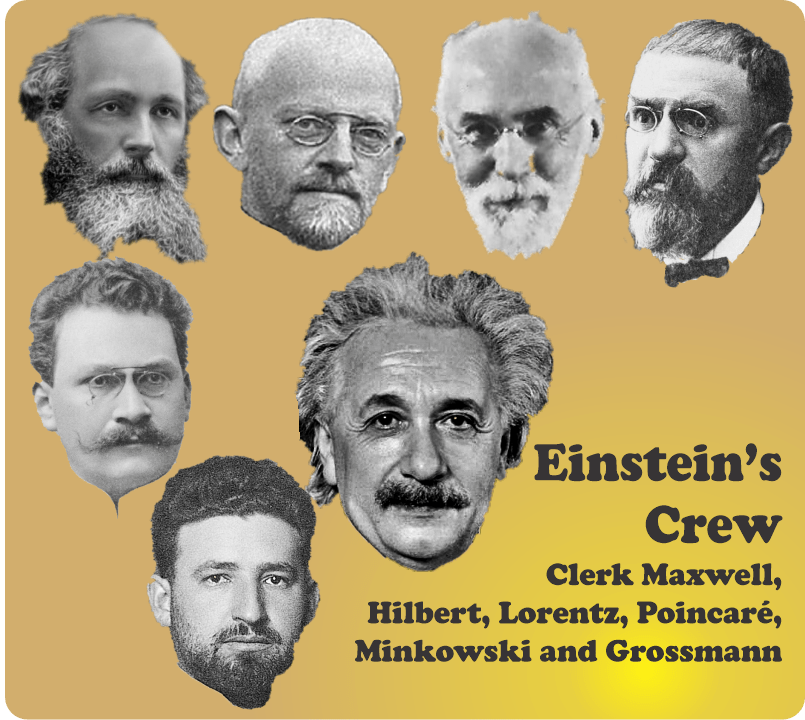
“Like I said, it’s everywhere. You’ve seen diagrams of DNA’s spiral staircase. It combines translation with rotation symmetry, does about 10 translation steps per turn, over and over. The Universe has a symmetry you don’t see at all. No‑one did until Lorentz and Poincaré revised Heaviside’s version of Maxwell’s electromagnetism equations for Minkowski space. Einstein, Hilbert and Grossman used that work to give us and the Universe a new symmetry.”

“Einstein didn’t do the math?”

“The crew I just named were world‑class in math, he wasn’t. Einstein’s strengths were his physical intuition and his ability to pick problems his math buddies would find interesting. Look, Newton’s Universe depends on absolute space and time. The distance between two objects at a given time is always the same, no matter who’s measuring it or how fast anyone is moving. All observers measure the same duration between two incidents regardless. Follow me?”

“Makes sense. That’s how things work hereabouts, anyway.”

“That’s how they work everywhere until you get to high speeds or high gravity. Lorentz proved that the distances and durations you measure depend on your velocity relative to what you’re measuring. Extreme cases lead to inconsistent numbers. Newton’s absolute space and time are pliable. To Einstein such instability was an abomination. Physics needs a firm foundation, a symmetry between all observers to support consistent measurements throughout the Universe. Einstein’s Relativity Theory rescued Physics with symmetrical mathematical transformations that enforce consistency.”

~~ Rich Olcott

Chocolate, Mint And Notation

“But calculus, Mr Moire. Why do they insist we learn calculus? You said that Newton and Leibniz started it but why did they do it?”

“Scoop me a double-dip chocolate-mint gelato, Jeremy, and I’ll tell you about an infamous quarrel. You named Newton first. I expect most Europeans would name Leibniz first.”

“Here’s your gelato. What does geography have to do with it?”

“Thanks. Mmm, love this combination. Part of the geography thing is international history, part of it is personality and part of it is convenience. England and continental Europe have a history of rivalry in everything from the arts to trade to outright warfare. Each naturally tends to favor its own residents and institutions. Some people say that the British Royal Society was founded to compete with the French philosophical clubs. Maybe England’s king appointed Newton as the society’s President to upgrade the rivalry. Dicey choice. From what I’ve read, Newton’s didn’t hate everybody, he just didn’t like anybody. But somehow he ran that group effectively despite his tendency to go full‑tilt against anyone who disagreed with his views.”

“Leibniz did the same thing on the European side?”

“No, quite the opposite. There was no pre‑existing group for him to head up and he didn’t start one. Instead, he served as a sort of Information Central while working as diplomat and counselor for a series of rulers of various countries. He carried on a lively correspondence with pretty much everyone doing science or philosophy. He kept the world up to date and in the process inserted his own ideas and proposals into the conversation. Unlike Newton, Leibniz was a friendly soul, constantly looking for compromise. Their separate calculus notations are a great example.”

“Huh? Didn’t everyone use the same letters and stuff?”

“The letters, yeah mostly, but the stuff part was a long time coming. What’s calculus about?”

“All I’ve seen so far is proofs and recipes for integrating different function types. Nothing about what it’s about.”

Newton approximates arc ABCDEF.

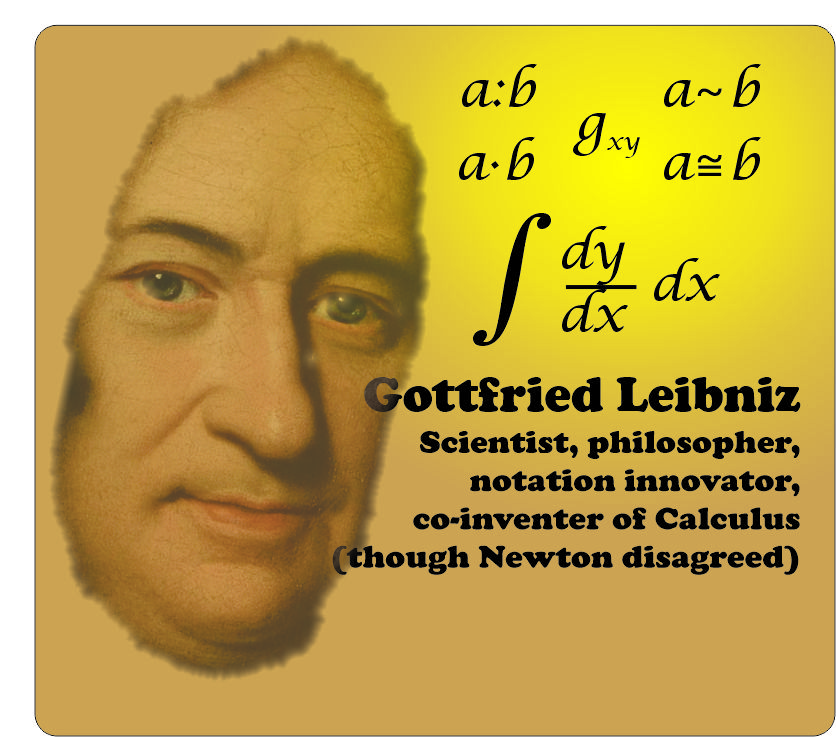
<sigh> “That’s because you’re being taught by a mathematician. Calculus is about change and how to handle it mathematically. That was a hot topic back in the 1600s and it’s still central to Physics. Newton’s momentum‑acceleration‑force perspective led him to visualize things flowing with time. His Laws of Motion made it easy to calculate straight‑line flows but what to do about curves? His solution was to break the curve into tiny segments he called fluxions. He considered each fluxion to be a microscopic straight line that existed for an infinitesimal time interval. A fluxion’s length was its time interval multiplied by the velocity along it. His algebraic shorthand for ‘per time‘ was to put a dot over whatever letter he was using for distance. Velocity along x was ẋ. Acceleration is velocity change per time so he wrote that with a double dot like ẍ. His version of calculus amounted to summing fluxion lengths across the total travel time.”

“But that only does time stuff. What about how, say, potential energy adds up across a distance?”

“Excellent question. Newton’s notation wasn’t up to that challenge, but Leibniz developed something better.”

“He copied what Newton was doing and generalized it somehow.”

“Uh, no. Newton claimed Leibniz had done that but Leibniz swore he’d been working entirely independently. Two lines of evidence. First, Newton was notoriously secretive about his work. He held onto his planetary orbit calculations for years before Halley convinced him to publish. Second, Leibniz and other European thinkers came to the problem with a different strategy. Descartes invented Cartesian coordinates a half‑century before. That invention naturally led the Europeans to plot anything against anything. Newton’s fluxions combined tiny amounts of distance and time; Leibniz and company split the two dimensions, one increment along each component. Leibniz tried out a dozen different notations for the increment. After much discussion he finally settled on a simple d. The increment along x is dx, but x could be anything quantitative. dy/dx quantifies y‘s change with x.”

“Ah, the increments are the differentials we see in class. But those all come from limit processes.”

“Leibniz’ d symbol and its powerful multi‑dimensional extensions carry that implication. More poetry.”

~~ Rich Olcott

Making Things Simpler

“How about a pumpkin spice gelato, Mr Moire?”

“I don’t think so, Jeremy. I’m a traditionalist. A double‑dip of pistachio, please.”

“Coming right up, sir. By the way, I’ve been thinking about the Math poetry you find in the circular and hyperbolic functions. How about what you’d call Physics poetry?”

“Sure. Starting small, Physics has symmetries for rhymes. If you can pivot an experiment or system through some angle and get the same result, that’s rotational symmetry. If you can flip it right‑to‑left that’s parity symmetry. I think of a symmetry as like putting the same sound at the end of each line in rhymed verse. Physicists have identified dozens of symmetries, some extremely abstract and some fundamental to how we understand the Universe. Our quantum theory for electrons in atoms is based on the symmetries of a sphere. Without those symmetries we wouldn’t be able to use Schrodinger’s equation to understand how atoms work.”

“Symmetries as rhymes … okaaayy. What else?”

“You mentioned the importance of word choice in poetry. For the Physics equivalent I’d point to notation. You’ve heard about the battle between Newton and Leibniz about who invented calculus. In the long run the algebraic techniques that Leibniz developed prevailed over Newton’s geometric ones because Leibniz’ way of writing math was far simpler to read, write and manipulate — better word choice. Trying to read Newton’s Principia is painful, in large part because Euler hadn’t yet invented the streamlined algebraic syntax we use today. Newton’s work could have gone faster and deeper if he’d been able to communicate with Euler‑style equations instead of full sentences.”

“Oiler‑style?”

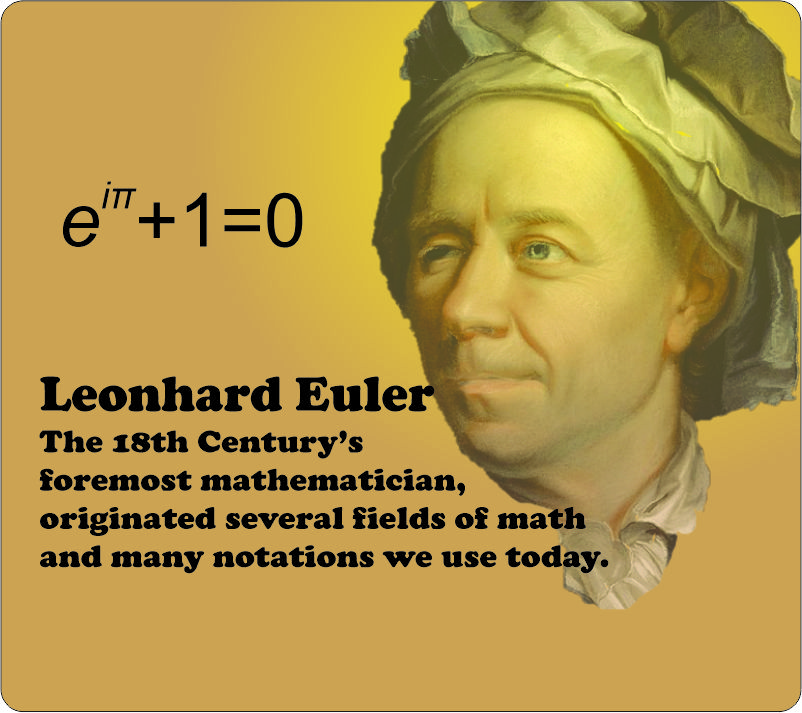
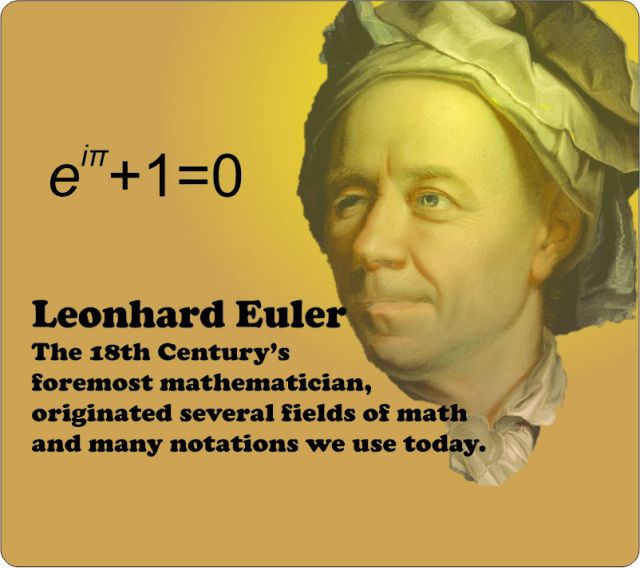
“Leonhard Euler, though it’s pronounced like ‘oiler‘. Europe’s foremost mathematician of the 18th Century. Much better at math than he was at engineering or court politics — both the Russian and Austrian royal courts supported him but they decided the best place for him was the classroom and his study. But while he was in there he worked like a fiend. There was a period when he produced more mathematics literature than all the rest of Europe. Descartes outright rejected numbers involving √‑1, labeled them ‘imaginary.’ Euler considered √‑1 a constant like any other, gave it the letter i and proceeded to build entire branches of math based upon it. Poor guy’s vision started failing in his early 30s — I’ve often wondered whether he developed efficient notational conventions as a defense so he could see more meaning at a glance.”

“He invented all those weird squiggles in Math and Physics books that aren’t even Roman or Greek letters?”

“Nowhere near all of them, but some important ones he did and he pointed the way for other innovators to follow. A good symbol has a well‑defined meaning, but it carries a load of associations just like words do. They lurk in the back of your mind when you see it. π makes you think of circles and repetitive function like sine waves, right? There’s a fancy capital‑R for ‘the set of all real numbers‘ and a fancy capital‑Z for ‘the set of all integers.’ The first set is infinitely larger than the second one. Each symbol carries implications abut what kind of logic is valid nearby and what to be suspicious of. Depends on context, of course. Little‑c could be either speed‑of‑light or a triangle’s hypotenuse so defining and using notation properly is important. Once you know a symbol’s precise meaning, reading an equation is much like reading a poem whose author used exactly the right words.”

“Those implications help squeeze a lot of meaning into not much space. That’s the compactness I like in a good poem.”

“It’s been said that a good notation can drive as much progress in Physics as a good experiment. I’m not sure that’s true but it certainly helps. Much of my Physics thinking is symbol manipulation. Give me precise and powerful symbols and I can reach precise and powerful conclusions. Einstein turned Physics upside down when he wrote the thirteen symbols his General Relativity Field Equation use. In his incredibly compact notation that string of symbols summarizes sixteen interconnected equations relating mass‑energy’s distribution to distorted spacetime and vice‑versa. Beautiful.”

“Beautiful, maybe, but cryptic.”

~~ Rich Olcott

Math Poetry

Eddie serves a good pizza. I amble over to the gelato stand for a chaser. “Evening, Jeremy. You’re looking a little distraught.”

“I am, Mr Moire. Just don’t ask me to quantify it! Math is getting me down. Why do they shove so much of it at us? You don’t put much math into your posts and they make sense mostly.”

“Thanks for the mostly. … Do you enjoy poetry?”

“Once I read some poems I liked. Except in English class. They spend too much time classifying genre and rhyme scheme instead of just looking at what the poet wrote. All that gets in the way.”

“Interesting. What is it that you like about poetry?”

“Mmm, part of it is how it can imply things without really saying them, part of it is how compact a really good one is. I like when they cram the maximum impact into the fewest possible words — take out one word and the whole thing falls apart. That’s awesome when it works.”

“Well, how does it work?”

“Oh, there’s lots of techniques. Metaphor’s a biggie — making one thing stand for something else. Word choice, too — an unexpected word or one with several meanings. Sometimes it’s a challenge finding the word that has just the right rhythm and message.”

“Ah, you write, too. When you compose something, do you use English or Navajo?”

“Whichever fits my thought better. Each language is better at some things, worse at others. A couple of times I’ve used both together even though only rez kids would understand the mix.”

“Makes sense. You realize, of course, that we’ve got a metaphor going here.”

“We do? What standing for what?”

“Science and Poetry. I’ve often said that Physics is poetry with numbers. Math is as much a language as English and Navajo. It has its own written and spoken forms just like they do and people do poetry with it. Like them, it’s precise in some domains and completely unable to handle others. Leaning math is like learning a very old language that’s had time to acquire new words and concepts. No wonder learning it is a struggle.”

“Poetry in math? That’s a stretch, Mr Moire.”

“Prettiest example I can think of quickly is rhyming between the circular and hyperbolic trigonometric systems. The circular system’s based on the sine and cosine. The tangent and such are all built from them.”

“We had those in class — I’ll remember ‘opposite over hypotenuse‘ forever and I got confused by all the formulas — but why do you call them circular and what’s ‘hyperbolic‘ about?”

“Here, let me use Ole Reliable to show you some pictures. I’m sure you recognize the wavy sine and cosine graphs in the circular system. The hyperbolic system is also based on two functions, ‘hyperbolic sine‘ and ‘hyperbolic cosine,’ known in the trade as ‘sinh‘ and ‘cosh.’ They don’t look very similar to the other set, do they?”

“Sure don’t.”

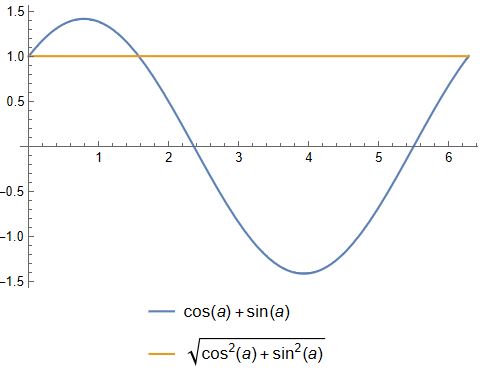
“But for every circular function and formula there’s a hyperbolic partner. Now watch what happens when we combine a sine and cosine. I’ll do it two ways, a simple sum and the Pythagorean sum.”

“Pythagorean?”

“Remember his a2+b2=c2? The orange curve comes from that, see in the legend underneath?”

“Oh, like a right triangle’s hypotenuse. But the orange curve is just a flat straight line.”

“True, as we’ve known since Euler’s day. Are you familiar with polar coordinates?”

“A little. There’s a center, one coordinate is distance from the center, and the other coordinate is the angle you’ve rotated something, right?”

“Good enough. Here’s what the same two combinations look like in polar coordinates..”

“Wow. Two circles. I never would have guessed that.”

“Mm-hm. Check the orange circle, the one that was just a level straight line on the simple graph. It’s centered on the origin. That tells us the sum of the squares is invariant, doesn’t change with the angle.”

“Do the hyperbolic thingies make hyperbolas when you add them that way?”

“Not really, just up-curving lines. The plots for their differences are interesting though. For these guys the Pythagorean difference is invariant. Einstein’s relativity is based on that property.”

“Pretty, like you say.”

~~ Rich Olcott

Now And Then

“Alright, I suppose there’s no going down below the Universe’s Year Zero, but what about the other direction? Do you physics guys have a handle on Time’s Top?”

“That’d be Cosmology, Mr Feder. We physicists avoid theorizing about stuff we can’t check against data. Well, except for string theory. The far past leaves clues that astronomers like Cathleen can gather. Sad to say, though, we barely have a handle on Now.”

Cathleen grins. Al and Mr Feder go, “Whaaat?”

“No, really. One of Einstein’s insights was that two observers randomly and independently flying through space won’t be able to agree on whether two external events occurred simultaneously. They can’t even agree on what time it is now.”

“Oh, yeah, I know about that. I’ve read about how the GPS system needs to make corrections to account for what relativity does to the satellite timings.”

“You’re right, Al, but that’s a different issue. Some of that relativistic correction has to do with space compression because of Earth’s mass. The simultaneity problem is strictly about rapid motion and geometry.”

“Wait — geometry?”

“Relativistic geometry, which is a bit different from the kind that Descartes built.”

“Whoa, Sy, slow down there. Descartes was the ‘I think therefore I am‘ guy, right? What’s that got to do with geometry?”

“I guess I got a little ahead of myself there, didn’t I? OK. Yeah, Al, same Descartes. Grew up Catholic in France, was a professional mercenary soldier in the Thirty Years War, wound up fighting first on the Catholic French side and later on fought on the Protestant Dutch side but cross‑over was common, both directions. He realized he was in an ostensibly religious war that was really about who ruled over whom. That may have had something to do with him becoming a professional philosopher who rejected all religious dogmas in favor of what he could learn solely from logic and his own senses. That’s where his famous mantra came from — he started by proving to himself that he existed.”

“Logic led to geometry, I suppose.”

“Indeed, but a new kind, one that required a few innovations that Descartes developed. On the one hand, mathematicians traditionally expressed algebraic problems in words and some of them were doozies, like saying ‘the zenzizenzizenzic‘ where we’d just say x8. We got that simple but <ahem> powerful notation from Descartes. On the geometry side, he’d ditch all the confusing line-ending markers in a diagram like this one. Instead, he’d label the whole line representing a known quantity with a front-of-the-alphabet letter like a or b or c. A line representing an unknown quantity would get its label from the alphabet-trailers like x, y and z. Then he used the same character conventions and his new power notation to write and manipulate algebraic expressions. Those notational inventions were foundational for his bridge between algebraic and geometrical problems. Draw your problem with lines and curves, transform it to algebraic equations, solve that problem exactly, transform it back to geometry and you’re done. Or vice-versa.”

The mesolabe instrument (in red).

“That goes back to Descartes, huh?”

“Mm-hm. His big innovation, though, arose from a borrow from an early Greek gadget called a mesolabe. He proposed an idealized version that would let someone break a line into exact fractions or compare a length against a unit length. That broke the rules of classical Geometry but setting his mesolabe’s Y‑angle to 90° prompted him to name points by their distance along the x– and y‑axes. That’s the nub of the Cartesian coordinate system — a rectangular grid of numbered straight lines that go on forever. Graph paper, right? Wrap the grid around the Earth and you’ve got latitudes and longitudes. Add more numbered grid lines perpendicular to either grid and you’ve got z‑axis coordinates. Three coordinates let you name any point in space. Newton and all the physicists who came after him until the dawn of the 20th Century assumed Descartes’ nice, stable coordinate system.”

“20th Century — that’s when Einstein came on the scene. He broke that system?”

“Sure did. You’ve heard about bent space?”

“Who hasn’t?”

“Well, fasten your seat belts, it’s going to be a fun ride.”

~~ Rich Olcott

Thinking in Spacetime

The Open Mic session in Al’s coffee shop is still going string. The crowd’s still muttering after Jeremy stuck a pin in Big Mike’s “coincidence” balloon when Jim steps up. Jim’s an Astrophysics post‑doc now so we quiet down expectantly. “Nice try, Mike. Here’s another mind expander to play with. <stepping over to the whiteboard> Folks, I give you … a hypotenuse. ‘That’s just a line,’ you say. Ah, yes, but it’s part of some right triangles like … these. Say three different observers are surveying the line from different locations. Alice finds her distance to point A is 300 meters and her distance to point B is 400. Applying Pythagoras’ Theorem, she figures the A–B distance as 500 meters. We good so far?”

A couple of Jeremy’s groupies look doubtful. Maybe‑an‑Art‑Major shyly raises a hand. “The formula they taught us is a2+b2=c2. And aren’t the x and y supposed to go horizontal and vertical?”

“Whoa, nice questions and important points. In a minute I’m going to use c for the speed of light. It’s confusing to use the same letter for two different purposes. Also, we have to pay them extra for double duty. Anyhow, I’m using d for distance here instead of c, OK? To your next point — Alice, Bob and Carl each have their own horizontal and vertical orientations, but the A–B line doesn’t care who’s looking at it. One of our fundamental principles is that the laws of Physics don’t depend on the observer’s frame of reference. In this situation that means that all three observers should measure the same length. The Pythagorean formula works for all of them, so long as we’re working on a flat plane and no-one’s doing relativistic stuff, OK?”

Tentative nods from the audience.

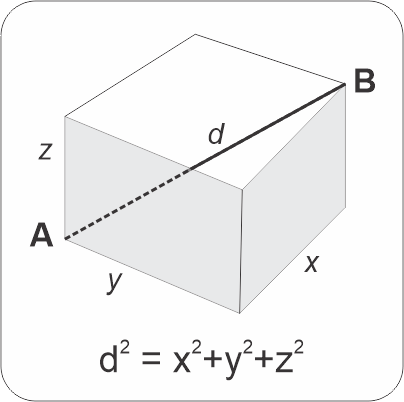
“Right, so much for flat pictures. Let’s up our game by a dimension. Here’s that same A–B line but it’s in a 3D box. <Maybe‑an‑Art‑Major snorts at Jim’s amateur attempt at perspective.> Fortunately, the Pythagoras formula extends quite nicely to three dimensions. It was fun figuring out why.”

Jeremy yells out. “What about time? Time’s a dimension.”

“For sure, but time’s not a length. You can’t add measurements unless they all have the same units.”

“You could fix that by multiplying time by c. Kilometers per second, times seconds, is a length.” His groupies go “Oooo.”

“Thanks for the bridge to spacetime where we have four coordinates — x, y, z and ct. That makes a big difference because now A and B each have both a where and a when — traveling between them is traveling in space and time. Computationally there’s two paths to follow from here. One is to stick with Pythagoras. Think of a 4D hypercube with our A–B line running between opposite vertices. We’re used to calculating area as x×y and volume as x×y×z so no surprise, the hypercube’s hypervolume is x×y×z×(ct). The square of the A–B line’s length would be b2=(ct)2+d2. Pythagoras would be happy with all of that but Einstein wasn’t. That’s where Alice and Bob and Carl come in again.”

“What do they have to do with it?”

“Carl’s sitting steady here on good green Earth, red‑shifted Alice is flying away at high speed and blue‑shifted Bob is flashing toward us. Because of Lorentz contractions and dilations, they all measure different A–B lengths and durations. Each observer would report a different value for b2. That violates the invariance principle. We need a ruggedized metric able to stand up to that sort of punishment. Einstein’s math professor Hermann Minkowski came up with a good one. First, a little nomenclature. Minkowski was OK with using the word ‘point‘ for a location in xyz space but he used ‘event‘ when time was one of the coordinates.”

“Makes sense, I put events on my calendar.”

“Good strategy. Minkowski’s next step quantified the separation between two events by defining a new metric he called the ‘interval.’ Its formula is very similar to Pythagoras’ formula, with one small change: s2=(ct)2–d2. Alice, Bob and Carl see different distances but they all see the same interval.”

“Minus? Where did that come from?”

~~ Rich Olcott

The Gelato Model

“Eddie, this ginger gelato’s delicious — not too sweet and just the right amount of ginger bite.”

“Glad you like it, Anne.”

“On the way down here, Sy was telling me about how so many things in the Universe run on the same mathematics if you look at them with the right coordinate system. Sy, how do you pick ‘the right coordinate system?”

“The same way you pick the right property to serve as a momentum in Newton’s Equation of Motion — physical intuition. You look for things that fit the system. Sometimes that puts you on the road to understanding, sometimes not. Eddie, you keep track of your gelato sales by flavor. How are they doing?”

“Pistachio’s always a good seller, Sy, but ginger has been coming on strong this year.”

“In motion terns, pistachio’s momentum is constant but ginger is gaining momentum, right?”

“S’what I said.”

“Measured in dollars or trayfuls?”

“In batches. I make it all in-house. I’m proud of that. Dollars, too, of course, but that’s just total for all flavors.”

“Batches all the same size?”

“Some are, some not, depending. If I had a bigger machine I could make more but I do what I can.”

“There you go, Anne, each gelato flavor is like a separate degree of freedom. Eddie’s tracked sales since he started so we can take that date as the origin. Measuring change along any degree in either batches or dollars we have perfectly respectable coordinates although the money view of the system is fuzzier. Velocity is batches per unit time, there’s even a speed limit, and ginger has accelerated. Sound familiar?”

“Sounds like you’re setting up a Physics model.”

“Call it gelato trend physics, but I don’t think I can push the analogy much further. The next step would be to define a useful momentum like Newton did with his Law of Motion.”

“F=ma? That’s about acceleration, isn’t it?”

“Probably not in Newton’s mind. Back in his day they were arguing about which was conserved, energy or momentum. It was a sloppy argument because no‑one agreed on crisp definitions. People could use words like ‘quantity of motion‘ to refer to energy or momentum or even something else. Finally Newton defined momentum as ‘mass times velocity‘, but first he had to define ‘mass‘ as ‘quantity of matter‘ to distinguish it from weight which he showed is a force that’s indirectly related to mass.”

“So is it energy or momentum that’s conserved?”

“Both, once you’ve got good definitions of them. But my point is, our car culture has trained us to emphasize acceleration. Newton’s thinking centered on momentum and its changes. In modern terms he defined force as momentum change per unit time. I’m trying to think of a force‑momentum pair for Eddie’s gelato. That’s a problem because I can’t identify an analog for inertia.”

“Inertia? What’s that got to do with my gelato?”

“Not much, and that’s the problem. Inertia is resistance to force. Who can resist gelato? If it weren’t for inertia, the smallest touch would be enough to send an object at high speed off to forever. The Universe would be filled with dust because stars and planets would never get the chance to form. But here we are, which I consider a good thing. Where does inertia come from? Newton changed his mind a couple of times. To this day we only have maybe‑answers to that question.”

“You know we want to know, Sy.”

“Einstein’s favorite guess was Mach’s Principle. There’s about a dozen different versions of the basic idea but they boil down to matter interacting with the combined gravitational and electromagnetic fields generated by the entire rest of the Universe.”

“Wow. Wait, the stars are far away and the galaxies are much, much further away. Their fields would be so faint, how can they have any effect at all?”

“You’re right, Anne, field intensity per star does drop with distance squared. But the number of stars goes up with distance cubed. The two trends multiply together so the force trends grow linearly. It’s a big Universe and size matters.”

“So what about my gelato?”

“We’ll need more research, Eddie. Another scoop of ginger, Anne?”

~~ Rich Olcott

Symmetrical Eavesdropping

“Wait, Sy, you’ve made this explanation way more complicated than it has to be. All I asked about was the horrible whirling I’d gotten myself into. The three angular coordinates part would have done for that, but you dragged in degrees of freedom and deep symmetry and even dropped in that bit about ‘if measurable motion is defined.’ Why bother with all that and how can you have unmeasurable motion?”

“Curiosity caught the cat, didn’t it? Let’s head down to Eddie’s and I’ll treat you to a gelato. Your usual scoop of mint, of course, but I recommend combining it with a scoop of ginger to ease your queasy.”

“You’re a hard man to turn down, Sy. Lead on.”

<walking the hall to the elevators> “Have you ever baked a cake, Anne?”

“Hasn’t everyone? My specialty is Crazy Cake — flour, sugar, oil, vinegar, baking soda and a few other things but no eggs.”

“Sounds interesting. Well, consider the path from fixings to cake. You’ve collected the ingredients. Is it a cake yet?”

“Of course not.”

“Ok, you’ve stirred everything together and poured the batter into the pan. Is it a cake yet?”

“Actually, you sift the dry ingredients into the pan, then add the others separately, but I get your point. No, it’s not cake and it won’t be until it’s baked and I’ve topped it with my secret frosting. Some day, Sy, I’ll bake you one.”

<riding the elevator down to 2> “You’re a hard woman to turn down, Anne. I look forward to it. Anyhow, you see the essential difference between flour’s journey to cakehood and our elevator ride down to Eddie’s.”

“Mmm… OK, it’s the discrete versus continuous thing, isn’t it?”

“You’ve got it. Measuring progress along a discrete degree of freedom can be an iffy proposition.”

“How about just going with the recipe’s step number?”

“I’ll bet you use a spoon instead of a cup to get the right amount of baking soda. Is that a separate step from cup‑measuring the other dry ingredients? Sifting one batch or two? Those’d change the step‑number metric and the step-by-step equivalent of momentum. It’s not a trivial question, because Emmy Noether’s symmetry theorem applies only to continuous coordinates.”

“We’re back to her again? I thought—”

The elevator doors open at the second floor. We walk across to Eddie’s, where the tail‑end of the lunch crowd is dawdling over their pizzas. “Hiya folks. You’re a little late, I already shut my oven down.”

“Hi, Eddie, we’re just here for gelato. What’s your pleasure, Anne?”

“On Sy’s recommendation, Eddie, I’ll try a scoop of ginger along with my scoop of mint. Sy, about that symmetry theorem—”

“The same for me, Eddie.”

“Comin’ up. Just find a table, I’ll bring ’em over.”

We do that and he does that. “Here you go, folks, two gelati both the same, all symmetrical.”

“Eddie, you’ve been eavesdropping again!”

“Who, me? Never! Unless it’s somethin’ interesting. So symmetry ain’t just pretty like snowflakes? It’s got theorems?”

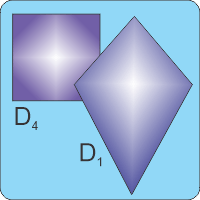
“Absolutely, Eddie. In many ways symmetry appears to be fundamental to how the Universe works. Or we think so, anyway. Here, Anne, have an extra bite of my ginger gelato. For one thing, Eddie, symmetry makes calculations a lot easier. If you know a particular system has the symmetry of a square, for instance, then you can get away with calculating only an eighth of it.”

“You mean a quarter, right, you turn a square four ways.”

“No, eight. It’s done with mirrors. Sy showed me.”

“I’m sure he did, Anne. But Sy, what if it’s not a perfect square? How about if one corner’s pulled out to a kite shape?”

“That’s called a broken symmetry, no surprise. Physicists and engineers handle systems like that with a toolkit of approximations that the mathematicians don’t like. Basically, the idea is to start with some nice neat symmetrical solution then add adjustments, called perturbations, to tweak the solution to something closer to reality. If the kite shape’s not too far away from squareness the adjusted solution can give you some insight onto how the actual thing works.”

“How about if it’s too far?”

“You go looking for a kite‑shaped solution.”

~~ Rich Olcott