The Tale of A Nail

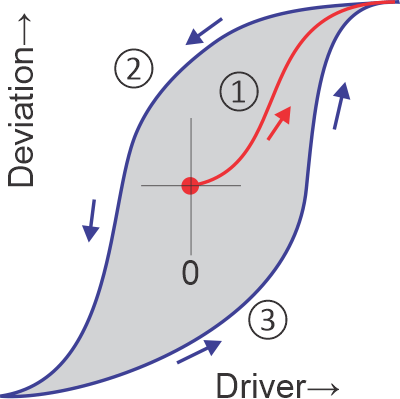
“Wait, Sy, let me get my head around that hysteresis loop diagram. You got my iron nail starting at that red dot because it’s not magnetized yet so that’s zero on the up‑down magnetism deviation scale, right? And it’s also zero on the left‑right driver scale because we’re not laying a magnetic field on it.”

“Yup, that’s the starting point, Vinnie.”

“OK, then we turn on the outside field and if it’s strong enough the nail gets magnetic, too, and so we travel up the red line. But the line’s not straight, it’s bendy. Why ain’t it straight?”

“To keep this specific, I’ll stick to the current theory for magnetization of iron. At point zero the individual iron atoms have their personal magnetic fields in completely random orientations. What we measure outside the nail is the average of all of that, which nets out to zero. Now we turn on the external magnetic field a little bit at a time so we can measure the effect. You remember we said that the iron atoms in a magnet are organized in domains.”

“Sure. I don’t forget easy.”

“I’ve noticed. OK, that upward bend at the beginning is slow increase in the nail’s magnetization while those domains are forming up. First a few atoms in one small area orient their local fields relative to the external field. Their combined field influences neighboring atoms to join in. The process is called nucleation because those first few atoms form the nucleus of a domain. The nucleus gains strength by recruiting more atoms, making it an even stronger recruiter. The red line rises exponentially until there aren’t any more unrecruited atoms.”

“That’s the end of the upward bend, huh?”

“Mm-hm, now we enter the linear phase and a different magnetization process. Energy in the external field feeds the domains pointed parallel to it at the expense of domains at a different angle. Domain growth is roughly linear with applied field strength. That line would like to stay straight but nothing goes on forever except maybe the Universe. Sooner or later the domains start running out of room to grow into. Increasing the driver strength doesn’t produce any further effect and we say that the nail’s magnetic field is saturated.”

“That makes sense. Let’s see if I can figure the blue loop from where the head end is north. The number 2 arrow says that if we dial down the driver, that’s the outside field and we’re moving to the left, when we get to zero the deviation, that’s the nail’s field, is still going strong and we got a permanent magnet. If we adjust the outside field leftward beyond zero that kills off the nail’s field … Hey, so the backward domains are eating the forward ones, right?”

“Probably. Depends on the material. Not good to ride the theory too far without checking the experimental data but that’d be my guess.”

“OK, so we drive those little domains until they saturate with the head end south. When we dial down the driver’s field backward strength we move to the right and the nail climbs the number 3 curve. The driver field returns to zero but the nail’s still a backward permanent magnet. We push the driver and the nail to forward saturation again and we can go loop‑de‑loop. But we never go through the red dot again — either the nail’s a permanent magnet when the driver’s zero or it not a magnet while the driver’s strong but they’re never both zero again.”

“Unless we scramble all the domains by heating the nail white-hot and letting it cool away from any external fields.”

“You know what’s missing from that picture, Sy?”

I’d wondered if he’d spot it. “I’ll bite. What?”

“Numbers. Up‑down is how strong the magnet is, right, but I know my knife‑holder magnets are a lot stronger than my calendar marker magnets. And the side‑to‑side part is about how well the stuff holds its magnetism. What’s the theory that puts numbers on the graph?”

“Sorry to tell you this given your math aversion, Vinnie, but the numbers are buried in big, thick books with equations in them. Pictures can only get you so far.”

~~ Rich Olcott

The Hysterical Penguin

“Sy, you said that hysteresis researchers filled in two of Newton’s Physics gaps. OK, I get that he couldn’t do atomic stuff ’cause atoms hadn’t been discovered yet. What’s the other one?”

Proposition XI, Problem VI
from Book I of Newton’s Principia

“Non‑linearity.”

“You’re gonna have to explain that.”

“It’s a math thing. I know you don’t go for equations, so here’s a picture to get you started on how Newton solved problems. Look at all familiar?”

“Whoa, looks like something toward the end of my Geometry class.”

“Exactly. Newton was trained as a geometer and he was good at it. His general strategy was to translate a physical system to a geometrical structure and then work out its properties as a series of geometric proofs. The good news was that he proved a lot of things that started us on the way to quantitative science. The bad news was that his proofs were hard to extend to situations where the geometry wasn’t so easy.”

“That’s easy?”

“For Newton, maybe it was. Who knows? Anyway, the toolkit they gave you in Geometry class was what Newton had to work with — logic, straight lines and some special curves like ellipses and parabolas whose properties had been studied since Euclid, all on a flat plane. Nearly everything depended on finding proportionalities between different distances or areas — this line is twice that one but equal to a third, that sort of thing. Proportionality like that is built into equations like here+(velocity×time)=there. See how distance traveled is proportional to time? The equation plots as a straight line, which is why it’s called a linear equation.”

“So what’s non‑linear look like — all wiggle‑waggle?”

“Not necessarily. Things can vary smoothly along curves that aren’t those classical ones. Newton’s methods are blocked on those but Leibniz’s algebra‑based calculus isn’t. That’s why it won out with people who needed answers. What’s important here is that Newton’s lines can’t describe everything. Mmm… where does a straight line end?”

“Either at a T or never. Same thing for a parabola. Hey, ellipses don’t really end, either.”

“Mm-hm. Newton’s lines either stop abruptly or they continue forever. They don’t grow or peter out exponentially like things in real life do. Suppose something’s velocity changes, for instance.”

“That’s acceleration. I like accelerating.”

“So true, I’ve experienced your driving. But even you don’t accelerate at a constant rate. You go heavy or light or maybe brake, whatever, and our speed goes up or down depending. The only way Newton’s geometry can handle variable acceleration is to break it into mostly‑constant pieces and work one piece at a time. Come to think of it, that may be where he got the idea for his fluxions method for calculus. Fortunately for him, some things like planets and artillery shells move pretty close to what his methods predict. Unfortunately, things like disease epidemics and economies don’t, which is why people are interested in non‑linearity.”

“So what do these hysteresis guys do about it?”

“Mostly algebraic calculus or computer approximations. But there wasn’t just one group of hysteresis guys, there was a bunch of groups, each looking at different phenomena where history makes a difference. Each group had their own method of attack.”

“Like your elephant thing with Anne, lots of notions about entropy.”

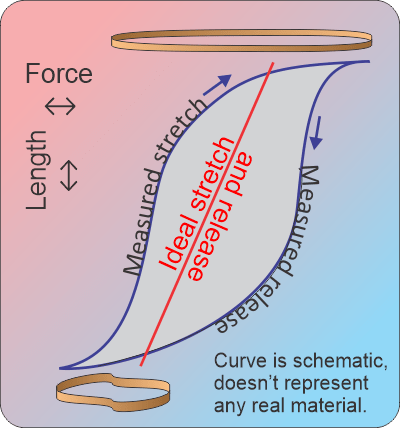
Typical hysteresis loop
Red — initial evolution
Blue — subsequent changes

“How’d you find out about that?”

You wrote those posts, Sy, about three years ago.”

“Oh, that’s right. Talk about history. Anyway, it took decades for the ecologists, epidemiologists, civil engineers and several kinds of physicist to realize that they all have systems that behave similarly when driven by a stressor. Starting at some neutral situation, the system evolves in the driver’s direction to some maximum deviation where increased stress has no further effect. When the stress is relieved, the system may stick temporarily at the strained position. When it does evolve away from there, maybe a reverse driver is needed to force a return to the starting situation. In fact, if the forward and reverse drivers are applied repeatedly the system may never get back to the initial unstressed position.”

“Like that iron nail. Not magnetic, then magnetic, then reversed.”

~~ Rich Olcott

Hysteria

<chirp, chirp> “Moire here.”

“Hi, Sy, it’s Vinnie again. Hey, I just heard something on NPR I wanted to check with you on.”

“What’s that?”

“They said that even with the vaccine and all, it’s gonna take years for us to get back to normal ’cause the economy’s hysterical. Does that mean it’s cryin’‑funny or just cryin’? Neither one seems to fit.”

“You’re right about the no‑fit. Hmm… Ah! Could the word have been ‘hysteresis‘?”

“Somethin’ like that. What’s it about?”

“It’s an old Physics word that’s been picked up by other fields. Not misused as badly as ‘quantum,’ thank goodness, but still. The word itself gives you a clue. Do you hear the ‘history‘ in there?”

“Hysteresis, history … cute. So it’s about history?”

“Yup. The classic case is magnetism. Take an iron nail, for instance. The nail might already be magnetized strongly enough to pick up a paper clip. If it can, you can erase the magnetism by heating the nail white‑hot. If the nail’s not magnetic you may be able to magnetize it by giving it a few hammer‑whacks while it’s pointed north‑south, parallel to Earth’s magnetic field. Things get more interesting if we get quantitative. A strong‑enough magnetic field will induce magnetism in that nail no matter what direction it’s pointed. Reverse that field’s direction and the nail stays magnetized, only less so. It takes a stronger reverse field to demagnetize the nail than it took to magnetize it in the first place. See how the history makes a difference?”

“Yeah, for some things.”

“And that’s the point. Some of a system’s properties are as fixed as the nail’s weight or chemical composition. However, it may have other properties we can’t understand without knowing the history. Usually we can’t even predict them without looking at deeper structures. Hysteresis highlights two more gaps in Newton’s Physics. As usual he’s got a good excuse because many history‑dependent phenomena couldn’t even be detected with 17th‑Century technology. We couldn’t produce controllable magnetic fields until the 19th Century, when Oersted and Ampere studied magnetism and electricity. We didn’t understand magnetic hysteresis until the 20th Century.”

“Haw! You’re talking history of history. Anyway, to me it looks like what’s going on is that the strong field gets the magnetic atoms in there to all point the same way and heat undoes that by shaking them up to point random‑like.”

“What about the reversing field?”

“Maybe it points some of the atoms in the other direction and that makes the nail less and less magnetic until the field is strong enough to point everything backwards.”

“Close enough. The real story is that the atoms, iron in this case, are organized in groups called domains. The direction‑switching happens at the domain level — battalions of magnetically aligned atoms — but we had no way to know that until 20th‑Century microscopy came along.”

“So it takes ’em a while to get rearranged, huh?”

“Mmm, that’d be rate-dependent hysteresis, where the difference between forward and backward virtually disappears if you go slow enough. Think about putting your hand slowly into a tub of water versus splashing in there. Slow in, slow out reverses pretty well, but if you splash the water’s in turmoil for quite a long time. Magnetic hysteresis, though, doesn’t care about speed except in the extreme case. It’s purely controlled by the strength of the applied field.”

“I’m thinking about that poor frog.”

‘You would go there, wouldn’t you? Yeah, the legendary frog in slowly heating water would be another history dependency but it’s a different kind. The nail’s magnetism only depends on atoms standing in alignment. A frog is a highly organized system, lots of subsystems that all have to work together. Warming water adds energy that will speed up some subsystems more than others. If Froggy exits the pot before things desynchronize too far then it can recover its original lively state. If it’s trapped in there you’ve got frog soup. By the way, it’s a myth that the frog won’t try to hop out if you warm the water slowly. Frogs move to someplace cool if they get hotter than their personal threshold temperature.”

“Frogs are smarter than legends, huh?”

~~ Rich Olcott

‘Twixt A Rock And A Vortex

A chilly late December walk in the park and there’s Vinnie on a lakeside bench, staring at the geese and looking morose. “Hi, Vinnie, why so down on such a bright day?”

“Hi, Sy. I guess you ain’t heard. Frankie’s got the ‘rona.”

Frankie??!? The guys got the constitution of an ox. I don’t think he’s ever been sick in his life.”

“Probably not. Remember when that bug going around last January had everyone coughing for a week? Passed him right by. This time’s different. Three days after he showed a fever, bang, he’s in the hospital.”

“Wow. How’s Emma?”

“She had it first — a week of headaches and coughing. She’s OK now but worried sick. Hospital won’t let her in to see him, of course, which is a good thing I suppose so she can stay home with the kids and their schoolwork.”

“Bummer. We knew it was coming but…”

“Yeah. Makes a difference when it’s someone you know. Hey, do me a favor — throw some science at me, get my mind off this for a while.”

“That’s a big assignment, considering. Let’s see … patient, pandemic … Ah! E pluribus unum and back again.”

“Come again?”

“One of the gaps that stand between Physics and being an exact science.”

“I thought Physics was exact.”

“Good to fifteen decimal places in a few special experiments, but hardly exact. There’s many a slip ‘twixt theory and practice. One of the slips is the gap between kinematic physics, about how separate objects interact, and continuum physics, where you’re looking at one big thing.”

“This is sounding like that Loschmidt guy again.”

“It’s related but bigger. Newton worked on both sides of this one. On the kinematics side there’s billiard balls and planets and such. Assuming no frictional energy loss, Newton’s Three Laws and his Law of Gravity let us calculate exact predictions for their future trajectories … unless you’ve got more than three objects in play. It’s mathematically impossible to write exact predictions for four or more objects unless they start in one of a few special configurations. Newton didn’t do atoms, no surprise, but his work led to Schrödinger’s equation for an exact description of single electron, single nucleus systems. Anything more complicated, all we can do is approximate.”

“Computers. They do a lot with computers.”

“True, but that’s still approximating. Time‑step by time‑step and you never know what might sneak in or out between steps.”

“What’s ‘continuum‘ about then? Q on Star trek?”

“Hardly, we’re talking predictability here. Q’s thing is unpredictability. A physics continuum is a solid or fluid with no relevant internal structure, just an unbroken mass from one edge to the other. Newton showed how to analyze a continuum’s smooth churning by considering the forces that act on an imaginary isolated packet of stuff at various points in there. He basically invented the idea of viscosity as a way to account for friction between a fluid and the walls of the pipe it’s flowing through.”

“Smooth churning, eh? I see a problem.”

“What’s that?”

“The eddies and whirlpools I see when I row — not smooth.”

“Good point. In fact, that’s the point I was getting to. We can use extensions of Newton’s technique to handle a single well‑behaved whirlpool, but in real life big whirlpools throw off smaller ones and they spawn eddies and mini‑vortices and so on, all the way down to atom level. That turns out to be another intractable calculation, just as impossible as the many‑body particle mechanics problem.”

“Ah‑hah! That’s the gap! Newton just did the simple stuff at both ends, stayed away from the middle where things get complicated.”

“Exactly. To his credit, though, he pointed the way for the rest of us.”

“So how can you handle the middle?”

“The same thing that quantum mechanics does — use statistics. That’s if the math expressions are average‑able which sometimes they’re not, and if statistical numbers are good enough for why you’re doing the calculation. Not good enough for weather prediction, for instance — climate is about averages but weather needs specifics.”

“Yeah, like it’s just started to snow which I wasn’t expecting. I’m heading home. See ya, Sy.”

“See ya, Vinnie. … Frankie. … Geez.

~~ Rich Olcott

Futile? Nope, Just Zero

“Megabar superconductivity.”

“Whoa, Susan. Too much information, too few words. Could you unpack that, please?”

“No problem, Sy. A bar is the barometric pressure (get it?) at sea level. A megabar is—”

“A million atmospheres, right?”

“Right, Al. So Ranga Dias and his crew were using their Diamond Anvil Cells to put their chemical samples under million-atmosphere pressures while they tested for superconductivity—”

“Like Superman uses?”

“Is he always like this, Sy?”

“Just when he gets excited, Susan. The guy loves Science, what can I say?”

“Sorry, Susan. So what makes conductivity into superconductivity?”

“Excellent question, Al. Answering it generated several Nobel Prizes and we still don’t have a complete explanation. I can tell you the what but I can’t give you a firm why. Mmm… what do you know about electrical resistance?”

“Just what we got in High School General Science. We built a circuit with a battery and a switch and an unknown resistor and a meter to measure the current. We figured the resistance from the voltage divided by the current. Or maybe the other way around.”

“You got it right the first try. The voltage drop across a resistor is the current times the resistance, V=IR so V/I=R. That’s for ordinary materials under ordinary conditions. But early last century researchers found that for many materials, if you get them cold enough the resistance is zero.”

“Zero? But … if you put any voltage across something like that it could swallow an infinite amount of current.”

“Whoa, Al, what’s my motto about infinities?”

“Oh yeah, Sy. ‘If your theory contains an infinity, you’ve left out physics that would stop that.’ So what’d stop an infinite current here?”

“The resistor wasn’t the only element in your experimental circuit. Internal resistance within the battery and meter would limit the current. Those 20th-century researchers had to use some clever techniques to measure what they had. Back to you, Susan.”

“Thanks, Sy. I’m going to remember that motto. Bottom line, Al, superconductors have zero resistance but only under the right conditions. You start with your test material, with a reasonable resistance at some reasonable temperature, and then keep measuring its resistance as you slowly chill it. If it’s willing to superconduct, at some critical temperature you see the resistance abruptly drop straight down to zero. The critical temperature varies with different materials. The weird thing is, once the materials are below their personal critical temperature all superconductors behave the same way. It’s seems to be all about the electrons and they don’t care what kind of atom they rode in on.”

“Wouldn’t copper superconduct better than iron?”

“Oddly enough, pure copper doesn’t superconduct at all. Iron and lead both superconduct and so do some weird copper-containing oxides. Oh, and superconductivity has another funny dependency — it’s blocked by strong magnetic fields, but on the other hand it blocks out weaker ones. Under normal conditions, a magnetic field can penetrate deep into most materials. However, a superconducting piece of material completely repels the field, forces the magnetic lines to go around it. That’s called the Meissner effect and it’s quantum and—”

“How’s it work?”

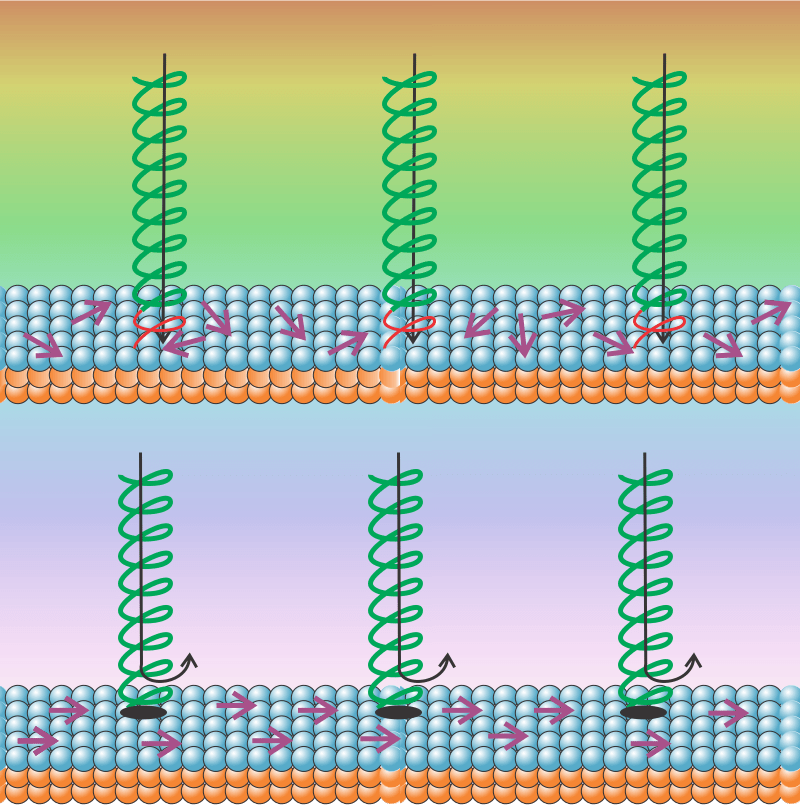
“Even though we’ve got a good theory for the materials with low critical temperature, the copper oxides and such are still a puzzle. Here’s a diagram I built for one of my classes…”

“The top half is the ordinary situation, like in a copper wire. Most of the current is carried by electrons near the surface, but there’s a lot of random motion there, electrons bouncing off of impurities and crystal defects and boundaries. That’s where ordinary conduction’s resistance comes from. Compare that with the diagram’s bottom half, a seriously simplified view of superconduction. Here the electrons act like soldiers on parade, all quantum‑entangled with each other and moving as one big unit.”

“The green spirals?”

“They represent an imposed magnetic field. See the red bits diving into the ordinary conductor? But the superconducting parade doesn’t make space for the circular motion that magnetism tries to impose. The force lines just bounce off. Fun fact — the supercurrent itself generates a huge magnetic field but only outside the superconductor.”

“How ’bout that? So how is megabar superconductivity different?”

~~ Rich Olcott

A Star’s Tale

It’s getting nippy outside so Al’s moved his out‑front coffee cart into his shop. Jeremy’s manning the curbside take‑out window but I’m walking so I step inside. Limited seating, of course. “Morning, Al. Here’s my hiking mug, fill ‘er up with high‑test and I’ll take a couple of those scones — one orange, one blueberry. Good news that the Governor let you open up.”

“You know it, Sy. Me and my suppliers have been on the phone every day. Good thing we’ve got long‑term relationships and they’ve been willing to carry me but it gets on my conscience ’cause they’re in a crack, too, ya know?”

“Low velocity of money hurts everybody, Al. Those DC doofuses and their political kabuki … but don’t get me started. Hey, you’ve got a new poster over the cash register.”

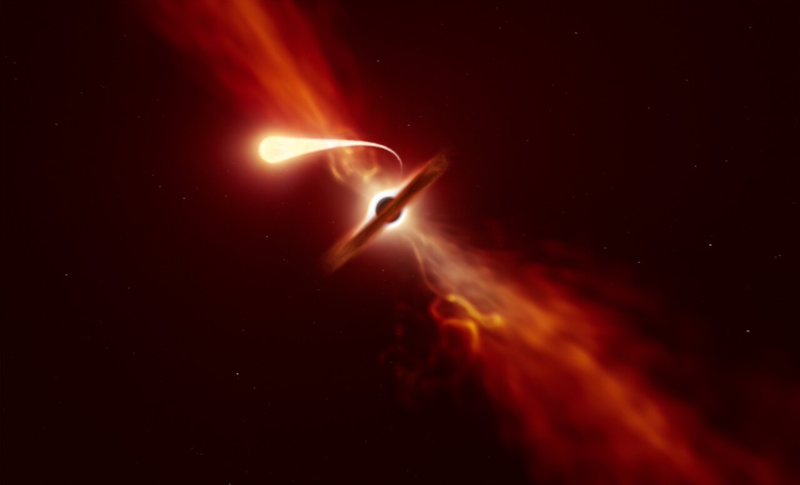
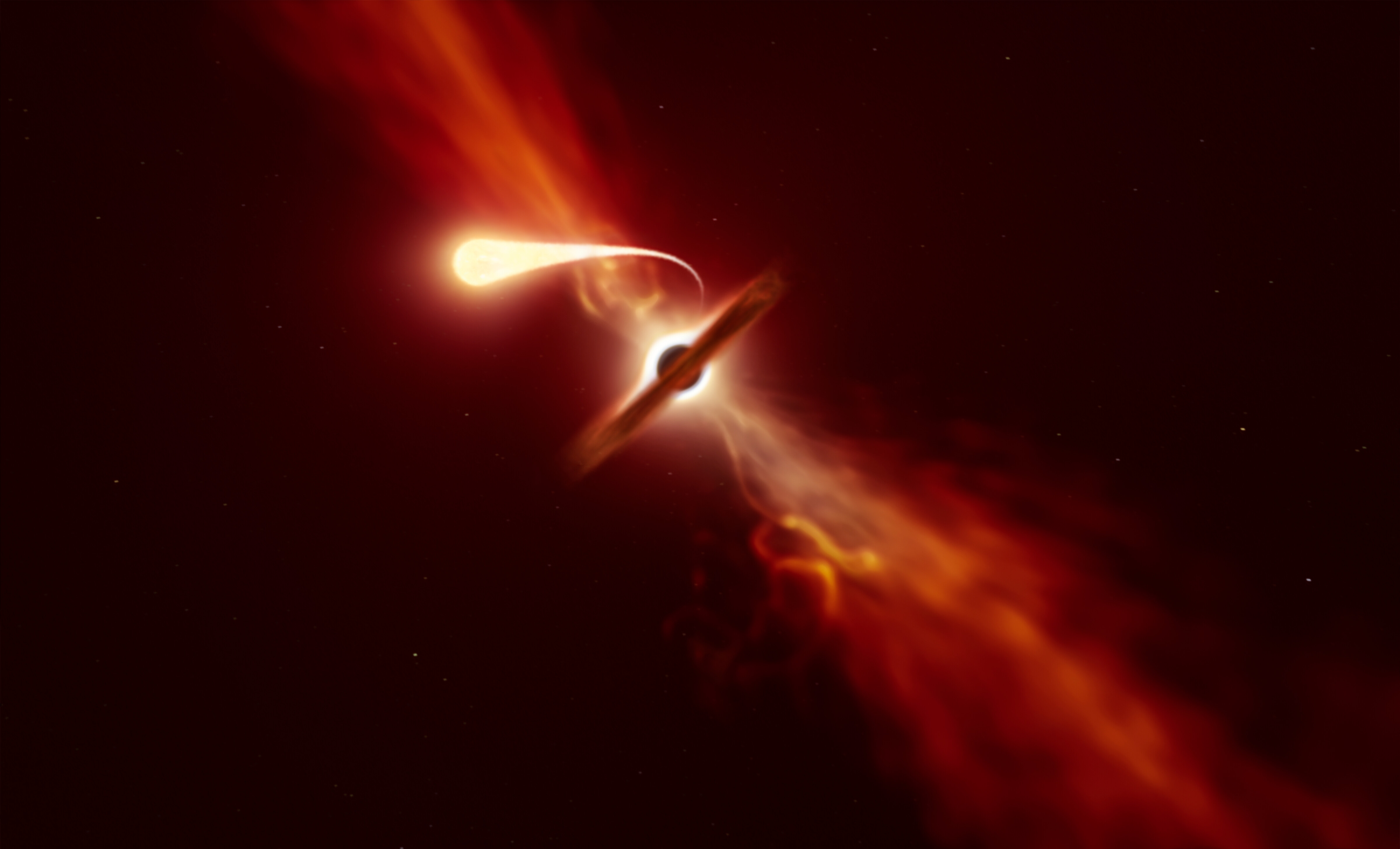
“You noticed. Yeah, it’s a beaut. Some artist’s idea of what it’d look like when a star gets spaghettified and eaten by a black hole. See, it’s got jets and a dust dusk and everything.”

“Very nice, except for a few small problems. That’s not spaghettification, the scale is all wrong and that tail-looking thing … no.”

Artist’s impression of AT2019qiz. Credit: ESO/M. Kornmesser
Under Creative Commons Attribution 4.0 International License

“Not spaghettification? That’s what was in the headline.”

“Sloppy word choice. True spaghettification acts on solid objects. Gravity’s force increases rapidly as you approach the gravitational center. Suppose you’re in a kilometer-long star cruiser that’s pointing toward a black hole from three kilometers away. The cruiser’s tail is four kilometers out. Newton’s Law of Gravity says the black hole pulls almost twice as hard on the nose as on the tail. If the overall field is strong enough it’d stretch the cruiser like taffy. Larry Niven wrote about the effect in his short story, Neutron Star.”

“The black hole’s stretching the star, right?”

“Nup, because a star isn’t solid. It’s fluid, basically a gas held together by its own gravity. You can’t pull on a piece of gas to stretch the whole mass. Your news story should have said ‘tidal disruption event‘ but I guess that wouldn’t have fit the headline space. Anyhow, an atom in the star’s atmosphere is subject to three forces — thermal expansion away from any gravitational center, gravitational attraction toward its home star and gravitational attraction toward the black hole. The star breaks up atom by atom when the two bodies get close enough that the black hole’s attraction matches the star’s surface gravity. That’s where the scale problem comes in.”

Al looks around — no waiting customers so he strings me along. “How?”

“The supermassive black hole in the picture, AT2019qiz, masses about a million Suns‑worth. The Sun‑size star can barely hold onto a gas atom at one star‑radius from the star’s center. The black hole can grab that atom from a thousand star‑radii away, about where Saturn is in our Solar System. The artist apparently imagined himself to be past the star and about where Earth is to the Sun, 100 star‑radii further out. Perspective will make the black hole pretty small.”

“But that’s a HUGE black hole!”

“True, mass‑wise, not so much diameter‑wise. Our Sun’s about 864,000 miles wide. If it were to just collapse to a black hole, which it couldn’t, its Event Horizon would be about 4 miles wide. The Event Horizon of a black hole a million times as massive as the Sun would be less than 5 times as wide as the Sun. Throw in the perspective factor and that black circle should be less than half as wide as the star’s circle.”

“What about the comet‑tail?”

“The picture makes you think of a comet escaping outward but really the star’s material is headed inward and it wouldn’t be that pretty. The disruption process is chaotic and exponential. The star’s gravity weakens as it loses mass but the loss is lop‑sided. Down at the star’s core where the nuclear reactions happen the steady burn becomes an irregular pulse. The tail should flare out near the star. The rest should be jagged and lumpy.”

“And when enough gets ripped away…”

“BLOOEY!”

~~ Rich Olcott

  • Thanks to T K Anderson for suggesting this topic.
  • Link to Technical PS — Where Do Those Numbers Come From?.

A Beetled Brow

Vinnie’s brow was wrinkling so hard I could hear it over the phone. “Boltzmann, Boltzmann, where’d I hear that name before? … Got it! That’s one of those constants, ain’t it, Sy? Molecules or temperature or something?”

“The second one, Vinnie. Avagadro was the molecule counter. Good memory. Come to think of it, both Boltzmann and Avagadro bridged gaps that Loschmidt worked on.”

“Loschmidt’s thing was the paradox, right, between Newton saying events can back up and thermodynamics saying no, they can’t. You said Boltzmann’s Statistical Mechanics solved that, but I’m still not clear how.”

“Let me think of an example. … Ah, you’ve got those rose bushes in front of your place. I’ll bet you’ve also put up a Japanese beetle trap to protect them.”

“Absolutely. Those bugs would demolish my flowers. The trap’s lure draws them away to my back yard. Most of them stay there ’cause they fall into the trap’s bag and can’t get out.”

“Glad it works so well for you. OK, Newton would look at individual beetles. He’d see right off that they fly mostly in straight lines. He’d measure the force of the wind and write down an equation for how the wind affects a beetle’s flight path. If the wind suddenly blew in the opposite direction, that’d be like the clock running backwards. His same equation would predict the beetle’s new flight path under the changed conditions. You with me?”

“Yeah, no problem.”

“Boltzmann would look at the whole swarm. He’d start by evaluating the average point‑to‑point beetle flight, which he’d call ‘mean free path.’ He’d probably focus on the flight speed and in‑the‑air time fraction. With those, if you tell him how many beetles you’ve got he could generate predictions like inter‑beetle separation and how long it’d take an incoming batch of beetles to cross your yard. However, predicting where a specific beetle will land next? Can’t do that.”

“Who cares about one beetle?”

“Well, another beetle might. …
Just thought of a way that Statistical Mechanics could actually be useful in this application. Once Boltzmann has his numbers for an untreated area, you could put in a series of checkpoints with different lures. Then he could develop efficiency parameters just by watching the beetle flying patterns. No need to empty traps. Anyhow, you get the idea.”

Japanese Beetle, photo by David Cappaert, Bugwood.org
under Creative Commons BY 3.0

“Hey, I feel good emptying that trap, I’m like standing up for my roses. Anyway, so how does Avagadro play into this?”

“Indirectly and he was half a century earlier. In 1805 Gay‑Lussac showed that if you keep the pressure and temperature constant, it tales two volumes of hydrogen to react with one volume of oxygen to produce one volume of water vapor. Better, the whole‑number‑ratio rule seemed to hold generally. Avagadro concluded that the only way Gay‑Lussac’s rule could be general is if at any temperature and pressure, equal volumes of every kind of gas held the same number of molecules. He didn’t know what that number was, though.”

“HAW! Avagadro’s number wasn’t a number yet.”

“Yeah, it took a while to figure out. Then in 1865, Loschmidt and a couple of others started asking, “How big is a gas molecule?” Some gases can be compressed to the liquid state. The liquids have a definite volume, so the scientists knew molecules couldn’t be infinitely small. Loschmidt put numbers to it. Visualize a huge box of beetles flying around, bumping into each other. Each beetle, or molecule, ‘occupies’ a cylinder one beetle wide and the length of its mean free path between collisions. So you’ve got three volumes — the beetles, the total of all the cylinders, and the much larger box. Loschmidt used ratios between the volumes, plus density data, to conclude that air molecules are about a nanometer wide. Good within a factor of three. As a side result he calculated the number of gas molecules per unit volume at any temperature and pressure. That’s now called Loschmidt’s Number. If you know the molecular weight of the gas, then arithmetic gives you Avagadro’s number.”

“Thinking about a big box of flying, rose‑eating beetles creeps me out.”

  • Thanks to Oriole Hart for the story‑line suggestion.

~~ Rich Olcott

Bridging A Paradox

<chirp, chirp> “Moire here.”

“Hi, Sy. Vinnie. Hey, I’ve been reading through some of your old stuff—”

“That bored, eh?”

“You know it. Anyhow, something just don’t jibe, ya know?”

“I’m not surprised but I don’t know. Tell me about it.”

“OK, let’s start with your Einstein’s Bubble piece. You got this electron goes up‑and‑down in some other galaxy and sends out a photon and it hits my eye and an atom in there absorbs it and I see the speck of light, right?”

“That’s about the size of it. What’s the problem?”

“I ain’t done yet. OK, the photon can’t give away any energy on the way here ’cause it’s quantum and quantum energy comes in packages. And when it hits my eye I get the whole package, right?”

“Yes, and?”

“And so there’s no energy loss and that means 100% efficient and I thought thermodynamics says you can’t do that.”

“Ah, good point. You’ve just described one version of Loschmidt’s Paradox. A lot of ink has gone into the conflict between quantum mechanics and relativity theory, but Herr Johann Loschmidt found a fundamental conflict between Newtonian mechanics, which is fundamental, and thermodynamics, which is also fundamental. He wasn’t talking photons, of course — it’d be another quarter-century before Planck and Einstein came up with that notion — but his challenge stood on your central issue.”

“Goody for me, so what’s the central issue?”

“Whether or not things can run in reverse. A pendulum that swings from A to B also swings from B to A. Planets go around our Sun counterclockwise, but Newton’s math would be just as accurate if they went clockwise. In all his equations and everything derived from them, you can replace +t with ‑t to make run time backwards and everything looks dandy. That even carries over to quantum mechanics — an excited atom relaxes by emitting a photon that eventually excites another atom, but then the second atom can play the same game by tossing a photon back the other way. That works because photons don’t dissipate their energy.”

“I get your point, Newton-style physics likes things that can back up. So what’s Loschmidt’s beef?”

“Ever see a fire unburn? Down at the microscopic level where atoms and photons live, processes run backwards all the time. Melting and freezing and chemical equilibria depend upon that. Things are different up at the macroscopic level, though — once heat energy gets out or randomness creeps in, processes can’t undo by themselves as Newton would like. That’s why Loschmidt stood the Laws of Thermodynamics up against Newton’s Laws. The paradox isn’t Newton’s fault — the very idea of energy was just being invented in his time and of course atoms and molecules and randomness were still centuries away.”

“Micro, macro, who cares about the difference?”

“The difference is that the micro level is usually a lot simpler than the macro level. We can often use measured or calculated micro‑level properties to predict macro‑level properties. Boltzmann started a whole branch of Physics, Statistical Mechanics, devoted to carrying out that strategy. For instance, if we know enough about what happens when two gas molecules collide we can predict the speed of sound through the gas. Our solid‑state devices depend on macro‑level electric and optical phenomena that depend on micro‑level electron‑atom interactions.”

“Statistical?”

“As in, ‘we don’t know exactly how it’ll go but we can figure the odds…‘ Suppose we’re looking at air molecules and the micro process is a molecule moving. It could go left, right, up, down, towards or away from you like the six sides of a die. Once it’s gone left, what are the odds it’ll reverse course?”

“About 16%, like rolling a die to get a one.”

“You know your odds. Now roll that die again. What’s the odds of snake‑eyes?”

“16% of 16%, that’s like 3 outa 100.”

“There’s a kajillion molecules in the room. Roll the die a kajillion times. What are the odds all the air goes to one wall?”

“So close to zero it ain’t gonna happen.”

“And Boltzmann’s Statistical Mechanics explained why not.”

“Knowing about one molecule predicts a kajillion. Pretty good.”

San Francisco’s Golden Gate Bridge, looking South
Photo by Rich Niewiroski Jr. / CC BY 2.5

~~ Rich Olcott

Breaking Up? Not So Hard

<transcript of smartphone dictation by Sy Moire, hard‑boiled physicist>
Day 173 of self‑isolation….
Perfect weather for a brisk solitary walk, taking the park route….
There’s the geese. No sign of Mr Feder, just as well….

Still thinking about Ms Baird and her plan for generating electric power from a black hole named Lonesome….
Can just hear Vinnie if I ever told him about this which I can’t….
“Hey, Sy, nothin’ gets out of a black hole except gravity, but she’s using Lonesome‘s magnetic field to generate electricity which is electromagnetic. How’s that happen?”
Good question….

Hhmph, that’s one angry squirrel….
Ah, a couple of crows pecking the ground under its tree. Maybe they’re too close to its acorn stash….

We know a black hole’s only measurable properties are its mass, charge and spin….
And maybe its temperature, thanks to Stephen Hawking….
Its charge is static — hah! cute pun — wouldn’t support continuous electrical generation….
The Event Horizon hides everything inside — we can’t tell if charge moves around in there or even if it’s matter or anti‑matter or something else….
The no‑hair theorem says there’s no landmarks or anything sticking out of the Event Horizon so how do we know the thing’s even spinning?

Ah, we know a black hole’s external structures — the jets, the Ergosphere belt and the accretion disk — rotate because we see red- and blue-shifted radiation from them….
The Ergosphere rotates in lockstep with Lonesome‘s contents because of gravitational frame-dragging….
Probably the disk and the jets do, too, but that’s only a strong maybe….
But why should the Ergosphere’s rotation generate a magnetic field?

How about Newt Barnes’ double‑wheel idea — a belt of charged light‑weight particles inside a belt of opposite‑charged heavy particles all embedded in the Ergosphere and orbiting at the black hole’s spin rate….
Could such a thing exist? Can simple particle collisions really split the charges apart like that?….

OK, fun problem for strolling mental arithmetic. Astronomical “dust” particles are about the size of smoke particles and those are about a micrometer across which is 10‑6 meter so the volume’s about (10‑6)3=10‑18 cubic meter and the density’s sorta close to water at 1 gram per cubic centimeter or a thousand kilograms per cubic meter so the particle mass is about 10‑18×103=10‑15 kilogram. If a that‑size particle collided with something and released just enough kinetic energy to knock off an electron, how fast was it going?

Ionization energy for a hydrogen atom is 13 electronvolts, so let’s go for a collision energy of at least 10 eV. Good old kinetic energy formula is E=½mv² but that’s got to be in joules if we want a speed in meters per second so 10 eV is, lemme think, about 2×10‑18 joules/particle. So is 2×2×10‑18/10‑15 which is 4×10‑3 or 40×10‑4, square root of 40 is about 6, so v is about 6×10‑2 or 0.06 meters per second. How’s that compare with typical speeds near Lonesome?

Ms Baird said that Lonesome‘s mass is 1.5 Solar masses and it’s isolated from external gravity and electromagnetic fields. So anything near it is in orbit and we can use the circular orbit formula v²=GM/r….
Dang, don’t remember values for G or M. Have to cheat and look up the Sun’s GM product on Old Reliable….
Ah-hah, 1.3×10²⁰ meters³/second so Lonesome‘s is also near 1020….
A solar‑mass black hole’s half‑diameter is about 3 kilometers so Lonesome‘s would be about 5×10³ meters. Say we’re orbiting at twice that so r‘s around 104 meters. Put it together we get v2=1020/104=1016 so v=108 meters/sec….
Everything’s going a billion times faster than 10 eV….
So yeah, no problem getting charged dust particles out there next to Lonesome….

Just look at the color in that tree…
Weird when you think about it. The really good color is summertime chlorophyll green when the trees are soaking up sunlight and turning CO2 into oxygen for us but people get excited about dying leaves that are red or yellow…

Well, now. Lonesome‘s Event Horizon is the no-going-back point on the way to its central singularity which we call infinity because its physics are beyond anything we know. I’ve just closed out another decade of my life, another Event Horizon on my own one‑way path to a singularity…

Hey! Mr Feder! Come ask me a question to get me out of this mood.

Author’s note — Yes, ambient radiation in Lonesome‘s immediate vicinity probably would account for far more ionization than physical impact, but this was a nice exercise in estimation and playing with exponents and applied physical principles.

~~ Rich Olcott

Engineering A Black Hole

<bomPAH-dadadadaDEEdah> That weird ringtone on Old Reliable again. Sure enough, the phone function’s caller-ID display says 710‑555‑1701.  “Ms Baird, I presume?”

A computerish voice, aggressive but feminine, with a hint of desperation. “Commander Baird will be with you shortly, Mr Moire. Please hold.”

A moment later, “Hello, Mr Moire.”

“Ms Baird. Congratulations on the promotion.”

“Thank you, Mr Moire. I owe you for that.”

“How so?”

“Your posts about phase-based weaponry got me thinking. I assembled a team, we demonstrated a proof of concept and now Federation ships are being equipped with the Baird‑Prymaat ShieldSaw. Works a treat on Klingon and Romulan shielding. So thank you.”

“My pleasure. Where are you now?”

“I’m on a research ship called the Invigilator. We’re orbiting black hole number 77203 in our catalog. We call it ‘Lonesome‘.”

“Why that name?”

“Because there’s so little other matter in the space nearby. The poor thing barely has an accretion disk.”

“Sounds boring.”

“No, it’s exciting, because it’s so close to a theoretical ideal. It’s like the perfectly flat plane and the frictionless pulley — in real life there are always irregularities that the simple equations can’t account for. For black holes, our only complete solutions assume that the collapsed star is floating in an empty Universe with no impinging gravitational or electromagnetic fields. That doesn’t happen, of course, but Lonesome comes close.”

“But if we understand the theoretical cases and it nearly matches one, why bother with it at all?”

“Engineering reasons.”

“You’re engineering a black hole?”

“In a way, yes. Or at least that’s what we’re working on. We think we have a way to extract power from a black hole. It’ll supply inexhaustible cheap energy for a new Star Fleet anti‑matter factory. “

“I thought the only thing that could escape a black hole’s Event Horizon was Hawking radiation, and it cheats.”

“Gravity escapes honestly. Its intense field generates some unexpected effects. Your physicist Roger Penrose used gravity to explain the polar jets that decorate so many compact objects including black holes. He calculated that if a comet or an atom or something else breakable shatters when it falls into a spinning compact object’s gravitational field, some pieces would be trapped there but under the right conditions other pieces would slingshot outward with more energy than they had going in. In effect, the extra energy would come from the compact object’s angular momentum.”

“And that’s what you’re planning to do? How are you going to trap the expelled pieces?”

“No, that’s not what we’re planning. Too random to be controlled with our current containment field technology. We’re going pure electromagnetic, turning Lonesome into a giant motor‑generator. We know it has a stable magnetic field and it’s spinning rapidly. We’ll start by giving Lonesome some close company. There’s enough junk in its accretion disk for several Neptune‑sized planets. The plan is to use space tugs to haul in the big stuff and Bussard technology for the dust, all to assemble a pair of Ceres-sized planetoids. W’re calling them Pine and Road. We’ll park them in a convenient equatorial orbit in a Lagrange‑stable configuration so Pine, Road and Lonesome stay in a straight line.”

“Someone’s been doing research on old cinema.”

“The Interstellar Movie Database. Anyhow, when the planetoids are out there we string conducting tractor beams between them. If we locate Pine and Road properly, Lonesome’s rotating magnetic field lines will cross the fields at right angles and induce a steady electric current. Power for the anti‑matter synthesizers.”

“Ah, so like Penrose’s process you’re going to drain off some of Lonesome‘s rotational kinetic energy. Won’t it run out?”

Lonesome‘s mass is half again heavier than your Sun’s, Mr Moire. It’ll spin for a long, long time.”

“Umm … that ‘convenient orbit.’ Lonesome‘s diameter is so small that orbits will be pretty speedy. <calculating quickly with Old Reliable> Even 200 million kilometers away you’d circle Lonesome in less than 15 minutes. Will the magnetic field that far out be strong enough for your purposes?”

“Almost certainly so, but the gravimagnetodynamic equations don’t have exact solutions. We’re not going to know until we get there.”

“That’s how research works, all right. Good luck.”

~~ Rich Olcott