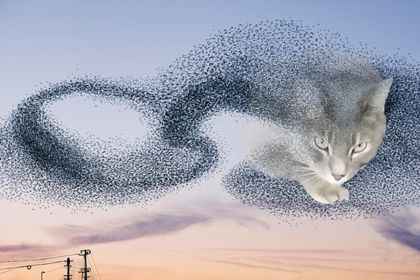
Schroeder’s Magic Kittycat

“Bedtime, Teena.”

“Aw, Mommie, I had another question for Uncle Sy.  And I’m not sleepy yet anyhow.”

“Well, if we’re just sitting here relaxing, I suppose.  Sy, make your answer as boring as possible.”

“You know me better than that, Sis, but I’ll try.  What’s your question, Teena?”

“You said something once about quantum and Schroeder’s famous kittycat.  Why is it famous?  If it’s quantum it must be a very, very small cat.  Is it magic?”

“???… Oh, Schrödinger’s Cat.  It’s a pretend cat, not a real one, but it’s famous because it’s both asleep and awake.”

“I see what you did there, Sy.”

“Yeah, Sis, but it’s for a good cause, right?”

“But Uncle Sy, how can you tell?  Sometimes Tommie our kittycat looks sound asleep but he’s not really because he can hear when Mommie opens the cat-food can.”

“Schrödinger’s Cat is special.  Whenever he’s awake his eyes are wide open and whenever he’s asleep his eyes are shut.  And he’s in a box.”

“Tommie loves to sit in boxes.”

“Schrödinger’s Cat’s box is sealed tight.  You can’t see into it.”

“So how do you know whether he’s asleep?”

“That was Mr Schrödinger’s point.  We can’t know, so we have to suppose it’s both.  Many people have made jokes about that.  Mr. Schrödinger said the usual interpretation of quantum mechanics is ridiculous and his cat story was his way of proving that.  The cat doesn’t even have to be quantum-small and the story still works.”

“How could it be halfway?  Either his eyes are open or they’re … wait, sometimes Tommie squints, is that it?”

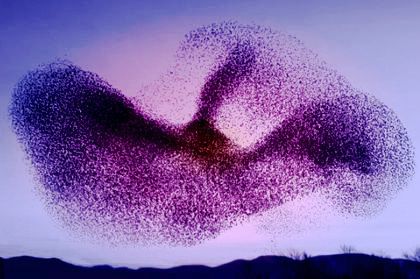
“Nice try, but no.  Do you remember when we were looking at the bird murmuration and I asked you to point to its middle?”

“Oh, yes, and it was making a beautiful spiral.  Mommie, you should have seen it!”

“Were there any birds right at its middle?”

“Um, no-o.  All around the middle but not right there.”

“Birds to the left, birds to the right, but no birds in the middle.  But if I’d I asked you to point to the place where the birds were, you’d’ve pointed to the middle.”

“Uh-huh.”

“You see how that’s like Mr Schrödinger’s cat’s situation?  It’s really asleep or maybe it’s really awake, but if we’re asked for just one answer we’d have to say ‘halfway between.’  Which is silly just like Mr Schrödinger said — by the usual quantum calculation we’d have to consider his cat to be half awake.  That was part of the long argument between Mr Einstein and the other scientist.”

“Wait, Sy, I didn’t hear that part of you two’s conversation on the porch.  What argument was that?”

“This was Einstein’s big debate with Niels Bohr.  Bohr maintained that all we could ever know about the quantum world are the probabilities the calculations yielded.  Einstein held that the probabilities had to result from processes taking place in some underlying reality.  Cat reality here, which we can resolve by opening the box, but the same issue applies across the board at the quantum level.  The problem’s more general than it appears, because much the same issue appears any time you can have a mixture of two or more states.  Are you asleep yet, Sweetie?”

“Nnn, kp tkng.”

“OK.  Entanglement, for instance.  Pretty much the same logic that Schrödinger disparaged can also apply to quantum particles on different paths through space.  Fire off any process that emits a pair of particles, photons for instance.  The wave function that describes both of them together persists through time so if you measure a property for one of them, say polarization direction, you know what that property is for the other one without traveling to measure it.  So far, so good.  What drove Einstein to deplore the whole theory is that the first particle instantaneously notifies the other one that it’s been measured.  That goes directly counter to Einstein’s Theory of Relativity which says that communication can’t go any faster than the speed of light.  Aaand I think she’s asleep.”

“Nice job, Sy, I’ll put her to bed.  We may discuss entanglement sometime.  G’night, Sy.”

“G’night, Sis.  Let me know the next time you do that meatloaf recipe.”

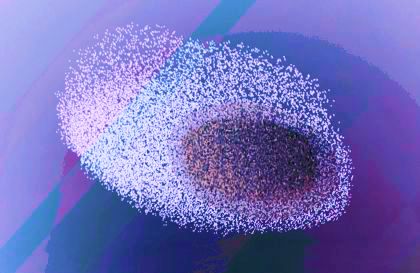
Cat emerging from murmuration~~ Rich Olcott

Stairway to A Rainbow

“OK, Teena, can you guess why I had you put those different things on different steps?”

“Oh, another game of Which of these things aren’t the same!  I love those!  So we’ve got a marble on one step; a tennis ball, a yo-yo and a ring-toss ring on the second step; and a softball and a ring-in-a-ring on the third step.”Shapes on steps

“Don’t forget we’re pretending the softball is hollow with a ping-pong ball floating in its middle.”

“I didn’t forget, Uncle Sy.  Uh… everything’s round, so that can’t be it.  Wait, there’s round-like-a-ball and round-like-a-donut, but we’ve got donut-thingies on two steps. … Oh!  The marble doesn’t have any empty places inside, the tennis ball has one and the softball has two.  Is that it?  But the other things don’t fit.”

“I’m sorry, I wasn’t fair with you ’cause I didn’t tell you about another rule.  See how yo-yo and donut shapes have a pinch-in-the-middle?  We call that a node and it counts as one empty place.”

“Wait, we forgot about the way-far-away empty place.  That counts for all of them, too, right?”

“Good remembering, that’s absolutely right.  It’s a node, too.”

<dancing about, singing>  “Then I know the answer, I know the answer!  The step number is the number of empty places, um, nodes.  The marble on the first step has one.  The tennis ball and the yo-yo and the ring on the second step have two, and the third-step things have three.  See that, Mommie?”

“Very good, Sweetie.  So what’s that got to do with colors, Sy?”

“Suppose we’re looking at a murmuration —”

“My lovely, lovely new word —”

“Yes, Teena.  Suppose for some reason we’d put a big hunk of bird food up on a tall pole.  Birds would fly to make a tight ball around the top of that pole.  Which of Teena’s toys would it look like?”

“Like that marble.”

“That’s right, no node in the middle.  Now suppose we want to get the birds away from the pole.  What could we do and what would the murmuration look like?”

“Set off a firecracker in the middle.  BOOM and all the birds fly away!”

“If they all fly the same distance, which toy would that look like?”

“The tennis ball!  BOOM and a tennis ball shape!  BOOM!”

“Settle down, Sweetie.  I suppose someone could make noise at the foot of the pole…. That would make a half-dumbbell shape as the birds fly upward.”

“Right on, Sis.  One more possibility — we could send a noisy drone to fly circles above the pole.”

“The birds would make a bigger circle between the drone’s orbit and the ground.  Oh!  Your donut shape.”

“Each way, the murmuration changes to a shape with one additional node and we go up a step.  And when we stop annoying the birds?”

“They fly right back to the food.  Ah, I see where you’re going.  They form that ball shape again and we have fewer nodes.  Now, about the colors…”

“Teena, do you think a murmuration could have half a node?”

“No, that’d be silly.”

“Absolutely right.  There’s no in-between step on the stairway, and there’s no in-between shape in an atom.”

“Wait, you mean that whenever an atom goes from a, say 2-node shape to a 3-node shape, that’s the famous quantum jump?”

“Yup, and the jump-down is, too.  Teena, let’s put all the toys back in your toy box and try an experiment.”

“OK … done!”

“Good job.  Now get up on the second step and jump down to the first one.  Make it a loud jump.”

“Sy!”

“Just this once, Sis, for demonstration purposes.”

“OK, just this once, Teena, and never again!”

“Yay!” <THUMP>

“So what’s that prove?”

“That energy is released when you go down a step or allow a murmuration to fill in an empty space.  Teena’s jump released sound energy.  Atoms release light energy when their charge cloud — ‘scuse me, Teena, quantum murmuration — goes to a shape with fewer nodes.  And the amount of energy for each different node-count change is always the same.”

“I think I see where you’re headed.  Each different jump makes a different color?”

“Sis, you’re as smart as I’ve always said you are.”

Murmuration concentric 2

~~ Rich Olcott

The Shapes of Fuzziness

Egg murmuration 1“That was a most excellent meat loaf, Sis.  Flavor balance was perfect.”
“Glad you liked it, Sy.  Mom’s recipe, of course, with the onion soup mix.”

“Yeah, but there was an extra tang in there.”

“Hah, you caught that!  I threw in some sweet pickle relish to brighten it some.”

“Mommy, Uncle Sy told me about quantum thingies and how they hide behind barriers and shoot rainbows at us.”

Sis gives me that What now? look so I must defend myself.  “Whoa, Teena, that’s not even close to what I said.”

“I know, Uncle Sy, but it’s more fun this way.  Little thingies going, ‘Pew! Pew! Pew!’

“Hey, get me out of trouble with your Mom, here.  What did I say really?”

<sigh> “Everything’s made of these teeny-weeny quantum thingies, smaller even than a water-bear egg — so small — and they have to obey quantum rules.  One of the rules is, um, if a lot of them get together to make a big thing, the big thing has to follow big-thing rules even though the little things follow quantum rules.”

“Nicely put, Sweetie.”

“And sometimes the quantum thingies act like waves and sometimes they act like real things and no-one knows how they do that.  And, uh, something about barriers making forbidden places that colors come out of and I’m mixed up about that.”

“Excellent summary, young lady.  That deserves an extra —” <sharp look from Sis who has a firm ‘No rewarding with food!‘ policy> “— chase around the block the next time we go scootering.”

“Yay!  But can you unconfuse me about the forbidden areas and colors?”

“Well, I can try.  Tell you what, bring your toy box over by the stairway, OK?  We’ll pick it all up when we’re done, Sis, I promise.  Ready, Teena?”

“Ready!”

“OK, put your biggest marble on the bottom step. Yes, it is pretty.  Now put a tennis ball and that dumbbell-shaped thing on the second step.  Oh, it’s a yo-yo?  Cool.  And that ring-toss ring, put it on the second step, too.  Now for the third step.  Put the softball there and … umm … take some of those Legos and make a little ring inside a big ring.  Thanks, Sis, just half a cup.  Ready, Teena?”

“Just a sec… ready!”

“Perfect.  Oh, Teena, you forgot to tell Mommy about the murmuration.”

“Oh, she’s seen them.  You know, Mommie, thousands of birds flying in a big flock and they have rules so they keep together but not too close and they make big pictures in the sky.”

“Yes, I have, sweetheart, but what does that have to do with quantum, Sy?”

“How would you describe their shapes?”

“Oh, they make spirals, and swirls… I’ve seen balls and cones and doughnuts and wide flowing sheets, and other shapes we simply don’t have names for.”

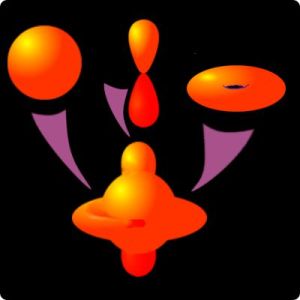
“These shapes on the stairs are the first few letters in science’s alphabet for describing complex shapes like atoms.  It’s like spelling a word.  That ball on the first step is solid.  The tennis ball is a hollow shell.  Pretend the softball is hollow, too, with a hollow ping-pong ball at its center.  If you pretend that each of these is a murmuration, Teena, does that make you think of anything?”

“Mmm..  There aren’t any birds flying outside of the marble, or outside or inside of the tennis ball.  And I guess there aren’t any flying between the layers in the ping-softball.  Are those forbidden areas?”

“C’mere for a high-five!  That’s exactly where I’m going with this.  The marble has one forbidden region infinitely far away.  The tennis ball has that one plus a second one at its middle.  The softball-ping-pong combo has three and so on.  We can describe any spherical fuzziness by mixing together shapes like that.”Combining shapes

“So what about the rings and that dumbbell yo-yo?”

“That’s the start of our alphabet for fuzziness that isn’t perfectly round.  Math has given us a toolkit of spheres, dumbbells, rings and fancier figures that can describe any atom.  Plain and fancy dumbbells stretch the shape out, rings bulge its equator, and so on.  Quantum scientists use the shapes to describe atoms and molecules.”

“Why the stairsteps?”

“What about my colors?”

~ Rich Olcott

Only A Bird in A Quantum Cage

“What’s another quantum rule, Uncle Sy?”

“Uhh…  Oh, look what the birds are doing now, Teena — flying back and forth between those two fields.”murmuration dipole 1“I think one side looks like a whale jumping out of the water, and the other side looks like the tail end of a buffalo or something.”

“Well, I can’t argue with that.  Look, though — the murmuration’s acting like it’s caught between two barriers of some kind.  That reminds me of another rule.  When you’re one of those tiny quantum things, it matters if you’re caught between barriers.”

“I’d want to be free so I could go wherever I want to.”

“Freedom’s nice for people but it must be boring for quantum things.  The rule says that a particle that doesn’t have any barriers just goes in a straight line forever and ever.  No stopping for lunch, never anyone to talk to, just traveling on and on.”

“Yeah, that’d be boring, all right.  What’s the rule say for when there’s barriers?”

“It depends on the barriers, what their shapes are and how far apart they are.  The general situation, though, is that there’s usually some forbidden regions, places where the particle can’t go.”

“Oooo, forbidden.  So spooky.  What happens to the particles who go there anyway?  Does something catch them and do bad things to them?”

“You’ve been watching too many horror movies.  No doing bad things but no trying to go into a forbidden area anyway.  Physics particles don’t have choice in the matter — they just can’t enter those places.  Almost can’t.”

“I heard ‘almost.’  Are you being sneaky?”

“No, just trying to keep things simple.  There’s something called ‘tunneling,’ where a particle that’s on one side of a barrier can sometimes somehow get to the other side of the barrier without going through it.  It’s one of the big puzzles in quantum mechanics.”

“Can’t it climb over, like I climb over fences?  (Shh, don’t tell Mommy.)”

“I suspect she already knows, Mommies are good at that, and I’m sure she’s praying that you’re being careful about which fences to climb and how you do it.”

“I am.  I only climb friendly fences that don’t have angry dogs behind them.”

“Good strategy, I feel better now.”

“If quantum thingies are even smaller than water-bear eggs, what do you make the barriers out of?”

“People don’t make the barriers, they’re just there, part of how the Universe works.  Um… Those little blocks you have that push each other away or pull together depending on how you point them…?”

“My rainbow blocks!  I love them.  Sometimes it’s hard to build something with them because you have to set one in a space just right or it’ll jump out.”

“Mm-hm.  Well, that push-or-pull force is called magnetism, and some of the barriers are made of that.”

“But that’s not a real thing!”

“Not something you can pick up, no, but the quantum things feel it and that’s what counts.  If the Universe didn’t have magnetism and forces related to it, we wouldn’t have rocks or stars or us.”

“I guess I’m happy that the barriers give quantum thingies places they can’t go.”

‘Just to make things more complicated, a lot of the forbidden places aren’t even where the barriers are.”

“Huh?”

“Like I said, it depends on the shape of the barriers.  If you’ve got two that face each other, there could be a forbidden place maybe in the middle, or two forbidden places a third of the way from each side, or three or four, all the way up.  And here’s a weird case that’s really important.  Ready to stretch your brain?”

“Just a minute … NNGGGGGH!  OK, I’m ready.”

“For an atom one of those barriers is infinitely far away.”

Infinitely??!?  My brain doesn’t stretch that far!”

“How about really, really far and let it go at that?  Anyway, atom barriers give us colors.”

“Now my head hurts.”

“Oh dear, better let your brain unstretch.  Hey look, the birds are flying off to roost in the woods ’cause it’s getting dark.  And it smells like your Mommy’s got dinner ready.  Time to go inside.”

“Mommy, can Uncle Sy stay for dinner with us?”

~~ Rich Olcott


What Are Quantum Birds Made Of?

“Do quantum thingies follow the same rules that birds do, Uncle Sy?”

“Mostly not, Teena.  Some quantum rules are simple, others are complicated and many are weird.”

“Tell me a simple one and a weird one.”

“Hm… the Principle of Correspondence is simple.  It says if you’ve got a lot of quantum things acting together, the whole mishmash acts by the same rules that a regular-sized thing that size would follow.  If all those birds flew in every direction there’s no flock to talk about, but if they fly by flock rules we can talk about how wind affects the flock’s motion.”

“It’s a murmuration, Uncle Sy.”

“Correction noted, Sweetie.”

“Now tell me a weird one.”

“There’s the rule that a quantum thing acts like it’s in a specific place when you look at it but it’s spread out when you’re not looking.”

“Kittie does that!  She’s never where you look for her.”

“Mm, that’s kind of in the other direction.  We see quantum particles in specific somewheres, not specific nowheres.  The rule is called wave-particle duality and people have been trying to figure out how it works for a hundred years.  Let’s try this.  Put your thumb and forefinger up to your eye and look between them at the blue sky.  Hold your fingers very close together but don’t let them touch.  What do you see?”

“Ooo, there’s stripes in between!  It looks like my finger’s going right into my thumb, but I can feel they’re not touching.  Hey, it works with my other fingers, too, but it hurts if I try it with my pinkie.”

“Then don’t do it with your pinkie, silly.  The stripes are called ‘interference’ and only waves do that.  You’ve watched how water waves go up and down, right?”

“Sure!”

“When the high part of one wave meets the low part of another wave, what happens?”

“I guess high and low make middle.”

“Good guess, that’s exactly right.  That little teeny space between your fingers lets through only certain waves.  You see light where the highs and lows are, dark where the waves middle out.”

“So light’s made out of waves, huh?”

“Well, except that scientists have done lots of experiments where light behaves like it’s made out of little particles called photons.  The funny thing is, light always acts like a wave when it’s traveling from one place to another, but at both ends of the trip it always acts like photons.  That’s the big mystery — how does it do that?”

“You know how it works, don’tcha, Uncle Sy?”

“Only kinda sorta, Teena.  I think it has to do with the idea of big things made out of little things made out of littler things.  Einstein — wait, you know who Einstein was, right?”

“He was the famous scientist with the big hair.”

“That’s right.  He and another scientist had a big debate over 80 years ago.  The other scientist said that when quantum things make patterns, like those stripes you’re looking at, the patterns are all we can know about them.  Einstein said that there has to be something deeper down that drives the patterns.”

“Who won the debate?”

“At the time most people thought that the other man had, but philosophies change.  Since that time lots of people have followed Einstein’s thinking.  Some of the theories are pretty silly, I think, but I’m betting on birds made out of birds.”

“That’s silly, too, Uncle Sy.”

“Maybe, maybe not, we’ll see some day.  It starts with what you might call ‘the smallness quantum,’ though it’s also called ‘the Planck length‘ after Mr Planck who helped invent quantum mechanics.  The Planck length is awesomely small.  It’s as much smaller than us as we are smaller than the whole universe.”

“But there’s lots of things bigger than we are.”

“Exactly.  We’re smaller than whales, they’re smaller than planets, planets are smaller than suns, and galaxies, and on up.  But we don’t know near as many size scales in the other direction – us and bacteria and atoms and protons and that’s about it.  I think there’s plenty of room down there for structures and chaos we’ve not thought of yet.”

“Like birds in murmurations.”

“Mm-hmm.”Bird made out of birds 1

~~ Rich Olcott

Teena And The Quantum Birds

“Hey, Uncle Sy, what’s quantum?”

“That’s a big question for a small person, Teena.  Where’d you hear that word?”

“You and Mommy were talking and you said that something had to do with quantum mechanics.  I know car mechanics work on cars so I want to know what the quantum mechanics work on.”

“That’s a fun question, Sweetie, because there actually is a kind of car called a Quantum.  Not very many of them and they’re made in England so you don’t often see one here.  But the quantum mechanics we were talking about is completely different.  I’ll take it one word at a time, OK?”

<sigh> “OK, but let’s sit on the porch swing, I can tell this will take a while.”

“Oh, it’s not going to be that bad.  You know what mechanisms are, right?”

“Um.. they’re not like people or animals and they’re not like my tablet thingie…. They’ve got gears and things.”

“Good enough.  A big part of physics is thinking about how mechanisms work and that’s called ‘mechanics.’  There’s lots of different kinds of mechanisms.  Each kind has a different kind of mechanics, like ‘celestial mechanics’ which is thinking about how stars and planets move, and ‘fluid mechanics’ which is thinking about how liquids and gases move.  With me so far?”

“So quantum mechanics is thinking about how quantums move.  But what’s a quantum?”

“Quantum isn’t a thing, it’s a set of rules that add up to be a theory.  The first rule is, it only applies to things that are very, very small.  That’s what the word ‘quantum’ has come to mean — the smallest possible amount of something.  So quantum rules apply to quantum-sized things.”

“As small as my water bears?”

“Much smaller.  Things that are as small compared to a water bear as a water bear egg is small compared to you.  Things like molecules and atoms, and those are made of lots of parts that are even way smaller.”

“Ooo, that’s teeny.  How do you even see them?”

“Well, you don’t.  They’re far too small to see even with a microscope.  It’s worse — if you did try to see an atom’s parts, any light you could shine on them would move them around so they’re not where they were when you started to look.”

“Then how do the quantum mechanics people learn about them?”

“Umm…  Ah! See that flock of birds flying past?”

“Mommy says they’re starlings but I think they’re blackbirds.”

“Could be either or both, it’s hard to tell when they’re in the air like that.  Sometimes the two kinds flock together.  If it’s a flock of starlings, the flock is called a murmuration, which is one of my favorite words.”

“Oh, that’ll be one of my favorites now, too.  Murmuration, mmmurmuration, mmmm.  I love  ‘M‘ words.”

“Anyway, can you see what direction any one bird is flying?”

“No, there’s too many and they go back and forth and it’s too confusing and I like the shapes the whole murmuration makes.”

“But can you point to the middle of it and see how the pattern moves?”

“It’s right the— ooo, look, it did a spiral!”

“Murmurations are sorta like the kind of thing the quantum mechanics people work with.  They look at lots and lots of quantum-size things to see how the typical ones and the special ones behave.  Then they try to work out what the behavior rules are.  Sometimes the rules are really simple, like the rules the birds use.”

“Birds use rules?  I thought they could fly wherever they wanted to.”

“Sometimes they do, but if they’re flying in a murmuration they definitely follow rules.  Most of them.  Most of the time.  If I were one of those birds, I’d stay about the same distance from each of my neighbor birds, I’d usually fly in about the same direction as my neighbors are flying, and I’d also aim at about the middle of the flo— murmuration.  Scientists have found that just those three rules account for most of how a murmuration behaves.  Cool, huh?”

“Simple rules for bird brains, that’s funny!”

“But look at the beautiful shapes those simple rules make.”Murmuration 1

~~ Rich Olcott

A Three-dog Night Would Be So Cool

“So we’ve got three fundamentally different messengers from the stars, Mr Feder.  The past couple of years have given us several encouraging instances of receiving two messengers from the same event.  If we ever receive all three messengers from the same event, that might give us what we need to solve the biggest problem in modern physics.”

“That’s a pretty deep statement, Moire.  Care to unpack it?  The geese here would love to hear about it.”

“Lakeside is a good place for thoughts like this.  The first messenger was photons.  We’ve been observing starlight photons for tens of thousand of years.  Tycho Brahe and Galileo took it to a new level a few centuries ago with their careful observation, precision measurements and Galileo’s telescope.”

“That’s done us pretty good, huh?”

“Oh sure, we’ve charted the heavens and how things move, what we can see of them.  But our charts imply there’s much we can’t see.  Photons only interact with electric charge.  Except for flat-out getting absorbed if the wavelength is right, photons don’t care about electrically neutral material and especially they don’t care about dark matter.”

“So that’s why we’re interested in the other messengers.”

“Exactly.  Even electrically neutral things have mass and interact with the gravitational field.  You remember the big news a few years ago, when our brand-new LIGO instruments caught a gravitational wave signal from a couple of black holes in collision.  Black holes don’t give off photons, so the gravitational wave messenger was our only way of learning about that event.”

“No lightwave signal at all?”

“Well, there was a report of a possible gamma-ray flare in that patch of sky, but it was borderline-detectable.  No observatory using lower-energy light saw anything there.  So, no.”

“You’re gonna tell me and the geese about some two-messenger event now, right?”

“That’s where I’m going, Mr Feder.  Photons first.  Astronomers have been wondering for decades about where short, high-energy gamma-ray bursts come from.  They seem to happen randomly in time and space.  About a year ago the Fermi satellite’s gamma-ray telescope detected one of those bursts and sent out an automated ‘Look HERE’ alert to other observatories.  Unfortunately, Fermi‘s resolution isn’t wonderful so its email pointed to a pretty large patch of sky.  Meanwhile back on Earth and within a couple of seconds of Fermi‘s moment, the LIGO instruments caught an unusual gravitational wave signal that ran about a hundred times slower than the black-hole signals they’d seen.  Another automated ‘Look HERE’ alert went out.  This one pointed to a small portion of that same patch of sky.  Two messengers.”

“Did anyone find anything?”

“Seventy other observatories scrutinized the overlap region at every wavelength known to Man.  They found a kilonova, an explosion of light and matter a thousand times brighter than typical novae.  The gravitational wave evidence indicated a collision between two neutron stars, something that had never before been recorded.  Photon evidence from the spewed-out cloud identified a dozen heavy elements theoreticians hadn’t been able to track to an origin.  Timing details in the signals gave cosmologists an independent path to resolving a problem with the Hubble Constant.  And now we know where those short gamma-ray bursts come from.”

“Pretty good for a two-messenger event.  Got another story like that?”

“A good one.  This one’s neutrinos and photons, and the neutrinos came in first.  One neutrino.”

One neutrino?”

“Yup, but it was a special one, a super-high-powered neutrino whose incoming path our IceCube observatory could get a good fix on.  IceCube sent out its own automated ‘Look HERE’ alert.  The Fermi team picked up the alert and got real excited because the alert’s coordinates matched the location of a known and studied gamma-ray source.  Not a short-burster, but a flaring blazar.  That neutrino’s extreme energy is evidence for blazars being one of the long-sought sources of cosmic rays.”

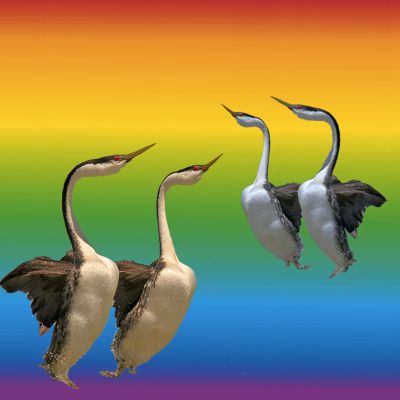
“Puzzle solved, maybe.  Now what you said about a three-messenger signal?”grebe messenger pairs“Gravitational waves are relativity effects and neutrinos are quantum mechanical.  Physicists have been struggling for a century to bridge those two domains.  Evidence from a three-messenger event could provide the final clues.”

“I’ll bet the geese enjoyed hearing all that.”

“They’re grebes, Mr Feder.”

~~ Rich Olcott

“Hot Jets, Captain Neutrino!”

“Hey, Cathleen, while we’re talking IceCube, could you ‘splain one other thing from that TV program?”

“Depends on the program, Al.”

“Oh, yeah, you weren’t here when we started on this.  So I was watching this program and they were talking about neutrinos and how there’s trillions of them going through like my thumbnail every second and then IceCube saw this one neutrino that they’re real excited about so what I’m wondering is, what’s so special about just that neutrino? How do they even tell it apart from all the others?”

“How about the direction it came from, Cathleen?  We get lotsa neutrinos from the Sun and this one shot in from somewhere else?”

SMBH jet and IceCube
Images from NASA and JPL-Caltech

“An interesting question, Vinnie.  The publicity did concern its direction, but the neutrino was already special.  It registered 290 tera-electron-volts.”

“Ter-what?”

“Sorry, scientific shorthand — tera is ten-to-the-twelfth.  A million electrons poised on a million-volt gap would constitute a Tera-eV of potential energy.  Our Big Guy had 290 times that much kinetic energy all by himself.”

“How’s that stack up against other neutrinos?”

“Depends on where they came from.  Neutrinos from a nuclear reactor’s uranium or plutonium fission carry only about 10 Mega-eV, wimpier by a factor of 30 million.  The Sun’s primary fusion process generates neutrinos peaking out at 0.4 MeV, 25 times weaker still.”

“How about from super-accelerators like the LHC?”

“Mmm, the LHC makes TeV-range protons but it’s not designed for neutrino production.  We’ve got others that have been pressed into service as neutrino-beamers. It’s a complicated process — you send protons crashing into a target.  It spews a splatter of pions and K-ons.  Those guys decay to produce neutrinos that mostly go in the direction you want.  You lose a lot of energy.  Last I looked the zippiest neutrinos we’ve gotten from accelerators are still a thousand times weaker than the Big Guy.”

I can see the question in Vinnie’s eyes so I fire up Old Reliable again.  Here it comes… “What’s the most eV’s it can possibly be?”  Good ol’ Vinnie, always goes for the extremes.

“You remember the equation for kinetic energy?”

“Sure, it’s E=½ m·v², learned that in high school.”

“And it stayed with you.  OK, and what’s the highest possible speed?”

“Speed o’ light, 186,000 miles per second.”

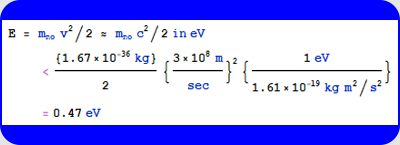
“Or 300 million meters per second, ’cause that’s Old Reliable’s default setting.  Suppose we’ve got a neutrino that’s going a gnat’s whisker slower than light.  Let’s apply that formula to the neutrino’s rest mass which is something less than 1.67×10-36 kilograms…”Speedy neutrino simple calculation“Half an eV?  That’s all?  So how come the Big Guy’s got gazillions of eV’s?”

“But the Big Guy’s not resting.  It’s going near lightspeed so we need to apply that relativistic correction to its mass…Speedy neutrino relativistic calculation“That infinity sign at the bottom means ‘as big as you want.’  So to answer your first question, there isn’t a maximum neutrino energy.  To make a more energetic neutrino, just goose it to go even closer to the speed of light.”
“Musta been one huge accelerator that spewed the Big Guy.”

“One of the biggest, Al.”  Cathleen again.  “That’s the exciting thing about what direction the particle came from.”

“Like the North Pole or something?”

“Much further away, much bigger and way more interesting.  As soon as IceCube caught that neutrino signal, it automatically sent out a “Look in THIS direction!” alert to conventional observatories all over the world.  And there it was — a blazar, 5.7 billion lightyears away!”

“Wait, Cathleen, what’s a blazar?”

“An incredibly brilliant but highly variable photon source, from radio frequencies all the way up to gamma rays and maybe cosmic rays.  We think the thousands we’ve catalogued are just a fraction of the ones within range.  We’re pretty sure that each of them depends on a super-massive black hole in the center of a galaxy.  The current theory is that those photons come from an astronomy-sized accelerator, a massive swirling jet that shoots out from the central source.  When the jet happens to point straight at us, flash-o!”

Duck!

“I wouldn’t worry about a neutrino flood.  The good news is IceCube’s signal alerted astronomers to check TXS 0506+056, a known blazar, early in a new flare cycle.”

“An astrophysical fire alarm!”

~~ Rich Olcott

Einstein’s Revenge

Vinnie’s always been a sucker for weird-mutant sci-fi films so what Jennie says gets him going.  “So you got these teeny-tiny neutrinos and they mutate?  What do they do, get huge and eat things?”

“Nothing that interesting, Vinnie — or uninteresting, depending on what you’re keen on.  No, what happens is that each flavor neutrino periodically switches to another flavor.”

“Like an electron becomes a muon or whatever?”

“Hardly.  The electron and muon and tau particles themselves don’t swap.  Their properties differ too much —  the muon’s 200 times heaver than the electron and the tau’s sixteen times more massive than that.  It’s their associated neutrinos that mutate, or rather, oscillate.  What’s really weird, though, is how they do that.”

“How’s that?”

“As I said, they cycle through the three flavors.  And they cycle through three different masses.”

“OK, that’s odd but how is it weird?”

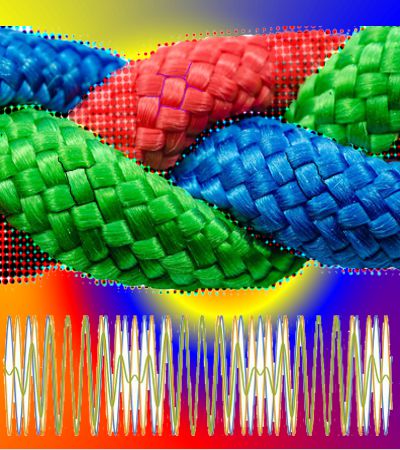
“Their flavor doesn’t change at the same time and place as their mass does.”Neutrino braid with sines

“Wait, what?”

“Each kind of neutrino, flavor-wise, is distinct — it reacts with a unique set of particles and yields different reaction products to what the other kinds do.  But experiments show that the mass of each kind of neutrino can vary from moment to moment.  At some point, the mass changes enough that suddenly the neutrino’s flavor oscillates.”

“That makes me think each mass could be a mix of three different flavors, too.”

“Capital, Vinnie!  That’s what the math shows.  It’s two different ways of looking at the same coin.”

“The masses oscillate, too?”

“Oh, indeed.  But no-one knows exactly what the mass values are nor even how the mass variation controls the flavors.  Or the other way to.  We know two of the masses are closer together than to the third but that’s about it.  On the experimental side there’s loads of physicists and research money devoted to different ways of measuring how neutrino oscillation rates depend on neutrino energy content.”

“And on the theory side?”

“Tons of theories, of course.  Whenever we don’t know much about something there’s always room for more theories.  The whole object of experiments like IceCube is to constrain the theories.  I’ve even got one I may present at Al’s Crazy Theory Night some time.”

“Oh, yeah?  Let’s hear it.”

“It’s early days, Al, so no flogging it about, mm?  Do you know about beat frequencies?”

“Yeah, the piano tuner ‘splained it to me.  You got two strings that make almost the same pitch, you get this wah-wah-wah effect called a beat.  You get rid of it when the strings match up exact.”  He grabs a few glasses from the counter and taps them with a spoon until he finds a pair that’s close.  “Like this.”

“Mm-hmm, and when the wah-wahs are close enough together they merge to become a note on their own.  You can just imagine how much more complicated it gets when there are three tones close together.”

I see where she’s going and bring up a display on Old Reliable —an overlay of three sine waves.   “Here you go, Jennie.  The red line is the average of the three regular waves.”Three sines on Old Reliable“Thanks, Sy.  Look, we’ve got three intervals where everything syncs up.  See the new satellite peaks half-way in between?  There’s more hidden pattern where things look chaotic in the rest of the space.”
“Yeah, so?”

“So, Vinnie, my crazy theory is that like a photon’s energy depends on its wave frequency in the electromagnetic field, a neutrino is a combination of three weak-field waves of slightly different frequency, one for each mass.  When they sync up one way you’ve got an electron neutrino, when they sync up a different way you’ve got a muon neutrino, and a third way for a tau neutrino.”

I’ve got to chuckle.  “Nothing against your theory, Jennie, though you’ve got some work ahead of you to flesh it out and test it.  I just can’t help thinking of Einstein and his debates with Bohr.  Bohr maintained that all we can know about the quantum realm are the averages we calculate.  Einstein held that there must be understandable mechanisms underlying the statistics.  Field-based theories like yours are just what Einstein ordered.”

“I could do worse.”Neutrino swirl around Einstein

~~ Rich Olcott

The Neapolitan Particle

“Welcome back, Jennie.  Why would anyone want to steer an ice cube?

“Thanks, Jeremy, it’s nice to be back..  And the subject’s not an ice cube, it’s IceCube, the big neutrino observatory in the Antarctic.”

“Then I’m with Al’s question.  Observatories have this big dome that rotates and inside there’s a lens or mirror or whatever that goes up and down to sight on the night’s target.  OK, the Hubble doesn’t have a dome and it uses gyros but even there you’ve got to point it.  How does IceCube point?”

“It doesn’t.  The targets point themselves.”

“Huh?”

“Ever relayed a Web-page?”

“Sure.”

“Guess what?  You don’t know where the page came from, you don’t know where it’s going to end up.  But it could carry a tracking bug to tell someone at some call-home server when and where the page had been opened.  IceCube works the same way, sort of.  It has a huge 3D array of detectors to record particles coming in from any direction.  A neutrino can come from above, below, any side, no problem — the detectors it touches will signal its path.”

IceCube architecture
Adapted from a work by Francis Halzen, Department of Physics, University of Wisconsin

“How huge?”

“Vastly huge.  The instrument is basically a cubic kilometer of ultra-clear Antarctic ice that’s ages old.  The equivalent of the tracking bugs is 5000 sensors in a honeycomb array more than a kilometer wide.  Every hexagon vertex marks a vertical string of sensors going down 2½ kilometers into the ice.  Each string has a couple of sensors near the surface but the rest of them are deeper than 1½ kilometers.  The sensors are looking for flashes of light.  Keep track of which sensor registered a flash when and you know the path a particle took through the array.”

icecube event 3“Why should there be flashes? I thought neutrinos didn’t interact with matter.”

“Make that, they rarely interact with matter.  Even that depends on what particle the neutrino encounters and what flavor neutrino it happens to be at the moment.”

That gets both Al and me interested.  His “Neutrinos come in flavors?” overlaps my “At the moment?”

“I thought that would get you into this, Sy.  Early experiments detected only 1/3 of the neutrinos we expected to come from the Sun.  Unwinding all that was worth four Nobel prizes and counting.  The upshot’s that there are three different neutrino flavors and they mutate.  The experiments caught only one.”

Vinnie’s standing behind us.  “You’re going to tell us the flavors, right?”

“Hoy, Vinnie, Jeremy’s question was first, and it bears on the others.  Jeremy, you know that blue glow you see around water-cooled nuclear fuel rods?”

“Yeah, looks spooky.  That’s neutrinos?”

“No, that’s mostly electrons, but it could be other charged particles.  It has to do with exceeding the speed of light in the medium.”

“Hey, me and Sy talked about that.  A lightwave makes local electrons wiggle, and how fast the wiggles move forward can be different from how fast the wave group moves.  Einstein’s speed-of-light thing was about the wave group’s speed, right, Sy?”

“That’s right, Vinnie.”

“So anyhow, Jeremy, a moving charged particle affects the local electromagnetic field.  If the particle moves faster than the surrounding atoms can adjust, that generates light, a conical electromagnetic wave with a continuous spectrum.  The light’s called Cherenkov radiation and it’s mostly in the ultra-violet, but enough leaks down to the visible range that we see it as blue.”

“But you said it takes a charged particle.  Neutrinos aren’t charged.  So how do the flashes happen in IceCube?”

“Suppose an incoming high-energy neutrino transfers some of its momentum to a charged particle in the ice — flash!  Even better, the flash pattern provides information for distinguishing between the neutrino flavors.  Muon neutrinos generate a more sharp-edged Cherenkov cone than electron neutrinos do.  Taus are so short-lived that IceCube doesn’t even see them.”Leptons

“I suppose muon and tau are flavors?”

“Indeed, Vinnie.  Any subatomic reaction that releases an electron also emits an electron-flavored neutrino.  If the reaction releases the electron’s heavier cousin, a muon, then you get a muon-flavored neutrino.  Taus are even heavier  and they’ve got their own associated neutrino.”

“And they mutate?”

“In a particularly weird way.”

~~ Rich Olcott