Perturbed? You’re not the only one

Dolls
Successive approximations
to a real girl, but still not there

It started with the Babylonians.  The Greeks abhorred the notion.  The Egyptians and Romans couldn’t have gotten along without it. Only 1600 years later did Newton gave final polishing to … The Method of Successive Approximations.

Stay with me, we’ll get to The Chicken soon.

Suppose for some weird reason you wanted to know the square root of 2701.  Any Babylonian could see immediately that 2701 is a bit less than 3600 = 602, so as a first approximation they’d guess ½(60 + (2701/60)) = 52.5.  They’d do the multiplication to check: 52.5×52.5 = 2756.25.

Well, 52.5 is closer than 60 but not close enough.  So they’d plug that number into the same formula to get the next successive approximation: ½(52.5 + 2701/52.5) = 51.97.  Check it: 51.97×51.97 = 2700.88.  That was probably good enough for government work in Babylonia, but if the boss wanted an even better estimate they could go around the loop again.

Scientists and engineers tackle a complex problem piecewise.  Start by looking for a simple problem you know how to solve. Adjust that solution little by little to account for the ways in which the real system differs from the simple case.  Successive Approximation is only one of many adjustment strategies invented over the centuries.

The most widely-used technique is called Perturbation Theory (which has nothing to do with the ways kids find to get on their parents’ nerves).  The strategy is to find some single parameter, maybe a ratio of two masses or the relative strength of a particle-particle interaction.  For a realistic solution, it’s important that the parameter’s value be small compared to other quantities in the problem.

Simplify the original problem by keeping that parameter in the equations but assume that it’s zero.  When you’ve found a solution to that problem, you “perturb” the solution — you see what happens to the model when you allow the parameter to be non-zero.

There’s an old story, famous among physicists and engineers, about an association of farmers who wanted to design an optimum chicken-raising operation.  Maybe with an optimal chicken house they could heat the place with the birds’ own body heat, things like that.  They called in an engineering consultant.  He looked around some running farms, took lots of measurements, and went away to compute.  A couple of weeks later he came back, with slides.  (I told you it’s an old story.)  He started to walk the group though his logic, but he lost them when he opened his pitch with, “Assume a spherical chicken…”

Fat chick bank
Henrietta
Fat Chicken Bank by Becky Zee

Now, he may actually have been on the right track.  It’s a known fact that many biological processes (digestion, metabolism, drug dosage, etc.) depend on an organism’s surface area.  A chicken’s surface area could be key to calculating her heat production.  But chickens (for example, our charming Henrietta) have a complicated shape with a poorly-defined surface area.  The engineer’s approximation strategy must have been to estimate each bird as a sphere with a tweakable perturbation parameter reflecting how spherical they aren’t.

Then, of course, he’d have to apply a second adjustment for feathers, but I digress.

Now here’s the thing.  In quantum mechanics there’s only a half-dozen generic systems with exact solutions qualifying them to be “simple” Perturbation Theory starters.  Johnny’s beloved Particle In A Box (coming next week) is one of them.  The others all depend in similar logic — the particle (there’s always only one of them) is confined to a region which contains places where the particle’s not allowed to be. (There’s one exception: the Free Particle has no boundaries and therefore is evenly smeared across the Universe.)

Virtually all other quantum-based results — multi-electron atoms, molecular structures, Feynman diagrams for sub-atomic physics, string theories, whatever — depend on Perturbation Theory.  (The exceptions are topology and group-theory techniques that generally attempt to produce qualitative rather quantitative predictions.)  They need those tweakable parameters.

In quantum-chemical calculations the perturbation parameters are generally reasonably small or at least controllable.  That’s not true for many of the other areas.  This issue is especially problematic for string theory.  In many of its proposed problem solutions no-one knows whether a first-, second- or higher-level approximation even exists, much less whether it would produce reasonable predictions.

I find that perturbing.

~~ Rich Olcott

How rockets don’t work

WoodyI was only 10 years old but already had Space Fever thanks to Chesley Bonestell’s artwork in Collier’s and Life magazines.  I eagerly joined the the movie theater ticket line to see George Pal’s Destination Moon.  I loved the Woody Woodpecker cartoon (it’s 12 minutes into the YouTube video) that explained rockets to a public just getting used to jet planes.  But the explanation’s wrong.

Go ahead, follow the link and watch the cartoon.  I’ll wait here.

Pretty far-sighted for 1950, eh?  And it’s amazing how much they got right, including how the driving force for the Space Race was international politics.  But oh, the physics…

Yeah, they tacitly acknowledged Newton’s Third Law: For every action there is an equal and opposite reaction.  The cartoon implies that the action is the pellets coming out of the barrel and the reaction is Woody getting knocked back.  But that can’t be right: if it were true you wouldn’t get any kick when you fire a blank cartridge — but you do.  Let’s take a close look at just what actions are in play.

Maybe it’s the pellets plus the gases behind it pushing forward and the gun pushing backward?  Sort of, but where do the gases come from?  Right, the exploding charge next to your cheek in the receiver.  Those gases move equally in all directions.  Some of them push pellets down the barrel.  Some of them push on the back end of the receiver which pushes the gun stock which mashes your shoulder.  But there’s bunches of molecules that uselessly collide with the receiver’s walls.

Action and reaction balance out just fine but only when you consider the gases moving outward from the center of the BANG.  For instance, if left and right didn’t balance perfectly the piece would crash into your ear or swing around and flatten your nose or the back of your head.

Both shotguns and conventional rockets get their propulsive energy from chemical combustion.  The reason gun parts have to be strong is all those hot molecules dashing in every direction other than down and up the barrel.  A chemical rocket casing has to be strong for the same reason.

Chemical combustion is just not an efficient use of propellant mass.  Just look at this NASA image of a SpaceX Falcon 9 during a DSCOVR launch — huge side-flare from molecules that make no contribution to forward thrust:DSCOVR launch
Wouldn’t it be nice if we had a way to put all our propulsion energy into moving the vehicle forward?

There’s good news and not-so-good news.  People are working on a few other options, all of which depend on forces we know how to steer: electric and magnetic.  Unfortunately, each of them has drawbacks.

Unlike rockets, ion thrusters use an electric or magnetic field to accelerate ions (duh!) away from the vehicle.  It’s a much more efficient process because there’s little off-axis action/reaction — all the propellant heads out the nozzle (action) and all the push-back force (reaction) acts directly on the vehicle.

But… ions resist being crowded together so you can’t blast huge quantities out the nozzle like you’d need to for a launch from Earth.  Up in space, though, ion thrusters are perfect for satellite attitude adjustment and similar low-power tasks.  The Dawn mission to Vesta and Ceres used an ion thruster to boost the spacecraft continuously from Earth to target.  It’d be impractical to build a chemical-powered system to do that.

Rather than send out atoms one by one, a rail-gun drive could use high-power magnetic fields to accelerate lumps of iron down a track and away.  Iron goes one way, vessel goes the other.  Might work in the Asteroid Belt where lumps of iron are there by the billions, but on the other hand I’d rather not be a Belter tooling along in my mining tug only to be hit amidships by someone’s cast-off reaction mass.

And then there’s the Q-thruster and EmDrive.  I hope to eventually include enough physics background in this blog that we can discuss the controversies and prospects for new-physics drives based on space warps and such.  You can check out Dr Harold White’s video for some of that.  It’d be sooo cool if they work.

~~ Rich Olcott

Another slice of π, wrapped up in a Black Hole crust

Last week a museum visitor wondered, “What’s the volume of a black hole?”  A question easier asked than answered.

Let’s look at black hole (“BH”) anatomy.  If you’ve seen Interstellar, you saw those wonderful images of “Gargantua,” the enormous BH that plays an essential role in the plot.  (If you haven’t seen the movie, do that.  It is so cool.)

A BH isn’t just a blank spot in the Universe, it’s attractively ornamented by the effects of its gravity on the light passing by:

Gargantua 2c
Gargantua,
adapted from Dr Kip Thorne’s book, The Science of “Interstellar”

Working from the outside inward, the first decoration is a background starfield warped as though the stars beyond had moved over so they could see us past Gargantua.  That’s because of gravitational lensing, the phenomenon first observed by Sir Arthur Eddington and the initial confirmation of Einstein’s Theory of General Relativity.

No star moved, of course.  Each warped star’s light comes to us from an altered angle, its lightwaves bent on passing through the spatial compression Gargantua imposes on its neighborhood.  (“Miles are shorter near a BH” — see Gravitational Waves Are Something Else for a diagrammatic explanation.)

Moving inward we come to the Accretion Disc, a ring of doomed particles destined to fall inward forever unless they’re jostled to smithereens or spat out along one of the BH’s two polar jets (not shown).  The Disc is hot, thanks to all the jostling.  Like any hot object it emits light.

Above and below the Disc we see two arcs that are actually images of the Accretion Disc, sent our way by more gravitational lensing.  Very close to a BH there’s a region where passing light beams are bent so much that their photons go into orbit.  The disc’s a bit further out than that so its lightwaves are only bent 90o over (arc A) and under (arc B) before they come to us.

By the way, those arcs don’t only face in our direction.  Fly 360o around Gargantua’s equator and those arcs will follow you all the way.  It’s as though the BH were embedded in a sphere of lensed Disclight.

Which gets us to the next layer of weirdness.  Astrophysicists believe that most BHs rotate, though maybe not as fast as Gargantua’s edge-of-instability rate.  Einstein’s GR equations predict a phenomenon called frame dragging — rapidly spinning massive objects must tug local space along for the ride.  The deformed region is a shell called the Ergosphere.

Frame dragging is why the two arcs are asymmetrical and don’t match up.  We see space as even more compressed on the right-hand side where Gargantua is spinning away from us.  Because the effect is strongest at the equator, the shell should really be called the Ergospheroid, but what can you do?

Inside the Ergosphere we find the defining characteristic of a BH, its Event Horizon, the innermost bright ring around the central blackness in the diagram.  Barely outside the EH there may or may not be a Firewall, a “seething maelstrom of particles” that some physicists suggest must exist to neutralize the BH Information Paradox.  Last I heard, theoreticians are still fighting that battle.

The EH forms a nearly spherical boundary where gravity becomes so intense that the escape velocity exceeds the speed of light.  No light or matter or information can break out.  At the EH, the geometry of spacetime becomes so twisted that the direction of time is In.  Inside the EH and outside of the movies it’s impossible for us to know what goes on.

Finally, the mathematical models say that at the center of the EH there’s a point, the Singularity, where spacetime’s curvature and gravity’s strength must be Infinite.  As we’ve seen elsewhere, Infinity in a calculation is Nature’s was of saying, “You’ve got it wrong, make a better model.”

So we’re finally down to the volume question.  We could simply measure the EH’s external diameter d and plug that into V=(πd3)/6.  Unfortunately, that forthright approach misses all the spatial twisting and compression — it’s a long way in to the Singularity.  Include those effects and you’ve probably got another Infinity.

Gargantua’s surface area is finite, but its volume may not be.

~~ Rich Olcott

Michelson, Morley and LIGO

Two teams of scientists, 128 years apart.  The first team, two men, got a negative result that shattered a long-standing theory.  The second team, a thousand strong, got a positive result that provided final confirmation of another long-standing theory.  Both teams used instruments based on the same physical phenomenon.  Each team’s innovations created whole new fields of science and technology.

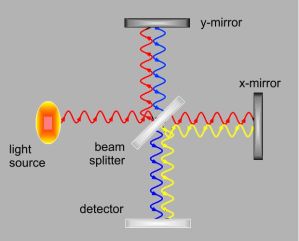
Interferometer 1Their common experimental strategy sounds simple enough — compare two beams of light that had traveled along different paths

Light (preferably nice pure laser light, but Albert Michelson didn’t have a laser when he invented interferometry in 1887) comes in from the source at left and strikes the “beam splitter” — typically, a partially-silvered mirror that reflects half the light and lets the rest through.  One beam goes up the y-arm to a mirror that reflects it back down through the half-silvered mirror to the detector.  The other beam goes on its own round-trip journey in the x-direction.  The detector (Michelson’s eye or a photocell or a fancy-dancy research-quality CCD) registers activity if the waves in the two beams are in step when they hit it.  On the other hand, if the waves cancel then there’s only darkness.

Getting the two waves in step requires careful adjustment of the x- and y-mirrors, because the waves are small.  The yellow sodium light Michelson used has a peak-to-peak wavelength of 589 nanometers.  If he twitched one mirror 0.0003 millimeter away from optimal position the valleys of one wave would cancel the peaks of the other.

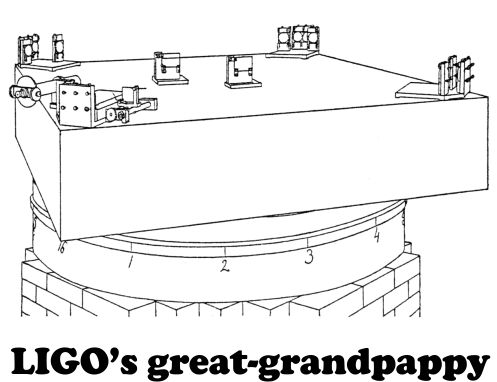
So much for principles.  The specifics of each team’s device relate to the theory being tested.  Michelson was confronting the æther theory, the proposition that if light is a wave then there must be some substance, the æther, that vibrates to carry the wave.  We see sunlight and starlight, so  the æther must pervade the transparent Universe.  The Earth must be plowing through the æther as it circles the Sun.  Furthermore, we must move either with or across or against the æther as we and the Earth rotate about its axis.  If we’re moving against the æther then lightwave peaks must appear closer together (shorter wavelengths) than if we’re moving with it.Michelson-Moreley device

Michelson designed his device to test that chain of logic. His optical apparatus was all firmly bolted to a 4′-square block of stone resting on a wooden ring floating on a pool of mercury.  The whole thing could be put into slow rotation to enable comparison of the x– and y-arms at each point of the compass.

Interferometer 3
Suppose the æther theory is correct. Michelson should see lightwaves cancel at some orientations.

According to the æther theory, Michelson and his co-worker Edward Morley should have seen alternating light and dark as he rotated his device.  But that’s not what happened.  Instead, he saw no significant variation in the optical behavior around the full 360o rotation, whether at noon or at 6:00 PM.

Cross off the æther theory.

Michelson’s strategy depended on light waves getting out of step if something happened to the beams as they traveled through the apparatus.  Alternatively, the beams could charge along just fine but something could happen to the apparatus itself.  That’s how the LIGO team rolled.

Interferometer 2
Suppose Einstein’s GR theory is correct. Gravitational wave stretching and compression should change the relative lengths of the two arms.

Einstein’s theory of General Relativity predicts that space itself is squeezed and stretched by mass.  Miles get shorter near a black hole.  Furthermore, if the mass configuration changes, waves of compressive and expansive forces will travel outward at the speed of light.  If such a wave were to encounter a suitable interferometer in the right orientation (near-parallel to one arm, near-perpendicular to the other), that would alter the phase relationship between the two beams.

The trick was in the word “suitable.”  The expected percentage-wise length change was so small that eLIGO needed 4-kilometer arms to see movement a tiny fraction of a proton’s width.  Furthermore, the LIGO designers flipped the classical detection logic.  Instead of looking for a darkened beam, they set the beams to cancel at the detector and looked for even a trace of light.

eLIGO saw the light, and confirmed Einstein’s theory.

~~ Rich Olcott

Gravitational Waves Are Something Else

gravitational-gif.0

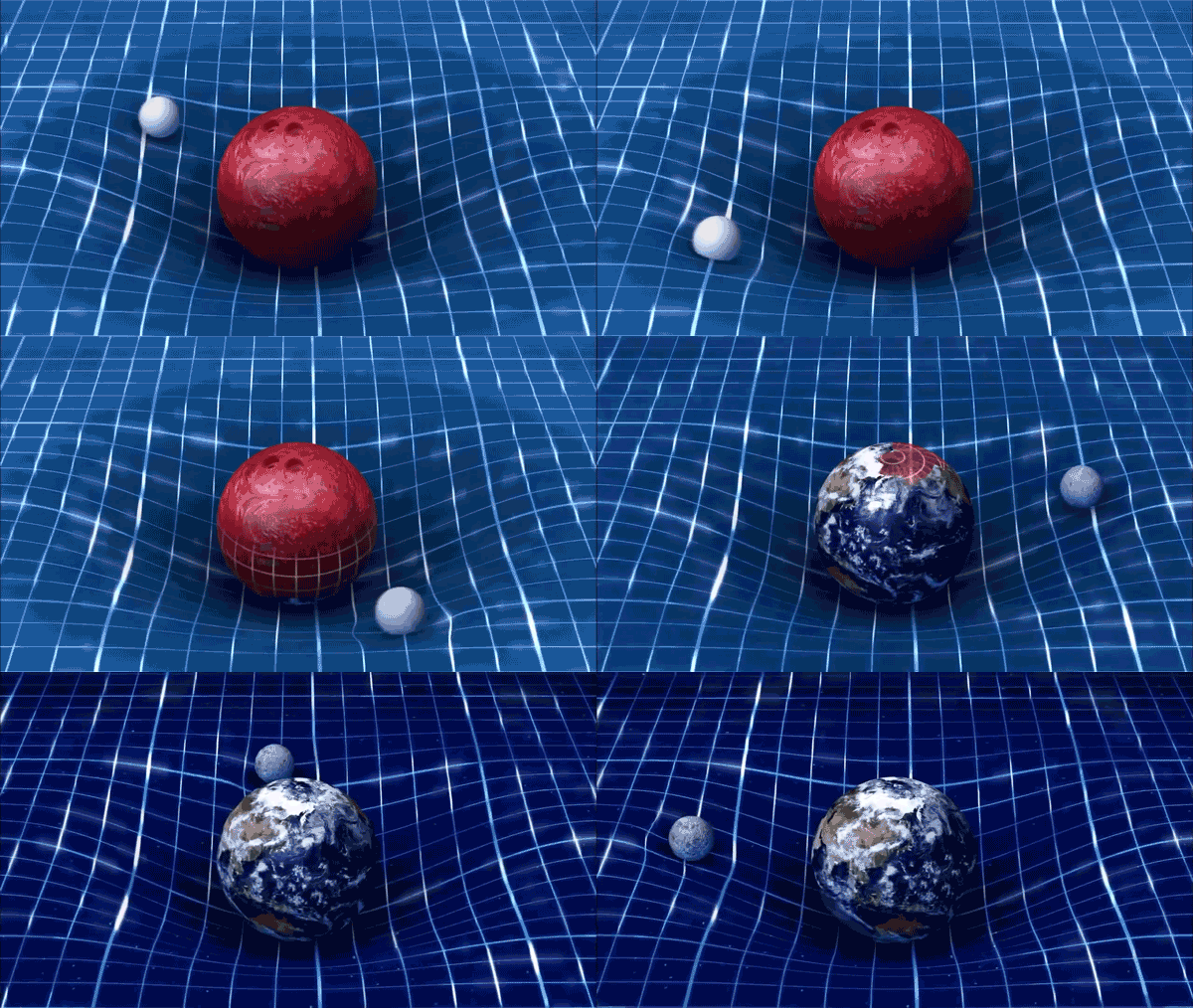
If you’re reading this post, you’ve undoubtedly seen at least one diagram like the above — a black hole or a planet or a bowling ball makes a dent in a rubber sheet and that’s supposed to explain Gravity.  But it doesn’t, and neither does this spirally screen-grab from Brian Greene’s presentation on Stephen Colbert’s Late Show:rubber-sheet waves_post

<Blush> I have to admit that the graphic I used a couple of weeks ago is just as bad.

Gravitational waves don’t make things go up and down like ocean waves, and they’re definitely not like that planet on a trampoline — after all, there’s nothing “below” to pull things downward so there can’t be a dent.  And gravitational waves don’t do spirals, much.

soundwaveOf all the wave varieties we’re familiar with, gravitational waves are most similar to (NOT identical with!!) sound waves.  A sound wave consists of cycles of compression and expansion like you see in this graphic.  Those dots could be particles in a gas (classic “sound waves”) or in a liquid (sonar) or neighboring atoms in a solid (a xylophone or marimba).

Contrary to rumor, there can be sound in space, sort of.  Any sizable volume of “empty” space contains at least a few atoms and dust particles.  A nova or similar sudden event can sweep particles together and give rise to successive waves that spread as those local collections bang into particles further away.  That kind of activity is invoked in some theories of spiral galaxy structure and the fine details of Saturn’s rings.

In a gravitational wave, space itself is compressed and stretched.  A particle caught in a gravitational wave doesn’t get pushed back and forth.  Instead, it shrinks and expands in place.  If you encounter a gravitational wave, you and all your calibrated measurement gear (yardsticks, digital rangers, that slide rule you’re so proud of) shrink and expand together.  You’d only notice the experience if you happened to be comparing two extremely precise laser rangers set perpendicular to each other (LIGO!).  One would briefly register a slight change compared to the other one.

Light always travels at 186,000 miles per second but in a compressed region of space those miles are shorter.  bent lightEinstein noticed that implication of his Theory of General Relativity and in 1916 predicted that the path of starlight would be bent when it passed close to a heavy object like the Sun.  The graphic shows a wave front passing through a static gravitational structure.  Two points on the front each progress at one graph-paper increment per step.  But the increments don’t match so the front as a whole changes direction.  Sure enough, three years after Einstein’s prediction, Eddington observed just that effect while watching a total solar eclipse in the South Atlantic.

Unlike the Sun’s steady field, a gravitational wave is dynamic. Gravitational waves are generated by changes in a mass configuration.  The wave’s compression and stretching forces spread out through space.

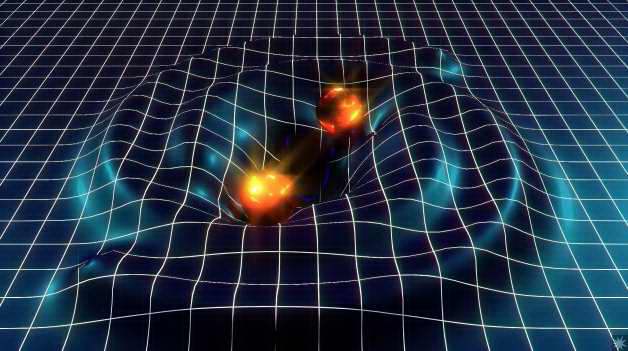
Here’s a simulation of the gravitational forces generated by two black holes orbiting into a collision.  The contours show the net force felt at each point in the region around the pair.
2 black holesWe’re being dynamic here, so the simulation has to include the fact that changes in the mass configuration aren’t felt everywhere instantaneously.  Einstein showed that space transmits gravitational waves at the speed of light, so I used a scaled “speed of light” in the calculation.  You can see how each of the new features expands outward at a steady rate.
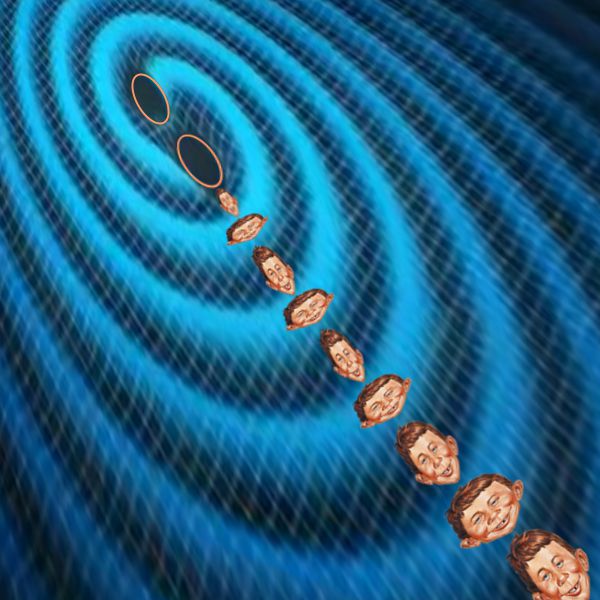
Even near the violent end, the massive objects move much more slowly than light speed.  The variation in their nearby field quickly smooths out to an oval and then a circle about the central point, which is why the calculated gravity field generates no spiral like the ones in the pretty pictures.

Oh, and those “gravity well” pictures?  They’re not showing gravitational fields, they’re really gravitational potential energy diagrams, showing how hard it’d be to get away from somewhere.  In the top video, for example, the satellite orbits the planet because it doesn’t have enough kinetic energy to get out of the well.  The more massive the attractor, the tighter it curves space around itself and the deeper the well.

~~ Rich Olcott

LIGO: Gravity Waves Ain’t Gravitational Waves

Sometimes the media get sloppy.  OK, a lot of times, especially when the reporters don’t know what they’re writing about.  Despite many headlines that “LIGO detected gravity waves,” that’s just not so.  In fact, the LIGO team went to a great deal of trouble to ensure that gravity waves didn’t muck up their search for gravitational waves.

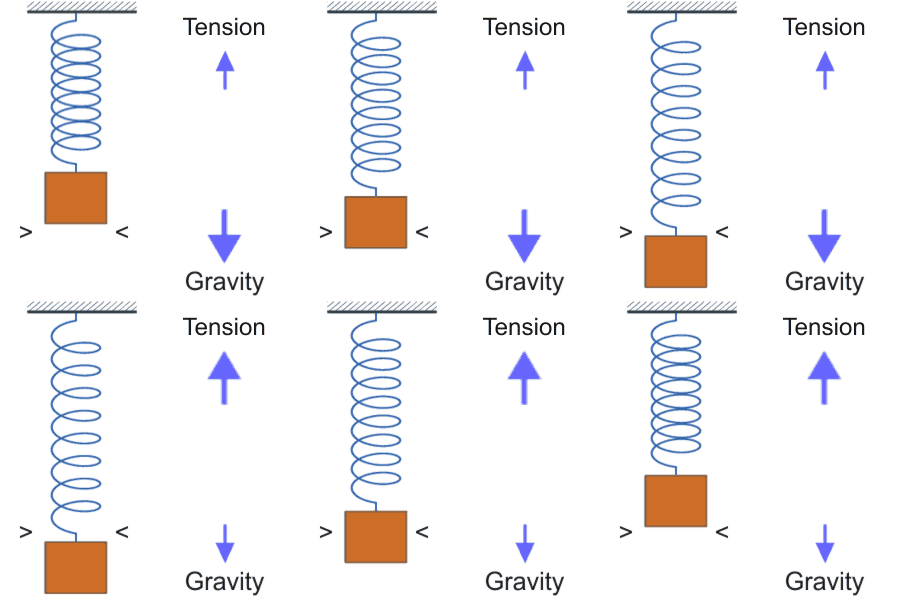
Spring2A wave happens in a system when a driving force and a restoring force take turns overshooting an equilibrium point AND the away-from-equilibrium-ness gets communicated around the system.  The system could be a bunch of springs tied together in a squeaky old bedframe, or labor and capital in an economic system, or the network of water molecules forming the ocean surface, or the fibers in the fabric of space (whatever those turn out to be).

If you  were to build a mathematical model of some wavery system you’d have to include those two forces plus quantitative descriptions of the thingies that do the moving and communicating.  If you don’t add anything else, the model will predict motion that cycles forever.  In reality, of course, there’s always something else that lets the system relax into equilibrium.

The something else could be a third force, maybe someone sitting on the bed, or government regulation in an economy, or reactant depletion for a chemical process.  But usually it’s friction of one sort or another — friction drains away energy of motion and converts it to heat.  Inside a spring, for instance, adjacent crystallites of metal rub against each other.  There appears to be very little friction in space — we can see starlight waves that have traveled for billions of years.

Physicists pay attention to waves because there are some general properties that apply to all of them.  For instance, in 1743 Jean-Baptiste le Rond d’Alembert proved there’s a strict relationship between a wave’s peakiness and its time behavior.  Furthermore, Jean-Baptiste Joseph Fourier (pre-Revolutionary France must have been hip-deep in physicist-mathematicians) showed that a wide variety of more-or-less periodic phenomena could be modeled as the sum of waves of differing frequency and amplitude.

Monsieur Fourier’s insight has had an immeasurable impact on our daily lives.  You can thank him any time you hear the word “frequency.”  From broadcast radio and digitally recorded music to time-series-based business forecasting to the mode-locked lasers in a LIGO device — none would exist without Fourier’s reasoning.

Gravity waves happen when a fluid is disturbed and the restoring force is gravity.  We’re talking physicist fluid here, which could be sea water or the atmosphere or solar plasma, anything where the constituent particles aren’t locked in place. Winds or mountain slopes or nuclear explosions push the fluid upwards, gravity pulls it back, and things wobble until friction dissipates that energy.

Gravitational waves are wobbles in gravity itself, or rather, wobbles in the shape of space.  According to General Relativity, mass exerts a tension-like force that squeezes together the spacetime immediately around it.  The more mass, the greater the tension.

Binary BH with AENAn isolated black hole is surrounded by an intense gravitational field and a corresponding compression of spacetime.  A pair of black holes orbiting each other sends out an alternating series of tensions, first high, then extremely high, then high…

Along any given direction from the pair you’d feel a pulsing gravitational field that varied above and below the average force attracting you to the pair.  From a distance and looking down at the orbital plane, if you could see the shape of space you’d see it was distorted by four interlocking spirals of high and low compression, all steadily expanding at the speed of light.

The LIGO team was very aware that the signal of a gravitational wave could be covered up by interfering signals from gravity waves — ocean tides, Earth tides, atmospheric disturbances, janitorial footsteps, you name it.  The design team arrayed each LIGO site with hundreds of “seismometers, accelerometers, microphones, magnetometers, radio receivers, power monitors and a cosmic ray detector.”  As the team processed the LIGO trace they accounted for artifacts that could have come from those sources.

So no, the LIGO team didn’t discover gravity waves, we’ve known about them for a century.  But they did detect the really interesting other kind.

~~ Rich Olcott

Would the CIA want a LIGO?

So I was telling a friend about the LIGO announcement, going on about how this new “device” will lead to a whole new kind of astronomy.  He suddenly got a far-away look in his eyes and said, “I wonder how many of these the CIA has.”

The CIA has a forest of antennas, but none of them can do what LIGO does.  That’s because of the physics of how it works, and what it can and cannot detect.  (If you’re new to this topic, please read last week’s post so you’ll be up to speed on what follows.  Oh, and then come back here.)

There are remarkable parallels between electromagnetism and gravity.  The ancients knew about electrostatics — amber rubbed by a piece of cat fur will attract shreds of dry grass.  They certainly knew about gravity, too.  But it wasn’t until 100 years after Newton wrote his Principia that Priestly and then Coulomb found that the electrostatic force law, F = ke·q1·q2 / r2, has the same form as Newton’s Law of Gravity, F = G·m1·m2 / r2. (F is the force between two bodies whose centers are distance r apart, the q‘s are their charges and the m‘s are their masses.)

Jim and AlAlmost a century later, James Clerk Maxwell (the bearded fellow at left) wrote down his electromagnetism equations that explain how light works.  Half a century later, Einstein did the same for gravity.

But interesting as the parallels may be, there are some fundamental differences between the two forces — fundamental enough that not even Einstein was able to tie the two together.

One difference is in their magnitudes.  Consider, for instance, two protons.  Running the numbers, I found that the gravitational force pulling them together is a factor of 1036 smaller than the electrostatic force pushing them apart.  If a physicist wanted to add up all the forces affecting a particular proton, he’d have to get everything else (nuclear strong force, nuclear weak force, electromagnetic, etc.) nailed down to better than one part in 1036 before he could even detect gravity.

But it’s worse — electromagnetism and gravity don’t even have the same shape.

Electromagneticwave3D
Electric (red) and magnetic (blue) fields in a linearly polarized light wave
(graphic from WikiMedia Commons, posted by Lookang and Fu-Kwun Hwang)

A word first about words.  Electrostatics is about pure straight-line-between-centers (longitudinal) attraction and repulsion — that’s Coulomb’s Law.  Electrodynamics is about the cross-wise (transverse) forces exerted by one moving charged particle on the motion of another one.  Those forces are summarized by combining Maxwell’s Equations with the Lorenz Force Law.  A moving charge gives rise to two distinct forces, electric and magnetic, that operate at right angles to each other.  The combined effect is called electromagnetism.

The effect of the electric force is to vibrate a charge along one direction transverse to the wave.  The magnetic force only affects moving charges; it acts to twist their transverse motion to be perpendicular to the wave.  An EM antenna system works by sensing charge flow as electrons move back and forth under the influence of the electric field.

Gravitostatics uses Newton’s Law to calculate longitudinal gravitational interaction between masses.  That works despite gravity’s relative weakness because all the astronomical bodies we know of appear to be electrically neutral — no electrostatic forces get in the way.  A gravimeter senses the strength of the local gravitostatic field.

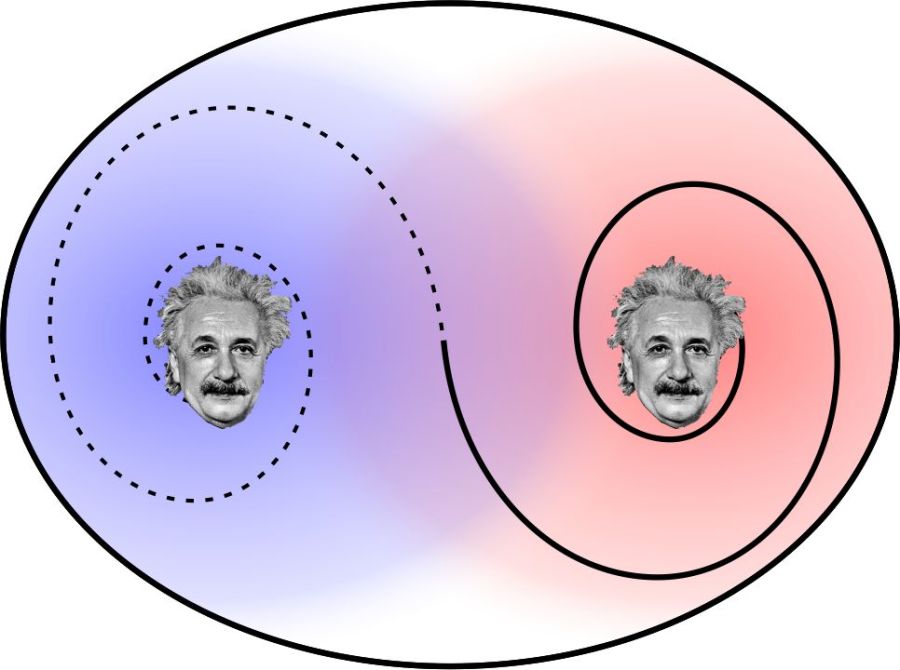
Maxwell and EinsteinGravitodynamics is completely unlike electrodynamics.  Gravity’s transverse “force” doesn’t act to move a whole mass up and down like Maxwell’s picture at left.  Instead, as shown by Einstein’s picture, gravitational waves stretch and compress while leaving the center of mass in place. I put “force” in quotes because what’s being stretched and compressed is space itself.  See this video for a helpful visualization of a gravitational wave.

LIGO is neither a telescope nor an electromagnetic antenna.  It operates by detecting sudden drastic changes in the disposition of matter within a “small” region.  In LIGO’s Sept 14 observation, 1031 kilograms of black hole suddenly ceased to exist, converted to gravitational waves that spread throughout the Universe.  By comparison, the Hiroshima explosion released the energy of 10-6 kilograms.

Seismometers do a fine job of detecting nuclear explosions.  Hey, CIA, they’re a lot cheaper than LIGO.

~~ Rich Olcott

LIGO, a new kind of astronomy

Like thousands of physics geeks around the world, I was glued to the tube Thursday morning for the big LIGO (Laser Interferometer Gravitational-Wave Observatory) announcement.  As I watched the for-the-public videos (this is a good one), I was puzzled by one aspect of the LIGO setup.  The de-puzzling explanation spotlit just how different gravitational astronomy will be from what we’re used to.

There are two LIGO installations, 2500 miles apart, one near New Orleans and the other near Seattle.  Each one looks like a big L with steel-pipe arms 4 kilometers long.  By the way, both arms are evacuated to eliminate some sources of interference and a modest theoretical consideration.

LIGO3The experiment consists of shooting laser beams out along both arms, then comparing the returned beams.

Some background: Einstein conquered an apparent relativity paradox.  If Ethel on vehicle A is speeding (like, just shy of light-speed speeding) past Fred on vehicle B, Fred sees that Ethel’s yardstick appears to be shorter than his own yardstick.  Meanwhile, Ethel is quite sure that Fred’s yardstick is the shorter one.

Einstein explained that both observations are valid.  Fred and Ethel can agree with each other but only after each takes proper account of their relative motion.  “Proper account” is a calculation called the Lorenz transformation.   What Fred (for instance) should do is divide what he thinks is the length of Ethel’s yardstick by √[1-(v/c)²] to get her “proper” length.  (Her relative velocity is v, and c is the speed of light.)

Suppose Fred’s standing in the lab and Ethel’s riding a laser beam.  Here’s the puzzle: wouldn’t the same Fred/Ethel logic apply to LIGO?  Wouldn’t the same yardstick distortion affect both the interferometer apparatus and the laser beams?

Well, no, for two reasons.  First, the Lorenz effect doesn’t even apply, because the back-and-forth reflected laser beams are standing waves.  That means nothing is actually traveling.  Put another way, if Ethel rode that light wave she’d be standing as still as Fred.

The other reason is that the experiment is less about distance traveled and more about time of flight.

Suppose you’re one of a pair of photons (no, entanglement doesn’t enter into the game) that simultaneously traverse the interferometer’s beam-splitter mirror.  Your buddy goes down one arm, strikes the far-end mirror and comes back to the detector.  You take the same trip, but use the other arm.

The beam lengths are carefully adjusted so that under normal circumstances, when the two of you reach the detector you’re out of step.   You peak when your buddy troughs and vice-versa.  The waves cancel and the detector sees no light.

Now a gravitational wave passes by (red arcs in the diagram).  In general, the wave will affect the two arms differently.  In the optimal case, the wave front hits one arm broadside but cuts across the perpendicular one.  Suppose the wave is in a space-compression phase when it hits.  The broadside arm, beam AND apparatus, is shortened relative to the other one which barely sees the wave at all.

The local speed of light (miles per second) in a vacuum is constant.  Where space is compressed, the miles per second don’t change but the miles get smaller.  The light wave slows down relative to the uncompressed laboratory reference frame.  As a result, your buddy in the compressed arm takes just a leetle longer than you do to complete his trip to the detector.  Now the two of you are in-step.  The detector sees light, there is great rejoicing and Kip Thorne gets his Nobel Prize.

But the other wonderful thing is, LIGO and neutrino astronomy are humanity’s first fundamentally new ways to investigate our off-planet Universe.  Ever since Galileo trained his crude telescope on Jupiter the astronomers have been using electromagnetic radiation for that purpose – first visible light, then infra-red and radio waves.  In 1964 we added microwave astronomy to the list.  Later on we put up satellites that gave us the UV and gamma-ray skies.

The astronomers have been incredibly ingenious in wringing information out of every photon, but when you look back it’s all photons.  Gravitational astronomy offers a whole new path to new phenomena.  Who knows what we’ll see.

~~ Rich Olcott

Smoke and a mirror

Etna jellyfish pairGrammie always grimaced when Grampie lit up one of his cigars inside the house.  We kids grinned though because he’d soon be blowing smoke rings for us.  Great fun to try poking a finger into the center, but we quickly learned that the ring itself vanished if we touched it.

My grandfather can’t take credit for the smoke ring on the left — it was “blown” by Mt Etna.  Looks very like the jellyfish on the right, doesn’t it?  When I see two such similar structures, I always wonder if the resemblance comes from the same physics phenomenon.

This one does — the physics area is Fluid Dynamics, and the phenomenon is a vortex ring. We need to get a little technical and abstract here: to a physicist a fluid is anything that’s composed of particles that don’t have a fixed spatial relationship to each other. Liquid water is a fluid, of course (its molecules can slide past each other) and so is air.  The sun’s ionized protons and electrons comprise a fluid, and so can a mob of people and so can vehicle traffic (if it’s moving at all).  You can use Fluid Dynamics to analyze motion when the individual particles are numerous and small relative to the volume in question.

Ring x-section
Adapted from a NOAA page

You get a vortex whenever you have two distinct fluids in contact but moving at sufficiently different velocities.  (Remember that “velocity” includes both speed and direction.)  When Grampie let out that little puff of air (with some smoke in it), his fast-moving breath collided with the still air around him.  When the still air didn’t get out of the way, his breath curled back toward him.  The smoke collected in the dark gray areas in this diagram.

That curl is the essence of vorticity and turbulence.  The general underlying rule is “faster curls toward slower,” just like that skater video in my previous post.  Suppose fluid is flowing through a pipe.  Layers next to the outside surface move slowly whereas the bulk material near the center moves quickly.  If the bulk is going fast enough, the speed difference will generate many little whorls against the circumference, converting pump energy to turbulence and heat.  The plant operator might complain about “back pressure” because the fluid isn’t flowing as rapidly as expected from the applied pressure.

But Grampie didn’t puff into a pipe (he’s a cigar man, right?), he puffed into the open air.  Those curls weren’t just at the top and bottom of his breath, they formed a complete circle all around his mouth.  If his puff didn’t come out perfectly straight, the smoke had a twist to it and circulated along that circle, the way Etna’s ring seems to be doing (note the words In and Out buried in the diagram’s gray blobs).  When a vortex closes its loop like that, you’ve got a vortex ring.

A vortex ring is a peculiar beast because it seems to have a life of its own, independent of the surrounding medium.  Grampie’s little puff of vortical air usually retained its integrity and carried its smoke particles for several feet before energy loss or little fingers broke up the circulation.

To show just how special vortex rings are, consider the jellyfish.  Until I ran across this article, I’d thought that jellyfish used jet propulsion like octopuses and squids do — squirt water out one way to move the other way.  Not the case.  Jellyfish do something much more sophisticated, something that makes them possibly “the most energy-efficient animals in the world.”

jellyfish vortices

Thanks to a very nice piece of biophysics detective work (read the paper, it’s cool, no equations), we now know that a jellyfish doesn’t just squirt.  Rather, it relaxes its single ring of muscle tissue to open wide.  That motion pulls in a pre-existing vortex ring that pushes against the bell.  On the power stroke, the jellyfish contracts its bell to push water out (OK, that’s a squirt) and create another vortex ring rolling in the opposite direction.  In effect, the jellyfish continually builds and climbs a ladder of vortex rings.

Vortex rings are encapsulated angular momentum, potentially in play at any size in any medium.

~~ Rich Olcott

The Force(s) of Geometry

There’s a lot more to Geometry than congruent triangles.  Geometry can generate hurricanes and slam you to the floor.

It all starts (of course) with Newton.  His three laws boil down to

Effect is to Cause as Change of Motion is to Force.

They successfully account for the physical movement of pretty much everything bigger than an atom.  But sometimes the forces are a bit weird and it takes Geometry to understand them.

Side forceFor instance, suppose Fred and Ethel collaborate on a narwhale research project.  Fred is based in San Diego CA and Ethel works out of Norfolk VA. They fly to meet their research vessel at the North Pole. Fred’s plane follows the green track, Ethel’s plane follows the yellow one.  At the start of the trip, they’re on parallel paths going straight north (the dotted lines).  After a few hours, though, Ethel notices the two planes pulling closer together.

Ethel calls on her Newton knowledge to explain the phenomenon.  “It can’t be Earth’s gravity moving us together, because that force points down to Earth’s center and this is a sideways motion.  Our planes each weigh about 2000 kilograms and we’re still 2,000 kilometers apart.  By Newton’s F = G m1m2/r2 equation, the gravitational force between us should be (6.7×10⁻¹¹ N m2/kg2) x (2000 kg) x (2000 kg) / (2,000 m)2 = 6.7×10⁻¹¹ newtons, way too small to account for our speed of approach.  Both planes were electrically grounded when we fueled up, so we’re both carrying a neutral electric charge and it can’t be an electrostatic force.  If it were magnetic my compass would be going nuts and it’s not.  Woo-hoo, I’ve discovered a new kind of force!”

See what I did there?  Fred and Ethel would have stayed a constant distance apart if Earth were a cylinder.  Parallel lines running up a cylinder never meet.  But Earth is a sphere, not a cylinder.  Any pair of lines on a sphere must meet, sooner or later.  Ethel’s “sideways force” is a product of Geometry.

Sandy
Images extracted from NOAA’s SOS Explorer app, available from sos.noaa.gov

Hurricanes, too.  This video shows a day in the life of Hurricane Sandy.  Weather geeks will find several interesting details there, but for now just notice the centers of  counter-clockwise rotation (the one off the Florida coast is Sandy).  Storm centers in the Northern Hemisphere virtually always spin counterclockwise.  Funny thing is, in the Southern Hemisphere those centers go clockwise instead.

The difference has to do with angular momentum.  We could get all formal vector math here, but the easy way is to consider how fast the air is moving in different parts of the world.

We’ve all seen at least one ice show act where skaters form a spinning line. The last skater to join up (usually it’s a short girl) has to push like mad to catch the end of that moving line and everyone applauds her success. Meanwhile the tall girl at the center of the line is barely moving except to fend off dizziness.

YellowknifeThe line rotates as a unit — every skater completes a 360o rotation in the same time. Similarly, everywhere on Earth a day lasts for exactly 24 hours.

Skaters at the end of the line must skate faster than those further in because they have to cover a greater distance in the same amount of time.  The same geometry applies to Earth’s atmosphere.  The Earth is 25,000 miles around at the equator but only 12,500 miles around near the latitude of Whitehorse, Canada.  By and large, a blob of air at the equator must move twice as fast as a blob at 60o north.

chain 2Now suppose our speedy skater hits a slushy patch of ice.  Her end of the line is slowed down, so what happens to the rest of the line?  It deforms — there’s a new center of rotation that forces the entire line to curl around towards the slow spot.  Similarly, that blob near the Equator in the split-Earth diagram curls in the direction of the slower-moving air to its north, which is counter-clockwise.

In the Southern hemisphere, “slower” is southward and clockwise.

If not for Geometry (those differing circle sizes), we wouldn’t have hurricanes.  Or gravity — but that’s another story.

~~ Rich Olcott