
In this series of posts I’ve tried to get across several ideas:
- By Einstein’s theories, in our Universe every possible combination of place and time is an event that can be identified with an “address” like (ct,x,y,z) where t is time, c is the speed of light, and x, y and z are spatial coordinates
- The Pythagorean distance between two events is d=√[(x1-x2)2+(y1-y2)2+(z1-z2)2]
- The Minkowski interval between two events is √[(ct1-ct2)2 – d2]
- When i=√(-1) shows up somewhere, whatever it’s with is in some way perpendicular to the stuff that doesn’t involve i
That minus sign in the third bullet has some interesting implications. If the time term is bigger then the spatial term, then the interval (that square root) is a real number. On the other hand, if the time term is smaller, the interval is an imaginary number and therefore is in some sense perpendicular to the real intervals.
We’ll see what that means in a bit. But first, suppose the two terms are exactly equal, which would make the interval zero. Can that happen?
Sure, if you’re a light wave. The interval can only be zero if d=(ct1-ct2). In other words, if the distance between two events is exactly the distance light would travel in the elapsed time between the same two events.
In this Minkowski diagram, we’ve got two number lines. The real numbers (time) run vertically (sorry, I know we had the imaginary line running upward in a previous post, but this is the way that Minkowski drew it). Perpendicular to that, the line of imaginary numbers (distance) runs horizontally, which is why that starscape runs off to the right.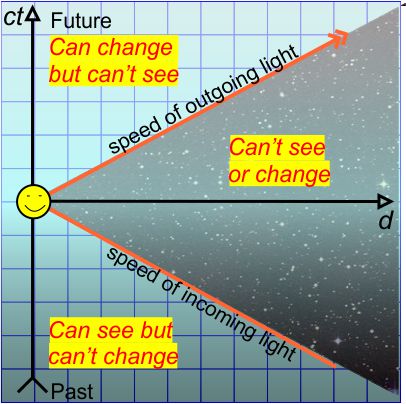
The smiley face is us at the origin (0,0,0,0). If we look upwards toward positive time, that’s the future at our present location. Looking downward to negative time is looking into the past. Unless we move (change x and/or y and/or z), all the events in our past and future have addresses like (ct,0,0,0).
What about all those points (events) that aren’t on the time axis? Pick one and use its address to figure the interval between it and us. In general, the interval will be a complex number, part real and part imaginary, because the event you picked isn’t on either axis.
The two orange lines are special. Each of them is drawn through all the events for which the distance is equal to ct. All the intervals between those events and us are zero. Those are the events that could be connected to us by a light beam.
The orange connections go one way only — someone in our past (t less than zero) can shine a light at us that we’ll see when it reaches us. However, if someone in our future tried to shine a light our way, well, the passage of time wouldn’t allow it (except maybe in the movies). Conversely, we can shine a light at some spatial point (x,y,z) at distance d=√(x2+y2+z2) from us, but those photons won’t arrive until the event in our future at (d,x,y,z).
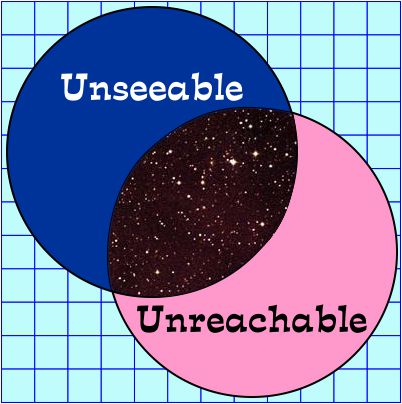
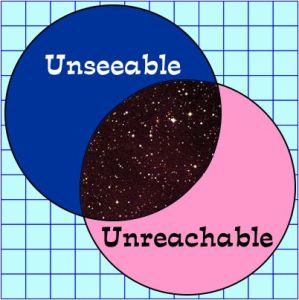 The rest of the Minkowski diagram could do for a Venn diagram. We at (0,0,0,0) can do something that will cause something to happen at (ct,x,y,z) to the left of the top orange line. However, we won’t be able to see that effect until we time-travel forward to its t. That region is “reachable but not seeable.”
Similarly, events to the left of the bottom orange line can affect us (we can see stars, for instance) but they’re in our past and we can’t cause anything to happen then/there. The region is “seeable but not reachable.”
Then there’s the overlap, the segment between the two orange lines. Events there are so far away in spacetime that the intervals between them and us are imaginary (in the mathematical sense). To put it another way, light can’t get here from there. Neither can cause and effect.
Physicists call that third region space-like, as opposed to the two time-like regions. Without a warp drive or some other way around Einstein’s universal speed limit, the edge of “space-like” will always be The Final Frontier.
~~ Rich Olcott
 One more step and we can answer Ken’s question. A moving object’s proper time is defined to be the time measured by a clock affixed to that object. The proper time interval between two events encountered by an object is exactly Minkowski’s spacetime interval. Lucy’s clock never moves from zero.


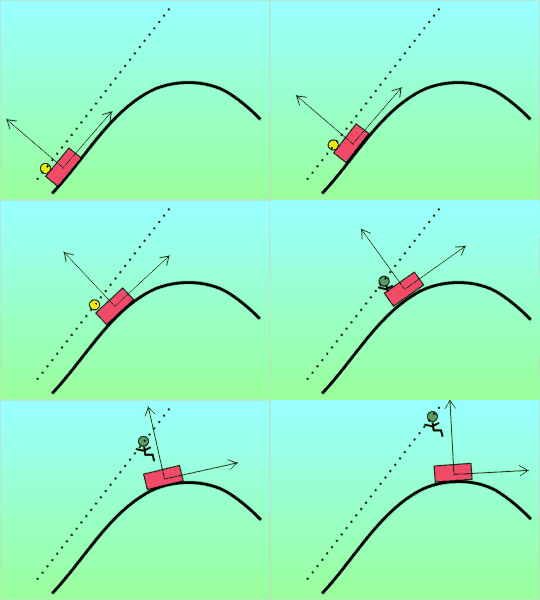 But there are other accelerations that aren’t so easily accounted for. Ever ride in a car going around a curve and find yourself almost flung out of your seat? This little guy wasn’t wearing his seat belt and look what happened. The car accelerated because changing direction is an acceleration due to a lateral force. But the guy followed Newton’s First Law and just kept going in a straight line. Did he accelerate?
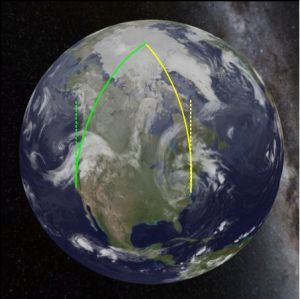 Suppose you’re investigating an object’s motion that appears to arise from a new force you’d like to dub “heterofugal.” If you can find a different frame of reference (one not attached to the object) or otherwise explain the motion without invoking the “new force,” then heterofugalism is a fictitious force.
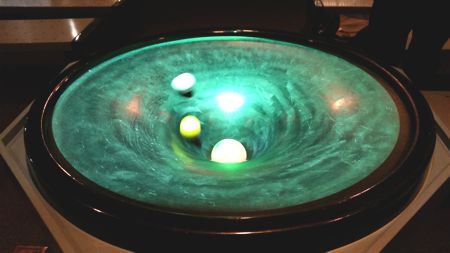


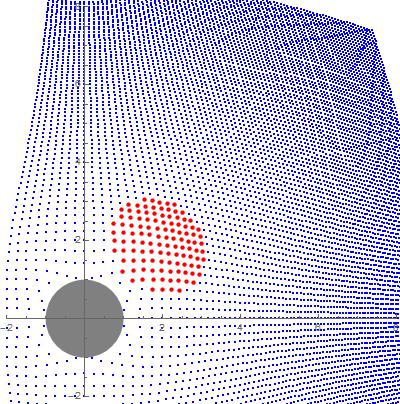
 Sure enough, that’s a straight line (see the chart). Reminds me of how Newton’s Law of Gravity is valid

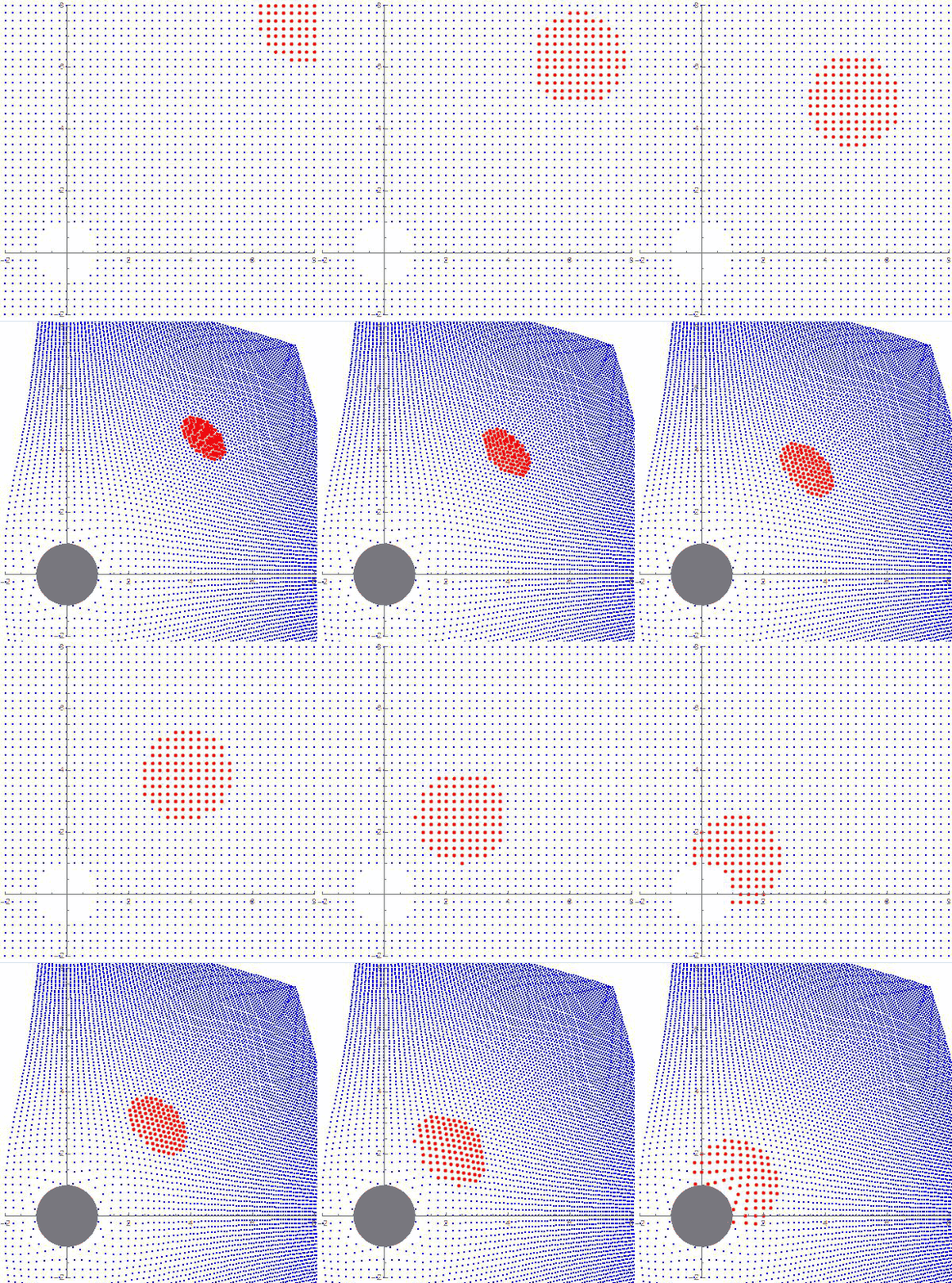


 Gargh, proto-humanity’s foremost physicist 2.5 million years ago, opened a practical investigation into how motion works. “I throw rock, hit food beast, beast fall down yes. Beast stay down no. Need better rock.” For the next couple million years, we put quite a lot of effort into making better rocks and better ways to throw them. Less effort went into understanding throwing.
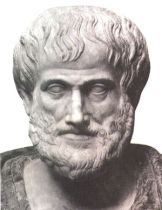 Aristotle wasn’t satisfied with anything so unsystematic. He was just full of theories, many of which got in each other’s way. One theory was that things want to go where they’re comfortable because of what they’re made of — stones, for instance, are made of earth so naturally they try to get back home and that’s why we see them fall downwards (no concrete linkage, so it’s still AAAD).


 It would have been awesome to watch Dragon Princes in battle (from a safe hiding place), but I’d almost rather have witnessed “The Tussles in Brussels,” the two most prominent confrontations between Albert Einstein and Niels Bohr.
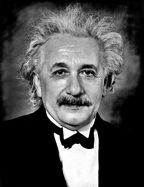 Like Newton, Einstein was a particle guy. He based his famous thought experiments on what his intuition told him about how particles would behave in a given situation. That intuition and that orientation led him to paradoxes such as entanglement, the
  Bohr was six years younger than Einstein. Both Bohr and Einstein had attained Directorship of an Institute at age 35, but Bohr’s has his name on it. He started out as a particle guy — his first splash was a trio of papers that treated the hydrogen atom like a one-planet solar system. But that model ran into serious difficulties for many-electron atoms so Bohr switched his allegiance from particles to Schrödinger’s wave theory. Solve a Schrödinger equation and you can calculate statistics like
  Here’s where Ludwig Wittgenstein may have come into the picture. Wittgenstein is famous for his telegraphically opaque writing style and for the fact that he spent much of his later life disagreeing with his earlier writings. His 1921 book, Tractatus Logico-Philosophicus (in German despite the Latin title) was a primary impetus to the Logical Positivist school of philosophy. I’m stripping out much detail here, but the book’s long-lasting impact on QM may have come from its Proposition 7: “Whereof one cannot speak, thereof one must be silent.“


