To Fly on Another World

“Uncle Sy, why is PV=nRT the Ideal Gas Equation? Is it because it’s so simple but makes sense anyway?”

“It is ideal that way, Teena, but it’s simply an equation about gases that are ideal. Except there aren’t any. Real gases come close but don’t always follow the rule.”

“Why not? Are they sneaky?”

“Your kind of question. We like to think of gas particles as tiny ping‑pong balls that just bounce off of each other like … ping‑pong balls. That’s mostly true most of the time for most kinds of gas. One exception has to do with stickiness. Water’s one of the worst cases because its H2O molecules like to chain up. When two H2Os collide, if they’re pointed in the right directions they share a hydrogen atom like a bridge and stick together. If that sort of stickiness happens a lot then the quantity measure n acts like it’s less than we’d expect. That makes the PV product smaller.”

“I bet that doesn’t happen much when the gas is really hot. Two particles might stick and then BANG! another particle hits ’em and breaks it up!”

“Good thinking and that’s true. But there’s another kind of exception that holds even at high temperatures. A well‑behaved gas is mostly empty space because the ping‑pong balls are far apart unless they’re actually colliding. But suppose you squeeze out nearly all of the empty space and then try to squeeze some more.”

“Oh! The pressure gets even bigger than the equation says it should because you can’t squeeze the particles any smaller than they are, right?”

“Exactly.”

“Well, if the equation has these problems, why do we even use it at all?”

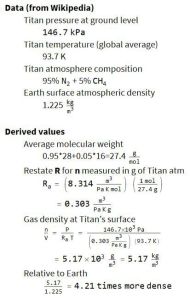
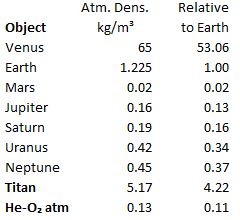
“Because it’s good enough, enough of the time, and we know when not to use it. I’ll give you an example. One of my clients wanted to know air density at ground level on Saturn’s moon Titan and all the planets that have an atmosphere.” <showing Old Reliable’s screen> “I found the planet data I needed in NASA’s Planetary Science website, but I had to do my own calculation for Titan. The pressure’s not crazy high and the temperature’s chilly but not quite cold enough to liquify nitrogen so the situation’s in‑range for the Ideal Gas Equation.”

“What’s a Pa?”

“That’s the symbol for a pascal, the unit of pressure. kPa is kilopascals, just like kg is kilograms. Earth’s atmospheric pressure is about 100 kPa.”

“Reliable says Wikipedia says Titan’s air is mostly nitrogen like Earth’s air is. Titan’s just a moon so it has to be smaller than Earth so its gravity must be smaller, too. Why is its atmosphere so much denser?”

“The cold. Titan’s air is 200 kelvins colder than Earth’s average temperature. You’re right, an individual gas particle feels a smaller pull of gravity on Titan, but it doesn’t have much kinetic energy to push its neighbors away so they all crowd closer together.”

“Why in the world does your client want to know that density number?”

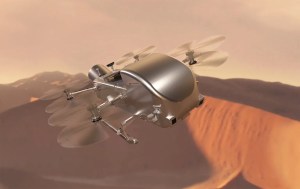
“Clients rarely give me reasons. I suspect this has to do with designing a Titan‑explorer aircraft.”

“Ooo! Wait, what does that have to do with air density?”

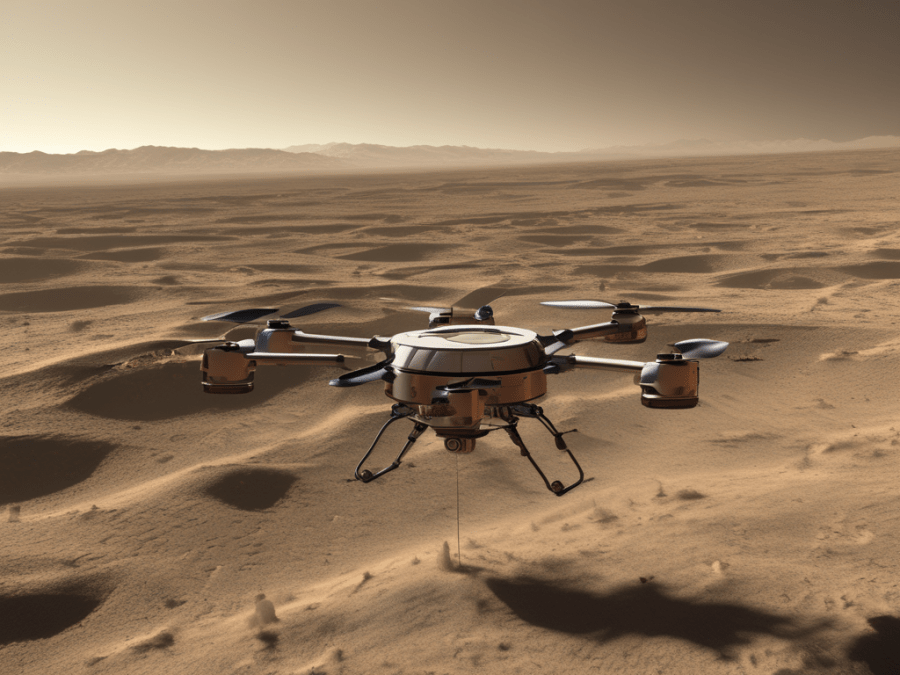
“It has to do with how hard the machine has to work to push itself up. It’ll probably have horizontally spinning blades that push the air downwards, like helicopters do. With a setup like that, the lift depends on the blade’s length, how fast it’s spinning, and how dense the air is. If the air is dense, like on Titan, the designers can get the lifting thrust they need with short blades or a slow spin. On Mars the density’s only 2% of Earth’s so Ingenuity‘s rotors were 4 feet across and spun about ten times faster than they’d have to on Earth.”

“What about on our helium‑oxygen Earth?”

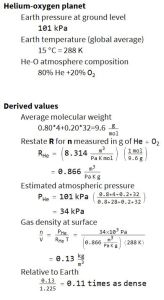
“That’s pretty much the same calculation. Give me a sec.” <tapping on Old Reliable’s screen> “Gas density would be a tenth of Earth’s, but a HeO‑copter would have to work against full‑Earth gravity. Huge blades rotating at supersonic speeds. Probably not a practical possibility.”

“Aw.”

“Yeah.”

~ Rich Olcott
The Ideal Gas Game

“But Uncle Sy, you never did answer my real question!”

“What question was that, Teena?”

“About the helium planet. With oxygen. Oh, I guess I never did get around to asking that part of it. You side‑tracked us into how a helium‑oxygen atmosphere would be unstable unless it was really cold or the planet had more gravity than Earth so the helium wouldn’t fly away. But what I wanted to know was, what would it be like before the helium left? Like, could we fly a plane there?”

“Mmm, let’s get a leetle more specific. You asked about swapping all of Earth’s atmospheric nitrogen with helium. Was that one helium atom for each nitrogen molecule or each nitrogen atom?”

“What difference would that make?”

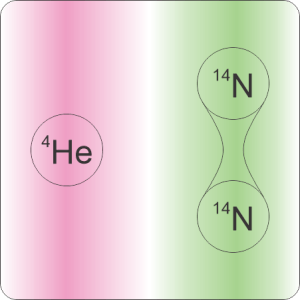
“Mass, to begin with. A helium atom weighs about 1/3 of a nitrogen atom, 1/7 of a nitrogen molecule. The atmospheric pressure we feel is the weight of all the air molecules above us. Swap out 80% of those molecules for something lighter, pressure goes down whether we swap helium for molecules or helium for atoms. We could calculate either one. But the change would be much harder to calculate for the atom‑for‑atom swap.”

“Why?”

“Mmm, have you gotten into equations yet in school?”

“You mean algebra, like 3x+7=8x+2? Yeah, they’re super‑easy.”

“This won’t even be as complicated as that. Here’s a famous Physics equation called The Ideal Gas Law — PV=nRT. Each letter stands for one quantity. Two adjacent quantities are multiplied together, okay? The pressure in a container is P, the container’s volume is V, T is the absolute temperature, and n is a measure of how much gas is in there.”

“You skipped R.”

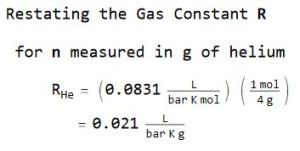
“Yes, I did. It’s a constant number. Its job is to make all the units come out right. For instance, if the pressure’s in atmospheres, the volume’s in liters, n is in grams of helium and the temperature is in kelvins, then R is 0.021. Suppose you’re holding a balloon filled with helium and it’s at room temperature. What can you say about the gas?”

“Umm, all the nRT stuff doesn’t change so P times V, whatever it is, doesn’t change either.”

“If we let it fly upward until the pressure was only half what it is here…?”

“Then V would double. The balloon would get twice as big. Unless it burst, right?”

“You got the idea. Okay, now let’s fiddle with the right-hand side. Suppose we double the amount of helium.”

P times V must get bigger but we don’t know which one.”

“Why not both?”

“Wooo… Each one could get some bigger… Oh, wait, I’m holding the balloon so the pressure’s not going to change so the balloon gets twice bigger.”

“Good thinking. One more thing and we can get back to your difference question. The Ideal Gas Law doesn’t care what kind of gas you’re working with. All the n quantity really cares about is how many particles are in the gas. A particle can be anything that moves about independently of anything else — helium atom or nitrogen molecule, doesn’t matter. If you change the definition of what n is measuring, all that happens is you have to adjust R so the units come out right. Then the equation works fine. Next step—”

“Wait, Uncle Sy, I want to think this atom‑or‑molecule thing through for myself. I’m gonna ignore R times T because both of them stay the same. So if we swap one atom of helium for one molecule of nitrogen, the number of particles doesn’t change and PV doesn’t change. But if we swap one atom of helium for each atom of nitrogen then n doubles and so does PV. But if we do that for the whole atmosphere then we can’t say that the pressure won’t change because the atmosphere could just expand and that’s the V but the pressures are all different as you go higher up anyway. Oh, wait, T changes, too, because it’s cold up there. It’s complicated, isn’t it?”

“It certainly is. Can we stick to just the simple atom‑for‑molecule swap?”

“Uh‑huh.”

~~ Rich Olcott

  • Thanks again, Xander, and happy birthday. Your question was deeper than I thought.

Virial Yang And Yin

“But Mr Moire, how does the Virial Equation even work?”

“Sometimes it doesn’t, Jeremy. There’s an ‘if’ buried deep in the derivation. It only works for a system in equilibrium. Sometimes people use the equation as a test for equilibrium.”

“Sorry, what does that mean?”

“Let’s take your problem galaxy cluster as an example. Suppose the galaxies are all alone in the Universe and far apart even by astronomical standards. Gravity’s going to pull them together. Galaxy i and galaxy j are separated by distance Rij. The potential energy in that interaction is Vij = G·mi·mj / Rij. The R‘s are very large numbers in this picture so the V attractions are very small. The Virial is the average of all the V’s so our starting Virial is nearly zero.”

“Nearly but not quite zero, I get that. Wait, if the potential energy starts near zero when things are far apart, and a falling‑in object gives up potential energy, then whatever potential energy it still has must go negative.”

“It does. The total energy doesn’t change when potential energy converts to kinetic energy so yes, we say potential energy decreases even though the negative number’s magnitude gets larger. It’d be less confusing if we measured potential energy going positive from an everything-all-together situation. However, it makes other things in Physics much simpler if we simply write (change in potential energy)+(change in kinetic energy)=0 so that’s the convention.”

“The distances do eventually get smaller, though.”

“Sure, and as the objects move closer they gain momentum and kinetic energy. Gaining momentum is gaining kinetic energy. You’re used to writing kinetic energy as T=m·v²/2, but momentum is p=m·v so it’s just as correct to write T=p²/2m. The two are different ways of expressing the same quantity. When a system is in equilibrium, individual objects may be gaining or losing potential energy, but the total potential energy across the system has reached its minimum. For a system held together by gravity or electrostatic forces, that’s when the Virial is twice the average kinetic energy. As an equation, V+2T=0.”

“So what you’re saying is, one galaxy might fall so far into the gravity well that its potential energy goes more negative than –2T. But if the cluster’s in equilibrium, galaxy‑galaxy interactions during the fall‑in process speed up other galaxies just enough to make up the difference. On the flip side, if a galaxy’s already in deep, other galaxies will give up a little T to pull it outward to a less negative V.”

“Well stated.”

“But why 2? Why not or some other number?”

“The 2 comes from the kinetic energy expression’s ½. The multiplier could change depending on how the potential energy varies with distance. For both gravity and electrostatic interactions the potential energy varies the same way and 2 is fine the way it is. In a system with a different rule, say Hooke’s Law for springs and rubber bands, the 2 gets multiplied by something other than unity.”

“All that’s nice and I see how the Virial Equation lets astronomers calculate cluster‑average masses or distances from velocity measurements. I suppose if you also have the masses and distances you can test whether or not a collection of galaxies is in equilibrium. What else can we do with it?”

“People analyze collections of stars the same way, but Professor Hanneken’s a physicist, not an astronomer. He wouldn’t have used class time on the Virial if it weren’t good for a broad list of phenomena in and outside of astronomy. Quantum mechanics, for instance. I’ll give you an important example — the Sun.”

“One star, all by itself? Pretty trivial to take its average.”

“Not averaging the Sun as an object, averaging its plasma contents — hydrogen nuclei and their electrons, buffeted by intense heat all the way down to the nuclear reactions that run near the Sun’s core. It’s gravitational potential energy versus kinetic energy all over again, but at the atomic level this time. The Virial Theorem still holds, even though turbulence and electromagnetic effects generate a complicated situation.”

“I’m glad he didn’t assign that as a homework problem.”

“The semester’s not over yet.”

~~ Rich Olcott

A Virial Homework Problem

“Uh, Mr Moire? Would you mind if we used Old Reliable to do the calculations on this problem about the galaxy cluster’s Virial?”

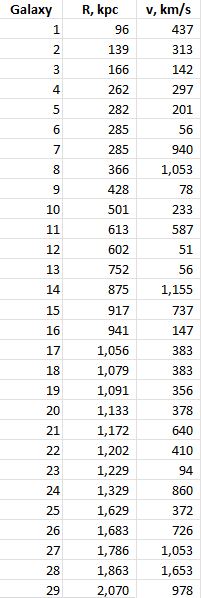
Data extracted and re-scaled from Fig 2 of Smith (1936), The Mass of the Virgo Cluster

“Mm, only if you direct the computation, Jeremy. I want to be able to face Professor Hanneken with a clear conscience if your name ever comes up in the conversation. Where do we start?”

“With the data he printed here on the other side of the problem sheet. Old Reliable can scan it in, right?”

“Certainly. What are the columns?”

“The first one’s clear. The second column is the distance between the galaxy and the center of the cluster. Professor Hanneken said the published data was in degrees but he converted that to kiloparsecs to get past a complication of some sort. The third column is, umm, ‘the relative line‑of‑sight velocity.’ I understand the line‑of‑sight part, but the numbers don’t look relativistic.”

“You’re right, they’re much smaller than lightspeed’s 300,000 km/s. I’m sure the author was referring to each galaxy’s motion relative to the other ones. That’s what the Virial’s about, after all. I’ll bet John also subtracted the cluster’s average velocity from each of the measured values because we don’t care about how the galaxies move relative to us. Okay, we’ve scanned your data. What do we do next?”

“Chart it, please, in a scatter plot. That’s always the first thing I do.”

“Wise choice. Here you go. What do we learn from this?”

“On the whole it looks pretty flat. Both fast and slow speeds are spread across the whole cluster. If the whole cluster’s rotating we’d see faster galaxies near the center but we don’t. They’re all moving randomly so the Virial idea should apply, right?”

“Mm-hm. Does it bother you that we’re only looking at motion towards or away from us?”

“Uhh, I hadn’t thought about that. You’re right, galaxy movements across the sky would be way too slow for us to detect. I guess the slowest ones here could actually be moving as fast as the others but they’re going crosswise. How do we correct for that?”

“Won’t need much adjustment. The measured numbers probably skew low but the average should be correct within a factor of 2. What’s next?”

“Let’s do the kinetic energy piece T. That’d be the average of galaxy mass m times v²/2 for each galaxy. But we don’t know the masses. For that matter, the potential energy piece, V=G·M·m/R, also needs galaxy mass.”

“If you divide each piece by m you get specific energy, joules/kilogram of galaxy. That’s the same as (km/s)². Does that help?”

“Cool. So have Old Reliable calculate /2 for each galaxy, then take the average.”

“We get 208,448 J/kg, which is too many significant figures but never mind. Now what?”

“Twice T would be 416,896 which the Virial Theorem says equals the specific potential energy. That’d be Newton’s G times the cluster mass M divided by the average distance R. Wait, we don’t know M but we do know everything else so we can find M. And dividing that by the galaxy count would be average mass per galaxy. So take the average of all the R distances, times the 416,896 number, and divide that by G.”

“What units do you want G in?”

“Mmm… To cancel the units right we need J/kg times parsecs over … can we do solar masses? That’d be easier to think about than kilograms.”

“Old Reliable says G = 4.3×10⁻³ (J/kg)·pc/Mʘ. Also, the average R is … 890,751 parsecs. Calculating M=v²·R/G … says M is about 90 trillion solar masses. With 29 galaxies the average is around 3 trillion solar masses give or take a couple of factors of 2 or so.”

“But that’s a crazy number, Mr Moire. The Milky Way only has 100 billion stars.”

“Sometimes when the numbers are crazy, we’ve done something wrong. Sometimes the numbers tell us something. These numbers mutter ‘dark matter‘ but in the 1930s only Fritz Zwicky was listening.”

~~ Rich Olcott

  • Thanks again to Dr KaChun Yu for pointing out Sinclair Smith’s 1936 paper. Naturally, any errors in this post are my own.

Viral, Virial, What’s The Difference?

A young man’s knock at my office door, eager yet a bit hesitant. “C’mon in, Jeremy, the door’s open.”

“Hi, Mr Moire. Got a minute?”

“It’s slow season, Jeremy. What can I do for you?”

“It’s my physics homework, sir. Professor Hanneken asked a question that I don’t understand.”

“John’s a bit of a joker but asking unsolvable questions isn’t usually one of his things. Well, except for that one about how long it would take to play Mahler’s Piano Quartet if you had only two musicians because of budget restrictions. What’s the question?”

“He wants us to use something called ‘the viral theorem‘ to deduce things about a certain galaxy cluster. I know what viral memes are but I don’t think I’ve ever heard of a theorem that spreads like a virus. I’ve done searches on my class notes and online textbook — nothing. So what is it and how am I supposed to use it?”

“Do you have the question with you?”

“Yessir, it’s #4 on this sheet.”

“Ah, just as I thought. Read it again. The word is ‘virial,’ not ‘viral.’ Big difference.”

“I suppose, but what’s a virial then?”

“We need some context. Imagine a cluster of free‑floating objects bound together by mutual forces of attraction. No central attractor, just lots of pairwise pulling, okay?”

“What kind of forces?”

“That’s the thing, it doesn’t matter. Gravitational, electrostatic, rubber bands even. The only restriction is that the force between each pair of objects follows the same force‑distance rule. For rubber bands it’s mostly just 1/distance until you get near the elastic limit. For gravity and electrostatics the rule is that force runs as 1/distance2. Got that picture?”

<grin> “It’d be tricky rigging up those rubber bands to not get tangled. Anyhow, instead of planets around the Sun you want me to think of stars held in a cluster by each other’s gravity. Do they all have to be the same size or the same distance apart?”

“No, because of what happens next. You’re thinking right — a heavier star pulls harder than a lighter one, and two stars close together feel more mutual force than stars far apart. We account for that variation by taking an average. Multiply force times distance for every possible pairing, then divide the total by the number of objects. The averaged number is the Virial, symbol V.”

“Wait, force times distance. That’s the Physics definition of work, like pulling something up against gravity.”

“Exactly. Work is directed energy. What we’re talking about here is the amount of energy required to pull all those objects away from the center of mass or charge or whatever, out to their current positions. The Virial is the average energy per object. It’s average potential energy because it depends on position, not motion.”

“They’d release all that energy if they just fell together so why don’t … wait, they’re going all different directions so momentum won’t let them, right?”

“You’re on your way. Motion’s involved.”

“Umm … Kepler’s Law — the closer any two of them get, the faster they orbit each other … OH! Kinetic energy! When things fall, potential energy’s converted to kinetic energy. Is there an average kinetic energy that goes up to compensate for the Virial getting smaller?”

“Bingo. When you say ‘average kinetic energy‘ what quantity springs to mind?”

“Temperature. But that’s only for molecules.”

“No reason we can’t define a galactic analog. In fact, Eddington did that back in 1916 when he brought the notion from gas theory over to astrophysics. He even used ‘T‘ for the kinetic average, but remember, this T refers to kinetic energy of stars moving relative to each other, not the temperatures of the stars themselves. Anyhow, the Virial Theorem says that a system of objects is in gravitational or electrostatic equilibrium when the Virial is T/2. Clausius’ ground‑breaking 1870 proof for gases was so general that the theorem’s been used to study everything from sub‑atomic particles to galaxies and dark matter.”

<bigger grin> “With coverage like that, the Virial’s viral after all. Thanks, Mr Moire.”

~~ Rich Olcott

  • Thanks to Dr KaChun Yu for helpful pointers to the literature. Naturally, any errors in this post are my own.

In Which Tone of Voice?

“Oh. OH! Wow, Uncle Sy, this changes everything!”

“Which ‘this,’ Teena?”

The resonator thing. Our music teacher, Ms Searcy, has been going on about us singing too much in our heads. I thought she’s been saying we’re thinking about the music too much and should just let the singing happen.”

“Sounds very Zen.”

“I’m too young to know Zen stuff. But now I think maybe she’s saying we’re using those head resonators you just told me about — singing with our sinuses and nasal cavities instead of somewhere else. She’s never been clear on what we can do about that.”

“You’re probably right. No music teacher since Harold Hill would try to get away with ‘think the music.’ I’m sure Ms Searcy’s complaint is about head tones as opposed to chest tones. If so, she’s got a good excuse for being unclear.”

“How can I have chest tones when you said vibrations come from my voice box and that’s above my chest?”

“Sound wave energy is about molecules colliding against any neighboring molecules. Up, down left, right — none of those matter. When air from your lungs makes your vocal cords buzz against each other, much of that buzzing goes up through your throat and head resonators. However, some of the buzz energy travels into your chest cavity. That’s your biggest resonator and it’s where your lowest tones come from.”

“I guess Ms Searcy wants us to send even more buzzing there, but how do we do that?”

“That’s a hard question. People have been interested in it since they started teaching singing and oratory to other people. We learned one part of the answer in medieval times when we began studying anatomy up close and personal. For instance, your voice box, which I really ought to call your larynx now we’re getting into detail, relates to about a dozen different muscles.”

“What’re the other parts?”

“The easiest part was kinesiology — figuring out what action each muscle supports. The hardest part was teaching a student how to feel and control the right muscles to make their voice do exactly what they want.”

“How can that be hard? I can flex my arm and leg muscles any time I want.”

“Can you make your larynx move up and down in your throat?”

“Easy.”

“That motion depends on a chain of muscles running between the back of your tongue and the top of your chest. One way to send buzzes downward is to activate the muscles that pull the larynx in that direction. Shorter distance makes for more efficient buzz transmission. It can also help to pull your head back a little. That tenses those pulled‑down tissues and improves transmission even more.”

<slightly deeper voice> “Like this?”

“That’s the idea. Learning to do that without having to pay attention to it is part of vocal training. Now, can you spread your toes out?”

“That’s weird. I can on my right foot but not my left.”

“Very common. Each foot has little tiny muscles, called intrinsic muscles, buried deep inside. Some people can control the whole set, some not so much. Your larynx has two pairs of intrinsic muscles that govern how your vocal cords work together. Some voice teachers claim the intrinsic muscles inside the larynx are the key to proper voice technique. Unfortunately, you can’t see them or get a feel for controlling them other then ‘keep trying things until you get it right and remember what you did.’ That’s Ms Searcy’s strategy. It’d be much harder with helium.”

“That’s right! Our voices with the balloons were all head tones. How come?”

“The speed of sound.”

“That’s a sideways answer, Uncle Sy.”

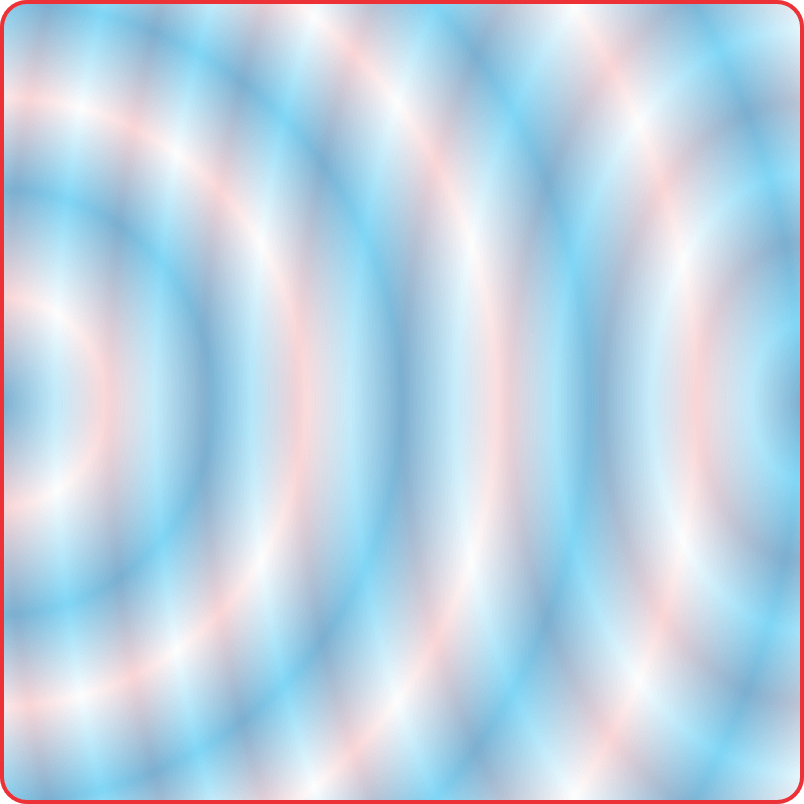
“Okay, this is more direct. We’ve said resonance was about waves whose wavelength just fit across a cavity. Picture two waves, the same number of waves per second, but the wave in helium travels about 3½ times faster than the one in air. The helium wave stretches about 3½ times farther between peaks. Whatever peaks per second your vocal cords make, in helium your chest cavity is 3½ times too small to resonate. Your head cavities, though, can resonate to overtones of those frequencies.”

“Squeaky overtones.”

~ Rich Olcott

When Sounds Rebound

<chirp chirp> “Moire here.”

“Hi, Uncle Sy.”

“Hi, Teena, How was the birthday party?”

“Pretty fun. We had balloons but Mom wouldn’t let us fly them into the sky.”

“Because animals might eat them when they come down, I suppose.”

“Yeah, that’s what she said. What we did was we untied the knotty part so we could breathe in the helium and sing squeaky Happy Birthdays. It didn’t make much difference to my voice but Brian’s came out weird ’cause his voice is breaking anyway. It was almost a yodel.”

“I thought you didn’t like Brian any more.”

“That was last month, Uncle Sy. He ‘poligized on accounta he’s still learning social skills. We had fun playing with the sounds.”

“Sure you did. Do you remember the slide whistle I gave you once?”

“That was a long time ago. It was fun until Brian bent the slider and it didn’t work any more.”

“No surprise. How’d you make it give a high note?”

“I’d push the slider all the way in. Slider-out made a low note, but Brian could make a high note even there if he blew really hard.”

“Well, he would. It all has to do with resonant cavities.”

“I don’t have any cavities! Mom makes sure I brush and floss every day. And what’s resonant?”

“You don’t have dental cavities but there are other kinds. ‘Cavity‘ is another word for ‘hole‘ and some of them are important. You breathe through two nasal cavities that join up to be your posterior nasal cavity and that connects to sinus cavities in your skull and down to your voice box and lungs. Your mouth cavity resonates with all those cavities and vibrations from your voice box to make your speaking sounds.”

“That’s twice you used that ‘resonate‘ word I don’t know.”

“Break it down. ‘–son–‘ means ‘sound,’ like ‘sonic.’ Then—”

“‘Re–‘ means ‘again‘ like ‘rebuild‘ so resonate is sounding again like an echo.”

“Right. Except a resonant cavity is picky about what sounds it works with. Here, I’m sending you a video. Did you get it?”

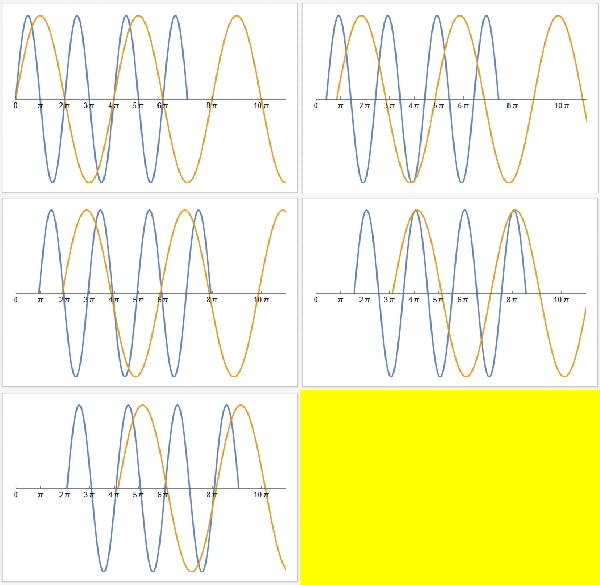
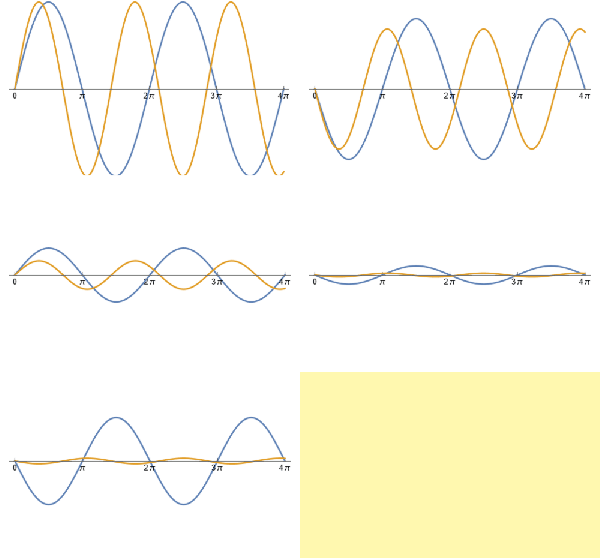
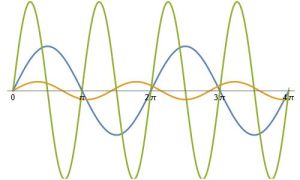
“Yeah, I see a couple of wiggly lines. Wait, the blue line stays the same size but the orange line gets littler until it’s all gone and then the picture goes yellow and starts over.”

“What happens over on the right‑hand side?”

“The blue line bounces back from zero but the orange line waves all over the place. Is that how sound works?”

“Sort of. The air molecules in a sound wave don’t go up‑and‑down, they go to‑and‑fro. The wiggly lines are a graph of where the energy is. Where the molecules bunch together they bang into each other more often than in the in‑between places. In open air the energy pushes along even though the molecules stay pretty much where they are. In a resonant cavity, sounds are trapped like the blue line if they have just the right wavelength. A cavity’s longest trappable wavelength is its lowest note, called its fundamental. The energy in the fundamental is sustained as long as new energy’s coming in.”

“What happens to the orange line?”

“It doesn’t get a chance to build up. The energy in those waves spreads out until the wave just isn’t any more.”

“Aww, poor wavey. Wait, what about when Brian blows extra‑hard and gets that high note?”

“He gives the commotion inside the whistle enough energy to excite a second trapped wave with twice the number of crowded places. That’s called an overtone of the fundamental. Sometimes you want to do that, sometimes you don’t.”

“Brian always did on the whistle.”

“Well, he would. The resonant cavity thing also explains why Brian’s voice breaks and how talking works. Your windpipe is a resonating cavity. Brian’s windpipe has grown just large enough that sometimes it resonates in his new fundamental and sometimes switches to some other fundamental or overtone. Talking depends on tuning the resonances inside your mouth cavity. Try saying ‘ooo‑eee‘ while holding your lips steady in ‘ooo‘ position. On ‘eee‘ your tongue rises up to squeeze out the low‑pitched long waves in ‘ooo‘, right?”

oooeeeoooeeeooo

  • Thanks to Xander, whose question inspired this story arc.

~ Rich Olcott
Why Physics Is Complex

“I guess I’m not surprised, Sy.”

“At what, Vinnie?”

“That quantum uses these imaginary numbers — sorry, you’d prefer we call them i‑numbers.”

“Makes no difference to me, Vinnie. Descartes’ pejorative term has been around for three centuries so that’s what the literature uses. It’s just that most people pick up the basic idea more quickly without the woo baggage that the real/imaginary nomenclature carries along. So, yes, it’s true that both i‑numbers and quantum mechanics appear mystical, but really quantum mechanics is the weird one. And relativity.”

“Wait, relativity too? That’s hard to imagine, HAW!”

“Were you in the room for Jim’s Open Mic session where he talked about Minkowski’s geometry?”

“Nope, missed that.”

“Ah, okay. Do you remember the formula for the diagonal of a rectangle?”

“That’d be the hypotenuse formula, c²=a²+b². Told you I was good at Geometry.”

“Let’s use ‘d‘ for distance, because we’re going to need ‘c‘ for the speed of light. While we’re at it, let’s replace your ‘a and ‘b‘ with ‘x‘ and ‘y,’ okay?”

“Sure, why not?”

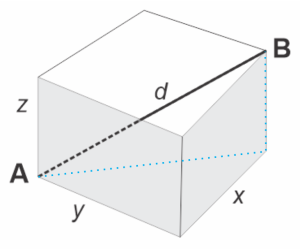
<casting image onto office monitor> “So the formula for the body diagonal of this box is…”

“Umm … That blue line across the bottom’s still √(x²+y²) and it’s part of another right triangle. d‘s gotta be the square root of x²+y²+z².”

“Great. Now for a fourth dimension, time, so call it ‘t.’ Say we’re going for light’s path between A at one moment and B some time t later.”

“Easy. Square root of x²+y²+z²+t².”

“That’s almost a good answer.”

“Almost?”

“The x, y and z are distance but t is a duration. The units are different so you can’t just add the numbers together. It’d be like adding apples to bicycles.”

“Distance is time times speed, so we multiply time by lightspeed to make distance traveled. The formula’s x²+y²+z²+(ct)². Better?”

“In Euclid’s or Newton’s world that’d be just fine. Not so much in our Universe where Einstein’s General Relativity sets the rules. Einstein or Minkowski, no‑one knows which one, realized that time is fundamentally perpendicular to space so it works by i‑numbers. You need to multiply t by ic.”

“But i²=–1 so that makes the formula x²+y²+z²–(ct)².”

“Which is Minkowski’s ‘interval between an event at A and another event at B. Can’t do relativity work without using intervals and complex numbers.”

“Well that’s nice but we started talking about quantum. Where do your i‑numbers come into play there?”

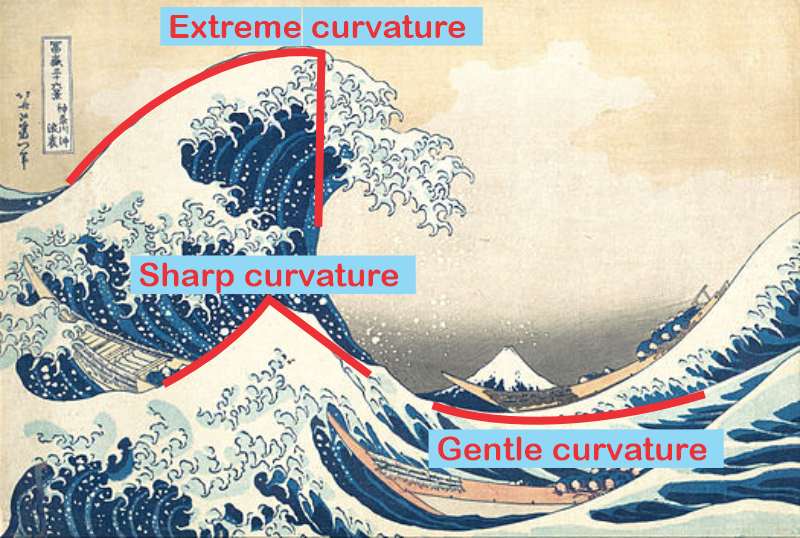
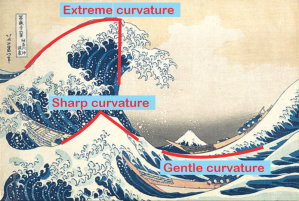
“It goes back to the wave equation— no, I know you hate equations. Visualize an ocean wave and think about describing its surface curvature.”

“Curvature?”

“How abruptly the slope changes. If the surface is flat the slope is zero everywhere and the curvature is zero. Up near the peak the slope changes drastically within a short distance and we say the surface is highly curved. With me?”

“So far.”

“Good. Now, visualize the wave moving past you at some convenient speed. Does it make sense that the slope change per unit time is proportional to the curvature?”

“The pointier the wave segment, the faster its slope has to change. Yeah, makes sense.”

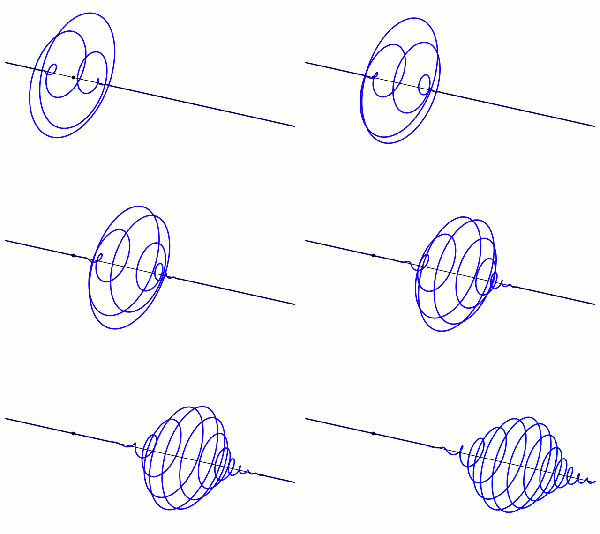
“Which is what the classical wave equation says — ‘time‑change is proportional to space‑change’. The quantum wave equation is fundamental to QM and has exactly the same form, except there’s an i in the proportionality constant and that changes how the waves work.” <casting a video> “The equation’s general solution has a complex exponential factor eix. At any point its value is a single complex number with two components. From the x‑direction, the circle looks like a sine wave. From the i‑direction it also looks like a sine wave, but out of phase with the x‑wave, okay?”

“Out of phase?”

“When one wave peaks, the other’s at zero and vice‑versa. The point is, rotation’s built into the quantum waves because of that i‑component.” <another video> “Here’s a lovely example — that black dot emits a photon that twists and releases the electromagnetic field as it moves along.”

~ Rich Olcott
Cal’s Gallery

“Goodness, Cal, you’ve redone your interior decorations.”

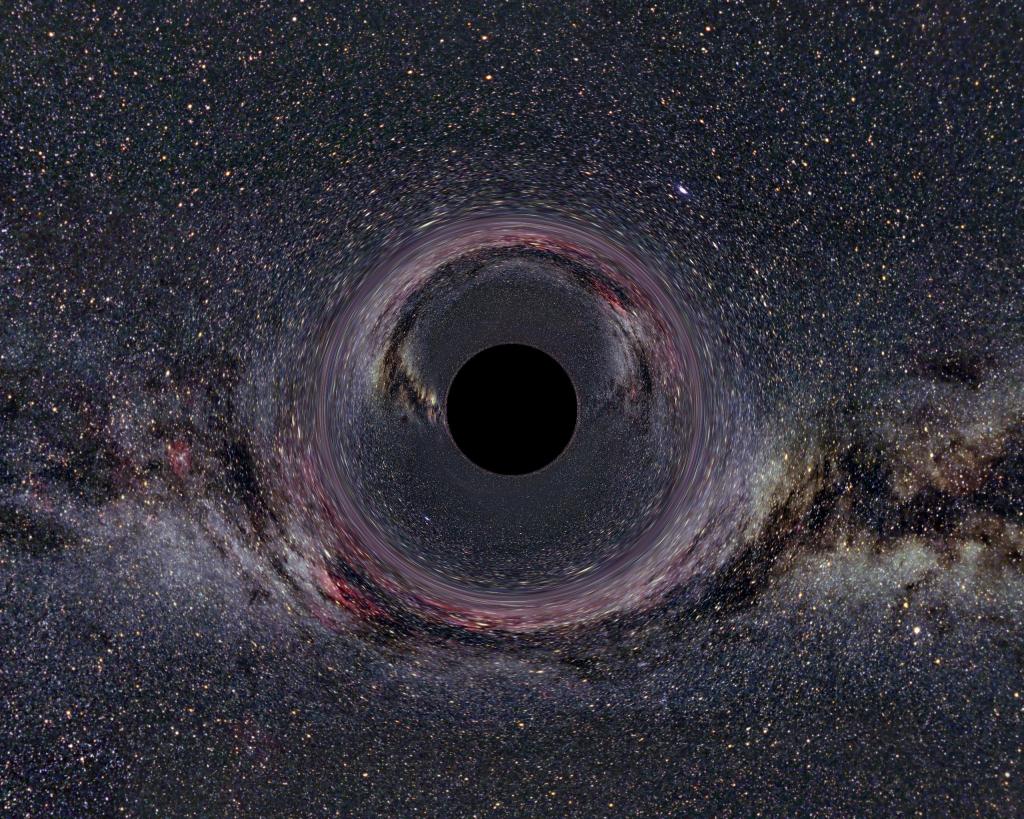
“I got tired of looking at the blank wall opposite the cash register, Sy. Check out the gallery. Way at the end here’s the earliest one I’ve got, goes back to 2005.”

“Yeah, ray-marching each background pixel as it passed through the distorting gravity field. That was heavy-duty computer graphics back then.”


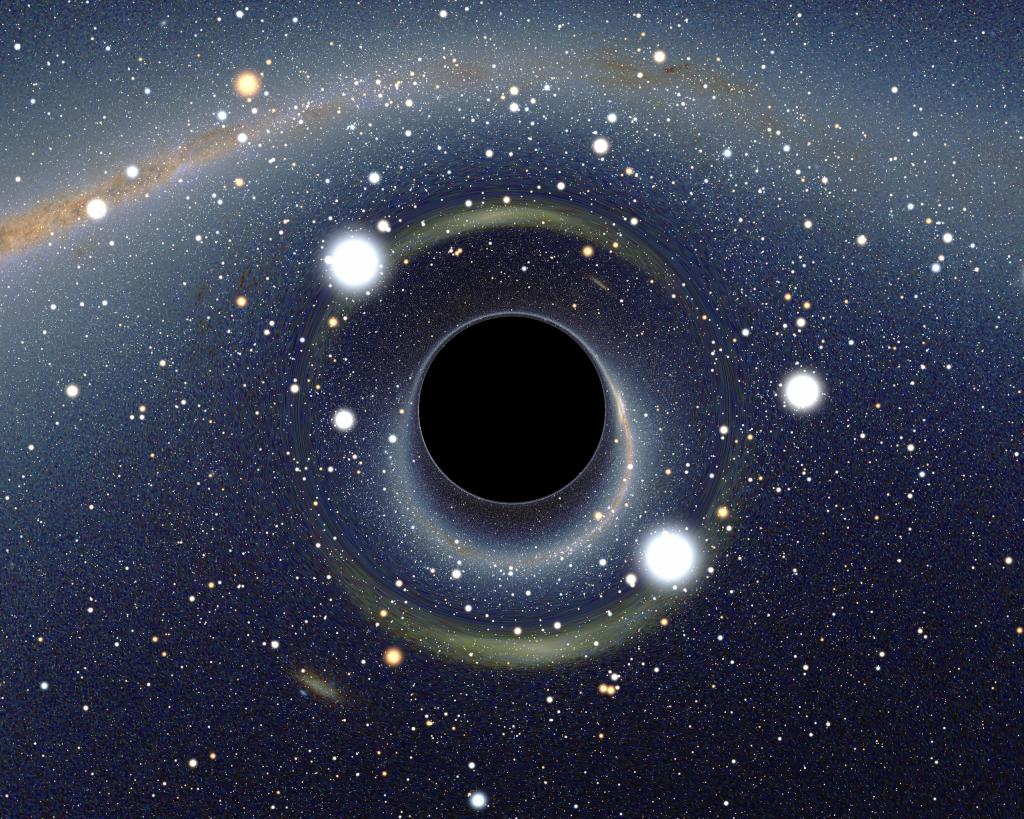
“Here’s another one from a year later. I like it better because you can pair up stars and stuff that show up on both sides of the Einstein ring.”


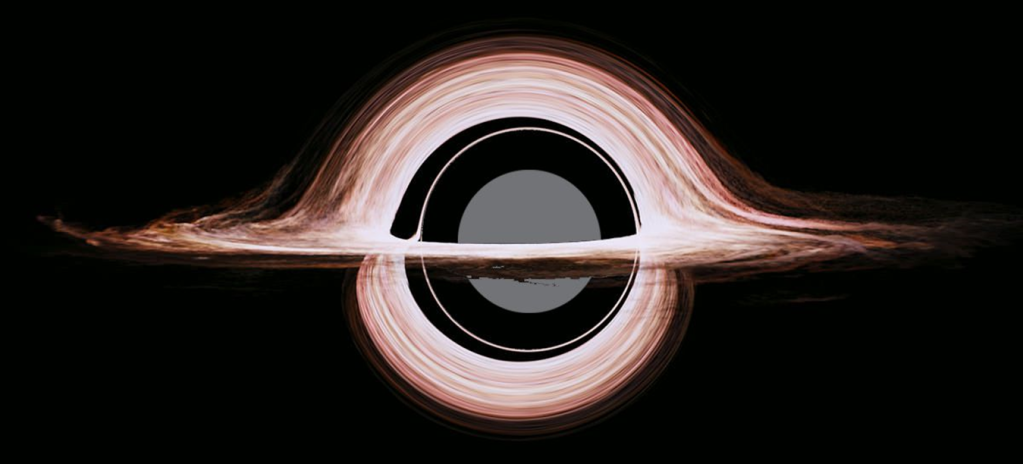
“This one’s famous, comin’ from the Interstellar movie. Funny, I can’t think of any black hole pictures before Interstellar that paid much attention to the accretion disk.”

“There certainly was a lot of that in the specialist literature, but you’re probably right for what leaked out to the pop‑sci press. Most of the published imagery was about how the gravity field distorts the figures behind it. That perpendicular handle was certainly a surprise.”


“This one’s famous, too. It shows what made the first good evidence that black holes are a thing, back in 1965. That ball to the right is a blue supergiant. See how its solar wind is feeding into X-1’s accretion disk? NASA’s picture is from 2017 so it’s not really historical or anything.”


“Now this one is historical, Cal. That image was released in 2019 from data collected in 2017.”

“I knew you’d recognize it, Sy. You’ve written about it enough.”


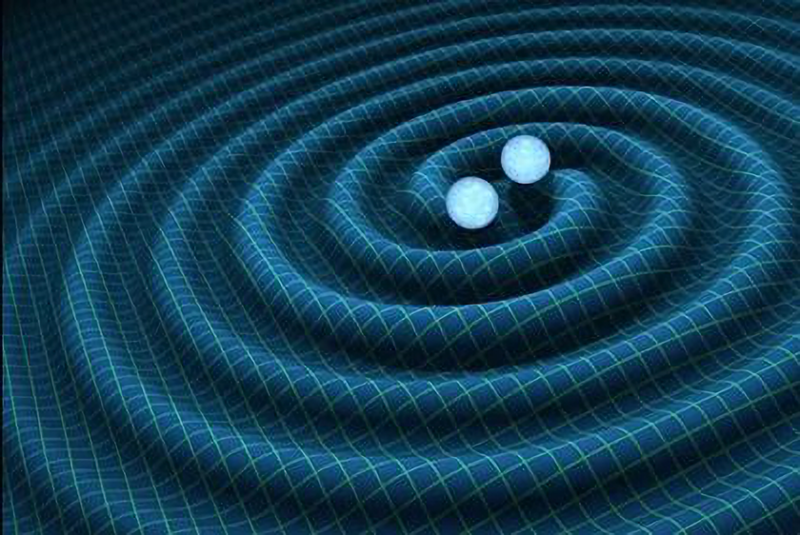
<sly grin> “Whaddya think of this one, Sy, the gravitational waves from those two black holes that LIGO told us about?”

“You knew I wouldn’t like it.”

The final waltz of two black holes” – click for video
Credit: R. Hurt – Caltech / JPL

“It’s just another trampoline picture, right?”

“No, it’s worse than that. Gravitational waves travel at lightspeed. Massive objects like people and 30‑solar‑mass black holes can’t get up to a fraction of a percent of lightspeed without expending an enormous amount of energy. The waves travel outward much faster than objects can orbit each other, even up to the end. Those waves winding outward should be nearly straight.”


“Whoa, Cal, this one isn’t a poster, it’s a monitor screen.”

“I bought a new bigger flat‑screen for home so I brought the old small one here for videos. I like how this movie shows the complicated shape flattening out when you get above the disk. The Interstellar movie made everyone think the disk is some weird double‑handled ring but the handle’s aren’t really there.”

“Mm‑hm, very nice gravity‑lens demonstration. Notice how the ring’s bright in whichever side’s coming toward us whether we’re above or below it?”

Circling over a black hole structure” — Click for video
Credit: NASA’s Goddard Space Flight Center/Jeremy Schnittman

“No, I hadn’t. Cool. How come?”

“It’s called relativistic Doppler beaming. Time distortion is significant in the close‑in parts of the ring. That affects how we see the flow. In the hole’s frame of reference the brightness and rotation speed are the same all around. In our frame the moving‑closer particles look brighter because they emit more photons per unit of our time. Another one of those unexpected phenomena where physicists say, ‘Of course!’ as soon as they see it but not before.”

~~ Rich Olcott
The Ultimate Pinhole Camera

Neither Kareem nor I are much for starting conversations. We’re more the responder type so the poker hands we dealt went pretty quickly. Cathleen had a topic, though. “Speaking of black holes and polarized radio waves, I just read a paper claiming to have developed a 3‑dimensional movie of an event wider than Mercury’s orbit, all from the flickering of a single pixel.”

Eddie bets big, for him. Ten chips. “That’s a lot to ask from just a dot. And what’s polarization got to do with it?”

Cal folds but pipes up anyway. “What was the event?”

“You know Sagittarius A*, the supermassive black hole in the middle of our galaxy?”

“Yeah, one of those orange‑ring pictures.”

“Mm‑hm. Based on radio‑wave emissions from its accretion disk. That image came from a 2‑day Event Horizon Telescope study in 2017. Well, four days after that data was taken, the Chandra satellite observatory saw an X‑ray flare from the same region. The ALMA radio telescope team immediately checked the location. ALMA has excellent signal‑to‑noise and time‑resolution capabilities but it’s only one observatory, not world‑wide like the EHT. The EHT can resolve objects a hundred thousand times closer together than ALMA’s limit. But the team did a lot with what they had.”

Vinnie tends to bet big, maybe because he’s always skeptical. Fifteen chips. “You said ‘claiming‘ like there’s doubt. People don’t trust the data?”

“In science there’s always doubt. In this case, no‑one doubts the data — ALMA’s been providing good observations for over a decade. The doubt’s in the completely new AI‑driven data reduction technique the team used. Is what they did valid? Could their results have been affected by a ‘hallucination’ bug?”

Vinnie doesn’t let go. “What did they do, what have people been doing, and what’s hallucination?”

Susan reluctantly shoves fifteen chips into the pot. “Hallucination is an AI making up stuff. I just encountered that in a paper I’m reviewing. There’s a long paragraph that starts off okay but midway it goes off on a tangent quoting numbers that aren’t in the data. I don’t believe the submitting authors even read what they sent in.”

Kareem drops out of the betting but stays in the conversation. “For a lot of science, curve‑fitting’s a standard practice. You optimize a model’s parameters against measured data. X‑ray crystallography, for example. The atoms in a good crystal are arranged in a regular lattice, right? We send a narrow beam of X‑rays at the crystal and record the intensity reflected at hundreds of angles by the atoms in different lattice planes. Inside the computer we build a parameterized model of the crystal where the parameters are the x‑, y‑ and z‑coordinates of each atom. We have computer routines that convert a given set of configuration parameters into predicted reflection intensity at each observation angle. Curve‑fitting programs cycle through the routines, adjusting parameters until the predictions match the experimental data. The final parameter values give us the atomic structure of the crystal.”

“There’s a lot of that in astrophysics and cosmology, too. This new AI technique stands that strategy on its head. The researchers started with well‑understood physics outside of the event horizon — hot rotating accretion disk, strong magnetic field mostly perpendicular to that, spacetime distortion thanks to General Relativity — and built 50,000 in‑computer examples of what that would look like from a distance.”

“Why so many?”

“The examples had to cover one or two supposed flares of different sizes and brightness at different points in their orbits, plus noise from the accretion disk’s radiation, all from a range of viewpoint angles. Mind you, each example’s only output was a single signal intensity and polarization angle (that’s two dimensions) for that specific set of disk and flare configuration parameters. The team used the example suite to train an AI specialized for assembling 2‑dimensional visual data into a 3‑dimensional model. The AI identified significant patterns in those 50,000 simulated signals. Then the team confronted the trained AI with 100 minutes of real single‑pixel data. It generated this…”

Click through to video, from Levis, et al.

“Curve‑fitting but we don’t know the curves!”

“True, Sy, but the AI does.”

“Maybe.”

~ Rich Olcott