A Cosmological Horse Race

A crisp Fall day, perfect for a brisk walk around the park. I see why the geese are huddled at the center of the lake — Mr Feder, not their best friend, is on patrol again. Then he spots me. “Hey, Moire, I gotta question!”

“Of course you do, Mr Feder. What is it?”

“Some guy on TV said Einstein proved gravity goes at the speed of light and if the Sun suddenly went away it’d take eight minutes before we went flying off into space. Did Einstein really say that? Why’d he say that? Was the TV guy right? And what would us flying across space feel like?”

“I’ll say this, Mr Feder, you’re true to form. Let’s see… Einstein didn’t quite prove it, the TV fellow was right, and we’d notice being cold and in the dark well before we’d notice we’d left orbit. As to why, that’s a longer story. Walk along with me.”

“Okay, but not too fast. What’s not quite about Einstein’s proving?”

“Physicists like proofs that use dependable mathematical methods to get from experimentally-tested principles, like conservation of energy, to some result they can trust. We’ve been that way since Galileo used experiments to overturn Aristotle’s pure‑thought methodology. When Einstein linked gravity to light the linkage was more like poetry. Beautiful poetry, though.”

“What’s so beautiful about something like that?”

“All the rhymes, Mr Feder, all the rhymes. Both gravity and light get less intense with the square of the distance. Gravity and light have the same kinds of symmetries—”

“What the heck does that mean?”

“If an object or system has symmetry, you can execute certain operations on it yet make no apparent difference. Rotate a square by 90° and it looks just the same. Gravity and light both have spherical symmetry. At a given distance from a source, the field intensity’s the same no matter what direction you are from the source. Because of other symmetries they both obey conservation of momentum and conservation of energy. In the late 1890s researchers found Lorentz symmetry in Maxwell’s equations governing light’s behavior.”

“You’re gonna have to explain that Lorentz thing.”

Lorentz symmetry has to do with phenomena an observer sees near an object when their speed relative to the object approaches some threshold. Einstein’s Special Relativity theory predicted that gravity would also have Lorentz symmetry. Observations showed he was right.”

“So they both do Lorentz stuff. That makes them the same?”

“Oh, no, completely different physics but they share the same underlying structure. Maxwell’s equations say that light’s threshold is lightspeed.”

“Gravity does lightspeed, too, I suppose.”

“There were arguments about that. Einstein said beauty demands that both use the same threshold. Other people said, ‘Prove it.’ The strongest argument in his favor at the time was rough, indirect, complicated, and had to do with fine details of Earth’s orbit around the Sun. Half a century later pulsar timing data gave us an improved measurement, still indirect and complicated. This one showed gravity’s threshold to be with 0.2% of lightspeed.”

“Anything direct like I could understand it?”

“How about a straight‑up horse race? In 2017, the LIGO facility picked up a gravitational signal that came in at the same time that optical and gamma ray observatories recorded pulses from the same source, a colliding pair of neutron stars in a galaxy 130 million lightyears away. A long track, right?”

“Waves, not horses, but how far apart were the signals?”

“Close enough that the measured speed of gravity is within 10–15 of the speed of light.”

“A photo-finish.”

“Nice pun, Mr Feder. We’re about 8½ light-minutes away from the Sun so we’re also 8½ gravity-minutes from the Sun. As the TV announcer said, if the Sun were to suddenly dematerialize then Earth would lose the Sun’s orbital attraction 8½ minutes later. We as individuals wouldn’t go floating off into space, though. Earth’s gravity would still hold us close as the whole darkened, cooling planet leaves orbit and heads outward.”

“I like it better staying close to home.”
~ Rich Olcott
Properties of Space

Vinnie gives me the side‑eye. “Wait, Sy. Back there you said Maxwell got the speed of light from the properties of space. What does any of that even mean?”

“Do you remember Newton’s equation for the force of gravity between two objects?”

“Of course not. Lessee… the force’d be bigger when either one gets bigger, and it’d get smaller when the distance between ’em gets bigger and there’s some constant number to make the units right, right?”

“Close enough, it’s the distance squared. The equation’s F=Gm1m2/r². The G is the constant you mentioned. It does more than turn mass‑units times mass‑units divided by length‑units‑squared into force‑units. It says how many force‑units. For one pair of objects at a certain distance, turn the G‑dial up and you get more force. Make sense?”

“Yeah, that looks right.”

“The value of G sets the force‑distance scale for how two objects attract each other everywhere in the Universe. That value is a property of space. So is the fact that the value is the same in all directions.”

“Huh! Never thought of it like a scale factor. Space has other properties like that?”

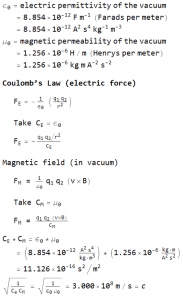
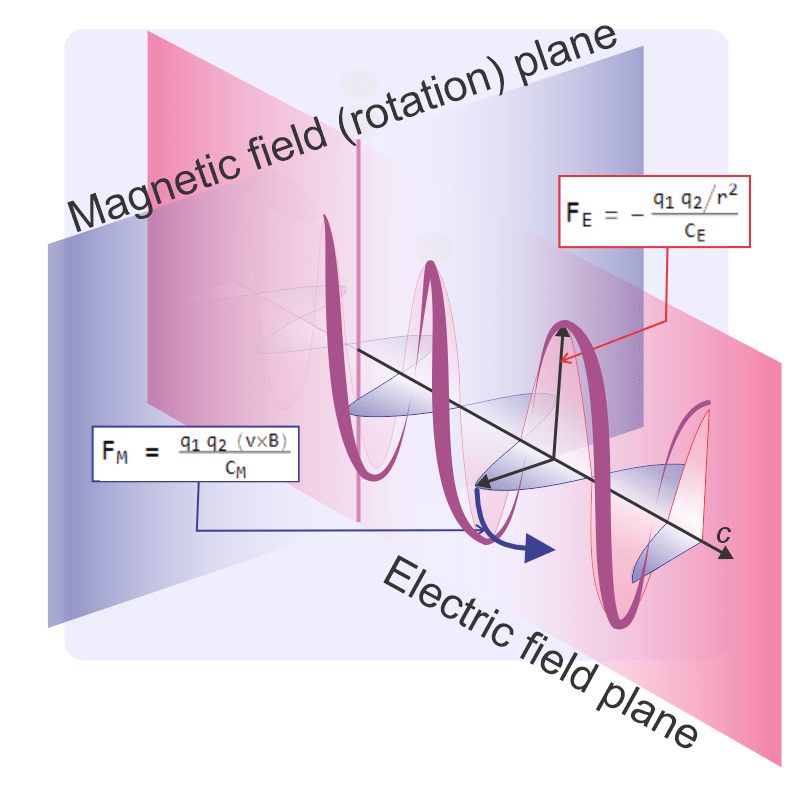
“Certainly. Coulomb’s Law for the electrostatic force between two charged objects has the same basic structure, FE=–(q1q2/r²)/CE. In any units you like you replace the q‘s with object charge amounts and r with the distance between them. For each set of change‑ and distance‑units there’s a well‑researched value of CE to convert your charge and distance numbers into force‑units. Under the covers, though, CE is a scale factor that controls the range of the electrostatic force. It’s the same everywhere in the Universe and it’s completely independent of Newton’s gravity scale factor.”

“Hey, what about ‘like charges repel, opposites attract’?”

“That’s what the minus sign’s in there for. If the q‘s have the same charge, the force is negative, that’s repulsion; opposite charges make for positive, attractive force.”

“If there’s a CE for electric there’s gotta be a CM for magnetic.”

“Sort of. The electrostatic force doesn’t care about direction. Magnetism does care so the equation’s more complicated. You’re right, though, there is a similar universal scale factor we might as well call CM.”

<chuckle> “Electric, magnetic, I don’t suppose we could mix those two somehow for an electromagnetic scale factor?”

<grin> “Did you read ahead in the book? Yes we can, and Maxwell’s equations showed us how. If you multiply the two C‘s together, you get one over the square of the speed of light. Re‑arranging a little, c=√(1/CECM), so c, the electromagnetic scale factor for velocity, is based on those space properties. Einstein showed that no material object can have a velocity greater than c.”

“I’ll take your word for the arithmetic, but how does that combination make for a speed limit?”

“There’s an easy answer you’re not going to like — it’s a speed because the units come out meters per second.”

“That’s a cheat. I don’t like it at all and it doesn’t account for the limit part. Explain it with Physics, no fancy equations.”

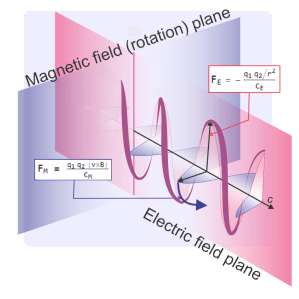
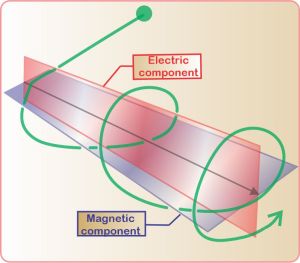
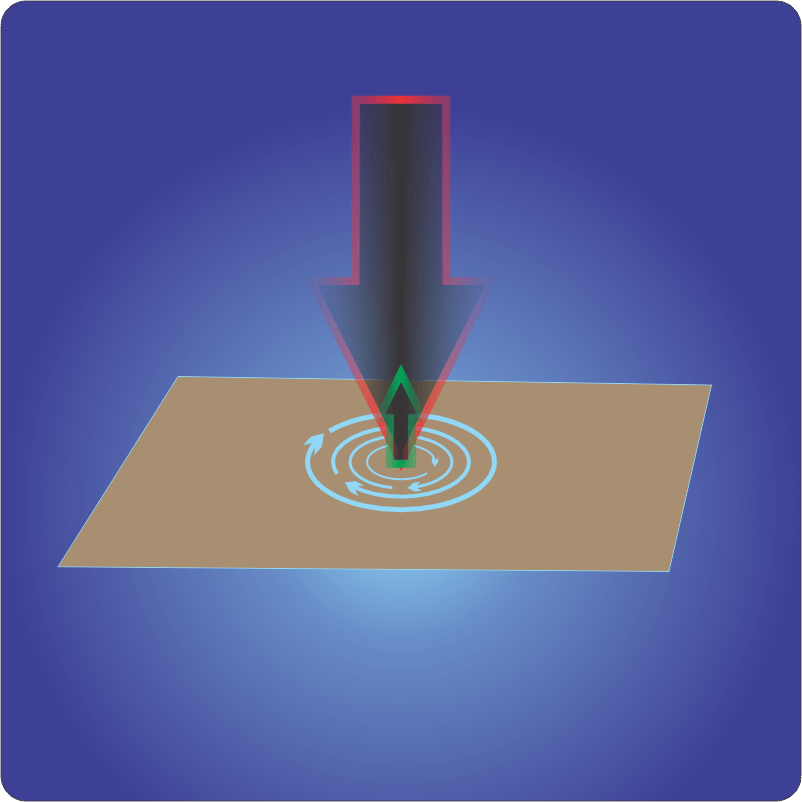
“Tough assignment. Okay, typical waves have a displacement force, like wind or something pushing up on an ocean wave, that works against a restoring force, such as gravity pulling down. Electromagnetic waves are different. The electric component supplies the up force, but the magnetic component twists sideways instead of restoring down. The wave travels as a helix. The CE and CM properties determine how tightly it spirals through space. That’s lightspeed.”

“And the limit part?”

“Einstein maintained that anything that happens must follow the same rules for all observers no matter how each is moving. The only way that can be true is if space is subject to the Lorentz contraction √[1-(v/vmax)²] for some universal maximum speed vmax. Maxwell’s electromagnetism equations showed that vmax is c. Okay?”

“I suppose.”

~ Rich Olcott
  • * Vinnie hates equations even with regular letters, Greek letters make it worse. Hence my using CE and CM instead of the conventional ε0 and μ0 notation. Sue me.

Snap The Whip

“You say Alfven invented a whole science, Sy, but his double‑layer structures in plasma don’t look like much compared with the real ground‑breakers like Herschel or Hubble.”

“Your Astronomy bias is showing, Cathleen. The double‑layer thing was only a fraction what he gave to magnetohydrodynamics. To begin with, he dreamed up a new kind of wave.”

“There’s more than light waves, sound waves and ocean waves?”

“Certainly. There’s dozens of different kinds — look up waves in Wikipedia some day. Some move, some make other things move; sometimes things move in the direction the wave does, sometimes crosswise to it. From a Physics perspective waves are about repetition. Something that happens just once, where do you go from there?”

“That used to be Astronomy’s problem — only one solar system with fewer than a dozen planets, only two galaxies we could inspect closely. Now our space telescopes and monster‑mirror ground‑based observatories have given us thousands of planets and billions of stars and galaxies. If we get our classifications right we can follow an object type through every stage of development. It’s almost like watching Chemistry happen.”

“I doubt Susan Kim would agree but I get your point. Anyhow, most waves have a common underlying process. Many systems have an equilibrium condition. Doing something energetic like plucking on a guitar string moves the system away from equilibrium. That provokes some force to restore equilibrium. For the guitar, tension in the wire pulls it straight. Usually the restoration overshoots so the restoring force turns around to act in the opposite direction. That’s when the repetition starts, right?”

“Mm-hm, that’s sound waves in a nutshell. Ocean waves, too, because gravity’s the restoring force fighting with the wind to pull things flat.”

“Same idea. Well, Alfven’s first trick was to demonstrate that in a plasma or any conducting medium, a magnetic field acts like that guitar string. The field’s equilibrium configuration is straight and smooth. If you perturb the medium somehow to put a bend or kink in the field, magnetic tension kicks in to restore equilibrium. Waves restored by magnetic fields are important enough that they’re now called Alfven waves in his honor.”

“First trick, mmm? There’s more?”

“Yup, an old one he borrowed from Maxwell — the flux tube. Maxwell worked before atoms were a conceptual thing. He thought about magnetism in terms of immaterial ‘lines of force’ that followed the rules laid out in his equations. Think of grabbing a handful of barely cooked spaghetti, still mostly stiff.”

“Yuck.”

“You’re wearing gloves, okay? The point is, you’ve got a more‑or‑less cylindrical bundle of parallel strands. Pretend each strand is a line of magnetic force. Maxwell’s rules say the number of lines of force, the total magnetic flux, coming out one end of the bundle exactly equals the flux that went in the other end. There’s no sourcing or destroying magnetic flux in between.”

“What if I squeeze real hard?”

“Nope. The flux per unit area intensifies — that’s called ‘the pinch effect’ and particle beam folks love it — but the total flux stays the same. Here’s where it gets interesting. Alfven showed that if the flux tube passes through a plasma or other conducting medium, the medium’s charged particles get frozen into the field. Waggle the field, you waggle the particles. Now put that together with his waves.”

“Oh, that’s what those guys have been talking about! There’s a slew of recent papers built on observations from the Parker Solar Probe mission. One of the biggest outstanding problems in solar physics is, how can the corona, the outermost layer of the Sun’s atmosphere, be millions of degrees hotter than the 6000‑degree photosphere beneath it? Well, PSP and other satellite missions have recorded many observations where the ambient magnetic field suddenly flipped from one direction to its near‑opposite. It’s like the probe had flown through a flux tube zig‑zag in space.”

“Those sharp angles indicate a lot of pent‑up magnetic tension.”

“Absolutely! Now imagine those zig‑zags in the crowded chaos inside the Sun’s atmosphere, colliding, criss‑crossing, disconnecting, reconnecting, releasing their magnetic flux energy into frozen‑in particles that aren’t frozen any more. What do you get, Sy?”

“Immense amounts of kinetic energy. Hot times, indeed”

~ Rich Olcott

Why Those Curtains Ripple

I’m in the scone line at Cal’s Coffee when suddenly there’s a too‑familiar poke at my back, a bit right of the spine and just below the shoulder blade. I don’t look around. “Morning, Cathleen.”

“Morning, Sy. Your niece Teena certainly likes auroras, doesn’t she?”

“She likes everything. She’s the embodiment of ‘unquenchable enthusiasm.’ At that age she’s allowed.”

“It’s a gift at any age. Some of the kids in my classes, they just can’t see the wonders no matter how I try. I show them aurora photos and they say, ‘Oh yes, red and green in the sky‘ and go back to their phone screens. Of course there’s no way to get them outside late at night at a location with minimal light pollution.”

“I feel your pain.”

“Thanks. By the way, your aurora write-ups have been all about Earth’s end of the magnetic show. When you you going to do the rest of the story?”

“How do you mean?”

“Magnetism on the Sun, how a CME works, that sort of thing.”

“As a physicist I know a lot about magnetism, but you’re going to have to educate me on the astronomy.”

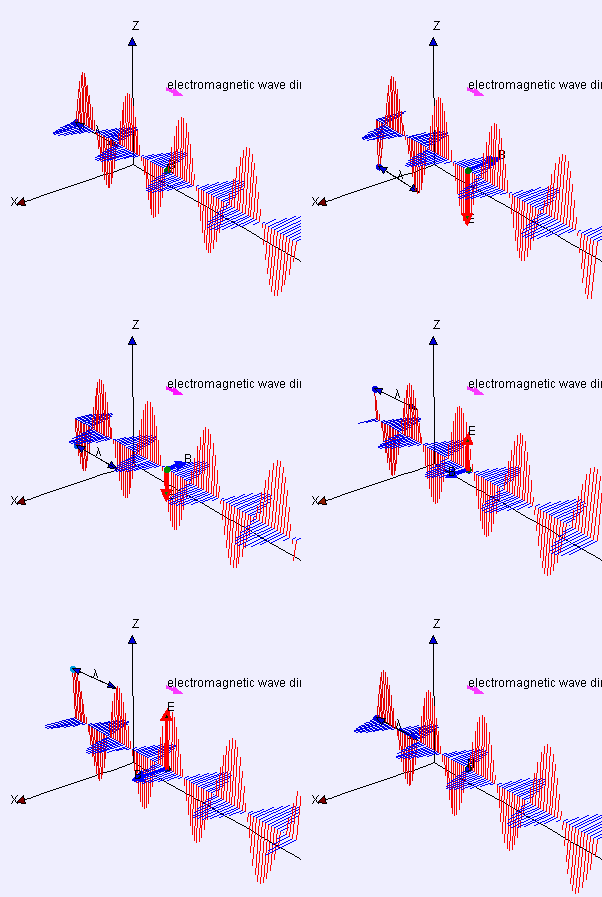
Plane‑polarized Lorentz (electromagnetic) wave
 Electric (E) component is red
 Magnetic (B) component is blue
(Image by Loo Kang Wee and Fu-Kwun Hwang from Wikimedia Commons)
Licensed under CC ASA3.0 Unported

“Deal. You go first.”

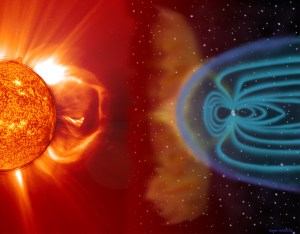
<displaying an animation on Old Reliable> “We’ll have to flip between microscopic and macroscopic a couple times. Here’s the ultimate micro — a single charged particle bouncing up and down somewhere far away has generated this Lorentz‑force wave traveling all alone in the Universe. The force has two components, electric and magnetic, that travel together. Neither component does a thing until the wave encounters another charged particle.”

“An electron, right?”

“Could be but doesn’t have to be. All the electric component cares about is how much charge the particle’s carrying. The magnetic component cares about that and also about its speed and direction. Say the Lorentz wave is traveling east. The magnetic component reaches out perpendicular, to the north and south. If the particle’s headed in exactly the same direction, there’s no interaction. Any other direction, though, the particle’s forced to swerve perpendicular to both the field and the original travel. Its path twists up- or downward.”

“But if the particle swerves, won’t it keep swerving?”

“Absolutely. The particle follows a helical path until the wave gives out or a stronger field comes along.”

“Wait. If a Lorentz wave redirects charge motion and moving charges generate Lorentz waves, then a swerved particle ought to mess up the original wave.”

“True. It’s complicated. You can simplify the problem by stepping back far enough that you don’t see individual particles any more and the whole assembly looks like a simple fluid. We’ve known for centuries how to do Physics with water and such. Newton invented hydrodynamics while battling the ghost of Descartes to prove that the Solar System’s motion was governed by gravity, not vortices in an interplanetary fluid. People had tried using Newton‑style hydrodynamics math to understand plasma phenomena but it didn’t work.”

<grinning> “I don’t imagine it would — all that twistiness would have thrown things for a loop.”

“Haha. Well, in the early 1940s Swedish physicist Hannes Alfven started developing ideas and techniques, extending hydrodynamics to cover systems containing charged particles. Their micro‑level electromagnetic interactions have macro‑level effects.”

“Like what?”

“Those aurora curtains up there. Alfven showed that in a magnetic field plasmas can self‑organize into what he called ‘double layers’, pairs of wide, thin sheets with positive particles on one side against negative particles in the other. Neither sheet is stable on its own but the paired‑up structure can persist. Better yet, plasma magnetic fields can support coherent waves like the ones making that curtain ripple.”

“Any plasma?”

“Sure.”

“Most of the astronomical objects I show my students are associated with plasmas — the stars themselves, of course, but also the planetary nebulae that survive nova explosions, the interstellar medium in galactic star‑forming regions, the Solar wind, CMEs…”

“Alfven said we can’t understand the Universe unless we understand magnetic fields and electric currents.”

~ Rich Olcott

Colors Made of Air

Teena’s whirling around in the night with her head thrown back. “I LUVV AURORAS!! They’re SO beautiful beautiful beautiful!”

“Yes, they are, Teena. They’re beautiful and magical, and for me it’s even better because they’re Physics at work right in front of us. Well, above us.”

“Oh, Sy, give it a rest.”

“No, really, Sis. I look at a rainbow and I’m dazzled by its glory against the rainclouds but I’m also aware that each particular glimpse of pure color comes to me by refraction through one individual droplet. Better yet, I appreciate the geometry that presents the entire spectrum in perfectly circular arcs. Marvels supported by underlying marvels. These curtains are another example of beauty emerging from hidden sources.”

“What do you mean?”

“Remember Teena’s teacher’s magnetic force lines that were organized and revealed by iron filings? Auroras are a bit like that, except one level deeper. Again we don’t see magnetic fields directly. What we do see is light coming to us from oxygen and nitrogen atoms that are bombarded by rampaging charged particles.”

“Wait, Uncle Sy, we learned that charges make magnetic fields when they move.”

“That, too. It works both ways, which is why they call it electromagnetism. A magnetic field steers protons and electrons which make their own field to push back on the first one. But my point is, the colors in each curtain and the curtains themselves tell us about the current state of the atmosphere and Earth’s magnetic field.”

“Okay, I can see how magnetic fields up there could steer charged particles to certain parts of the sky, but how does that tell us about the atmosphere? What do the colors have to do with it? Is this more rainbows and geometry?”

“Definitely not. Sis. Rainbows are sunlight refracted through water droplets. Aurora light’s emitted by atoms in our own atmosphere. Each color is like a fingerprint of a specific atom in specific circumstances. The uppermost reds, for instance come from oxygen atoms that rarely touch another atom of any kind. They’re at 150 or more kilometers altitude, way above the stratosphere. There aren’t many of them that far up which is why the curtain tops sort of fade away into infinity.”

“Oooo, now it’s going green and yellow!”

“Mm-hm, the bombardment’s reaching further now. Excited oxygen atoms emit green lower down in the atmosphere where collisions happen more often and don’t give the red‑emitters a chance to do their thing. The in‑between yellow isn’t really there — it’s what your eye tells you when it sees pure red and pure green overlapping.”

“Why do the curtains have that sharp lower edge, Sy? Surely we don’t run out of oxygen there.”

“Quite the reverse. That level’s about 100 kilometers up. It’s where the atmosphere gets so thick that collisions drain away an excited atom’s energy before it gets a chance to shine.”

“But why are there curtains at all? Why not simply fill the sky with a smooth color wash?”

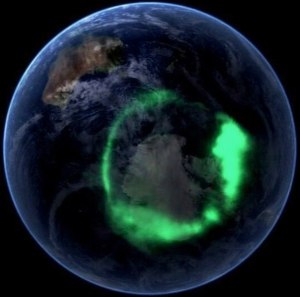
“Mars gets auroras like that, or at least Perseverance just spotted one. We don’t, thanks to our well‑ordered magnetic field. Mars’ field is lumpy and too weak to funnel incoming charged particles to special spots like our poles. Actually, those curtains are just segments of rings that go all around Earth’s magnetic axis. The rings usually lurk about 2/3 of the way to our poles but a really strong solar event like this one can push them closer to the Equator.”

“Mars gets auroras? Uncle Sy, how about other planets?”

“Them, too, but theirs mostly don’t look like ours. You’d have to be able to see X‑rays on Mercury, for instance. Venus gets a general green glow for the same reason that Mars does. Jupiter is Texas for the Solar System — everything’s bigger there, including auroras in every color from X‑ray to infrared. Strong ordered field, so I’m sure there’s curtains up there.”

Sis yanks out her writer’s‑companion notebook and scribbles without looking down…
  ”Curtains made of colors
   Colors made of air.

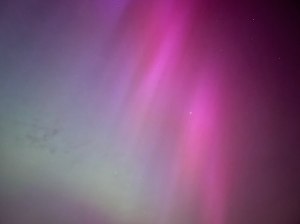
Aurora, photo by Bellezzasolo
licensed under CC BY-SA 4.0

~ Rich Olcott
Sky Lights

“Mom! Uncle Sy! Come outside NOW before it goes away!”

“Whah— oooh!”
 ”An aurora! Thanks for calling us.”

“Glowing curtains rippling across the sky! Spotlights shining down through them! Where do those come from?”

“From the Sun, Teena.”

“C’mon, Sy. The Sun’s 93 million miles away. Even if that bright streak up there is as much as 10 miles across, which I doubt, the beam from the Sun would be only a teeny‑tiny fraction of a degree wide. Not even magnetars send out anything that narrow.”

“Didn’t say it’s a beam, Sis. The whole display comes from the Sun as single package. Sort of. Sometimes.”

“Even for you, little brother, that’s a new level of weasel‑wording.”

“Well, it’s complicated.”

“So unravel it. Start from the beginning.”

“Okay. The Sun’s covered in plasma—”

“Eww!”

“Not that kind of plasma, Teena. This is mostly hydrogen atoms except they’re so hot that the electrons and protons break away from each other and travel separately. What have they told you in school about magnets?”

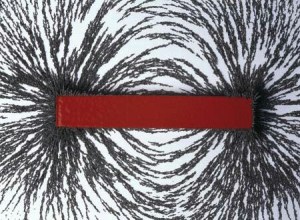
“Not much. Umm … electric currents push on magnets and that’s how motors work, and magnets push on electrons and that’s how a generator works. Oh, and Mr Cox laid a sheet of paper on top of a magnet and sprinkled iron filings on it so we could see the lines of force, but when I asked him what made the magnetism ’cause I didn’t see any wires he started talking about electrons in iron atoms and then the bell rang and I had to go to Spanish class.”

The shape of the bar magnet’s field, disclosed by iron filings chaining together.

<sigh> “The clock rules, doesn’t it? Anyway, he was on the right track, but I want to get back to those lines of force. Were they there before he sprinkled on those filings?”

“Mmm … Mom would say, ‘That’s a good question,’ but how could you know? I’m gonna say they were.”

“Your Mom would be right, but sorry, you’re wrong. With no iron filings in the picture, the magnetic field is nice and smooth, everywhere just the same or maybe only a little bit stronger or weaker than neighboring points. No lines. Conditions change when you put the first bit of iron anywhere in the field. As Mr Cox was probably saying when the bell interrupted, the electrons in the grain’s iron atoms align orbitals with the magnetic field. The alignment affects the surrounding field and that pulls in other iron bits that change the field even more.”

“But wouldn’t that make just a solid iron blob?”

“No, because a magnetic field has both strength and direction. Once the first particle points along the field, the iron bits it recruits rotate to point mostly in the same direction. You wind up with a chain of specks tracing out where they’ve acted together to alter the field. The chain’s surrounded by spaces where the field’s been stressed.”

“And then lotsa chains make lotsa lines, yeah!”

“I see where you’re headed, Sy. You’re going to claim that the vertical lines we see in the curtains trace out the Sun’s magnetic field.”

“Not quite, Sis. There’s only one magnetic field, a combination of Earth’s field, the Sun’s field, and the magnetic fields contained in whatever the Sun throws our way. Way out here Earth’s field is about ten thousand times stronger than the Sun’s is, but the fields inside a CME can range up to 10% or 20% of Earth’s. The moving curtains up there are the result of a magnetic tussle between us and a CME or maybe a flare’s outflow.”

“But there aren’t any iron filings up there, Uncle Sy!”

“True, but there are free charged particles in the ionosphere thanks to UV radiation from the Sun. A free electron caught in a magnetic field whips into a tight spiral. Its field gets neighbor particles spiraling. Pretty soon you wind up with a chain of them spiraling together, lining up like the filings do.”

“The spotlights?”

“Probably ion blobs embedded in the CME, but that’s a guess.”

Aurora, photo by W.carter
licensed under CC BY-SA 4.0

~ Rich Olcott
Not Silly-Season Stuff, Maybe

“Keep up the pace, Mr Feder, air conditioning is just up ahead.”

“Gotta stop to breathe, Moire, but I got just one more question.”

“A brief pause, then. What’s your question?”

“What’s all this about LK99 being a superconductor? Except it ain’t? Except maybe it is? What is LK99, anyway, and how do superconductors work? <puffing>”

“So many question marks for just one question. Are you done?”

“And why do news editors care?”

“There’s lots of ways we’d put superconductivity to work if it didn’t need liquid‑helium temperatures. Efficient electric power transmission, portable MRI machines, maglev trains, all kinds of advances, maybe even Star Trek tricorders.”

“Okay, I get how zero‑resistance superconductive wires would be great for power transmission, but how do all those other things have anything to do with it?”

“They depend on superconductivity’s conjoined twin, diamagnetism.”

Dia—?”

“Means ‘against.’ It’s sort of an application of Newton’s Third Law.”

“That’s the one says, ‘If you push on the Universe it pushes back,’ right?”

“Very good, Mr Feder. In electromagnetism that’s called Lenz’ Law. Suppose you bring a magnet towards some active conductor, say a moving sheet of copper. Or maybe it’s already carrying an electric current. Either way, the magnet’s field makes charge carriers in the sheet move perpendicular to the field and to the prevailing motion. That’s an eddy current.”

“How come?”

“Because quantum and I’m not about to get into that in this heat. Emil Lenz didn’t propose a mechanism when he discovered his Law in 1834 but it works. What’s interesting is what happens next. The eddy current generates its own magnetic field that opposes your magnet’s field. There’s your push‑back and it’s called diamagnetism.”

“I see where you’re going, Moire. With a superconductor there’s zero resistance and those eddy currents get big, right?”

“In theory they could be infinite. In practice they’re exactly strong enough to cancel out any external magnetic field, up to a limit that depends on the material. A maglev train’s superconducting pads would float above its superconducting track until someone loads it too heavily.”

“What about portable MRI you said? It’s not like someone’s gonna stand on one.”

“A portable MRI would require a really strong magnet that doesn’t need plugging in. Take that superconducting sheet and bend it into a doughnut. Run your magnet through the hole a few times to start a current. That current will run forever and so will the magnetic field it generates, no additional power required. You can make the field as strong as you like, again within a limit that depends on the material.”

“Speaking of materials, what’s the limit for that LK99 stuff?”

“Ah, just in time! Ahoy, Susan! Out for a walk yourself, I see. We’re on our way to Al’s for coffee and air conditioning. Mr Feder’s got a question that’s more up your Chemistry alley than my Physics.”

“LK99, right? It’s so newsy.”

“Yeah. What is it? Does it superconduct or not?”

“Those answers have been changing by the week. Chemically, it’s basically lead phosphate but with copper ions replacing some of the lead ions.”

“They can do that?”

“Oh yes, but not as neatly as we’d like. Structurally, LK99’s an oxide framework in the apatite class — a lattice of oxygens with phosphorus ions sitting in most of the holes in the lattice, lead ions in some of the others. Natural apatite minerals also have a sprinkling of hydroxides, fluorides or chlorides, but the reported synthesis doesn’t include a source for any of those.”

“Synthesis — so the stuff is hand‑made?”

“Mm‑hm, from a series of sold‑state reactions. Those can be tricky — you grind each of your reactants to a fine powder, mix the powders, seal them in a tube and bake at high temperature for hours. The heat scrambles the lattices. The atoms can settle wherever they want, mostly. I think that’s part of the problem.”

“Like maybe they don’t?”

“Maybe. There are uncontrollable variables — grinding precision, grain size distribution, mixing details, reaction tube material, undetected but critical impurities — so many. That’s probably why other labs haven’t been able to duplicate the results. Superconductivity might be so structure‑sensitive that you have to prepare your sample j‑u‑s‑t right.”

~~ Rich Olcott

The Tale of A Nail

“Wait, Sy, let me get my head around that hysteresis loop diagram. You got my iron nail starting at that red dot because it’s not magnetized yet so that’s zero on the up‑down magnetism deviation scale, right? And it’s also zero on the left‑right driver scale because we’re not laying a magnetic field on it.”

“Yup, that’s the starting point, Vinnie.”

“OK, then we turn on the outside field and if it’s strong enough the nail gets magnetic, too, and so we travel up the red line. But the line’s not straight, it’s bendy. Why ain’t it straight?”

“To keep this specific, I’ll stick to the current theory for magnetization of iron. At point zero the individual iron atoms have their personal magnetic fields in completely random orientations. What we measure outside the nail is the average of all of that, which nets out to zero. Now we turn on the external magnetic field a little bit at a time so we can measure the effect. You remember we said that the iron atoms in a magnet are organized in domains.”

“Sure. I don’t forget easy.”

“I’ve noticed. OK, that upward bend at the beginning is slow increase in the nail’s magnetization while those domains are forming up. First a few atoms in one small area orient their local fields relative to the external field. Their combined field influences neighboring atoms to join in. The process is called nucleation because those first few atoms form the nucleus of a domain. The nucleus gains strength by recruiting more atoms, making it an even stronger recruiter. The red line rises exponentially until there aren’t any more unrecruited atoms.”

“That’s the end of the upward bend, huh?”

“Mm-hm, now we enter the linear phase and a different magnetization process. Energy in the external field feeds the domains pointed parallel to it at the expense of domains at a different angle. Domain growth is roughly linear with applied field strength. That line would like to stay straight but nothing goes on forever except maybe the Universe. Sooner or later the domains start running out of room to grow into. Increasing the driver strength doesn’t produce any further effect and we say that the nail’s magnetic field is saturated.”

“That makes sense. Let’s see if I can figure the blue loop from where the head end is north. The number 2 arrow says that if we dial down the driver, that’s the outside field and we’re moving to the left, when we get to zero the deviation, that’s the nail’s field, is still going strong and we got a permanent magnet. If we adjust the outside field leftward beyond zero that kills off the nail’s field … Hey, so the backward domains are eating the forward ones, right?”

“Probably. Depends on the material. Not good to ride the theory too far without checking the experimental data but that’d be my guess.”

“OK, so we drive those little domains until they saturate with the head end south. When we dial down the driver’s field backward strength we move to the right and the nail climbs the number 3 curve. The driver field returns to zero but the nail’s still a backward permanent magnet. We push the driver and the nail to forward saturation again and we can go loop‑de‑loop. But we never go through the red dot again — either the nail’s a permanent magnet when the driver’s zero or it not a magnet while the driver’s strong but they’re never both zero again.”

“Unless we scramble all the domains by heating the nail white-hot and letting it cool away from any external fields.”

“You know what’s missing from that picture, Sy?”

I’d wondered if he’d spot it. “I’ll bite. What?”

“Numbers. Up‑down is how strong the magnet is, right, but I know my knife‑holder magnets are a lot stronger than my calendar marker magnets. And the side‑to‑side part is about how well the stuff holds its magnetism. What’s the theory that puts numbers on the graph?”

“Sorry to tell you this given your math aversion, Vinnie, but the numbers are buried in big, thick books with equations in them. Pictures can only get you so far.”

~~ Rich Olcott

Futile? Nope, Just Zero

“Megabar superconductivity.”

“Whoa, Susan. Too much information, too few words. Could you unpack that, please?”

“No problem, Sy. A bar is the barometric pressure (get it?) at sea level. A megabar is—”

“A million atmospheres, right?”

“Right, Al. So Ranga Dias and his crew were using their Diamond Anvil Cells to put their chemical samples under million-atmosphere pressures while they tested for superconductivity—”

“Like Superman uses?”

“Is he always like this, Sy?”

“Just when he gets excited, Susan. The guy loves Science, what can I say?”

“Sorry, Susan. So what makes conductivity into superconductivity?”

“Excellent question, Al. Answering it generated several Nobel Prizes and we still don’t have a complete explanation. I can tell you the what but I can’t give you a firm why. Mmm… what do you know about electrical resistance?”

“Just what we got in High School General Science. We built a circuit with a battery and a switch and an unknown resistor and a meter to measure the current. We figured the resistance from the voltage divided by the current. Or maybe the other way around.”

“You got it right the first try. The voltage drop across a resistor is the current times the resistance, V=IR so V/I=R. That’s for ordinary materials under ordinary conditions. But early last century researchers found that for many materials, if you get them cold enough the resistance is zero.”

“Zero? But … if you put any voltage across something like that it could swallow an infinite amount of current.”

“Whoa, Al, what’s my motto about infinities?”

“Oh yeah, Sy. ‘If your theory contains an infinity, you’ve left out physics that would stop that.’ So what’d stop an infinite current here?”

“The resistor wasn’t the only element in your experimental circuit. Internal resistance within the battery and meter would limit the current. Those 20th-century researchers had to use some clever techniques to measure what they had. Back to you, Susan.”

“Thanks, Sy. I’m going to remember that motto. Bottom line, Al, superconductors have zero resistance but only under the right conditions. You start with your test material, with a reasonable resistance at some reasonable temperature, and then keep measuring its resistance as you slowly chill it. If it’s willing to superconduct, at some critical temperature you see the resistance abruptly drop straight down to zero. The critical temperature varies with different materials. The weird thing is, once the materials are below their personal critical temperature all superconductors behave the same way. It’s seems to be all about the electrons and they don’t care what kind of atom they rode in on.”

“Wouldn’t copper superconduct better than iron?”

“Oddly enough, pure copper doesn’t superconduct at all. Iron and lead both superconduct and so do some weird copper-containing oxides. Oh, and superconductivity has another funny dependency — it’s blocked by strong magnetic fields, but on the other hand it blocks out weaker ones. Under normal conditions, a magnetic field can penetrate deep into most materials. However, a superconducting piece of material completely repels the field, forces the magnetic lines to go around it. That’s called the Meissner effect and it’s quantum and—”

“How’s it work?”

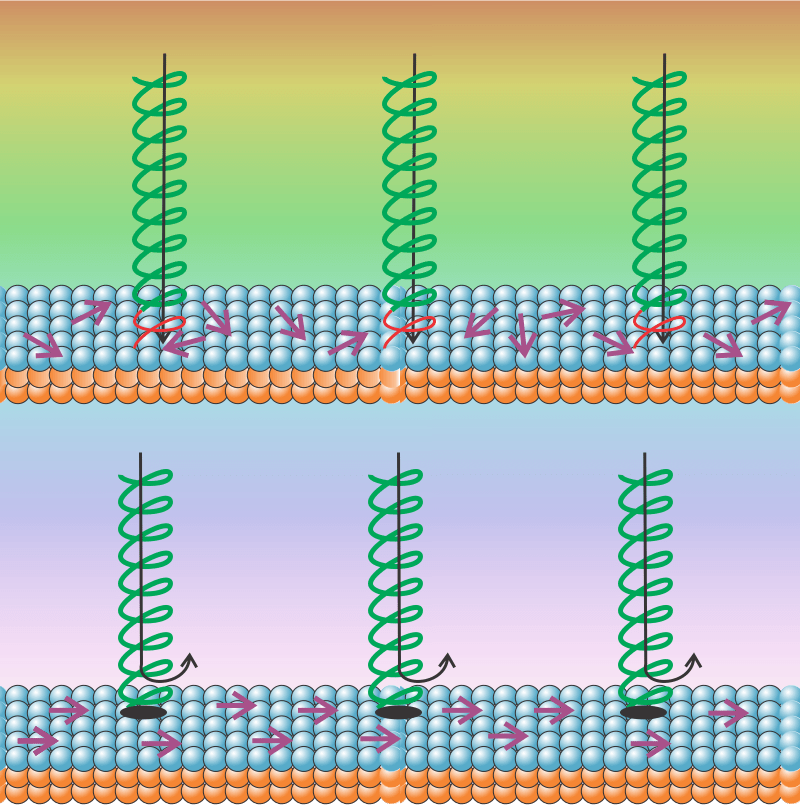
“Even though we’ve got a good theory for the materials with low critical temperature, the copper oxides and such are still a puzzle. Here’s a diagram I built for one of my classes…”

“The top half is the ordinary situation, like in a copper wire. Most of the current is carried by electrons near the surface, but there’s a lot of random motion there, electrons bouncing off of impurities and crystal defects and boundaries. That’s where ordinary conduction’s resistance comes from. Compare that with the diagram’s bottom half, a seriously simplified view of superconduction. Here the electrons act like soldiers on parade, all quantum‑entangled with each other and moving as one big unit.”

“The green spirals?”

“They represent an imposed magnetic field. See the red bits diving into the ordinary conductor? But the superconducting parade doesn’t make space for the circular motion that magnetism tries to impose. The force lines just bounce off. Fun fact — the supercurrent itself generates a huge magnetic field but only outside the superconductor.”

“How ’bout that? So how is megabar superconductivity different?”

~~ Rich Olcott

The Currant Affair

Al has a new sign up at his coffee shop, “Scone of the day — Current.” He chuckles when I quietly point out the spelling error. “I know how to spell currant, Sy. I’m just gonna enjoy telling people that whatever I’m taking from the oven is the current flavor.” I’m high-fiving him for that, just as Vinnie slams in and yells out, “Hey, Al, you got your sign spelled wrong. Got any cranberry ones in there?”

Al gives me a look. I shrug. Vinnie starts in on me. “Hey, Sy, that was pretty slick what that Kibble guy did. All the measurements and calculations had the mass standard depending on three universal constants but then suddenly there was only two.”

Al pricks up his ears. “Universal constants, Sy?”

“We think so. Einstein said that the speed of light c is the same everywhere. That claim has withstood a century of testing so the International Bureau of Weights and Measures took that as their basis when they redefined the meter as the standard of length. Planck’s constant h is sometimes called the quantum of action. It shows up everywhere in quantum-related phenomena and appears to be fundamental to the way the Universe works. Bryan Kibble’s team created a practical way to have a measure-anywhere standard of mass and it just happens to depend only on having good values for c and h.”

“What’s the one that Vinnie said dropped out?”

“I knew you’d ask that, Al. It’s e, the charge on an electron. The proton and every other sub-atomic particle we’ve measured has a charge that’s some integer multiple of e. Sometimes the multiplier is one, sometimes it’s zero, sometimes it’s a negative, but e appears to be a universal quantum of charge. Millikan’s oil drop experiment is the classic example. He measured the charge on hundreds of ionized droplets floating in an electric field between charged plates. Every droplet held some integer multiple between 1 and 150 of 1.6×10⁻¹⁹ Coulomb.”

“That’s a teeny bit of electricity. I remember from Ms Kendall’s class that one coulomb is one ampere flowing for one second. Then a microampere flowing for a microsecond is, uhh, 6 million electrons. How did they make that countable?”

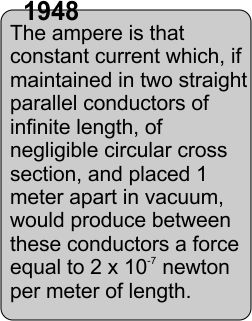
“Ah, you’ve just touched on the ‘realization problem,’ which is not about getting an idea but about making something real, turning a definition into a practical measurement. Electrical current is a good example. Here’s the official definition from 60 years ago. See any problems with it, Vinnie?”

“Infinitely long wires that are infinitely thin? Can’t do it. That’s almost as goofy as that 1960 definition of a second. And how does the force happen anyway?”

“The force comes from electrons moving in each wire electromagnetically pushing on the electrons in the other wire, and that’s a whole other story. The question here is, how could you turn those infinities into a real measurement?”

“Lemme guess. In the 1960 time standard they did a math trick to model a fake Sun and based the second on how the fake Sun moves. Is this like that, with fake wires?”

“Nice shot, Vinnie. One of the methods worked like that — take a pair of wires with a known resistance, bend them along a pair of parabolas or some other known curve set close together, apply a voltage and measure the force. Then you use Maxwell’s equations to ‘correct’ the force to what it would have been with the infinite wires the right distance apart. Nobody was comfortable with that.”

“Not surprised — too many ways to do it wrong, and besides, that’s an awfully small force to measure.”

“Absolutely. Which is why there were so many competing standards, some dating back to the 1860s when we were still trying to figure out what electricity is. Some people used a standard resistor R and the voltage V from a standard chemical cell. Then they defined their standard current I from I=V/R. Some measured power P and calculated I2=P/R. Other people standardized charge from the electrostatic force F=q1q2/r2 between two charged objects; they defined current as charge passed per second. It was a huge debate.”

“Who won?”

“Charge and R and V, all playing together and it’s beautiful.”

~~ Rich Olcott