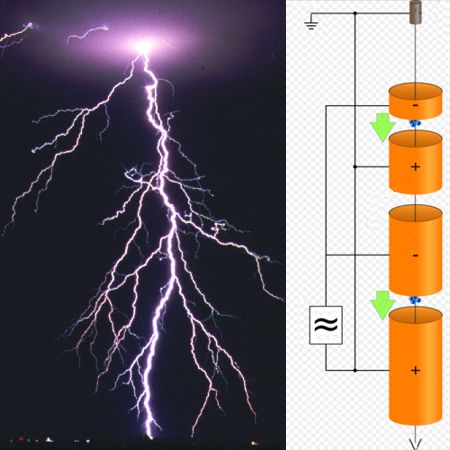
Lighting and a diagram of a linac

Curiosity in The Internet Market

“I got another question, Moire.”

“Of course you do, Mr Feder.  Let’s hear it.”

“I read on the Internet that there’s every kind of radioactivity coming out of lightning bolts.  So is that true, how’s it happen and how come we’re not all glowing in the dark?”

“Well, now, like much else you read on the Internet there’s a bit of truth in there, and a bit of not-truth, all wrapped up in hype.  The ‘every kind of radioactivity’ part, for instance, that’s false.”

“Oh yeah?  What’s false about that?”

“Kinds like heavy-atom fission and alpha-particle ejection.  Neither have been reported near lightning strikes and they’re not likely to be.  Lightning travels through air.  Air is 98% nitrogen and oxygen with a sprinkling of light atoms.  Atoms like that don’t do those kinds of radioactivity.”

“So what’s left?”

“There’s only two kinds worth worrying about — beta decay, where the nucleus spits out an electron or positron, and some processes that generate gamma-rays.  Gamma’s a high-energy photon, higher even than X-rays.  Gamma photons are strong enough to ionize atoms and molecules.”

“You said ‘worth worrying about.’  I like worrying.  What’s in the not-worth-it bucket?”

“Neutrinos.  They’re so light and interact so little with matter that many physicists think of them as just an accounting device.  Trillions go through you every second and you don’t notice and neither do they.  Really, don’t worry about them.”

“Easy for you to say.  Awright, so how does lightning make the … I guess the beta and gamma radioactivity?”

“We know the general outlines, although a lot of details have yet to be filled in.  What do you know about linear accelerators?”

“Not a clue.  What is one?”

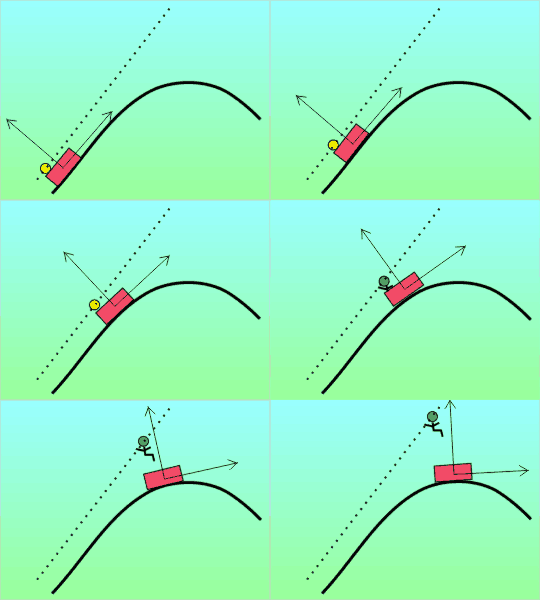
Lighting and a diagram of a linac
Linac diagram adapted from
Sgbeer – Own work, CC BY-SA 3.0

“It’s a technology for making high-energy electrons and other charged particles.  Picture a straight evacuated pipe equipped with ring electrodes at various distances from the source end.  The source could be an electron gun or maybe a rig that spits out ions of some sort.  Voltages between adjacent electrodes downstream of a particle will give it a kick when it passes en route to the target end.  By using the right voltages at the right times you can boost an electron’s kinetic energy into the hundred-million-eV range.  That’s a lot of kinetic energy.  Got that picture?”

“Suppose that I do.  Then what?”

“Lightning is the same thing but without the pipe and it’s not straight.  The electrons have an evacuated path, because plasma formation drives most of the molecules out of there.  Activity inside the clouds gives them high voltages, up to a couple hundred megavolts.  But on top of that there’s bremsstrahlung.”

“Brem…?”

Bremsstrahlung — German for braking radiation.  You know how your car’s tires squeal when you make a turn at speed?”

“One of my favorite sounds, ‘specially when … never mind.  What about it?”

“That’s your tires converting your forward momentum into sound waves.  Electrons do that, too, but with electromagnetism.  The lightning path zigs and zags.  An electron’s path has to follow suit.  At each swerve, the electron throws off some of its kinetic energy as an electromagnetic wave, otherwise known as a photon.  Those can be very high-energy photons, X-rays or even gamma-rays.”

“So that’s where the gammas come from.”

“Yup.  But there’s more.  Remember those nitrogen atoms?  Ninety-nine-plus percent of them are nitrogen-14, a nice, stable isotope with seven protons and seven neutrons.  If a sufficiently energetic gamma strikes a nitrogen-14, the atom’s nucleus can kick out a neutron and turn into unstable nitrogen-13.  That nucleus emits a positron to become stable carbon-13.  So you’ve got free neutrons and positrons to add to the radiation list.”

“With all that going on, how come I’m not glowing in the dark?”

“‘Because the radiation goes away quickly and isn’t contagious.  Most of the neutrons are soaked up by  hydrogen atoms in passing water molecules (it’s raining, remember?).  Nitrogen-13 has a 10-minute half-life and it’s gone.  The remaining neutrons, positrons and gammas can ionize stuff, but that happens on the outsides of molecules, not in the nuclei.  Turning things radioactive is a lot harder to do.  Don’t worry about it.”

“Maybe I want to.”

“Your choice, Mr Feder.”

~~ Rich Olcott

Ya got potential, kid, but how much?

Dusk at the end of January, not my favorite time of day or year.  I was just closing up the office when I heard a familiar footstep behind me.  “Hi, Vinnie.  What’s up?”

“Energy, Sy.”

“Energy?”

“Energy and LIGO.  Back in flight school we learned all about trading off kinetic energy and potential energy.  When I climb I use up the fuel’s chemical energy to gain gravitational potential energy.  When I dive I convert gravitational potential energy into  kinetic energy ’cause I speed up.  Simple.”

“So how do you think that ties in with LIGO?”

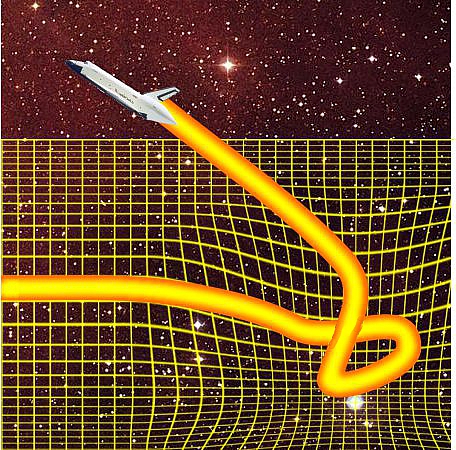
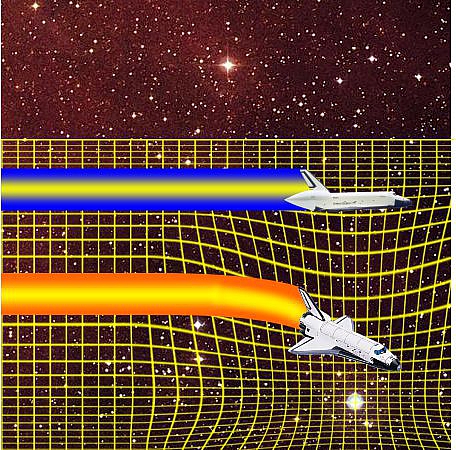
“OK, back when we pretended we was in those two space shuttles (which you sneaky-like used to represent photons in a LIGO) and I got caught in that high-gravity area where space is compressed, we said that in my inertial frame I’m still flying at the same speed but in your inertial frame I’ve slowed down.”

“Yeah, that’s what we worked out.”

“Well, if I’m flying into higher gravity, that’s like diving, right, ’cause I’m going where gravity is stronger like closer to the Earth, so I’m losing gravitational potential energy.  But if I’m slowing down I’ve gotta be losing kinetic energy, too, right?  So how can they both happen?  And how’s it work with photons?”

“Interesting questions, Vinnie, but I’m hungry.  How about some dinner?”shuttle-escape-1

We took the elevator down to Eddie’s pizza joint on the second floor.  I felt heavier already.  We ordered, ate and got down to business.

“OK, Vinnie.  Energy with photons is different than with objects that have mass, so let’s start with the flying-objects case.  How do you calculate gravitational potential energy?”

“Like they taught us in high school, Sy, ‘little g’ times mass times the height, and ‘little g’ is some number I forget.”

“Not a problem, we’ll just suppose that ‘little g’ times your plane’s mass is some convenient number, like 1,000.  So your gravitational potential energy is 1000×height, where the height’s in feet and the unit of energy is … call it a fidget.  OK?”

“Saves having to look up that number.”

sfo-to-den
Vinnie’s route, courtesy of Google Earth

“Fine.  Let’s suppose you’re flying over San Francisco Bay and your radar altimeter reads 20,000 feet.  What’s your gravitational potential energy?”

“Uhh… twenty million fidgets.”

“Great.  You maintain level flight to Denver.  As you pass over the Rockies you notice your altimeter now reads 6,000 feet because of that 14,000-foot mountain you’re flying over.  What’s your gravitational potential energy?”

“Six million fidgets.  Or is it still twenty?”

“Well, if God forbid you were to drop out of the sky, would you hit the ground harder in California or Colorado?”

“California, of course.  I’d fall more than three times as far.”

“So what you really care about isn’t some absolute amount of potential energy, it’s the relative amount of smash you experience if you fall down this far or that far.  ‘Height’ in the formula isn’t some absolute height, it’s height above wherever your floor is.  Make sense?”

“Mm-hm.”

“That’s an essential characteristic of potential energy — electric, gravitational, chemical, you name it.   It’s only potential.  You can’t assign a value without stating the specific transition you’re interested in.  You don’t know voltages in a circuit until you put a resistance between two specific points and meter the current through it.  You don’t know gravitational potential energy until you decide what location you want to compare it with.”

“And I suppose a uranium atom’s nuclear energy is only potential until a nuke or something sets it off.”

“You got the idea.  So, when you flew into that high-gravity compressed-space sector, what happened to your gravitational potential energy?”

“Like I said, it’s like I’m in a dive so I got less, right?”

“Depends on what you’re going to fall onto, doesn’t it?”

“No, wait, it’s definitely less ’cause I gotta use energy to fly back out to flat space.”

“OK, you’re comparing here to far away.  That’s legit.  But where’s that energy go?”

“Ahh, you’re finally getting to the kinetic energy side of my question –”

“Whoa, look at the time!  Got a plane to catch.  We’ll pick this up next week.  Bye.”

“Hey, Sy, your tab! …  Phooey, stuck for it again.”

~~ Rich Olcott

Three ways to look at things

A familiar shadow loomed in from the hallway.

“C’mon in, Vinnie, the door’s open.”

“I brought some sandwiches, Sy.”

“Oh, thanks, Vinnie.”

“Don’t mention it.    An’ I got another LIGO issue.”

“Yeah?”

“Ohh, yeah.  Now we got that frame thing settled, how does it apply to what you wrote back when?  I got a copy here…”

The local speed of light (miles per second) in a vacuum is constant.  Where space is compressed, the miles per second don’t change but the miles get smaller.  The light wave slows down relative to the uncompressed laboratory reference frame.

“Ah, I admit I was a bit sloppy there.  Tell you what, let’s pretend we’re piloting a pair of space shuttles following separate navigation beams that are straight because that’s what light rays do.  So long as we each fly a straight line at constant speed we’re both using the same inertial frame, right?”

“Sure.”

“And if a gravity field suddenly bent your beam to one side, you’d think you’re still flying straight but I’d think you’re headed on a new course, right?”

“Yeah, because now we’d have different inertial frames.  I’d think your heading has changed, too.”two-shuttles

“So what does the guy running the beams see?”

“Oh, ground-pounders got their own inertial frame, don’t they?  Uhh… He sees me veer off and you stay steady ’cause the gravity field bent only my beam.”

“Right — my shuttle and the earth-bound observer share the same inertial frame, for a while.”

“A while?”

“Forever if the Earth were flat because I’d be flying straight and level, no threat to the shared frame.  But the Earth’s not flat.  If I want to stay at constant altitude then I’ve got to follow the curve of the surface rather than follow the light beam straight out into space.  As soon as I vector downwards I have a different frame than the guy on the ground because he sees I’m not in straight-line motion.”

“It’s starting to get complicated.”

“No worries, this is as bad as it gets.  Now, let’s get back to square one and we’re flying along and this time the gravity field compresses your space instead of bending it.  What happens?  What do you experience?”

“Uhh… I don’t think I’d feel any difference.  I’m compressed, the air molecules I breath are compressed, everything gets smaller to scale.”

“Yup.  Now what do I see?  Do we still have the same inertial frame?”

“Wow.  Lessee… I’m still on the beam so no change in direction.  Ah!  But if my space is compressed, from your frame my miles look shorter.  If I keep going the same miles per second by my measure, then you’ll see my speed drop off.”

“Good thinking but there’s even more to it.  Einstein showed that space compression and time dilation are two sides of the same phenomenon.  When I look at you from my inertial frame, your miles appear to get shorter AND your seconds appear to get longer.”

“My miles per second slow way down from the double whammy, then?”

“Yup, but only in my frame and that other guy’s down on the ground, not in yours.”

“Wait!  If my space is compressed, what happens to the space around what got compressed?  Doesn’t the compression immediately suck in the rest of the Universe?”

“Einstein’s got that covered, too.  He showed that gravity doesn’t act instantaneously.  Whenever your space gets compressed, the nearby space stretches to compensate (as seen from an independent frame, of course).  The edge of the stretching spreads out at the speed of light.  But the stretch deformation gets less intense as it spreads out because it’s only offsetting a limited local compression.”

“OK, let’s get back to LIGO.  We got a laser beam going back and forth along each of two perpendicular arms, and that famous gravitational wave hits one arm broadside and the other arm cross-wise.  You gonna tell me that’s the same set-up as me and you in the two shuttles?”

“That’s what I’m going to tell you.”

“And the guy on the ground is…”

“The laboratory inertial reference.”

“Eat your sandwich, I gotta think about this.”

(sounds of departing footsteps and closing door)

“Don’t mention it.”

~~ Rich Olcott

A Shift in The Flight

I heard a familiar squeak from the floorboard outside my office.

“C’mon in, Vinnie, the door’s open.  What can I do for you?”

“I still got problems with LIGO.  I get that dark energy and cosmic expansion got nothin’ to do with it.  But you mentioned inertial frame and what’s that about?”

earth-moon“Does the Moon go around the Earth or does the Earth go around the Moon?”
“Huh?  Depends on where you are, I guess.”

“Well, there you are.”

“Waitaminnit!  That can’t be all there is to it!”

“You’re right, there’s more.  It all goes back to Newton’s First Law.”  (showing him my laptop screen)  “Here’s how Wikipedia puts it in modern terms…”

In an inertial reference frame, an object either remains at rest or continues to move at a constant velocity, unless acted upon by a net force.

“That’s really a definition rather than a Law.  If you’re looking at an object and it doesn’t move relative to you or else it’s moving at constant speed in a straight line, then you and the object share the same inertial frame.  If it changes speed or direction relative to you, then it’s in a different inertial frame from yours and Newton’s Laws say that there must be some force that accounts for the difference.”

“So another guy’s plane flying straight and level with me has a piece of my inertial frame?”

“Yep, even if you’re on different vectors.  You only lose that linkage if either airplane accelerates or curves off.”

“So how’s that apply to LIGO’s laser beams?  I thought light always traveled in straight lines.”

“It does, but what’s a straight line?”

“Shortest distance between two points — I been to flight school, Sy.”

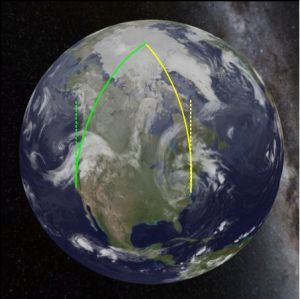
“Fine.  So if you fly from London to Mexico City on this globe here you’d drill through the Earth?”mex-atl-jfk-lgw

“Of course not, I’d take the Great Circle route that goes through those two cities.  It’s the shortest flight path.  Hey, how ’bout that, the circle goes through NYC and Atlanta, too.”

“Cool observation, but that line looks like a curve from where I sit.”

“Yeah, but you’re not sittin’ close to the globe’s surface.  I gotta fly in the flight space I got.”

“So does light.  Photons always take the shortest available path, though sometimes that path looks like a curve unless you’re on it, too.  Einstein predicted that starlight passing through the Sun’s gravitational field would be bent into a curve.  Three years later, Eddington confirmed that prediction.”

“Light doesn’t travel in a straight line?”

“It certainly does — light’s path defines what is a straight line in the space the light is traveling through.  Same as your plane’s flight path defines that Great Circle route.  A gravitational field distorts the space surrounding it and light obeys the distortion.”

“You’re getting to that ‘inertial frames’ stuff, aren’t you?”

“Yeah, I think we’re ready for it.  You and that other pilot are flying steady-speed paths along two navigation beams, OK?”

“Navigation beams are radio-frequency.”

“Sure they are, but radio’s just low-frequency light.  Stay with me.  So the two of you are zinging along in the same inertial frame but suddenly a strong gravitational field cuts across just your beam and bends it.  You keep on your beam, right?”

“I suppose so.”

“And now you’re on a different course than the other plane.  What happened to your inertial frame?”

“It also broke away from the other guy’s.”

“Because you suddenly got selfish?”

“No, ’cause my beam curved ’cause the gravity field bent it.”

“Do the radio photons think they’re traveling a bent path?”

“Uh, no, they’re traveling in a straight line in a bent space.”

“Does that space look bent to you?”

“Well, I certainly changed course away from the other pilot’s.”

“Ah, but that’s referring to his inertial frame or the Earth’s, not yours.  Your inertial frame is determined by how those photons fly, right?  In terms of your frame, did you peel away or stay on-beam?”

“OK, so I’m on-beam, following a straight path in a space that looks bent to someone using a different inertial frame.  Is that it?”

“You got it.”

(sounds of departing footsteps and closing door)

“Don’t mention it.”

~~ Rich Olcott

Breathing Space

It was December, it was cold, no surprise.  I unlocked my office door, stepped in and there was Vinnie, standing at the window.  He turned to me, shrugged a little and said, “Morning, Sy.”  That’s Vinnie for you.

“Morning, Vinnie.  What got you onto the streets this early?”

“I ain’t on the streets, I’m up here where it’s warm and you can answer my LIGO question.”

“And what’s that?”

“I read your post about gravitational waves, how they stretch and compress space.  What the heck does that even mean?”

gravwave
An array of coordinate systems
floating in a zero-gravity environment,
each depicting a local x, y, and z axis

“Funny thing, I just saw a paper by Professor Saulson at Syracuse that does a nice job on that.  Imagine a boxful of something real light but sparkly, like shiny dust grains.  If there’s no gravitational field nearby you can arrange rows of those grains in a nice, neat cubical array out there in empty space.  Put ’em, oh, exactly a mile apart in the x, y, and z directions.  They’re going to serve as markers for the coordinate system, OK?”

“I suppose.”

“Now it’s important that these grains are in free-fall, not connected to each other and too light to attract each other but all in the same inertial frame.  The whole array may be standing still in the Universe, whatever that means, or it could be heading somewhere at a steady speed, but it’s not accelerating in whole or in part.  If you shine a ray of light along any row, you’ll see every grain in that row and they’ll all look like they’re standing still, right?”

“I suppose.”

“OK, now a gravitational wave passes by.  You remember how they operate?”

“Yeah, but remind me.”

(sigh)  “Gravity can act in two ways.  The gravitational attraction that Newton identified acts along the line connecting the two objects acting on each other.  That longitudinal force doesn’t vary with time unless the object masses change or their distance changes.  We good so far?”
long-and-transverse-grav
“Sure.”

“Gravity can also act transverse to that line under certain circumstances.  Suppose we here on Earth observe two black holes orbiting each other.  The line I’m talking about is the one that runs from us to the center of their orbit.  As each black hole circles that center, its gravitational field moves along with it.  The net effect is that the combined gravitational field varies perpendicular to our line of sight.  Make sense?”

“Gimme a sec…  OK, I can see that.  So now what?”

“So now that variation also gets transmitted to us in the gravitational wave.  We can ignore longitudinal compression and stretching along our sight line.  The black holes are so far away from us that if we plug the distance variation into Newton’s F=m1m2/r² equation the force variation is way too small to measure with current technology.

“The good news is that we can measure the off-axis variation because of the shape of the wave’s off-axis component.  It doesn’t move space up-and-down.  Instead, it compresses in one direction while it stretches perpendicular to that, and then the actions reverse.  For instance, if the wave is traveling along the z-axis, we’d see stretching follow compression along the x-axis at the same time as we’d see compression following stretching along the y-axis.”

gravwave-2“Squeeze in two sides, pop out the other two, eh?”
“Exactly.  You can see how that affects our grain array in this video I just happen to have cued up.  See how the up-down and left-right coordinates close in and spread out separately as the wave passes by?”

“Does this have anything to do with that ‘expansion of the Universe’ thing?”

“Well, the gravitational waves don’t, so far as we know, but the notion of expanding the distance between coordinate markers is exactly what we think is going on with that phenomenon.  It’s not like putting more frosting on the outside of a cake, it’s squirting more filling between the layers.  That cosmological pressure we discussed puts more distance between the markers we call galaxies.”

“Um-hmm.  Stay warm.”

(sound of departing footsteps and door closing)

“Don’t mention it.”

~~ Rich Olcott

Does a photon experience time?

My brother Ken asked me, “Is it true that a photon doesn’t experience time?”  Good question.  As I was thinking about it I wondered if the answer could have implications for Einstein’s bubble.

When Einstein was a grad student in Göttingen, he skipped out on most of the classes given by his math professor Hermann Minkowski.  Then in 1905 Einstein’s Special Relativity paper scooped some work that Minkowski was doing.  In response, Minkowski wrote his own paper that supported and expanded on Einstein’s.  In fact, Minkowski’s contribution changed Einstein’s whole approach to the subject, from algebraic to geometrical.

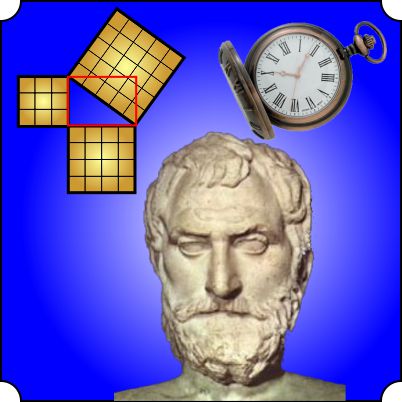
But not just any geometry, four-dimensional geometry — 3D space AND time.  But not just any space-AND-time geometry — space-MINUS-time geometry.  Wait, what?Pythagoras1

Early geometer Pythagoras showed us how to calculate the hypotenuse of a right triangle from the lengths of the other two sides. His a2+b2 = c2 formula works for the diagonal of the enclosing rectangle, too.

Extending the idea, the body diagonal of an x×y×z cube is √(x2+y2+z2) and the hyperdiagonal  of a an ct×x×y×z tesseract is √(c2t2+x2+y2+z2) where t is time.  Why the “c“?  All terms in a sum have to be in the same units.  x, y, and z are lengths so we need to turn t into a length.  With c as the speed of light, ct is the distance (length) that light travels in time t.

But Minkowski and the other physicists weren’t happy with Pythagorean hyperdiagonals.  Here’s the problem they wanted to solve.  Suppose you’re watching your spacecraft’s first flight.  You built it, you know its tip-to-tail length, but your telescope says it’s shorter than that.  George FitzGerald and Hendrik Lorentz explained that in 1892 with their length contraction analysis.

What if there are two observers, Fred and Ethel, each of whom is also moving?  They’d better be able to come up with the same at-rest (intrinsic) size for the object.

Minkowski’s solution was to treat the ct term differently from the others.  Think of each 4D address (ct,x,y,z) as a distinct event.  Whether or not something happens then/there, this event’s distinct from all other spatial locations at moment t, and all other moments at location (x,y,z).

To simplify things, let’s compare events to the origin (0,0,0,0).  Pythagoras would say that the “distance” between the origin event and an event I’ll call Lucy at (ct,x,y,z) is √(c2t2+x2+y2+z2).

Minkowski proposed a different kind of “distance,” which he called the interval.  It’s the difference between the time term and the space terms: √[c2t2 + (-1)*(x2+y2+z2)].

If Lucy’s time is t=0 [her event address (0,x,y,z)], then the origin-to-Lucy interval is  √[02+(-1)*(x2+y2+z2)]=i(x2+y2+z2).  Except for the i=√(-1) factor, that matches the familiar origin-to-Lucy spatial distance.

Now for the moment let’s convert the sum from lengths to times by dividing by c2.  The expression becomes √[t2-(x/c)2-(y/c)2-(z/c)2].  If Lucy is at (ct,0,0,0) then the origin-to-Lucy interval is simply √(t2)=t, exactly the time difference we’d expect.

Finally, suppose that Lucy departed the origin at time zero and traveled along x at the speed of light.   At any time t, her address is (ct,ct,0,0) and the interval for her trip is √[(ct)2-(ct)2-02-02] = √0 = 0.  Both Fred’s and Ethel’s clocks show time passing as Lucy speeds along, but the interval is always zero no matter where they stand and when they make their measurements.

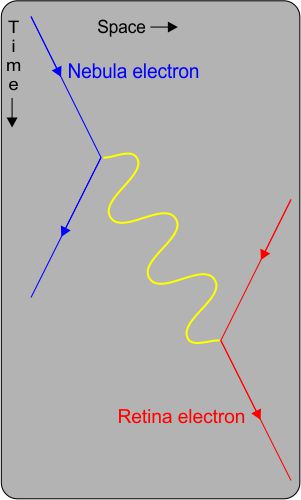
Feynman diagramOne more step and we can answer Ken’s question.  A moving object’s proper time is defined to be the time measured by a clock affixed to that object.  The proper time interval between two events encountered by an object is exactly Minkowski’s spacetime interval.  Lucy’s clock never moves from zero.
So yeah, Ken, a photon moving at the speed of light experiences no change in proper time although externally we see it traveling.

Now on to Einstein’s bubble, a lightwave’s spherical shell that vanishes instantly when its photon is absorbed by an electron somewhere.  We see that the photon experiences zero proper time while traversing the yellow line in this Feynman diagram.  But viewed from any other frame of reference the journey takes longer.  Einstein’s objection to instantaneous wave collapse still stands.

~~ Rich Olcott

Gravity and other fictitious forces

In this post I wrote, “gravitational force is how we we perceive spatial curvature.”
Here’s another claim — “Gravity is like centrifugal force, because they’re both fictitious.”   Outrageous, right?  I mean, I can feel gravity pulling down on me now.  How can it be fictional?

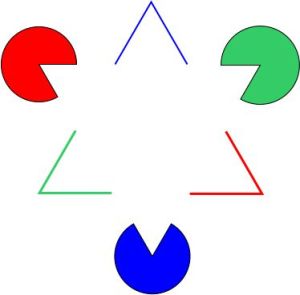
Fictitious triangle
A fictitious triangle

“Fictitious,” not “fictional,” and there’s a difference.  “Fictional” doesn’t exist, but a fictitious force is one that, to put it non-technically, depends on how you look at it.

Newton started it, of course.  From our 21st Century perspective, it’s hard to recognize the ground-breaking impact of his equation F=a.  Actually, it’s less a discovery than a set of definitions.  Its only term that can be measured directly is a, the acceleration, which Newton defined as any change from rest or constant-speed straight-line motion.  For instance, car buffs know that if a vehicle covers a one-mile half-mile (see comments) track in 60 seconds from a standing start, then its final speed is 60 mph (“zero to sixty in sixty”).  Furthermore, we can calculate that it achieved a sustained acceleration of 1.47 ft/sec2.

Both F and m, force and mass, were essentially invented by Newton and they’re defined in terms of each other.  Short of counting atoms (which Newton didn’t know about), the only routes to measuring a mass boil down to

  • compare it to another mass (for instance, in a two-pan balance), or
  • quantify how its motion is influenced by a known amount of force.

Conversely, we evaluate a force by comparing it to a known force or by measuring its effect on a known mass.

Once the F=a. equation was on the table, whenever a physicist noticed an acceleration they were duty-bound to look for the corresponding force.  An arrow leaps from the bow?  Force stored as tension in the bowstring.  A lodestone deflects a compass needle?  Magnetic force.  Objects accelerate as they fall?  Newton identified that force, called it “gravity,” and showed how to calculate it and how to apply it to planets as well as apples.  It was Newton who pointed out that weight is a measure of gravity’s force on a given mass.

Incidentally, to this day the least accurately known physical constant is Newton’s G, the Universal Gravitational Constant in his equation F=G·m1·m2/r2.  We can “weigh” planets with respect to each other and to the Sun, but without an independently-determined accurate mass for some body in the Solar System we can only estimate G.  We’ll have a better value when we can see how much rocket fuel it takes to push an asteroid around.

CoasterBut there are other accelerations that aren’t so easily accounted for.  Ever ride in a car going around a curve and find yourself almost flung out of your seat?  This little guy wasn’t wearing his seat belt and look what happened.  The car accelerated because changing direction is an acceleration due to a lateral force.  But the guy followed Newton’s First Law and just kept going in a straight line.  Did he accelerate?
This is one of those “depends on how you look at it” cases.  From a frame of reference locked to the car (arrows), he was accelerated outwards by a centrifugal force that wasn’t countered by centripetal force from his seat belt.  However, from an earthbound frame of reference he flew in a straight line and experienced no force at all.

Side forceSuppose you’re investigating an object’s motion that appears to arise from a new force you’d like to dub “heterofugal.”  If you can find a different frame of reference (one not attached to the object) or otherwise explain the motion without invoking the “new force,” then heterofugalism is a fictitious force.
Centrifugal and centripetal forces are fictitious.  The  “force” “accelerating” one plane towards another as they both fly to the North Pole in this tale is actually geometrical and thus also fictitious   So is gravity.

In this post you’ll find a demonstration of gravity’s effect on the space around it.  Just as a sphere’s meridians give the effect of a fictitious lateral force as they draw together near its poles, the compressive curvature of space near a mass gives the effect of a force drawing other masses inward.

~~ Rich Olcott

Gargh, His Heirs, and the AAAD Problem

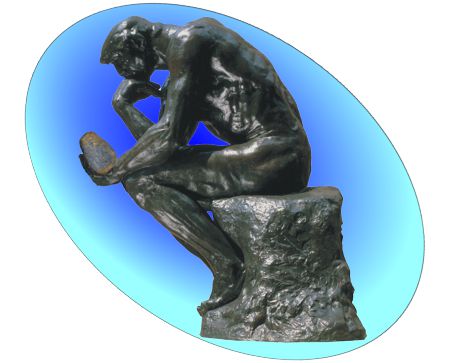
Gargh the thinkerGargh, proto-humanity’s foremost physicist 2.5 million years ago, opened a practical investigation into how motion works.  “I throw rock, hit food beast, beast fall down yes.  Beast stay down no.  Need better rock.”  For the next couple million years, we put quite a lot of effort into making better rocks and better ways to throw them.  Less effort went into understanding throwing.
There seemed to be two kinds of motion.  The easier kind to understand was direct contact — “I push rock, rock move yes.  Rock stop move when rock hit thing that move no.”  The harder kind was when there wasn’t direct contact — “I throw rock up, rock hit thing no but come back down.  Why that?

Gargh was the first but hardly the last physicist to puzzle over the Action-At-A-Distance problem (a.k.a. “AAAD”).  Intuition tells us that between pusher and pushee there must be a concrete linkage to convey the push-force.  To some extent, the history of physics can be read as a succession of solutions to the question, “What linkage induces this apparent case of AAAD?”

Most of humanity was perfectly content with AAAD in the form of magic of various sorts.  To make something happen you had to wish really hard and/or depend on the good will of some (generally capricious) elemental being.

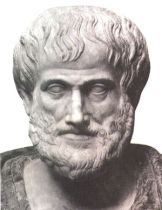
aristotle 1Aristotle wasn’t satisfied with anything so unsystematic.  He was just full of theories, many of which got in each other’s way.  One theory was that things want to go where they’re comfortable  because of what they’re made of — stones, for instance, are made of earth so naturally they try to get back home and that’s why we see them fall downwards (no concrete linkage, so it’s still AAAD).
Unfortunately, that theory didn’t account for why a thrown rock doesn’t just fall straight down but instead goes mostly in the direction it’s thrown.  Aristotle (or one of his followers) tied that back to one of his other theories, “Nature hates a vacuum.”  As the rock flies along, it pushes the air aside (direct contact) and leaves a vacuum behind it. More air rushes in to fill the vacuum and pushes the rock ahead (more direct contact).

We got a better (though still AAAD) explanation in the 17th Century when physicists invented the notions of gravity and inertia.Newton 204

Newton made a ground-breaking claim in his Principia.  He proposed that the Solar System is held together by a mysterious AAAD force he called gravity.  When critics asked how gravity worked he shrugged, “I do not form hypotheses” (though he did form hypotheses for light and other phenomena).

Inertia is also AAAD.  Those 17th Century savants showed that inertial forces push mass towards the Equator of a rotating object.  An object that’s completely independent of the rest of the Universe has no way to “know” that it’s rotating so it ought to be a perfect sphere.  In fact, the Sun and each of its planets are wider at the equator than you’d expect from their polar diameters.  That non-sphere-ness says they must have some AAAD interaction with the rest of the Universe.  A similar argument applies to linear motion; the general case is called Mach’s Principle.
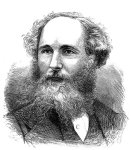
JCMaxwell

The ancients knew of the mysterious AAAD agents electricity and its fraternal twin, magnetism.  However, in the 19th Century James Clerk Maxwell devised a work-around.  Just as Newton “invented” gravity, Maxwell “invented” the electromagnetic field.  This invisible field isn’t a material object.  However, waves in the field transmit electromagnetic forces everywhere in the Universe.  Not AAAD, sort of.

It wasn’t long before someone said, “Hey, we can calculate gravity that way, too.”  That’s why we now speak of a planet’s gravitational field and gravitational waves.

But the fields still felt like AAAD because they’re not concrete.  Some modern physicists stand that objection on its head.  Concrete objects, they say, are made of atoms which themselves are nothing more than persistent fluctuations in the electromagnetic and gravitational fields.  By that logic, the fields are what’s fundamental — all motion is by direct contact.einstein-tongue edged

Einstein moved resolutely in both directions.  He negated gravity’s AAAD-ness by identifying mass-contorted space as the missing linkage.  On the other hand, he “invented” quantum entanglement, the ultimate spooky AAAD.

 ~~ Rich Olcott

Perturbed? You’re not the only one

Dolls
Successive approximations
to a real girl, but still not there

It started with the Babylonians.  The Greeks abhorred the notion.  The Egyptians and Romans couldn’t have gotten along without it. Only 1600 years later did Newton gave final polishing to … The Method of Successive Approximations.

Stay with me, we’ll get to The Chicken soon.

Suppose for some weird reason you wanted to know the square root of 2701.  Any Babylonian could see immediately that 2701 is a bit less than 3600 = 602, so as a first approximation they’d guess ½(60 + (2701/60)) = 52.5.  They’d do the multiplication to check: 52.5×52.5 = 2756.25.

Well, 52.5 is closer than 60 but not close enough.  So they’d plug that number into the same formula to get the next successive approximation: ½(52.5 + 2701/52.5) = 51.97.  Check it: 51.97×51.97 = 2700.88.  That was probably good enough for government work in Babylonia, but if the boss wanted an even better estimate they could go around the loop again.

Scientists and engineers tackle a complex problem piecewise.  Start by looking for a simple problem you know how to solve. Adjust that solution little by little to account for the ways in which the real system differs from the simple case.  Successive Approximation is only one of many adjustment strategies invented over the centuries.

The most widely-used technique is called Perturbation Theory (which has nothing to do with the ways kids find to get on their parents’ nerves).  The strategy is to find some single parameter, maybe a ratio of two masses or the relative strength of a particle-particle interaction.  For a realistic solution, it’s important that the parameter’s value be small compared to other quantities in the problem.

Simplify the original problem by keeping that parameter in the equations but assume that it’s zero.  When you’ve found a solution to that problem, you “perturb” the solution — you see what happens to the model when you allow the parameter to be non-zero.

There’s an old story, famous among physicists and engineers, about an association of farmers who wanted to design an optimum chicken-raising operation.  Maybe with an optimal chicken house they could heat the place with the birds’ own body heat, things like that.  They called in an engineering consultant.  He looked around some running farms, took lots of measurements, and went away to compute.  A couple of weeks later he came back, with slides.  (I told you it’s an old story.)  He started to walk the group though his logic, but he lost them when he opened his pitch with, “Assume a spherical chicken…”

Fat chick bank
Henrietta
Fat Chicken Bank by Becky Zee

Now, he may actually have been on the right track.  It’s a known fact that many biological processes (digestion, metabolism, drug dosage, etc.) depend on an organism’s surface area.  A chicken’s surface area could be key to calculating her heat production.  But chickens (for example, our charming Henrietta) have a complicated shape with a poorly-defined surface area.  The engineer’s approximation strategy must have been to estimate each bird as a sphere with a tweakable perturbation parameter reflecting how spherical they aren’t.

Then, of course, he’d have to apply a second adjustment for feathers, but I digress.

Now here’s the thing.  In quantum mechanics there’s only a half-dozen generic systems with exact solutions qualifying them to be “simple” Perturbation Theory starters.  Johnny’s beloved Particle In A Box (coming next week) is one of them.  The others all depend in similar logic — the particle (there’s always only one of them) is confined to a region which contains places where the particle’s not allowed to be. (There’s one exception: the Free Particle has no boundaries and therefore is evenly smeared across the Universe.)

Virtually all other quantum-based results — multi-electron atoms, molecular structures, Feynman diagrams for sub-atomic physics, string theories, whatever — depend on Perturbation Theory.  (The exceptions are topology and group-theory techniques that generally attempt to produce qualitative rather quantitative predictions.)  They need those tweakable parameters.

In quantum-chemical calculations the perturbation parameters are generally reasonably small or at least controllable.  That’s not true for many of the other areas.  This issue is especially problematic for string theory.  In many of its proposed problem solutions no-one knows whether a first-, second- or higher-level approximation even exists, much less whether it would produce reasonable predictions.

I find that perturbing.

~~ Rich Olcott

How rockets don’t work

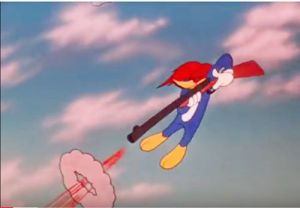
WoodyI was only 10 years old but already had Space Fever thanks to Chesley Bonestell’s artwork in Collier’s and Life magazines.  I eagerly joined the the movie theater ticket line to see George Pal’s Destination Moon.  I loved the Woody Woodpecker cartoon (it’s 12 minutes into the YouTube video) that explained rockets to a public just getting used to jet planes.  But the explanation’s wrong.

Go ahead, follow the link and watch the cartoon.  I’ll wait here.

Pretty far-sighted for 1950, eh?  And it’s amazing how much they got right, including how the driving force for the Space Race was international politics.  But oh, the physics…

Yeah, they tacitly acknowledged Newton’s Third Law: For every action there is an equal and opposite reaction.  The cartoon implies that the action is the pellets coming out of the barrel and the reaction is Woody getting knocked back.  But that can’t be right: if it were true you wouldn’t get any kick when you fire a blank cartridge — but you do.  Let’s take a close look at just what actions are in play.

Maybe it’s the pellets plus the gases behind it pushing forward and the gun pushing backward?  Sort of, but where do the gases come from?  Right, the exploding charge next to your cheek in the receiver.  Those gases move equally in all directions.  Some of them push pellets down the barrel.  Some of them push on the back end of the receiver which pushes the gun stock which mashes your shoulder.  But there’s bunches of molecules that uselessly collide with the receiver’s walls.

Action and reaction balance out just fine but only when you consider the gases moving outward from the center of the BANG.  For instance, if left and right didn’t balance perfectly the piece would crash into your ear or swing around and flatten your nose or the back of your head.

Both shotguns and conventional rockets get their propulsive energy from chemical combustion.  The reason gun parts have to be strong is all those hot molecules dashing in every direction other than down and up the barrel.  A chemical rocket casing has to be strong for the same reason.

Chemical combustion is just not an efficient use of propellant mass.  Just look at this NASA image of a SpaceX Falcon 9 during a DSCOVR launch — huge side-flare from molecules that make no contribution to forward thrust:DSCOVR launch
Wouldn’t it be nice if we had a way to put all our propulsion energy into moving the vehicle forward?

There’s good news and not-so-good news.  People are working on a few other options, all of which depend on forces we know how to steer: electric and magnetic.  Unfortunately, each of them has drawbacks.

Unlike rockets, ion thrusters use an electric or magnetic field to accelerate ions (duh!) away from the vehicle.  It’s a much more efficient process because there’s little off-axis action/reaction — all the propellant heads out the nozzle (action) and all the push-back force (reaction) acts directly on the vehicle.

But… ions resist being crowded together so you can’t blast huge quantities out the nozzle like you’d need to for a launch from Earth.  Up in space, though, ion thrusters are perfect for satellite attitude adjustment and similar low-power tasks.  The Dawn mission to Vesta and Ceres used an ion thruster to boost the spacecraft continuously from Earth to target.  It’d be impractical to build a chemical-powered system to do that.

Rather than send out atoms one by one, a rail-gun drive could use high-power magnetic fields to accelerate lumps of iron down a track and away.  Iron goes one way, vessel goes the other.  Might work in the Asteroid Belt where lumps of iron are there by the billions, but on the other hand I’d rather not be a Belter tooling along in my mining tug only to be hit amidships by someone’s cast-off reaction mass.

And then there’s the Q-thruster and EmDrive.  I hope to eventually include enough physics background in this blog that we can discuss the controversies and prospects for new-physics drives based on space warps and such.  You can check out Dr Harold White’s video for some of that.  It’d be sooo cool if they work.

~~ Rich Olcott