Superman flying at lightspeed? Umm… no

Back when I was in high school I did a term paper for some class (can’t remember which) ripping the heck out of Superman physics.  Yeah, I was that kind of kid.  If I recall correctly, I spent much of it slamming his supposed vision capabilities — they were fairly ludicrous even to a HS student and that was many refreshes of the DC universe ago.FTL SupermanBut for this post let’s consider a trope that’s been taken off the shelf again and again since those days, even in the movies.  This rendition should get the idea across — Our Hero, in a desperate effort to fix a narrative hole the writers had dug themselves into, is forced to fly around the Earth at faster-than-light speeds, thereby reversing time so he can patch things up.
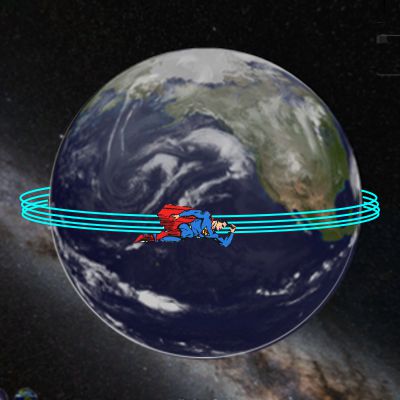
So many problems…  Just for starters, the Earth is 8000 miles wide, Supey’s what, 6’6″?, so on this scale he shouldn’t fill even a thousandth of a pixel.  OK, artistic license.  Fine.

Second problem, only one image of the guy.  If he’s really passing us headed into the past we should see two images, one coming in feet-first from the future and the other headed forward in both space and time.  Oh, and because of the Doppler effect the feet-first image should be blue-shifted and the other one red-shifted.

Of course both of those images would be the wrong shape.  The FitzGerald-Lorentz Contraction makes moving objects appear shorter in the direction of motion.  In other words, if the Man of Steel were flying just shy of the speed of light then 6’6″ tall would look to us more like a disk with a short cape.

Tall-Dark-And-Muscular has other problems to solve on his way to the past.  How does he get up there in the first place?  Back in the day, DC explained that he “leaped tall buildings in a single bound.”   That pretty much says ballistic high-jump, where all the energy comes from the initial impulse.  OK, but consider the rebound effects on the neighborhood if he were to jump with as much energy as it would take to orbit a 250-lb man.  People would complain.

Remember Einstein’s famous E=mc²?  That mass m isn’t quite what most people think it is.  Rather, it’s an object’s rest mass m0 modified by a Lorentz correction to account for the object’s kinetic energy.   In our hum-drum daily life that correction factor is basically 1.00000…   When you get into the lightspeed ballpark it gets bigger.

Here’s the formula with the Lorentz correction in red: m=m0/√[1-(v/c)2].  The square root nears zero as Superman’s velocity v approaches lightspeed c.  When the divisor gets very small the corrected mass gets very large.  If he got to the Lightspeed Barrier (where v=c) he’d be infinitely massive.

So you’ve got an infinite mass circling the Earth about 7 times a second — ocean tides probably couldn’t keep up, but the planet would be shaking enough to fracture the rock layers that keep volcanoes quiet.  People would complain.

Of course, if he had that much mass, Earth and the entire Solar System would be orbiting him.

On the E side of Einstein’s equation, Superman must attain that massive mass by getting energy from somewhere.  Gaining that last mile/second on the way to infinity is gonna take a lot of energy.

But it’s worse.  Even at less than lightspeed, the Kryptonian isn’t flying in a straight line.  He’s circling the Earth in an orbit.  The usual visuals show him about as far out as an Earth-orbiting spacecraft.  A GPS satellite’s stable 24-hour orbit has a 26,000 mile radius so it’s going about 1.9 miles/sec.  Superman ‘s traveling about 98,000 times faster than that.  Physics demands that he use a powered orbit, continuously expending serious energy on centripetal acceleration just to avoid flying off to Vega again.

The comic books have never been real clear on the energy source for Superman’s feats.  Does he suck it from the Sun?  I sure hope not — that’d destabilize the Sun and generate massive solar flares and all sorts of trouble.

Not even the DC writers would want Superman to wipe out his adopted planet just to fix up a plot point.

~~ Rich Olcott
Light’s hourglass

Terry Pratchett’s anthropomorphic character Death (who always speaks in UPPER CASE with a voice that sounds like tombstones falling) has a thing about hourglasses.  So do physicists, but theirs don’t have sand in them.  And they don’t so much represent Eternity as describe it.  Maybe.

The prior post was all about spacetime events (an event is the combination of a specific (x,y,z) spatial location with a specific time t) and how the Minkowski diagram divides the Universe into mutually exclusive pieces:

  • “look but don’t touch” — the past, all the spacetime events which could have caused something to happen where/when we are
  • “touch but don’t look” — the future, the events where/when we can cause something to happen
  • “no look, no touch” — the spacelike part that’s so far away that light can’t reach us and we can’t reach it without breaching Einstein’s speed-of-light constraint
  • “here and now” — the tiny point in spacetime with address (ct,x,y,z)=(0,0,0,0)

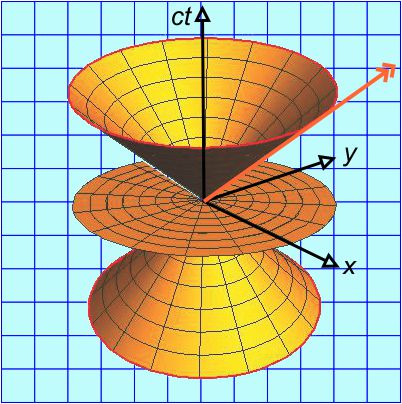
Light_s hourglassLast week’s Minkowski diagram was two-dimensional.  It showed time running along the vertical axis and Pythagorean distance d=√(x²+y²+z²) along the horizontal one.  That was OK in the days before computer graphics, but it  loaded many different events onto the same point on the chart.  For instance, (0,1,0,0), (0,-1,0,0), (0,0,1,0) and (0,0,0,1) (and more) are all at d=1.
This chart is one dimension closer to what the physicists really think about.  Here we have x and y along distinct axes.  The z axis is perpendicular to all three, and if you can visualize that you’re better at it than I am.  The xy plane (and the xyz cube if you’re good at it) is perpendicular to t.

That orange line was in last week’s diagram and it means the same thing in this one.  It contains events that can use light-speed somehow to communicate with the here-and-now event.  But now we see that the line into the future is just part of a cone (or a hypercone if you’re good at it).

If we ignite a flash of light at time t=0, at any positive time t that lightwave will have expanded to a circle (or bubble) with radius d=c·t. The circles form the “future” cone.

Another cone extends into the past.  It’s made up of all the events from which a flash of light at time at some negative t would reach the here-and-now event.

The diagram raises four hotly debated questions:

  • Is the pastward cone actually pear-shaped?  It’s supposed to go back to The Very Beginning.  That’s The Big Bang when the Universe was infinitesimally small.  Back then d for even the furthest event from (ct,0,0,0) should have been much smaller than the nanometers-to-lightyears range of sizes we’re familiar with today.  But spacetime was smaller, too, so maybe everything just expanded in sync once we got past Cosmic Inflation.  We may never know the answer.
  • What’s outside the cones?  You think what you see around you is right now?  Sorry.  If the screen you’re reading this on is a typical 30 inches or so distant, the light you’re seeing left the screen 2½ nanoseconds ago.  Things might have changed since then.  We can see no further into the Universe than 14 billion lightyears, and even that only tells us what happened 14 billion years ago.  Are there even now other Earth-ish civilizations just 15 billion lightyears away from us?  We may never know the answer.
  • How big is “here-and-now”?  We think of it as a size=zero mathematical point, but there are technical grounds to think that the smallest possible distance is the Planck length, 1.62×10⁻³⁵ meters.  Do incidents that might affect us occur at a smaller scale than that?  Is time quantized?  We may never know the answers.
  • Do the contents of the futureward cone “already” exist in some sense, or do we truly have free will?  Einstein thought we live in a block universe, with events in future time as fixed as those in past time.  Other thinkers hold that neither past not future are real.  I like the growing block alternative, in which the past is real and fixed but the future exists as maybes.  We may never know the answer.

~~ Rich Olcott

You can’t get there from here

In this series of posts I’ve tried to get across several ideas:

  • By Einstein’s theories, in our Universe every possible combination of place and time is an event that can be identified with an “address” like (ct,x,y,z) where t is time, c is the speed of light, and x, y and z are spatial coordinates
  • The Pythagorean distance between two events is d=√[(x1-x2)2+(y1-y2)2+(z1-z2)2]
  • The Minkowski interval between two events is √[(ct1-ct2)2 d2]
  • When i=√(-1) shows up somewhere, whatever it’s with is in some way perpendicular to the stuff that doesn’t involve i

That minus sign in the third bullet has some interesting implications.  If the time term is bigger then the spatial term, then the interval (that square root) is a real number.  On the other hand, if the time term is smaller, the interval is an imaginary number and therefore is in some sense perpendicular to the real intervals.

We’ll see what that means in a bit.  But first, suppose the two terms are exactly equal, which would make the interval zero.  Can that happen?

Sure, if you’re a light wave.  The interval can only be zero if d=(ct1-ct2).  In other words, if the distance between two events is exactly the distance light would travel in the elapsed time between the same two events.

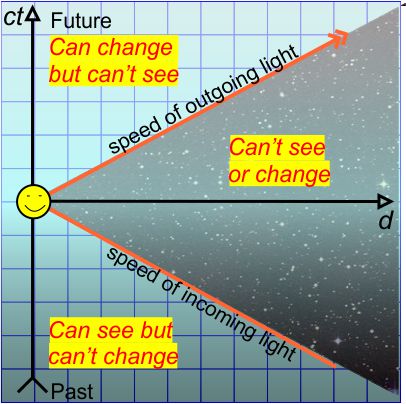
In this Minkowski diagram, we’ve got two number lines.  The real numbers (time) run vertically (sorry, I know we had the imaginary line running upward in a previous post, but this is the way that Minkowski drew it).  Perpendicular to that, the line of imaginary numbers (distance) runs horizontally, which is why that starscape runs off to the right.Minkowski diagram
The smiley face is us at the origin (0,0,0,0).  If we look upwards toward positive time, that’s the future at our present locationLooking downward to negative time is looking into the past.  Unless we move (change x and/or y and/or z), all the events in our past and future have addresses like (ct,0,0,0).

What about all those points (events) that aren’t on the time axis?  Pick one and use its address to figure the interval between it and us.  In general, the interval will be a complex number, part real and part imaginary, because the event you picked isn’t on either axis.

The two orange lines are special.  Each of them is drawn through all the events for which the distance is equal to ct.  All the intervals between those events and us are zero.  Those are the events that could be connected to us by a light beam.

The orange connections go one way only — someone in our past (t less than zero) can shine a light at us that we’ll see when it reaches us.  However, if someone in our future tried to shine a light our way, well, the passage of time wouldn’t allow it (except maybe in the movies).  Conversely, we can shine a light at some spatial point (x,y,z) at distance d=√(x2+y2+z2) from us, but those photons won’t arrive until the event in our future at (d,x,y,z).

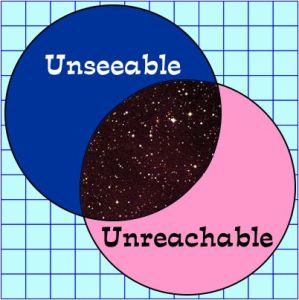
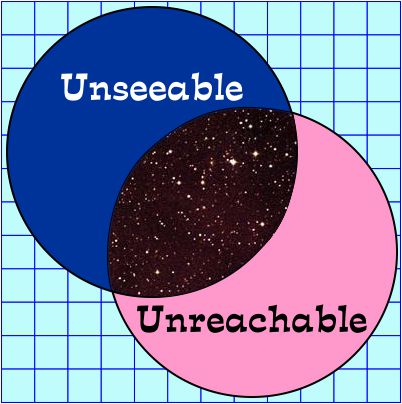
space VennThe rest of the Minkowski diagram could do for a Venn diagram.  We at (0,0,0,0) can do something that will cause something to happen at (ct,x,y,z) to the left of the top orange line.  However, we won’t be able to see that effect until we time-travel forward to its t.  That region is “reachable but not seeable.”
Similarly, events to the left of the bottom orange line can affect us (we can see stars, for instance) but they’re in our past and we can’t cause anything to happen then/there.  The region is “seeable but not reachable.”

Then there’s the overlap, the segment between the two orange lines.  Events there are so far away in spacetime that the intervals between them and us are imaginary (in the mathematical sense).  To put it another way, light can’t get here from there.  Neither can cause and effect.

Physicists call that third region space-like, as opposed to the two time-like regions.  Without a warp drive or some other way around Einstein’s universal speed limit, the edge of “space-like” will always be The Final Frontier.

~~ Rich Olcott

Does a photon experience time?

My brother Ken asked me, “Is it true that a photon doesn’t experience time?”  Good question.  As I was thinking about it I wondered if the answer could have implications for Einstein’s bubble.

When Einstein was a grad student in Göttingen, he skipped out on most of the classes given by his math professor Hermann Minkowski.  Then in 1905 Einstein’s Special Relativity paper scooped some work that Minkowski was doing.  In response, Minkowski wrote his own paper that supported and expanded on Einstein’s.  In fact, Minkowski’s contribution changed Einstein’s whole approach to the subject, from algebraic to geometrical.

But not just any geometry, four-dimensional geometry — 3D space AND time.  But not just any space-AND-time geometry — space-MINUS-time geometry.  Wait, what?Pythagoras1

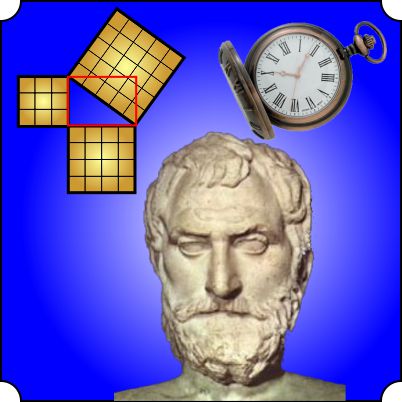
Early geometer Pythagoras showed us how to calculate the hypotenuse of a right triangle from the lengths of the other two sides. His a2+b2 = c2 formula works for the diagonal of the enclosing rectangle, too.

Extending the idea, the body diagonal of an x×y×z cube is √(x2+y2+z2) and the hyperdiagonal  of a an ct×x×y×z tesseract is √(c2t2+x2+y2+z2) where t is time.  Why the “c“?  All terms in a sum have to be in the same units.  x, y, and z are lengths so we need to turn t into a length.  With c as the speed of light, ct is the distance (length) that light travels in time t.

But Minkowski and the other physicists weren’t happy with Pythagorean hyperdiagonals.  Here’s the problem they wanted to solve.  Suppose you’re watching your spacecraft’s first flight.  You built it, you know its tip-to-tail length, but your telescope says it’s shorter than that.  George FitzGerald and Hendrik Lorentz explained that in 1892 with their length contraction analysis.

What if there are two observers, Fred and Ethel, each of whom is also moving?  They’d better be able to come up with the same at-rest (intrinsic) size for the object.

Minkowski’s solution was to treat the ct term differently from the others.  Think of each 4D address (ct,x,y,z) as a distinct event.  Whether or not something happens then/there, this event’s distinct from all other spatial locations at moment t, and all other moments at location (x,y,z).

To simplify things, let’s compare events to the origin (0,0,0,0).  Pythagoras would say that the “distance” between the origin event and an event I’ll call Lucy at (ct,x,y,z) is √(c2t2+x2+y2+z2).

Minkowski proposed a different kind of “distance,” which he called the interval.  It’s the difference between the time term and the space terms: √[c2t2 + (-1)*(x2+y2+z2)].

If Lucy’s time is t=0 [her event address (0,x,y,z)], then the origin-to-Lucy interval is  √[02+(-1)*(x2+y2+z2)]=i(x2+y2+z2).  Except for the i=√(-1) factor, that matches the familiar origin-to-Lucy spatial distance.

Now for the moment let’s convert the sum from lengths to times by dividing by c2.  The expression becomes √[t2-(x/c)2-(y/c)2-(z/c)2].  If Lucy is at (ct,0,0,0) then the origin-to-Lucy interval is simply √(t2)=t, exactly the time difference we’d expect.

Finally, suppose that Lucy departed the origin at time zero and traveled along x at the speed of light.   At any time t, her address is (ct,ct,0,0) and the interval for her trip is √[(ct)2-(ct)2-02-02] = √0 = 0.  Both Fred’s and Ethel’s clocks show time passing as Lucy speeds along, but the interval is always zero no matter where they stand and when they make their measurements.

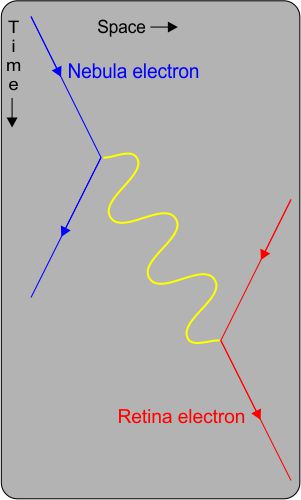
Feynman diagramOne more step and we can answer Ken’s question.  A moving object’s proper time is defined to be the time measured by a clock affixed to that object.  The proper time interval between two events encountered by an object is exactly Minkowski’s spacetime interval.  Lucy’s clock never moves from zero.
So yeah, Ken, a photon moving at the speed of light experiences no change in proper time although externally we see it traveling.

Now on to Einstein’s bubble, a lightwave’s spherical shell that vanishes instantly when its photon is absorbed by an electron somewhere.  We see that the photon experiences zero proper time while traversing the yellow line in this Feynman diagram.  But viewed from any other frame of reference the journey takes longer.  Einstein’s objection to instantaneous wave collapse still stands.

~~ Rich Olcott

Reflections in Einstein’s bubble

There’s something peculiar in this earlier post where I embroidered on Einstein’s gambit in his epic battle with Bohr.  Here, I’ll self-plagiarize it for you…

Consider some nebula a million light-years away.  A million years ago an electron wobbled in the nebular cloud, generating a spherical electromagnetic wave that expanded at light-speed throughout the Universe.

Last night you got a glimpse of the nebula when that lightwave encountered a retinal cell in your eye.  Instantly, all of the wave’s energy, acting as a photon, energized a single electron in your retina.  That particular lightwave ceased to be active elsewhere in your eye or anywhere else on that million-light-year spherical shell.

Suppose that photon was yellow light, smack in the middle of the optical spectrum.  Its wavelength, about 580nm, says that the single far-away electron gave its spherical wave about 2.1eV (3.4×10⁻¹⁹ joules) of energy.  By the time it hit your eye that energy was spread over an area of a trillion square lightyears.  Your retinal cell’s cross-section is about 3 square micrometers so the cell can intercept only a teeny fraction of the wavefront.  Multiplying the wave’s energy by that fraction, I calculated that the cell should be able to collect only 10-75 joules.  You’d get that amount of energy from a 100W yellow light bulb that flashed for 10-73 seconds.  Like you’d notice.

But that microminiscule blink isn’t what you saw.  You saw one full photon-worth of yellow light, all 2.1eV of it, with no dilution by expansion.  Water waves sure don’t work that way, thank Heavens, or we’d be tsunami’d several times a day by earthquakes occurring near some ocean somewhere.

Feynman diagramHere we have a Feynman diagram, named for the Nobel-winning (1965) physicist who invented it and much else.  The diagram plots out the transaction we just discussed.  Not a conventional x-y plot, it shows Space, Time and particles.  To the left, that far-away electron emits a photon signified by the yellow wiggly line.  The photon has momentum so the electron must recoil away from it.

The photon proceeds on its million-lightyear journey across the diagram.  When it encounters that electron in your eye, the photon is immediately and completely converted to electron energy and momentum.

Here’s the thing.  This megayear Feynman diagram and the numbers behind it are identical to what you’d draw for the same kind of yellow-light electron-photon-electron interaction but across just a one-millimeter gap.

It’s an essential part of the quantum formalism — the amount of energy in a given transition is independent of the mechanical details (what the electrons were doing when the photon was emitted/absorbed, the photon’s route and trip time, which other atoms are in either neighborhood, etc.).  All that matters is the system’s starting and ending states.  (In fact, some complicated but legitimate Feynman diagrams let intermediate particles travel faster than lightspeed if they disappear before the process completes.  Hint.)

Because they don’t share a common history our nebular and retinal electrons are not entangled by the usual definition.  Nonetheless, like entanglement this transaction has Action-At-A-Distance stickers all over it.  First, and this was Einstein’s objection, the entire wave function disappears from everywhere in the Universe the instant its energy is delivered to a specific location.  Second, the Feynman calculation describes a time-independent, distance-independent connection between two permanently isolated particles.  Kinda romantic, maybe, but it’d be a boring movie plot.

As Einstein maintained, quantum mechanics is inherently non-local.  In QM change at one location is instantaneously reflected in change elsewhere as if two remote thingies are parts of one thingy whose left hand always knows what its right hand is doing.

Bohr didn’t care but Einstein did because relativity theory is based on geometry which is all about location. In relativity, change here can influence what happens there only by way of light or gravitational waves that travel at lightspeed.

In his book Spooky Action At A Distance, George Musser describes several non-quantum examples of non-locality.  In each case, there’s no signal transmission but somehow there’s a remote status change anyway.  We don’t (yet) know a good mechanism for making that happen.

It all suggests two speed limits, one for light and matter and the other for Einstein’s “deeper reality” beneath quantum mechanics.

~~ Rich Olcott

Michelson, Morley and LIGO

Two teams of scientists, 128 years apart.  The first team, two men, got a negative result that shattered a long-standing theory.  The second team, a thousand strong, got a positive result that provided final confirmation of another long-standing theory.  Both teams used instruments based on the same physical phenomenon.  Each team’s innovations created whole new fields of science and technology.

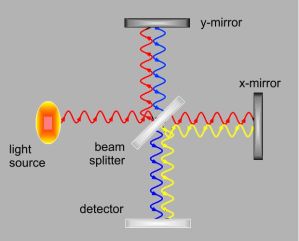
Interferometer 1Their common experimental strategy sounds simple enough — compare two beams of light that had traveled along different paths

Light (preferably nice pure laser light, but Albert Michelson didn’t have a laser when he invented interferometry in 1887) comes in from the source at left and strikes the “beam splitter” — typically, a partially-silvered mirror that reflects half the light and lets the rest through.  One beam goes up the y-arm to a mirror that reflects it back down through the half-silvered mirror to the detector.  The other beam goes on its own round-trip journey in the x-direction.  The detector (Michelson’s eye or a photocell or a fancy-dancy research-quality CCD) registers activity if the waves in the two beams are in step when they hit it.  On the other hand, if the waves cancel then there’s only darkness.

Getting the two waves in step requires careful adjustment of the x- and y-mirrors, because the waves are small.  The yellow sodium light Michelson used has a peak-to-peak wavelength of 589 nanometers.  If he twitched one mirror 0.0003 millimeter away from optimal position the valleys of one wave would cancel the peaks of the other.

So much for principles.  The specifics of each team’s device relate to the theory being tested.  Michelson was confronting the æther theory, the proposition that if light is a wave then there must be some substance, the æther, that vibrates to carry the wave.  We see sunlight and starlight, so  the æther must pervade the transparent Universe.  The Earth must be plowing through the æther as it circles the Sun.  Furthermore, we must move either with or across or against the æther as we and the Earth rotate about its axis.  If we’re moving against the æther then lightwave peaks must appear closer together (shorter wavelengths) than if we’re moving with it.Michelson-Moreley device

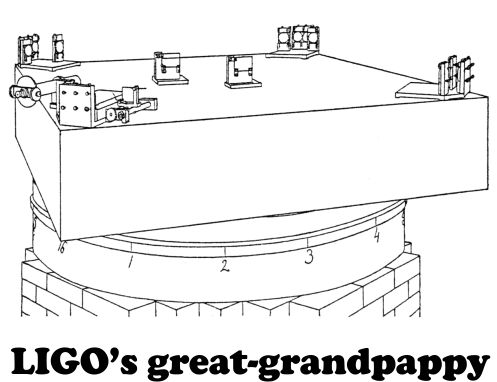
Michelson designed his device to test that chain of logic. His optical apparatus was all firmly bolted to a 4′-square block of stone resting on a wooden ring floating on a pool of mercury.  The whole thing could be put into slow rotation to enable comparison of the x– and y-arms at each point of the compass.

Interferometer 3
Suppose the æther theory is correct. Michelson should see lightwaves cancel at some orientations.

According to the æther theory, Michelson and his co-worker Edward Morley should have seen alternating light and dark as he rotated his device.  But that’s not what happened.  Instead, he saw no significant variation in the optical behavior around the full 360o rotation, whether at noon or at 6:00 PM.

Cross off the æther theory.

Michelson’s strategy depended on light waves getting out of step if something happened to the beams as they traveled through the apparatus.  Alternatively, the beams could charge along just fine but something could happen to the apparatus itself.  That’s how the LIGO team rolled.

Interferometer 2
Suppose Einstein’s GR theory is correct. Gravitational wave stretching and compression should change the relative lengths of the two arms.

Einstein’s theory of General Relativity predicts that space itself is squeezed and stretched by mass.  Miles get shorter near a black hole.  Furthermore, if the mass configuration changes, waves of compressive and expansive forces will travel outward at the speed of light.  If such a wave were to encounter a suitable interferometer in the right orientation (near-parallel to one arm, near-perpendicular to the other), that would alter the phase relationship between the two beams.

The trick was in the word “suitable.”  The expected percentage-wise length change was so small that eLIGO needed 4-kilometer arms to see movement a tiny fraction of a proton’s width.  Furthermore, the LIGO designers flipped the classical detection logic.  Instead of looking for a darkened beam, they set the beams to cancel at the detector and looked for even a trace of light.

eLIGO saw the light, and confirmed Einstein’s theory.

~~ Rich Olcott

Would the CIA want a LIGO?

So I was telling a friend about the LIGO announcement, going on about how this new “device” will lead to a whole new kind of astronomy.  He suddenly got a far-away look in his eyes and said, “I wonder how many of these the CIA has.”

The CIA has a forest of antennas, but none of them can do what LIGO does.  That’s because of the physics of how it works, and what it can and cannot detect.  (If you’re new to this topic, please read last week’s post so you’ll be up to speed on what follows.  Oh, and then come back here.)

There are remarkable parallels between electromagnetism and gravity.  The ancients knew about electrostatics — amber rubbed by a piece of cat fur will attract shreds of dry grass.  They certainly knew about gravity, too.  But it wasn’t until 100 years after Newton wrote his Principia that Priestly and then Coulomb found that the electrostatic force law, F = ke·q1·q2 / r2, has the same form as Newton’s Law of Gravity, F = G·m1·m2 / r2. (F is the force between two bodies whose centers are distance r apart, the q‘s are their charges and the m‘s are their masses.)

Jim and AlAlmost a century later, James Clerk Maxwell (the bearded fellow at left) wrote down his electromagnetism equations that explain how light works.  Half a century later, Einstein did the same for gravity.
But interesting as the parallels may be, there are some fundamental differences between the two forces — fundamental enough that not even Einstein was able to tie the two together.

One difference is in their magnitudes.  Consider, for instance, two protons.  Running the numbers, I found that the gravitational force pulling them together is a factor of 1036 smaller than the electrostatic force pushing them apart.  If a physicist wanted to add up all the forces affecting a particular proton, he’d have to get everything else (nuclear strong force, nuclear weak force, electromagnetic, etc.) nailed down to better than one part in 1036 before he could even detect gravity.

But it’s worse — electromagnetism and gravity don’t even have the same shape.

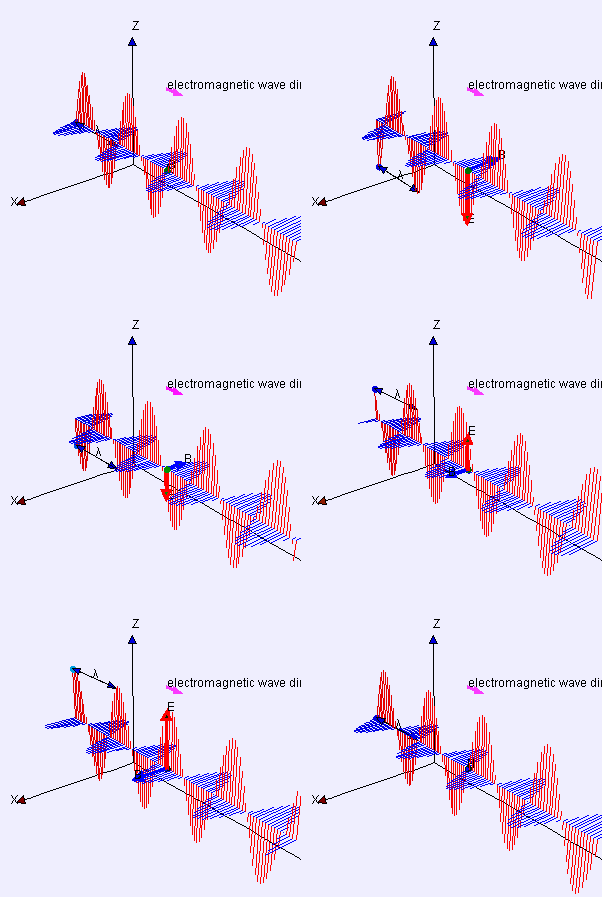
Electromagneticwave3D
Electric (red) and magnetic (blue) fields in a linearly polarized light wave
(graphic from WikiMedia Commons, posted by Lookang and Fu-Kwun Hwang)

A word first about words.  Electrostatics is about pure straight-line-between-centers (longitudinal) attraction and repulsion — that’s Coulomb’s Law.  Electrodynamics is about the cross-wise (transverse) forces exerted by one moving charged particle on the motion of another one.  Those forces are summarized by combining Maxwell’s Equations with the Lorenz Force Law.  A moving charge gives rise to two distinct forces, electric and magnetic, that operate at right angles to each other.  The combined effect is called electromagnetism.

The effect of the electric force is to vibrate a charge along one direction transverse to the wave.  The magnetic force only affects moving charges; it acts to twist their transverse motion to be perpendicular to the wave.  An EM antenna system works by sensing charge flow as electrons move back and forth under the influence of the electric field.

Gravitostatics uses Newton’s Law to calculate longitudinal gravitational interaction between masses.  That works despite gravity’s relative weakness because all the astronomical bodies we know of appear to be electrically neutral — no electrostatic forces get in the way.  A gravimeter senses the strength of the local gravitostatic field.

Maxwell and EinsteinGravitodynamics is completely unlike electrodynamics.  Gravity’s transverse “force” doesn’t act to move a whole mass up and down like Maxwell’s picture at left.  Instead, as shown by Einstein’s picture, gravitational waves stretch and compress while leaving the center of mass in place. I put “force” in quotes because what’s being stretched and compressed is space itself.  See this video for a helpful visualization of a gravitational wave.

LIGO is neither a telescope nor an electromagnetic antenna.  It operates by detecting sudden drastic changes in the disposition of matter within a “small” region.  In LIGO’s Sept 14 observation, 1031 kilograms of black hole suddenly ceased to exist, converted to gravitational waves that spread throughout the Universe.  By comparison, the Hiroshima explosion released the energy of 10-6 kilograms.

Seismometers do a fine job of detecting nuclear explosions.  Hey, CIA, they’re a lot cheaper than LIGO.

~~ Rich Olcott