Not Even A Sneeze in A Hurricane

Quite a commotion at the lakeshore this morning. I walk over to see what’s going on. Not surprised at who’s involved. “Come away from there, Mr Feder, you’re too close to their goslings.” Doesn’t work, of course, so I resort to stronger measures. “Hey, Mr Feder, any questions for me?”

That did the trick. “Hey, yeah, Moire, I got one. There’s this big problem with atomic power ’cause there’s leftovers when the fuel’s all used up and nobody wants it buried their back yard and I unnerstand that. How about we just load all that stuff into one of Musk’s Starships and send it off to burn up in the Sun? Or would that make the Sun blow up?”

“Second part first. Do you sneeze?”

“What kinda question is that? Of course I sneeze. Everyone sneezes.”

“Ever been in a hurricane?”

“Oohyeah. Sandy, back in 2012. Did a number on my place in Fort Lee. Took out my back fence, part of the roof, branches down all over the place—”

“Did you sneeze during the storm?”

“Who remembers that sort of thing?”

“If you had, would it have made any difference to how the winds blew?”

“Nah, penny‑ante compared to what else was going on. Besides, the storm eye went a couple hundred miles west of us.”

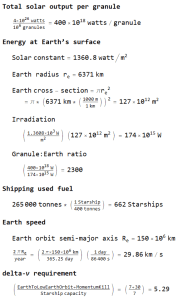
“Well, there you go. The Sun’s surface is covered by about a million granules, each about the size of Texas, and each releasing about 400 exawatts—”.

“Exawha?”

“Exawatt. One watt is one joule of energy per second. Exa– means 1018. So just one of those granules releases 400×1018 joules of energy per second. By my numbers that’s about 2300 times the total energy that Earth gets from the Sun. There’s a million more granules like that. Still think one of our rockets would make much difference with all that going on?”

“No difference anybody’d notice. But that just proves it’d be safe to send our nuclear trash straight to the Sun.”

“Safe, yes, but not practical.”

“When someone says ‘practical’ they’re about to do numbers, right?”

“Indeed. How much nuclear waste do you propose to ship to the Sun?”

“I dunno. How much we got?”

“I saw a 2022 estimate from the International Atomic Energy Agency that our world‑wide accumulation so far is over 265 000 tonnes, mostly spent fuel. Our heaviest heavy‑lift vehicle is the SpaceX Starship. Maximum announced payload to low‑Earth orbit is 400 tonnes for a one‑way trip. You ready to finance 662 launches?”

“Not right now, I’m a little short ’til next payday. How about we just launch the really dangerous stuff, like plutonium?”

“Much easier rocket‑wise, much harder economics‑wise.”

“Why do you say that?”

“Because most of the world’s nuclear power plants depend on MOX fuel, a mixture of plutonium and uranium oxides. Take away all the plutonium, you mess up a significant chunk of our carbon‑free‑mostly electricity production. But I haven’t gotten to the really bad news yet.”

“I’m always good for bad news. Give.”

“Even with the best of intentions, it’s an expensive challenge to shoot a rocket straight from Earth into the Sun.”

“Huh? It’d go down the gravity well just like dropping a ball.”

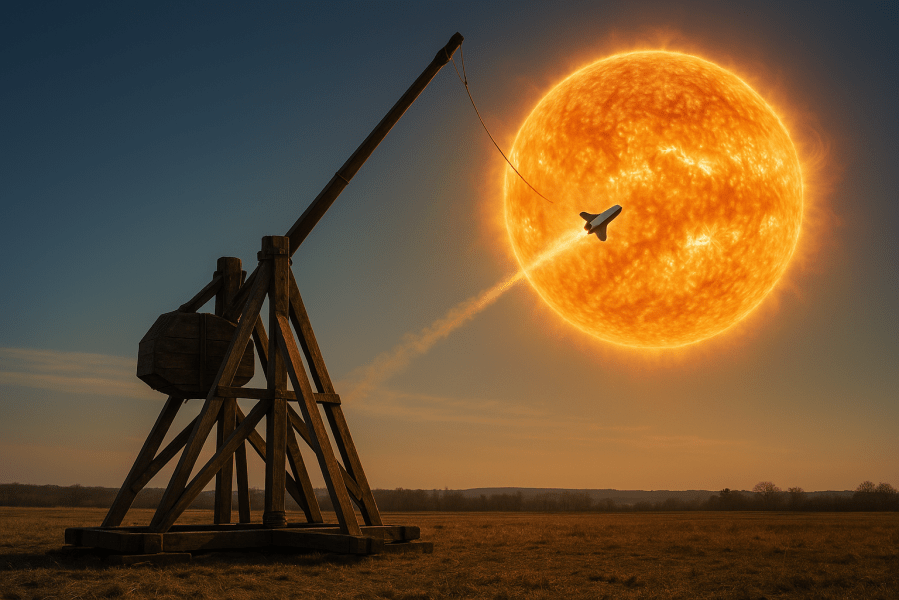
“Nope, not like dropping a ball. More like flinging it off to the side with a badly‑aimed trebuchet. Guess how fast the Earth moves around the Sun.”

“Dunno. I heard it’s a thousand miles an hour at the Equator.”

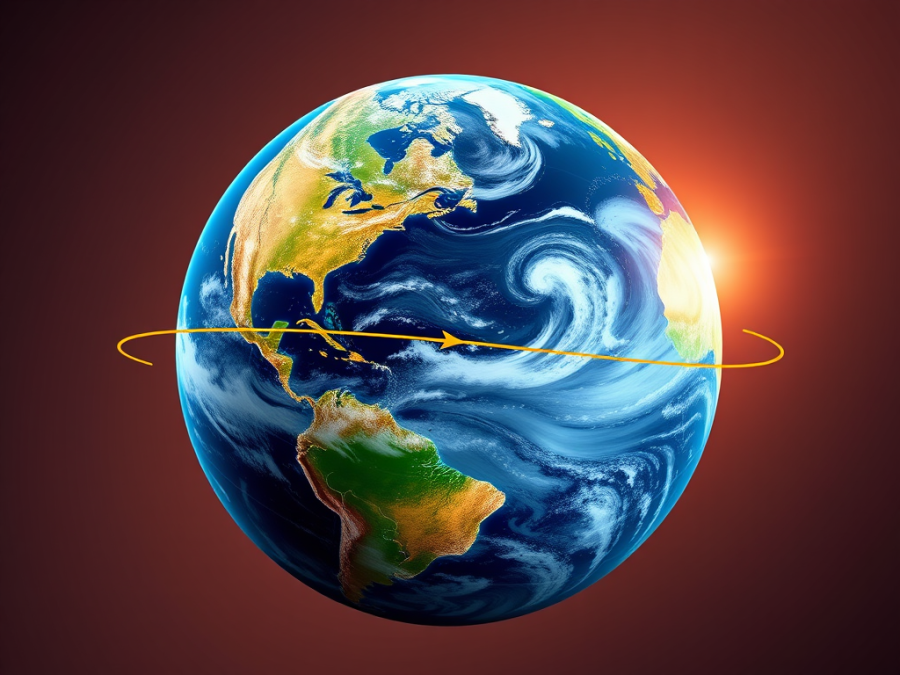
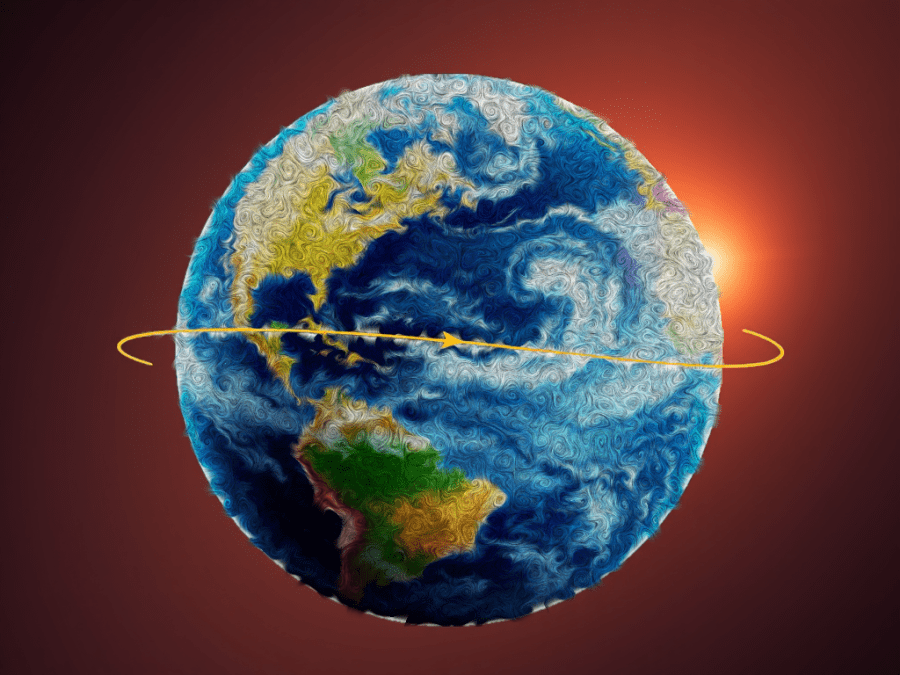
“That’s the planet’s rotation on its own axis. My question was how fast we go taking a year to do an orbit around the Sun. I’ll spare you the arithmetic — the planet speeds eastward at 30 kilometers per second. Any rocket taking off from Earth starts with that vector, and it’s at right angles to the Earth‑Sun line. You can’t hit the Sun without shedding all that lateral momentum. If you keep it, the rules of orbital mechanics force the ship to go faster and faster sideways as it drops down the well — you flat‑out miss the Sun. By the way, LEO delta‑v for SpaceX’s most advanced Starship is about 7 km/s, less than a fifth of the minimum necessary for an Earth‑to‑Sun lift.”

~ Rich Olcott
Two’s Company, Three Is Perturbing

Vinnie does this thing when he’s near the end of his meal. He mashes his pizza crumbs and mozzarella dribbles into marbles he rolls around on his plate. Mostly on his plate. Eddie hates it when one escapes onto his floor. “Vinnie, you lose one more of those, you’ll be paying extra.”

“Aw, c’mon, Eddie, I’m your best customer.”

“Maybe, but there’ll be a surcharge for havin’ to mop extra around your table.”

Always the compromiser, I break in. “How about you put on less sauce, Eddie?”

Both give me looks you wouldn’t want.
  ”Lower the quality of my product??!?”
    ”Adjust perfection??!?”

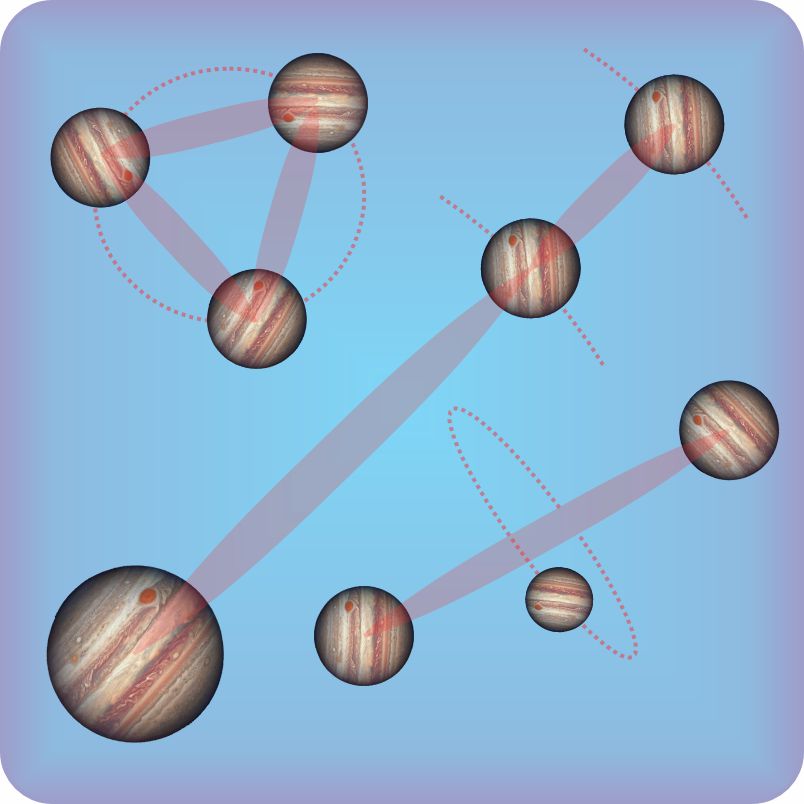
“Looks like we’ve got a three‑body problem here.” Blank looks all around. “You two were just about to go at it until I put in my piece and suddenly you’re on the same side. Two‑way interaction predictable results, three‑way interaction hard to figure. Like when Newton calculated celestial orbits to confirm his Laws of Gravity and Motion. They worked fine for the Earth going around the Sun, not so good for the Moon going around the Earth. The Sun pulls on the Moon just enough to play hob with his two‑body Earth‑Moon predictions.”

“Newton again. So how did he solve it?”

“He didn’t, not exactly anyway.”

“Not smart enough?”

“No, Eddie, plenty smart. Later mathematicians have proven that the three‑body problem simply doesn’t have a general exact solution.”

“Ah-hah, Sy, I heard weaseling — general?”

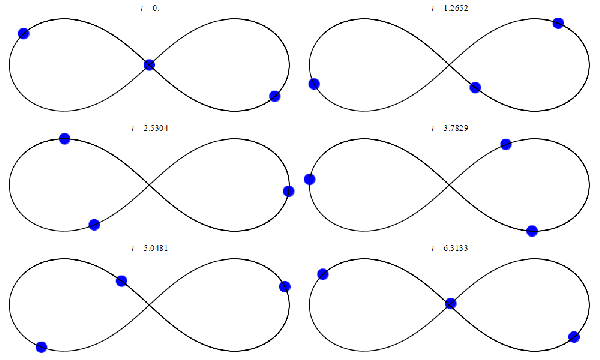
“Alright, Vinnie, there are some stable special cases. Three bodies at relative rest in an equilateral triangle; certain straight‑line configurations; two biggies circling each other and a third, smaller one in a distant orbit around the other two’s center of gravity. There are other specials but none stable in the sense that they wouldn’t be disrupted by a wobbly gravity field from a nearby star or the host galaxy.”

“So if NASA’s mission planners are looking at a four‑body Sun‑Jupiter‑Europa‑Juno situation, what’re they gonna do? ‘Give up’ ain’t an option.”

“Sure not. There’s a grand strategy with variations. The oldest variation goes back to before the Egyptian builders and everybody still uses it. Vinnie, when you fly a client to Tokyo, do you target a specific landing runway?”

“Naw, I aim for Japan, contact ATC Narita when I get close and they vector me in to wherever they want me to land.”

“How about you, Eddie? How do you get that exquisite balance in your flavoring?”

“Ain’t easy, Sy. Every batch of each herb is different — when it was picked, how it was stored, even the weather while it was growing. I start with an average mix which is usually close, then add a pinch of this and a little of that until it’s right.”

“For both of you, the critical word there was ‘close’. Call it in‑flight course adjustments, call it pinch‑and‑taste, everybody uses the ‘tweaking’ strategy. It’s a matter of skill and intuition, usually hard to generalize and even harder to teach in a systematic fashion. Engineers do it a lot, theoretical physicists work hard to avoid it.”

“What’ve they got that’s better?”

” ‘Better’ depends on your criteria. The method’s called ‘perturbation theory’ and strictly speaking, you can only use it for certain kinds of problems. Newton’s, for instance.”

“Good ol’ Newton.”

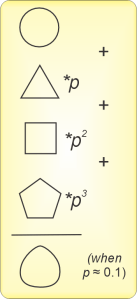
“Of course. Newton’s calculations almost matched Kepler’s planetary observations, but finagling the ‘not quite’ gave Newton headaches. More than 150 years passed before Laplace and others figured out how to treat a distant object as a perturbation of an ideal two‑body situation. It starts with calculating the system’s total energy, which wasn’t properly defined in Newton’s day. A perturbation factor p controls the third body’s contribution. The energy expression lets you calculate the orbits, but they’re the sum of terms containing powers of p. If p=0.1, p2=0.01, p3=0.001 and so on. If p isn’t zero but is still small enough, the p3 term and maybe even the p2 term are too small to bother with.”

“I’ll stick with pinch‑and‑taste.”

“Me and NASA’ll keep course‑correcting.”

~ Rich Olcott

The Spaghettification Zone

Vinnie’s still wincing. “That neutron star pulling all the guy’s joints apart — yuckhh! So that’s spaghettification? I thought that was a black hole thing.”

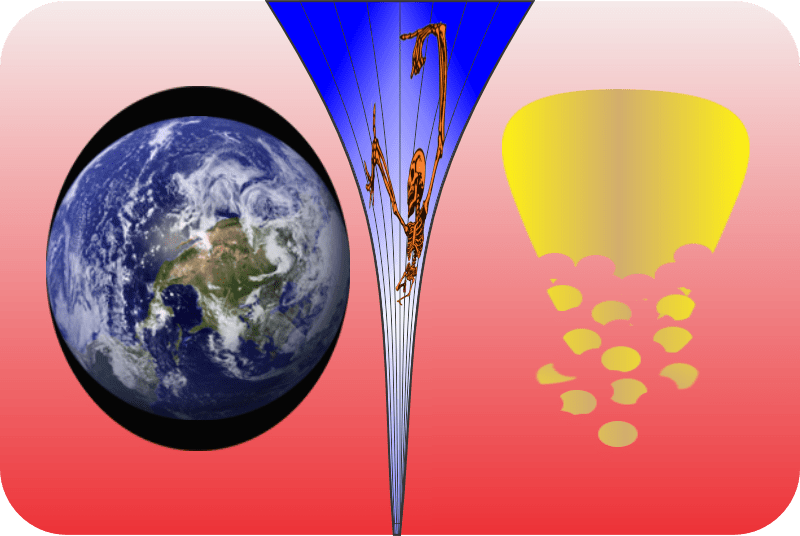
“Yes and no, in that order. Spaghettification’s a tidal phenomenon associated with lopsided gravity fields, black holes or otherwise. You know what causes the tides, of course.”

“Sure, Sy. The Sun pulls up on the water underneath it.”

“That’s not quite it. The Sun’s direct‑line pull on a water molecule is less than a part per million of the Earth’s. What really happens is that the Sun broadly attracts water molecules north‑south east‑west all across the Sun‑side hemisphere. There’s a general movement towards the center of attraction where molecules pile up. The pile‑up’s what we call the tide.”

“What explains the high tide on the other side of the Earth? You can’t claim the Sun pushes it over there.”

“Of course not. It goes back to our lopsided taste of the Sun’s gravitational field. If it weren’t for the Sun’s pull, sea level would be a nice round circle where centrifugal force balances Earth’s gravity. The Sun’s gravity puts its thumb on the scale for the near side, like I said. It’s weaker on the other side, though — balance over there tilts toward the centrifugal force, makes for a far‑side bulge and midnight tides. We get lopsided forces from the moon’s gravity, too. That generates lunar tides. The solar and lunar cycles combine to produce the pattern of tides we experience. But tides can get much stronger. Ever hear of the Roche effect?”

“Can’t say as I have.”

“Imagine the Earth getting closer to the Sun but ignore the heat. What happens?”

“Sun‑side tides get higher and higher until … the Sun pulls the water away altogether!”

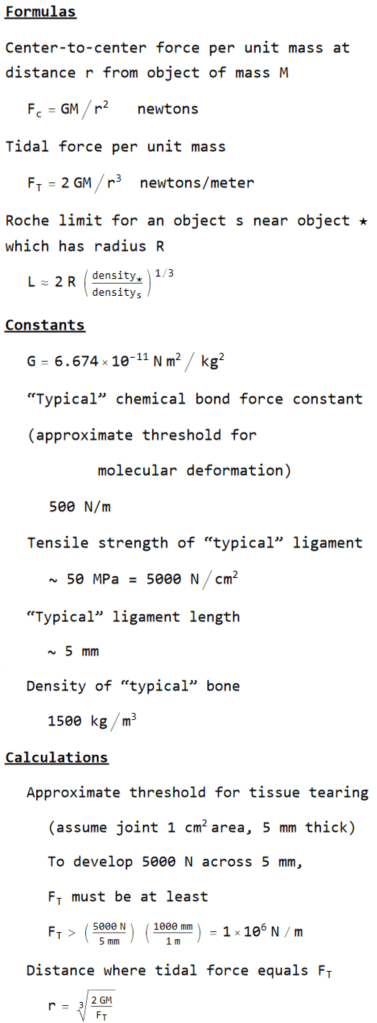
“That’s the idea. In the mid‑1800s Édouard Roche noticed the infinity buried in Newton’s F=GMm/r² equation. He realized that the forces get immense when the center‑to‑center distance, r, gets tiny. ‘Something’s got to give!’ he thought so he worked out the limits. The center‑to‑center force isn’t the critical one. The culprit is the tidal force which arises from the difference in the gravitational strength on either side of an object. When the force difference exceeds the forces holding the object together, it breaks up.”

“Only thing holding the ocean to Earth is gravity.”

“Exactly. Roche’s math applies strictly to objects where gravity’s the major force in play. Things like rubble‑pile asteroids like Bennu and Dimorphos or a black hole sipping the atmosphere off a neighboring blue supergiant star. We relate spaghettification to rubble piles but it can also compete with interatomic electronic forces which are a lot stronger.”

“You’re gonna get quantitative, right?”

“Of course, that’s how I operate.” <tapping on Old Reliable’s screen> “Okay, suppose Niven’s guy Shaffer is approaching some object from far away. I’ve set up tidal force calculations for some interesting cases. Turns out if you know or can estimate an object’s mass and size, you can calculate its density which is key to Roche’s distance where a rubble pile flies apart. You don’t need density for the other thresholds. Spagettification sets in when tidal force is enough to bend a molecule. That’s about 500 newtons per meter, give or take a factor of ten. I estimated the rip‑apart tidal force to be near the tensile strength of the ligaments that hold your bones together. Sound fair?”

“Fair but yucky.”

“Mm‑hm. So here’s the results.”

“What’s with the red numbers?”

“I knew you’d ask that first. Those locations are inside the central object so they make no sense physically. Funny how Niven picked the only object class where stretch and tear effects actually show up.”

“How come there’s blanks under whatever ‘Sgr A*’ is?”

“Astronomer‑ese for ‘Sagittarius A-star,’ the Milky Way’s super‑massive black hole. Can’t properly calculate its density because the volume’s ill‑defined even though we know the Event Horizon’s diameter. Anyhow, look at the huge difference between the Roche radii and the two thresholds that affect chemical bonds.”

“Hey, Niven’s story had Shaffer going down to like 13 miles, about 20 kilometers. He’d’ve been torn apart before he got there.”

“Roughly.”

~~ Rich Olcott

Stretch

It’s a chilly day as I take my favorite elevator up to my office on the Acme Building’s 12th floor. Vinnie’s on my sofa, reading an old paperback. “Morning, Sy. Whaddaya think of Larry Niven?”

“One of the grand old men of hard science fiction. I gather you’re reading something of his there?”

“Yup, been bingeing on his Known Space series. His Neutron Star short story here won a Hugo back in 1967. It’s got so many numbers I wonder how good they are.”

“Probably pretty good. He and Heinlein both enjoyed showing off their celestial mechanics chops. What numbers stick out to you? Wait, what’s the story line again?”

“Story line? Most of Niven’s shorts were puzzles. When he had a good one he’d wrap some hokey story around it. This one, there’s a magical space ship that’s supposed to be invulnerable. Says here nothing can get through the hull, ‘no kind of electromagnetic energy except visible light. No kind of matter, from the smallest subatomic particle to the fastest meteor’ except something reached in and squashed two people to death in the nose of their ship. Our hero Mr Shaeffer’s in a ship just like theirs and has to figure out what the something was before it gets him, too.”

“Ah. What numbers did Niven give us?”

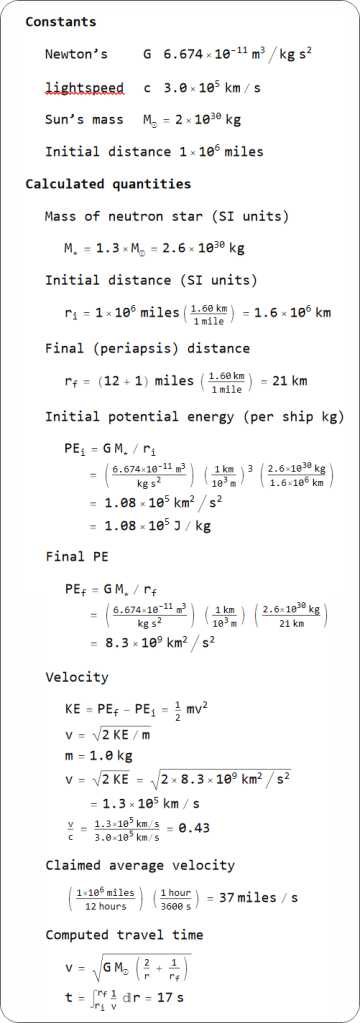
“Shaeffer’s ship was heading towards a neutron star. Lessee… ah, says the star’s mass is 1.3 times the Sun’s, diameter’s about 12 miles, and the ship’s on a fast in‑and‑out orbit, closest approach just a mile above the surface. Oh, and early on he drifts forward like something’s pulling on him but not on the ship. What does that tell you?”

“Enough to solve the puzzle, not enough to check his numbers. Anything about speed?”

“Mmm, he says the ship popped into the system a million miles out and it’d take 12 hours to reach the close‑approach point. The average speed’s just arithmetic, right?”

“Not really. A simple average doesn’t take account of acceleration changes or relativity effects. It’s easier and more accurate to apply conservation of energy. Okay with you if I assume the ship ‘pops into the system’ with zero velocity relative to the star and then free‑falls towards it?”

“That fits with the story, mostly.”

“Good. So right after the pop‑in” <tapping on Old Reliable’s screen> “the ship’s gravitational potential energy is ‑1.08×10⁵ joules/kilogram—”

“Negative?”

“It’s defined as the potential energy Shaeffer’d gave up en route from infinitely far away. At 13 miles from the star’s center, that’s zoomed to ‑8.3×10⁹ J/kg. The potential energy’s converted to kinetic energy ½mv² except we’re talking per kilogram so m is 1.0 and the velocity is —whoa!— 129 thousand kilometers/second. That’s 43% of lightspeed!”

“Well, Shaeffer did see the background stars shift blue even before he got deep into the gravity well. So, how about Niven’s 12‑hour, million‑mile claim?”

“That distance in that time works out to 37 miles per second, way less than lightspeed’s 186 000. Shaeffer was dawdling. You need calculus to figure the actual travel time — integrate 1/v between here and there. Ugly problem to solve manually but Old Reliable’s up to it. Given the appropriate orbit equation and the numbers we’ve worked out so far, Old Reliable says the trip should have taken him about 17 seconds.”

“HAW! I knew something seemed off. Wait, you said you’d solved the puzzle. What’s your answer?”

“Tides. That’s what moved him forward relative to the ship.”

“Yeah, that’s what Niven wrote, but I don’t see why what Shaeffer did saved him.”

“What did Shaeffer do?”

“Spread-eagled himself across a gangway at the ship’s center of gravity.”

“Brilliant — minimized his thickness along the star‑to‑ship line. Gravity’s pull on his sternum wasn’t much different from the pull on his spine. If he’d oriented himself perpendicular to that, his feet would feel a stronger pull than his head would have. Every transverse joint from neck to ankles would crackle or even tear. Talk about chiropractic.”

Vinne winces. “Why does thickness matter?”

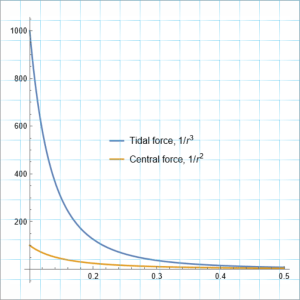
“Tidal force reflects how center‑to‑center force changes with distance. Center‑to‑center force rises with 1/r². Tidal force goes up as 1/r³. Cube grows faster than square. Small r, big tides.”

~ Rich Olcott

A Pencil In Space

<chirp, chirp> “Moire here.”

“I have a question I think you’ll find interesting, but it’s best we talk in person. Care for pizza?”

“If you’re buying.”

“Of course. Meet me at Eddie’s, twenty minutes. Bring Old Reliable.”

“Of course.”


Tall fellow, trimmed chevron mustache, erect bearing except when he’s leaning on that cane. “Moire?”

“That’s me. Good to meet you, Mr … ?”

“No names. Call me … Walt.”

We order, find a table away from the kitchen. “So, Walt, what’s this interesting question?”

“Been following this year’s Jupiter series in your blog. Read over the Kaspi paper, too, though most of that was over my head. What I did get was that his conclusions and your conclusions all come from measuring very small orbit shifts which arise from millionths of a g of force. Thing is, I don’t see where any of you take account of the Sun’s gravity. If the Sun’s pull holds Jupiter in orbit, it ought to swamp those micro-g effects. Apparently it doesn’t. Why not?”

“Well. That’s one of those simple questions that entail a complicated answer.”

“I’ve got time.”

“I’ll start with a pedantic quibble but it’ll clarify matters later on. You refer to g as force but it’s really acceleration. The one‑g acceleration at Earth’s surface means velocity changes by 980 meters/second per second of free fall. Drop a one kilogram mass, it’ll accelerate that fast. Drop a 100 kilogram mass, it’ll experience exactly the same acceleration, follow?”

“But the second mass feels 100 times the force.”

“True, but we can’t measure forces, only movement changes. Goes all the way back to Newton defining mass in terms of force and vice‑versa. Anyway, when you’re talking micro‑g orbit glitches you’re talking tiny changes in acceleration. Next step — we need the strength of the Sun’s gravitational field in Jupiter’s neighborhood.”

“Depends on the Sun’s mass and Jupiter’s mass. No, wait, just the Sun’s mass because that’s how it curves spacetime. The force depends on both masses.”

I’m impressed. “And the square of the very large distance between them.” <tapping on Old Reliable’s screen> “Says here the Sun’s field strength out there is 224 nano‑g, which is pretty small.”

“How’s that compare to what else is acting on Juno?”

<more tapping> “Jupiter’s local field strength crushes the Sun’s. At Juno’s farthest point it’s 197 micro‑g but at Juno’s closest point the field’s 22.7 million micro‑g and the craft’s doing 41 km/s during a 30-minute pass. Yeah, the Sun’s field would make small adjustments to Juno’s orbital speed, depending on where everybody is, but it’d be a very slow fluctuation and not the rapid shakes NASA measured.”

“How about side‑to‑side?”

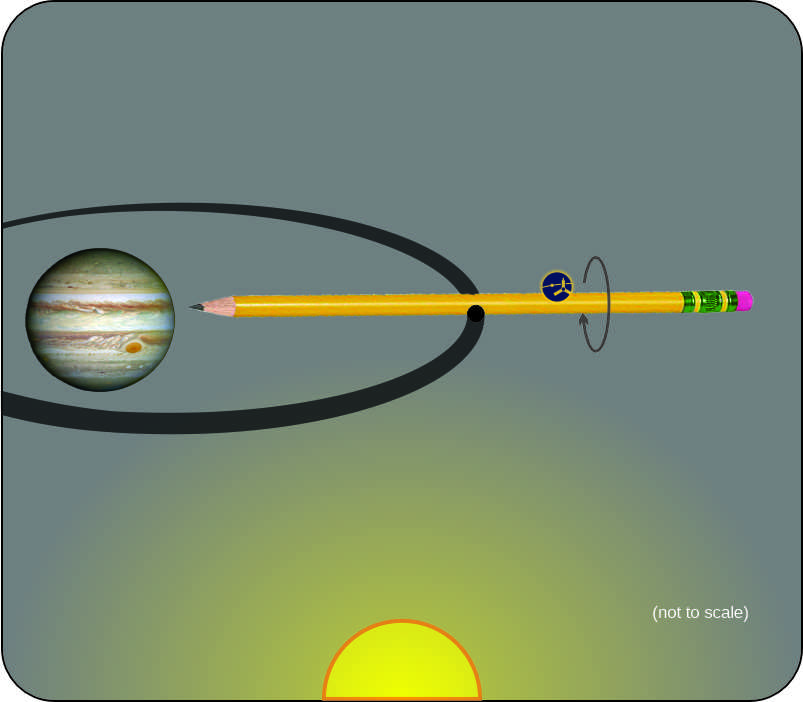
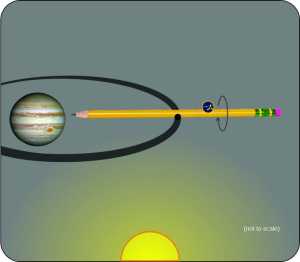
“Good point, but now we’re getting to the structure of Juno’s orbit. Its eccentricity is 98%, a long way from circular. Picture a skinny oval pencil 8 million kilometers long, always pointed at Jupiter while going around it. It’s a polar orbit, rises above Jupiter on the approach, then falls below going away. The Sun’s effect is greatest when the orbit’s at right angles to the Sun‑Jupiter line. The solar field twists the oval away from N‑S on approach, trues it back up on retreat. That changes the angle at which Juno crosses Jupiter’s gravitational wobbles but won’t affect how it experiences the zonal harmonics.”

“Tell me about those zonal things.”

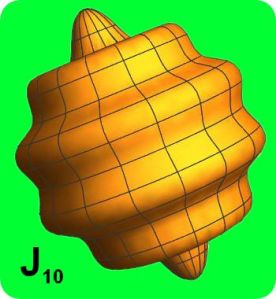
“A zone is a region, like the stripes on Jupiter, that circles a sphere at constant latitude. Technically, zonal harmonic Jn is the nth Legendre polynomial in cos(θ)—”

“Too technical.”

“Gotcha. Okay, each Jn names a shape, a set of gravitational ripples perpendicular to the polar axis. J0‘s a sphere with no ripples. Jupiter’s average field looks like that. A bigger n number means more ripples. Kaspi’s values estimate how much each Jn‘s intensity adds to or subtracts from J0‘s strength at each latitude. The Sun’s field can modify the intensity of J0 but none of the others.”

Walt grabs his cane, stands, drops a C‑note on the table. “This’ll cover the pizza and your time. Forget we had this conversation.” And he’s gone.

“Don’t mention it.”

~~ Rich Olcott

  • Thanks to Will, who asked the question.

Tilting at Black Holes

“What’s the cause-effect-time thing got to do with black holes and information?”

“We’re getting there, Al. What happens to spacetime near a black hole?”

“Everybody knows that, Sy, spacetime gets stretched and squeezed until there’s infinite time dilation at the Event Horizon.”

“As usual, Vinnie, what everybody knows isn’t quite what is. Yes, Schwarzschild’s famous solution includes that Event Horizon infinity but it’s an artifact of his coordinate system. Al, you know about coordinate systems?”

“I’m a star-watcher, Sy. Sure, I know about latitude and longitude, declination and right ascension, all that stuff no problem.”

“Good. Well, Einstein wrote his General Relativity equations using generalized coordinates, like x,y,z but with no requirement that they be straight lines or at right angles. Schwarzschild solved the equations for a non‑rotating sphere so naturally he used spherical coordinates — radius, latitude and longitude. Since then other people have solved the equations for more complicated cases using more complicated coordinate systems. Their solutions don’t have that infinity.”

“No infinity?”

“Not that one, anyhow. The singularity at the hole’s geometric center is a real thing, not an artifact. So’s a general Event Horizon, but it’s not quite where Schwarzschild said it should be and it doesn’t have quite the properties that everybody thinks they know it has. It’s still weird, though.”

“How so?”

“First thing you have to understand is that when you get close to a black hole, you don’t feel any different. Except for the spaghettification, of course.”

“It’s frames again, ain’t it?”

“With black holes it’s always frames, Vinnie. If you’re living in a distorted space you won’t notice it. Whirl a meter‑long sword around, you’d always see it as a meter long. A distant observer would see you and everything around you as being distorted right along with your space. They’ll see that sword shrink and grow as it passes through different parts of the distortion.”

“Weird.”

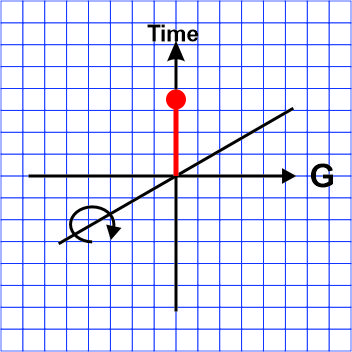
“We’re just getting started, Al. Time’s involved, too. <grabbing a paper napkin and sketching> Here’s three axes, just like x,y,z except one’s time, the G one points along a gravity field, and the third one is perpendicular to the other two. By the way, Al, great idea, getting paper napkins printed like graph paper.”

“My location’s between the Physics and Astronomy buildings, Sy. Gotta consider my clientele. Besides, I got a deal on the shipment. What’s the twirly around that third axis?”

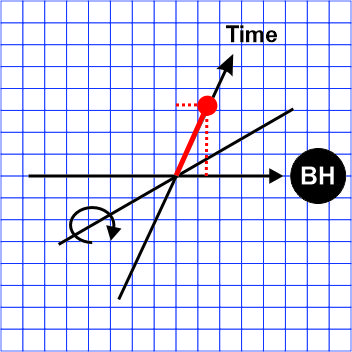
“It’s a reminder that there’s a couple of space dimensions that aren’t in the picture. Now suppose the red ball is a shuttlecraft on an exploration mission. The blue lines are its frame. The thick vertical red line shows it’s not moving because there’s no spatial extent along G. <another paper napkin, more sketching> This second drawing is the mothership’s view from a comfortable distance of the shuttlecraft near a black hole.”

“You’ve got the time axis tilted. What’s that about?”

“Spacetime being distorted by the black hole. You’ve heard Vinnie and me talk about time dilation and space compression like they’re two different phenomena. Thing is, they’re two sides of the same coin. On this graph that shows up as time tilted to mix in with the BH direction.”

“How about those twirly directions?”

“Vinnie, you had to ask. In the simple case where everything’s holding still and you’re not too close to the black hole, those two aren’t much affected. If the big guy’s spinning or if the Event Horizon spans a significant amount of your sky, all four dimensions get stressed. Let’s keep things simple, okay?”

“Fine. So the time axis is tilted, so what?”

“We in the distant mothership see the shuttlecraft moving along pure tilted time. The shuttlecraft doesn’t. The dotted red lines mark its measurements in its blue‑line personal frame. Shuttlecraft clocks run slower than the mothership’s. Worse, it’s falling toward the black hole.”

“Can’t it get away?”

“Al, it’s a shuttlecraft. It can just accelerate to the left.”

“If it’s not too close, Vinnie. The accelerative force it needs is the product of both masses, divided by the distance squared. Sound familiar?”

“That’s Newton’s Law of Gravity. This is how gravity works?”

“General Relativity cut its teeth on describing that tilt.”

~~ Rich Olcott

Turn This Way to Turn That Way

“I don’t understand, Sy. I get that James Webb Space Telescope uses its reaction wheels like a ship uses a rudder to change direction by pushing against something outside. Except the rudder pushes against water but the reaction wheels push against … what, the Universe?”

“Maybe probably, Al. We simply don’t know how inertia works. Newton just took inertia as a given. His Laws of Motion say that things remain at rest or persist in linear motion unless acted upon by some force. He didn’t say why. Einstein’s General Relativity starts from his Equivalence Principle — gravitational inertia is identical to mechanical inertia. That’s held up to painstaking experimental tests, but why it works is still an open question. Einstein liked Mach’s explanation, that we experience these inertias because matter interacts somehow with the rest of the Universe. He didn’t speculate how that interaction works because he didn’t like Action At A Distance. The quantum field theory people say that everything’s part of the universal field structure, which sounds cool but doesn’t help much. String theory … ’nuff said.”

“Hey, Moire, what’s all that got to do with the reaction wheel thing? JWST can push against one all it wants but it won’t go anywhere ’cause the wheel’s inside it. What’s magic about the wheels?”

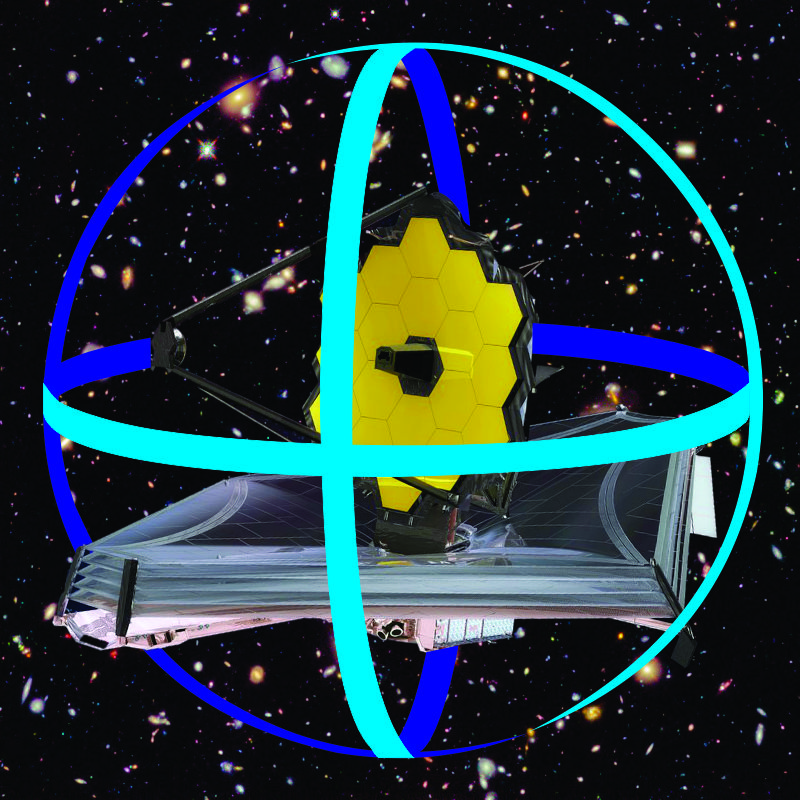
JWST doesn’t want to go anywhere else, Mr Feder. We’re happy with it being in its proper orbit, but it needs to be able to point to different angles. Reaction wheels and gyroscopes are all about angular momentum, not about the linear kind that’s involved with moving from place to place.”

“HAH! JWST is moving place to place, in that orbit! Ain’t it got linear momentum then?”

Newton’s Principia, Proposition II, Theorem II

“In a limited way, pun intended. Angular momentum is linear momentum plus a radial constraint. This goes back to Newton and his Principia book. I’ve got a copy of his basic arc‑splitting diagram here in Old Reliable. The ABCDEF line is a section of some curve around point S. He treated it as a succession of short line segments ABc, BCd, CDe and so on. If JWST is at point B, for instance, Newton would say that it’s traveling with a certain linear momentum along the BCd line. However, it’s constrained to move along the arc so it winds up at D instead d. To account for the constraint Newton invented centripetal force to pull along the Sd line. He then mentally made the steps smaller and smaller until the sequence of short lines matched the curve. At the limit, a sequence of little bits of linear momentum becomes angular momentum. By the way, this step‑reduction process is at the heart of calculus. Anyway, JWST uses its reaction wheels to swing itself around, not to propel itself.”

“And we’re back to my original question, Sy. What makes that swinging happen?”

“Oh, you mean the mechanical reality. Easy, Al. Like I said, three pairs of motorized wheels are mounted on JWST‘s frame near the center of mass. Their axles are at mutual right angles. Change a wheel’s angular momentum, you get an equal opposing change to the satellite’s. Suppose the Attitude Control System wants the satellite to swing to starboard. That’d be clockwise viewed from the cold side. ACS must tell a port/starboard motor to spin its wheel faster counterclockwise. If it’s already spinning clockwise, the command would be to put on the brakes, right? Either way, JWST swings clockwise. With the forward/aft motors and the hot‑side/cold‑side motors, the ACS is equipped to get to any orientation. See how that works?”

“Hang on.” <handwaving ensues> “Yeah, I guess so.”

“Hey, Moire. What if the wheel’s already spinning at top speed in the direction the ACS wants more of?”

“Ah, that calls for a momentum dump. JWST‘s equipped with eight small rocket engines called thrusters. They convert angular momentum back to linear momentum in rocket exhaust. Suppose we need a further turn to starboard but a port/starboard wheel is nearing threshold spin rate. ACS puts the brakes on that wheel, which by itself would turn the satellite to port. However, ACS simultaneously activates selected thrusters to oppose the portward slew. Cute, huh?”

~~ Rich Olcott

The Gelato Model

“Eddie, this ginger gelato’s delicious — not too sweet and just the right amount of ginger bite.”

“Glad you like it, Anne.”

On the way down here, Sy was telling me about how so many things in the Universe run on the same mathematics if you look at them with the right coordinate system. Sy, how do you pick ‘the right coordinate system?”

“The same way you pick the right property to serve as a momentum in Newton’s Equation of Motion — physical intuition. You look for things that fit the system. Sometimes that puts you on the road to understanding, sometimes not. Eddie, you keep track of your gelato sales by flavor. How are they doing?”

“Pistachio’s always a good seller, Sy, but ginger has been coming on strong this year.”

“In motion terns, pistachio’s momentum is constant but ginger is gaining momentum, right?”

“S’what I said.”

“Measured in dollars or trayfuls?”

“In batches. I make it all in-house. I’m proud of that. Dollars, too, of course, but that’s just total for all flavors.”

“Batches all the same size?”

“Some are, some not, depending. If I had a bigger machine I could make more but I do what I can.”

“There you go, Anne, each gelato flavor is like a separate degree of freedom. Eddie’s tracked sales since he started so we can take that date as the origin. Measuring change along any degree in either batches or dollars we have perfectly respectable coordinates although the money view of the system is fuzzier. Velocity is batches per unit time, there’s even a speed limit, and ginger has accelerated. Sound familiar?”

“Sounds like you’re setting up a Physics model.”

“Call it gelato trend physics, but I don’t think I can push the analogy much further. The next step would be to define a useful momentum like Newton did with his Law of Motion.”

F=ma? That’s about acceleration, isn’t it?”

“Probably not in Newton’s mind. Back in his day they were arguing about which was conserved, energy or momentum. It was a sloppy argument because no‑one agreed on crisp definitions. People could use words like ‘quantity of motion‘ to refer to energy or momentum or even something else. Finally Newton defined momentum as ‘mass times velocity‘, but first he had to define ‘mass‘ as ‘quantity of matter‘ to distinguish it from weight which he showed is a force that’s indirectly related to mass.”

“So is it energy or momentum that’s conserved?”

“Both, once you’ve got good definitions of them. But my point is, our car culture has trained us to emphasize acceleration. Newton’s thinking centered on momentum and its changes. In modern terms he defined force as momentum change per unit time. I’m trying to think of a force‑momentum pair for Eddie’s gelato. That’s a problem because I can’t identify an analog for inertia.”

“Inertia? What’s that got to do with my gelato?”

“Not much, and that’s the problem. Inertia is resistance to force. Who can resist gelato? If it weren’t for inertia, the smallest touch would be enough to send an object at high speed off to forever. The Universe would be filled with dust because stars and planets would never get the chance to form. But here we are, which I consider a good thing. Where does inertia come from? Newton changed his mind a couple of times. To this day we only have maybe‑answers to that question.”

“You know we want to know, Sy.”

“Einstein’s favorite guess was Mach’s Principle. There’s about a dozen different versions of the basic idea but they boil down to matter interacting with the combined gravitational and electromagnetic fields generated by the entire rest of the Universe.”

“Wow. Wait, the stars are far away and the galaxies are much, much further away. Their fields would be so faint, how can they have any effect at all?”

“You’re right, Anne, field intensity per star does drop with distance squared. But the number of stars goes up with distance cubed. The two trends multiply together so the force trends grow linearly. It’s a big Universe and size matters.”

“So what about my gelato?”

“We’ll need more research, Eddie. Another scoop of ginger, Anne?”

~~ Rich Olcott

Space Potatoes

“Uncle Sy, what’s the name of the Moon face that’s just a sliver?”

“It’s called a crescent, Teena, and it’s ‘phase,’ not ‘face’. Hear the z-sound?”

“Ah-hah, one of those spelling things, huh?”

“I’m afraid so. What brought that question up?”

“I was telling Bratty Brian about the Moon shadows and he said he saw a cartoon about something that punched a hole in the Moon and left just the sliver.”

“Not going to happen, Sweetie. Anything as big as the Moon, Mr Newton’s Law of Gravity says that it’ll be round, mostly, except for mountains and things.”

“Cause there’s something really heavy in the center?”

“No, and that’s probably what shocked people the most back in those days. They had Kings and Emperors, remember, and a Pope who led all the Christians in Europe. People expected everything to have some central figure in charge. That’s why they argued about whether the center of the Universe was the Earth or the Sun. Mr Newton showed that you don’t need anything at all at the center of things.”

“But then what pulls the things together?”

“The things themselves and the rules they follow. Remember the bird murmuration rules?”

“That was a long time ago, Uncle Sy. Umm… wasn’t one rule that each bird in the flock tries to stay about the same distance from all its neighbors?”

“Good memory. That was one of the rules. The others were to fly in the same general direction as everybody else and to try stay near the middle of the flock. Those three rules pretty much kept the whole flock together and protected most of the birds from predators. Mr Newton had simpler rules for rocks and things floating in space. His first rule was. ‘Keep going in the direction you’ve been going unless something pulls you in another direction.’ We call that inertia. The second rule explained why rocks fly differently than birds do.”

“Rocks don’t fly, Uncle Sy, they fall down.”

“Better to think of it as flying towards other things. Instead of the safe‑distance rule, Mr Newton said, ‘The closer two things are, the harder they pull together.’ Simple, huh?”

“Oh, like my magnet doggies.”

“Yes, exactly like that, except gravity always attracts. There’s no pushing away like magnets do when you turn one around. Suppose that back when the Solar System was being formed, two big rocks got close. What would happen?”

“They’d bang together.”

“And then?”

“They’d attract other rocks and more and more. Bangbangbangbang!”

“Right. What do you suppose happens to the energy from those bangs? Remember, we’re out in space so there’s no air to carry the sound waves away.”

“It’d break the rocks into smaller rocks. But the energy’s still there, just in smaller pieces, right?”

“The most broken-up energy is heat. What does that tell you?”

“The rock jumble must get … does it get hot enough to melt?”

“It can So now suppose there’s a blob of melted rock floating in space, and every atom in the melted rock is attracted to every other atom. Pretend you’re an atom out at one end of the blob.”

“I see as many atoms to one side as to the other so I’m gonna pull in towards the middle.”

“And so will all the other atoms. What shape is that going to make the blob?”

“Ooooh. Round like a planet. Or the Sun. Or the Moon!”

“So now tell me what would happen if someone punched a hole in the Moon?”

“All the crumbles at the crescent points would get pulled in towards the middle. It wouldn’t be a crescent any more!”

“Exactly. Mind you, if it doesn’t melt it may not be spherical. Melted stuff can only get round because molten atoms are free to move.”

“Are there not-round things in space?”

“Lots and lots. Small blobs couldn’t pull themselves spherical before freezing solid. They could be potato‑shaped, like the Martian moons Phobos and Deimos. Some rocks came together so gently that they didn’t melt. They just stuck together, like Asteroid Bennu where our OSIRIS-REx spacecraft sampled.”

“Space has surprising shapes, huh?”

“Space always surprises.”

~~ Rich Olcott

  • Thanks to Xander and Alex who asked the question.

Rotation, Revolution and The Answer

“Sy, I’m startin’ to think you got nothin’. Al and me, we ask what’s pushing the Moon away from us and you give us angular momentum and energy transfers. C’mon, stop dancin’ around and tell us the answer.”

“Yeah, Sy, gravity pulls things together, right, so how come the Moon doesn’t fall right onto us?”

“Not dancing, Vinnie, just laying some groundwork for you. Newton answered Al’s question — the Moon is falling towards us, but it’s going so fast it overshoots. That’s where momentum comes in, Vinnie. Newton showed that a ball shot from a cannon files further depending on how much momentum it gets from the initial kick. If you give it enough momentum, and set your cannon high enough that the ball doesn’t hit trees or mountains, the ball falls beyond the planet and keeps on falling forever in an elliptical orbit.”

“Forever until it hits the cannon.”

“hahaha, Al. Anyway, the ball achieves orbit by converting its linear momentum to angular momentum with the help of gravity. The angular momentum pretty much defines the orbit. In Newton’s gravity‑determined universe, momentum and position together let you predict everything.”

“Linear and angular momentum work the same way?”

“Mostly. There’s only one kind of linear momentum — straight ahead — but there are two kinds of angular momentum — rotation and revolution.”

“Aw geez, there’s another pair of words I can never keep straight.”

“You and lots of people, Vinnie. They’re synonyms unless you’re talking technicalese. In Physics and Astronomy, rotation with the O gyrates around an object’s own center, like a top or a planet rotating on its axis. Revolution with the E gyrates around some external location, like the planet revolving around its sun. Does that help?”

“Cool, that may come in handy. So Newton’s cannon ball got its umm, revolution angular momentum from linear momentum so where does rotation angular momentum come from?”

“Subtle question, Vinnie, but they’re actually all just momentum. Fair warning, I’m going to avoid a few issues that’d get us too far into the relativity weeds. Let’s just say that momentum is one of those conserved quantities. You can transfer momentum from one object to another and convert between forms of momentum, but you can’t create momentum in an isolated system.”

“That sounds a lot like energy, Sy.”

“You’re right, Al, the two are closely related. Newton thought that momentum was THE conserved quantity and all motion depended on it. His arch‑enemy Leibniz said THE conserved quantity was kinetic energy, which he called vis viva. That disagreement was just one battle in the Newton‑Leibniz war. It took science 200 years to understand the momentum/kinetic energy/potential energy triad.”

“Wait, Sy, I’ve seen NASA steer a rocketship and give it a whole different momentum. I don’t see no conservation.”

“You missed an important word, Vinnie — isolated. Momentum calculations apply to mechanical systems — no inputs of mass or non‑mechanical energy. Chemical or nuclear fuels break that rule and get you into a different game.”

“Ah-hahh, so if the Earth and Moon are isolated…”

“Exactly, and you’re way ahead of me. Like we said, no significant net forces coming from the Sun or Jupiter, so no change to our angular momentum.”

“Hey, wait, guys. Solar power. I know we’ve got a ton of sunlight coming in every day.”

“Not relevant, Al. Even though sunlight heats the Earth, mass and momentum aren’t affected by temperature. Anyhow, we’re finally at the point where I can answer your question.”

“About time.”

“Hush. OK, here’s the chain. Earth rotates beneath the Moon and gets its insides stirred up by the Moon’s gravity. The stirring is kinetic energy extracted from the energy of the Earth‑Moon system. The Moon’s revolution or the Earth’s rotation or both must slow down. Remember the M=m·r·c/t equation for angular momentum? The Earth‑Moon system is isolated so the angular momentum M can’t change but the angular velocity c/t goes down. Something’s got to compensate. The system’s mass m doesn’t change. The only thing that can increase is distance r. There’s your answer, guys — conservation of angular momentum forces the Moon to drift outward.”

“Long way to the answer.”

“To the Moon and back.”

~~ Rich Olcott