Atoms are solar systems? Um, no…

Suddenly there’s a hubbub of girlish voices to one side of the crowd.  “Go on, Jeremy, get up there.”  “Yeah, Jeremy, your theory’s no crazier than theirs.”  “Do it, Jeremy.”

Sure enough, the kid’s here with some of his groupies.  Don’t know how he does it.  He’s a lot younger than the grad students who generally present at these contests, but he’s got guts and he grabs the mic.

“OK, here’s my Crazy Theory.  The Solar System has eight planets going around the Sun, and an oxygen atom has eight electrons going around the nucleus.  Maybe we’re living in an oxygen atom in some humongous Universe, and maybe there are people living on the electrons in our oxygen atoms or whatever.  Maybe the Galaxy is like some huge molecule.  Think about living on an electron in a uranium atom with 91 other planets in the same solar system and what happens when the nucleus fissions.  Would that be like a nova?”

There’s a hush because no-one knows where to start, then Cathleen’s voice comes from the back of the room.  Of course she’s here — some of the Crazy Theory contest ring-leaders are her Astronomy students.  “Congratulations, Jeremy, you’ve joined the Honorable Legion of Planetary Atom Theorists.  Is there anyone in the room who hasn’t played with the idea at some time?”

No-one raises a hand except a couple of Jeremy’s groupies.

“See, Jeremy, you’re in good company.  But there are a few problems with the idea.  I’ll start off with some astronomical issues and then the physicists can throw in some more.  First, stars going nova collapse, they don’t fission.  Second, compared to the outermost planet in the Solar System, how far is it from the Sun to the nearest star?”

A different groupie raises her hand and a calculator.  “Neptune’s about 4 light-hours from the Sun and Alpha Centauri’s a little over 4 light-years, so that would be … the 4’s cancel, 24 hours times 365 … about 8760 times further away than Neptune.”

“Nicely done.  That’s a typical star-to-star distance within the disk and away from the central bulge.  Now, how far apart are the atoms in a molecule?”

“Aren’t they pretty much touching?  That’s a lot closer than 8760 times the distance.”

“Yes, indeed, Jeremy.  Anyone else with an objection?  Ah, Maria.  Go ahead.”

“Yes, ma’am.  All electrons have exactly the same properties, ¿yes? but different planets, they have different properties.  Jupiter is much, much heavier than Earth or Mercury.”

Astrophysicist-in-training Jim speaks up.  “Different force laws.  Solar systems are held together by gravity but at this level atoms are held together by electromagnetic forces.”

“Carry that a step further, Jim.  What does that say about the geometry?”

“Gravity’s always attractive.  The planets are attracted to the Sun but they’re also attracted to each other.  That’ll tend to pull them all into the same plane and you’ll get a flat disk, mostly.  In an atom, though, the electrons or at least the charge centers repel each other — four starting at the corners of a square would push two out of the plane to form a tetrahedron, and so forth.  That’s leaving aside electron spin.  Anyhow, the electronic charge will be three-dimensional around the nucleus, not planar.  Do you want me to go into what a magnetic field would do?”

“No, I think the point’s been made.  Would someone from the Physics side care to chime in?”

“Synchrotron radiation.”

“Good one.  And you are …?”

“Newt Barnes.  I’m one of Dr Hanneken’s students.”

“Care to explain?”

“Sure.  Assume a hydrogen atom is a little solar system with one electron in orbit around the nucleus.  Any time a charge moves it radiates waves into the electromagnetic field.  The waves carry forces that can compel other charged objects to move.  The distance an object moves, times the force exerted, equals the amount of energy expended by the wave.  Therefore the wave must carry energy and that energy must have come from the electron’s motion.  After a while the electron runs out of kinetic energy and falls into the nucleus.  That doesn’t actually happen, so the atom’s not a solar system.”

Jeremy gets general applause when he waves submission, then the crowd’s chant resumes…

.——<“Amanda! Amanda! Amanda!”>Bohr and Bohr atom

~~ Rich Olcott

Schroeder’s Magic Kittycat

“Bedtime, Teena.”

“Aw, Mommie, I had another question for Uncle Sy.  And I’m not sleepy yet anyhow.”

“Well, if we’re just sitting here relaxing, I suppose.  Sy, make your answer as boring as possible.”

“You know me better than that, Sis, but I’ll try.  What’s your question, Teena?”

“You said something once about quantum and Schroeder’s famous kittycat.  Why is it famous?  If it’s quantum it must be a very, very small cat.  Is it magic?”

“???… Oh, Schrödinger’s Cat.  It’s a pretend cat, not a real one, but it’s famous because it’s both asleep and awake.”

“I see what you did there, Sy.”

“Yeah, Sis, but it’s for a good cause, right?”

“But Uncle Sy, how can you tell?  Sometimes Tommie our kittycat looks sound asleep but he’s not really because he can hear when Mommie opens the cat-food can.”

“Schrödinger’s Cat is special.  Whenever he’s awake his eyes are wide open and whenever he’s asleep his eyes are shut.  And he’s in a box.”

“Tommie loves to sit in boxes.”

“Schrödinger’s Cat’s box is sealed tight.  You can’t see into it.”

“So how do you know whether he’s asleep?”

“That was Mr Schrödinger’s point.  We can’t know, so we have to suppose it’s both.  Many people have made jokes about that.  Mr. Schrödinger said the usual interpretation of quantum mechanics is ridiculous and his cat story was his way of proving that.  The cat doesn’t even have to be quantum-small and the story still works.”

“How could it be halfway?  Either his eyes are open or they’re … wait, sometimes Tommie squints, is that it?”

“Nice try, but no.  Do you remember when we were looking at the bird murmuration and I asked you to point to its middle?”

“Oh, yes, and it was making a beautiful spiral.  Mommie, you should have seen it!”

“Were there any birds right at its middle?”

“Um, no-o.  All around the middle but not right there.”

“Birds to the left, birds to the right, but no birds in the middle.  But if I’d I asked you to point to the place where the birds were, you’d’ve pointed to the middle.”

“Uh-huh.”

“You see how that’s like Mr Schrödinger’s cat’s situation?  It’s really asleep or maybe it’s really awake, but if we’re asked for just one answer we’d have to say ‘halfway between.’  Which is silly just like Mr Schrödinger said — by the usual quantum calculation we’d have to consider his cat to be half awake.  That was part of the long argument between Mr Einstein and the other scientist.”

“Wait, Sy, I didn’t hear that part of you two’s conversation on the porch.  What argument was that?”

“This was Einstein’s big debate with Niels Bohr.  Bohr maintained that all we could ever know about the quantum world are the probabilities the calculations yielded.  Einstein held that the probabilities had to result from processes taking place in some underlying reality.  Cat reality here, which we can resolve by opening the box, but the same issue applies across the board at the quantum level.  The problem’s more general than it appears, because much the same issue appears any time you can have a mixture of two or more states.  Are you asleep yet, Sweetie?”

“Nnn, kp tkng.”

“OK.  Entanglement, for instance.  Pretty much the same logic that Schrödinger disparaged can also apply to quantum particles on different paths through space.  Fire off any process that emits a pair of particles, photons for instance.  The wave function that describes both of them together persists through time so if you measure a property for one of them, say polarization direction, you know what that property is for the other one without traveling to measure it.  So far, so good.  What drove Einstein to deplore the whole theory is that the first particle instantaneously notifies the other one that it’s been measured.  That goes directly counter to Einstein’s Theory of Relativity which says that communication can’t go any faster than the speed of light.  Aaand I think she’s asleep.”

“Nice job, Sy, I’ll put her to bed.  We may discuss entanglement sometime.  G’night, Sy.”

“G’night, Sis.  Let me know the next time you do that meatloaf recipe.”

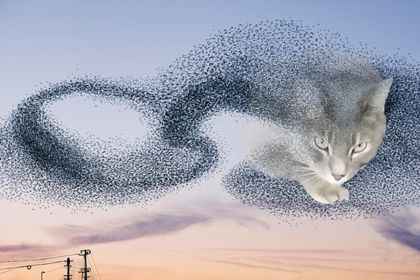
Cat emerging from murmuration~~ Rich Olcott

Stairway to A Rainbow

“OK, Teena, can you guess why I had you put those different things on different steps?”

“Oh, another game of Which of these things aren’t the same!  I love those!  So we’ve got a marble on one step; a tennis ball, a yo-yo and a ring-toss ring on the second step; and a softball and a ring-in-a-ring on the third step.”Shapes on steps

“Don’t forget we’re pretending the softball is hollow with a ping-pong ball floating in its middle.”

“I didn’t forget, Uncle Sy.  Uh… everything’s round, so that can’t be it.  Wait, there’s round-like-a-ball and round-like-a-donut, but we’ve got donut-thingies on two steps. … Oh!  The marble doesn’t have any empty places inside, the tennis ball has one and the softball has two.  Is that it?  But the other things don’t fit.”

“I’m sorry, I wasn’t fair with you ’cause I didn’t tell you about another rule.  See how yo-yo and donut shapes have a pinch-in-the-middle?  We call that a node and it counts as one empty place.”

“Wait, we forgot about the way-far-away empty place.  That counts for all of them, too, right?”

“Good remembering, that’s absolutely right.  It’s a node, too.”

<dancing about, singing>  “Then I know the answer, I know the answer!  The step number is the number of empty places, um, nodes.  The marble on the first step has one.  The tennis ball and the yo-yo and the ring on the second step have two, and the third-step things have three.  See that, Mommie?”

“Very good, Sweetie.  So what’s that got to do with colors, Sy?”

“Suppose we’re looking at a murmuration —”

“My lovely, lovely new word —”

“Yes, Teena.  Suppose for some reason we’d put a big hunk of bird food up on a tall pole.  Birds would fly to make a tight ball around the top of that pole.  Which of Teena’s toys would it look like?”

“Like that marble.”

“That’s right, no node in the middle.  Now suppose we want to get the birds away from the pole.  What could we do and what would the murmuration look like?”

“Set off a firecracker in the middle.  BOOM and all the birds fly away!”

“If they all fly the same distance, which toy would that look like?”

“The tennis ball!  BOOM and a tennis ball shape!  BOOM!”

“Settle down, Sweetie.  I suppose someone could make noise at the foot of the pole…. That would make a half-dumbbell shape as the birds fly upward.”

“Right on, Sis.  One more possibility — we could send a noisy drone to fly circles above the pole.”

“The birds would make a bigger circle between the drone’s orbit and the ground.  Oh!  Your donut shape.”

“Each way, the murmuration changes to a shape with one additional node and we go up a step.  And when we stop annoying the birds?”

“They fly right back to the food.  Ah, I see where you’re going.  They form that ball shape again and we have fewer nodes.  Now, about the colors…”

“Teena, do you think a murmuration could have half a node?”

“No, that’d be silly.”

“Absolutely right.  There’s no in-between step on the stairway, and there’s no in-between shape in an atom.”

“Wait, you mean that whenever an atom goes from a, say 2-node shape to a 3-node shape, that’s the famous quantum jump?”

“Yup, and the jump-down is, too.  Teena, let’s put all the toys back in your toy box and try an experiment.”

“OK … done!”

“Good job.  Now get up on the second step and jump down to the first one.  Make it a loud jump.”

“Sy!”

“Just this once, Sis, for demonstration purposes.”

“OK, just this once, Teena, and never again!”

“Yay!” <THUMP>

“So what’s that prove?”

“That energy is released when you go down a step or allow a murmuration to fill in an empty space.  Teena’s jump released sound energy.  Atoms release light energy when their charge cloud — ‘scuse me, Teena, quantum murmuration — goes to a shape with fewer nodes.  And the amount of energy for each different node-count change is always the same.”

“I think I see where you’re headed.  Each different jump makes a different color?”

“Sis, you’re as smart as I’ve always said you are.”

Murmuration concentric 2

~~ Rich Olcott

The Shapes of Fuzziness

Egg murmuration 1“That was a most excellent meat loaf, Sis.  Flavor balance was perfect.”
“Glad you liked it, Sy.  Mom’s recipe, of course, with the onion soup mix.”

“Yeah, but there was an extra tang in there.”

“Hah, you caught that!  I threw in some sweet pickle relish to brighten it some.”

“Mommy, Uncle Sy told me about quantum thingies and how they hide behind barriers and shoot rainbows at us.”

Sis gives me that What now? look so I must defend myself.  “Whoa, Teena, that’s not even close to what I said.”

“I know, Uncle Sy, but it’s more fun this way.  Little thingies going, ‘Pew! Pew! Pew!’

“Hey, get me out of trouble with your Mom, here.  What did I say really?”

<sigh> “Everything’s made of these teeny-weeny quantum thingies, smaller even than a water-bear egg — so small — and they have to obey quantum rules.  One of the rules is, um, if a lot of them get together to make a big thing, the big thing has to follow big-thing rules even though the little things follow quantum rules.”

“Nicely put, Sweetie.”

“And sometimes the quantum thingies act like waves and sometimes they act like real things and no-one knows how they do that.  And, uh, something about barriers making forbidden places that colors come out of and I’m mixed up about that.”

“Excellent summary, young lady.  That deserves an extra —” <sharp look from Sis who has a firm ‘No rewarding with food!‘ policy> “— chase around the block the next time we go scootering.”

“Yay!  But can you unconfuse me about the forbidden areas and colors?”

“Well, I can try.  Tell you what, bring your toy box over by the stairway, OK?  We’ll pick it all up when we’re done, Sis, I promise.  Ready, Teena?”

“Ready!”

“OK, put your biggest marble on the bottom step. Yes, it is pretty.  Now put a tennis ball and that dumbbell-shaped thing on the second step.  Oh, it’s a yo-yo?  Cool.  And that ring-toss ring, put it on the second step, too.  Now for the third step.  Put the softball there and … umm … take some of those Legos and make a little ring inside a big ring.  Thanks, Sis, just half a cup.  Ready, Teena?”

“Just a sec… ready!”

“Perfect.  Oh, Teena, you forgot to tell Mommy about the murmuration.”

“Oh, she’s seen them.  You know, Mommie, thousands of birds flying in a big flock and they have rules so they keep together but not too close and they make big pictures in the sky.”

“Yes, I have, sweetheart, but what does that have to do with quantum, Sy?”

“How would you describe their shapes?”

“Oh, they make spirals, and swirls… I’ve seen balls and cones and doughnuts and wide flowing sheets, and other shapes we simply don’t have names for.”

“These shapes on the stairs are the first few letters in science’s alphabet for describing complex shapes like atoms.  It’s like spelling a word.  That ball on the first step is solid.  The tennis ball is a hollow shell.  Pretend the softball is hollow, too, with a hollow ping-pong ball at its center.  If you pretend that each of these is a murmuration, Teena, does that make you think of anything?”

“Mmm..  There aren’t any birds flying outside of the marble, or outside or inside of the tennis ball.  And I guess there aren’t any flying between the layers in the ping-softball.  Are those forbidden areas?”

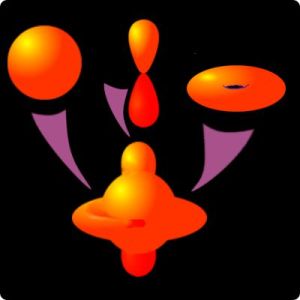
“C’mere for a high-five!  That’s exactly where I’m going with this.  The marble has one forbidden region infinitely far away.  The tennis ball has that one plus a second one at its middle.  The softball-ping-pong combo has three and so on.  We can describe any spherical fuzziness by mixing together shapes like that.”Combining shapes

“So what about the rings and that dumbbell yo-yo?”

“That’s the start of our alphabet for fuzziness that isn’t perfectly round.  Math has given us a toolkit of spheres, dumbbells, rings and fancier figures that can describe any atom.  Plain and fancy dumbbells stretch the shape out, rings bulge its equator, and so on.  Quantum scientists use the shapes to describe atoms and molecules.”

“Why the stairsteps?”

“What about my colors?”

~ Rich Olcott

Only A Bird in A Quantum Cage

“What’s another quantum rule, Uncle Sy?”

“Uhh…  Oh, look what the birds are doing now, Teena — flying back and forth between those two fields.”murmuration dipole 1“I think one side looks like a whale jumping out of the water, and the other side looks like the tail end of a buffalo or something.”

“Well, I can’t argue with that.  Look, though — the murmuration’s acting like it’s caught between two barriers of some kind.  That reminds me of another rule.  When you’re one of those tiny quantum things, it matters if you’re caught between barriers.”

“I’d want to be free so I could go wherever I want to.”

“Freedom’s nice for people but it must be boring for quantum things.  The rule says that a particle that doesn’t have any barriers just goes in a straight line forever and ever.  No stopping for lunch, never anyone to talk to, just traveling on and on.”

“Yeah, that’d be boring, all right.  What’s the rule say for when there’s barriers?”

“It depends on the barriers, what their shapes are and how far apart they are.  The general situation, though, is that there’s usually some forbidden regions, places where the particle can’t go.”

“Oooo, forbidden.  So spooky.  What happens to the particles who go there anyway?  Does something catch them and do bad things to them?”

“You’ve been watching too many horror movies.  No doing bad things but no trying to go into a forbidden area anyway.  Physics particles don’t have choice in the matter — they just can’t enter those places.  Almost can’t.”

“I heard ‘almost.’  Are you being sneaky?”

“No, just trying to keep things simple.  There’s something called ‘tunneling,’ where a particle that’s on one side of a barrier can sometimes somehow get to the other side of the barrier without going through it.  It’s one of the big puzzles in quantum mechanics.”

“Can’t it climb over, like I climb over fences?  (Shh, don’t tell Mommy.)”

“I suspect she already knows, Mommies are good at that, and I’m sure she’s praying that you’re being careful about which fences to climb and how you do it.”

“I am.  I only climb friendly fences that don’t have angry dogs behind them.”

“Good strategy, I feel better now.”

“If quantum thingies are even smaller than water-bear eggs, what do you make the barriers out of?”

“People don’t make the barriers, they’re just there, part of how the Universe works.  Um… Those little blocks you have that push each other away or pull together depending on how you point them…?”

“My rainbow blocks!  I love them.  Sometimes it’s hard to build something with them because you have to set one in a space just right or it’ll jump out.”

“Mm-hm.  Well, that push-or-pull force is called magnetism, and some of the barriers are made of that.”

“But that’s not a real thing!”

“Not something you can pick up, no, but the quantum things feel it and that’s what counts.  If the Universe didn’t have magnetism and forces related to it, we wouldn’t have rocks or stars or us.”

“I guess I’m happy that the barriers give quantum thingies places they can’t go.”

‘Just to make things more complicated, a lot of the forbidden places aren’t even where the barriers are.”

“Huh?”

“Like I said, it depends on the shape of the barriers.  If you’ve got two that face each other, there could be a forbidden place maybe in the middle, or two forbidden places a third of the way from each side, or three or four, all the way up.  And here’s a weird case that’s really important.  Ready to stretch your brain?”

“Just a minute … NNGGGGGH!  OK, I’m ready.”

“For an atom one of those barriers is infinitely far away.”

Infinitely??!?  My brain doesn’t stretch that far!”

“How about really, really far and let it go at that?  Anyway, atom barriers give us colors.”

“Now my head hurts.”

“Oh dear, better let your brain unstretch.  Hey look, the birds are flying off to roost in the woods ’cause it’s getting dark.  And it smells like your Mommy’s got dinner ready.  Time to go inside.”

“Mommy, can Uncle Sy stay for dinner with us?”

~~ Rich Olcott


What Are Quantum Birds Made Of?

“Do quantum thingies follow the same rules that birds do, Uncle Sy?”

“Mostly not, Teena.  Some quantum rules are simple, others are complicated and many are weird.”

“Tell me a simple one and a weird one.”

“Hm… the Principle of Correspondence is simple.  It says if you’ve got a lot of quantum things acting together, the whole mishmash acts by the same rules that a regular-sized thing that size would follow.  If all those birds flew in every direction there’s no flock to talk about, but if they fly by flock rules we can talk about how wind affects the flock’s motion.”

“It’s a murmuration, Uncle Sy.”

“Correction noted, Sweetie.”

“Now tell me a weird one.”

“There’s the rule that a quantum thing acts like it’s in a specific place when you look at it but it’s spread out when you’re not looking.”

“Kittie does that!  She’s never where you look for her.”

“Mm, that’s kind of in the other direction.  We see quantum particles in specific somewheres, not specific nowheres.  The rule is called wave-particle duality and people have been trying to figure out how it works for a hundred years.  Let’s try this.  Put your thumb and forefinger up to your eye and look between them at the blue sky.  Hold your fingers very close together but don’t let them touch.  What do you see?”

“Ooo, there’s stripes in between!  It looks like my finger’s going right into my thumb, but I can feel they’re not touching.  Hey, it works with my other fingers, too, but it hurts if I try it with my pinkie.”

“Then don’t do it with your pinkie, silly.  The stripes are called ‘interference’ and only waves do that.  You’ve watched how water waves go up and down, right?”

“Sure!”

“When the high part of one wave meets the low part of another wave, what happens?”

“I guess high and low make middle.”

“Good guess, that’s exactly right.  That little teeny space between your fingers lets through only certain waves.  You see light where the highs and lows are, dark where the waves middle out.”

“So light’s made out of waves, huh?”

“Well, except that scientists have done lots of experiments where light behaves like it’s made out of little particles called photons.  The funny thing is, light always acts like a wave when it’s traveling from one place to another, but at both ends of the trip it always acts like photons.  That’s the big mystery — how does it do that?”

“You know how it works, don’tcha, Uncle Sy?”

“Only kinda sorta, Teena.  I think it has to do with the idea of big things made out of little things made out of littler things.  Einstein — wait, you know who Einstein was, right?”

“He was the famous scientist with the big hair.”

“That’s right.  He and another scientist had a big debate over 80 years ago.  The other scientist said that when quantum things make patterns, like those stripes you’re looking at, the patterns are all we can know about them.  Einstein said that there has to be something deeper down that drives the patterns.”

“Who won the debate?”

“At the time most people thought that the other man had, but philosophies change.  Since that time lots of people have followed Einstein’s thinking.  Some of the theories are pretty silly, I think, but I’m betting on birds made out of birds.”

“That’s silly, too, Uncle Sy.”

“Maybe, maybe not, we’ll see some day.  It starts with what you might call ‘the smallness quantum,’ though it’s also called ‘the Planck length‘ after Mr Planck who helped invent quantum mechanics.  The Planck length is awesomely small.  It’s as much smaller than us as we are smaller than the whole universe.”

“But there’s lots of things bigger than we are.”

“Exactly.  We’re smaller than whales, they’re smaller than planets, planets are smaller than suns, and galaxies, and on up.  But we don’t know near as many size scales in the other direction – us and bacteria and atoms and protons and that’s about it.  I think there’s plenty of room down there for structures and chaos we’ve not thought of yet.”

“Like birds in murmurations.”

“Mm-hmm.”Bird made out of birds 1

~~ Rich Olcott

Teena And The Quantum Birds

“Hey, Uncle Sy, what’s quantum?”

“That’s a big question for a small person, Teena.  Where’d you hear that word?”

“You and Mommy were talking and you said that something had to do with quantum mechanics.  I know car mechanics work on cars so I want to know what the quantum mechanics work on.”

“That’s a fun question, Sweetie, because there actually is a kind of car called a Quantum.  Not very many of them and they’re made in England so you don’t often see one here.  But the quantum mechanics we were talking about is completely different.  I’ll take it one word at a time, OK?”

<sigh> “OK, but let’s sit on the porch swing, I can tell this will take a while.”

“Oh, it’s not going to be that bad.  You know what mechanisms are, right?”

“Um.. they’re not like people or animals and they’re not like my tablet thingie…. They’ve got gears and things.”

“Good enough.  A big part of physics is thinking about how mechanisms work and that’s called ‘mechanics.’  There’s lots of different kinds of mechanisms.  Each kind has a different kind of mechanics, like ‘celestial mechanics’ which is thinking about how stars and planets move, and ‘fluid mechanics’ which is thinking about how liquids and gases move.  With me so far?”

“So quantum mechanics is thinking about how quantums move.  But what’s a quantum?”

“Quantum isn’t a thing, it’s a set of rules that add up to be a theory.  The first rule is, it only applies to things that are very, very small.  That’s what the word ‘quantum’ has come to mean — the smallest possible amount of something.  So quantum rules apply to quantum-sized things.”

“As small as my water bears?”

“Much smaller.  Things that are as small compared to a water bear as a water bear egg is small compared to you.  Things like molecules and atoms, and those are made of lots of parts that are even way smaller.”

“Ooo, that’s teeny.  How do you even see them?”

“Well, you don’t.  They’re far too small to see even with a microscope.  It’s worse — if you did try to see an atom’s parts, any light you could shine on them would move them around so they’re not where they were when you started to look.”

“Then how do the quantum mechanics people learn about them?”

“Umm…  Ah! See that flock of birds flying past?”

“Mommy says they’re starlings but I think they’re blackbirds.”

“Could be either or both, it’s hard to tell when they’re in the air like that.  Sometimes the two kinds flock together.  If it’s a flock of starlings, the flock is called a murmuration, which is one of my favorite words.”

“Oh, that’ll be one of my favorites now, too.  Murmuration, mmmurmuration, mmmm.  I love  ‘M‘ words.”

“Anyway, can you see what direction any one bird is flying?”

“No, there’s too many and they go back and forth and it’s too confusing and I like the shapes the whole murmuration makes.”

“But can you point to the middle of it and see how the pattern moves?”

“It’s right the— ooo, look, it did a spiral!”

“Murmurations are sorta like the kind of thing the quantum mechanics people work with.  They look at lots and lots of quantum-size things to see how the typical ones and the special ones behave.  Then they try to work out what the behavior rules are.  Sometimes the rules are really simple, like the rules the birds use.”

“Birds use rules?  I thought they could fly wherever they wanted to.”

“Sometimes they do, but if they’re flying in a murmuration they definitely follow rules.  Most of them.  Most of the time.  If I were one of those birds, I’d stay about the same distance from each of my neighbor birds, I’d usually fly in about the same direction as my neighbors are flying, and I’d also aim at about the middle of the flo— murmuration.  Scientists have found that just those three rules account for most of how a murmuration behaves.  Cool, huh?”

“Simple rules for bird brains, that’s funny!”

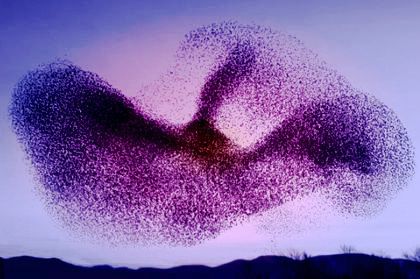
“But look at the beautiful shapes those simple rules make.”Murmuration 1

~~ Rich Olcott

Einstein’s Revenge

Vinnie’s always been a sucker for weird-mutant sci-fi films so what Jennie says gets him going.  “So you got these teeny-tiny neutrinos and they mutate?  What do they do, get huge and eat things?”

“Nothing that interesting, Vinnie — or uninteresting, depending on what you’re keen on.  No, what happens is that each flavor neutrino periodically switches to another flavor.”

“Like an electron becomes a muon or whatever?”

“Hardly.  The electron and muon and tau particles themselves don’t swap.  Their properties differ too much —  the muon’s 200 times heaver than the electron and the tau’s sixteen times more massive than that.  It’s their associated neutrinos that mutate, or rather, oscillate.  What’s really weird, though, is how they do that.”

“How’s that?”

“As I said, they cycle through the three flavors.  And they cycle through three different masses.”

“OK, that’s odd but how is it weird?”

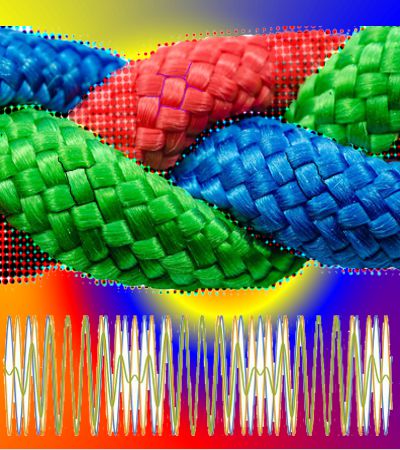
“Their flavor doesn’t change at the same time and place as their mass does.”Neutrino braid with sines

“Wait, what?”

“Each kind of neutrino, flavor-wise, is distinct — it reacts with a unique set of particles and yields different reaction products to what the other kinds do.  But experiments show that the mass of each kind of neutrino can vary from moment to moment.  At some point, the mass changes enough that suddenly the neutrino’s flavor oscillates.”

“That makes me think each mass could be a mix of three different flavors, too.”

“Capital, Vinnie!  That’s what the math shows.  It’s two different ways of looking at the same coin.”

“The masses oscillate, too?”

“Oh, indeed.  But no-one knows exactly what the mass values are nor even how the mass variation controls the flavors.  Or the other way to.  We know two of the masses are closer together than to the third but that’s about it.  On the experimental side there’s loads of physicists and research money devoted to different ways of measuring how neutrino oscillation rates depend on neutrino energy content.”

“And on the theory side?”

“Tons of theories, of course.  Whenever we don’t know much about something there’s always room for more theories.  The whole object of experiments like IceCube is to constrain the theories.  I’ve even got one I may present at Al’s Crazy Theory Night some time.”

“Oh, yeah?  Let’s hear it.”

“It’s early days, Al, so no flogging it about, mm?  Do you know about beat frequencies?”

“Yeah, the piano tuner ‘splained it to me.  You got two strings that make almost the same pitch, you get this wah-wah-wah effect called a beat.  You get rid of it when the strings match up exact.”  He grabs a few glasses from the counter and taps them with a spoon until he finds a pair that’s close.  “Like this.”

“Mm-hmm, and when the wah-wahs are close enough together they merge to become a note on their own.  You can just imagine how much more complicated it gets when there are three tones close together.”

I see where she’s going and bring up a display on Old Reliable —an overlay of three sine waves.   “Here you go, Jennie.  The red line is the average of the three regular waves.”Three sines on Old Reliable“Thanks, Sy.  Look, we’ve got three intervals where everything syncs up.  See the new satellite peaks half-way in between?  There’s more hidden pattern where things look chaotic in the rest of the space.”
“Yeah, so?”

“So, Vinnie, my crazy theory is that like a photon’s energy depends on its wave frequency in the electromagnetic field, a neutrino is a combination of three weak-field waves of slightly different frequency, one for each mass.  When they sync up one way you’ve got an electron neutrino, when they sync up a different way you’ve got a muon neutrino, and a third way for a tau neutrino.”

I’ve got to chuckle.  “Nothing against your theory, Jennie, though you’ve got some work ahead of you to flesh it out and test it.  I just can’t help thinking of Einstein and his debates with Bohr.  Bohr maintained that all we can know about the quantum realm are the averages we calculate.  Einstein held that there must be understandable mechanisms underlying the statistics.  Field-based theories like yours are just what Einstein ordered.”

“I could do worse.”Neutrino swirl around Einstein

~~ Rich Olcott

The Neapolitan Particle

“Welcome back, Jennie.  Why would anyone want to steer an ice cube?

“Thanks, Jeremy, it’s nice to be back..  And the subject’s not an ice cube, it’s IceCube, the big neutrino observatory in the Antarctic.”

“Then I’m with Al’s question.  Observatories have this big dome that rotates and inside there’s a lens or mirror or whatever that goes up and down to sight on the night’s target.  OK, the Hubble doesn’t have a dome and it uses gyros but even there you’ve got to point it.  How does IceCube point?”

“It doesn’t.  The targets point themselves.”

“Huh?”

“Ever relayed a Web-page?”

“Sure.”

“Guess what?  You don’t know where the page came from, you don’t know where it’s going to end up.  But it could carry a tracking bug to tell someone at some call-home server when and where the page had been opened.  IceCube works the same way, sort of.  It has a huge 3D array of detectors to record particles coming in from any direction.  A neutrino can come from above, below, any side, no problem — the detectors it touches will signal its path.”

IceCube architecture
Adapted from a work by Francis Halzen, Department of Physics, University of Wisconsin

“How huge?”

“Vastly huge.  The instrument is basically a cubic kilometer of ultra-clear Antarctic ice that’s ages old.  The equivalent of the tracking bugs is 5000 sensors in a honeycomb array more than a kilometer wide.  Every hexagon vertex marks a vertical string of sensors going down 2½ kilometers into the ice.  Each string has a couple of sensors near the surface but the rest of them are deeper than 1½ kilometers.  The sensors are looking for flashes of light.  Keep track of which sensor registered a flash when and you know the path a particle took through the array.”

icecube event 3“Why should there be flashes? I thought neutrinos didn’t interact with matter.”

“Make that, they rarely interact with matter.  Even that depends on what particle the neutrino encounters and what flavor neutrino it happens to be at the moment.”

That gets both Al and me interested.  His “Neutrinos come in flavors?” overlaps my “At the moment?”

“I thought that would get you into this, Sy.  Early experiments detected only 1/3 of the neutrinos we expected to come from the Sun.  Unwinding all that was worth four Nobel prizes and counting.  The upshot’s that there are three different neutrino flavors and they mutate.  The experiments caught only one.”

Vinnie’s standing behind us.  “You’re going to tell us the flavors, right?”

“Hoy, Vinnie, Jeremy’s question was first, and it bears on the others.  Jeremy, you know that blue glow you see around water-cooled nuclear fuel rods?”

“Yeah, looks spooky.  That’s neutrinos?”

“No, that’s mostly electrons, but it could be other charged particles.  It has to do with exceeding the speed of light in the medium.”

“Hey, me and Sy talked about that.  A lightwave makes local electrons wiggle, and how fast the wiggles move forward can be different from how fast the wave group moves.  Einstein’s speed-of-light thing was about the wave group’s speed, right, Sy?”

“That’s right, Vinnie.”

“So anyhow, Jeremy, a moving charged particle affects the local electromagnetic field.  If the particle moves faster than the surrounding atoms can adjust, that generates light, a conical electromagnetic wave with a continuous spectrum.  The light’s called Cherenkov radiation and it’s mostly in the ultra-violet, but enough leaks down to the visible range that we see it as blue.”

“But you said it takes a charged particle.  Neutrinos aren’t charged.  So how do the flashes happen in IceCube?”

“Suppose an incoming high-energy neutrino transfers some of its momentum to a charged particle in the ice — flash!  Even better, the flash pattern provides information for distinguishing between the neutrino flavors.  Muon neutrinos generate a more sharp-edged Cherenkov cone than electron neutrinos do.  Taus are so short-lived that IceCube doesn’t even see them.”Leptons

“I suppose muon and tau are flavors?”

“Indeed, Vinnie.  Any subatomic reaction that releases an electron also emits an electron-flavored neutrino.  If the reaction releases the electron’s heavier cousin, a muon, then you get a muon-flavored neutrino.  Taus are even heavier  and they’ve got their own associated neutrino.”

“And they mutate?”

“In a particularly weird way.”

~~ Rich Olcott

Bigger than you’d think

Al’s coffee shop, the usual mid-afternoon crowd of chatterers and laptop-tappers.  Al’s walking his refill rounds, but I notice he’s carrying a pitcher rather than his usual coffee pot.  “Hey, Al, what’s with the hardware?”

“Got iced coffee here, Sy.  It’s hot out, people want to cool down.  Besides, this is in honor of IceCube.”

“Didn’t realize you’re gangsta fan.”

“Nah, not the rapper, the cool experiment down in the Antarctic.  It was just in the news.”

“Oh?  What did they say about it?”

“It’s the biggest observatory in the world, set up to look for the tiniest particles we know of, and it uses a cubic mile of ice which I can’t think how you’d steer it.”

A new voice, or rather, a familiar one. “One doesn’t, Al.”
Neutrino swirl 1“Hello, Jennie.  Haven’t seen you for a while.”

“I flew home to England to see my folks.  Now I’m back here for the start of the Fall term.  I’ve already picked a research topic — neutrinos.  They’re weird.”

“Hey, Jennie, why are they so tiny?”

“It’s the other way to, Al.  They’re neutrinos because they’re so tiny.  Sy would say that for a long time they were simply an accounting gimmick to preserve the conservation laws.”

“I would?”

“Indeed.  People had noticed that when uranium atoms give off alpha particles to become thorium, the alpha particles always have about the same amount of energy.  The researchers accounted for that by supposing that each kind of nucleus has some certain quantized amount of internal energy.  When one kind downsizes to another, the alpha particle carries off the difference.”

“That worked well, did it?”

“Oh, yes, there are whole tables of nuclear binding energy for alpha radiation.  But when a carbon-14 atom emits a beta particle to become nitrogen-14, the particle can have pretty much any amount of energy up to a maximum.  It’s as though the nuclear quantum levels don’t exist for beta decay.  Physicists called it the continuous beta-spectrum problem and people brought out all sorts of bizarre theories to try to explain it.  Finally Pauli suggested maybe something we can’t see carries off energy and leaves less for the beta.  Something with no charge and undetectable mass and the opposite spin from what the beta has.”

“Yeah, that’d be an accounting gimmick, alright.  The mass disappears into the rounding error.”

“It might have done, but twenty years later they found a real particle.  Oh, I should mention that after Pauli made the suggestion Fermi came up with a serious theory to support it.  Being Italian, he gave the particle its neutrino name because it was neutral and small.”

“But how small?”

“We don’t really know, Al.  We know the neutrino’s mass has to be greater than zero because it doesn’t travel quite as fast as light does.  On the topside, though, it has to be lighter than than a hydrogen atom by at least a factor of a milliard.”

“Milliard?”

“Oh, sorry, I’m stateside, aren’t I?  I should have said a billion.  Ten-to-the-ninth, anyway.”

“That’s small.  I guess that’s why they can sneak past all the matter in Earth like the TV program said and never even notice.”

This gives me an idea.  I unholster Old Reliable and start to work.

“Be right with you… <pause> … Jennie, I noticed that you were being careful to say that neutrinos are light, rather than small.  Good careful, ’cause ‘size’ can get tricky at this scale.  In the early 1920s de Broglie wrote that every particle is associated with a wave whose wavelength depends on the particle’s momentum.  I used his formula, together with Jennie’s upper bound for the neutrino’s mass, to calculate a few wavelength lower bounds.Neutrino wavelength calcMomentum is velocity times mass.  These guys fly so close to lightspeed that for a long time scientists thought that neutrinos are massless like photons.  They’re not, so I used several different v/c ratios to see what the relativistic correction does.  Slow neutrinos are huge, by atom standards.  Even the fastest ones are hundreds of times wider than a nucleus.”

“With its neutrino-ness spread so thin, no wonder it’s so sneaky.”

“That may be part of it, Al.”

“But how do you steer IceCube?”

~~ Rich Olcott