Not Even A Sneeze in A Hurricane

Quite a commotion at the lakeshore this morning. I walk over to see what’s going on. Not surprised at who’s involved. “Come away from there, Mr Feder, you’re too close to their goslings.” Doesn’t work, of course, so I resort to stronger measures. “Hey, Mr Feder, any questions for me?”

That did the trick. “Hey, yeah, Moire, I got one. There’s this big problem with atomic power ’cause there’s leftovers when the fuel’s all used up and nobody wants it buried their back yard and I unnerstand that. How about we just load all that stuff into one of Musk’s Starships and send it off to burn up in the Sun? Or would that make the Sun blow up?”

“Second part first. Do you sneeze?”

“What kinda question is that? Of course I sneeze. Everyone sneezes.”

“Ever been in a hurricane?”

“Oohyeah. Sandy, back in 2012. Did a number on my place in Fort Lee. Took out my back fence, part of the roof, branches down all over the place—”

“Did you sneeze during the storm?”

“Who remembers that sort of thing?”

“If you had, would it have made any difference to how the winds blew?”

“Nah, penny‑ante compared to what else was going on. Besides, the storm eye went a couple hundred miles west of us.”

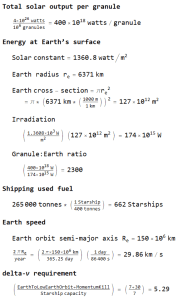
“Well, there you go. The Sun’s surface is covered by about a million granules, each about the size of Texas, and each releasing about 400 exawatts—”.

“Exawha?”

“Exawatt. One watt is one joule of energy per second. Exa– means 1018. So just one of those granules releases 400×1018 joules of energy per second. By my numbers that’s about 2300 times the total energy that Earth gets from the Sun. There’s a million more granules like that. Still think one of our rockets would make much difference with all that going on?”

“No difference anybody’d notice. But that just proves it’d be safe to send our nuclear trash straight to the Sun.”

“Safe, yes, but not practical.”

“When someone says ‘practical’ they’re about to do numbers, right?”

“Indeed. How much nuclear waste do you propose to ship to the Sun?”

“I dunno. How much we got?”

“I saw a 2022 estimate from the International Atomic Energy Agency that our world‑wide accumulation so far is over 265 000 tonnes, mostly spent fuel. Our heaviest heavy‑lift vehicle is the SpaceX Starship. Maximum announced payload to low‑Earth orbit is 400 tonnes for a one‑way trip. You ready to finance 662 launches?”

“Not right now, I’m a little short ’til next payday. How about we just launch the really dangerous stuff, like plutonium?”

“Much easier rocket‑wise, much harder economics‑wise.”

“Why do you say that?”

“Because most of the world’s nuclear power plants depend on MOX fuel, a mixture of plutonium and uranium oxides. Take away all the plutonium, you mess up a significant chunk of our carbon‑free‑mostly electricity production. But I haven’t gotten to the really bad news yet.”

“I’m always good for bad news. Give.”

“Even with the best of intentions, it’s an expensive challenge to shoot a rocket straight from Earth into the Sun.”

“Huh? It’d go down the gravity well just like dropping a ball.”

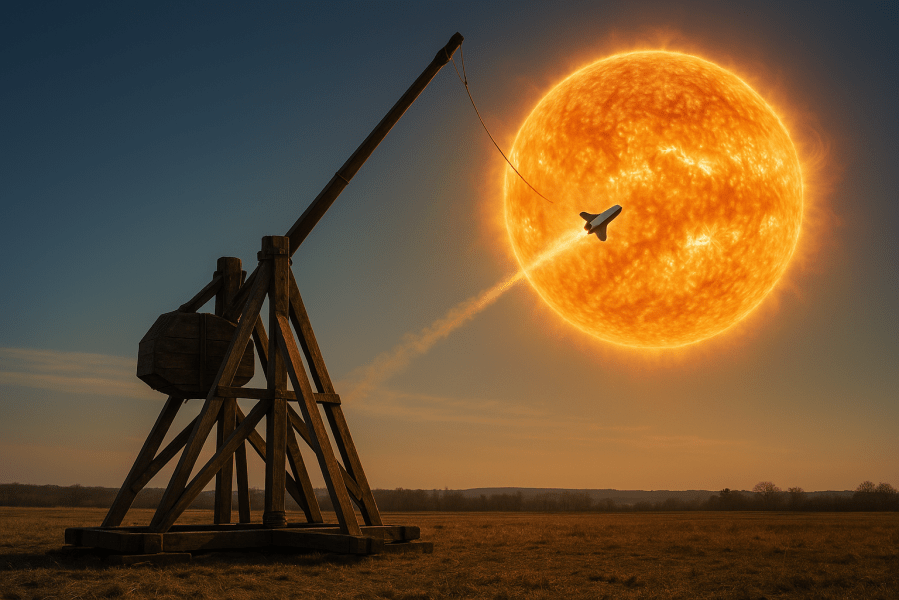
“Nope, not like dropping a ball. More like flinging it off to the side with a badly‑aimed trebuchet. Guess how fast the Earth moves around the Sun.”
“Dunno. I heard it’s a thousand miles an hour at the Equator.”

“That’s the planet’s rotation on its own axis. My question was how fast we go taking a year to do an orbit around the Sun. I’ll spare you the arithmetic — the planet speeds eastward at 30 kilometers per second. Any rocket taking off from Earth starts with that vector, and it’s at right angles to the Earth‑Sun line. You can’t hit the Sun without shedding all that lateral momentum. If you keep it, the rules of orbital mechanics force the ship to go faster and faster sideways as it drops down the well — you flat‑out miss the Sun. By the way, LEO delta‑v for SpaceX’s most advanced Starship is about 7 km/s, less than a fifth of the minimum necessary for an Earth‑to‑Sun lift.”

~ Rich Olcott
Two’s Company, Three Is Perturbing

Vinnie does this thing when he’s near the end of his meal. He mashes his pizza crumbs and mozzarella dribbles into marbles he rolls around on his plate. Mostly on his plate. Eddie hates it when one escapes onto his floor. “Vinnie, you lose one more of those, you’ll be paying extra.”

“Aw, c’mon, Eddie, I’m your best customer.”

“Maybe, but there’ll be a surcharge for havin’ to mop extra around your table.”

Always the compromiser, I break in. “How about you put on less sauce, Eddie?”

Both give me looks you wouldn’t want.
  ”Lower the quality of my product??!?”
    ”Adjust perfection??!?”

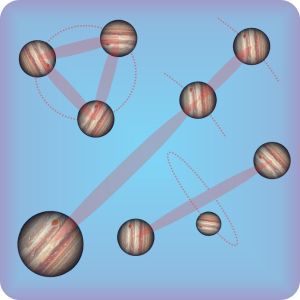
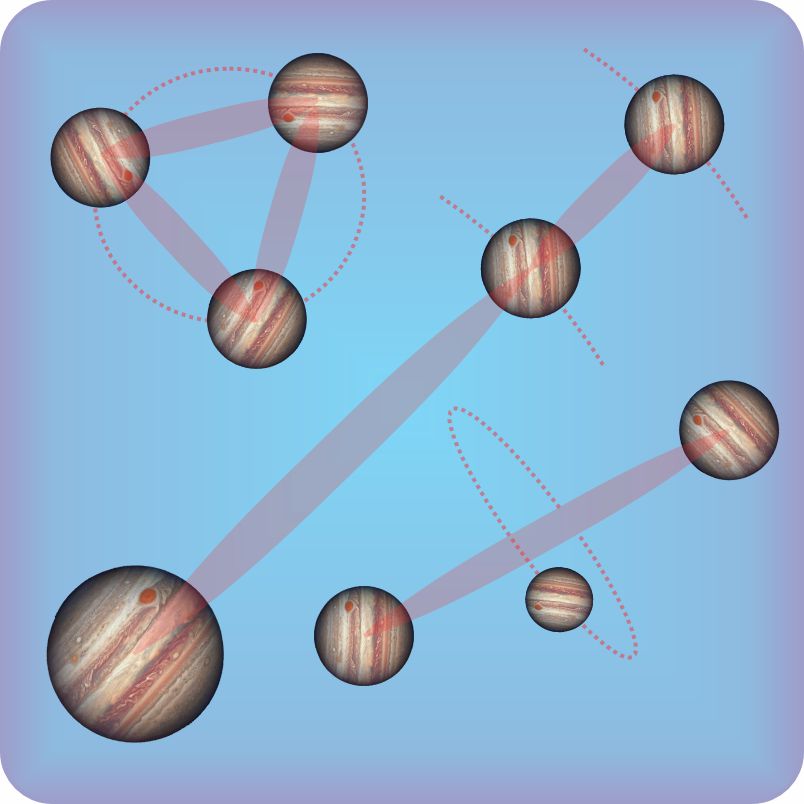
“Looks like we’ve got a three‑body problem here.” Blank looks all around. “You two were just about to go at it until I put in my piece and suddenly you’re on the same side. Two‑way interaction predictable results, three‑way interaction hard to figure. Like when Newton calculated celestial orbits to confirm his Laws of Gravity and Motion. They worked fine for the Earth going around the Sun, not so good for the Moon going around the Earth. The Sun pulls on the Moon just enough to play hob with his two‑body Earth‑Moon predictions.”

“Newton again. So how did he solve it?”

“He didn’t, not exactly anyway.”

“Not smart enough?”

“No, Eddie, plenty smart. Later mathematicians have proven that the three‑body problem simply doesn’t have a general exact solution.”

“Ah-hah, Sy, I heard weaseling — general?”

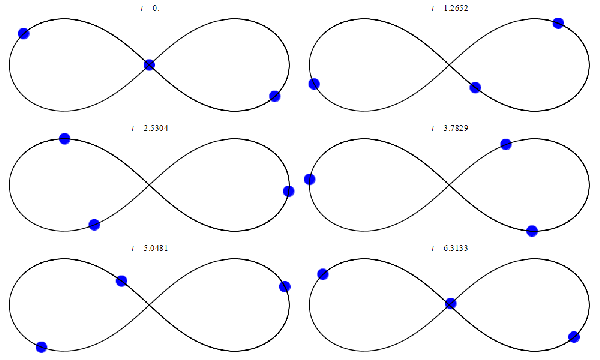
“Alright, Vinnie, there are some stable special cases. Three bodies at relative rest in an equilateral triangle; certain straight‑line configurations; two biggies circling each other and a third, smaller one in a distant orbit around the other two’s center of gravity. There are other specials but none stable in the sense that they wouldn’t be disrupted by a wobbly gravity field from a nearby star or the host galaxy.”

“So if NASA’s mission planners are looking at a four‑body Sun‑Jupiter‑Europa‑Juno situation, what’re they gonna do? ‘Give up’ ain’t an option.”

“Sure not. There’s a grand strategy with variations. The oldest variation goes back to before the Egyptian builders and everybody still uses it. Vinnie, when you fly a client to Tokyo, do you target a specific landing runway?”

“Naw, I aim for Japan, contact ATC Narita when I get close and they vector me in to wherever they want me to land.”

“How about you, Eddie? How do you get that exquisite balance in your flavoring?”

“Ain’t easy, Sy. Every batch of each herb is different — when it was picked, how it was stored, even the weather while it was growing. I start with an average mix which is usually close, then add a pinch of this and a little of that until it’s right.”

“For both of you, the critical word there was ‘close’. Call it in‑flight course adjustments, call it pinch‑and‑taste, everybody uses the ‘tweaking’ strategy. It’s a matter of skill and intuition, usually hard to generalize and even harder to teach in a systematic fashion. Engineers do it a lot, theoretical physicists work hard to avoid it.”

“What’ve they got that’s better?”

” ‘Better’ depends on your criteria. The method’s called ‘perturbation theory’ and strictly speaking, you can only use it for certain kinds of problems. Newton’s, for instance.”

“Good ol’ Newton.”

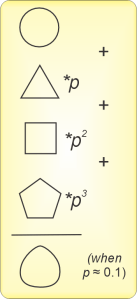
“Of course. Newton’s calculations almost matched Kepler’s planetary observations, but finagling the ‘not quite’ gave Newton headaches. More than 150 years passed before Laplace and others figured out how to treat a distant object as a perturbation of an ideal two‑body situation. It starts with calculating the system’s total energy, which wasn’t properly defined in Newton’s day. A perturbation factor p controls the third body’s contribution. The energy expression lets you calculate the orbits, but they’re the sum of terms containing powers of p. If p=0.1, p2=0.01, p3=0.001 and so on. If p isn’t zero but is still small enough, the p3 term and maybe even the p2 term are too small to bother with.”

“I’ll stick with pinch‑and‑taste.”

“Me and NASA’ll keep course‑correcting.”

~ Rich Olcott
Stretch

It’s a chilly day as I take my favorite elevator up to my office on the Acme Building’s 12th floor. Vinnie’s on my sofa, reading an old paperback. “Morning, Sy. Whaddaya think of Larry Niven?”

“One of the grand old men of hard science fiction. I gather you’re reading something of his there?”

“Yup, been bingeing on his Known Space series. His Neutron Star short story here won a Hugo back in 1967. It’s got so many numbers I wonder how good they are.”

“Probably pretty good. He and Heinlein both enjoyed showing off their celestial mechanics chops. What numbers stick out to you? Wait, what’s the story line again?”

“Story line? Most of Niven’s shorts were puzzles. When he had a good one he’d wrap some hokey story around it. This one, there’s a magical space ship that’s supposed to be invulnerable. Says here nothing can get through the hull, ‘no kind of electromagnetic energy except visible light. No kind of matter, from the smallest subatomic particle to the fastest meteor’ except something reached in and squashed two people to death in the nose of their ship. Our hero Mr Shaeffer’s in a ship just like theirs and has to figure out what the something was before it gets him, too.”

“Ah. What numbers did Niven give us?”

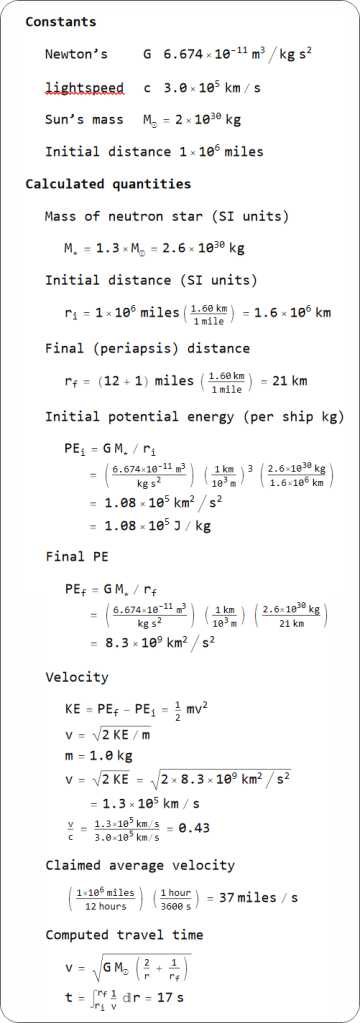
“Shaeffer’s ship was heading towards a neutron star. Lessee… ah, says the star’s mass is 1.3 times the Sun’s, diameter’s about 12 miles, and the ship’s on a fast in‑and‑out orbit, closest approach just a mile above the surface. Oh, and early on he drifts forward like something’s pulling on him but not on the ship. What does that tell you?”

“Enough to solve the puzzle, not enough to check his numbers. Anything about speed?”

“Mmm, he says the ship popped into the system a million miles out and it’d take 12 hours to reach the close‑approach point. The average speed’s just arithmetic, right?”

“Not really. A simple average doesn’t take account of acceleration changes or relativity effects. It’s easier and more accurate to apply conservation of energy. Okay with you if I assume the ship ‘pops into the system’ with zero velocity relative to the star and then free‑falls towards it?”

“That fits with the story, mostly.”

“Good. So right after the pop‑in” <tapping on Old Reliable’s screen> “the ship’s gravitational potential energy is ‑1.08×10⁵ joules/kilogram—”

“Negative?”

“It’s defined as the potential energy Shaeffer’d gave up en route from infinitely far away. At 13 miles from the star’s center, that’s zoomed to ‑8.3×10⁹ J/kg. The potential energy’s converted to kinetic energy ½mv² except we’re talking per kilogram so m is 1.0 and the velocity is —whoa!— 129 thousand kilometers/second. That’s 43% of lightspeed!”

“Well, Shaeffer did see the background stars shift blue even before he got deep into the gravity well. So, how about Niven’s 12‑hour, million‑mile claim?”

“That distance in that time works out to 37 miles per second, way less than lightspeed’s 186 000. Shaeffer was dawdling. You need calculus to figure the actual travel time — integrate 1/v between here and there. Ugly problem to solve manually but Old Reliable’s up to it. Given the appropriate orbit equation and the numbers we’ve worked out so far, Old Reliable says the trip should have taken him about 17 seconds.”

“HAW! I knew something seemed off. Wait, you said you’d solved the puzzle. What’s your answer?”

“Tides. That’s what moved him forward relative to the ship.”

“Yeah, that’s what Niven wrote, but I don’t see why what Shaeffer did saved him.”

“What did Shaeffer do?”

“Spread-eagled himself across a gangway at the ship’s center of gravity.”

“Brilliant — minimized his thickness along the star‑to‑ship line. Gravity’s pull on his sternum wasn’t much different from the pull on his spine. If he’d oriented himself perpendicular to that, his feet would feel a stronger pull than his head would have. Every transverse joint from neck to ankles would crackle or even tear. Talk about chiropractic.”

Vinne winces. “Why does thickness matter?”

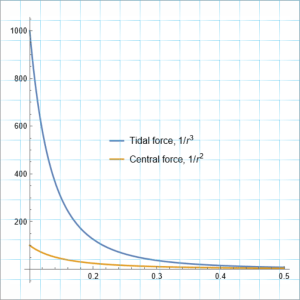
“Tidal force reflects how center‑to‑center force changes with distance. Center‑to‑center force rises with 1/r². Tidal force goes up as 1/r³. Cube grows faster than square. Small r, big tides.”

~ Rich Olcott
To Fly on Another World

“Uncle Sy, why is PV=nRT the Ideal Gas Equation? Is it because it’s so simple but makes sense anyway?”

“It is ideal that way, Teena, but it’s simply an equation about gases that are ideal. Except there aren’t any. Real gases come close but don’t always follow the rule.”

“Why not? Are they sneaky?”

“Your kind of question. We like to think of gas particles as tiny ping‑pong balls that just bounce off of each other like … ping‑pong balls. That’s mostly true most of the time for most kinds of gas. One exception has to do with stickiness. Water’s one of the worst cases because its H2O molecules like to chain up. When two H2Os collide, if they’re pointed in the right directions they share a hydrogen atom like a bridge and stick together. If that sort of stickiness happens a lot then the quantity measure n acts like it’s less than we’d expect. That makes the PV product smaller.”

“I bet that doesn’t happen much when the gas is really hot. Two particles might stick and then BANG! another particle hits ’em and breaks it up!”

“Good thinking and that’s true. But there’s another kind of exception that holds even at high temperatures. A well‑behaved gas is mostly empty space because the ping‑pong balls are far apart unless they’re actually colliding. But suppose you squeeze out nearly all of the empty space and then try to squeeze some more.”

“Oh! The pressure gets even bigger than the equation says it should because you can’t squeeze the particles any smaller than they are, right?”

“Exactly.”

“Well, if the equation has these problems, why do we even use it at all?”

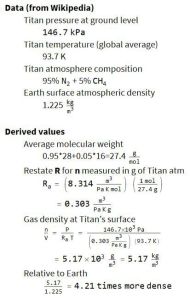
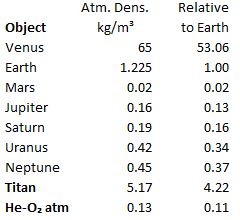
“Because it’s good enough, enough of the time, and we know when not to use it. I’ll give you an example. One of my clients wanted to know air density at ground level on Saturn’s moon Titan and all the planets that have an atmosphere.” <showing Old Reliable’s screen> “I found the planet data I needed in NASA’s Planetary Science website, but I had to do my own calculation for Titan. The pressure’s not crazy high and the temperature’s chilly but not quite cold enough to liquify nitrogen so the situation’s in‑range for the Ideal Gas Equation.”

“What’s a Pa?”

“That’s the symbol for a pascal, the unit of pressure. kPa is kilopascals, just like kg is kilograms. Earth’s atmospheric pressure is about 100 kPa.”

“Reliable says Wikipedia says Titan’s air is mostly nitrogen like Earth’s air is. Titan’s just a moon so it has to be smaller than Earth so its gravity must be smaller, too. Why is its atmosphere so much denser?”

“The cold. Titan’s air is 200 kelvins colder than Earth’s average temperature. You’re right, an individual gas particle feels a smaller pull of gravity on Titan, but it doesn’t have much kinetic energy to push its neighbors away so they all crowd closer together.”

“Why in the world does your client want to know that density number?”

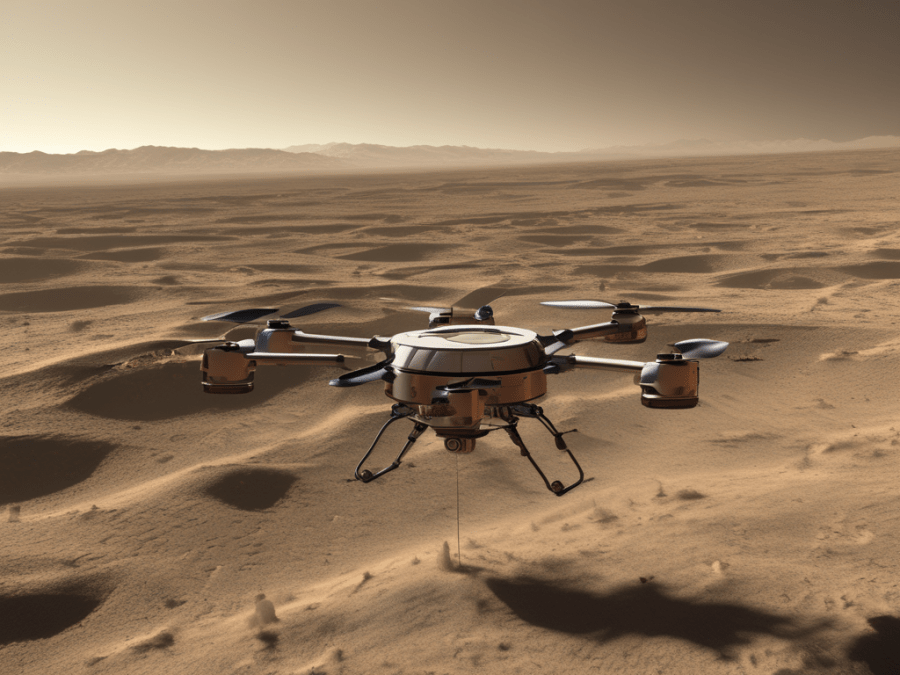
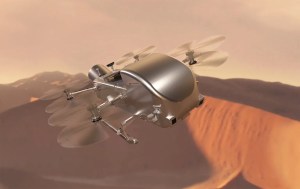
“Clients rarely give me reasons. I suspect this has to do with designing a Titan‑explorer aircraft.”

“Ooo! Wait, what does that have to do with air density?”

“It has to do with how hard the machine has to work to push itself up. It’ll probably have horizontally spinning blades that push the air downwards, like helicopters do. With a setup like that, the lift depends on the blade’s length, how fast it’s spinning, and how dense the air is. If the air is dense, like on Titan, the designers can get the lifting thrust they need with short blades or a slow spin. On Mars the density’s only 2% of Earth’s so Ingenuity‘s rotors were 4 feet across and spun about ten times faster than they’d have to on Earth.”

“What about on our helium‑oxygen Earth?”

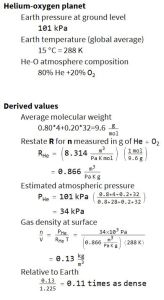
“That’s pretty much the same calculation. Give me a sec.” <tapping on Old Reliable’s screen> “Gas density would be a tenth of Earth’s, but a HeO‑copter would have to work against full‑Earth gravity. Huge blades rotating at supersonic speeds. Probably not a practical possibility.”

“Aw.”

“Yeah.”

~ Rich Olcott
Drag Show

Vinnie lumbers into my office with a troubled look on his face. “Something’s bothering me, Sy.”

“What’s that, Vinnie?”

“This article says NASA’s just finalized a contract with SpaceX to get the International Space Station down, all burnt up and buried in the ocean. Seems a shame. I mean, all the engineering and sweat and risk it took to build it up there, the international cooperation no matter the Cold War, the science for figuring out how to live in space — they ought to leave ISS up there as a memorial or a museum, right?”

“It certainly is a shame, Vinnie, but they just can’t.”

“Why not? 400 kilometers up, it’s not in anyone’s way. It’s all in one piece, won’t contribute to that Kessel cascade problem.”

Kessler cascade. The Kessel Run is a Star Wars thing. But if we left ISS up there it would ultimately contribute to the cascade and in a big way.”

“It’s in space, what could break it up?”

“Actually, it’s in an outer layer of Earth’s atmosphere. Pressure up there is measured in microbars but it’s still billions of atoms per cubic meter. ISS‘ gawky structure induces retrograde drag forces, even in that sparse gas. Drag pulls ISS down about 2 kilometers per month so periodically ISS Mission Control fires rocket engines to boost it back up to nominal orbit. Takes tons of fuel each time. Smaller‑scale drag tries to rip the station apart starting with its solar panels and radiators.”

“Radiators?”

“The white panels hanging off the central truss near the middle. The big brown rectangles are solar panels that power all the station’s equipment. Any time you use energy, inevitably some of it is wasted as heat which builds up unless you eject it somehow. That’s the radiators’ job — can’t dump heat by conduction or convection up there. I read an article once that said your primary target in a space battle would be your enemy’s radiators, because once they’re knocked out whatever’s inside gets cooked.”

“HAW! Basic design flaw for the Millennium Falcon and all the Federation’s Enterprise starships. Fun to know. But I see what you mean about we can’t keep it up there. I’m a pilot, I know what drag can do when it gets a chance. Drag pulls one big chunk off ISS, the rest’d crumble quick. … Wait, now something else doesn’t make sense.”

“What’s that?”

“I thought when you’re in orbit and you slow down you go higher, not lower. You and me and Cal, we talked about that back when Cal was Al. But you just said that drag slowdown pushes ISS lower.”

“You’re right, but back then we considered the case when only gravity and momentum are in play. You’re in stable orbit when you’re going at just the right speed for centrifugal force to balance the pull of gravity at that altitude. Go higher, gravity’s weaker so you don’t need as much speed to balance out.”

“That’s what I remembered.”

“Now we’re looking at a three‑force game where drag is playing on gravity’s side. With both those guys cooperating, the balance shifts away from centrifugal force. Dragged objects slow down and drop down to a lower orbit. Come to think of it, your aircraft is in the same game. When you come in for a landing you deploy your flaps to increase your drag and reduce your lift, right?”

“Right. How ’bout that, ISS acts like an aircraft!”

“Sort of. Mostly spacecraft, a little bit aircraft. Two kilometers isn’t much against four hundred, and the air pressure’s way less. Anyway, NASA’s plan is for a SpaceX ‘US Deorbit Vehicle‘ to act like a super‑drag. If we let drag run its course with no constraints, ISS would eventually come down in pieces all over the place. Deorbit Mission Control should be able to use USDV‘s steerability to aim ISS‘ decaying orbit towards a minimal footprint near Point Nemo.”

“Point Nemo?”

“The ‘oceanic pole of inaccessibility,’ as far away as you can get from any piece of land. It’s also far away from regular shipping and air traffic. Can’t say much about whale traffic though.”

~~ Rich Olcott

Loud Enough Was Good Enough

“Okay, Moire, enough with the strings. I got another question.”

“Of course you do, Mr Feder, but step along more quickly, please. In this heat the sooner I get back to the air conditioning the better I’ll like it.”

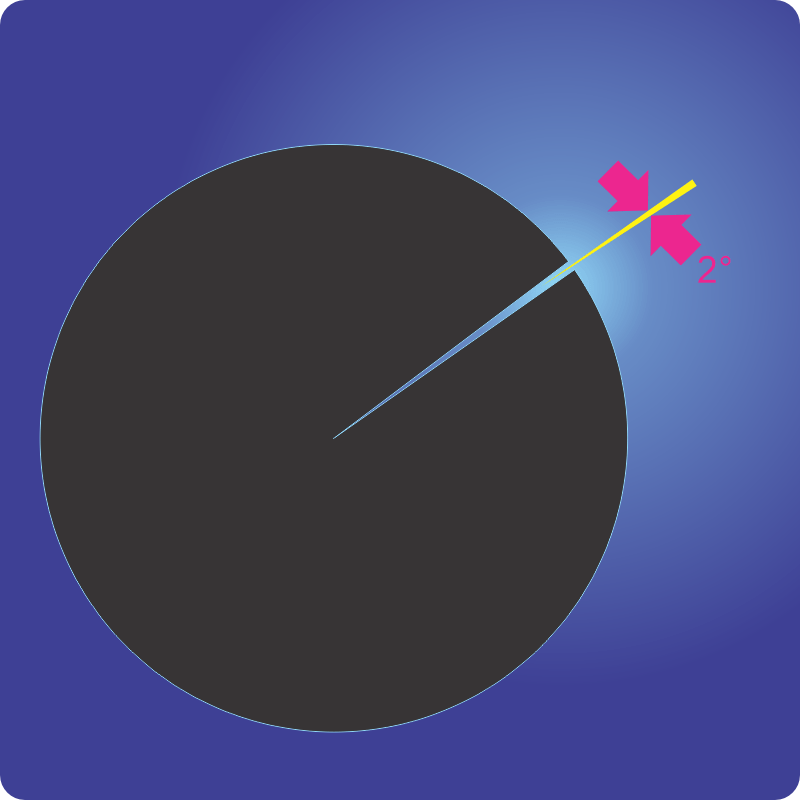
“Alright,” <puffing> “why all this fuss about the Voyager 2 spacecraft missing its target by two degrees? Earth’s pretty big, two degrees I can barely see on a protractor. Should be an easy hit.”

“Can you see the Moon?”

“Sure, if there’s no clouds in front of it. Sometimes even in the daytime.”

“A full Moon is only half a degree wide, ¼ of your two degrees.”

“No!”

“Yes.”

“But when it’s just rising it’s huge, takes up half the sky.”

“Check that carefully some evening. Hold up your hand at arm’s length. Your little finger’s about one degree wide. The Moon will be half as wide as that no matter where it is in the sky, we’ve talked about this. You can see half a degree easy and probably a lot less than that. Tycho Brahe, the last great pre‑telescope astronomer, was able to make measurements as small as 1/150 of a degree.”

“Okay, I guess two degrees is a little bigger than I was thinking. But still, Earth’s pretty big, there’s no excuse for Voyager 2 missing it by two degrees.”

“A two‑degree angle is huge when it extends across astronomical distances.” <drawing Old Reliable from its holster, tapping screen> “From Voyager 2‘s perspective at 12 billion miles out the short leg of a two‑degree isosceles triangle spans 419 million miles. That’s over twice the width of Earth’s orbit! Poor Voyager could be pointing past Mars away from us.”

“Big distances from a small angle make a long triangle, got it. What did NASA have to do to get things pointed right again?”

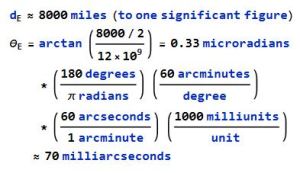
“I consider it a technological miracle. At Voyager‘s distance, Earth’s 8000‑mile diameter spans only 70 milliarcseconds. And before you ask, a milliarcsecond is a thousandth of 1/60 of 1/60 of a degree, about 3 billionths of the way across your little finger. Pretty darn small. Frankly, I’m amazed that Voyager 2 has been able to keep its antenna pointed at us so accurately for so long using tech that dates back to the mid‑70s and earlier. Our tax dollars working hard.”

“Amazing, yeah — something like that’s gotta have a kajillion moving parts. A lubrication nightmare in space I bet.”

“Not as many as you might think. The only parts that move on purpose are small things like its gyroscopes, its tracking optics and the valves on its attitude‑adjustment thrusters.”

“Wait, how’d they point the antenna towards us in the first place? I figured that was on gears.”

“Way too much play in a gear train for this level of accuracy. No, the antenna’s solidly fixed to the rest of the structure. Voyager 2‘s Attitude and Articulation Control System adjusts the whole probe as a unit using propellant bursts through its choice of little thrusters. The mass of a single burst is so small compared to the spacecraft mass that the AACS can manage milliarcsecond‑level orientation control.”

“I heard they finally got it talking to us again. How’d they manage that if it was pointed the wrong way?”

“The key is it was only mostly pointing the wrong way.”

“Like the guy’s ‘mostly dead’ in Princess Bride?”

“Mr Feder, you know that movie?”

“Hey, it’s got the greatest sword fight ever, plus the two‑cups poison challenge and the part where the pirate keeps insulting the prince. What’s not to like? Whaddaya mean, mostly the wrong way?”

Voyager 2‘s antenna is parabolic, the best shape for transmitting a tight beam. Best doesn’t mean perfect — 50% of the beam’s power stays within a degree or so either side of the center but the rest leaks out to the sides. The same pattern applies to signal reception. Optimal reception happens when the antenna is pointing right at you. If it’s aimed off‑center, reception is worse. Our normal transmission power level wasn’t high enough to punch though the two-degree offset penalty but NASA’s extra-high-power ‘shout’ worked.”

“Caught the flash outta the corner of its eye, huh?”

~~ Rich Olcott
Hiding Among The Hill Spheres

Bright Spring sunlight wakes me earlier than I’d like. I get to the office before I need to, but there’s Jeremy waiting at the door. “Morning, Jeremy. What gets you here so soon after dawn?”

“Good morning, Mr Moire. I didn’t sleep well last night, still thinking about that micro black hole. Okay, I know now that terrorists or military or corporate types couldn’t bring it near Earth, but maybe it comes by itself. What if it’s one of those asteroids with a weird orbit that intersects Earth’s orbit? Could we even see it coming? Aren’t we still in danger of all those tides and quakes and maybe it’d hollow out the Earth? How would the planetary defense people handle it?”

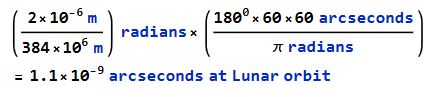
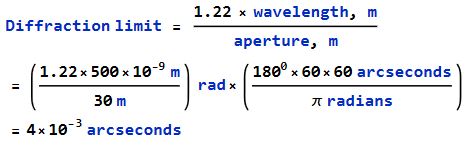
“For so early in the day you’re in fine form, Jeremy. Let’s take your barrage one topic at a time, starting with the bad news. We know this particular object would radiate very weakly and in the far infrared, which is already a challenge to detect. It’s only two micrometers wide. If it were to cross the Moon’s orbit, its image then would be about a nanoarcsecond across. Our astrometers are proud to resolve two white‑light images a few milliarcseconds apart using a 30‑meter telescope. Resolution in the far‑IR would be about 200 times worse. So, we couldn’t see it at a useful distance. But the bad news gets worse.”

“How could it get worse?”

“Suppose we could detect the beast. What would we do about it? Planetary defense people have proposed lots of strategies against a marauding asteroid — catch it in a big net, pilot it away with rocket engines mounted on the surface, even blast it with A‑bombs or H‑bombs. Black holes aren’t solid so none of those would work. The DART mission tried using kinetic energy, whacking an asteroid’s moonlet to divert the moonlet‑asteroid system. It worked better than anyone expected it to, but only because the moonlet was a rubble pile that broke up easily. The material it threw away acted as reaction mass for a poorly controlled rubble rocket. Black holes don’t break up.”

“You’re not making getting to sleep any easier for me.”

“Understood. Here’s the good news — the odds of us encountering anything like that are gazillions‑to‑one against. Consider the probabilities. If your beast exists I don’t think it would be an asteroid or even from the Kuiper Belt. Something as exotic as a primordial black hole or a mostly‑evaporated stellar black hole couldn’t have been part of the Solar System’s initial dust cloud, therefore it wouldn’t have been gathered into the Solar System’s ecliptic plane. It could have been part of the Oort cloud debris or maybe even flown in on a hyperbolic orbit from far, far away like ‘Oumuamua did. Its orbit could be along any of an infinite number of orientations away from Earth’s orbit. But it gets better.”

“I’ll take all the improvement you can give me.”

“Its orbital period is probably thousands of years long or never.”

“What difference does that make?”

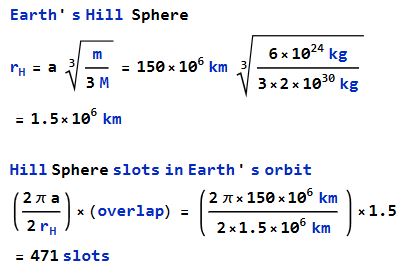
“You’ve got to be in the right place at the right time to collide. Earth is 4.5 billion years old. Something with a 100‑year orbit would have had millions of chances to pass through a spot we happen to occupy. An outsider like ‘Oumuamua would have only one. We can even figure odds on that. It’s like a horseshoe game where close enough is good enough. The object doesn’t have to hit Earth right off, it only has to pierce our Hill Sphere.”

“Hill Sphere?”

“A Hill Sphere is a mathematical abstract like an Event Horizon. Inside a planet’s Sphere any nearby object feels a greater attraction to the planet than to its star. Velocities permitting, a collision may ensue. The Sphere’s radius depends only on the average planet–star distance and the planet and star masses. Earth’s Hill Sphere radius is 1.5 million kilometers. Visualize Hill Spheres crowded all along Earth’s orbit. If the interloper traverses any Sphere other than the one we’re in, we survive. It has 1 chance out of 471 . Multiply 471 by 100 spheres sunward and an infinity outward. We’ve got a guaranteed win.”

“I’ll sleep better tonight.”

~~ Rich Olcott
A Tug at The Ol’ Gravity Strings

“Why, Jeremy, you’ve got such a stunned look on your face. What happened? Is there anything I can do to help?”

“Sorry, Mr Moire. I guess I’ve been thinking too much about this science fiction story I just read. Which gelato can I scoop for you?”

“Two dips of mint, in a cup. Eddie went heavy with the garlic on my pizza this evening. What got to you in the story?”

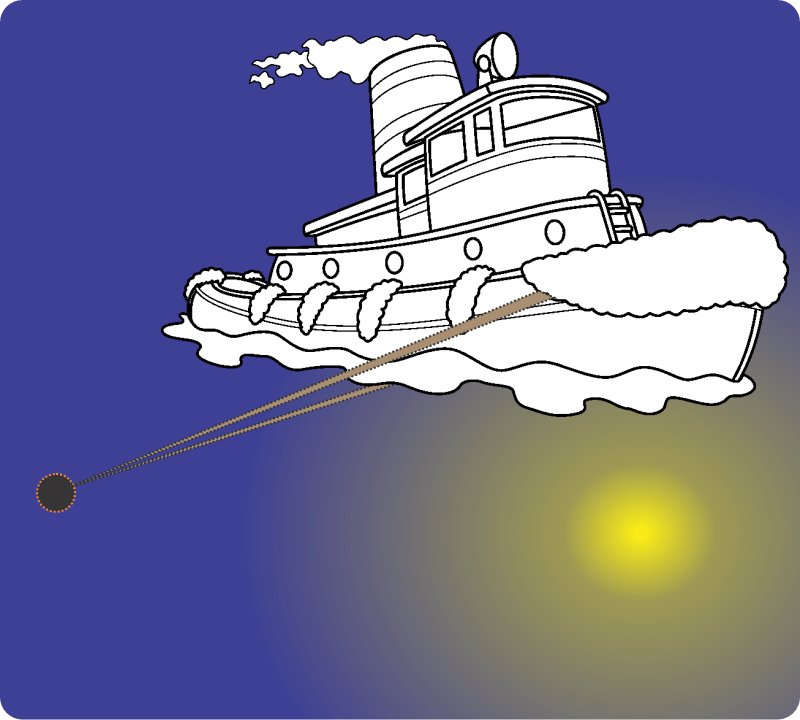
“The central plot device. Here’s your gelato. In the story, someone locates a rogue black hole hiding in the asteroid belt. Tiny, maybe a few thousandths of a millimeter across, but awful heavy. A military‑industrial combine uses a space tug to tow it to Earth orbit for some kind of energy source, but their magnetic grapple slips and the thing falls to Earth. Except it doesn’t just fall to Earth, it’s so small it falls into Earth and now it’s orbiting inside, eating away the core until everything crumbles in. I can’t stop thinking about that.”

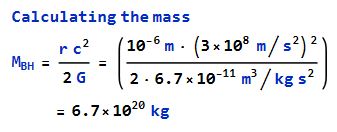
“Sounds pretty bad, but it might help if we run the numbers.” <drawing Old Reliable from its holster> “First thing — Everything about a black hole depends on its mass, so just how massive is this one?” <tapping on Old Reliable’s screen with gelato spoon> “For round numbers let’s say its diameter is 0.002 millimeter. The Schwartzschild ‘radius’ r is half that. Solve Schwartschild’s r=2GM/c² equation for the mass … plug in that r‑value … mass is 6.7×10²⁰ kilograms. That’s about 1% of the Moon’s mass. Heavy indeed. How did they find this object?”

“The story didn’t say. Probably some asteroid miner stumbled on it.”

“Darn lucky stumble, something only a few microns across. Not likely to transit the Sun or block light from any stars unless you’re right on top of it. Radiation from its accretion disk? Depends on the history — there’s a lot of open space in the asteroid belt but just maybe the beast encountered enough dust to form one. Probably not, though. Wait, how about Hawking radiation?”

“Oh, right, Stephen Hawking’s quantum magic trick that lets a black hole radiate light from just outside its Event Horizon. Does Old Reliable have the formulas for that?”

“Sure. From Hawking’s work we know the object’s temperature and that gives us its blackbody spectrum, then we’ve got the Bekenstein‑Hawking equation for the power it radiates. Mind you, the spectrum will be red‑shifted to some extent because those photons have to crawl out of a gravity well, but this’ll give us a first cut.” <more tapping> “Chilly. 170 kelvins, that’s 100⁰C below room temperature. Most of its sub‑nanowatt emission will be at far infrared wavelengths. A terrible beacon. But suppose someone did find this thing. I wonder what’ll it take to move it here.”

“Can you calculate that?”

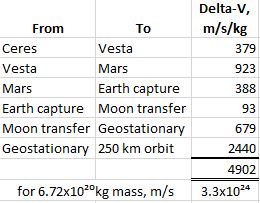
“Roughly. Suppose your space tug follows the cheapest possible flight path from somewhere near Ceres. Assuming the tug itself has negligible mass … ” <more tapping> “Whoa! That is literally an astronomical amount of delta-V. Not anything a rocket could do. Never mind. But where were they planning to put the object? What level orbit?”

“Well, it’s intended to beam power down to Earth. Ions in the Van Allen Belts would soak up a lot of the energy unless they station it below the Belts. Say 250 miles up along with the ISS.”

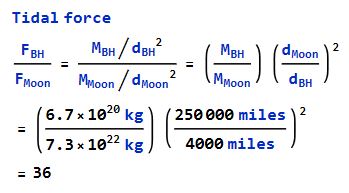
“Hoo boy! A thousand times closer than the Moon. Force is inverse to distance squared, remember. Wait, that’s distance to the center and Earth’s radius is about 4000 miles so the 250 miles is on top of that. 250,000 divided by 4250 … quotient squared … is a distance factor of almost 3500. Put 1% of the Moon that close to the Earth and you’ve got ocean tides 36 times stronger than lunar tides. Land does tides, too, so there’d be earthquakes. Um. The ISS is on a 90‑minute orbit so you’d have those quakes and ocean tides sixteen times a day. I wouldn’t worry about the black hole hollowing out the Earth, the tidal effect alone would do a great job of messing us up.”

“The whole project is such a bad idea that no-one would or could do it. I feel better now.”

~~ Rich Olcott

The Sky’s The Limit

Another meeting of the Acme Pizza and Science Society, at our usual big round table in Pizza Eddie’s place on the Acme Building’s second floor. (The table’s also used for after‑hours practical studies of applied statistics, “only don’t tell nobody, okay?“) It’s Eddie’s turn to announce the topic for the evening. “This one’s from my nephew, guys. How high up is the sky on Mars?”

General silence ensues, then Al throws in a chip. “Well, how high up is the sky on Earth?”

Being a pilot, Vinnie’s our aviation expert. “Depends on who’s defining ‘sky‘ and why they did that. I’m thinking ‘the sky’s the limit‘ and for me that’s the highest altitude I can get up to legal‑like. Private prop planes generally stay below 10,000 feet, commercial jets aren’t certified above 43,000 feet, private jets aren’t supposed to go above 51,000 feet.”

Eddie counters. “How about the Concorde? And those military high-flyers?”

“They’re special. The SST has, um, had unique engineering to let it go up to 60,000 feet ’cause they didn’t want sonic boom complaints from ground level. But it don’t fly no more anyhow. I’ve heard that the Air Force’s SR-71 could hit 85,000 feet but it got retired, too.”

Al’s not impressed. “All that’s legal stuff. There’s a helicopter flying on Mars but the FAA don’t make the rules there. What else we got?”

Geologist Kareem swallows his last bite of cheese melt. “How about the top of the troposphere? That’s the lowest layer of our atmosphere, the one where most of our weather and sunset colors happen. If you look at clouds in the sky, they’re inside the troposphere.”

“How high is that?”

“It expands with heating, so the top depends where you’re measuring. At the Equator it can be as high as 18½ kilometers; near a pole in local winter the top squeezes down to 6 kilometers or so. And to your next question — above the troposphere we’ve got the stratosphere that goes up to 50 kilometers. What’s that in feet, Sy?”

<drawing Old Reliable and screen-tapping…> “Says about 31.2 miles or 165,000 feet. Let’s keep things in kilometers from here on, okay?”

“Then you’ve got the mesosphere and the exosphere but the light scattering that gives us a blue sky happens below them so I’d say the sky stops at 50 kilometers.”

Al’s been rummaging through his astronomy magazines. “I read somewhere here that you’re not an astronaut unless you’ve gone past either 80 or 100 kilometers, which is weird with two cut‑offs. Who came up with those?”

Vinnie’s back in. “Who came up with the idea was a guy named von Kármán. One of the many Hungarians who came to the US in the 30s to get away from the Nazis. He did a bunch of advanced aircraft design work, helped found Aerojet and JPL. Anyway, he said the boundary between aeronautics and astronautics is how high you are when the atmosphere gets too thin for wings to keep you up with aerodynamic lift. Beyond that you need rockets or you’re in orbit or you fall down. He had equations and everything. For the Bell X‑2 he figured the threshold was around 52 miles up. What’s that in kilometers, Sy?”

“About 84.”

“So that’s where the 80 comes from. NASA liked that number for their astronauts but the Europeans rounded it up to 100. Politics, I suppose. Do von Kármán’s equations apply to Mars as well as Earth?”

“Now we’re getting somewhere, Vinnie. They do, sort of. It’s complicated, because there’s a four‑way tug‑of‑war going on. Your aircraft has gravity pulling you down, lift and centrifugal force pulling you up. Lift depends on the atmosphere’s density and your vehicle’s configuration. The fourth player is the kicker — frictional heat ruining the craft. Lift, centrifugal force and heating all get stronger with speed. Von Kármán based his calculations on the Bell X‑2’s configuration and heat‑management capabilities. Problem is, we’re not sending an X‑2 to Mars.”

“Can you re‑calibrate his equation to put a virtual X‑2 up there?”

“Hey, guys, I think someone did that. This magazine says the Karman line on Mars is 88 kilometers up.”

“Go tell your nephew, Eddie.”

~~ Rich Olcott

The Frame Game

A familiar footstep outside my office, “C’mon in, Vinnie, the door’s open.”

“Hi, Sy, how ya doin’?”

“Can’t complain. Yourself?”

“Fine, fine. Hey, I been thinking about something you said while Al and us were talking about rockets and orbits and such. You remember that?”

“We’ve done that in quantity. What statement in particular?”

“It was about when you’re in the ISS, you still see like 88% of Earth’s gravity. But I seen video of those astronauts just floating around in the station. Seems to me those two don’t add up.”

“Hah! We’re talking physics of motion here. What’s the magic word?”

“You’re saying it’s frames? I thought black holes did that.”

“Black holes are an extreme example, but frame‑thinking is an essential tool in analyzing any kind of relative motion. Einstein’s famous ‘happy thought‘ about a man in a free‑falling elevator—”

“Whoa, why is that a happy thought? I been nervous about elevators ever since that time we got stuck in one.”

“At least it wasn’t falling, right? Point is, the elevator and whoever’s in it agree that Newton’s First Law of Motion is valid for everything they see in there.”

“Wait, which Law is that?”

“‘Things either don’t move or else they move at a steady pace along a straight line.’ Suppose you’re that guy—”

“I’d rather not.”

“… and the elevator is in a zero‑gravity field. You take something out of your pocket, put it the air in front of you and it stays there. You give it a tap and it floats away in a straight line. Any different behavior means that your entire frame — you, the elevator and anything else in there — is being accelerated by some force. Let’s take two possibilities. Case one, you and the elevator are resting on terra firma, tightly held by the force of gravity.”

“I like that one.”

“Case two, you and the elevator are way out in space, zero‑gravity again, but you’re in a rocket under 1-g acceleration. Einstein got happy because he realized that you’d feel the same either way. You’d have no mechanical way to distinguish between the two cases.”

“What’s that mean, mechanical?”

“It excludes sneaky ways of outside influence by magnetic fields and such. Anyhow, Einstein’s insight was key to extending Newton’s First Law to figuring acceleration for an entire frame. Like, for instance, an orbiting ISS.”

“Ah, you’re saying that floating astronauts in an 88% Earth-gravity field is fine because the ISS and the guys share the frame feeling that 88% but the guys are floating relative to that frame. But down here if we could look in there we’d see how both kinds of motion literally add up.”

“Exactly. It’s just much easier to think about only one kind at a time.”

“Wait. You said the ISS is being accelerated. I thought it’s going a steady 17500 miles an hour which it’s got to do to stay 250 miles up.”

“Is it going in a straight line?”

“Well, no, it’s going in a circle, mostly, except when it has to dodge some space junk.”

“So the First Law doesn’t apply. Acceleration is change in momentum, and the ISS momentum is constantly changing.”

“But it’s moving steady.”

“But not in a straight line. Momentum is a vector that points in a specific direction. Change the direction, you change the momentum. Newton’s Second Law links momentum change with force and acceleration. Any orbiting object undergoes angular acceleration.”

“Angular acceleration, that’s a new one. It’s degrees per second per second?”

“Yup, or radians. There’s two kinds, though — orbiting and spinning. The ISS doesn’t spin because it has to keep its solar panels facing the Sun.”

“But I’ve seen sci-fi movies set in something that spins to create artificial gravity. Like that 2001 Space Odyssey where the guy does his running exercise inside the ship.”

“Sure, and people have designed space stations that spin for the same reason. You’d have a cascade of frames — the station orbiting some planet, the station spinning, maybe even a ballerina inside doing pirouettes.”

“How do you calculate all that?”

“You don’t. You work with whichever frame is useful for what you’re trying to accomplish.”

“Makes my head spin.”

~~ Rich Olcott