Circular Logic

We often read “singularity” and “black hole” in the same pop-science article.  But singularities are a lot more common and closer to us than you might think. That shiny ball hanging on the Christmas tree over there, for instance.  I wondered what it might look like from the inside.  I got a surprise when I built a mathematical model of it.

To get something I could model, I chose a simple case.  (Physicists love to do that.  Einstein said, “You should make things as simple as possible, but no simpler.”)

I imagined that somehow I was inside the ball and that I had suspended a tiny LED somewhere along the axis opposite me.  Here’s a sketch of a vertical slice through the ball, and let’s begin on the left half of the diagram…Mirror ball sketch

I’m up there near the top, taking a picture with my phone.

To start with, we’ll put the LED (that yellow disk) at position A on the line running from top to bottom through the ball.  The blue lines trace the light path from the LED to me within this slice.

The inside of the ball is a mirror.  Whether flat or curved, the rule for every mirror is “The angle of reflection equals the angle of incidence.”  That’s how fun-house mirrors work.  You can see that the two solid blue lines form equal angles with the line tangent to the ball.  There’s no other point on this half-circle where the A-to-me route meets that equal-angle condition.  That’s why the blue line is the only path the light can take.  I’d see only one point of yellow light in that slice.

But the ball has a circular cross-section, like the Earth.  There’s a slice and a blue path for every longitude, all 360o of them and lots more in between.  Every slice shows me one point of yellow light, all at the same height.  The points all join together as a complete ring of light partway down the ball.  I’ve labeled it the “A-ring.”

Now imagine the ball moving upward to position B.  The equal-angles rule still holds, which puts the image of B in the mirror further down in the ball.  That’s shown by the red-lined light path and the labeled B-ring.

So far, so good — as the LED moves upward, I see a ring of decreasing size.  The surprise comes when the LED reaches C, the center of the ball.  On the basis of past behavior, I’d expect just a point of light at the very bottom of the ball (where it’d be on the other side of the LED and therefore hidden from me).

Nup, doesn’t happen.  Here’s the simulation.  The small yellow disk is the LED, the ring is the LED’s reflected image, the inset green circle shows the position of the LED (yellow) and the camera (black), and that’s me in the background, taking the picture…g6z
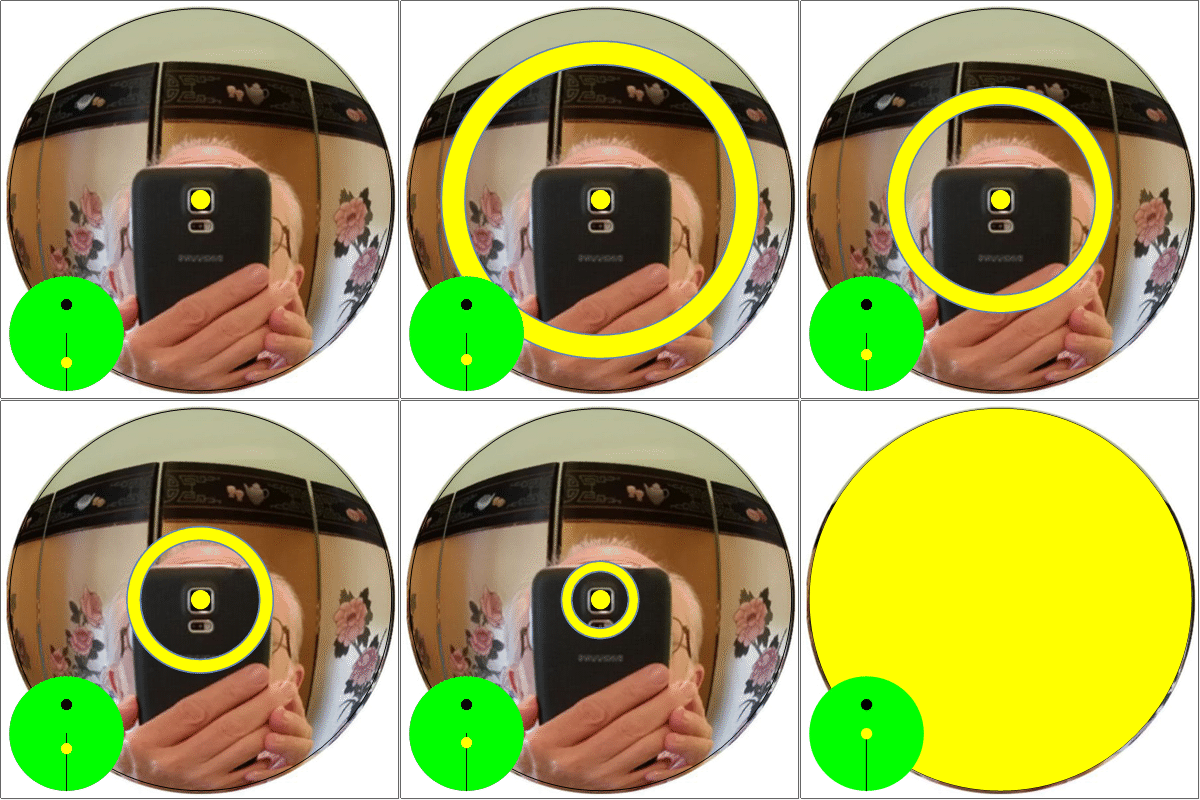
The entire surface suddenly fills with light — BLOOIE! — when the LED is exactly at the ball’s center.  Why does that happen?  Scroll back up and look at the right-hand half of the diagram.  When the ball is exactly at C, every outgoing ray of light in any direction bounces directly back where it came from.  And keeps on going, and going and going.  That weird display can only happen exactly at the center, the ball’s optical singularity, that special point where behavior is drastically different from what you’d expect as you approach it.

So that’s using geometry to identify a singularity.  When I built the model* that generated the video I had to do some fun algebra and trig.  In the process I encountered a deeper and more general way to identify singularities.

<Hint> Which direction did Newton avoid facing?

* – By the way, here’s a shout-out to Mathematica®, the Wolfram Research company’s software package that I used to build the model and create the video.  The product is huge and loaded with mysterious special-purpose tools, pretty much like one of those monster pocket knives you can’t really fit into a pocket.  But like that contraption, this software lets you do amazing things once you figure out how.

~~ Rich Olcott

And now for some completely different dimensions

Terry Pratchett wrote that Knowledge = Power = Energy = Matter = Mass.  Physicists don’t agree because the units don’t match up.

Physicists check equations with a powerful technique called “Dimensional Analysis,” but it’s only theoretically related to the “travel in space and time” kinds of dimension we discussed earlier.

Place setting LMTIt all started with Newton’s mechanics, his study of how objects affect the motion of other objects.  His vocabulary list included words like force, momentum, velocity, acceleration, mass, …, all concepts that seem familiar to us but which Newton either originated or fundamentally re-defined. As time went on, other thinkers added more terms like power, energy and action.
They’re all linked mathematically by various equations, but also by three fundamental dimensions: length (L), time (T) and mass (M). (There are a few others, like electric charge and temperature, that apply to problems outside of mechanics proper.)

Velocity, for example.  (Strictly speaking, velocity is speed in a particular direction but here we’re just concerned with its magnitude.)   You can measure it in miles per hour or millimeters per second or parsecs per millennium — in each case it’s length per time.  Velocity’s dimension expression is L/T no matter what units you use.

Momentum is the product of mass and velocity.  A 6,000-lb Escalade SUV doing 60 miles an hour has twice the momentum of a 3,000-lb compact car traveling at the same speed.  (Insurance companies are well aware of that fact and charge accordingly.)  In terms of dimensions, momentum is M*(L/T) = ML/T.

Acceleration is how rapidly velocity changes — a car clocked at “zero to 60 in 6 seconds” accelerated an average of 10 miles per hour per second.  Time’s in the denominator twice (who cares what the units are?), so the dimensional expression for acceleration is L/T2.

Physicists and chemists and engineers pay attention to these dimensional expressions because they have to match up across an equal sign.  Everyone knows Einstein’s equation, E = mc2. The c is the velocity of light.  As a velocity its dimension expression is L/T.  Therefore, the expression for energy must be M*(L/T)2 = ML2/T2.  See how easy?

Now things get more interesting.  Newton’s original Second Law calculated force on an object by how rapidly its momentum changed: (ML/T)/T.  Later on (possibly influenced by his feud with Leibniz about who invented calculus), he changed that to mass times acceleration M*(L/T2).  Conceptually they’re different but dimensionally they’re identical — both expressions for force work out to ML/T2.

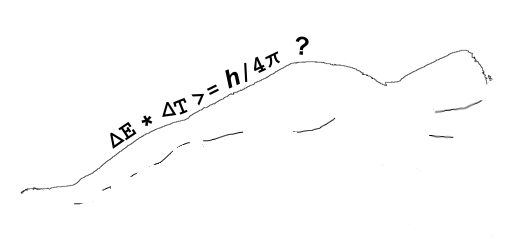
Something seductively similar seems to apply to Heisenberg’s Area.  As we’ve seen, it’s the product of uncertainties in position (L) and momentum (ML/T) so the Area’s dimension expression works out to L*(ML/T) = ML2/T.

SeductiveThere is another way to get the same dimension expression but things aren’t not as nice there as they look at first glance.  Action is given by the amount of energy expended in a given time interval, times the length of that interval.  If you take the product of energy and time the dimensions work out as (ML2/T2)*T = ML2/T, just like Heisenberg’s Area.

It’s so tempting to think that energy and time negotiate precision like position and momentum do.  But they don’t.  In quantum mechanics, time is a driver, not a result.  If you tell me when an event happens (the t-coordinate), I can maybe calculate its energy and such.  But if you tell me the energy, I can’t give you a time when it’ll happen.  The situation reminds me of geologists trying to predict an earthquake.  They’ve got lots of statistics on tremor size distribution and can even give you average time between tremors of a certain size, but when will the next one hit?  Lord only knows.

File the detailed reasoning under “Arcane” — in technicalese, there are operators for position, momentum and energy but there’s no operator for time.  If you’re curious, John Baez’s paper has all the details.  Be warned, it contains equations!

Trust me — if you’ve spent a couple of days going through a long derivation, totting up the dimensions on either side of equations along the way is a great technique for reassuring yourself that you probably didn’t do something stupid back at hour 14.  Or maybe to detect that you did.

~~ Rich Olcott

Heisenberg’s Area

Unlike politicians, scientists want to know what they’re talking about when they use a technical word like  “Uncertainty.”  When Heisenberg laid out his Uncertainty Principle, he wasn’t talking about doubt.  He was talking about how closely experimental results can cluster together, and he was putting that in numbers.

ArrowsThink of Robin Hood competing for the Golden Arrow.  For the showmanship of the thing, Robin wasn’t just trying to hit the target, he wanted his arrow to split the Sheriff’s.  If the Sheriff’s shot was in the second ring (moderate accuracy, from the target’s point of view), then Robin’s had to hit exactly the same off-center location (still moderate accuracy but great precision).  The Heisenberg Uncertainty Principle (HUP) is all about precision (a.k.a, range of variation).

We’ve all encountered exams that were graded “on the curve.”  But what curve is that?  I can say from personal experience that it’s extraordinarily difficult to create an exam where  the average grade is 75.  I want to give everyone the chance to show what they’ve learned.  Each student probably learned only part of what’s in the unit, but I won’t know which part until after the exam is graded.  The only way to be fair is to ask about everything in the unit.  Students complained that my tests were really hard because to get 100 they had to know it all.

Translating test scores to grades for a small class was straightforward.  I would plot how many papers got between 95 and 100, how many got 90-95, etc, and look at the graph.  Nearly always it looked like the top example.  TestsThere’s a few people who clearly have the material down pat; they clearly earned an “A.”  Then there’s a second group who didn’t do as well as the A’s but did significantly better than the rest of the class — they earned a “B.”  As the other end there’s a (hopefully small) group of students who are floundering.  Long-term I tried to give them extra help but short-term I had no choice but to give them an “F.”

With a large class those distinctions get blurred and all I saw (usually) was a single broad range of scores, the well-known “bell-shaped curve.”  If the test was easy the bell was centered around a high score.  If the test was hard that center was much lower.  What’s interesting, though, is that the width of that bell for a given class stayed pretty much the same.  The curve’s width is described by a number called the standard deviation (SD), proportional to the width at half-height.  If a student asked, “What’s my score?” I could look at the curve for that exam and say there’s a 66% chance that the score was within one SD of the average, and a 95% chance that it was within two SD’s.

The same bell-shape also shows up in research situations where a scientist wants to measure some real-world number, be it an asteroid’s weight or elephant gestation time.  He can’t know the true value, so instead he makes many replicate measurements or pays close attention to many pregnant elephants.  He summarizes his results by reporting the average of all the measurements and also the SD calculated from those measurements.  Just as for the exams, there’s a 95% chance that the true value is within two SD’s of the average.  The scientist would say that the SD represents the uncertainty of the measured average.

Which is what Heisenberg’s inequality is about.  Heisenberg area 1He wrote that the product of two paired uncertainties (like position and momentum) must be larger than that teeny “quantum of action,” h.  There’s a trade-off.  We can refine our measurement of one variable but we’ll lose precision on the other.  If we plot results for one member of the pair against results for the other, there’s no linkage between their average values.  However, there will be a rectangle in the middle representing the combined uncertainty.

Heisenberg tells us that the minimum area of that rectangle is a constant.

It’s a very small rectangle, area = h/4π = 0.5×10⁻³⁴ Joule-sec, but it’s significant on the scale of atoms — and maybe on the scale of the Universe (see next week).

~~ Rich Olcott

Heisenberg’s trade-offs

KiteA kite floating on the breeze.  Optimal work-life balance.  Smoothly functioning free markets.  The Heisenberg Uncertainty Principle.  Why would an alien from another planet recognize the last one but maybe not the others?

The kite is a physical object, intentionally built by humans to human scale.  The next two are idealized theoretical constructs, goals to be approached but rarely achieved.  The Heisenberg Uncertainty Principle (HUP) is fundamental to how the Universe works.

The first three are each in a dynamic equilibrium that is constantly buffeted by competing forces.  The HUP comes straight out of the deep math for where those forces come from.  Kites and work stress and markets may be peculiar to Earth, but the HUP is in play on every planet and star.

In the last post we saw that thanks to the HUP we can precisely identify an oboe’s pitch if it plays forever.  We can know precisely when a pitchless cymbal crashed.  But it’s mathematically impossible to get both exact pitch and exact time for the same sound.  Thank goodness, we can have imprecise knowledge of both quantities and actually play some music.

We determine a pitch (cycles per second) by counting sound waves passing during a given duration — and that limits our knowledge.  We can’t know that a wave has passed unless we see at least two peaks.  Our observation period must be at least long enough to see two peaks.  To put it the other way, the pitch must be high enough to give us at least two peaks during the time we’re watching.  This isn’t quantum mechanics, it’s just arithmetic, but it’s basic to physics.

Mathematically the HUP is as simple as Einstein’s E=mc2 equation, except the HUP is an inequality:

[A-uncertainty] x [B-uncertainty] ≥ h / 4π

where A and B are two paired quantities like pitch and duration.

TNT(That h is Planck’s constant, “the quantum of action,” 6.6×10⁻³⁴ joule-sec.  That’s a very small number indeed but it shows up everywhere in quantum physics.  To put h in scale, one gram of TNT packs 4184 joules of explosive energy.  TNT has a detonation velocity of 6900 meters/sec and density of 1.60 gram/cm3, so we can figure a 1-gram cube of the stuff would burn for 1.2 microseconds and generate a total action of about 5×10⁻³ joule-sec.  Divide that by Avagadro’s number to get that one molecule of TNT is good for 10-26 joule-sec.  That’s about 10 million times h.  So, yeah, h is small.)

Back to the HUP inequality.  A and B are our paired quantities.  The standard examples that everyone’s heard of are position and momentum, as in the old physicist joke, “I haven’t a clue where I’m going, but I know how fast I’m getting there.”  For things that are tied to a central attractor like an atomic nucleus, A and B would be angular position and angular momentum.  If you’re into solid-state physics you may have run into another example — the number of electrons in a superconducting current is paired with a metric that reflects the degree of order in the conducting medium.  One more pair is energy and time, but that’s a story for another week.

Balance 1But what’s in the HUP inequality isn’t A and B, but rather our uncertainty about each.  A billiard ball might be on the lip of the near cup or it can be all the way across the table — HUP won’t care.  What’s important to HUP is whether the ball is here plus/minus one inch, or here plus/minus a millionth of an inch.  Similarly, HUP doesn’t care how fast the ball is going, but it does care whether the speed is plus/minus one inch per second or plus/minus one millionth of an inch per second.  HUP tells us that we can know one of the pair precisely and the other not at all, or that we can know both imprecisely.  Furthermore, even the imprecision has a limit.

We can’t simultaneously know both A and B more precisely than that little teeny h, but some physicists believe h may have been big enough to launch our Universe.

Next week — HUP, two, three, four

~~ Rich Olcott

Don’t blame Heisenberg

There was the time I discovered that a chemical compound I’d made is destroyed by the light of the spectrometer I was using to study it. The NYT just ran an article about how biologists have a new-tech problem studying animals in the field because a camera drone can scare the critters away (or provoke an attack).  A teacher can’t shut down an ongoing bullying campaign because student chatter stops when they see him coming.  What’s the common thread in these situations?

You probably thought “Heisenberg,” but please don’t dis the poor guy for them.  You may have seen the for-real Heisenberg Uncertainty Principle in action, but only if you’re a physicist or a music-reading percussionist.  Rather, the incidents in the first paragraph are all examples of the Observer Effect, which is completely separate from the work of Werner H.

The confusion arises because the Observer Effect is often used in classroom explanations of the Heisenberg Uncertainty Principle (the HUP).  The Observer Effect could well apply pretty much anywhere there’s an observer and an observee (see photo), which is why research psychologists and police interrogators use one-way mirrors.

By contrast, the HUP is in play in only a few circumstances, chiefly audio and physics labs.  The key is that word uncertainty, because the HUP is all about the limits of our knowledge.  It says that there are certain pairs of quantities where we must trade off knowledge of one against knowledge of the other.  The more precisely we know the value of one, the more uncertain we are about the other one’s value.

drum notesLet’s start with sound.  Did you know that sheet music for a drummer doesn’t really use a “proper” staff with keys and all?  Oh, sure, they use a staff, sort of, but the “notes” indicate strokes rather than tones.  Here’s one variant of many notations out there.

Suppose an oboist plays a tone for you, that nice, long “A” that the orchestra tunes to.  (It’s generally the oboe playing that note, by the way, for two reasons.  First, the oboe uses very little air to produce its sound, so the oboist can hold that note much longer than a flautist or trumpeter could.  More important, though, is that the oboe simply isn’t adjustable — everyone else perforce has to re-tune to match up.)  The primary component of that “A” sound should be a wave of 440 cycles per second.

Now suppose the oboist plays that “A” in shorter and shorter bursts — half-note, quarter-note, etc., down to where all that comes out is a blip.  His fingering and embouchure don’t change, so he’s still playing an “A.” However, when the emitted sound wave is very short we can no longer identify the pitch because there aren’t enough cycles there.  We need at least 2 cycles in a known time period to be able to say how many cycles per second the tone has.

Now the oboist switches up an octave (880 cycles per second) with the same burst length.  That gives us twice as many cycles in the blip and we can identify the new pitch.  However, if he cuts the note’s length in half once more, then again we don’t have enough cycles to count.  The shorter the note, the more precisely we know when it sounded, but the less precisely we know what note it was.

A cymbal crash is basically the limiting case.  It has no distinct pitch (or the physicist would say it has a huge number of pitches that all die away after a few cycles).  Rather than tell the percussionist to play an unidentifiably short note, the composer says, “T’heck with it!” and writes an “X” somewhere on the staff.

And vice-versa — at the start of the oboist’s note the sound contained an mixture of other frequencies.  The interlopers eventually died out as the note proceeded.  There will be another mixing when the oboist runs out of breath.  We can only have a really pure tone if the note never starts and never ends — the poor oboist plays that one note forever.

Thank to Heisenberg, we can be confident that even Bach’s well-tempered clavier was imprecise.

Next week — more fun with Heisenberg.

~~ Rich Olcott

Buttered Cats — The QM perspective

You may have heard recently about the “buttered cat paradox,” a proposition that starts from two time-honored claims:

  • Cats always land on their feet.
  • Buttered toast always lands buttered side down.

“The paradox arises when one considers what would happen if one attached a piece of buttered toast (butter side up) to the back of a cat, then dropped the cat from a large height. …
“[There are those who suggest] that the experiment will produce an anti-gravity effect. They propose that as the cat falls towards the ground, it will slow down and start to rotate, eventually reaching a steady state of hovering a short distance from the ground while rotating at high speed as both the buttered side of the toast and the cat’s feet attempt to land on the ground.”

~~ en.wikipedia.org/wiki/Buttered_cat_paradox

After extensive research (I poked around with Google a little), I’ve concluded that no-one has addressed the situation properly from the quantum mechanical perspective. The cat+toast system in flight clearly meets the Schrödinger conditions — we cannot make an a priori prediction one way or the other so we must consider the system to be in a 50:50 mix of both positions (cat-up and cat-down).

In a physical experiment with a live cat it’s probable that cat+toast actually would be rotating. As is the case with unpolarized light, we must consider the system’s state to be a 50:50 mixture of clockwise and counter-clockwise rotation about its roll axis (defined as one running from the cat’s nose to the base of its tail). Poor kitty would be spinning in two opposing directions at the same time.

Online discussions of the problem have alluded to some of the above considerations. Some writers have even suggested that the combined action of the two opposing adages could generate infinite rotational acceleration and even anti-gravity effects. Those are clearly incorrect conclusions – the concurrent counter-rotations would automatically cancel out any externally observable effects. As to the anti-gravity proposal, not even Bustopher Jones is heavy enough to bend space like a black hole. Anyway, he has white spats.

However, the community appears to have completely missed the Heisenbergian implications of the configuration.

The Heisenberg Uncertainty Principle declares that it’s impossible to obtain simultaneous accurate values for two paired variables such as a particle’s position and momentum. The better the measurement of one variable, the less certain you can be of the other, and vice-versa. There’s an old joke about a cop who pulled a physicist to the side of the road and angrily asked her, “Do you have any idea how fast you were going?”  “I’m afraid not, officer, but I know exactly where I am.”

It’s less commonly known that energy and time are another such pair of variables – the stronger the explosion, the harder it is to determine precisely when it started.

Suppose now that our cat+toast system is falling slowly, perhaps in a low-gravity environment. The landing, when it finally occurs, will be gentle and extend over an arbitrarily long period of time. Accordingly, the cat will remain calm and may not even awake from its usual slumberous state.

Tom and toastBy contrast, suppose that cat+toast falls rapidly. The resulting impact will occur over a very small duration. As we would expect from Heisenberg’s formulation, the cat will become really really angry and with strong probability will attack the researcher in a highly energetic manner.

From a theoretical standpoint therefore, we caution experimentalists to take proper precautions in preparing a laboratory system to test the paradox.

Next week – Getting more certain about Heisenberg

~~ Rich Olcott

Dimensional Venturing, Part 6 – Tiny Dimensions

“The Universe is much larger than is generally supposed.”  

What a great opening line, eh?  Decades later I still recall reading that in a technical paper about then-recent adjustments in the way astronomical distances were measured.

The authors didn’t know the half of it.  They were thinking in only three dimensions.  That’s so last-century.

If you read science articles in the popular press you’ve probably run into statements like this one from Brian Green’s article “Hanging by a String” in the January 2015 Smithsonian:

String theory’s equations require that the universe has extra dimensions beyond the three of everyday experience – left/right, back/forth and up/down…. [T]heorists realized that there might be two kinds of spatial dimensions: those that are large and extended, which we directly experience, and others that are tiny and tightly wound, too small for even our most refined equipment to reveal.

Tightly wound dimensions?  What’s that about?  And what’s it got to do with strings?

The “large extended” dimensions are the kind we discussed in Part 1 of this series.  The essential point is that (in principle) once you or a light ray start moving in a particular direction you can keep going in that direction forever.

Seems obvious, how else could it be?

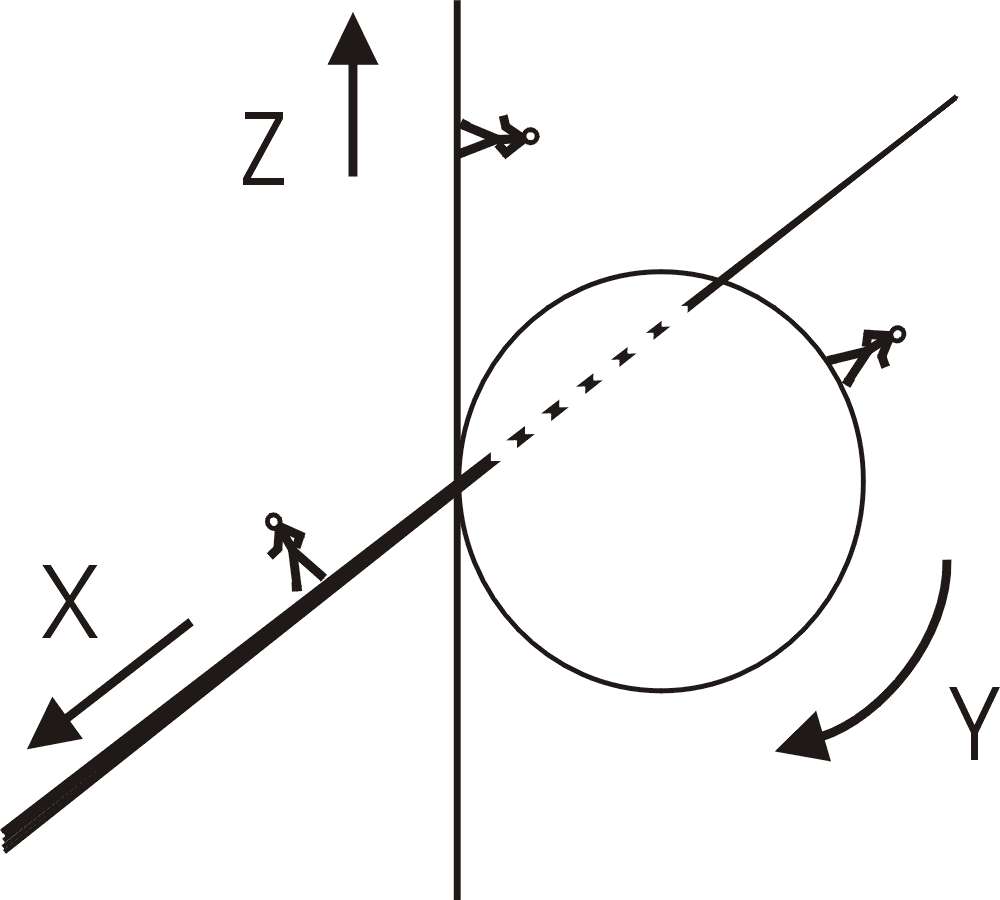
tiny dimension 1Well, suppose that we bend one of those three familiar “large” dimensions around in a circle, as in the drawing to the right. Our little guy could walk straight out of the page “forever” in the X direction. He could walk straight up the page “forever” in the Z direction. However, if he tries to walk along the Y track perpendicular to both of those two, in a while he’ll wind up right back where he started.

That’s an example of a “tightly wound” dimension.

Because it makes the math easier, physicists usually don’t calculate the absolute distance traveled around the circle.  Instead they write equations that depend on the angle from zero as the starting point. Notice that 360 degrees is exactly the same as zero — that’ll be important in a later post here.  Anyhow, there’s reason to believe that the effective circumference of a “tightly wound” dimension is really, really small.

OK, having a closed-off dimension is a little strange but it’s just not real-world, is it?

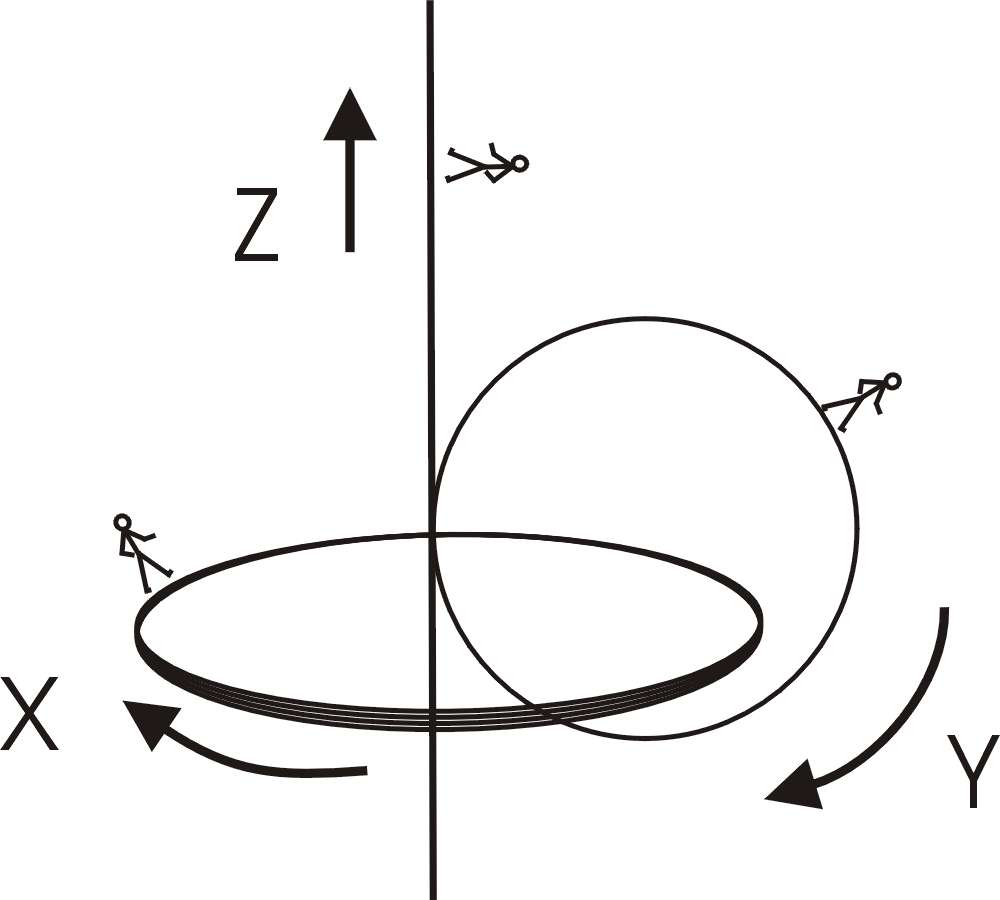
tiny dimension 2Actually, our real world is like that but moreso. Look at this drawing where we’ve got a pair of perpendicular wound-up dimensions. The little guy on the Y track can go from Denver down to Mazatlan in Mexico and proceed all the way around the world back up to Denver. On the X track he’s going from Denver westward to Chico CA and could continue across the Pacific and onward until he gets back to Denver The only way he can travel in one direction “forever” is to go along the Z track, straight upward, and that’s why NASA builds rocket ships.

Back to the strings. Depending on which variety of string theory you choose, the strings wriggle in a space of three Z-style “extended” dimensions, plus time, plus half-a-dozen or more wound-up or “compactified” (look it up) dimensions.  If string-theory strings can wriggle in all those directions, then how much room does each one have to move around in?  We’ve all learned the formulas for area of a rectangle and volume of a cube — [length times height] and [length times height times depth].  To extend the notion of “volume” to more dimensions you just keep multiplying.

Back to the size of the Universe. You may think that just with straight-line space it’s pretty good-sized.  With those stringy dimensions in play, for every single cube-shaped region you pick in straight-line space you need to multiply that volume by [half-a-dozen or more dimensions] times [many possible angles] to account for all the “space” in all the enhanced regions you could choose from when you include those wound-up dimensions. The total multi-dimensional volume is very, very huge.

The universe is indeed much larger than is generally supposed.

Next week — buttered cats.

~~ Rich Olcott

Dimensional Venturing Part 5 – You Ain’t From Around Here, Are You?

OK, I’ll admit it, back in the day I read a lot of comics.  Even then, though, I was skeptical — “Wait, how could Superman just pick up that building?  It’d fall apart!”

But I was intrigued by one recurring character, Mr Mxyzptlk, a pixie-like “visitor from the 5th dimension.”   His primary purpose in life (other than getting us to buy more comics) seemed to be to play tricks on or otherwise torment Our Hero.

Mxycus 2Mxy wasn’t the only comics character coming in “from another dimension.” It seemed like the entire Marvel team (both sides) was continually flickering out of and into our universe that way. How often did Jane Grey die and then somehow get cloned or refreshed?  (BTW, if the accompanying cartoon is a little obscure, show it to the friendly clerks at your local comics store — it may give them a chuckle.)

But my question was, where was that dimension Mxy came from?  I got an answer, sort of, when our geometry teacher explained that a dimension is just a direction you could travel.  Different dimensions are directions at right angles to each other.  She was right (see my first post in this series), at least in the context of then-HS math, but that explanation opened an editorial issue that’s never been properly settled.

A dimension is a direction, not a location.  You can’t be “from” a fifth or sixth or nth dimension any more than you can be from up.  If there is a spatial fifth dimension, we’re already “in” it in the same sense that we’re already somewhere along east-to-west and somewhen along past-to-future.

What’s going on is that for the purpose of the story, the authors want the character to come from somewhere very else.  We often associate a place with the direction to it — the sun rises in the east, Frodo departs to the west,  Heaven is up, Hell is down — but those are all directions relative to our current location.  We even associate future times as being in front of us and past times behind us (there’s that 4th dimension again).

Mash_sign_post
The M*A*S*H signpost, now at the Smithsonian. Photo by Steven Williamson., in commons.wikimedia.org/wiki/File:Mash_sign.jpg

But a place is more specific than a direction — to navigate to a certain there you need to know the direction and the distance (or another quantity that stands in for a distance).  That matters.  Jimmie Rodgers sang, “Twelve more miles to Tucumcari” as he kept track of the distance left to go along the road he was traveling.  Or away from the town, as it turned out.

Physicists have lots of uses for the combination of a direction and a magnitude, so many that they gave the combination a name — a vector.  The vector may represent a direction and a distance, a direction and the strength of a magnetic field, or a direction and any quantity that happens to be useful in the application at hand.  A wind map uses vectors of direction and wind speed to show air flow.  Here’s a very nice wind map of the US, and I love NOAA’s wind map of the world.  Vectors will be real useful when we start talking about black holes.

OK, so Mr Mxyzpltk (the spelling seemed to vary from issue to issue of the comic) comes from somewhere along a fifth dimension, but they never tell us from how far away.

Next week –As Steve Martin said, “Let’s get small, really small.”

~~ Rich Olcott

Dimensional Venturing Part 4 – To infini-D and beyond!

apple plumNow that you’ve read my previous posts and have the 4-D thing working well, you’re ready to go for a few more dimensions.  Consider the apple that struck Isaac Newton’s head.  The event occurred in 1665, in England at 52°55´N by 0°38´E, roughly three feet above ground level.  The apple, variety “Flower of Kent,” weighed about 8 ounces and was probably somewhat past fully ripened.  Got that picture in your head?  You’re doing great.

Now visualize the apple taking thirty seconds to move twenty feet diagonally upward, northward and eastward as it morphs to an underripe 4-ounce Damson plum.

The change you just imagined followed an eight-dimensional path: three dimensions of space, one of time, one of weight, one for degree of ripeness, and two category dimensions, species and variety.

Length in a given direction is only one kind of dimension, as Sir Isaac’s example demonstrates.  A mathematician would say that a dimension is a set of values that can be traversed independently of any other set of values. A dimension can be confined to a limited range (360 degrees in a circle) or be infinite like … well, “infinitely far away.”  A dimension might be continuous (think how loudness can vary smoothly from sleeping-baby hush to stadium ROAR and beyond) or be in discrete steps like the click-stops on a digital controller.  The physicists are arguing now whether, at the smallest of scales, space itself is continuous or discrete.

colors_post
Photo by Becky Ziemer

Color vision’s a good example of dimensions in action.  For most of us, our eyes have three types of cone cells, respectively optimized for red, green and blue light.  We see a specific color as some mixture of the three and that’s how the screen you’re looking at now can fake 16 million colors using just three kinds of color-emitting elements (phosphor dots in old-style TVs, LEDs in most devices these days).

Where did that 16 million number come from?  The signal-processing math is seriously techie, but at the bottom the technology uses 256 intensity levels of red, 256 levels of green and 256 levels of blue — each is a discrete dimension with a limited range.  Together they define a 256x256x256-point cube.  Any point in that cube represents a unique mix of primary colors.  One of the colors in the little girl’s hat, for instance, is at the intersection of 249/256 red, 71/256 green, and 48/256 blue.  The arithmetic tells us there are 16,777,216 points (possible mixed colors) in that cube.

Well, actually, there’s one more dimension to color vision because our eyes also have rod cells that simply sense light or darkness.  Neither brown nor grey are in the spectrum that cones care about.  A good printer uses four separate inks to produce browns and greys as mixtures of three dimensions of red-green-blue plus one of black.

So color is 3-dimensional, mostly.  But that’s just the start of color vision because most of us have millions of cone cells in each eye.  A mathematician would say that any scene you look at has that number of dimensions, because the intensity registered by one cone can vary in its range independently of all the other cones.

Ain’t it wonderful that you’re perfectly OK with living in a multi-million-dimensional world?

Next week – a word from the other side

~~ Rich Olcott

Dimensional venturing, Part 3 – Klein’s thingy

The Klein bottle is one of the most misunderstood objects in popular math.  Let’s start with the name.  When he initially described the object Herr Doktor Professor Felix Klein said it was a surface.  Being German and writing in German, he used the word Fläche (note the two little dots over the a).  When his paper was translated to English, the translator noticed the shape of the thing but didn’t notice those two little dots.  He misread the word as Flasche, meaning flask or bottle, and the latter word stuck.

Cut Torus
Adapted from “Torus”. Licensed under Public Domain via Commons – https://commons.wikimedia.org/wiki/File:Torus.png

So who was Herr Klein and what was it that he wrote about?  One of the world’s foremost mathematicians in the last quarter of the 19 Century, he specialized in geometry, complex analysis and mathematical physics.  Among his other accomplishments was that as director of a research center at Georg-August-Universität Göttingen in 1895 he supervised Germany’s first Ph.D. thesis written by a woman (Grace Chisholm Young).

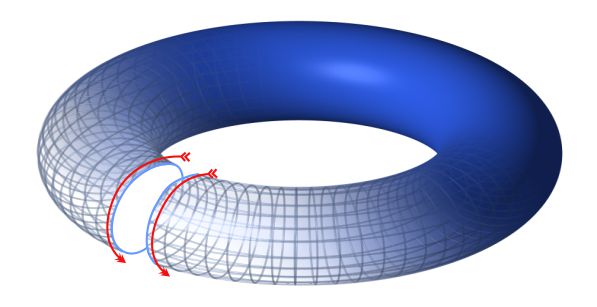
As a small part of one of his many papers he noted that a cylinder could be deformed in two different ways to connect its two ends. The first way is to simply bend it around in a circle to form a torus (or bicycle tire or doughnut, depending on how hungry you are.)

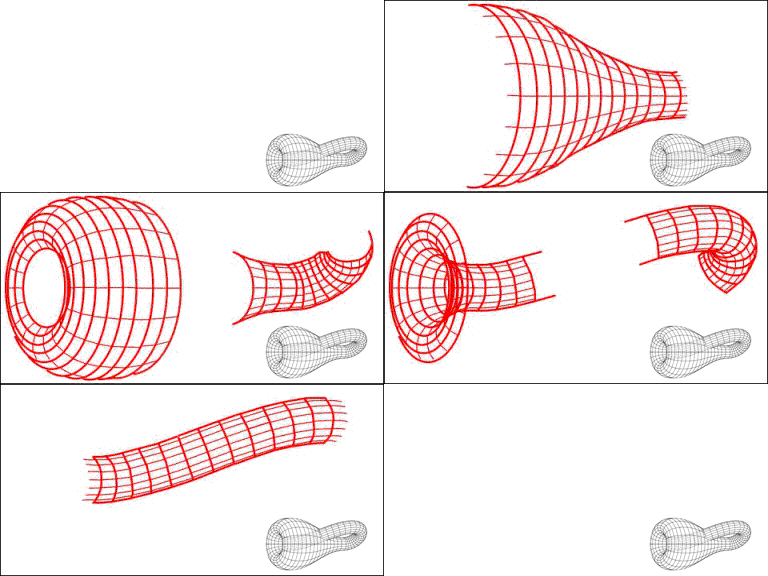
IssueThe other way is more of a challenge — bringing one end to meet the other from inside the cylinder.  The problem is that in the context of Klein’s work, he wasn’t “allowed” to pierce the cylinder’s surface to get it there.  Klein’s solution was simple  — swing it in through the fourth dimension.  Sounds like a cheat, doesn’t it?

Actually, the cheat is in the way KKleinthat the Klein bottle is usually represented.  When the glass artisan created this example, he probably brought one tube up from the bottom, sealed it to the side wall, blew a hole in the side wall at that location, and then brought the outside tube around to join there.  That hole would not have satisfied Herr Klein.

If you’ve looked at my previous post in this series you probably have a pretty good idea of how he would have preferred his Fläche to be depicted — as an animation which exploits time as the fourth dimension.  So here you have it.

Suppose the figure’s wall sprouts from a bud somewhere near the intersection point.  After the figure has grown for a while, the earliest section of the wall begins to recede, disappearing like the Cheshire Cat but leaving its ever-expanding smile behind.  By the time the growth front gets to where the bud was, there’s nothing there to intersect.

Reverse Klein If you opt to build the “bottle” in 4-space, there’s no problem getting those two ends of the cylinder to join up.  A shape that’s impossible to build in three dimensions is easy-peasy (with a little planning) in four.

Yeah, yeah, the Klein bottle has lots of interesting properties, like not having an inside, but we’ll defer talking about them for a while.

Next week, getting past that pesky four-dimension limitation.

~~ Rich Olcott