


Surely you’ve heard of The Infinite Monkey Theorem. You probably don’t believe it. No way could that monkey accidentally type out anything meaningful, much less the complete works of Shakespeare. Well…
 In several of his Discworld books, author Terry Pratchett featured something called Library-space, L-space for short. It’s defined as “a dimension that connects every library and book depository in the universe. L-Space is portrayed as a natural outgrowth of the fact that knowledge = power = energy = matter = mass and mass warps space, and therefore, libraries in the Discworld universe are a very dangerous place indeed for the unprepared”.
Somewhere, Pratchett wrote that L-space contains all the books that have been written, all those that will be written, and all those that would have been written but the author thought better of it. Well, how big is L-space?
To over-estimate, suppose L-space contains a billion (109) books, each book is 500 pages long, each page contains 4000 characters, and the characters are chosen from an “alphabet” of 500 marks (upper- and lower-case letters, numbers and punctuation marks, all in normal, bold and italic forms in a several different fonts). One book would then contain two million marks.
Now, how many possible books are there, including ‘impossible’ character combinations like “zqzqzqzq”? We can construct a “possible” book by choosing some random one of the 500 marks as the first character, the same or a different one as the second character (500×500 = 5002 = 250,000 possibilities so far) and so on, until we’ve built (or our monkey has typed) a two-million-character book. It could be a book that contains nothing but a string of a million copies of “zq” — but that’s OK, it’s still a possible book. So is the book that contains all the works of Shakespeare and so is a typo version that inconsistently misspells “Romeo.”
On this basis there are some 5002,000,000 = 105,397,940 different possible books. L-space with only a billion books is thus very small indeed compared to the number of possible books. Put another way, the set of all possible books (which we can call B-space) could hold 105,397,931 versions of the L-space that initially seemed so immense.
Note that there are two distinct operations involved in the Monkey Theorem’s process
- Generate a string of characters, and
- Identify a meaningful substring within that.
The monkey* has no clue what it’s typing. Any given random string might or might not be intelligible to someone who reads English, or German, or Cherokee. The string might be a computer program in FORTRAN or JavaScript, or maybe a sequence of DNA icons for a gene mutation that makes green hair — or it (probably) would have no valid interpretation in any context.
The monkey doesn’t care, it’s just typing.
In the second step of the process someone has to recognize Macbeth or The Tempest buried in all the nonsense. If we were walking through the stacks of B-space and pulled a book off the shelf, what are the odds that the book we grabbed belongs to L-space?
The answer is one in 105,397,931. That’s a very small probability, BUT IT’S NOT ZERO. By construction, we’re guaranteed that all the L-space books are in B-space – but we have a vanishingly small chance of finding one of them.
Now for our extremely patient monkey who has been typing for a really, really long time. It’s been at it long enough to produce many, many copies of B-space. After all, even 105,397,940 is a very small number compared to infinity.
The core of the Infinite Monkey Theorem is that with so much opportunity for duplication, we are guaranteed that there exists at least one complete and perfect copy of B-space and so at least one good copy of L-space and so at least one good copy of all the works of Shakespeare. Also there’s at least one copy of “zqzqzqzq”.
The challenge is in laying hands on that one good copy. From a physicist’s perspective, it’s such a low-probability event that it can be ignored. On the other hand, the probability of Life arising on Earth was pretty low, too, but I’m glad it happened.
~~ Rich Olcott
* – I had a great “Monkeys typing” graphic, but they were chimps. Pratchett’s Diskworld Librarian would object, quite firmly, because apes aren’t monkeys.
** – I also had a pretty good “feature image,” a collage of many different monkey faces, but it seems at least one of them has a copyright lawyer. Now the feature image is a picture of my library prior to the down-sizing.



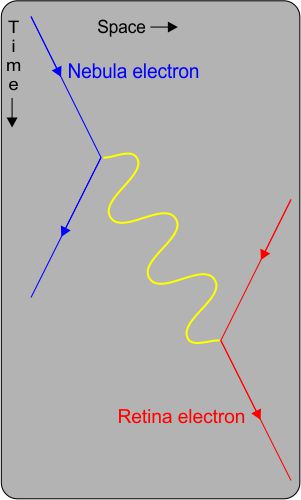 Here we have a Feynman diagram, named for the Nobel-winning (1965) physicist who invented it and much else. The diagram plots out the transaction we just discussed. Not a conventional x-y plot, it shows Space, Time and particles. To the left, that far-away electron emits a photon signified by the yellow wiggly line. The photon has momentum so the electron must recoil away from it.
 Gargh, proto-humanity’s foremost physicist 2.5 million years ago, opened a practical investigation into how motion works. “I throw rock, hit food beast, beast fall down yes. Beast stay down no. Need better rock.” For the next couple million years, we put quite a lot of effort into making better rocks and better ways to throw them. Less effort went into understanding throwing.
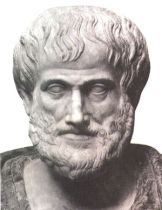 Aristotle wasn’t satisfied with anything so unsystematic. He was just full of theories, many of which got in each other’s way. One theory was that things want to go where they’re comfortable because of what they’re made of — stones, for instance, are made of earth so naturally they try to get back home and that’s why we see them fall downwards (no concrete linkage, so it’s still AAAD).


 It would have been awesome to watch Dragon Princes in battle (from a safe hiding place), but I’d almost rather have witnessed “The Tussles in Brussels,” the two most prominent confrontations between Albert Einstein and Niels Bohr.
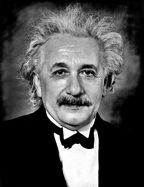 Like Newton, Einstein was a particle guy. He based his famous thought experiments on what his intuition told him about how particles would behave in a given situation. That intuition and that orientation led him to paradoxes such as entanglement, the
  Bohr was six years younger than Einstein. Both Bohr and Einstein had attained Directorship of an Institute at age 35, but Bohr’s has his name on it. He started out as a particle guy — his first splash was a trio of papers that treated the hydrogen atom like a one-planet solar system. But that model ran into serious difficulties for many-electron atoms so Bohr switched his allegiance from particles to Schrödinger’s wave theory. Solve a Schrödinger equation and you can calculate statistics like
  Here’s where Ludwig Wittgenstein may have come into the picture. Wittgenstein is famous for his telegraphically opaque writing style and for the fact that he spent much of his later life disagreeing with his earlier writings. His 1921 book, Tractatus Logico-Philosophicus (in German despite the Latin title) was a primary impetus to the Logical Positivist school of philosophy. I’m stripping out much detail here, but the book’s long-lasting impact on QM may have come from its Proposition 7: “Whereof one cannot speak, thereof one must be silent.“


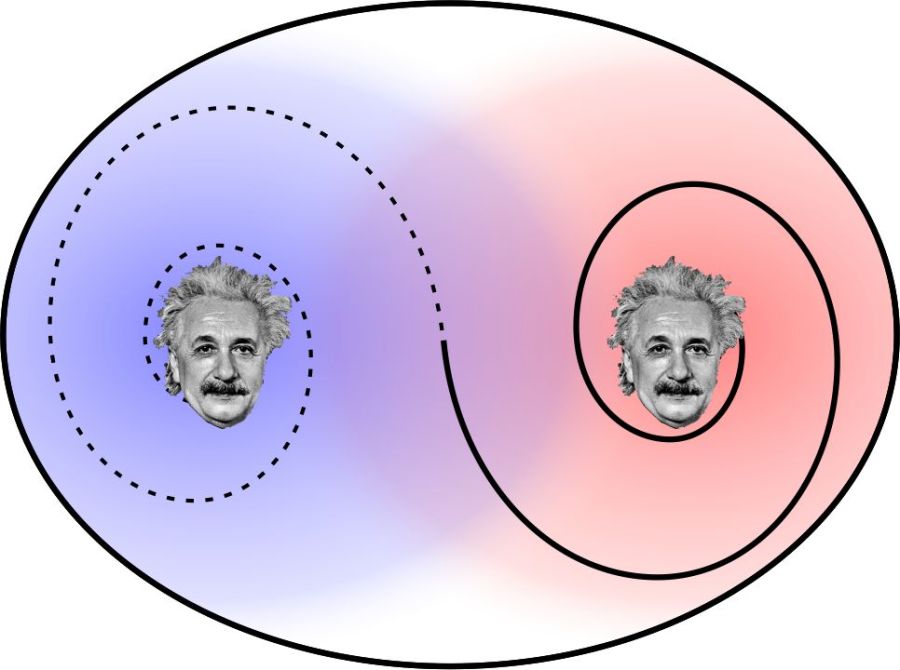
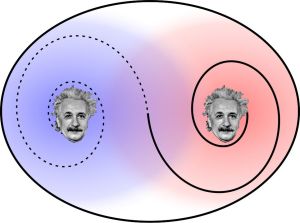 Information transfer at infinite speed? Of course not, because neither hungry person knows what’s in either box until they open one or until they exchange information. Even Skype operates at light-speed (or slower).


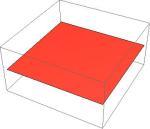

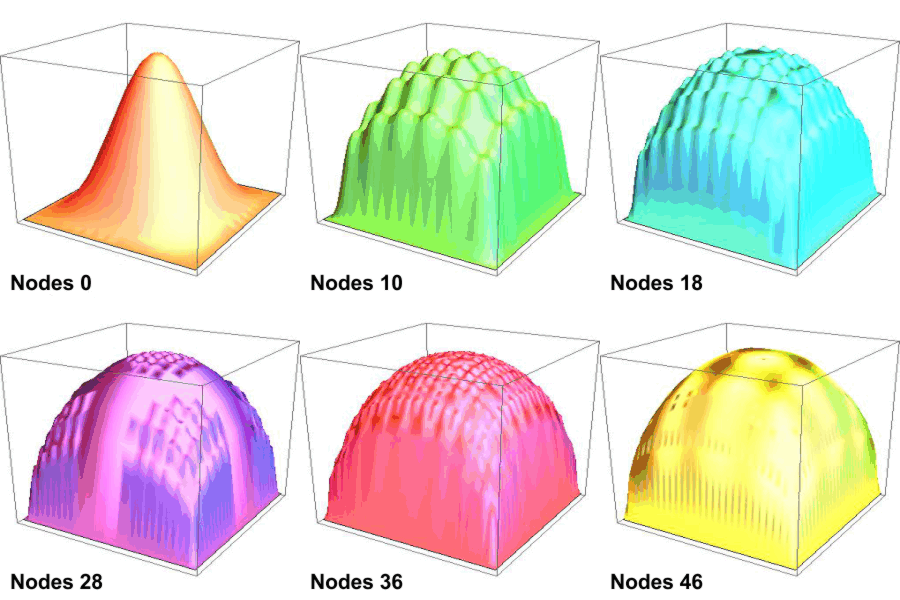
 Suppose you’re playing goalie in an inverse tennis game. There’s a player in each service box. Your job is to run the net line using your rackets to prevent either player from getting a ball into the opposing half-court. Basically, you want the ball’s locations to look like the single-node yellow shape up above. You’ll have to work hard to do that.

 Hard Science Ain't Hard