Smoke and a mirror

Etna jellyfish pairGrammie always grimaced when Grampie lit up one of his cigars inside the house.  We kids grinned though because he’d soon be blowing smoke rings for us.  Great fun to try poking a finger into the center, but we quickly learned that the ring itself vanished if we touched it.

My grandfather can’t take credit for the smoke ring on the left — it was “blown” by Mt Etna.  Looks very like the jellyfish on the right, doesn’t it?  When I see two such similar structures, I always wonder if the resemblance comes from the same physics phenomenon.

This one does — the physics area is Fluid Dynamics, and the phenomenon is a vortex ring. We need to get a little technical and abstract here: to a physicist a fluid is anything that’s composed of particles that don’t have a fixed spatial relationship to each other. Liquid water is a fluid, of course (its molecules can slide past each other) and so is air.  The sun’s ionized protons and electrons comprise a fluid, and so can a mob of people and so can vehicle traffic (if it’s moving at all).  You can use Fluid Dynamics to analyze motion when the individual particles are numerous and small relative to the volume in question.

Ring x-section
Adapted from a NOAA page

You get a vortex whenever you have two distinct fluids in contact but moving at sufficiently different velocities.  (Remember that “velocity” includes both speed and direction.)  When Grampie let out that little puff of air (with some smoke in it), his fast-moving breath collided with the still air around him.  When the still air didn’t get out of the way, his breath curled back toward him.  The smoke collected in the dark gray areas in this diagram.

That curl is the essence of vorticity and turbulence.  The general underlying rule is “faster curls toward slower,” just like that skater video in my previous post.  Suppose fluid is flowing through a pipe.  Layers next to the outside surface move slowly whereas the bulk material near the center moves quickly.  If the bulk is going fast enough, the speed difference will generate many little whorls against the circumference, converting pump energy to turbulence and heat.  The plant operator might complain about “back pressure” because the fluid isn’t flowing as rapidly as expected from the applied pressure.

But Grampie didn’t puff into a pipe (he’s a cigar man, right?), he puffed into the open air.  Those curls weren’t just at the top and bottom of his breath, they formed a complete circle all around his mouth.  If his puff didn’t come out perfectly straight, the smoke had a twist to it and circulated along that circle, the way Etna’s ring seems to be doing (note the words In and Out buried in the diagram’s gray blobs).  When a vortex closes its loop like that, you’ve got a vortex ring.

A vortex ring is a peculiar beast because it seems to have a life of its own, independent of the surrounding medium.  Grampie’s little puff of vortical air usually retained its integrity and carried its smoke particles for several feet before energy loss or little fingers broke up the circulation.

To show just how special vortex rings are, consider the jellyfish.  Until I ran across this article, I’d thought that jellyfish used jet propulsion like octopuses and squids do — squirt water out one way to move the other way.  Not the case.  Jellyfish do something much more sophisticated, something that makes them possibly “the most energy-efficient animals in the world.”

jellyfish vortices

Thanks to a very nice piece of biophysics detective work (read the paper, it’s cool, no equations), we now know that a jellyfish doesn’t just squirt.  Rather, it relaxes its single ring of muscle tissue to open wide.  That motion pulls in a pre-existing vortex ring that pushes against the bell.  On the power stroke, the jellyfish contracts its bell to push water out (OK, that’s a squirt) and create another vortex ring rolling in the opposite direction.  In effect, the jellyfish continually builds and climbs a ladder of vortex rings.

Vortex rings are encapsulated angular momentum, potentially in play at any size in any medium.

~~ Rich Olcott

The Force(s) of Geometry

There’s a lot more to Geometry than congruent triangles.  Geometry can generate hurricanes and slam you to the floor.

It all starts (of course) with Newton.  His three laws boil down to

Effect is to Cause as Change of Motion is to Force.

They successfully account for the physical movement of pretty much everything bigger than an atom.  But sometimes the forces are a bit weird and it takes Geometry to understand them.

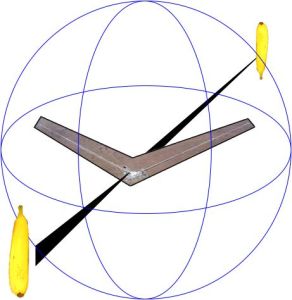
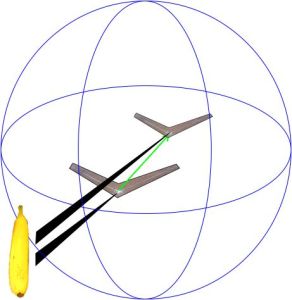
Side forceFor instance, suppose Fred and Ethel collaborate on a narwhale research project.  Fred is based in San Diego CA and Ethel works out of Norfolk VA. They fly to meet their research vessel at the North Pole. Fred’s plane follows the green track, Ethel’s plane follows the yellow one.  At the start of the trip, they’re on parallel paths going straight north (the dotted lines).  After a few hours, though, Ethel notices the two planes pulling closer together.

Ethel calls on her Newton knowledge to explain the phenomenon.  “It can’t be Earth’s gravity moving us together, because that force points down to Earth’s center and this is a sideways motion.  Our planes each weigh about 2000 kilograms and we’re still 2,000 kilometers apart.  By Newton’s F = G m1m2/r2 equation, the gravitational force between us should be (6.7×10⁻¹¹ N m2/kg2) x (2000 kg) x (2000 kg) / (2,000 m)2 = 6.7×10⁻¹¹ newtons, way too small to account for our speed of approach.  Both planes were electrically grounded when we fueled up, so we’re both carrying a neutral electric charge and it can’t be an electrostatic force.  If it were magnetic my compass would be going nuts and it’s not.  Woo-hoo, I’ve discovered a new kind of force!”

See what I did there?  Fred and Ethel would have stayed a constant distance apart if Earth were a cylinder.  Parallel lines running up a cylinder never meet.  But Earth is a sphere, not a cylinder.  Any pair of lines on a sphere must meet, sooner or later.  Ethel’s “sideways force” is a product of Geometry.

Sandy
Images extracted from NOAA’s SOS Explorer app, available from sos.noaa.gov

Hurricanes, too.  This video shows a day in the life of Hurricane Sandy.  Weather geeks will find several interesting details there, but for now just notice the centers of  counter-clockwise rotation (the one off the Florida coast is Sandy).  Storm centers in the Northern Hemisphere virtually always spin counterclockwise.  Funny thing is, in the Southern Hemisphere those centers go clockwise instead.

The difference has to do with angular momentum.  We could get all formal vector math here, but the easy way is to consider how fast the air is moving in different parts of the world.

We’ve all seen at least one ice show act where skaters form a spinning line. The last skater to join up (usually it’s a short girl) has to push like mad to catch the end of that moving line and everyone applauds her success. Meanwhile the tall girl at the center of the line is barely moving except to fend off dizziness.

YellowknifeThe line rotates as a unit — every skater completes a 360o rotation in the same time. Similarly, everywhere on Earth a day lasts for exactly 24 hours.

Skaters at the end of the line must skate faster than those further in because they have to cover a greater distance in the same amount of time.  The same geometry applies to Earth’s atmosphere.  The Earth is 25,000 miles around at the equator but only 12,500 miles around near the latitude of Whitehorse, Canada.  By and large, a blob of air at the equator must move twice as fast as a blob at 60o north.

chain 2Now suppose our speedy skater hits a slushy patch of ice.  Her end of the line is slowed down, so what happens to the rest of the line?  It deforms — there’s a new center of rotation that forces the entire line to curl around towards the slow spot.  Similarly, that blob near the Equator in the split-Earth diagram curls in the direction of the slower-moving air to its north, which is counter-clockwise.

In the Southern hemisphere, “slower” is southward and clockwise.

If not for Geometry (those differing circle sizes), we wouldn’t have hurricanes.  Or gravity — but that’s another story.

~~ Rich Olcott

Smack-dab in the middle

BridgeSee that little guy on the bridge, suspended halfway between all the way down and all the way up?  That’s us on the cosmic size scale.

I suspect there’s a lesson there on how to think about electrons and quantum mechanics.

Let’s start at the big end.  The physicists tell us that light travels at 300,000 km/s, and the astronomers tell us that the Universe is about 13.7 billion years old.  Allowing for leap years, the oldest photons must have taken about 4.3×10¹⁷ seconds to reach us, during which time they must have covered 1.3×1026 meters.  Double that to get the diameter of the visible Universe, 2.6×1026 meters.  The Universe probably is even bigger than that, but far as I can see that’s as far as we can see.

At the small end there’s the Planck length, which takes a little explaining.  Back in 1899, Max Planck published his epochal paper showing that light happens piecewise (we now call them photons).  In that paper, he combined several “universal constants” to derive a convenient (for him) universal unit of length: 1.6×10⁻³⁵ meters.  It’s certainly an inconvenient number for day-to-day measurements (“Gracious, Junior, how you’ve grown!  You’re now 8×1034 Planck-lengths tall.”).  However, theoretical physicists have saved barrels of ink and hours of keyboarding by using Planck-lengths and other such “natural units” in their work instead of explicitly writing down all the constants.

Furthermore, there are theoretical reasons to believe that the smallest possible events in the Universe occur at the scale of Planck lengths.  For instance, some theories suggest that it’s impossible to measure the distance between two points that are closer than a Planck-length apart.  In a sense, then, the resolution limit of the Universe, the ultimate pixel size, is a Planck length.

sizelineSo that’s the size range of the Universe, from 1.6×10⁻³⁵ up to 2.6×1026 meters. What’s a reasonable way to fix a half-way mark between them?

It makes no sense to just add the two numbers together and divide by two the way we’d do for an arithmetic average. That’d be like adding together the dime I owe my grandson and the US national debt — I could owe him 10¢ or $10, but either number just disappears into the trillions.

The best way is to take the geometrical average — multiply the two numbers and take the square root.  I did that.  It’s the X in the sizeline, at 6.5×10⁻⁵ meters, or about the diameter of a fairly large bacterium.  (In the diagram, VSC is the Vega Super Cluster, AG is the Andromeda Galaxy, and the numbers are those exponents of 10.)

That’s worth marveling at.  Sixty orders of magnitude between the size of the Universe and the size of the ultimate pixel.  Yet from blue whales to bacteria, Earth’s life just happens to occupy the half-dozen orders right in the middle of the range.  We think that’s it.

Could this be another case of the geocentric fallacy?  Humans were so certain that Earth was the center of the Universe, before Brahe and Galileo and Newton proved otherwise.  Is there life out there at scales much larger or much smaller than we imagine?

Who knows? But here’s an intriguing physics/quantum angle I’d like to promote.  We know a lot about structures bigger than us — solar systems and binary stars and galaxy clusters on up.  We know a few sizes and structures a bit smaller — viruses and molecules and atoms.  We’re aware of quarks and gluons that reside inside protons and atomic nuclei, but we don’t know their size or structure.

Even a proton is huge on the Planck-length scale.  At 1.8×10⁻¹⁵ meters the proton measures some 1020 Planck-lengths.  There’s as much scale-space between the Planck-length and the proton as there is between the Earth (1.3×10⁷ meters) and the Universe.

It’s hard to believe that Terra infravita’s area has no structure whereas Terra supravita is so … busy.  The Standard Model’s “ultimate particles,” the electrons and photons and neutrinos and quarks and gluons, all operate down there somewhere.   It’s reasonable to suppose that they reflect a deeper architecture somewhere on the way down to the Planck-length foam.

Newton wrote (in Latin), “I do not make hypotheses.”  But golly, it’s tempting.

~~ Rich Olcott

There’s a lot of not much in Space

A while ago I drove from Denver to Fort Worth, and I was impressed. See, there’s a lot of not much in eastern Colorado. It’s pretty much the same in western Oklahoma except there’s less not much because there’s less of Oklahoma – but Texas has way more not much than anybody.

That gives Texas not much to brag about, but they do the best they can, bless their hearts.

What got me started on this rant was a a pair of astronomical factoids Katherine Kornei wrote in the Nov 2014 Discover magazine.

“If galaxies were shrunk to the size of apples, neighboring galaxies would be only a few meters apart….”
“If the stars within galaxies were shrunk to the size of oranges, they would be separated by 4,800 kilometers (3,000 miles).”

Apple orangeSo there’s a lot of not much between galaxies, but a whole lot more not much, relatively speaking, within them. I just measured an apple and an orange in my kitchen. They’re both about the same size, 3 inches in diameter, so I have no idea why she chose different fruits – perhaps she wanted to avoid comparing apples and oranges.

Anyway, if you felt like doing the galaxy visualization you could put two apple galaxies on the floor about 12 feet apart and then line up about 50 apples between them. A fair amount of space for more galaxies.

To see inside a galaxy you could put one orange star in Miami FL, and its on-the-average nearest orange neighbor in Seattle WA. Then you could set out a long skinny row of just about 63 million oranges in between. Oh, and on this scale the nearest galaxy would be about 2 billion miles (or 43 quadrillion oranges) away. Way more not much inside a galaxy than between two neighboring ones.

So if we squeeze all those apples and oranges together we’d get rid of all the empty space, right?

Not by a long shot. Nearly all those stars are balls of very hot gas, which means they’re made up of atoms crossing empty space inside the star to collide with other atoms. Relative to the size of the atoms, how much empty space is there inside the star?

Matryoshkii 1For example, every chemistry student learns that 6×10²³ molecules of any gas take up a volume of 22.4 liters at normal Earth temperature and pressure. For a single-atom gas like helium that works out to about 22 atom-widths between atoms.

Now think about emptiness inside the Sun. If it’s a typical star (which it is) and if all of its atoms are hydrogen (which they mostly are) and if the average density of the Sun (1408 kg/m3) applied all the way down to the center of the Sun (which it doesn’t), and if we believe NASA’s numbers for the Sun (hey, why not?), then the average density works out to about 0.7 atom-widths between neighbors.

So no empty space to squeeze out of the Sun, eh? Well, actually there is quite a lot, because those atoms are mostly empty space, too.

OK, I cheated up there about the Sun, because virtually all of the Sun’s atoms have been dissociated into separated electrons and nuclei. The nucleus is much smaller than than its atom – by a factor of 60,000 or so. Think of a grape seed in the middle of a football field.

To sum it upward, we’ve got a set of Russian matryoshka dolls, one inside the next. At the center is a collection of grape seeds, billions and billions of them, each in their own football field. The football fields are all balled into a stellar orange (or maybe an apple), but there are billions of those crammed into a galactic apple (or maybe an orange) that’s about ten feet away from the nearest other piece of fruit.

As Douglas Adams wrote in Hitchhiker’s Guide to The Galaxy,

“Space … is big. Really big. You just won’t believe how vastly, hugely, mindbogglingly big it is. I mean, you may think it’s a long way down the road to the chemist’s, but that’s just peanuts to space…”

The thing to realize is that the function of all that space is to keep everything from being in the same place. That’s important.

~~ Rich Olcott

Sir Isaac, The Atom And The Whirlpool

Newton and atomNewton definitely didn’t see that one coming.  He has an excuse, though.  No-one in in the 17th Century even realized that electricity is a thing, much less that the electrostatic force follows the same inverse-square law that gravity does. So there’s no way poor Isaac would have come up with quantum mechanics.

Lemme ‘splain.  Suppose you have a mathematical model that’s good at predicting some things, like exactly where Jupiter will be next week.  But if the model predicts an infinite value under some circumstances, that tells you it’s time to look for a new model for those particular circumstances.

For example, Newton’s Law of Gravity says that the force between two objects is proportional to 1/r2, where r is the distance between their centers of mass.  The Law does a marvelous job with stars and satellites but does the infinity thing when r approaches zero.  In prior posts I’ve described some physics models that supercede Newton’s gravity law at close distances.

Electrical forces are same song second verse with a coda.  They follow the 1/r2 law, so they also have those infinity singularities.  According to the force law, an electron (the ultimate “particle” of negative charge) that approaches another electron would feel a repulsion that rises to infinity.  The coda is that as an electron approaches a positive atomic nucleus it would feel an attraction that rises to infinity.  Nature abhors infinities, so something else, some new physics, must come into play.

I put that word “particle” in quotes because common as the electron-is-a-particle notion is, it leads us astray.  We tend to think of the electron as this teeny little billiard-ballish thing, but it’s not like that at all.  It’s also not a wave, although it sometimes acts like one.  “Wavicle” is just  a weasel-word.  It’s far better to think of the electron as just a little traveling parcel of energy.  Photons, too, and all those other denizens of the sub-atomic zoo.

An electron can’t crumble or leak mass or deform to merge the way that sizable objects can.  What it does is smear. Quantum mechanics is all about the smear.  Much more about that in later posts.


Newton in whirlpoolIf Newton loved anything (and that question has been discussed at length), he loved an argument.  His battle with Leibniz is legendary.  He even fought with Descartes, who was a decade dead when Newton entered Cambridge.

Descartes had grabbed “Nature abhors a vacuum” from Aristotle and never let it go.  He insisted that the Universe must be filled with some sort of water-like fluid.  He know the planets went round the Sun despite the fluid getting in the way, so he reasoned they moved as they did because of the fluid.

Surely you once played with toy boats in the bathtub.  You may have noticed that when you pulled your arm quickly through the water little whirlpools followed your arm.  If a whirlpool encountered a very small boat, the boat might get caught in it and move in the same direction.  Descartes held that the Solar System worked like that, with the Sun as your arm and the planets caught in Sun-stirred vortices within that watery fluid.

Newton knew that couldn’t be right.  The planets don’t run behind the Sun, they share the same plane.  Furthermore, comets orbit in from all directions.  Crucially, Descartes’ theory conflicted with his own and that settled the matter for Newton.  Much of Principia‘s “Book II” is about motions of and through fluid media.  He laid out there what a trajectory would look like under a variety of conditions.  As you’d expect, none of the paths do what planets, moons and comets do.

From Newton’s point of view, the only use for Book II was to demolish Descartes.  For us in later generations, though, he’d invented the science of hydrodynamics.

Which was a good thing so long as you don’t go too far upstream towards the center of the whirlpool.  As you might expect (or I wouldn’t even be writing this section), Book II is littered with 1/rn formulas that go BLOOIE when the distances get short.  What happens near the center?  That’s where the new physics of turbulence kicks in.

~~ Rich Olcott

Squeezing past Newton’s infinity

One of the most powerful moments in musical theater — Philip Quast Quastin his Les Miz role of Inspector Javert, praising the stars for the steadfastness and reverence for law that they signify for him.  The performance is well worth a listen.

Javert’s certitude came from Newton’s sublimely reliable mechanics — the notion that every star’s and planet’s motion is controlled by a single law, F~(1/r2).  The law says that the attractive force between any pair of bodies is inversely proportional to the square of the distance between their centers.  But as Javert’s steel-clad resolve hid a fatal spark of mercy towards Jean Valjean, so Newton’s clockworks hold catastrophe at their axles.

Newton’s gravity law has a problem.  As the distance approaches zero, the predicted force approaches infinity.  The law demands that nearby objects accelerate relentlessly at each other to collide with infinite force, after which their combined mass attracts other objects.  In time, everything must collapse in a reverse of The Big Bang.

Victor Hugo wrote Les Misérables about 180 years after Newton published his Principia.  A decade before Hugo’s book, Professeur Édouard Roche (pronounced rōsh) solved at least part of Newton’s problem.

Roche realized that Newton had made an important but crucial simplification.  Early in the Principia, he’d proven that for many purposes you can treat an entire object as though all of its mass were concentrated at a single point (the “center of mass”).  But in real gravity problems every particle of one object exerts an attraction for every particle of the other.

That distinction makes no difference when the two objects are far apart.  However, when they’re close together there are actually two opposing forces in play:

  • gravity, which preferentially affects the closest particles, and
  • tension, which maintains the integrity of each structure.
contact_binary_1
Binary star pair demonstrating Roche lobes, image courtesy of Cronodon.com

Roche noted that the gravity fields of any pair of objects must overlap.  There will always be a point on the line between them where a particle will be tugged equally in either direction.  If two bodies are close and one or both are fluid (gases and plasmas are fluid in this sense), the tension force is a weak competitor.  The partner with the less intense gravity field will lose material across that bridge to the other partner. Binary star systems often evolve by draining rather than collision.

Now suppose both bodies are solid.  Tension’s game is much stronger.  Nonetheless, as they approach each other gravity will eventually start ripping chunks off of one or both objects.  The only question is the size of the chunks — friable materials like ices will probably yield small flakes, as opposed to larger lumps made from silicates and other rocky materials.  Roche described the final stage of the process, where the less-massive body shatters completely.  The famous rings of Saturn and the less famous rings of Neptune, Uranus and Jupiter all appear to have been formed by this mechanism.

Roche was even able to calculate how close the bodies need to be for that final stage to occur. The threshold, now called the Roche Limit, depends on the size and mass of each body. You can get more detail here.

Klingon3And then there’s spaghettification.  That’s a non-relativistic tidal phenomenon that occurs near an extremely dense body like a neutron star or a black hole.  Because these objects pack an enormous amount of mass into a very small volume, the force of gravity at a close-in point is significantly greater than the force just a little bit further out. Any object, say a Klingon Warbird that ignored peril markings on a space map (Klingons view warnings as personal challenges), would find itself stretched like a noodle between high gravity on the side near the black hole and lower gravity on the opposite side.  (In this cartoon, notice how the stretching doesn’t care which way the pin-wheeling ship is pointed.)

Nature abhors singularities.  Where a mathematical model like Newton’s gravity law predicts an infinity, Nature generally says, “You forgot something.”  Newton assumed that objects collide as coherent units.  Real bodies drain, crumble, or deform to slide together.  Look to the apparent singularities to find new physics.

~~ Rich Olcott

Prime years and such

I’ve liked 4s and 6s ever since when, but lately 3s and 7s have been cropping up.  A lot.  And they have a really weird connection with 2016.

For me New Year has always been an opportunity to inspect the upcoming year’s number for interesting properties.

Maybe the easiest way for a number to be interesting is to be prime, that is, not divisible by anything other than itself and one.  My Uncle Harold once proved to me that all odd numbers are prime.

“One’s a prime, and so are three and five.  How about seven?  Seven’s prime.  Nine?  Not a prime but we can throw that one out as experimental error.  Eleven?  Prime.  Thirteen?  Prime.  Case closed.”

They use that logic a lot in politics nowadays.

There are a few prime-ity tests that just need a quick glance.  Take 2015 for example.  Ends with a “5” so it’s got to be divisible by five.  Not a prime.  A number ending with a “0” is like ending with twice five so it’s not prime either.

Take 2016.  Ends in an even digit so it’s divisible by two.  Not a prime.  Moreover, it fails the “nines test” — add up all the digits (2+0+1+6=9).  If the total is nine or divisible by nine then the number itself is divisible by nine (and by three) so it’s non-prime.  2016 is also divisible by seven but that’s not as easy to diagnose.

That’s about it for quickies.  Beyond those tests you have to slog through dividing the target by every prime number from three up to the target’s square root.  Why stop there?  Because any factor bigger than the square root will have a partner smaller than the square root.

Remember Party Like It’s 1999 (prime)?  Very popular when the Artist Then Known As Prince produced it in 1982 (not a prime).  Unfortunately, we who were working on Y2K projects were too busy to party that year so we couldn’t celebrate 1999 being prime until it was all over.

Y2K itself, 2000, definitely wasn’t prime.  If you know that 1999 is prime you know 2000 can’t be because after you get past 1-2-3, no two adjacent numbers can be prime — one of them would have to be even.  Next-but-one can work, though: both 1997 and 1999 are prime.  Primes separated by two like that are twin primes.

If 2016 won’t be a prime year, is there another way it can be special?  Hmmm…  2016 isn’t a perfect square, nor is it the sum of two squares.  Neither its square nor its cube are particularly noteworthy, but the square PLUS the cube is kinda cute: their sum is 8,197,604,352 which contains every digit just once.

According to The On-Line Encyclopedia of Integer Sequences, 2016 is a hexagonal number.  Start with a dot.  Make that dot one corner of a hexagon of dots.  Then add a hexagon around that, one more dot per side,  keeping the original dot as a corner (like the plan for a starter motte-and-bailey castle)…Hexagonal numbers Keep going until the outermost hexagon has 32 dots along each edge.  All the hexagons together will have exactly 2016 dots.

The OEIS says that 2016 is a participant in at least 925 more special sequences, so I guess it’s a pretty cool number after all.

Those 3s and 7s?  Here they come….

My nominee for Puzzle King of The World is my good friend Jimmy.  I challenged him once to find the connection between

  • the British Army’s WWII section number (2701) for Alan Turing’s super-secret cryptography unit at Bletchley Park, and
  • Jean Valjean’s prisoner number (24601) in Les Misérables 

Turns out it’s all about the primes.  2701 is the product of two primes: 73×37.  24601 is also the product of two primes 73×337.   Better yet, both of the product expressions are palindromes in their digits (7337, 73337). To put whipped cream on top, I first noticed the connection during my 73rd year.

So then of course I went looking for other 3…7 and 7…3 primes. There aren’t a lot of them. Going all the way out to 1037 I found:

37 73
337 733
 (3,337 is 47×71, not a prime) 7,333
333,337 733,333

Pretty good symmetry there.

OK, back to number 2016. I asked Mathematica®, “How many different pairs of primes, like 1999 and 17, sum to 2016?”

What do you suppose the answer was?  Yup, “73.”

Oh, and the next prime year is 2017.  It’ll be great.

~~ Rich Olcott

The direction Newton avoided facing

Reading Newton’s Philosophiæ Naturalis Principia Mathematica is less challenging than listening to Vogon poetry.  You just have to get your head working like a 17th Century genius who had just invented Calculus and who would have deep-fried his right arm in rancid skunk oil before he’d admit to using any of his rival Leibniz’ math notations or techniques.

Newton II-II ellipseNewton was essentially a geometer. These illustrations (from Book 1 of the Principia) will give you an idea of his style.  He’d set himself a problem then solve it by constructing sometimes elaborate diagrams by which he could prove that certain components were equal or in strict proportion.

Newton XII-VII hyperbolaFor instance, in the first diagram (Proposition II, Theorem II), we see an initial glimpse of his technique of successive approximation.  He defines a sequence of triangles which as they proliferate get closer and closer to the curve he wants to characterize.

The lines and trig functions escalate in the second diagram (Prop XII, Problem VII), where he calculates the force  on a body traveling along a hyperbola.

Newton XLIV-XIV precessionThe third diagram is particularly relevant to the point I’ll finally get to when I get around to it.  In Prop XLIV, Theorem XIV he demonstrates something weird.  Suppose two objects A and B are orbiting around attractive center C, but B is moving twice as fast as A.  If C exerts an additional force on B that is inversely dependent on the cube of the B-C distance, then A‘s orbit will be a perfect circle (yawn) but B‘s will be an ellipse that rotates around C, even though no external force pushes it laterally.

In modern-day math we’d write the additional force as F∼(1/rBC3), but Newton verbalized it as “in a triplicate ratio of their common altitudes inversely.”  See what I mean about Vogon poetry?

Now, about that point I was going to get to.  It’s C, in the center of that circle.  If the force is proportional to 1/r3, what happens when r approaches zero?  BLOOIE, the force becomes infinite.

In the previous post we used geometry to understand the optical singularity at the center of the Christmas ball.  I said there that my modeling project showed me a deeper reason for a BLOOIE.  That reason showed up partway through the calculation for the angle between the axis and the ring of reflected  light.  A certain ratio came out to be (1-x)/2x, where x is proportional to the distance between the LED and the ball’s center.  Same problem: as the LED approaches the center, x approaches zero and BLOOIE.  (No problem when x is one, because the ratio is 0/2 which is zero which is OK.)

Singularities happen when the formula for something goes to infinity.

Now, Newton recognized that his central-force (1/rn)-type equations covered gravity and magnetism and even the inward force on the rim of a rotating wheel.  It’s surprising that he didn’t seem too worried about BLOOIE.

I think he had two excuses.  First, he was limited by his graphical methodology.  In most of his constructions, when a certain distance goes to zero there’s a general catastrophe — rectangles and triangles collapse to lines or even points, radii whirl aimlessly without a vertex to aim at…  His lovely derivations devolve into meaninglessness.  Further advances would depend on the  algebraic approach to Calculus taken by the detested Leibniz.

Second (here’s the hook for this post’s title), Newton was looking outward, not inward.  He was considering the orbits of planets and other sizable objects.  r is always the distance between object centers.  For sizable objects you don’t have to worry about r=0 because “center-to-center equals zero” never occurs.  If the Moon (radius 1080 miles) were to drop down to touch the Earth (radius 3960 miles), their centers would still be 5000 miles apart.  No BLOOIE.

Actually, there would be CRUMBLE instead of BLOOIE because a different physical model would apply — but that’s a tale for another post.

The moral of the story is this.  Mathematical models don’t care about infinities, but Nature does.  Any conditions where the math predicts an infinite value (for instance, where a denominator can become zero) are prime territory for new models that make better predictions.

~~ Rich Olcott

Circular Logic

We often read “singularity” and “black hole” in the same pop-science article.  But singularities are a lot more common and closer to us than you might think. That shiny ball hanging on the Christmas tree over there, for instance.  I wondered what it might look like from the inside.  I got a surprise when I built a mathematical model of it.

To get something I could model, I chose a simple case.  (Physicists love to do that.  Einstein said, “You should make things as simple as possible, but no simpler.”)

I imagined that somehow I was inside the ball and that I had suspended a tiny LED somewhere along the axis opposite me.  Here’s a sketch of a vertical slice through the ball, and let’s begin on the left half of the diagram…Mirror ball sketch

I’m up there near the top, taking a picture with my phone.

To start with, we’ll put the LED (that yellow disk) at position A on the line running from top to bottom through the ball.  The blue lines trace the light path from the LED to me within this slice.

The inside of the ball is a mirror.  Whether flat or curved, the rule for every mirror is “The angle of reflection equals the angle of incidence.”  That’s how fun-house mirrors work.  You can see that the two solid blue lines form equal angles with the line tangent to the ball.  There’s no other point on this half-circle where the A-to-me route meets that equal-angle condition.  That’s why the blue line is the only path the light can take.  I’d see only one point of yellow light in that slice.

But the ball has a circular cross-section, like the Earth.  There’s a slice and a blue path for every longitude, all 360o of them and lots more in between.  Every slice shows me one point of yellow light, all at the same height.  The points all join together as a complete ring of light partway down the ball.  I’ve labeled it the “A-ring.”

Now imagine the ball moving upward to position B.  The equal-angles rule still holds, which puts the image of B in the mirror further down in the ball.  That’s shown by the red-lined light path and the labeled B-ring.

So far, so good — as the LED moves upward, I see a ring of decreasing size.  The surprise comes when the LED reaches C, the center of the ball.  On the basis of past behavior, I’d expect just a point of light at the very bottom of the ball (where it’d be on the other side of the LED and therefore hidden from me).

Nup, doesn’t happen.  Here’s the simulation.  The small yellow disk is the LED, the ring is the LED’s reflected image, the inset green circle shows the position of the LED (yellow) and the camera (black), and that’s me in the background, taking the picture…g6z

The entire surface suddenly fills with light — BLOOIE! — when the LED is exactly at the ball’s center.  Why does that happen?  Scroll back up and look at the right-hand half of the diagram.  When the ball is exactly at C, every outgoing ray of light in any direction bounces directly back where it came from.  And keeps on going, and going and going.  That weird display can only happen exactly at the center, the ball’s optical singularity, that special point where behavior is drastically different from what you’d expect as you approach it.

So that’s using geometry to identify a singularity.  When I built the model* that generated the video I had to do some fun algebra and trig.  In the process I encountered a deeper and more general way to identify singularities.

<Hint> Which direction did Newton avoid facing?

* – By the way, here’s a shout-out to Mathematica®, the Wolfram Research company’s software package that I used to build the model and create the video.  The product is huge and loaded with mysterious special-purpose tools, pretty much like one of those monster pocket knives you can’t really fit into a pocket.  But like that contraption, this software lets you do amazing things once you figure out how.

~~ Rich Olcott

And now for some completely different dimensions

Terry Pratchett wrote that Knowledge = Power = Energy = Matter = Mass.  Physicists don’t agree because the units don’t match up.

Physicists check equations with a powerful technique called “Dimensional Analysis,” but it’s only theoretically related to the “travel in space and time” kinds of dimension we discussed earlier.

Place setting LMTIt all started with Newton’s mechanics, his study of how objects affect the motion of other objects.  His vocabulary list included words like force, momentum, velocity, acceleration, mass, …, all concepts that seem familiar to us but which Newton either originated or fundamentally re-defined. As time went on, other thinkers added more terms like power, energy and action.

They’re all linked mathematically by various equations, but also by three fundamental dimensions: length (L), time (T) and mass (M). (There are a few others, like electric charge and temperature, that apply to problems outside of mechanics proper.)

Velocity, for example.  (Strictly speaking, velocity is speed in a particular direction but here we’re just concerned with its magnitude.)   You can measure it in miles per hour or millimeters per second or parsecs per millennium — in each case it’s length per time.  Velocity’s dimension expression is L/T no matter what units you use.

Momentum is the product of mass and velocity.  A 6,000-lb Escalade SUV doing 60 miles an hour has twice the momentum of a 3,000-lb compact car traveling at the same speed.  (Insurance companies are well aware of that fact and charge accordingly.)  In terms of dimensions, momentum is M*(L/T) = ML/T.

Acceleration is how rapidly velocity changes — a car clocked at “zero to 60 in 6 seconds” accelerated an average of 10 miles per hour per second.  Time’s in the denominator twice (who cares what the units are?), so the dimensional expression for acceleration is L/T2.

Physicists and chemists and engineers pay attention to these dimensional expressions because they have to match up across an equal sign.  Everyone knows Einstein’s equation, E = mc2. The c is the velocity of light.  As a velocity its dimension expression is L/T.  Therefore, the expression for energy must be M*(L/T)2 = ML2/T2.  See how easy?

Now things get more interesting.  Newton’s original Second Law calculated force on an object by how rapidly its momentum changed: (ML/T)/T.  Later on (possibly influenced by his feud with Leibniz about who invented calculus), he changed that to mass times acceleration M*(L/T2).  Conceptually they’re different but dimensionally they’re identical — both expressions for force work out to ML/T2.

Something seductively similar seems to apply to Heisenberg’s Area.  As we’ve seen, it’s the product of uncertainties in position (L) and momentum (ML/T) so the Area’s dimension expression works out to L*(ML/T) = ML2/T.

SeductiveThere is another way to get the same dimension expression but things aren’t not as nice there as they look at first glance.  Action is given by the amount of energy expended in a given time interval, times the length of that interval.  If you take the product of energy and time the dimensions work out as (ML2/T2)*T = ML2/T, just like Heisenberg’s Area.

It’s so tempting to think that energy and time negotiate precision like position and momentum do.  But they don’t.  In quantum mechanics, time is a driver, not a result.  If you tell me when an event happens (the t-coordinate), I can maybe calculate its energy and such.  But if you tell me the energy, I can’t give you a time when it’ll happen.  The situation reminds me of geologists trying to predict an earthquake.  They’ve got lots of statistics on tremor size distribution and can even give you average time between tremors of a certain size, but when will the next one hit?  Lord only knows.

File the detailed reasoning under “Arcane” — in technicalese, there are operators for position, momentum and energy but there’s no operator for time.  If you’re curious, John Baez’s paper has all the details.  Be warned, it contains equations!

Trust me — if you’ve spent a couple of days going through a long derivation, totting up the dimensions on either side of equations along the way is a great technique for reassuring yourself that you probably didn’t do something stupid back at hour 14.  Or maybe to detect that you did.

~~ Rich Olcott