


If you’ve ever watched or read a space opera (oh yes, you have), you know about the gravity well that a spacecraft has to climb out of when leaving a planet. Every time I see the Museum’s gravity well model (photo below), I’m reminded of all the answers the guy gave to, “Johnny, what can you make of this?”
The model’s a great visitor-attracter with those “planets” whizzing around the “Sun,” but this one exhibit really represents several distinct concepts. For some of them it’s not quite the right shape.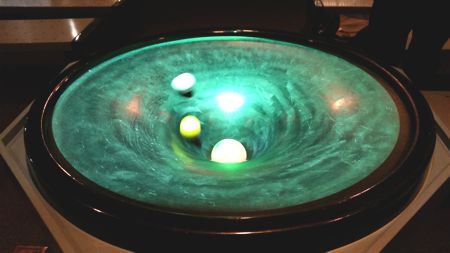
The simplest concept is geometrical. “Down” is the direction you move when gravity’s pulling on you.

for small height differences
A gravity well model for that concept would be just a straight line between you and the neighborhood’s most intense gravity source.
You learned the second concept in high school physics class. Any object has gravitational potential energy that measures the amount of energy it would give up on falling. Your teacher probably showed you the equation GPE = m·g·h, where m is the mass of the object, h is its height above ground level, and g is a constant you may have determined in a lab experiment.
If the width of the gravity well model at a given height represents GPE at that level, the model is a simple straight-sided cone.

for large height differences
The h indicates
an approximately linear range
where the HS equation could apply.
But of course it’s not that simple. Newton’s Law of Gravity says that the potential energy at any height r away from the planet’s center is proportional to 1/r.
Hmm… that looks different from the “proportional to h” equation. Which is right?
Both equations are valid, but over different distance scales. The HS teachers didn’t quite lie to you, but they didn’t give you the complete picture either. Your classroom was about 4000 miles (21,120,000 feet) from Earth’s center, whereas the usual experiments involve height differences of at most a dozen feet. Even the 20-foot drop from a second-story window is less than a millionth of the way down to Earth’s center.
Check my numbers:
| Height h | 1/(r+h) × 108 |
Difference in 1/(r+h) × 1014 |
|---|---|---|
| 0 | 4.734,848,484 | 0 |
| 20 | 4.734,844,001 | 4.48 |
| 40 | 4.734,839,517 | 8.97 |
| 60 | 4.734,835,033 | 13.45 |
| 80 | 4.734,830,549 | 17.93 |
| 100 | 4.734,826,066 | 22.42 |
 Sure enough, that’s a straight line (see the chart). Reminds me of how Newton’s Law of Gravity is valid except at very short distances. The HS Law of Gravity works fine for small spans but when the distances get big we have to use Newton’s equation.
We’re not done yet. That curvy funnel-shaped gravity well model could represent the force of gravity rather than its potential energy. Newton told us that the force goes as 1/r2 so it decreases much more rapidly than the potential energy does as you get further away. The gravity force well has a correspondingly sharper curve to it than the gravity energy well.

or an embedding diagram
The funnel model could also represent the total energy required to get a real spacecraft off the surface and up into space. Depending on which sci-fi gimmickry is in play, the energy may come from a chemical or ion rocket, an electromagnetic railgun, or even a tractor beam from some mothership way up there.
No matter the technology, the theoretical energy requirement to get to a given height is the same. In practice, however, each technology is optimal for some situations but forbiddingly inefficient in others. Thus, each technology’s funnel has its own shape and that shape will change depending on the setting.
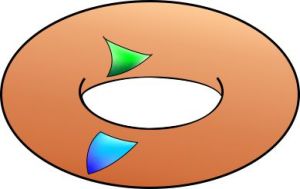
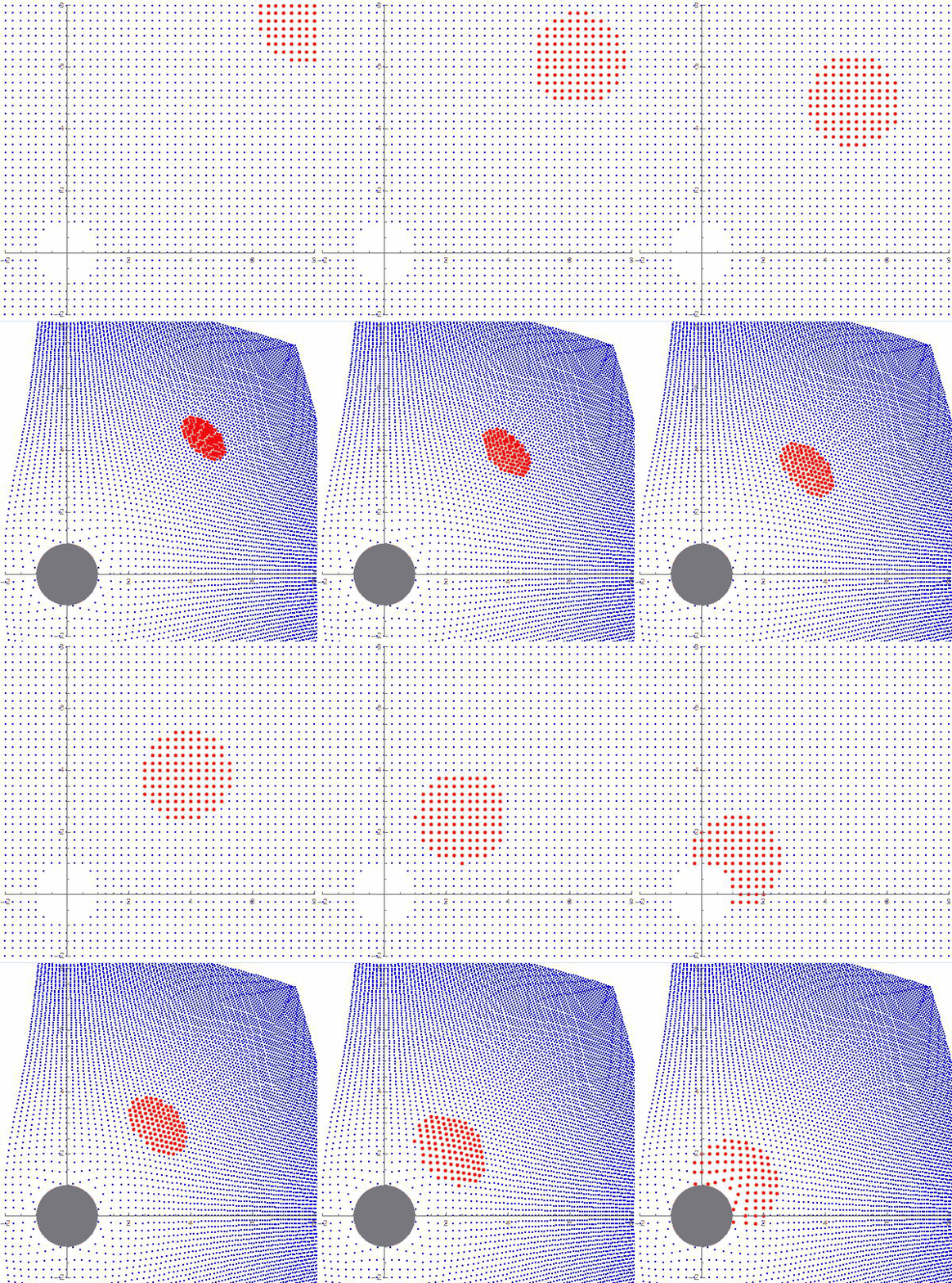
In modern physics, the funnel model could also represent Einstein’s theory of how a mass “bends” the space around it. (Take a look at this post, which is about how mass curves space by changing the local distance scale.) Cosmologists describe the resulting “shapes” with embedding diagrams that are essentially 2D pictures of 3D (or 4D) contour plots. The contours are closest together where space is most compressed, just as lines showing a steep hillside on a landscape contour map are close together.
The ED around a non-spinning object looks just like the force model picture above. No surprise — gravitational force is how we we perceive spatial curvature.
~~ Rich Olcott


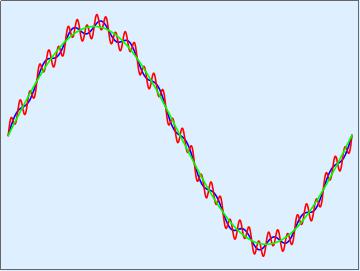

 In several of his Discworld books, author Terry Pratchett featured something called Library-space, L-space for short. It’s defined as “a dimension that connects every library and book depository in the universe. L-Space is portrayed as a natural outgrowth of the fact that knowledge = power = energy = matter = mass and mass warps space, and therefore, libraries in the Discworld universe are a very dangerous place indeed for the unprepared”.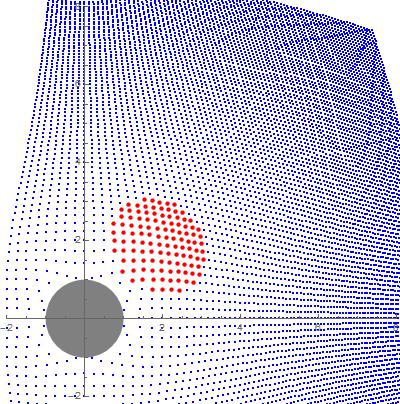


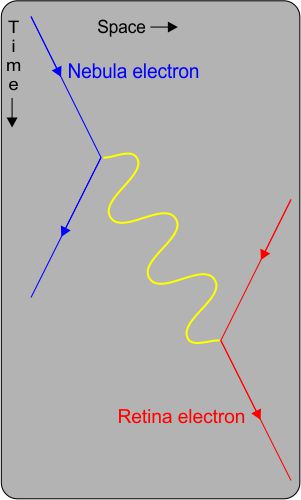 Here we have a Feynman diagram, named for the Nobel-winning (1965) physicist who invented it and much else. The diagram plots out the transaction we just discussed. Not a conventional x-y plot, it shows Space, Time and particles. To the left, that far-away electron emits a photon signified by the yellow wiggly line. The photon has momentum so the electron must recoil away from it.
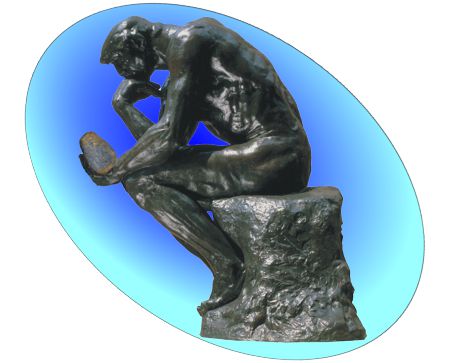 Gargh, proto-humanity’s foremost physicist 2.5 million years ago, opened a practical investigation into how motion works. “I throw rock, hit food beast, beast fall down yes. Beast stay down no. Need better rock.” For the next couple million years, we put quite a lot of effort into making better rocks and better ways to throw them. Less effort went into understanding throwing.
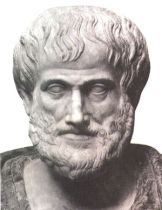 Aristotle wasn’t satisfied with anything so unsystematic. He was just full of theories, many of which got in each other’s way. One theory was that things want to go where they’re comfortable because of what they’re made of — stones, for instance, are made of earth so naturally they try to get back home and that’s why we see them fall downwards (no concrete linkage, so it’s still AAAD).


 It would have been awesome to watch Dragon Princes in battle (from a safe hiding place), but I’d almost rather have witnessed “The Tussles in Brussels,” the two most prominent confrontations between Albert Einstein and Niels Bohr.
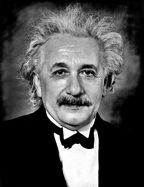 Like Newton, Einstein was a particle guy. He based his famous thought experiments on what his intuition told him about how particles would behave in a given situation. That intuition and that orientation led him to paradoxes such as entanglement, the
  Bohr was six years younger than Einstein. Both Bohr and Einstein had attained Directorship of an Institute at age 35, but Bohr’s has his name on it. He started out as a particle guy — his first splash was a trio of papers that treated the hydrogen atom like a one-planet solar system. But that model ran into serious difficulties for many-electron atoms so Bohr switched his allegiance from particles to Schrödinger’s wave theory. Solve a Schrödinger equation and you can calculate statistics like
  Here’s where Ludwig Wittgenstein may have come into the picture. Wittgenstein is famous for his telegraphically opaque writing style and for the fact that he spent much of his later life disagreeing with his earlier writings. His 1921 book, Tractatus Logico-Philosophicus (in German despite the Latin title) was a primary impetus to the Logical Positivist school of philosophy. I’m stripping out much detail here, but the book’s long-lasting impact on QM may have come from its Proposition 7: “Whereof one cannot speak, thereof one must be silent.“


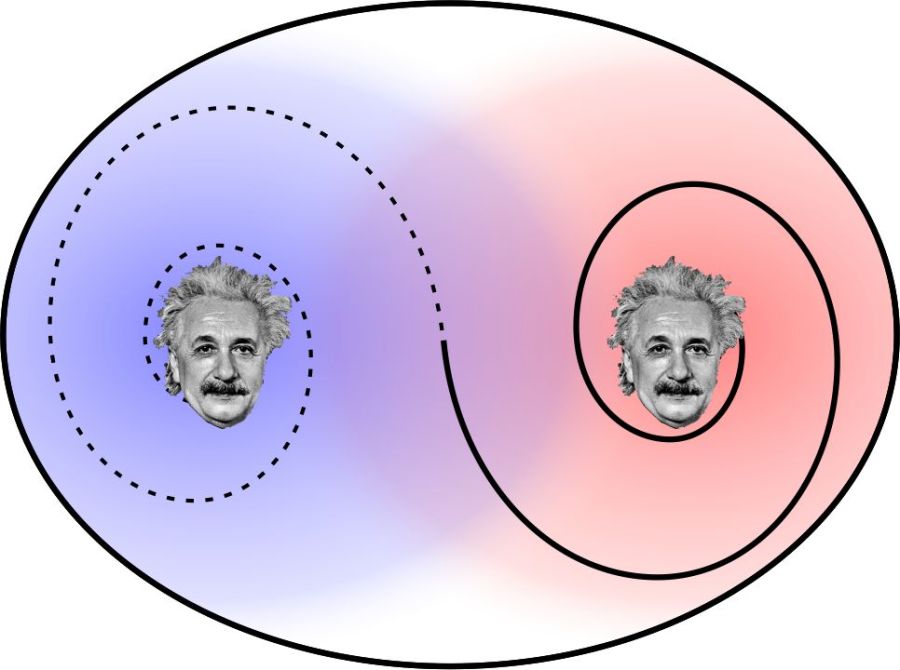
 Information transfer at infinite speed? Of course not, because neither hungry person knows what’s in either box until they open one or until they exchange information. Even Skype operates at light-speed (or slower).


