Buttered Cats — The QM perspective

You may have heard recently about the “buttered cat paradox,” a proposition that starts from two time-honored claims:

  • Cats always land on their feet.
  • Buttered toast always lands buttered side down.

“The paradox arises when one considers what would happen if one attached a piece of buttered toast (butter side up) to the back of a cat, then dropped the cat from a large height. …
“[There are those who suggest] that the experiment will produce an anti-gravity effect. They propose that as the cat falls towards the ground, it will slow down and start to rotate, eventually reaching a steady state of hovering a short distance from the ground while rotating at high speed as both the buttered side of the toast and the cat’s feet attempt to land on the ground.”

~~ en.wikipedia.org/wiki/Buttered_cat_paradox

After extensive research (I poked around with Google a little), I’ve concluded that no-one has addressed the situation properly from the quantum mechanical perspective. The cat+toast system in flight clearly meets the Schrödinger conditions — we cannot make an a priori prediction one way or the other so we must consider the system to be in a 50:50 mix of both positions (cat-up and cat-down).

In a physical experiment with a live cat it’s probable that cat+toast actually would be rotating. As is the case with unpolarized light, we must consider the system’s state to be a 50:50 mixture of clockwise and counter-clockwise rotation about its roll axis (defined as one running from the cat’s nose to the base of its tail). Poor kitty would be spinning in two opposing directions at the same time.

Online discussions of the problem have alluded to some of the above considerations. Some writers have even suggested that the combined action of the two opposing adages could generate infinite rotational acceleration and even anti-gravity effects. Those are clearly incorrect conclusions – the concurrent counter-rotations would automatically cancel out any externally observable effects. As to the anti-gravity proposal, not even Bustopher Jones is heavy enough to bend space like a black hole. Anyway, he has white spats.

However, the community appears to have completely missed the Heisenbergian implications of the configuration.

The Heisenberg Uncertainty Principle declares that it’s impossible to obtain simultaneous accurate values for two paired variables such as a particle’s position and momentum. The better the measurement of one variable, the less certain you can be of the other, and vice-versa. There’s an old joke about a cop who pulled a physicist to the side of the road and angrily asked her, “Do you have any idea how fast you were going?”  “I’m afraid not, officer, but I know exactly where I am.”

It’s less commonly known that energy and time are another such pair of variables – the stronger the explosion, the harder it is to determine precisely when it started.

Suppose now that our cat+toast system is falling slowly, perhaps in a low-gravity environment. The landing, when it finally occurs, will be gentle and extend over an arbitrarily long period of time. Accordingly, the cat will remain calm and may not even awake from its usual slumberous state.

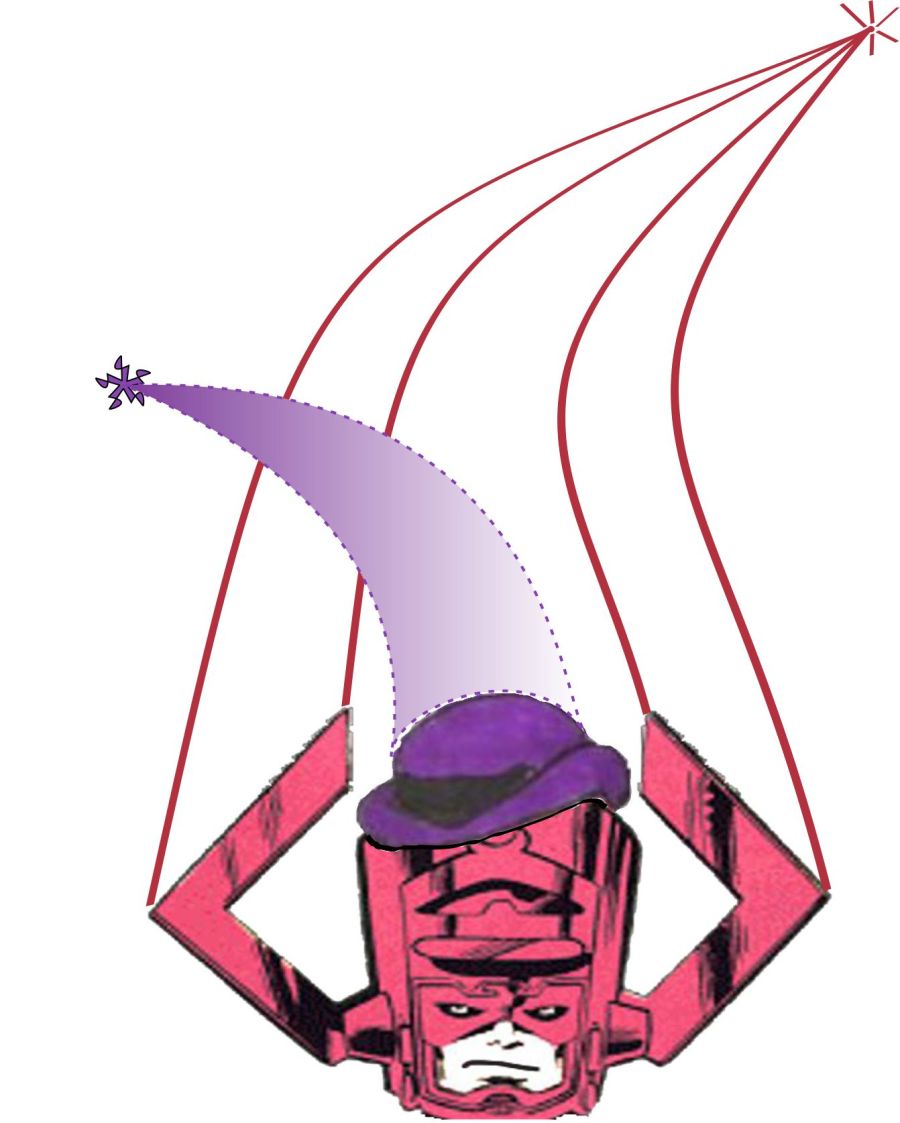
Tom and toastBy contrast, suppose that cat+toast falls rapidly. The resulting impact will occur over a very small duration. As we would expect from Heisenberg’s formulation, the cat will become really really angry and with strong probability will attack the researcher in a highly energetic manner.

From a theoretical standpoint therefore, we caution experimentalists to take proper precautions in preparing a laboratory system to test the paradox.

Next week – Getting more certain about Heisenberg

~~ Rich Olcott

Dimensional Venturing, Part 6 – Tiny Dimensions

“The Universe is much larger than is generally supposed.”  

What a great opening line, eh?  Decades later I still recall reading that in a technical paper about then-recent adjustments in the way astronomical distances were measured.

The authors didn’t know the half of it.  They were thinking in only three dimensions.  That’s so last-century.

If you read science articles in the popular press you’ve probably run into statements like this one from Brian Green’s article “Hanging by a String” in the January 2015 Smithsonian:

String theory’s equations require that the universe has extra dimensions beyond the three of everyday experience – left/right, back/forth and up/down…. [T]heorists realized that there might be two kinds of spatial dimensions: those that are large and extended, which we directly experience, and others that are tiny and tightly wound, too small for even our most refined equipment to reveal.

Tightly wound dimensions?  What’s that about?  And what’s it got to do with strings?

The “large extended” dimensions are the kind we discussed in Part 1 of this series.  The essential point is that (in principle) once you or a light ray start moving in a particular direction you can keep going in that direction forever.

Seems obvious, how else could it be?

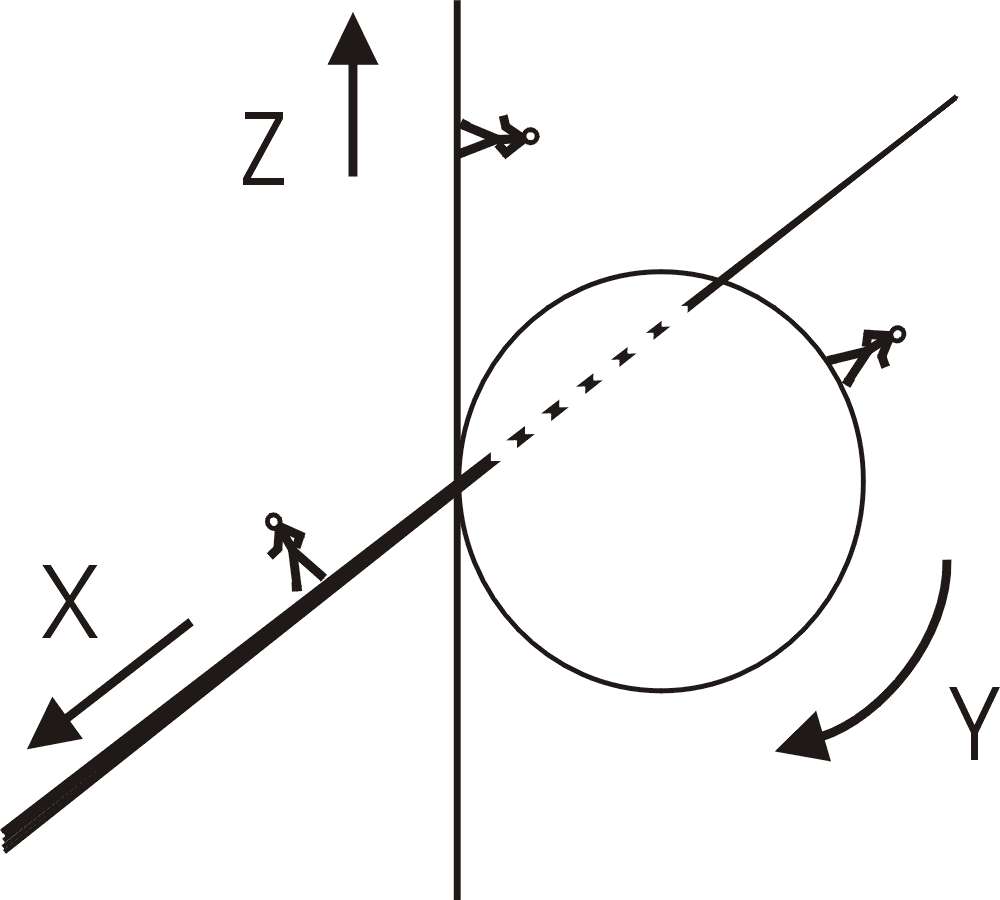
tiny dimension 1Well, suppose that we bend one of those three familiar “large” dimensions around in a circle, as in the drawing to the right. Our little guy could walk straight out of the page “forever” in the X direction. He could walk straight up the page “forever” in the Z direction. However, if he tries to walk along the Y track perpendicular to both of those two, in a while he’ll wind up right back where he started.

That’s an example of a “tightly wound” dimension.

Because it makes the math easier, physicists usually don’t calculate the absolute distance traveled around the circle.  Instead they write equations that depend on the angle from zero as the starting point. Notice that 360 degrees is exactly the same as zero — that’ll be important in a later post here.  Anyhow, there’s reason to believe that the effective circumference of a “tightly wound” dimension is really, really small.

OK, having a closed-off dimension is a little strange but it’s just not real-world, is it?

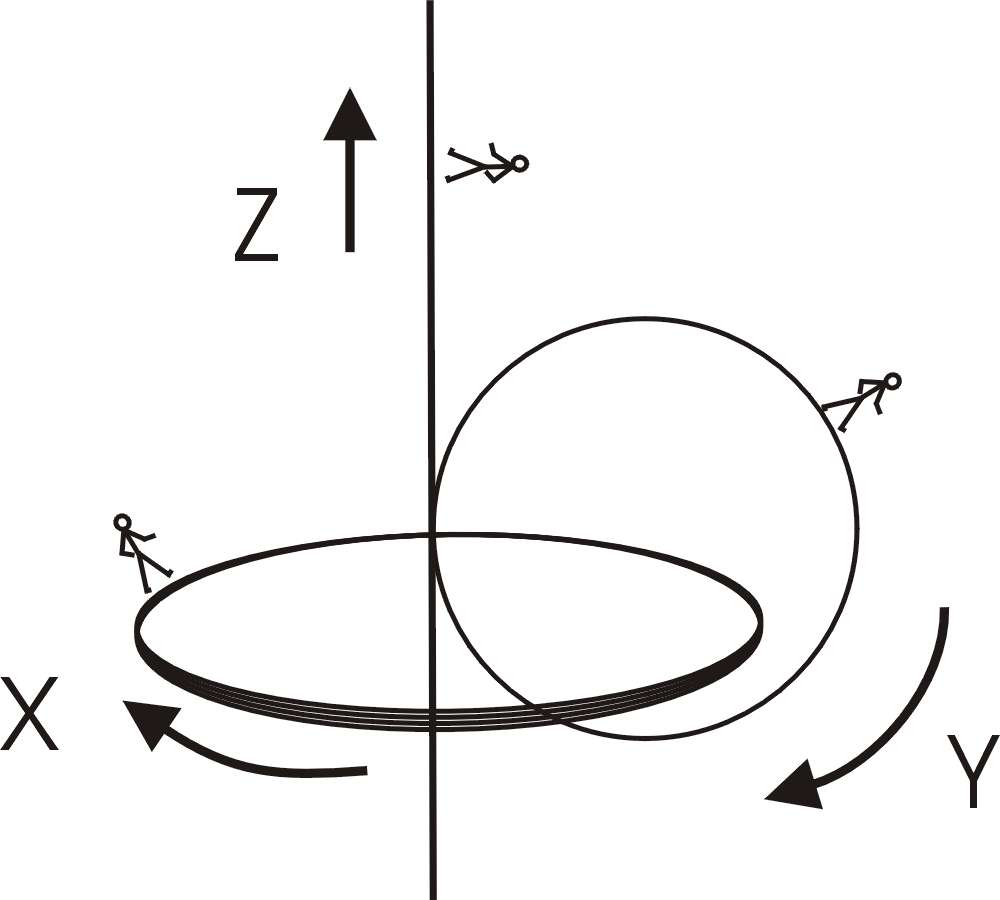
tiny dimension 2Actually, our real world is like that but moreso. Look at this drawing where we’ve got a pair of perpendicular wound-up dimensions. The little guy on the Y track can go from Denver down to Mazatlan in Mexico and proceed all the way around the world back up to Denver. On the X track he’s going from Denver westward to Chico CA and could continue across the Pacific and onward until he gets back to Denver The only way he can travel in one direction “forever” is to go along the Z track, straight upward, and that’s why NASA builds rocket ships.

Back to the strings. Depending on which variety of string theory you choose, the strings wriggle in a space of three Z-style “extended” dimensions, plus time, plus half-a-dozen or more wound-up or “compactified” (look it up) dimensions.  If string-theory strings can wriggle in all those directions, then how much room does each one have to move around in?  We’ve all learned the formulas for area of a rectangle and volume of a cube — [length times height] and [length times height times depth].  To extend the notion of “volume” to more dimensions you just keep multiplying.

Back to the size of the Universe. You may think that just with straight-line space it’s pretty good-sized.  With those stringy dimensions in play, for every single cube-shaped region you pick in straight-line space you need to multiply that volume by [half-a-dozen or more dimensions] times [many possible angles] to account for all the “space” in all the enhanced regions you could choose from when you include those wound-up dimensions. The total multi-dimensional volume is very, very huge.

The universe is indeed much larger than is generally supposed.

Next week — buttered cats.

~~ Rich Olcott
Dimensional Venturing Part 5 – You Ain’t From Around Here, Are You?

OK, I’ll admit it, back in the day I read a lot of comics.  Even then, though, I was skeptical — “Wait, how could Superman just pick up that building?  It’d fall apart!”

But I was intrigued by one recurring character, Mr Mxyzptlk, a pixie-like “visitor from the 5th dimension.”   His primary purpose in life (other than getting us to buy more comics) seemed to be to play tricks on or otherwise torment Our Hero.

Mxycus 2Mxy wasn’t the only comics character coming in “from another dimension.” It seemed like the entire Marvel team (both sides) was continually flickering out of and into our universe that way. How often did Jane Grey die and then somehow get cloned or refreshed?  (BTW, if the accompanying cartoon is a little obscure, show it to the friendly clerks at your local comics store — it may give them a chuckle.)

But my question was, where was that dimension Mxy came from?  I got an answer, sort of, when our geometry teacher explained that a dimension is just a direction you could travel.  Different dimensions are directions at right angles to each other.  She was right (see my first post in this series), at least in the context of then-HS math, but that explanation opened an editorial issue that’s never been properly settled.

A dimension is a direction, not a location.  You can’t be “from” a fifth or sixth or nth dimension any more than you can be from up.  If there is a spatial fifth dimension, we’re already “in” it in the same sense that we’re already somewhere along east-to-west and somewhen along past-to-future.

What’s going on is that for the purpose of the story, the authors want the character to come from somewhere very else.  We often associate a place with the direction to it — the sun rises in the east, Frodo departs to the west,  Heaven is up, Hell is down — but those are all directions relative to our current location.  We even associate future times as being in front of us and past times behind us (there’s that 4th dimension again).

Mash_sign_post
The M*A*S*H signpost, now at the Smithsonian. Photo by Steven Williamson., in commons.wikimedia.org/wiki/File:Mash_sign.jpg

But a place is more specific than a direction — to navigate to a certain there you need to know the direction and the distance (or another quantity that stands in for a distance).  That matters.  Jimmie Rodgers sang, “Twelve more miles to Tucumcari” as he kept track of the distance left to go along the road he was traveling.  Or away from the town, as it turned out.

Physicists have lots of uses for the combination of a direction and a magnitude, so many that they gave the combination a name — a vector.  The vector may represent a direction and a distance, a direction and the strength of a magnetic field, or a direction and any quantity that happens to be useful in the application at hand.  A wind map uses vectors of direction and wind speed to show air flow.  Here’s a very nice wind map of the US, and I love NOAA’s wind map of the world.  Vectors will be real useful when we start talking about black holes.

OK, so Mr Mxyzpltk (the spelling seemed to vary from issue to issue of the comic) comes from somewhere along a fifth dimension, but they never tell us from how far away.

Next week –As Steve Martin said, “Let’s get small, really small.”

~~ Rich Olcott
Dimensional Venturing Part 4 – To infini-D and beyond!

apple plumNow that you’ve read my previous posts and have the 4-D thing working well, you’re ready to go for a few more dimensions.  Consider the apple that struck Isaac Newton’s head.  The event occurred in 1665, in England at 52°55´N by 0°38´E, roughly three feet above ground level.  The apple, variety “Flower of Kent,” weighed about 8 ounces and was probably somewhat past fully ripened.  Got that picture in your head?  You’re doing great.

Now visualize the apple taking thirty seconds to move twenty feet diagonally upward, northward and eastward as it morphs to an underripe 4-ounce Damson plum.

The change you just imagined followed an eight-dimensional path: three dimensions of space, one of time, one of weight, one for degree of ripeness, and two category dimensions, species and variety.

Length in a given direction is only one kind of dimension, as Sir Isaac’s example demonstrates.  A mathematician would say that a dimension is a set of values that can be traversed independently of any other set of values. A dimension can be confined to a limited range (360 degrees in a circle) or be infinite like … well, “infinitely far away.”  A dimension might be continuous (think how loudness can vary smoothly from sleeping-baby hush to stadium ROAR and beyond) or be in discrete steps like the click-stops on a digital controller.  The physicists are arguing now whether, at the smallest of scales, space itself is continuous or discrete.

colors_post
Photo by Becky Ziemer

Color vision’s a good example of dimensions in action.  For most of us, our eyes have three types of cone cells, respectively optimized for red, green and blue light.  We see a specific color as some mixture of the three and that’s how the screen you’re looking at now can fake 16 million colors using just three kinds of color-emitting elements (phosphor dots in old-style TVs, LEDs in most devices these days).

Where did that 16 million number come from?  The signal-processing math is seriously techie, but at the bottom the technology uses 256 intensity levels of red, 256 levels of green and 256 levels of blue — each is a discrete dimension with a limited range.  Together they define a 256x256x256-point cube.  Any point in that cube represents a unique mix of primary colors.  One of the colors in the little girl’s hat, for instance, is at the intersection of 249/256 red, 71/256 green, and 48/256 blue.  The arithmetic tells us there are 16,777,216 points (possible mixed colors) in that cube.

Well, actually, there’s one more dimension to color vision because our eyes also have rod cells that simply sense light or darkness.  Neither brown nor grey are in the spectrum that cones care about.  A good printer uses four separate inks to produce browns and greys as mixtures of three dimensions of red-green-blue plus one of black.

So color is 3-dimensional, mostly.  But that’s just the start of color vision because most of us have millions of cone cells in each eye.  A mathematician would say that any scene you look at has that number of dimensions, because the intensity registered by one cone can vary in its range independently of all the other cones.

Ain’t it wonderful that you’re perfectly OK with living in a multi-million-dimensional world?

Next week – a word from the other side

~~ Rich Olcott
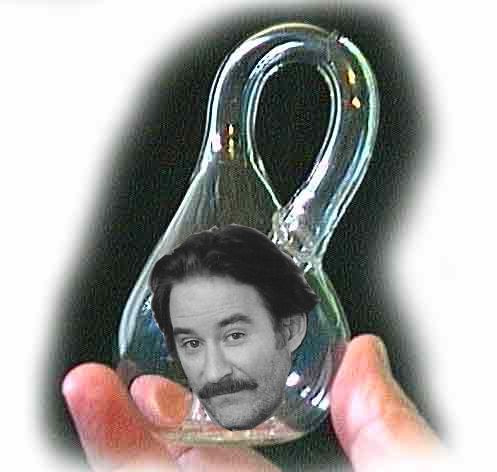
Dimensional venturing, Part 3 – Klein’s thingy

The Klein bottle is one of the most misunderstood objects in popular math.  Let’s start with the name.  When he initially described the object Herr Doktor Professor Felix Klein said it was a surface.  Being German and writing in German, he used the word Fläche (note the two little dots over the a).  When his paper was translated to English, the translator noticed the shape of the thing but didn’t notice those two little dots.  He misread the word as Flasche, meaning flask or bottle, and the latter word stuck.

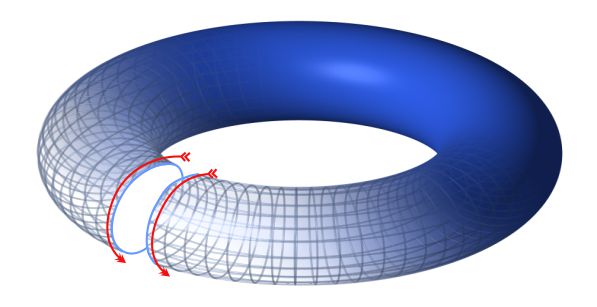
Cut Torus
Adapted from “Torus”. Licensed under Public Domain via Commons – https://commons.wikimedia.org/wiki/File:Torus.png

So who was Herr Klein and what was it that he wrote about?  One of the world’s foremost mathematicians in the last quarter of the 19 Century, he specialized in geometry, complex analysis and mathematical physics.  Among his other accomplishments was that as director of a research center at Georg-August-Universität Göttingen in 1895 he supervised Germany’s first Ph.D. thesis written by a woman (Grace Chisholm Young).

As a small part of one of his many papers he noted that a cylinder could be deformed in two different ways to connect its two ends. The first way is to simply bend it around in a circle to form a torus (or bicycle tire or doughnut, depending on how hungry you are.)

IssueThe other way is more of a challenge — bringing one end to meet the other from inside the cylinder.  The problem is that in the context of Klein’s work, he wasn’t “allowed” to pierce the cylinder’s surface to get it there.  Klein’s solution was simple  — swing it in through the fourth dimension.  Sounds like a cheat, doesn’t it?

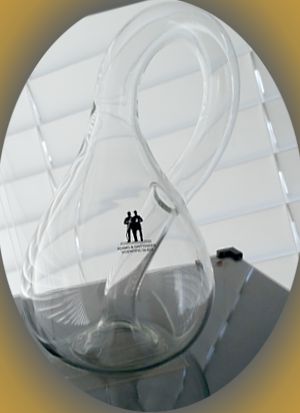
Actually, the cheat is in the way KKleinthat the Klein bottle is usually represented.  When the glass artisan created this example, he probably brought one tube up from the bottom, sealed it to the side wall, blew a hole in the side wall at that location, and then brought the outside tube around to join there.  That hole would not have satisfied Herr Klein.

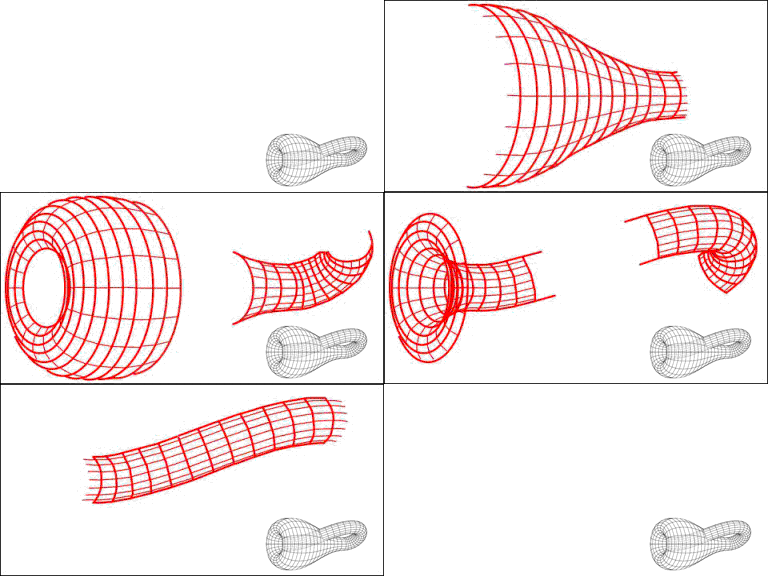
If you’ve looked at my previous post in this series you probably have a pretty good idea of how he would have preferred his Fläche to be depicted — as an animation which exploits time as the fourth dimension.  So here you have it.

Suppose the figure’s wall sprouts from a bud somewhere near the intersection point.  After the figure has grown for a while, the earliest section of the wall begins to recede, disappearing like the Cheshire Cat but leaving its ever-expanding smile behind.  By the time the growth front gets to where the bud was, there’s nothing there to intersect.

Reverse Klein If you opt to build the “bottle” in 4-space, there’s no problem getting those two ends of the cylinder to join up.  A shape that’s impossible to build in three dimensions is easy-peasy (with a little planning) in four.

Yeah, yeah, the Klein bottle has lots of interesting properties, like not having an inside, but we’ll defer talking about them for a while.

Next week, getting past that pesky four-dimension limitation.

~~ Rich Olcott

Dimensional venturing, Part 2 – Twirling in 4-space

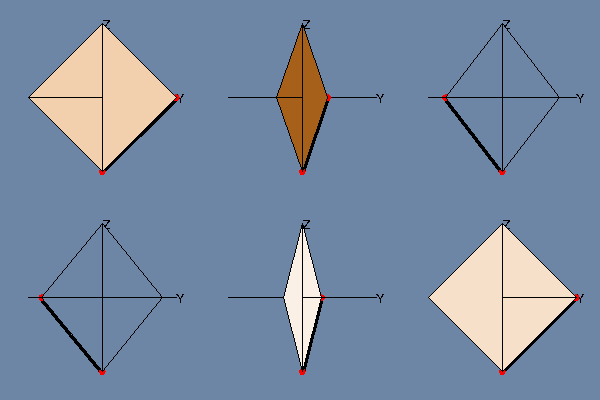
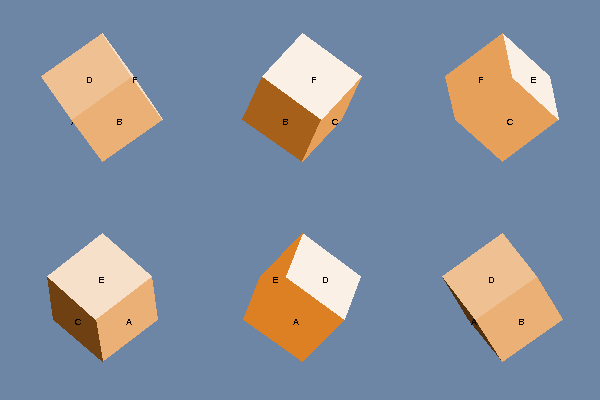
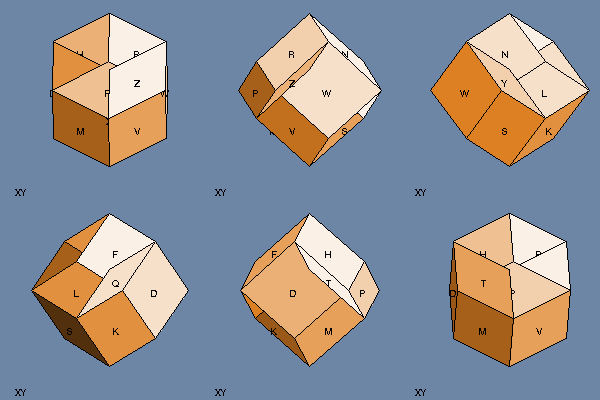
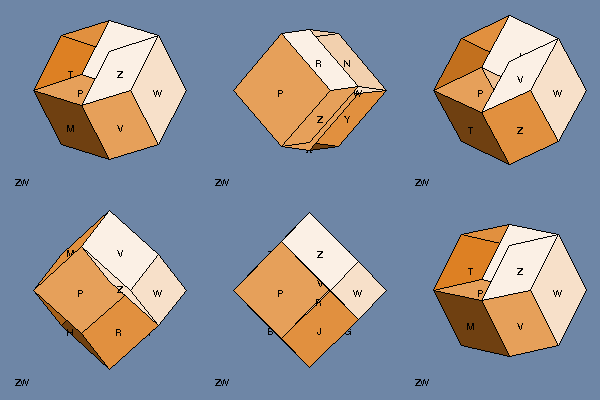
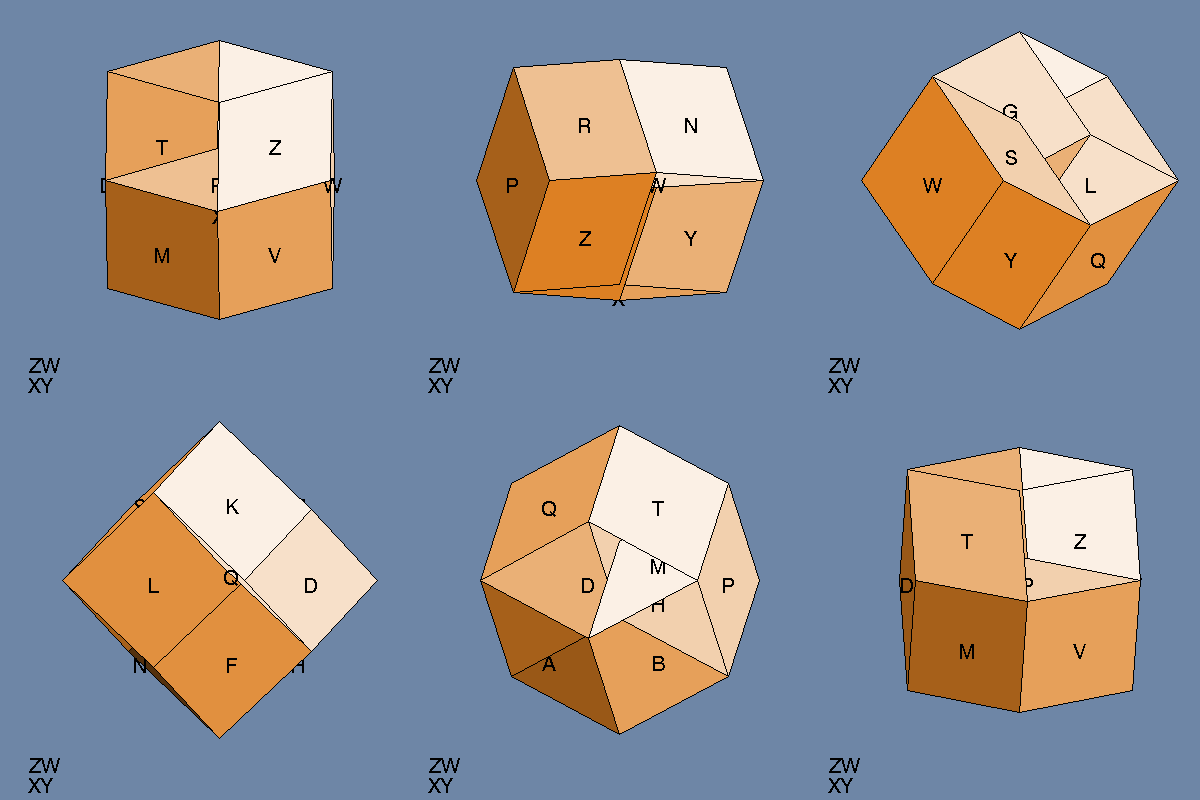
Last week we introduced the tesseract, which is to a cube what a cube is to a square — an extension into one more dimension.  That’s why it’s also called a hypercube.  The first tesseract diagrams I ever saw were so confusing — they looked like lots of overlapped squares tied together with lines that didn’t make much sense.  I wondered, “Wouldn’t it be easier to understand a tesseract if I could see it rotating?”

Years later computers and I had both moved ahead to where I could generate the pictures you see in this post.  What I learned while doing that was that 4-D figures have two equators.  In four dimensions, it’s possible for something to rotate in two perpendicular directions at the same time.  Read on and please don’t mind my doggerel — it doesn’t bite.

line2c The LINE is just a single stroke,
a path from here to there.
Stretch it out beside itself
and you will have a SQUARE.
Where’s its face when it turns around?
Gone, ’cause its back’s not there.
square2c
cube2c The CUBE’s a square
made thick, you see.
Length, breadth and depth
comprise a full 3-D.
Add yet a thickness more,
crosswise all to X, Y, Z.
A TESSERACT on a corner spins
but an XY-slice is all we see.
tess2cxy
tess2czw But the axis, too, can rotate through
a path that’s drawn invisibly.
Four faces grow and shrink in place —
it’s hard to do that physically.
This tesseract is tumbling ’bout
two equators perpendicular.
Were I in such a state, I vow,
I’d be giddy, even sickular.
tess4cxyzw

In the 4-D views, when one of the tesseract’s cubical faces appears to disappear into an adjacent face, what’s actually happening is that the face is sliding past the other face along that fourth dimension (which I called W because why not?)

You’re looking at a two-dimensional picture of the three-dimensional projection of a four-dimensional object as it moves in 5-space (X, Y, Z, W, and time — if it didn’t move in time then it couldn’t be spinning).

Next week — Herr Klein’s bottle, or rather flask, or rather surface.

~~ Rich Olcott

Dimensional venturing, Part 1 – What’s 4-D?

Whenever a science reporter uses the phrase “string theory,” it’s invariably accompanied by a sentence about tiny strings vibrating in 10 or 11 dimensions. Huh? How can you have more than three? And what does it really mean to say that that comix villain comes from the 4th dimension?  Actually, we live in many dimensions, though it’s not easy to visualize them all at once. Let’s get some practice.

Right now, you’re reading along a line, a one-dimensional path from left to right. Imagine a point drawing a straight line about a foot in front of you. Let that line just hang out there in the air, glowing a gentle green color, with one “edge” (the line itself) and two “corners” (its ends).

As you read down the page, you traverse a series of lines laid out next to each other in the two-dimensional plane of the page. Imagine your green line moving upward, leaving a plane of yellow sparkles behind it. Stop when you’ve got a sparkly yellow square in front of you showing its one face, four edges (one green, three yellow) and four corners (two green, two yellow). Let’s put some red paint on one of those yellow edges.Cube

Stack up enough printed pages and you’re got a 3-dimensional book. Imagine that nice yellow square moving away from you until you’ve got a friendly cube hanging out in the air. Our original line, the green edge, has produced a green face going into the distance. The red edge has built a pink face. All together, the cube has 8 corners, 12 edges and 6 faces. OK, now make your cube disappear.

But we’re not done yet. Time is a dimension. Consider that cube. Before you dreamed it up – nothing. Then suddenly a cube. Then nothing again. During the interval the cube was floating in front of you, the green line was tracing out a green face in time. The pink face was drawing a pink cube. The whole cube, from when it started to exist until it went away, traced out a four-dimensional figure called a tesseract, also called a 4-cube or hypercube. The tesseract was bounded by a cube at the beginning, six cubes while it existed (one from each face of the initial cube), and a cube at the end of its time, for a total of eight.

Just for grins, count up the faces, edges and corners for yourself.

But wait, there’s more. The tesseract doesn’t just sit there, it can spin. Being four-dimensional, it can spin in a surprising way. We’ll get to that next week.

~~ Rich Olcott

The Four-force Model, generalized

The particle physicist’s Standard Model recognizes four fundamental forces

  • the Strong nuclear force, which holds atomic nuclei together
  • the Weak nuclear force, which mediates some kinds of radioactivity
  • Electromagnetism, which holds molecules together
  • Gravity, which holds together planets and stars and galaxies and such

On Terry Pratchett’s Diskworld*, the Druids also recognize four fundamental forces but at a much higher level of emergent structure

  • Charm
  • Persuasiveness
  • Chaos/Uncertainty
  • Bloody-mindedness

I suggest that the seasons presents us with an excellent example of this Druidic principle

  • Springtime is clearly all Charm
  • Summertime uses Persuasion to bring forth crops and lull us to sleep
  • Fall is Chaos, with school terms starting and fallen leaves fluttering everywhere, especially into the gutters
  • Winter — ah, bloody-mindedness in action, both in its effects and in what it takes to get through them.

~~ Rich Olcott

* – The Light Fantastic, halfway down the right-hand page

Bilayer membranes - Earth-standard and reversed

The basis for life on Titan — maybe

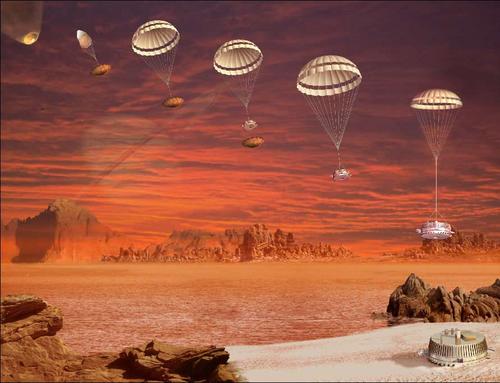
When the Huygens probe flashed us those images of lakes on Saturn’s moon Titan, people chattered that maybe there’s life in those hydrocarbon “waters.”

Huygens descending on Titan (image courtesy NASA/JPL-Caltech)

If there is life there, we might not even recognize it as such. Not just because of the frigid temperatures and other reasons laid out in en.wikipedia.org/wiki/Life_on_Titan, but for a couple of reasons having to do with the physical chemistry of solvents.

Water is a polar solvent, good at dissolving salts and other substances in which centers of positive and negative charge are in different parts of the molecule. Conversely, water molecules interact so strongly with each other that interspersed hydrocarbons and other non-polar molecules are forced away and out of solution. Hence the existence of oil slicks … and cell membranes.

Every kind of life on Earth, or at least everything that a biologist would be willing to call life, is composed of units whose integrity depends upon hydrocarbon moieties (molecules that contain significant amounts of hydrocarbon structure) being forced together in escape from a polar environment.

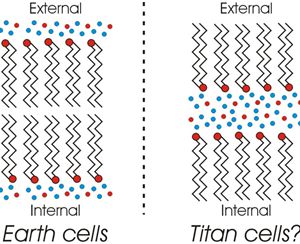
For bacteria and multi-cellular life forms, the boundary between interior and exterior is the cell membrane (see diagram), two layers of two-tailed molecules laid tail-to-tail with their non polar (black) hydrocarbon chains sandwiched between negative (red) polar groups that face out of and into the polar (red and blue) cell. Bilayer membranes - Earth-standard and reversedFurthermore, our cellular life also depends upon a whole collection of two-layer membranes that isolate different metabolic functions within the cell — respiration over here, protein construction over there, and so forth.

By some definitions we have smaller kinds of life, too: viruses and phages. Many viruses (e.g., herpes) have a non-polar fatty coating. Others make do with proteins to hide their DNA.  However, biochemistry tells us that these structural proteins are almost certainly held together in large part by patches of non-polar regions with precisely matching shapes.

However, Titan’s surface is dominated by a hydrocarbon solvent, a liquid mix of methane and ethane, that behaves very differently from water. Critically, hydrocarbon solvents do not dissolve water and other polar materials. The amino acids from which we build our proteins, the nucleic acids from which we build our RNA and DNA, even the carbohydrate groups from which plants build sugars and cellulose — all are essentially insoluble in hydrocarbons.

If lightning or some other process were to generate some nucleic acids in a Titan lake (as in the Miller-Urey experiment, see en.wikipedia.org/wiki/Miller_experiment), those molecules would immediately aggregate and fall as a sludgy solid onto the lake floor. There’d be no opportunity for those small molecules to interact with each other, much less find some amino acids to tie together to produce a protein. Life as we know it could not begin.

Well, how about a non-polar kind of life? The properties of hydrocarbon solvents permit two possibilities, both of which are very strange from an Earth-life perspective.

The easier one to visualize turns that double-layered cell membrane inside out. A Titanic cell membrane could be a sandwich with a layer of polar stuff between two non-polar layers. Given that structure, the cell’s internal non-polar metabolic processes could operate in isolation from the non-polar outside, just as our cell membranes isolate our watery internal cellular metabolism from our watery outside. A reversed cell membrane on a Titanic cell would wrap around some very interesting biochemistry.

But things could be even stranger. All hydrocarbons can intermix in all proportions with all hydrocarbons. That’s why petroleum crude is such a complex mix, and why different crudes break out differently at the refinery.  Any non-polar molecule can slide in between any other hydrocarbon molecules with very little effort.  On Titan, then, non-polar materials can diffuse freely throughout those ethane seas.

Moreover, liquid hydrocarbons have very low surface tension compared to water.  At the surface of a pool or droplet of water, those H2O molecules cling to each other so tightly that another object must exert force to get between them and into the bulk liquid.  The threshold force, measured by the surface tension, is so high for water that pond skaters and similar bugs can live their lives on a pond rather than in it.  In contrast, surface tension for a liquid hydrocarbon is only one-third that of water.

What’s important here is that surface tension is the force that works to minimize the surface to-volume ratio of a blob of liquid.  The form with the smallest possible ratio is a sphere.  Sure enough, small droplets of water are spherical.  Hydrocarbon fluids, with their much lower surface tension, tend to accept looser forms.  Water on a tarry surface beads up; oil on a wet surface spreads out.  Scientists think that water’s powerful sphere forming propensity was crucial in creating proto-cells during Earth-life’s early stages.

Suppose that Titan’s hydrocarbon life doesn’t depend on nearly-spherical cells.  Maybe Titan life has no cell boundary as we know it. Titan’s “biology” could be one titanic (in both senses) “cell” with different metabolic processes isolated by geography rather than by membranes the way Earth life does it.

Maybe the lakes closest to Titan’s equator generate long-chain hydrocarbons.  Maybe another set of lakes links those molecules to form complex benzenes and graphenes that catalyze reactions in still other lakes.

Maybe Titan’s rivers and streams carry information the way our nerve cells do.

Maybe Titan thinks.

I wonder what Titan thought of the Huygens probe.

~~ Rich Olcott