
A Shot Through The Dark

<THUNK!!> “Oh, dear. Is this the same elevator that you and Vinnie got trapped in, Sy?”

“Afraid so, Cathleen, but at least we had lights. This looks like a power outage, not a stuck door mechanism. Calling the building super probably won’t help. Hope you’re okay being stuck in the dark.”

“I’m an astronomer, Sy. A dark night’s my best thing. Remember the time we got locked with no light in my Mom’s closet?”

<chuckle> “Mm-hm. It was our pretend spaceship to Mars. We had no idea that closet had a catch we couldn’t reach. We were stuck there until your Mom came home. <sigh> We’ll have to wait ’til power comes back.”

<FZzzzzttPOP!!> … <then a voice like molten silver> “Oh, there you are, Sy! I’ve been looking all over for you. Who’s this?”

“Been a while, Anne. This is Cathleen. Cathleen, meet Anne. Anne’s an … explorer.”

“Ooo, where do you explore? For that matter, how did you get in here, and why is your dress (is it satin?) glowing like that?”

“Yes, it is satin, at the moment. It figures out whatever I need and makes that happen. It’s glowing because we’re in the dark.”

“I suspect your dress saved you when you met anti‑Anne.”

“Auntie Anne?”

“No, Cathleen, anti‑Anne, another me in the anti‑Universe. You might be right, Sy. It would have held anti‑Earth’s anti‑atoms away long enough for me to escape annihilation. Maybe I should explain.”

“I wish you would.”

“Wellll, I’ve got this super‑power for jumping across spacetime. Sy helped me calibrate my jumps and we even worked out how I can change size and use entropy to navigate between probabilities. So I explore everywhere and everywhen and that’s how I got into this elevator.” <brief fizzing sound> “Don’t worry, power will be back on soon but we’ve got time for Sy to explain my most recent experience.”

“Ah‑boy, now what?”

“Well, it seemed like a fun thing to do — go back to the earliest time I could, maybe even watch the Big Bang. I did some reading so I had an idea of what to expect as I dove down the time axis — gas clouds collapsing with glittering bursts of star formation, stars collecting into galaxies, galaxies streaming by like granular gas — so beautiful, especially because I can tweak my time rate and watch it all in motion!”

“And did you see all that?”

“Oh, yes, but then I hit a wall I couldn’t get past and I don’t understand why.”

“What were things like just before you hit the wall?”

“This was just beyond when I saw the very first stars turning on. There were vague clouds glowing here and there but basically the Universe became pitch black, no light at all for a while until the background started to glow with a very deep red just before I was blocked.”

“Ah. Cathleen, this is more your bailiwick than mine. Anne, Cathleen teaches Astronomy and Cosmology.”

“Just as a check, Anne, do you know exactly how far into the past you got?”

“Sorry, no. My time sense is pretty well calibrated for hours‑to‑centuries but this was billions of years. You probably know when I was better than I do.”

“On the evidence, I’d say you got 99.98% of the way back to your goal, nearly to the beginning of the Dark Age.”

“Dark Age? I’ve been there — 10th‑century Earth, bad times for everyone unless you were at the top of the heap but you wouldn’t stay there long. But I was too far out in space to see Earth. I couldn’t even pick out the Milky Way.”

“No, this was the Universe’s Dark Age, a couple hundred million years between when atoms formed and stars formed. Nothing could make new light. The Dark Age started at Big Bang plus 370 000 years when temperature cooled to 4000 K. The dark red you saw everywhere was atoms emitting blackbody radiation at 4000 K. Just 0.01% further into the past, the Universe was a billion‑degree quark plasma where not even atoms could survive. No wonder your dress wouldn’t let you enter.”

<THUNK!!> “Oh, good, power’s back on. We have light again!”

~ Rich Olcott
A Matter of Degree

“Wait, Sy, you said something about my matryoshkacascade multiverse, that the speed of light might not match between mama and baby Universes. How can that be?”

“Deep question, Susan. The answer is that we don’t know. Maybe gravitational stress at a supermassive black hole’s singularity is intense enough to birth a new Universe inside the Event Horizon, or maybe not. Suppose it does. We don’t have theories strong enough to determine whether the speed of light inside there would or would not match the one we have out here.”

“Talk about pregnant questions.” <sips latte> “Ah! Here’s another thing. Both my matryoshki and your bubbly multiverse are about spreading Universes across space. Neither one addresses the timeline splits we started talking about. Maybe I decide on noodles for lunch and another me in a different Universe opts for a sandwich, but how about one me that splits to follow parallel paths right here? Could a multiverse work that way?”

“Another deep question. Timeline splits require a fivedimensional spacetime. Want to talk about that?”

“Just a moment. Oh, Al, can I have another mocha latte, please, and add a dash of peppermint to it.”

“That’s a change from your usual recipe, Susan.”

“Yes,” <side glance my way> “I’m splitting my timeline. Thanks, Al. Ok, Sy, let’s go for it.”

“It’s about degrees of freedom.”

“I like freedom, but I didn’t know it comes in degrees.”

“In certain contexts that’s a matter of geography, law and opinion. I’m talking Physics here. For physicists each degree of freedom in a system is a relevant variable that’s independent of other specifications. Location parameters are a prime example. On a Star Trek vessel, how does the Captain specify a heading?”

“When they know where they’re going she’ll say ‘Set coordinates for‘ wherever, but for a course change she’ll say ‘some‑number MARK some‑number‘. Ah, got it — that’s like latitude and longitude, two arcs along perpendicular circles. Two angles and a distance to the target make three degrees of freedom, right?”

“A‑k‑a three dimensions of space. How about time?”

“All you can do is go forward, no freedom.”

“Not quite. Conceptually at least, you can go forward and back. Timewise we’re moving along a line. That’s a one‑dimensional thing. Combine time and space as Minkowski recommended and you’ve got a four‑dimensional spacetime. Relativity may serve us time at different rates but we’re still trapped on that line.”

“Ah, now I see why you said five dimensions. High school geometry — you’d need a second time dimension to angle away from the one we’re on. Ooo, if it’s an angle we could do time‑trigonometry, like the sine would measure how different two timelines get divided by how long it took to get there.”

“Cute idea, Susan, but defining time fractures in terms of time would be a challenge. I think a better metric would be probability, like what are the odds that things would be this different?”

A rustle of satin behind me and a familiar voice like molten silver. “Hello, Sy, I read your posts about multiverses so I thought I’d drop by. You’re Susan? Hi, my name’s Anne.”

“Um … hello.” Anne is kind of breath‑taking.

“Hi, Anne. It’s been a while. Funny you should show up just as we’re getting to the idea of a probability dimension.”

“Mm-hm, how ’bout that? Sorry, Susan, but time‑trig won’t work. I’ve got a better idea for you. Sy’s physicists are so used to thinking thermodynamically. Entropy’s based on probability, isn’t it, Sy? The split‑off dimension should be marked off in units of information entropy.” <giggle> “You haven’t told Susan your twenty‑dimension idea yet, have you?”

“Anne, you’ve always been too fast for me. Susan, the Physics we have so far still has about twenty fundamental constants — numbers like the speed of light — whose values we can’t explain in our best models of how things work. Think of each as a coordinate in a twenty‑plus‑four-dimensional hyper‑Universe. The Anthropic Principle says we and my entire bubble Universe happen to be at the twenty‑way intersection where those coordinates are just right for life to exist. Each of your matryoshki Universes may or may not be there. “

“Lucky, aren’t we?”

~~ Rich Olcott

The Gelato Model

“Eddie, this ginger gelato’s delicious — not too sweet and just the right amount of ginger bite.”

“Glad you like it, Anne.”

On the way down here, Sy was telling me about how so many things in the Universe run on the same mathematics if you look at them with the right coordinate system. Sy, how do you pick ‘the right coordinate system?”

“The same way you pick the right property to serve as a momentum in Newton’s Equation of Motion — physical intuition. You look for things that fit the system. Sometimes that puts you on the road to understanding, sometimes not. Eddie, you keep track of your gelato sales by flavor. How are they doing?”

“Pistachio’s always a good seller, Sy, but ginger has been coming on strong this year.”

“In motion terns, pistachio’s momentum is constant but ginger is gaining momentum, right?”

“S’what I said.”

“Measured in dollars or trayfuls?”

“In batches. I make it all in-house. I’m proud of that. Dollars, too, of course, but that’s just total for all flavors.”

“Batches all the same size?”

“Some are, some not, depending. If I had a bigger machine I could make more but I do what I can.”

“There you go, Anne, each gelato flavor is like a separate degree of freedom. Eddie’s tracked sales since he started so we can take that date as the origin. Measuring change along any degree in either batches or dollars we have perfectly respectable coordinates although the money view of the system is fuzzier. Velocity is batches per unit time, there’s even a speed limit, and ginger has accelerated. Sound familiar?”

“Sounds like you’re setting up a Physics model.”

“Call it gelato trend physics, but I don’t think I can push the analogy much further. The next step would be to define a useful momentum like Newton did with his Law of Motion.”

F=ma? That’s about acceleration, isn’t it?”

“Probably not in Newton’s mind. Back in his day they were arguing about which was conserved, energy or momentum. It was a sloppy argument because no‑one agreed on crisp definitions. People could use words like ‘quantity of motion‘ to refer to energy or momentum or even something else. Finally Newton defined momentum as ‘mass times velocity‘, but first he had to define ‘mass‘ as ‘quantity of matter‘ to distinguish it from weight which he showed is a force that’s indirectly related to mass.”

“So is it energy or momentum that’s conserved?”

“Both, once you’ve got good definitions of them. But my point is, our car culture has trained us to emphasize acceleration. Newton’s thinking centered on momentum and its changes. In modern terms he defined force as momentum change per unit time. I’m trying to think of a force‑momentum pair for Eddie’s gelato. That’s a problem because I can’t identify an analog for inertia.”

“Inertia? What’s that got to do with my gelato?”

“Not much, and that’s the problem. Inertia is resistance to force. Who can resist gelato? If it weren’t for inertia, the smallest touch would be enough to send an object at high speed off to forever. The Universe would be filled with dust because stars and planets would never get the chance to form. But here we are, which I consider a good thing. Where does inertia come from? Newton changed his mind a couple of times. To this day we only have maybe‑answers to that question.”

“You know we want to know, Sy.”

“Einstein’s favorite guess was Mach’s Principle. There’s about a dozen different versions of the basic idea but they boil down to matter interacting with the combined gravitational and electromagnetic fields generated by the entire rest of the Universe.”

“Wow. Wait, the stars are far away and the galaxies are much, much further away. Their fields would be so faint, how can they have any effect at all?”

“You’re right, Anne, field intensity per star does drop with distance squared. But the number of stars goes up with distance cubed. The two trends multiply together so the force trends grow linearly. It’s a big Universe and size matters.”

“So what about my gelato?”

“We’ll need more research, Eddie. Another scoop of ginger, Anne?”

~~ Rich Olcott

Symmetrical Eavesdropping

“Wait, Sy, you’ve made this explanation way more complicated than it has to be. All I asked about was the horrible whirling I’d gotten myself into. The three angular coordinates part would have done for that, but you dragged in degrees of freedom and deep symmetry and even dropped in that bit about ‘if measurable motion is defined.’ Why bother with all that and how can you have unmeasurable motion?”

“Curiosity caught the cat, didn’t it? Let’s head down to Eddie’s and I’ll treat you to a gelato. Your usual scoop of mint, of course, but I recommend combining it with a scoop of ginger to ease your queasy.”

“You’re a hard man to turn down, Sy. Lead on.”

<walking the hall to the elevators> “Have you ever baked a cake, Anne?”

“Hasn’t everyone? My specialty is Crazy Cake — flour, sugar, oil, vinegar, baking soda and a few other things but no eggs.”

“Sounds interesting. Well, consider the path from fixings to cake. You’ve collected the ingredients. Is it a cake yet?”

“Of course not.”

“Ok, you’ve stirred everything together and poured the batter into the pan. Is it a cake yet?”

“Actually, you sift the dry ingredients into the pan, then add the others separately, but I get your point. No, it’s not cake and it won’t be until it’s baked and I’ve topped it with my secret frosting. Some day, Sy, I’ll bake you one.”

<riding the elevator down to 2> “You’re a hard woman to turn down, Anne. I look forward to it. Anyhow, you see the essential difference between flour’s journey to cakehood and our elevator ride down to Eddie’s.”

“Mmm… OK, it’s the discrete versus continuous thing, isn’t it?”

“You’ve got it. Measuring progress along a discrete degree of freedom can be an iffy proposition.”

“How about just going with the recipe’s step number?”

“I’ll bet you use a spoon instead of a cup to get the right amount of baking soda. Is that a separate step from cup‑measuring the other dry ingredients? Sifting one batch or two? Those’d change the step‑number metric and the step-by-step equivalent of momentum. It’s not a trivial question, because Emmy Noether’s symmetry theorem applies only to continuous coordinates.”

“We’re back to her again? I thought—”

The elevator doors open at the second floor. We walk across to Eddie’s, where the tail‑end of the lunch crowd is dawdling over their pizzas. “Hiya folks. You’re a little late, I already shut my oven down.”

“Hi, Eddie, we’re just here for gelato. What’s your pleasure, Anne?”

“On Sy’s recommendation, Eddie, I’ll try a scoop of ginger along with my scoop of mint. Sy, about that symmetry theorem—”

“The same for me, Eddie.”

“Comin’ up. Just find a table, I’ll bring ’em over.”

We do that and he does that. “Here you go, folks, two gelati both the same, all symmetrical.”

“Eddie, you’ve been eavesdropping again!”

“Who, me? Never! Unless it’s somethin’ interesting. So symmetry ain’t just pretty like snowflakes? It’s got theorems?”

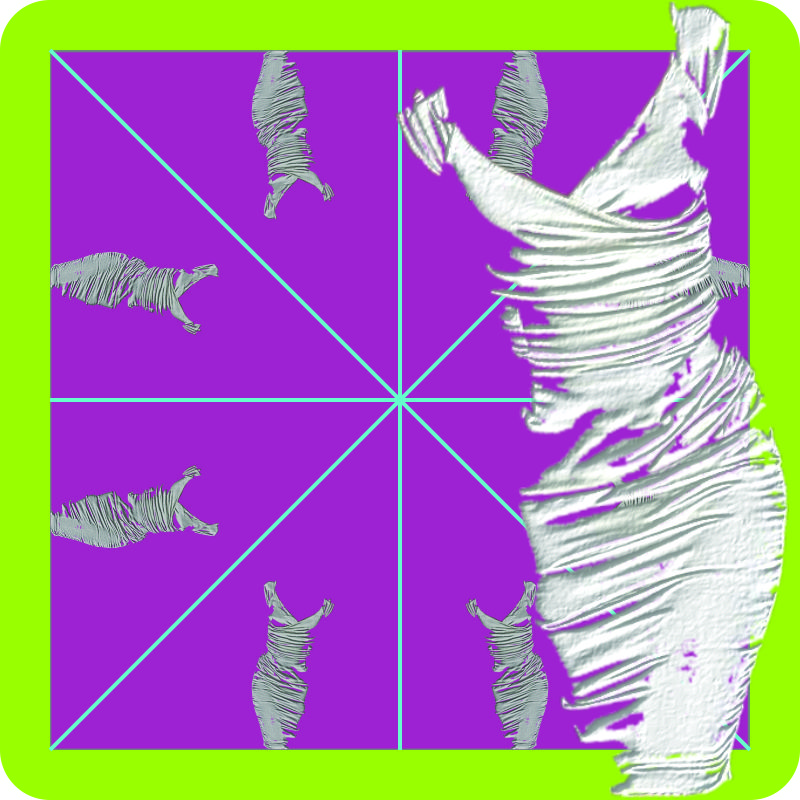
“Absolutely, Eddie. In many ways symmetry appears to be fundamental to how the Universe works. Or we think so, anyway. Here, Anne, have an extra bite of my ginger gelato. For one thing, Eddie, symmetry makes calculations a lot easier. If you know a particular system has the symmetry of a square, for instance, then you can get away with calculating only an eighth of it.”

“You mean a quarter, right, you turn a square four ways.”

“No, eight. It’s done with mirrors. Sy showed me.”

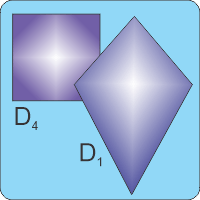
“I’m sure he did, Anne. But Sy, what if it’s not a perfect square? How about if one corner’s pulled out to a kite shape?”

“That’s called a broken symmetry, no surprise. Physicists and engineers handle systems like that with a toolkit of approximations that the mathematicians don’t like. Basically, the idea is to start with some nice neat symmetrical solution then add adjustments, called perturbations, to tweak the solution to something closer to reality. If the kite shape’s not too far away from squareness the adjusted solution can give you some insight onto how the actual thing works.”

“How about if it’s too far?”

“You go looking for a kite‑shaped solution.”

~~ Rich Olcott

Deep Symmetry

“Sy, I can understand mathematicians getting seriously into symmetry. They love patterns and I suppose they’ve even found patterns in the patterns.”

“They have, Anne. There’s a whole field called ‘Group Theory‘ devoted to classifying symmetries and then classifying the classifications. The split between discrete and continuous varieties is just the first step.”

“You say ‘symmetry‘ like it’s a thing rather than a quality.”

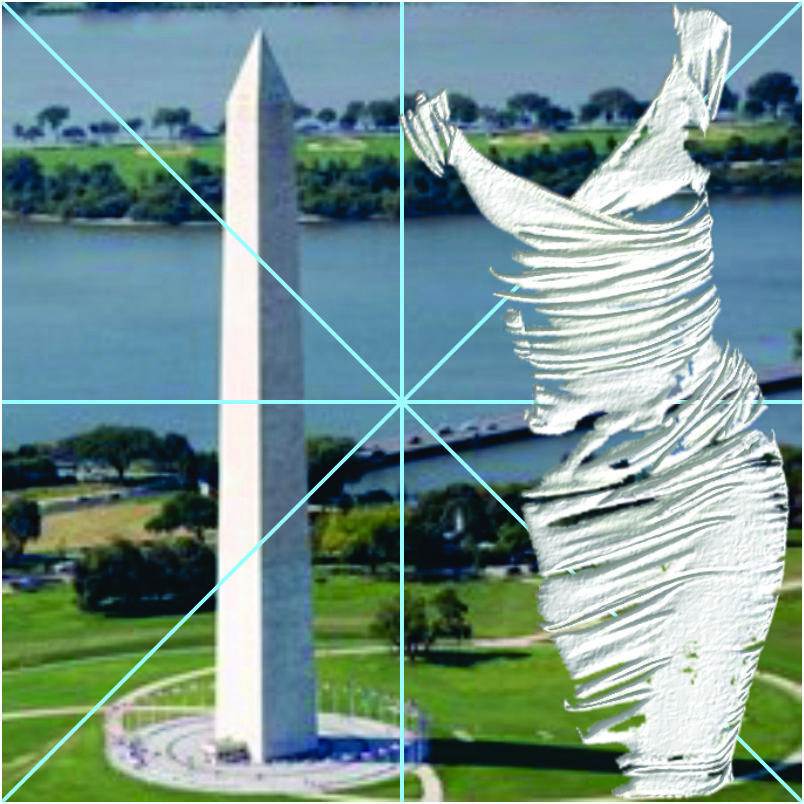
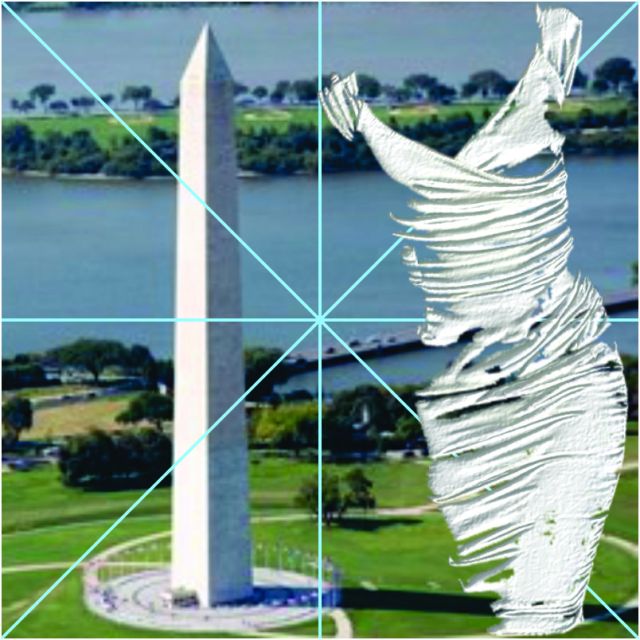
“Nice observation. In this context, it is. Something may be symmetrical, that’s a quality. Or it may be subject to a symmetry operation, say a reflection across its midline. Or it may be subject to a whole collection of operations that match the operations of some other object, say a square. In that case we say our object has the symmetry of a square. It turns out that there’s a limited number of discrete symmetries, few enough that they’ve been given names. Squares, for instance, have D4 symmetry. So do four-leaf clovers and the Washington Monument.”

“OK, the ‘4’ must be in there because you can turn it four times and each time it looks the same. What’s the ‘D‘ about?”

Dihedral, two‑sided, like two appearances on either side of a reflection. That’s opposed to ‘C‘ which comes from ‘Cyclic’ like 1‑2‑3‑4‑1‑2‑3‑4. My lawn sprinkler has C4 symmetry, no mirrors, but add one mirror and bang! you’ve got eight mirrors and D4 symmetry.”

“Eight, not just four?”

“Eight. Two mirrors at 90° generate another one 45° between them. That’s the thing with symmetry operations, they combine and multiply. That’s also why there’s a limited number of symmetries. You think you’ve got a new one but when you work out all the relationships it turns out to be an old one looked at from a different angle. Cubes, for instance — who knew they have a three‑fold rotation axis along each body diagonal, but they do.”

“I guess symmetry can make physics calculations simpler because you only have to do one symmetric piece and then spread the results around. But other than that, why do the physicists care?”

“Actually they don’t care much about most of the discrete symmetries but they care a whole lot about the continuous kind. A century ago, a young German mathematician named Emmy Noether proved that within certain restrictions, every continuous symmetry comes along with a conserved quantity. That proof suddenly tied together a bunch of Physics specialties that had grown up separately — cosmology, relativity, thermodynamics, electromagnetism, optics, classical Newtonian mechanics, fluid mechanics, nuclear physics, even string theory—”

“Very large to very small, I get that, but how can one theory have that range? And what’s a conserved quantity?”

“It’s theorem, not theory, and it capped two centuries of theoretical development. Conserved quantities are properties that don’t change while a system evolves from one state to another. Newton’s First Law of Motion was about linear momentum as a conserved quantity. His Second Law, F=ma, connected force with momentum change, letting us understand how a straight‑line system evolves with time. F=ma was our first Equation of Motion. It was a short step from there to rotational motion where we found a second conserved quantity, angular momentum, and an Equation of Motion that had exactly the same form as Newton’s first one, once you converted from linear to angular coordinates.”

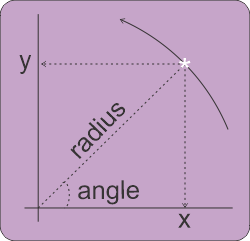
“Converting from x-y to radius-angle, I take it.”

“Exactly, Anne, with torque serving as F. That generalization was the first of many as physicists learned how to choose the right generalized coordinates for a given system and an appropriate property to serve as the momentum. The amazing thing was that so many phenomena follow very similar Equations of Motion — at a fundamental level, photons and galaxies obey the same mathematics. Different details but the same form, like a snowflake rotated by 60 degrees.”

“Ooo, lovely, a really deep symmetry!”

“Mm-hm, and that’s where Noether came in. She showed that for a large class of important systems, smooth continuous symmetry along some coordinate necessarily entails a conserved quantity. Space‑shift symmetry implies conservation of momentum, time‑shift symmetry implies conservation of energy, other symmetries lock in a collection of subatomic quantities.”

“Symmetry explains a lot, mm-hm.”

~~ Rich Olcott

Edged Things and Smooth Things

Yeughh, Sy, that whirling, the entire Universe spinning around me in every direction at once.”

“Well, you were at a point of spherical symmetry, Anne.”

“There’s that word ‘symmetryagain. Right side matches left side, what else is there to say?”

“A whole lot, especially after the mathematicians and physicists started playing with the basic notion.”

“Which is?”

“Being able to execute a transformation without making a relevant difference.”

“Relevant?”

“To the context. Swapping the king of spades for the king of hearts would be relevant in some card games but not others, right? If it doesn’t affect the play or the scoring, swapping those two when no‑one’s looking would be a legitimate symmetry operation. Spin a snowflake 60° and it looks the same unless you care exactly where each molecule is. That’s rotational symmetry, but there’s lots of geometric symmetry operations — reflections, inversions, glides, translations—”

“Translation is a symmetry operation?”

“In this connection, ‘translation‘ means movement or swapping between two different places in space. The idea came from crystals. Think of a 3D checkerboard, except the borderlines aren’t necessarily perpendicular. Perfect crystals are like that. Every cube‑ish cell contains essentially the same arrangement of atoms. In principle you could swap the contents of any two cells without making a difference in any of the crystal’s measurable properties. That’d be a translation symmetry operation.”

“Glides make me think of ice skating.”

“The glide operation makes me think of a chess knight’s move — a translation plus a reflection across the translation path. Think of wet footprints crossing a dry floor. That’s one example of combining operations to create additional symmetries. You can execute 48 unique symmetry operations on a cube even without the translation‑related ones. In my grad school’s crystallography class they taught us about point group and wallpaper and space group symmetries. It blew me away — beautiful in both mathematical and artistic senses. You’ve seen M C Escher’s art?”

“Of course, I love it. I pushed into his studio once to watch him work but he spotted me and shouted something Dutch at me. I’ve wondered what he thought when I pushed out of there.”

“His pieces drew heavily on geometric symmetries. So did Baroque art, music and architecture.”

“Music? Oh, yes — they had motifs and whole sections you could swap, and rhythm patterns and tunes you could read forwards and backwards like in a mirror… We’ve come a long way from snowflake symmetry, haven’t we?”

“We’re just getting started. Here’s where the Physics folks generalized the idea. Your unfortunate experience in space is right on the edge of what most people consider as symmetry. Were you impressed with the cube’s 48 operations?”

“I suppose. I haven’t had time to think about it.”

“A sphere has an infinite number. You could pick any of an infinite number of lines through its center. Each is an axis for an infinite number of rotational symmetries. Times two because there’s an inversion point at the center so the rotation could go in either direction. Then each line is embedded in an infinite number of reflection planes.”

“Goodness, no wonder I was dizzy. But it’s still geometry. What was the edge that the physicists went past?”

“The border between step‑at‑a‑time discrete symmetries and continuous ones. Rotate that snowflake 60° and you’ve got a match; anything not a multiple of 60° won’t pair things up. Across the border, some of the most important results in modern Physics depend on continuous symmetries.”

“How can you even have a continuous symmetry?”

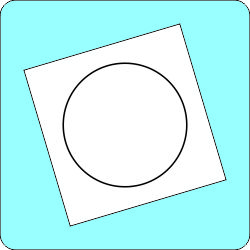
“Here, I’ll draw a circle on this square of paper. I can rotate the square by 90, 180 or 270 degrees and everything’s just the way it was. But if the square’s not relevant because we’re only interested in the circle, then I can rotate the paper by any amount I like and it’s a no‑difference transformation, right?”

“Continuous like on an infinite line but it’s wrapped around.”

“Exactly, and your infinite line is another example — any translation along that line, by a mile or a millimeter, is a perfectly good symmetry operation.”

“Ooo, and time, too. I experience time as an infinite line.”

“So does everyone. but most only travel in one direction.”

~~ Rich Olcott

Three Ways To Get Dizzy

<FZzzzzzzzzzzzzzzzzzzzzzzttt!> “Urk … ulp … I need to sit down, quick.”

“Anne? Welcome back, the couch is over there. Goodness, you do look a little green. Can I get you something to drink?”

“A little cool water might help, thanks.”

“Here. Just sit and breathe. That wasn’t your usual fizzing sound when you visit my office. When you’re ready tell me what happened. Must have been an experience, considering some of your other superpower adventures. Where did you ‘push‘ to this time?”

“Well, you know when I push forward I go into the future and when I push backward I go into the past. When I push up or down I get bigger or smaller. You figured out how pushing sideways kicks me to alternate probabilities. And then <shudder> there was that time I found a new direction to push and almost blew up the Earth.”

“Yes, that was a bad one. I’d think you’ve pretty well used up all the directions, though.”

“Not quite. This time I pushed outwards, the same in every direction.”

“Creative. And what happened?”

“Suddenly I was out in deep space, just tumbling in the blackness. There wasn’t an up or down or anything. I couldn’t even tell how big I was. I could see stars way off in the distance or maybe they were galaxies, but they were spinning all crazy. It took me a minute to realize it was me that was spinning, gyrating in several ways at once. It was scary and nauseating but I finally stopped part of it.”

“Floating in space with nothing to kill your angular momentum … how’d you manage to stabilize yourself at all?”

“Using my push superpower, of course. The biggest push resistance is against the past. I pulled pastward from just my shoulders and that stopped my nose‑diving but I was still whirling and cart‑wheeling. I tried to stop that with my feet but that only slowed me down and I was getting dizzy. My white satin had transformed into a spacesuit and I definitely didn’t want to get sick in there so I came home.”

“How’d you do that?”

“Oh, that was simple, I pulled inward. I had to um, zig‑zag? until I got just the right amount.”

“That explains the odd fizzing. I’m glad you got back. Looks like you’re feeling better now.”

“Mostly. Whew! So, Mr Physicist Sy, help me understand it all. <her voice that sounds like molten silver> Please?”

“Well. Um. There’s a couple of ways to go here. I’ll start with degrees of freedom, okay?”

“Whatever you say.”

“Right. You’re used to thinking in straight‑line terms of front/back, left/right and up/down, which makes sense if you’re on a large mostly‑flat surface like on Earth. In mathspeak each of those lines marks an independent degree of freedom because you can move along it without moving along either of the other two.”

“Like in space where I had those three ways to get dizzy.”

“Yup, three rotations at right angles to each other. Boatmen and pilots call them pitch, roll and yaw. Three angular degrees of freedom. Normal space adds three x-y-z straight‑line degrees, but you wouldn’t have been able to move along those unless you brought along a rocket or something. I guess you didn’t, otherwise you could have controlled that spinning.”

“Why would I have carried a rocket when I didn’t know where I was going? Anyhow, my push‑power can drive my straight‑line motion except I didn’t know where I was and that awful spinning had me discombobulated”

“Frankly, I’m glad I don’t know how you feel. Anyhow, if measurable motion is defined along a degree of freedom the measurement is called a coordinate. Simple graphs have an x-coordinate and a y-coordinate. An origin plus almost any three coordinates makes a coordinate system able to locate any point in space. The Cartesian x-y-z system uses three distances or you can have two distances and an angle, that’s cylindrical coordinates, or two angles and one distance and that’s polar coordinates.”

“Three angles?”

“You don’t know where you are.”

<shudder>
 <shudder>

~~ Rich Olcott

Big Bang│Gnab Gib?

Anne’s an experienced adventurer, but almost exploding the Earth when she tried transporting herself into an anti‑Universe was a jolt. It takes her a while to calm down. Fortunately, I’m there to help. <long soothing pause> “Sy, I promise that’s one direction I’ll never ‘push’ to go again.”

“No reason to go there and big reasons not to. <long friendly pause> Hmm. You’ve told me that when you use your superpower to go somewhere, you can feel whether there’d be a wall or something in the way. That’s how you know to get to a safer location before you ‘push.’ Didn’t you get that feeling before you went to meet anti‑Anne?”

“No, it felt just like just any other ‘push.’ Why?”

“I’m curious. Could you feel for just a second in the direction opposite to anti‑Anne? For Heaven sake don’t go there! Just look, OK?”

“All right … <shiver> Now, that’s weird. There’s nothing there, except there’s not even a there there, if you know what I mean.”

“I think I do, and you’ve just given us one more clue to where you almost went. Whoa, no more shivering, you’re back here safe where there’s normal matter and real locations, OK? <another soothing pause> That’s better. So, I was assuming a binary situation, an anti‑Universe obeying a Charge‑Parity‑Time symmetry that’s exactly the reverse of ours. The math allows only the two possibilities. You observed ‘no there there’ when you tried for a third option. That’s support for the assumption.”

“How could we have even two Universes?”

“It goes back to the high‑energy turmoil at the Big Bang’s singularity. Symmetry says the chaos in the singularity should have generated as many anti‑atoms, umm, as many positrons and anti‑protons, as their normal equivalents.”

“Positrons?”

“Anti‑electrons. Long story. The big puzzle is, where did those anti‑guys go? One proposal that’s been floating around is that while normal matter and our normal CPT symmetry expanded from the singularity to make our Universe, the anti‑matter and reversed symmetry expanded in some kind of opposite direction to make the anti‑Universe. You may have found that direction. Here, I’ll do a quick sketch on Old Reliable.”

“Looks like some of the banged‑up painted‑up battle shields I saw a thousand years ago.”

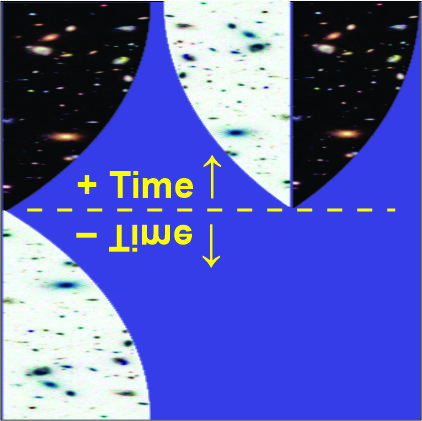
“It does, a little. Over on the top left is our normal‑matter Universe with galaxies and all, expanding out of the singularity at time zero. Time runs vertically upward from that point. I can’t draw three spatial dimensions so just one expanding sideways will have to do, OK?”

“No problem, I do x‑y‑z‑t thinking all the time when I use my superpower.”

“Of course you do. Well, coming down out of the singularity into minus‑time we’ve got the anti‑Universe. I’ve reversed the color scheme because why not, although I expect their colors would look exactly like ours because we know that photons are their own anti‑particles and should behave the same in both Universes.”

“They do. Anti‑Anne looked just like me, white satin and all.”

“Excellent, another clue. Anyway, see how minus‑time increases in the negative direction as the anti‑Universe expands just like plus‑time increases positively for us?”

“Mmm, yeah, but we only call them minus and plus because we’re standing outside of both of them. Looking from the inside, I’d say time in each increases towards expansion.”

“Good insight, you’re way ahead of me. That’s what I’ve drawn on the right side of the sketch. The two are perfectly equivalent except for CPT and anti‑CPT. Time direction, x‑y‑z space directions, even spin orientation, can all be made parallel between the two. However, the charges are reversed. Anti‑Anne’s atoms have positrons where we have electrons, negative anti‑protons where we have positive protons. When anti‑matter meets matter, there’s massive energy release from equivalent charged particles neutralizing each other.”

“Wait. Gravity. Wouldn’t anti‑matter particles repel each other? Your picture has galaxies and they couldn’t grow up with everything backwards.”

“Nope, you’re carrying this model too far. The only thing that’s reversed is charge. Masses work the same in each symmetry. Gravity pays attention to mass, not charge, and it’s always a force of attraction.”

“Anyway, not going back there.”

“Good.”

~~ Rich Olcott

Maybe even smaller?

There’s a sofa in my office. Sometimes it’s used to seat some clients for a consultation, sometimes I use it for a nap. This evening Anne and I are sitting on it, close together, after a meal of Eddie’s Pizza d’amore.

“I’ve been thinking, Sy. I don’t want to use my grow-shrink superpower very much.”

“Fine with me, I like the size you are. Why’d you decide that?”

“I remember Alice saying, ‘Three inches is such a wretched height to be.’ She was thinking about what her cat would do to her at that height. I’m thinking about what an amoeba might do to me if I were down to bacteria-size and I wouldn’t be able to see it coming because I’d be too small to see light. It would be even messier further down.”

“Well, mess is the point of quantum mechanics — all we get is the averages because it’s all chaos at the quantum level. Bohr would say we can’t even talk about what’s down there, but you’d be in the thick of it.”

She shudders delicately, leans in tighter. <long, very friendly pause> “Where’d that weird number come from, Sy?”

“What weird number?”

“Ten-to-the-minus-thirty-fifth. You mentioned it as a possible bottom to the size range.”

Now you’re asking?”

“I’ve got this new superpower, I need to think about stuff.  Besides, we’ve finished the pizza.”

<sigh> “This conversation reminds me of our elephant adventure.  Oh well.  Umm. It may have started on a cold, wet afternoon. You know, when your head’s just not up to real work so you grab a scratchpad and start doodling? I’ll bet Max Planck was in that state when he started fiddling with universal constants, like the speed of light and his own personal contribution ħ, the quantum of action.”

“He could change their values?”

“No, of course not. But he could combine them in different ways to see what came out. Being a proper physicist he’d make sure the units always came out right. I’m not sure which unit-system he worked in so I’ll just stick with SI units, OK?”

“Why should I argue?”

“No good reason to. So… c is a velocity so its units are meters per second. Planck’s constant ħ is energy times time, which you can write either as joule-seconds or kilogram-meter² per second. He couldn’t just add the numbers together because the units are different. However, he could divide the one by the other so the per-seconds canceled out. That gave him kilogram-meters, which wasn’t particularly interesting. The important step was the next one.”

“Don’t keep me in suspense.”

“He threw Newton’s gravitational constant G into the mix. Its units are meter³ per kilogram per second². ‘Ach, vut a mess,’ he thought, ‘but maybe now ve getting somevere. If I multiply ħ by G the kilograms cancel out und I get meter5 per second³. Now … Ah! Divide by c³ vich is equal to multiplying by second³/meter³ to cancel out all the seconds and ve are left mit chust meter² vich I can take the square root uff. Wunderbar, it is simply a length! How ’bout that?‘”

“Surely he didn’t think ‘how ’bout that?‘”

“Maybe the German equivalent. Anyway, doodling like that is one of the ways researchers get inspirations. This one was so good that (Għ/c³)=1.6×10-35 meter is now known as the Planck length. That’s where your ten-to-the-minus-thirty-fifth comes from.”

“That’s pretty small. But is it really the bottom?”

“Almost certainly not, for a couple of different reasons. First, although the Planck formula looks like a fundamental limit, it’s not. In the same report Planck re-juggled his constants to define the Planck mass (ħc/G)=2.2×10-8 kilograms or 22 micrograms. Grains of sand weight less than that. If Planck’s mass isn’t a limit, Planck’s length probably isn’t either. Before you ask, the other reason has to do with relativity and this is not the time for that.”

“Mmm … so if space is quantized, which is where we started, the little bits probably aren’t Planck-sized?”

“Who knows? But my guess is, no, probably much smaller.”

“So I wouldn’t accidentally go out altogether like a candle then. That’s comforting to know.”

My turn to shudder. <another long, friendly pause>.

~~Rich Olcott

Small, yes, but how small?

Another quiet summer afternoon in the office. As I’m finishing up some paperwork I hear a fizzing sound I’d not heard in a while. “Hello, Anne, welcome back. Where’ve you been?”

Her white satin looks a bit speckled somehow but her voice still sounds like molten silver. “I’m not sure, Sy. That’s what I’ve come to you about.”

“Tell me about it.”

“Well, after we figured out that I can sort of ‘push’ myself across time and probability variation I realized that the different ‘pushes’ felt like different directions, kind of. When I go backward and forward in time it feels a little like falling backward or forward. Not really, but that’s the best way I can describe it. Moving to a different probability is a little like going left or right. So I wondered, what about up and down?”

“And I gather you tried that.”

“Sure, why not? What good’s a superpower if you don’t know what you can do with it? When I ‘push’ just a little upward thIS HAPPENS.”

“Whoa, watch out for the ceiling fan! Shrink back down again before you break the furniture or something.”

“Oh, I won’t, I’ve learned to be careful when I resize. Good thing I was outside and all by myself the first time I tried it. Took some practice to control how how much my size changes by how light or heavy I ‘pushed’.”

“I think I can see where this is going.”

“Mm-hm, it’s good to know what the limits are, right? I’ve got a pretty good idea of what would happen if I got huge. What I want to know is, what’ll I be getting into if I try ‘pushing’ down as hard as I can?”

“Kinda depends on how far down you go. I’m assuming your retinas scale their sensitivity with your size. When you get bigger do green things look blue and yellow things look green and so forth?”

“Yeah, orange juice had this weird yellow color. Tasted OK, though.”

“Right. So when you get smaller the colors you perceive will shift the other way, to shorter wavelengths — at first, yellow things will look red, blue things will look yellow and you’ll see ultraviolet as blue. When you get a thousand times smaller than normal, most things will look black because there’s not much X-ray illumination unless you’re close to a badly-shielded Crookes tube.”

“Good thing this ‘push’ ability also gave me some kind of extra feel-sense that’s not sight. Sometimes when I try to ‘push’ it ‘feels’ blocked until I move around a little. After the ‘push’ I see a wall or something I would have jumped into.”

“That’s a relief. I was wondering how you’d navigate when you’re a million times smaller than normal, at the single-cell level, or a million times smaller than that when you’d be atom-sized.”

“Then what comes?”

“Mmm… one more factor of a thousand would get you down to about the size of an atomic nucleus, but below that things get real fuzzy. It’s hard to get experimental data in the sub-nuclear size range because any photon with a wavelength that short is essentially an extremely-high-energy gamma ray, better at blowing nuclei apart than measuring them. Theory says you’d encounter nuclei as roiling balls of protons and neutrons, but each of those is a trio of quarks which may or may not be composed of even smaller things.”

“Is that the end of small?”

“Maybe not. Some physicists think space is quantized at scales near 10—35 meter. If they’re wrong then there’s no end.”

“Quantized?”

Quantized means something is measured out in whole numbers. Electric charge is quantized, for instance, because you can have one electron, two electrons, and so on, but you can’t have 1½ electrons. Some physicists think it’s possible that space itself is quantized. The basic idea is to somehow label each point in space with its own set of whole numbers.  There’d be no vacant space between points, just like there’s no whole number between two adjacent whole numbers.”

“So how small can I get?”

“Darned if I know.”

~~ Rich Olcott

Thanks to Jerry Mirelli for his thoughts that inspired this post and the next.