Trio for Rubber Ruler

“It’s all about how lightwaves get generated and then what happens.”

Sy and me talked about that, Cathleen.  Lightwaves come from jiggling electrons, right?”

“Any kind of charged particles, Vinnie, but there’s different ways that can happen.  Each leads to its own kind of spectrum.”

“Different kinds of spectrum?  Do you mean like visible versus infrared and ultraviolet, Cathleen?”

“No, I don’t, Sy.  I’m referring to the thing’s overall appearance in every band.  A hundred and fifty years ago Kirchoff pointed out that light from a source can have lines of color, lines without color, or a smooth display without lines.”

“Like that poster that Al put up between the physicist and astronomer corners?”  (We’re still chatting at a table in Al’s coffee shop.  I’m on my fourth scone.)

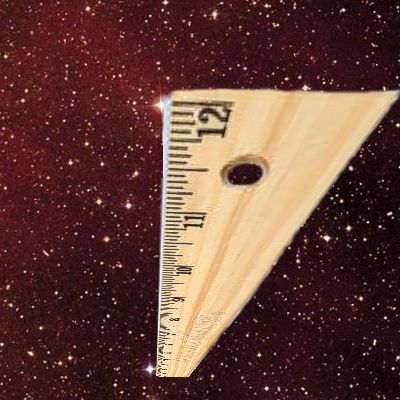
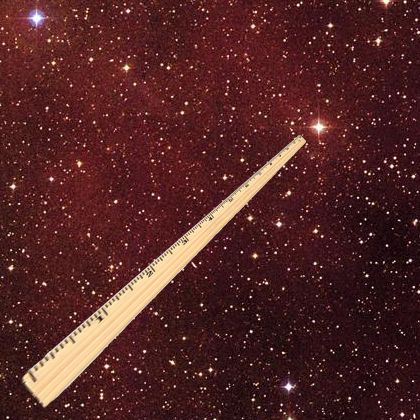
Astroruler with solar spectrum
Based on N.A.Sharp, NOAO/NSO/Kitt Peak FTS/AURA/NSF

“Kind of.  That’s based on a famous image created at Kitt Peak Observatory.  In the background there you see a representation of what Kirchoff called a continuous or black-body spectrum, where all the colors fade smoothly into each other in classic rainbow order.  You’re supposed to ignore the horizontal dark lines.”

“And the vertical lines?”

“They form what Kirchoff called an absorption spectrum.  Each dark vertical represents an isolated color that we don’t get from the Sun.”

“You’re saying we get all the other colors but them, right?”

“Exactly, Vinnie.  The Sun’s chromosphere layer filters those specific wavelengths before they get from the deeper photosphere out into space.”

“Complicated filter.”

“Of course.  The Sun contains most of the elements lighter than nickel.  Each kind of atom absorbs its own collection of frequencies.”

“Ah, that’s the quantum thing that Sy and me talked about, right, Sy?”

“Mm-hm.  We only did the hydrogen atom, but the same principles apply.  An electromagnetic wave tickles an atom.  If the wave delivers exactly the right amount of energy, the atom’s chaotic storm of electrons resonates with the energy and goes a different-shaped storm.  But each kind of atom has a limited set of shapes.  If the energy doesn’t match the energy difference between a pair of levels, there’s no absorption and the wave just passes by.”

“But I’ll bet the atom can’t hold that extra energy forever.”

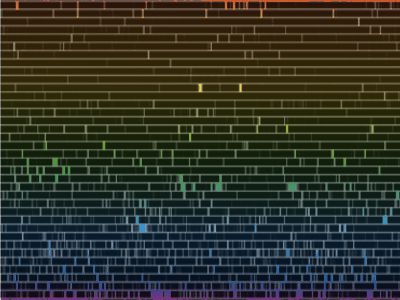
“Good bet, Vinnie.  The flip side of absorption is emission.  I expect that Cathleen has an emission spectrum somewhere on her laptop there.”Emission spectrum“You’re right, Sy.  It’s not a particularly pretty picture, but it shows that nice strong sodium doublet in the yellow and the broad iron and hydrogen lines down in the green and blue.  I’ll admit it, Vinnie, this is a faked image I made to show my students what the solar atmosphere would look like if you could turn off the photosphere’s continuous blast of light.  The point is that the atoms emit exactly the same sets of colors that they absorb.”
“You do what you gotta do, Cathleen.  But tell me, if each kind of atom does only certain colors, where’s that continuous rainbow come from?  Why aren’t we only getting hydrogen colors?”

“Kirchoff didn’t have a clue on that, Vinnie.  It took 50 years and Einstein to solve it.  Not just where the light comes from but also its energy-wavelength profile.”

“So where does the light come from?”

“Pure heat.  You can get a continuous spectrum from a hot wire, molten lava, a hole through the wall of a hot oven, even the primordial chaos of the Big Bang.  It doesn’t matter what kind of matter you’re looking at, the profile just depends on the temperature.  You know that temperature measures the kinetic energy stored in particle random motion, Vinnie?”

“Well, I wouldn’t have put it that way, but yeah.”

“Well, think about the Sun, just a big ball of really hot atoms and electrons and nuclei, all bouncing off each other in frantic motion.  Every time one of those changes direction it affects the electromagnetic field, jiggles it as you say.  The result of all that jiggling is the continuous spectrum.  Absorption and emission lines come from electrons that are confined to an atom, but heat motion is unconfined.”

“How about hot metal?”

“The atoms are locked in their lattice, but heat jiggles the whole lattice.”

~~ Rich Olcott
Étude for A Rubber Ruler

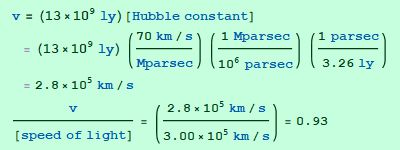
93% redder?  How do you figure that, Sy, and what’s it even mean?”

“Simple arithmetic, Vinnie.  Cathleen said that most-distant galaxy is 13 billion lightyears away.  I primed Old Reliable with Hubble’s Constant to turn that distance into expansion velocity and compare it with lightspeed.  Here’s what came up on its screen.”Old Reliable z calculation“Whoa, Sy.  Do you read the final chapter of a mystery story before you begin the book?”

“Of course not, Cathleen.  That way you don’t know the players and you miss what the clues mean.”

“Which is the second of Vinnie’s questions.  Let’s take it a step at a time.  I’m sure that’ll make Vinnie happier.”

“It sure will.  First step — what’s a parsec?”

“Just another distance unit, like a mile or kilometer but much bigger.  You know that a lightyear is the distance light travels in an Earth year, right?”

“Right, it’s some huge number of miles.”

“About six trillion miles, 9½ trillion kilometers.  Multiply the kilometers by 3.26 to get parsecs.  And no, I’m not going to explain the term, you can look it up.  Astronomers like the unit, other people put it in the historical-interest category with roods and firkins.”

“Is that weird ‘km/sec/Mparsec’ mix another historical thing?”

“Uh-huh.  That’s the way Hubble wrote it in 1929.  It makes more sense if you look at it piecewise.  It says for every million parsecs away from us, the outward speed of things in general increases by 70 kilometers per second.”

“That helps, but it mixes old and new units like saying miles per hour per kilometer.  Ugly.  It’d be prettier if you kept all one system, like (pokes at smartphone screen) … about 2.27 km/sec per 1018 kilometers or … about 8 miles an hour per quadrillion miles.  Which ain’t much now that I look at it.”

“Not much, except it adds up over astronomical distances.  The Andromeda galaxy, for instance, is 15×1018 miles away from us, so by your numbers it’d be moving away from us at 120,000 miles per hour.”

“Wait, Cathleen, I thought Andromeda is going to collide with the Milky Way four billion years from now.”

Opposing motion in a starfield“It is, Sy, and that’s one of the reasons why Hubble’s original number was so far off.  He only looked at about 50 close-by galaxies, some of which are moving toward us and some away.  You only get a view of the general movement when you look at large numbers of galaxies at long distances.  It’s like looking through a window at a snowfall.  If you concentrate on individual flakes you often see one flying upward, even though the fall as a whole is downward.  Andromeda’s 250,000 mph march towards us is against the general expansion.”
“Like if I’m flying a plane and the airspeed indicator says I’m doing 200 but my ground-speed is about 140 then I must be fighting a 60-knot headwind.”

“Exactly, Vinnie.  For Andromeda the ‘headwind’ is the Hubble Flow, that general outward trend.  If Sy’s calculation were valid, which it’s not, then that galaxy 13 billion lightyears from here would indeed be moving further away at  93% of lightspeed.  Someone living in that galaxy could shine a 520-nanometer green laser at us.  At this end we see the beam stretched by 193% to 1000nm.  That’s outside the visible range, well into the near-infrared.  All four visible lines in the hydrogen spectrum would be out there, too.”

“So that’s why ‘old hydrogens’ look different — if they’re far enough away in the Hubble Flow they’re flying away from us so fast all their colors get stretched by the red-shift.”

“Right, Vinnie.”

“Wait, Cathleen, what’s wrong with my calculation?”

“Two things, Sy.  Because the velocities are close to lightspeed, you need to apply a relativistic correction factor.  That velocity ratio Old Reliable reported — call it b.  The proper stretch factor is z=√ [(1+b)/(1–b)].  Relativity takes your 93% stretch down to (taps on laptop keyboard) … about 86%.  The bluest wavelength on hydrogen’s second-down series would be just barely visible in the red at 680nm.”

“What’s the other thing?”Ruler in perspective

“The Hubble Constant can’t be constant.  Suppose you run the movie backwards.  The Universe shrinks steadily at 70 km/sec/Mparsec.  You hit zero hundreds of millions of years before the Big Bang.”

“The expansion must have started slow and then accelerated.”

“Vaster and faster, eh?”

“Funny, Sy.”

~~ Rich Olcott

Toccata for A Rubber Ruler

“How the heck do they know that?”

“Know what, Vinnie?”

“That the galaxy they saw with that gravitational lens is 13 billion years old?  I mean, does it come with a birth certificate, Cathleen?”

“Mm, it does, sort of — hydrogen atoms.  Really old hydrogen atoms.”

“Waitaminit.  Hydrogen’s hydrogen — one proton, one electron per atom.  They’re all the same, right?  How do you know one’s older than another one?”

“Because they look different.”

“How could they look different when they’re all the same?”

“Let me guess, Cathleen.  These old hydrogens, are they far far away?”

“On the button, Sy.”

“What where they’re at got to do with it?”

“It’s all about spectroscopy and the Hubble constant, Vinnie.  What do you know about Edwin Hubble?”

“Like in Hubble Space Telescope?  Not much.”

“Those old atoms were Hubble’s second big discovery.”

“Your gonna start with the other one, right?”

“Sorry, classroom habit.  His first big discovery was that there’s more to the Universe than just the Milky Way Galaxy.  That directly contradicted Astronomy’s Big Names.  They all believed that the cloudy bits they saw in the sky were nebulae within our galaxy.  Hubble’s edge was that he had access to Wilson Observatory’s 100-inch telescope that dwarfed the smaller instruments that everyone else was using.  Bigger scope, more light-gathering power, better resolution.”

“Hubble won.”

“Yeah, but how he won was the key to his other big discovery.  The crucial question was, how far away are those ‘nebulae’?  He needed a link between distance and something he could measure directly.  Stellar brightness was the obvious choice.  Not the brightness we see on Earth but the brightness we’d see if we were some standard distance away from it.  Fortunately, a dozen years earlier Henrietta Swan Leavitt found that link.  Some stars periodically swing bright, then dim, then bright again.  She showed that for one subgroup of those stars, there’s a simple relationship between the star’s intrinsic brightness and its peak-to-peak time.”Astroruler

“So Hubble found stars like that in those nebulas or galaxies or whatever?”

“Exactly.  With his best-of-breed telescope he could pick out individual variable stars in close-by galaxies.  Their fluctuation gave him intrinsic brightness.  The brightness he measured from Earth was a lot less.  The brightness ratios gave him distances.  They were a lot bigger than everyone thought.”

“Ah, so now he’s got a handle on distance.  Scientists love to plot everything against everything, just to see, so I’ll bet he plotted something against distance and hit jackpot.”

“Well, he was a bit less random than that, Sy.  There were some theoretical reasons to think that the Universe might be expanding.  The question was, how fast?  For that he tapped another astronomer’s results.  Vesto Slipher at Lowell Observatory was looking at the colors of light emitted by different galaxies.  None had light exactly like our Milky Way’s.  A few were a bit bluer, but most were distinctly red-shifted.”

“Like the Doppler effect in radar?  Things coming toward you blue-shift the radar beam, things going away red-shift it?”

“Similar to that, Vinnie, but it’s emitted light, not a reflected beam. To a good approximation, though, you can say that the red shift is proportional to the emitting object’s speed towards or away from us.  Hubble plotted his distance number for each galaxy he’d worked on, against Slipher’s red-shift speed number for the same galaxy.  It wasn’t the prettiest graph you’ve ever seen, but there was a pretty good correlation.  Hubble drew the best straight line he could through the points.  What’s important is that the line sloped upward.”

“Lemme think … If everything just sits there, there’d be no red-shift and no graph, right?  If everything is moving away from us at a steady speed, then the line would be flat — zero slope.  But he saw an upward slope, so the farther something is the faster it’s going further from us?”

“Bravo, Vinnie.  That’s the expansion of the Universe you’ve heard about.  Locally there are a few things coming toward us — that’s those blue-shifted galaxies, for instance — but the general trend is away.”

“So that’s why you say those far-away hydrogens look different.  By the time we see their light it’s been red-shifted.”

“93% redder.”

~~ Rich Olcott

The Biggest Telescope in The Universe

Vinnie rocks back in his chair.  “These gravitational lenses, Cathleen.  How do you figure their apertures and f-numbers, space being infinite and all?”

She takes a breath to answer, but I cut in.  “Whoa, I never got past a snapshot camera.  How about you explain Vinnie’s question before you answer it?”Bird and lenses

“You’re right, Sy, most people these days just use their cellphone camera and have no clue about what it does inside.  Apertures and f-numbers are all just simple geometry.  Everything scales with the lens’ focal length.”

“That’s how far away something is that you’re taking a picture of?”

“No, it’s a characteristic of the lens itself.  It’s the distance between the midpoint of the lens and its focal plane, which is where you’d want to put the sensor chip or film in a camera.  The aperture is the diameter of the light beam entering the lens.  The optimal aperture, the image size, even the weight of the lens, all scale to the lens focal length.”

“I can see image size thing — the further back the focal plane, the bigger the image by the the time it gets there.  It’s like a lever.”

“Sort of, Vinnie, but you’ve got the idea.”

“The aperture scales to focal length?  I’d think you could make a lens with any diameter you like.”

“Sure you could, Sy, but remember you’d be using a recording medium of some sort and it’s got an optimum input level.  Too much light and you over-expose, too little and you under-expose.  To get the right amount of light when you take the shot the aperture has to be right compared to the focal length.”

“Hey, so that’s the reason for the old ‘Sunny 16‘ rule.  Didn’t matter if I had a 35mm Olympus or a big ol’ Rollei, if it was a sunny day I got good pictures with an f/16 aperture.  ‘Course I had to balance the exposure time with the film’s speed rating but that was easy.”

“Exactly, Vinnie.  If I remember right, the Rollei’s images were about triple the size of the little guy’s.  Tripled focal length meant tripled lens size.  You could use the same speed-rated film in both cameras and use the same range of f-stops.  The rule still works with digital cameras but you need to know your sensor’s ISO rating.”

“Ya got this, Sy?  Can we move on to Cathleen’s gravity lenses?”

“Sure, go ahead.”

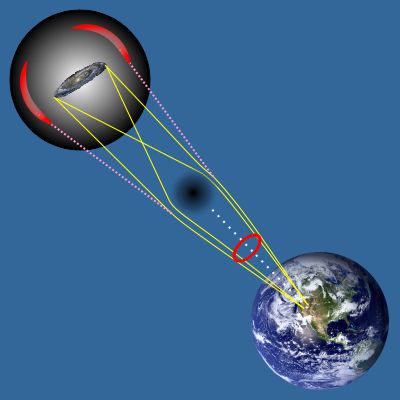
“Well, they’re completely different from … I’ll call them classical lenses. That kind has a focal plane and a focal length and an aperture and only operates along one axis.  Gravitational lenses have none of that, but they have an infinite number of focal lines and rings.”

Gravitational lens and galaxy“Infinite?”

“At least in principle.  Any observation point in the Universe has a focal line running to a massive object’s center of gravity.  At any point along the line, you could look toward an object and potentially see all or part of a ring composed of light from some bright object behind it.  Einstein showed that a completed ring’s  visual angle depends on the deflector’s mass and the three distances between the observer, the deflector and the bright object.”

“The way you said that, there could be a bunch of rings.”

“Sure, one for each bright object shining onto the lens.  For that matter, the deflector itself could be complex — the gravity of a whole cluster of galaxies rather than the single black hole we’ve been assuming as an example.”

“That diagram reminds me of Galileo’s telescope, just a three-foot tube with an objective lens at the far end and an eyepiece lens to look through.  But it was enough to show him the rings of Saturn and the moons of Jupiter.”

“Right, Sy.  His objective lens was maybe a couple of inches across.  If its focal point was halfway down the tube, his scope’s light-gathering power would match an f/9 camera lens.  Gravitational lenses don’t have apertures so not an issue.”

“So here we are like Galileo, with a brand new kind of telescope.”

“Poetic, Vinnie, and so right.  It’s already shown us maybe the youngest galaxy, born 13 billion years ago.  We’re just getting started.”

~~ Rich Olcott

The Fellowship of A Ring

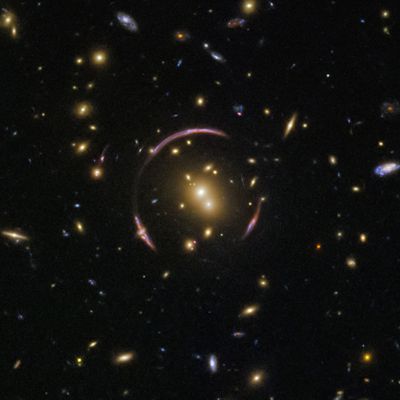
Einstein ring 2018
Hubble photo from NASA’s Web site

Cathleen and I are at a table in Al’s coffee shop, discussing not much, when Vinnie comes barreling in.  “Hey, guys.  Glad I found you together.  I just saw this ‘Einstein ring’ photo.  They say it’s some kind of lensing phenomenon and I’m thinking that a lens floating out in space to do that has to be yuuuge.  What’s it made of, and d’ya think aliens put it there to send us a message?”

Astronomer Cathleen rises to the bait.  I sit back to watch the fun.  “No, Vinnie, I don’t.  We’re not that special, the rings aren’t signals, and the lenses aren’t things, at least not in the way you’re thinking.”

“There’s more than one?”

“Hundreds we know of so far and it’s early days because the technology’s still improving.”

“How come so many?”

“It’s because of what makes the phenomenon happen.  What do you know about gravity and light rays?”

Me and Sy talked about that a while ago.  Light rays think they travel in straight lines past a heavy object, but if you’re watching the beam from somewhere else you think it bends there.”

I chip in.  “Nice summary, good to know you’re storing this stuff away.”Gravitational lens 1

“Hey, Sy, it’s why I ask questions is to catch up.  So go on, Cathleen.”

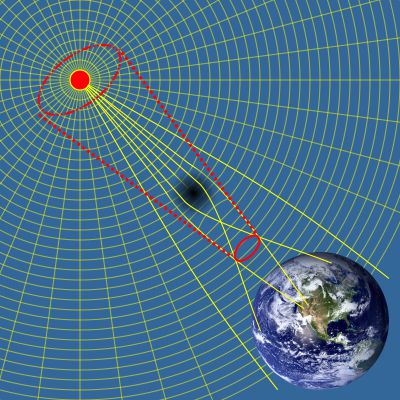
She swings her laptop around to show us a graphic.  “So think about a star far, far away.  It’s sending out light rays in every direction.  We’re here in Earth and catch only the rays emitted in our direction.  But suppose there’s a black hole exactly in the way of the direct beam.”

“We couldn’t see the star, I get that.”

“Well, actually we could see some of its light, thanks to the massive black hole’s ray-bending trick. Rays that would have missed us are bent inward towards our telescope.  The net effect is similar to having a big magnifying lens out there, focusing the star’s light on us.”

“You said, ‘similar.’  How’s it different?”Refraction lens

“In the pattern of light deflection.  Your standard Sherlock magnifying lens bends light most strongly at the edges so all the light is directed towards a point.  Gravitational lenses bend light most strongly near the center.  Their light pattern is hollow.  If we’re exactly in a straight line with the star and the black hole, we see the image ‘focused’ to a ring.”

“That’d be the Einstein ring, right?”

“Yes, he gets credit because he was the one who first set out the equation for how the rays would converge.  We don’t see the star, but we do see the ring.  His equation says that the angular size of the ring grows as the square root of the deflecting object’s mass.  That’s the basis of a widely-used technique for measuring the masses not only of black holes but of galaxies and even larger structures.”

“The magnification makes the star look brighter?”

“Brighter only in the sense that we’re gathering photons from a wider field then if we had only the direct beam.  The lens doesn’t make additional photons, probably.”

Suddenly I’m interested.  “Probably?”

“Yes, Sy, theoreticians have suggested a couple of possible effects, but to my knowledge there’s no good evidence yet for either of them.  You both know about Hawking radiation?”

“Sure.”

“Yup.”

“Well, there’s the possibility that starlight falling on a black hole’s event horizon could enhance virtual particle production.  That would generate more photons than one would expect from first principles.  On the other hand, we don’t really have a good handle on first principles for black holes.”

“And the other effect?”

“There’s a stack of IFs under this one.  IF dark matter exists and if the lens is a concentration of dark matter, then maybe photons passing through dark matter might have some subtle interaction with it that could generate more photons.  Like I said, no evidence.”

“Hundreds, you say.”

“Pardon?”

“We’ve found hundreds of these lenses.”

“All it takes is for one object to be more-or-less behind some other object that’s heavy enough to bend light towards us.”

“Seein’ the forest by using the trees, I guess.”

“That’s a good way to put, it, Vinnie.”

~~ Rich Olcott

Far out, man

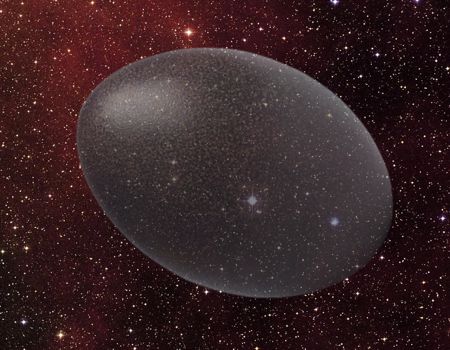
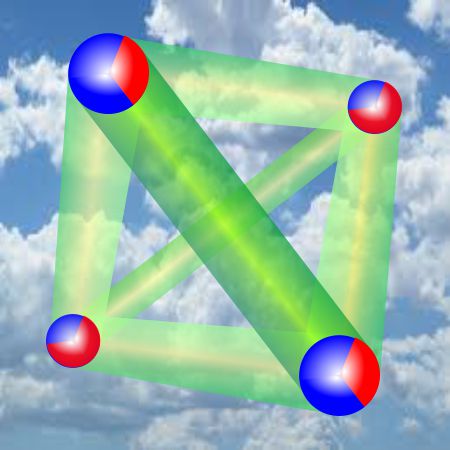
Egg in the UniverseThe thing about Al’s coffee shop is that there’s generally a good discussion going on, usually about current doings in physics or astronomy.  This time it’s in the physicist’s corner but they’re not writing equations on the whiteboard Al put up over there to save on paper napkins.  I step over there and grab an empty chair.
“Hi folks, what’s the fuss about?”

“Hi, Mr Moire, we’re arguing about where the outer edge of the Solar System is.  I said it’s Pluto’s orbit, like we heard in high school — 325 lightminutes from the Sun.”

The looker beside him pipes up.  “Jeremy, that’s just so bogus.”  Kid keeps scoring above his level, don’t know how he does it.  “Pluto doesn’t do a circular orbit, it’s a narrow ellipse so average distance doesn’t count.  Ten percent of the time Pluto’s actually closer to the Sun than Neptune is, and that’s only 250 lightminutes out.”

Then the looker on his other side chimes in.  Doing good, kid.  “How about the Kuiper Belt?  A hundred thousand objects orbiting the Sun out to maybe twice Neptune’s distance, so it’s 500 lightminutes.”

Third looker, across the table.  You rock, Jeremy.  “Hey, don’t forget the Scattered Disk, where the short-period comets drop in from.  That goes out to 100 astronomical units, which’d be … 830 lightminutes.”

One of Cathleen’s Astronomy grad students can’t help diving in despite he’s only standing nearby, not at the table.  “Nah, the edge is at the heliopause.”

<several voices> “The what?”

“You know about the solar wind, right, all the neutral and charged particles that get blown out of the Sun?  Mass-density-wise it’s a near-vacuum, but it’s not nothing.  Neither is the interstellar medium, maybe a few dozen hydrogen and helium atoms per cubic meter but that adds up and they’re not drifting on the same vector the Sun’s using.  The heliopause is the boundary where the two flows collide.  Particles in the solar wind are hot, relatively speaking, compared to the interstellar medium.  Back in 2012, our outbound spacecraft Voyager 1 detected a sharp drop in temperature at 121 astronomical units.  You guys are talking lightminutes so that’d be <thumb-pokes his smartphone> how about that? almost exactly 1000 lightminutes out.  So there’s your edge.”

Now Al’s into it.  “Hold on, how about the Oort Cloud?”

“Mmm, good point.  Like this girl said <she bristles at being called ‘girl’>, the short-period comets are pretty much in the ecliptic plane and probably come in from the Scattered Disk.  But the long-period comets seem to come in from every direction.  That’s why we think the Cloud’s a spherical shell.  Furthermore, the far points of their orbits generally lie in the range between 20,000 and 50,000 au’s, though that outer number’s pretty iffy.  Call the edge at 40,000 au’s <more thumb-poking> that’d be 332,000 lightminutes, or 3.8 lightdays.”

“Nice job, Jim.”  Cathleen speaks up from behind him.  “But let’s think a minute about why that top number’s iffy.”

“Umm, because it’s dark out there and we’ve yet to actually see any of those objects?”

“True.  At 40,000 au’s the light level is 1/40,000² or 1/1,600,000,000 the sunlight intensity we get on Earth.  But there’s another reason.  Maybe that ‘spherical shell’ isn’t really a sphere.”

I have to ask.  “How could it not be?  The Sun’s gravitational field is spherical.”

“Right, but at these distances the Sun’s field is extremely weak.  The inverse-square law works for gravity the same way it does for light, so the strength of the Sun’s gravitational field out there is also 1/1,600,000,000 of what keeps the Earth on its orbit.  External forces can compete with that.”

“Yeah, I get that, Cathleen, but 3.8 lightdays is … over 400 times closer than the 4½ lightyear distance to the nearest star.  The Sun’s field at the Cloud is stronger than Alpha Centauri’s by at least a factor of 400 squared.”

“Think bigger, Sy.  The galactic core is 26,000 lightyears away, but it’s the center of 700 billion solar masses.  I’ve run the numbers.  At Jim’s Oort-Cloud ‘edge’ the Galaxy’s field is 11% as strong as the Sun’s.  Tidal forces will pull the outer portion of the Cloud into an egg shape pointed to the center of the Milky Way.”

Jeremy’s agog.  “So the edge of the Solar System is 1,000 times further than Pluto?  Wow!”

“About.”

“Maybe.”

~~ Rich Olcott

Water, Water Everywhere — How Come?

Lunch time, so I elbow my way past Feder and head for the elevator.  He keeps peppering me with questions.

“Was Einstein ever wrong?”

“Sure. His equations pointed the way to black holes but he thought the Universe couldn’t pack that much mass into that small a space.  It could.  There are other cases.”

We’re on the elevator and I punch 2.  “Where you going?  I ain’t done yet.”

“Down to Eddie’s Pizza.  You’re buying.”

“Awright, long as I get my answers.  Next one — if the force pulling an electron toward a nucleus goes as 1/r², when it gets to where r=0 won’t it get stuck there by the infinite force?”

“No, because at very short distances you can’t use that simple force law.  The electron’s quantum wave properties dominate and the charge is a spread-out blur.”

The elevator stops at 7.  Cathleen and a couple of her Astronomy students get on, but Feder just peppers on.  “So I read that everywhere we look in the Solar System there’s water.  How come?”

I look over at Cathleen.  “This is Mr Richard Feder of Fort Lee, NJ.  He’s got questions.  Care to take this one?  He’s buying the pizza.”

“Well, in that case.  It all starts with alpha particles, Mr Feder.”

The elevator door opens on 2, we march into Eddie’s, order and find a table.  “What’s an alpha particle and what’s that got to do with water?”

Alpha particle
Two protons and two neutrons, assembled as an alpha particle

“An alpha particle’s a fragment of nuclear material that contains two protons and two neutrons.  99.999% of all helium atoms have an alpha particle for a nucleus, but alphas are so stable relative to other possible combinations that when heavy atoms get indigestion they usually burp alpha particles.”

“And the water part?”

“That goes back to where our atoms come from — all our atoms, but in particular our hydrogen and oxygen.  Hydrogen’s the simplest atom, just a proton in its nucleus.  That was virtually the only kind of nucleus right after the Big Bang, and it’s still the most common kind.  The first generation of stars got their energy by fusing hydrogen nuclei to make helium.  Even now, that’s true for stars about the size of the Sun or smaller.  More massive stars support hotter processes that can make heavier elements.  Umm, Maria, do you have your class notes from last Tuesday?”

“Yes, Professor.”

“Please show Mr Feder that chart of the most abundant elements in the Universe.  Do you see any patterns in the second and fourth columns, Mr Feder?”

Element Atomic number Mass % *103 Atomic weight Atom % *103
Hydrogen 1 73,900 1 92,351
Helium 2 24,000 4 7,500
Oxygen 8 1,040 16 81
Carbon 6 460 12 48
Neon 10 134 20 8
Iron 26 109 56 2
Nitrogen 7 96 14 <1
Silicon 14 65 32 <1

“Hmm…  I’m gonna skip hydrogen, OK?  All the rest except nitrogen have an even atomic number, and all of ’em except nitrogen the atomic weight is a multiple of four.”

“Bravo, Mr Feder.  You’ve distinguished between two of the primary reaction paths that larger stars use to generate energy.  The alpha ladder starts with carbon-12 and adds one alpha particle after another to go from oxygen-16 on up to iron-56.  The CNO cycle starts with carbon-12 and builds alphas from hydrogens but a slow step in the cycle creates nitrogen-14.”

“Where’s the carbon-12 come from?”

“That’s the third process, triple alpha.  If three alphas with enough kinetic energy meet up within a ridiculously short time interval, you get a carbon-12.  That mostly happens only while a star’s going nova, simultaneously collapsing its interior and spraying most of its hydrogen, helium, carbon and whatever out into space where it can be picked up by neighboring stars.”

“Where’s the water?”

“Part of the whatever is oxygen-16 atoms.  What would a lonely oxygen atom do, floating around out there?  Look at Maria’s table.  Odds are the first couple of atoms it runs across will be hydrogens to link up with.  Presto!  H2O, water in astronomical quantities.  The carbon atoms can make methane, CH4; the nitrogens can make ammonia, NH3; and then photons from Momma star or somewhere can help drive chemical reactions  between those molecules.”

“You’re saying that the water astronomers find on the planets and moons and comets comes from alpha particles inside stars?”

“We’re star dust, Mr Feder.”

~~ Rich Olcott

Planetary Pastry, Third Course

The Al’s Coffee Shop Astronomy gang is still discussing Jupiter’s Great Red Spot.  Cathleen‘s holding court, which is natural because she’s the only for-real Astronomer in the group…  “So here’s what we’ve got.  The rim of the Great Red Spot goes hundreds of miles an hour in the wrong direction compared to hurricanes on Earth.  An Earth hurricane’s eye is calm but the Jupiter Spot’s rim encloses a complex pattern of high winds.  Heat transport and cloud formation on Earth are dominated by water, but Jupiter’s atmospheric dynamic has two active players — water and ammonia.”

“Here’s your pastries, Cathleen.  I brought you a whole selection.  Don’t nobody sneeze on ’em, OK?”

“Oh, they’re perfect, Al.  Thanks.  Let’s start with this bear claw.  We’ll pretend it’s the base of the weather column.  On Earth that’d be mostly ocean, some land surface and some ice.  They’re all rough-ish and steer air currents, which is why there’s a rain shadow inland of coastal mountain ranges.”pastries 2

“Jupiter doesn’t have mountains?”

“We’re virtually certain it doesn’t, Sy.  The planet’s density is so low that it can’t have much heavy material.  It’s essentially an 88,000-mile-wide ball of helium-diluted liquid hydrogen topped by a 30-mile-high weather column.  Anything rocky sank to the core long ago.  The liquid doesn’t even have a real surface.”

<Al and Sy> “Huh?”

“Jovian temps are so low that even at moderate pressures there’s no boundary between gaseous and liquid phases.  Going downward you dive through clear ‘air,’ then progress through an increasingly opalescent haze until you realize you’re swimming.  Physicists just define the ‘surface’ to be the height where the pressure is one atmosphere.  That level’s far enough down that water and ammonia freeze to form overlying cloud layers but hydrogen and helium are still gases.  It could conceivably look like home there except the sky would be weird colors and you don’t see a floor.”

“If the boundary is that blurry, it’s probably pretty much frictionless — weather passes over it without slowing down or losing energy, right?”

“Yup.”

“So there’s way too much slivered almonds and stuff on that bear claw. On this scale it ought to have a mirror finish.”

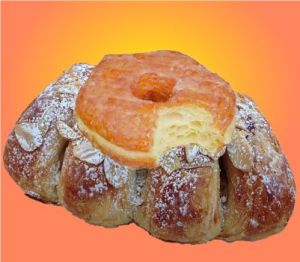
“Good point.  But now we can start stacking weather onto it.  Here’s my doughnut, to represent the Great Red Spot or any of the other long-lived anticyclones.”

“Auntie who?”

“A-n-t-i-cyclone, Al.  Technical term for a storm that disobeys the Coriolis theory.”

“Uh-HUH. So why’s it do that?”

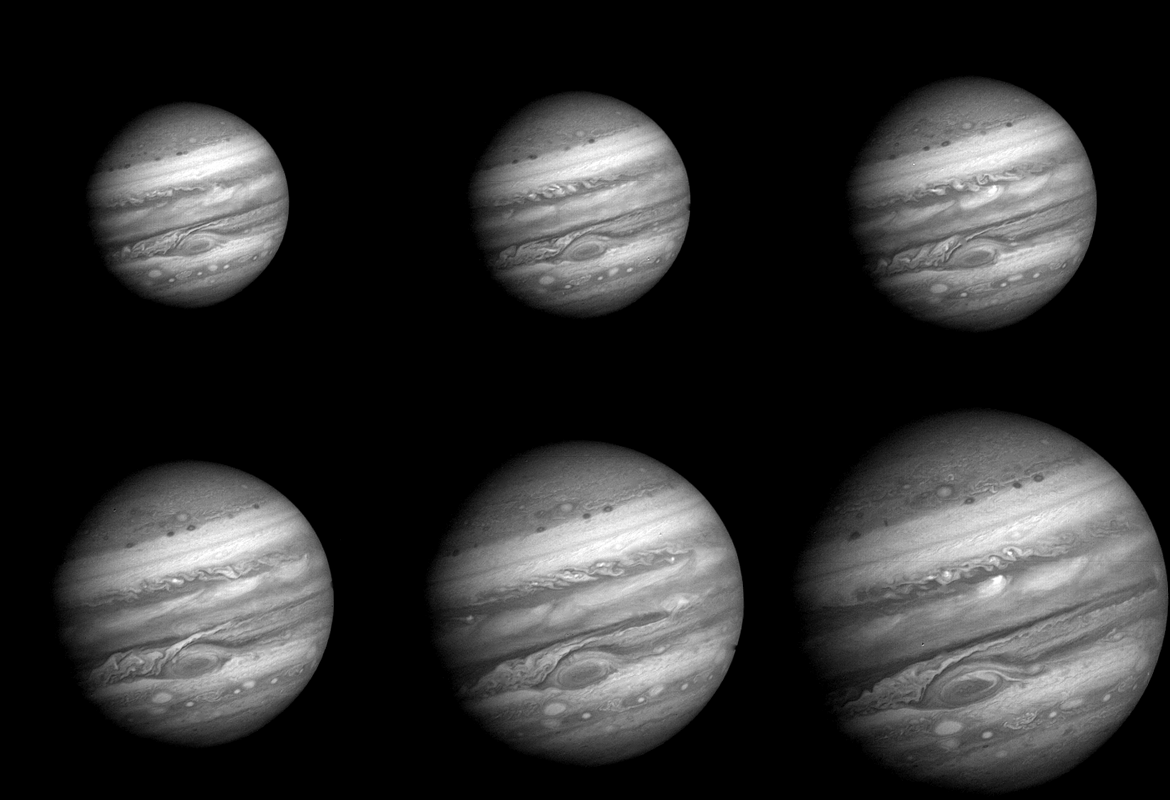
“Well, at this point we can only go up one level in the cause-and-effect chain.  <pulling out smartphone>  NASA’s Voyager 1 spacecraft sent back data for this this wonderful video

790106-0203_Voyager_58M_to_31M_reduced
Jupiter seen by Voyager 1 probe with blue filter in 1979. One image was taken every Jupiter day (approximately 10 hours).  Credit: NASA

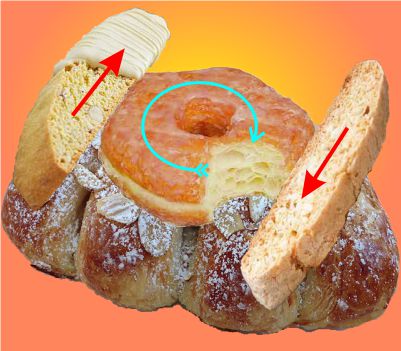
“Basically, the Spot is trapped between two jet streams, one going westward at 135 mph and the other going eastward at 110 mph.  I’ll use these biscotti to represent them.pastries with arrows

“Hey, that’s like a rack-and-pinion gear setup, with two racks and an idler, except the idler gear’s four times as wide as the Earth.”

“A bit less than that these days, Sy.  The Spot’s been shrinking and getting rounder.  Every year since 1980 it’s lost about 300 miles east-west and about 60 miles north-south.  As of 2014 it was about 2.8 Earth-widths across.  And no, we don’t know why.  Theories abound, though.”

“What’s one of them?”

“Believe it or not, climate change.  On Jupiter, not Earth.  One group of scientists at Berkeley tackled a couple of observations

  • Unlike Earth, which is much hotter near the Equator than near the poles, Jupiter’s Equator is only a few degrees warmer than its poles.
  • Three persistent White Ovals near the Great Red Spot merged to form a single White Oval that recently turned red but only around the edges.

Their argument is long, technical and still controversial.  However, their proposal is that merging the three ovals disrupted the primary heat transport mechanism that had been evening out Jupiter’s temperature.  IF that’s true, and if it’s the case that Jupiter’s jet streams are powered by heat transport, then maybe disrupted heat patterns are interfering with  the Great Red Spot’s rack-and-pinion machine.  And maybe more.”

“Big changes ahead for the Big Planet.”

“Maybe.”

~~ Rich Olcott

Planetary Pastry, Second Course

We’re still sitting in Al’s coffee shop.  “OK, Cathleen, so Jupiter’s Great Red Spot acts like a hurricane turned inside-out.  Where’s the problem?”

“Just that it goes completely against all the computer models we’ve built to understand and predict hurricane activity.  It’ll take a whole new generation of even more complicated models for Jupiter-like planets.”

“Here’s the doughnuts you asked for, Cathleen.”

“Thanks, Al.  Perfect timing. <drawing on a paper napkin>  Let’s look at hurricanes first, OK, Sy?”

“Sure.”

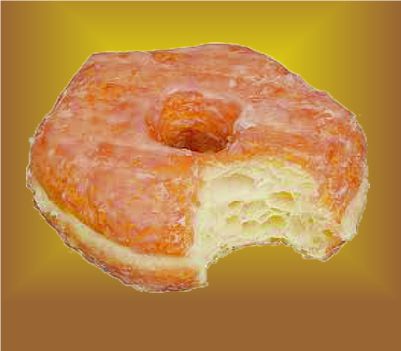
“We’ll start with this doughnut that I’ve just taken a bite out of.  First thing that happens is that warm ocean water heats up the overlying air.  Warmed air rises, so we’ve got an updraft.”

“And then?”

“The rising air is humid (ocean air, remember?).  As it rises it cools and forces moisture to condense out.  Upward flow stops when the warmed air hits the top of the troposphere.  But there’s still more warm air pushing up the plume.  The cooled air has to go somewhere so it spreads out.  That’s where these red arrows on my paper napkin go horizontal.  The cooled air, loaded with water droplets, is heavy so it starts sinking which is why the red arrows turn downward.  They move back across that ocean water again ’cause they’re caught in the inflow.  Full cycle and that’s number 1 here, got it?”

“Yeah.”

“Hey, Cathleen,  are you gonna need more paper napkins?”Donuts 1
“A couple should be enough, Al, thanks.  Now we get to number 2, the Coriolis thing. That’s always tough to talk students through but let’s try.  The Earth rotates once every 24 hours, right, and its circumference at the Equator is 25,000 miles, so relative to the Sun anything at the Equator is flying eastward at about 1,000 miles per hour.  Any place north of the Equator has to be going slower than that, and further north, even slower.  With me, Sy?”

“Gimme a minute … OK, I suppose.”

“Good.  Now suppose a balloon is floating in the breeze somewhere south of that rising plume.  Relative to the plume, it’ll have eastward momentum.  Now the balloon’s caught in the plume’s inflow but it doesn’t go straight in because of that eastward momentum.  Instead it’s going to arc around the plume.  See how I’ve got it coming in off-center?  Al, would that be clockwise or counterclockwise if you’re looking down from a satellite or something?”

“Umm … counterclockwise, yeah?”

“Mm-hm.  What about a balloon that starts out north of the plume?”

“Uhh … It’ll be going slower than the plume, so the plume gets ahead of it and it’ll arc … hey, counterclockwise again!”

“How ’bout that?  Anywhere in the northern hemisphere, air flowing into a low-pressure region will turn it counterclockwise.  As the inflow draws from greater distances, there’s a greater speed difference to drive the counterclockwise spin.  So that’s number 2 here.  Add those two cycles together and you’ve got number 3, which spirals all around the doughnut.  And there’s your hurricane.”

“Cool.  So how does that model not account for the Great Red Spot?”

“To begin with, the Spot’s in Jupiter’s southern hemisphere so it ought to be going clockwise which it definitely is not.  And there’s no broad band of surrounding clouds — just a lot of structure inside the ring, not outside.  There’s something else going on that swamps Coriolis.”

“So how’s Jupiter different from Earth?  Besides being bigger, of course.”

“Lots of ways, Sy.  You know how labels on healthcare products divide the contents into active ingredients and inert ingredients?  The inert ones just carry or modify the effects of the active ones.  Atmospheres work the same way.  On Earth the inert ingredients are nitrogen and oxygen…”

“Hey, oxygen’s important!”

“Sure, Al, but not when you’re modeling air movement.  The important active ingredient is water — it transports a lot of heat when it evaporates from one place and condenses somewhere else.  The biggest outstanding problem in Earth meteorology is accounting for clouds.”

“You’re gonna tell us that Jupiter’s inactive ingredients are hydrogen and helium, I suppose.”

“Precisely, Sy.  Jupiter has two active ingredients, water and ammonia, plus smaller amounts of sulfur and phosphorus compounds.  Makes for a crazy complicated modeling problem.  I’m going to need more pastries.”

“Comin’ up.”


~~ Rich Olcott

Planetary Pastry, First Course

“Morning, Al.  What’s the scone of the day?”

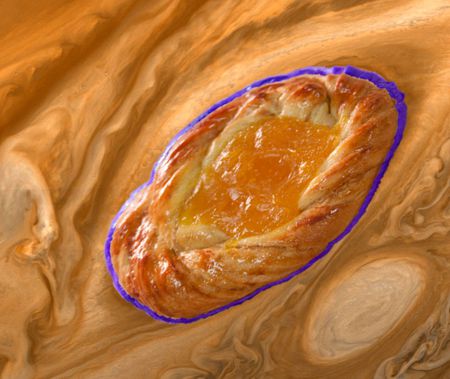
“No scones today, Sy.  Cathleen and one of her Astronomy students used my oven to do a whole batch of these orange-and-apricot Danishes.  Something to do with Jupiter.  Try one.”Great Apricot Spot 1
Cathleen was standing behind me.  “They’re in honor of NASA’s Juno spacecraft.  She just completed a close-up survey of Jupiter’s famous cloud formation, the Great Red Spot.  Whaddaya think?”

“Not bad.  Nice bright color and a good balance of sweetness from the apricot against tartness from the orange.”

“You noticed that, hey?  We had to do a lot of balancing — flavors, colors, the right amount of liquid.  Too juicy and the pastry part comes out gummy, too dry and you break a tooth.  Notice something else?”

“The structure, right?  Like the Spot’s collar around a mushed-up center.”

“Close, but Juno showed us that center’s anything but mushed-up.  <pulls out her smartphone>  Here’s what she sent back.”

GRS 1 @400
Credits: NASA/JPL-Caltech/SwRI/MSSS/Jason Major

“See, it’s swirls within swirls. We tried stirring the filling to look like that but it mostly smoothed out in the baking.”

“Hey, is it true what I heard that the Great Red Spot has been there for 400 years?”

“We think so, Al, but nobody knows for sure.  When Galileo published his telescopic observations of Jupiter in 1610 he didn’t mention a spot.  But that could be because he’d already caught flak from the Church by describing mountains and craters on the supposedly perfect face of the Moon.   Besides, the Jovian moons he saw were much more exciting for the science of the time.  A planet with satellites was a direct contradiction to Aristotle’s Earth-centered Solar System.”

“OK, but what about after Galileo?”

“There are records of a spot between 1665 and 1713 but then no reports of a spot for more than a century.  Maybe it was there and nobody was looking for it, maybe it had disappeared.  But Jupiter’s got one now and it’s been growing and shrinking for the past 185 years.”

“So what is it, what’s it made of and why’s it been there so long?”

“Three questions, one of them easy.”

“Which is easy, Sy?”

“The middle one.  The answer is, no-one knows what it’s made of.  That’s part of Juno‘s mission, to do close-up spectroscopy and help us wheedle what kinds of molecules are in there.  We know that Jupiter’s mostly hydrogen and helium, just like the Sun, but both of those are colorless.  Why some of the planet’s clouds are blue and some are pink — that’s a puzzle, right, Cathleen?”

“Well, we know a little more than that, especially since the Galileo probe dove 100 miles into the clouds in 1995.  The white clouds are colder and made of ammonia ice particles.  The pink clouds are warmer and … ok, we’re still working on that.”

“What about my other two questions, Cathleen?”

“People often call it a hurricane, but that’s a misnomer.  On Earth, a typical hurricane is a broad, complex ring of rainstorms with wind speeds from 75 to 200 mph.  Inside the ring wall people say it’s eerily calm.  The whole thing goes counterclockwise in the northern hemisphere, clockwise in the southern one.”

“So how’s the Great Red Spot different?”

“Size, speed, complexity, even direction.  East-to-west, the Spot is eight times wider than the biggest hurricanes.  Its collar winds run about 350 mph and it rotates counterclockwise even though it’s in Jupiter’s southern hemisphere.  It’s like a hurricane inside-out.”

“It’s not calm inside?”

“Nope, take another look at that Juno image.  There’s at least three very busy bands wrapped around a central structure that looks like it holds three distinct swirls.  That’s the part that’s easiest to understand.” GRS core

“Why so?”

“Geometry.  Adjacent segments of separate swirls have to be moving in the same direction or they’ll cancel each other out.  <scribbles diagram on a paper napkin>  Suppose I’ve got just one inside another one.  If they go in the same direction the faster one speeds up the slower one and they merge.  If they go in opposite directions, one of them disappears.  If there’s more than one inner swirl, there has to be an odd number, see?”

“So if it’s not a hurricane, what is it?”

“Got any donuts, Al?”

~~ Rich Olcott