Elliptically Speaking

“Oh. I have one other eclipse question, Dr O’Brien.”

“What’s that, Teena?”

“Well, I found a list of solar eclipses—”

“An interesting place to start, especially for a 10‑year‑old.”

“And it had three kinds of eclipse — total, partial and annual. ‘Total‘ must be when the Moon covers up the whole Sun like when I wink my eye tight. ‘Partial‘ sounds like when I only squinch up my eye like this. I guess that happens when we’re just on the edge of an eclipse track so we still see part of the Sun like we see just part of the Moon most of the time. But my eye wide open is like there’s no eclipse at all. There’s no fourth way to hold my eye left over for ‘annual.’ Besides, ‘annual‘ means ‘every year.’ Is there some special kind of eclipse that comes every year but we don’t see it?”

Cathleen doesn’t quite hide a smile. “Sorry, dear, I think you’ve misread a word. It’s not ‘annual,’ it’s ‘annular.’ They’re very similar and they both came from Latin but they came from different Latin words and have different meanings today. ‘Annual‘ means ‘yearly,’ just as you said. ‘Annular‘ means ‘ring‑shaped‘, like a circle with a hole in the middle.”

“A ring‑shaped eclipse? Is there a big hole in the Moon we only see sometimes?”

“Quite the reverse. The Moon and its shadow are compact, no holes even in an annular eclipse. What we see in those eclipses is a ring of the Sun’s light around the outside of a black disk of Moon‑shadow. The bright ring is called an ‘annulus‘ and you must be very careful to use the special dark glasses to look at it.”

“But … Uncle Sy said the reason we’re so lucky we can see eclipses is that the Moon is just the right size to match the size of the Sun. Does the Moon get smaller for an annular eclipse?”

“Hold up your thumb. Now move your arm out until your thumb just covers my head. Can’t see me at all, can you? Now move your arm out just a little farther until you can see my hair but not my face. Got it? Your thumb didn’t change size, did it?”

“No, it just looked smaller and I could see more of you past it.”

“Right. That’s how an annular eclipse works.”
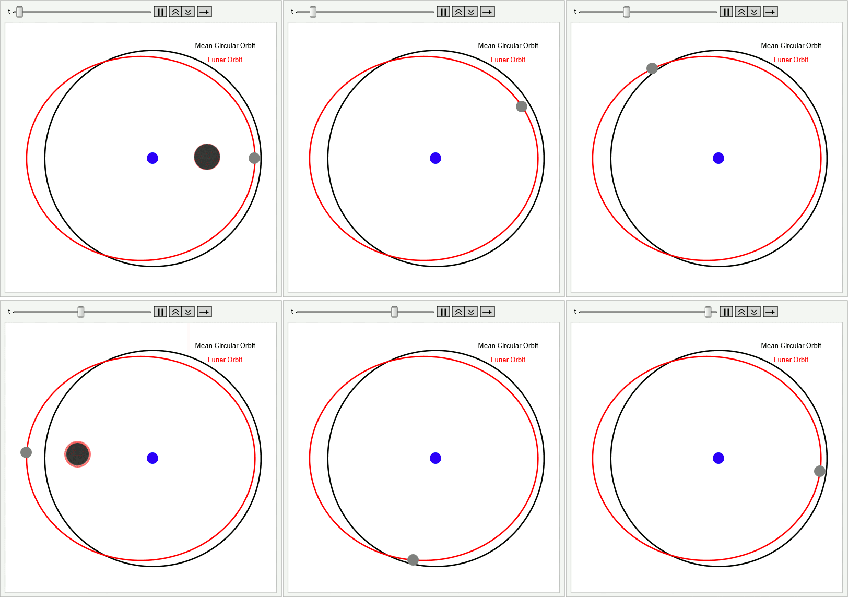
<drawing Old Reliable from its holster> “Excuse me, Cathleen, I think this might help.”

“What are all those circles, Uncle Sy, and why does it blink?”

“It’s like a map of space. The blue disk represents Earth and the gray disk represents the Moon. If the Moon were always the same distance from Earth it’d follow the black circle, but it doesn’t. It follows the red line which isn’t a true circle. It’s a special shape of squashed circle, called an ellipse. Very few moons or planets follow a truly circular orbit — their track is almost always elliptical to some degree. Now you tell me what the blinky things are about and don’t say it’s when the Moon stops in its orbit because it doesn’t. The animation motion pauses to call attention to when the eclipses happen.”

“Okayyy… Oh! They’re what we’d see in an eclipse, right? The red … ellipse?… brings the Moon closer to us or farther away. When it’s close like over there it’s like my thumb covering Dr O’Brien’s whole head and we don’t see any of the Sun and that’s a total eclipse, right? When we have an eclipse if the Moon’s outside of that circle like on the side, it’s like my thumb farther away and that’s why your picture has the orange ring, it’s an annulus, right?”

“You broke the code, Teena, Well done!”

“I think it’s silly to have two words like eclipse and ellipse that sound so much alike but they’re so different. Like annual and annulus.”

“Sorry about that, sweetie, but we pretty much have to take the language as we find it. English has a long and complicated history. Sometimes I’m surprised it works at all. Sometimes it doesn’t and that makes problems.”

~~ Rich Olcott

Eclipse Vectors

“I think I understand why we have eclipse seasons, Dr O’Meara, but why do the two eclipses in a season travel in such different directions?”

“Put this question on top of Teena’s, Cathleen. Everyone knows the Sun rises in the East because the Earth rotates towards the East. But it seems like eclipses fly eastward even faster than the Earth turns. If that’s true, why?”

“As an Astronomy educator, Sy, I wish ‘everyone’ were truly everyone. You wouldn’t believe the arguments I get from some students when I’m trying to teach 21st Century material. Why are they even in my class?”

“We can only wonder. You and the Flatties, Kareem and the 6000‑year Earthers, poor Jennifer over in Public Health having to cope with the anti‑vaxxers; these contrarians seem to be everywhere. They’re excellent models of Orwellian doublethink — they happily use their science‑dependent smart phones, internet and GPS while they’re trashing Science. Split brains? I dunno.”

“C’mon, Uncle Sy, that’s boring grown‑up stuff. What about my eclipses? Why do they go north or south like that? Does it have to do with those angles that were drawn too big?”

“Sorry, sweetie. Dr O’Meara showed us that the Moon can only make an eclipse if it’s near the Solar System’s plane where Earth’s center stays. The angle of the Moon’s orbital plane only matters when the Moon is away from there.”

“Earth’s center is the Equator! All the eclipses should go on the Equator. But they don’t. That’s wrong.”

“The Equator’s around Earth’s center, Teena, but so are other circles. Think of your globe at home. Does the North Pole point straight up?”

“Noo‑oh … you mean the tilt? Mom said that was about Winter and Summer.”

“Well, she’s not wrong. In the northern hemisphere we have Summer when the North Pole tilts toward the Sun, Winter when it tilts away. That’s only part of the story, though. In Spring and Fall the tilt is broadside to the Sun. Not as hot as Summertime, not as cold as Winter. Those three gyroscopes give us eclipse seasons. But they do more. Look at these diagrams.”

“Sorry, I don’t understand what you’re showing me.”

“No worries. In the upper one, the Earth’s in the rear. The North Pole is the green arrow. The Equator’s the yellow band. Pole and Equator are both tilted 23°. The Sun is in front, shining at the Earth. The Earth orbits the Sun counterclockwise so it’s moving to our left. Moving in that direction gives the northern hemisphere more and more daylight so it’s northern Springtime going towards Summer. Okay?”

“Yyyes….”

“Good. The sketch shows eclipse conditions, when the Moon and its shadow are in Earth’s orbital plane. The only places on Earth that can see the eclipse are on the red band. That’s another circle where the plane intersects the Earth’s surface. What direction does that band point on Earth?”

<chortle> “It goes northeast, just like I noticed on that map! Okay, let me think about the other picture… The North Pole’s a gyroscope and doesn’t change direction so we’re looking at us from the other side … Yeah! That red band goes southeast on Earth. Perfect! … Umm, everything’s upside‑down for Bindi in Australia, so does she … Wait, in the upper picture when it’s Springtime for us it’s Autumn for her so her Autumn eclipses go northeast, just like our Springtime ones do! And her Spring’s the bottom picture and her Springtime eclipses go southeast like our Autumn ones, right?”

“Smart girl! I’m going to tell your Mom about your thinking and she’ll be so proud of you. Now, Cathleen, how about speedy eclipses going east faster than the Earth does?”

“It’s not the eclipse going fast, Sy, it’s the Moon. Relative to the Sun‑Earth line, the Moon in its orbit is traveling eastward at just under 3700 kilometers per hour. Meanwhile, a point on Earth’s Equator is heading in the same direction at just under 1700 kph. Places away from the Equator move even slower. The Moon and its shadow win the race going away.”

~~ Rich Olcott

  • Thanks again to Naomi Pequette for her expertise and eclipse‑related internet links.

Eclipse Seasons

“C’mon in, Sy.”

“Morning, Cathleen. You know my niece Teena.”

“Hi, Teena. What brings you here to my office?”

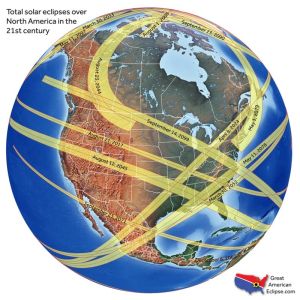
“I’m working on a school project about eclipses, Dr O’Meara, and I noticed something weird. Uncle Sy said you could explain it to me. You know how an eclipse isn’t in just one place, the Moon writes its shadow along a track?”

“Of course, dear, I do teach Astronomy.”

“Sorry, I was just giving context.” <Cathleen and I give each other a look.> “Anyhow, I found this picture of lots of eclipse tracks and see how they weave together almost like cloth?”

“Oh, it’s better than that, Teena. Look at the dates. Is there a pattern there, too?”

“Oooh, the Springtime ones go northeast and the Fall ones go southeast. Hey, I don’t see any in the Summer or Winter! Why is that?”

“It’s complicated, because it’s the result of several kinds of motion all going on at once. Have you ever played with a gyroscope?”

“Uh-huh, Uncle Sy gave me one for my birthday last year. He said that 10 years was old enough I could make it spin without hitting someone’s eye with the string. He was mostly right and I promise I really wasn’t aiming at Brian.”

<another look> “Well … okay. What’s a gyroscope’s special thing?”

“Once you start it spinning it tries to stay pointing in the same direction, except mine acts dizzy a little. Uncle Sy says the really good ones they put in satellites don’t get hardly get dizzy at all.”

“Good, you know gyroscope behavior. Planets spin, too, though a lot slower than your gyroscope. Do you know about planets?”

“Oh yes, when I was small and we looked at the eclipse my Mom and Uncle Sy explained about how we live on a planet that goes round the Sun and sometimes the Moon gets in the way and makes a shadow on us but when the Earth turns so we’re facing away from the Sun we’re in Earth’s shadow.”

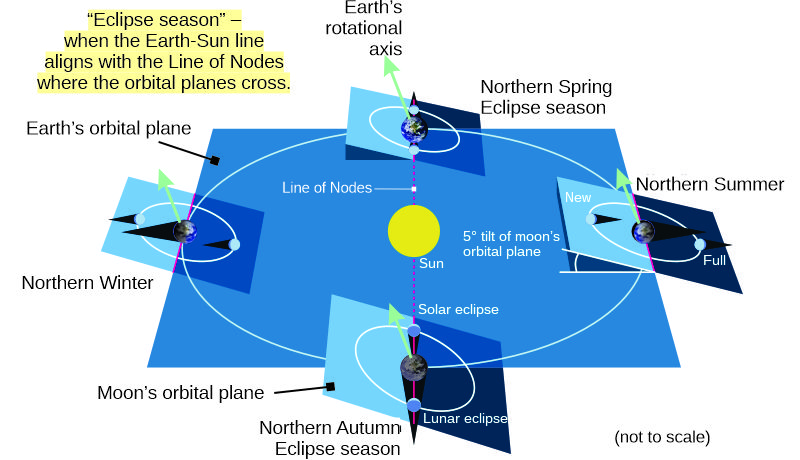
“Nice. Well, here’s a diagram about how eclipses happen. It shows four Earth‑images at special points in its orbit. Each Earth has Moon‑images at two special points in the Moon’s orbit. There’s also an arrow coming out of each Earth’s North Pole to show the axis that the Earth spins on. We’ve got three circular motions and each one acts like your gyroscope.”

Adapted from a graphic by Nela, licensed under CCA-SA 4.0

“Does the Moon spin, too?”

“We talked about this a couple years ago, sweetie. The Moon always keeps one face towards the Earth so it spins once each month as it orbits around the Earth. Dr O’Meara’s just using a single circle to cover both, okay?”

“Okay. So there’s three gyroscopes, four really but one’s hiding. The picture says that all three point in different directions, right, and they stay that way?”

“Perfect.”

“Excuse me, but those angles don’t look right. The Earth axis is pointed too close or something.”

“Sharp, Sy. You’re partially correct. Actually, that axis is at a proper 23° angle from the perpendicular to Earth’s orbital plane. It’s the lunar orbital plane and its axis that are off. They’re supposed to be at a 5° angle to Earth’s plane but they’re drawn at 15° to highlight that important line where the two planes meet. The gyroscopes keep that line steady all year.”

“What’s so important about the line?”

“If the Moon is too far above or below Earth’s plane, its shadow is too far above or below Earth to make an eclipse. Eclipses only happen when the line runs through the Sun AND when the Moon is close to the line. The line only runs through the Sun in the Spring and Fall, in this century anyway, so those are our eclipse seasons.”

“Why not every century?”

“A century ago, the eclipses came a few months earlier. The gyroscopes slowly drag the line around Earth’s solar orbit, shifting when the eclipse seasons arrive. If you want a New Year eclipse you’ll have to wait a long, long time.”

~~ Rich Olcott

  • Thanks to Naomi Pequette, Peak Nova Solutions, whose “Eclipses” presentation inspired this post.

Big Spin May Make Littler Spins

“Sorry, Vinnie, if there’s anything to your ‘Big Skip‘ idea you can’t blame Jupiter’s Great Red Spot on Io.”

“Come again, Cathleen? Both you and Sy were acting intrigued.”

“That was before I looked up a few numbers. You suggested that a long‑ago grazing collision between Io and Jupiter could account for Jupiter’s weird off‑center magnetic field, its Great Red Spot and Io’s heat and paltry waterless atmosphere. The problem is, there’s two big pieces of evidence against you. The first is Io’s orbit. It’s almost a perfect circle, eccentricity 0.0041, less than half the average of the other Galilean moons. A true circle has zero eccentricity compared to a parabola at 1.0.”

“So why is that evidence against the idea?”

“There’s virtually zero probability that a chaotic skip would send Io directly into such a perfect orbit. Okay, repetitive tugs from Ganymede’s and Europa’s gravity fields could conceivably have acted together to circularize and synchronize Io’s behavior but that would take millions of years.”

“So it’d take a while. Who’s in a hurry?”

“Your idea is, because of the second piece of evidence. Jupiter is a fluid planet, gaseous‑fluid much of the way in, liquid‑fluid most of the rest, right? Lots of up‑and‑down circulation due to outward heat flow from Jupiter’s core, plus twisty Coriolis winds at all levels powered by the planet’s rotation. All that commotion would smear out any trace of your grazing collision, probably within a hundred thousand years. The scars from Shoemaker-Levy’s impact on Jupiter were gone within months. Circularization’s too slow, smearing’s too fast, idea’s pfft.”

“Oh well, another beautiful picture bites the dust.” Vinnie glances up and to the left, the thing he does when he’s visualizing stuff. (On him, a quick glance up and to the right is a bluff tell but he knows I know which makes things interesting.) “Okay, so we’re thinking about how Jupiter’s weird atmosphere and how its equator rotates faster than its poles. That cylinder spinning inside a spinning cylinder idea looks nice for an explanation but I can think of a different way it could happen. How about like a roller bearing?”

“Hmm?”

“Big spinning columns deep inside all around the planet. Think about what goes on in between those cylinders you talked about — two layers flowing at different speeds right next to each other. There’s gonna be all kinds of watchacallit – turbulence – in there, trying to match things up but it can’t. Sooner or later twisters are gonna grow up to be north‑south columns.”

“He’s got a point, Cathleen. His columns would reduce between‑layer friction at the cost of increased between‑column friction. Depending on conditions that could give a lower‑energy, more stable configuration.”

“Spoken like a true physicist, Sy. Columns may be part of the story, but not all of it. There’s mostly‑for evidence but also really‑against evidence.”

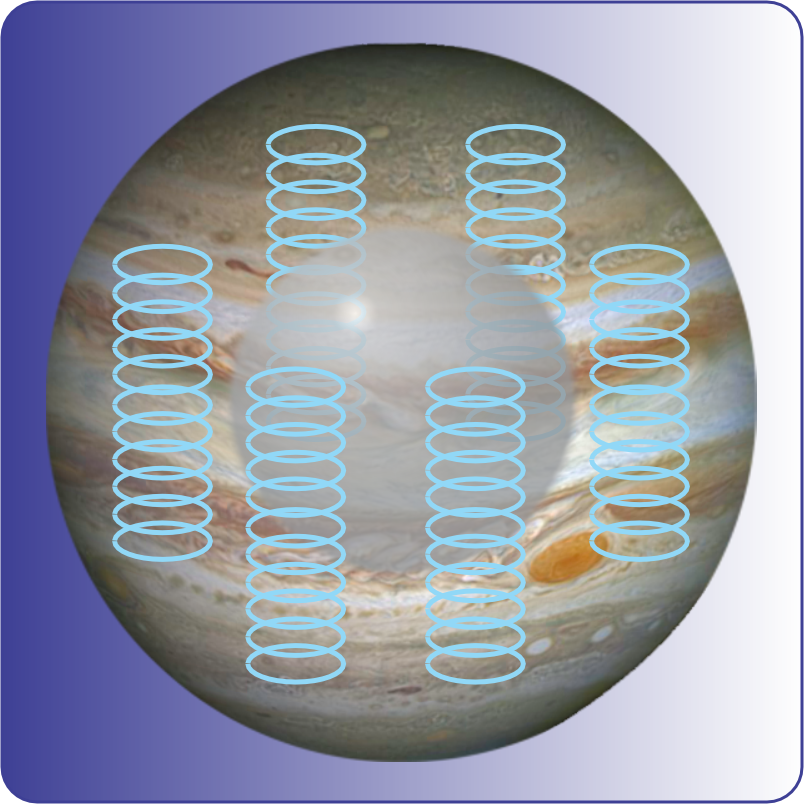
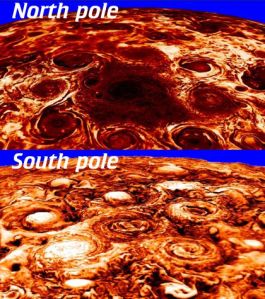
Adapted from images by NASA/JPL-Caltech/SwRI/ASI/INAF/JIRAM

“Give us the ‘mostly‑for,’ make us feel good.”

“You guys.” <drawing tablet from her purse, tapping screen> “Alright, here’s a couple of images that Juno sent us when it orbited over Jupiter’s poles.”

“Sure looks like what was in my mind. I’ve seen that before somewhere…. Yeah, Al had that poster up behind his cash register like five years ago.”

“Impressive memory, Vinnie. Anyway, those vortices are similar to your idea, except look at these images critically.”

“Wait, different whirlpool counts top and bottom.”

“Right. These columns obviously don’t go all the way through. They must extend only partway inward until they’re blocked at some lower level.”

“Why can’t I have my columns all the way through if they’re outside the blocking level?”

“You could and there may be something like that inside the Sun, but that’s probably not the case for Jupiter.”

“Why not?”

“That’s the ‘really‑against’ evidence — the Great Red Spot and Jupiter’s off‑center magnetism. Something’s powerful enough to cause those two massive phenomena. That something would disrupt your ring‑in‑a‑ring rotation, at least down to the level where the disrupter lives. Your columns could only operate in some layer deeper than the disrupter’s level but above whatever’s blocking the polar columns. If there is such a layer.”

“Geez. Well, a guy can still hope.”

“But that’s not Science.”

~~ Rich Olcott

The Big Skip?

Suddenly Vinnie gets a grin all over his face. “Tell me something, Cathleen. Suppose I’m a pilot in a shuttle craft like in Star Trek. Tell me how conditions change as I dive down into Jupiter.”

“Hmm .. okay. Mind you, it’ll be a dangerous flight. You’ll fly through an atmosphere that’s mostly molecular hydrogen which is notorious for sneaking into metallic materials and weakening them. I recommend investing in a Starfleet‑grade force shield to keep the atmosphere completely away from your hull. While you’re in the stratosphere high above the cloud decks you’ll see a deep blue sky pretty much the same as Earth’s stratosphere. Try to avoid the thin gray clouds in the upper troposphere — their greasy hydrocarbons will fog your windshield. You want to stick to clear air as much as possible so dodge around the white ammonia‑ice zones. You can drop a couple hundred kilometers more before you hit the top of a brownish ammonium sulfides band.”

“Once I’m that deep there’s clear air underneath the white deck, right?”

“We just don’t know. Unlikely, but if you do want to fly beneath a zone you’ll have to traverse the jetstream separating it from your band. Pick the pole‑ward zone — jetstreams on that side seem to host fewer thunderstorms. Strap in for the jump, because the jetstreams sustain windspeeds 2‑3 times what we get in a Category 5 hurricane. Things’ll get muddier when you drop beneath the brown clouds.”

“Brown as mud, uh-huh.”

“No, I mean literal mud, maybe. First there’s a water‑ice layer and below that there may be a layer of clay‑ish or silicate droplets which may include water of crystallization. I like to visualize clouds of opal, but of course there’d be no sunlight to see them by. A bit lower and you’ll fly through helium rain. Get past all that and you’re about 20% of the way down, about two Earth diameters.”

“That’s where I bump into something?”

“No, that’s the transition zone where heat and pressure convert molecular H₂ into a metallic fluid of protons embedded in a conducting ocean of electrons. Sy, how do you suppose that would affect Vinnie’s aerodynamics?”

“Destructively. If his shuttle’s skin doesn’t rupture he’d be floating rather than sinking. Net density of an intact hull and everything inside would be less than the prevailing density outside where protons are crammed together. Even powered descent would be tough.”

“Sy, that’s exactly what my crazy idea needs! Cathleen, when’s your next Crazy Theory seminar?”

“Not until next term, some time in the Fall. C’mon, Vinnie, out with it!”

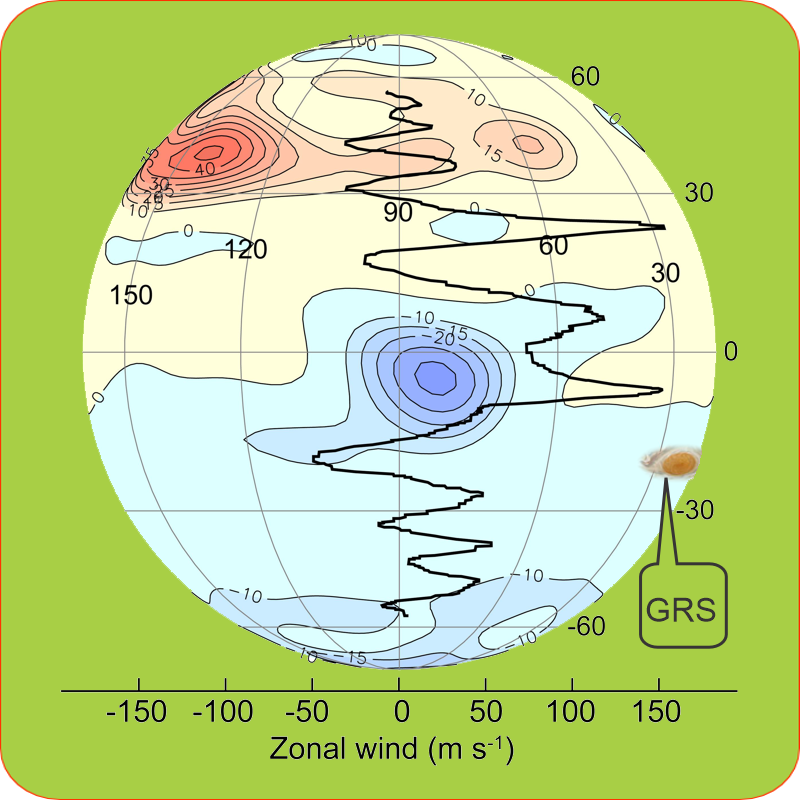
Magnetism and wind map by NASA/JPL-Caltech/SwRI/John E. Connerney. Great Red Spot image added by the author.

“All right. That diagram you showed us with the red and blue spots in Jupiter’s off‑center magnetic field? It got me thinking. You get magnetism from moving charge, right, and they say Earth’s field comes from swirls in the molten iron deep underneath our crust. Jupiter doesn’t have iron so much, but you say it’s got electrons in liquid metallic hydrogen and that oughta be able to swirl, too. Maybe Jupiter has a shallow major swirl on that one side.”

“And just what do you suggest would cause a swirl like that?”

“Al was talking the other day about ‘the grand tack hypothesis‘ where Jupiter waltzed in across the inner Solar System before it waltzed back out and settled down where it’s at. Suppose while it was waltzing it hit a planetoid, maybe the size of Io. The little guy couldn’t sink and wouldn’t stick because metallic hydrogen’s liquid so it’d skip across the surface and shoot away and maybe became a moon. That’d raise a swirl like I’m talking about. See, on the map a line crossing the line between the magnetic red and blue spots could be the skip path.”

<silence>

“Hey, and the Great Red Spot, see how it’s like opposite to where I guess the hit was, that’d be like a through-planet resonance like on Mars where that Hellas meteor strike is opposite the Tharsis Bulge.”

<long pause>

“I dunno, Cathleen, Io’s so weird, do you suppose…”

“I dunno, Sy. Io has that magnetic bridge to Jupiter…”

~ Rich Olcott

Stripes And Solids

“Any other broad-brush Jupiter averages, Cathleen?”

“How about chemistry, Vinnie? Big picture, 84% of Jupiter’s atoms are hydrogen, 16% are helium.”

“Doesn’t leave much room for asteroids and such that fall in.”

“Less than a percent for all other elements. Helium doesn’t do chemistry, so from a distant chemist’s perspective Jupiter and Saturn both look like a dilute hydrogen‑helium solution of every other element. But the solvent’s not a typical laboratory liquid.”

“Hard to think of a gas as a solvent.”

“True, Sy, but chemistry gets strange under high temperatures and pressures.”

“Hey, I always figured Jupiter to be cold ’cause it’s farther from the Sun than us.”

“Good logic, Vinnie, but Jupiter generates its own heat. That’s one reason its weather is different from ours. Earth gets more than 99% of its energy budget from sunlight, especially in the infrared. There’s year‑long solar heating at low latitudes but only half‑years of that near the Poles. The imbalance is behind the temperature disparities that drive our prevailing weather patterns.”

“Jupiter’s not like that?”

“Nope. It gets 30 times less energy from the Sun than Earth does and actually gives off more heat than it receives. Its poles and equator are at virtually the same chilly temperature. There’s a small amount of heat flow from equator to poles, but most of Jupiter’s heat migrates spherically from a 24,000 K fever near its core to its outer layers.”

“What could generate all that heat?”

“Probably several contributors. The dominant one is gravitational potential energy from everything falling inward and banging into everything else. Random rock or atom collisions generate heat. Entropy rules.”

“Sounds reasonable. What’s another?”

“Radioactives. Half of Earth’s internal heating comes from gravity, same mechanism as Jupiter though on a smaller scale. The rest comes from unstable isotopes like uranium, thorium and potassium‑40. Also aluminum‑26, back in the early years, but that’s all gone now. Jupiter undoubtedly ate from the same dinner table. Those fissionable atoms split and release heat whenever they feel like it whether or not they’re collected in one place like in a reactor or bomb. Whatever the origin, Jupiter ferries that heat to the surface and dumps it as infrared radiation.”

“Yeah or else it’d explode or something.”

“Mm-hm. The question is, what are the heat‑carrying channels? They must thread their way through the planet’s structure.”

“It’s just a big ball of gas, how can it have structure?”

“I can help with that, Vinnie. Remember a few years back I wrote about high‑pressure chemistry? Hydrogen gets weird at a million bars‑‑‑”

“Anyone’d get weird after that many bars, Sy.” <heh, heh>

“Ha ha, Vinnie. A bar is pressure equal to one Earth atmosphere. Pressures deep inside Jupiter get into hundreds of megabars. Hydrogen molecules down there are crammed so close together that their electron clouds merge and you have a collection of protons floating in a sea of electron charge. They call it metallic hydrogen, but it’s fluid like mercury, not crystalline. Cathleen, when you refer to Jupiter’s structure you’re thinking layers?”

“That’s right, Sy, but the layers may or may not be arranged like Earth’s crust, mantle, core scheme. A lot of the Juno data is consistent with that — a shell of the atmosphere we see, surrounding a thick layer of increasingly compressed hydrogen‑helium over a core of heavy stuff suspended in metallic hydrogen. About 20% down we think the helium is squeezed out and falls like rain, only to evaporate again at a lower level. The core’s metallic hydrogen may even be solid despite thousand‑degree temperatures — we just don’t know how hydrogen behaves in that regime.”

“What other kind of layering can there be?”

“Experiments have demonstrated that under the right conditions a rapidly spinning fluid can self-organize into a series of concentric rotating cylinders. Maybe Jupiter and the other gas planets follow that model and the stripes show where the cylinders intersect with gravity’s spherical imperative. Coaxial cylinders would account for the equator and poles rotating at different rates. Juno data indicates that Jupiter’s equatorial zone has more ammonia than the rest of its atmosphere. Maybe between‑cylinder winds trap the ammonia and prevent it from mixing with the next deeper cylinder.”

~ Rich Olcott

Red And Blue Enigmas

“All that cloud stuff goes on in Jupiter’s tissue-paper outer layer. What’s the rest of the planet doing, Cathleen?”

“You’re not going to like this, Vinnie, but all we’ve got so far is broad‑brush averages. The Galileo atmosphere probe penetrated less than 0.2% of the way to the center. The good news is that the Juno probe has been sending us oodles of data about Jupiter’s gravity and magnetic fields. That’s great for planet‑wide theorizing, not quite as useful for weather prediction.”

“Can the data explain the Great Red Spot?”

“Well, it ruled out some ideas. Back in the day we thought the Spot was a deep whirlpool opening a view into the interior. Nope. Juno‘s measurements revealed that the Spot is actually a dome rising hundreds of kilometers above the white cloud‑tops. When one window closes, another one opens, I suppose. The fact that the Spot’s a dome says down below there’s an immense energy source lifting the gases above it. We don’t know what it is or why it’s there or how for two centuries it’s mostly held position in a completely fluid environment.”

“Weird. You’d expect something like that at a special location, like at one of the poles, but the Spot isn’t even on the planet’s equator.”

“Right, Sy. Its latitude is 22° south.”

“Hey, that’s the Tropic of Capricorn.”

“Almost, Vinnie, but not relevant. Earth’s two Tropics are at 23½° north and south. If the Earth’s rotational axis were perpendicular to its solar orbit, the Sun’s highest position would always be directly over the Equator. But Earth’s axis is tilted at 23½° to our orbital plane. To see the noon Sun at the zenith you’d have to be 23½° north of the Equator in June, 23½° south of the Equator in December. Jupiter’s rotational axis is tilted, too, but by only 3°. That rules out significant seasonality on Jupiter, but it also says that on Jupiter there’s nothing special about 22° except that it’s where the Spot hangs out.”

“How about longitude?”

“Longitude on Jupiter is an embarrassing topic. Zero longitude on Earth, our Prime Meridian, runs through Greenwich Observatory in London, right? I don’t want to get into the history behind that. On a completely gaseous planet like Jupiter, there’s no stable physical object to tag with a zero. Jupiter’s cloud‑tops rotate faster near its equator than at its poles. Neither rotation syncs with Jupiter’s magnetic field which is like Earth’s except it’s much more intense and it points in the opposite direction. Oh, and it’s offset from the center of the planet and it’s lumpy. For lack of a better alternative, astronomers arbitrarily thumbtacked Jupiter’s Prime Meridian to its magnetic field. They selected the magnetic longitudinal line that pointed directly towards Earth at a particular moment in 1965. Given a good clock and the field’s rate of rotation you can calculate where that line will be at any other time.”

“Sounds like that ephemeris strategy Sy told me about in our elevator adventure. Why’s that embarrassing?”

“Well, back in 1965 the tool of choice for studying Jupiter’s rotating magnetic field was radio spectroscopy. Technology wasn’t as good as we have now and they … didn’t get a completely accurate rate of rotation. We’re stuck with a standard coordinate system where the Prime Meridian slips about 3° every year relative to the magnetic field. Even the Great Red Spot slips a little.”

“Cathleen, I’ve read that Juno uncovered a region of particularly intense magnetic activity they’re calling Jupiter’s Great Blue Spot. Does it have any connection to the Red Spot?”

Magnetism and wind map by NASA/JPL-Caltech/SwRI/John E. Connerney. Great Red Spot image added by the author.

“Probably not, Sy, the Red Spot’s 15° south and 60° east of the Blue. But with Jupiter who knows?”

“Got any other interesting averages?”

“Extreme wind speeds. There’s a jet stream between each pair of Jupiter’s stripes, eastbound on the poleward side of a white zone, westbound in the other side. Look at the zig‑zag graph on this chart. 75 meters/second is 167 miles per hour is a Category 5 hurricane here on Earth. At latitudes near Jupiter’s equator average winds are double that.”

~~ Rich Olcott

Clouds From Both Sides Now

I don’t usually see Vinnie in a pensive mood. Moody, occasionally, but there he is at his usual table by the door, staring at the astronomy poster behind Al’s cash register. “Have a scone, Vinnie. What’s on your mind?”

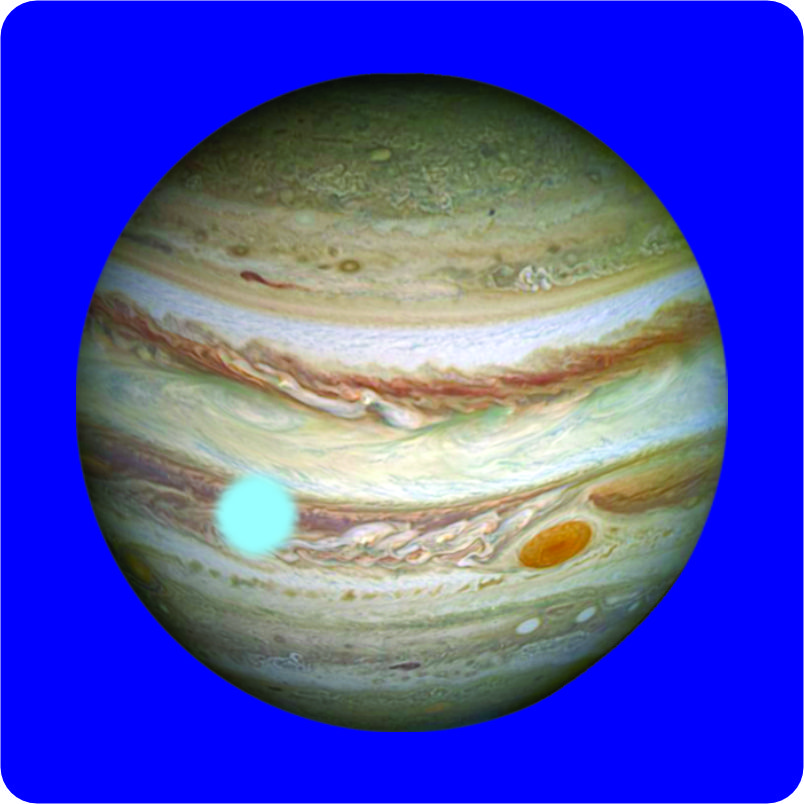
“Thanks, Sy. Welcome back, Cathleen. What’s bugging me is the hard edges on that picture of Jupiter. It looks like those stripes are painted on. Everyone says Jupiter’s not really solid so how come the planet looks so smooth?”

“Cathleen, this is definitely in your astronomer baliwick.”

“I suppose. It’s a matter of scale, Vinnie. The white zones mark updrafts. The whiteness is clouds that rise a couple hundred kilometers above a brownish lower layer. The downdraft belts on either side are transparent enough to let us see the next lower layer. ‘A couple hundred kilometers‘ sounds like a lot, but that’s only a tenth of a percent of Jupiter’s radius. If Jupiter were a foot‑wide ball floating in front of us, the altitude difference would be as thin as a piece of tissue paper. You might be able to feel the ridges and valleys but you’d have a hard time seeing them.”

“But why does the updraft stop so sharp? Is there like a cap on the atmosphere?”

“The clouds stop, but the updrafts don’t. The cloud tops aren’t even close to the top of Jupiter’s atmosphere, any more than Earth clouds reach the top of ours. C’mon, Vinnie, you’re a pilot. Surely you’ve noticed that most thunderheads top out at about the same altitude. Isn’t the sky still blue above them?”

“That’s higher than the planes I fly are cleared for, but I wouldn’t want to get above one anyway. I know a guy who flew over one that was just getting started. He said it’s a bumpy ride but yeah, there’s still kind of a dark blue sky above.”

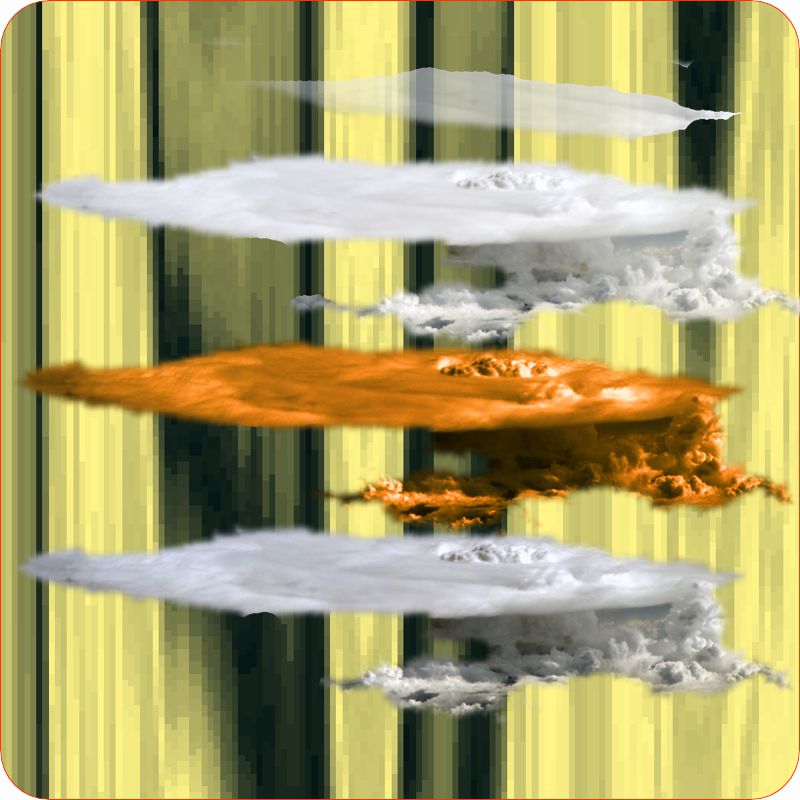
“All of that makes my point — our atmosphere doesn’t stop at the tropospheric boundary where the clouds do. Beyond that you’ve got another 40‑or‑so kilometers of stratosphere. Jupiter’s the same way, clouds go up only partway. For that matter, Jupiter has at least four separate cloud decks.”

“Wait, Cathleen — four? I know how Earth clouds work. Warm humid air rises, expanding and cooling as it goes. When its temperature falls below the dew point or freezing point, its humidity condenses to water droplets or ice crystals and that’s the cloud. I suppose if that same bucketful of air keeps rising far enough the pressure gets so low the water evaporates again and that’s the top of the cloud. How can that happen multiple times?”

“It doesn’t, Sy. In Jupiter’s complicated atmosphere each deck is formed from a different gas. Top layer is a wispy white hydrocarbon fog. The white zone clouds next down are ices of ammonia, which has to get a lot colder than water before it condenses. Water ice probably has a layer much farther down.”

“What’s the brownish layer?”

“There’s one or maybe two of them, each a complex mixture of ammonium ions with various sulfide species. The variety of colors in there make the visible light spectroscopy an opaque muddle.”

“Hey, if the brownish layers block what we can see, how do we even know lower layers are a thing?”

“Good question, Vinnie. Actually, we can do spectroscopy in the middle infrared. That gives us some clues. We’d hoped that the Galileo mission’s deep‑diver probe would sense the lower layers directly but unfortunately it dove into a hot spot where the upwelling heat messes up the layering. Our last resort is modeling. We have an inventory of lab data on thousands of compounds containing the chemical elements we’ve detected on Jupiter. We also have a pretty good temperature‑pressure profile of the atmosphere from the planet’s stratosphere down nearly to the core. Put the two together and we can paint a broad‑brush picture of what compounds should be stable in what physical state at every altitude.”

“Those ‘broad‑brush‘ and ‘should‘ weasel‑words say you’re working with averages like Einstein didn’t like with quantum mechanics. Those vertical winds mix things up pretty good, I’ll bet.”

“Fair objection, Vinnie, but we do what we can.”

~~ Rich Olcott

Visionaries Old And New

Cathleen’s back at the mic. “Let’s have a round of applause for Maria, Jeremy, Madison and C‑J. Thank you all. We have a few minutes left for questions… Paul, you’re first.”

“Thanks, Cathleen. A comment, not a question. As you know, archeoastronomy is my specialty so I applaud Jeremy’s advocacy for the field. I agree with his notion that the Colorado Plateau’s dry, thin air generally lets us see more stars than sea‑level Greeks do. When I go to a good dark sky site, it can be difficult to see the main stars that define a constellation because of all the background dimmer stars. However, I don’t think that additional stars would change the pictures we project into the sky. Most constellations are outlined from only the brightest stars up there. Dimmer stars may confuse the issue, but I very much doubt they would have altered the makeup of the constellations a culture defines. Each culture uses their own myths and history when finding figures among the stars.”

“Thanks for the confirmation from personal experience, Paul. Yes, Sy?”

“Another comment not a question. I’m struck by how Maria’s Doppler technique and Jeremy’s Astrometry complement each other Think of a distant stellar system like a spinning plate balanced on a stick. Doppler can tell you how long the stick is. Astrometry can tell you how wide the plate is. Both can tell you how fast it’s spinning. The strongest Doppler signal comes from systems that are edge‑on to us. The strongest Astrometry signal comes from systems we see face‑on. Those are the extreme cases, of course. Most systems are be at some in‑between angle and give us intermediate signals.”

“That’s a useful classification, Sy. Madison’s and C‑J’s transit technique also fits the edge‑on category. Jim, I can see you’re about to bust. What do you have to tell us about?”

“How about a technique that lets you characterize exoplanets inside a galaxy we see as only a blurry blob? This paper I just read blew me away.”

“Go ahead, you have the floor.”

“Great. Does everyone know about Earendel?” <blank looks from half the audience, mutters about ‘Lord Of The Rings?’ from several> “OK, quick refresher. Earendel is the name astronomers gave to the farthest individual star we’ve ever discovered. It’s either 13 or 28 billion lightyears away, depending on how you define distance. We only spotted it because of an incredible coincidence — the star happens to be passing through an extremely small region of space where light in our general direction is concentrated thousands‑fold into a beam towards us. Earendel may be embedded in a galaxy, but the amplification region is so narrow we can’t see stars that might be right next to it.”

<Feder’s voice> “Ya gonna tell us what makes the region?”

“Only very generally, because it’s complicated. You know what a magnifying lens does in sunlight.”

“Sure. I’ve burnt ants that way.”

“… Right. So what you did was take all the light energy hitting the entire surface of your lens and concentrate it on a miniscule spot. The concentration factor was controlled by the Sun‑to‑lens‑to‑spot distances and the surface area of the lens. Now bring that picture up to cosmological distances. The lens is the combined gravitational field of an entire galaxy cluster, billions of lightyears away from us, focusing light from Earendel’s galaxy billions of lightyears farther away. Really small spots at both ends of the light path and that’s what isolated that star.”

“That’s what got you excited?”

“That’s the start of it. This new paper goes in the other direction. The scientists used brilliant X‑ray light from an extremely distant quasar to probe for exoplanets inside a galaxy’s gravitational lens. Like one of your ants analyzing sunlight’s glare to assess dust flecks on your lens. Or at least their averaged properties. A lens integrates all the light hitting it so your ant can’t see individual grains. What it can do, though, is estimate numbers and size ranges. This paper suggests the lensing galaxy is cluttered with 2000 free‑floating planets per main‑sequence star — stars too far for us to see.”

~~ Rich Olcott

  • Thanks to Dave Martinez and Dr Ka Chun Yu for their informative comments.

Significant Twinkles

Cathleen’s got a bit of fire in her eye. “Good exposition, Jeremy, but only just barely on‑assignment. You squeezed in your exoplanet search material at the very end. <sigh> Okay, for our next presentation we have two of our freshmen, Madison and C‑J.”

“Hello, everybody, I’m Madison. I fell in love with Science while watching Nova and Star Trek with my family. Doctor O’Meara’s Astronomy class is my first step into the real thing. C‑J?”

“Hi, I’m C‑J, like she said. What started me on Astronomy was just looking at the night sky. My family’s ranch is officially in dark sky country, but really it’s so not dark. Jeremy’s also from the High Plateau and we got to talking. We see a gazillion stars up there, probably more stars than the Greeks did because they were looking up through humid sea-level air. On a still night our dry air’s so clear you can read by the light of those stars. I want to know what’s up there.”

“Me, too, but I’m even more interested in who‘s up there living on some exoplanet somewhere. How do we find them? We’ve just heard about spectroscopy and astrometry. C‑J and I will be talking about photometry, measuring the total light from something. You can use it even with light sources that are too dim to pick out a spectrum. Photometry is especially useful for finding transits.”

“A transit is basically an eclipse, an exoplanet getting between us and its star—”

“Like the one we had in 2017. It was so awesome when that happened. All the bird and bug noises hushed and the corona showed all around where the Sun was hiding. I was only 12 then but it changed my Universe when they showed us on TV how the Moon is exactly the right size and distance to cover the Sun.”

“Incredible coincidence, right? Almost exactly 100% occultation. If the Moon were much bigger or closer to us we’d never see the corona’s complicated structure. We wouldn’t have that evidence and we’d know so much less about how the Sun works. But even with JWST technology we can’t get near that much detail from other stars.”

“Think of trying to read a blog post on your computer, but your only tool is a light meter that gives you one number for the whole screen. Our nearest star, Alpha Centauri, is 20% larger than our Sun but it’s 4.3 lightyears away. I worked out that at that distance its image would be about 8½ milliarcseconds across. C‑J found that JWST’s cameras can’t resolve details any finer than 8 times that. All we can see of that star or any star is the light the whole system gives off.”

“So here’s where we’re going. We can’t see exoplanets because they’re way too small and too far away, but if an exoplanet transits a star we’re studying, it’ll block some of the light. The question is, how much, and the answer is, not very. Exoplanets block starlight according to their silhouette area. Jupiter’s diameter is about a tenth the Sun’s so it’s area is 1% of the Sun’s. When Jupiter transits the Sun‑‑‑”

“From the viewpoint of some other solar system, of course—”

“Doesn’t matter. Jupiter could get in between the Sun and Saturn; the arithmetic works out the same. The maximum fraction of light Jupiter could block would be its area against the Sun’s area and that’s still 1%.”

“Well, it does matter, because of perspective. If size was the only variable, the Moon is so much smaller than the Sun we’d never see a total eclipse. The star‑planet distance has to be much smaller than the star‑us distance, okay?”

“Alright, but that’s always the way with exoplanets. Even with a big planet and a small star, we don’t expect to measure more than a few percent change. You need really good photometry to even detect that.”

“And really good conditions. Everyone knows how atmospheric turbulence makes star images twinkle—”

“Can’t get 1% accuracy on an image that’s flickering by 50%—”

“And that’s why we had to get stable observatories outside the atmosphere before we could find exoplanets photometrically.”

~~ Rich Olcott